Judges 21:13

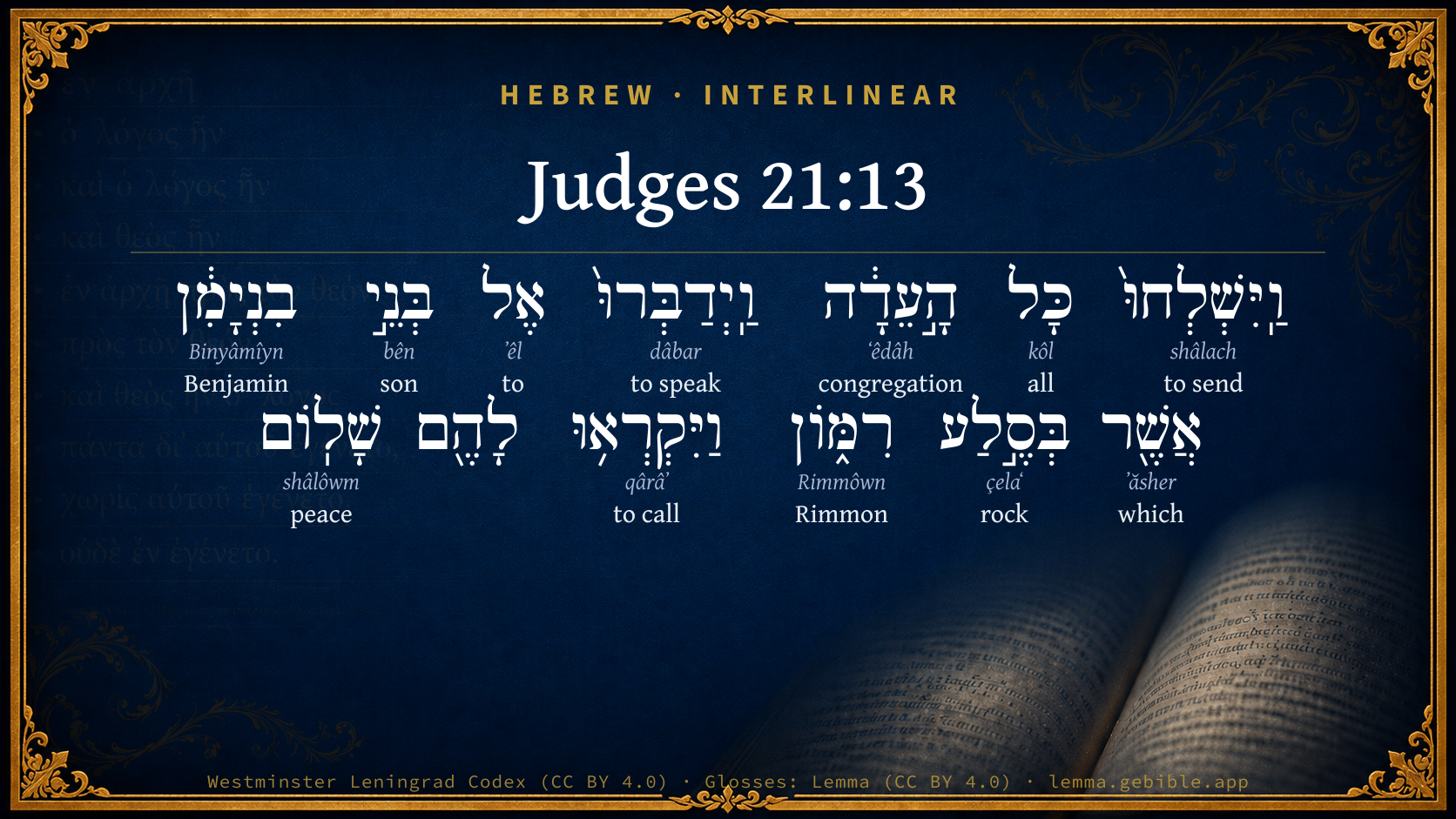
Hebrew (Westminster Leningrad Codex) Judges 21:13 appears in the Hebrew Old Testament. The text above is from the Westminster Leningrad Codex. Each word links to its Strong’s number, a concise gloss, and parsing drawn from the Open Scriptures Hebrew Bible morphology. Click any word for its full Brown-Driver-Briggs (BDB) entry.
Download image
Cite this verse

Judges 21:13 (World English Bible). Public Domain. Lemma interlinear Bible study tool, https://lemma.gebible.app/v/judges/21/13.

Show BibTeX & RIS
BibTeX
RIS
English Translation
The whole congregation sent and spoke to the children of Benjamin who were in the rock of Rimmon, and proclaimed peace to them.
World English Bible · Public Domain
Download a study sheet

One document with this verse’s original text, its word-by-word gloss line, the meaning frame, cross-references with their text, attributed commentary, and full source and license credits — printable, and it pastes into notes with its structure intact.

This verse Autodidact and up

Study sheet (.html) Plain text (.txt)

A passage Seminary Student

Up to 50 verses in one chapter. A passage sheet keeps up to 6 commentary sources and 12 cross-references per verse, in the order this page ranks them, and says so on the sheet whenever that leaves anything out. Ask for a single verse and you get the Autodidact verse sheet above.

Everything on this page stays free to read, with no account — the sheet is a download of what is already on screen, not access to it.

Want to remove ads? Support Godless Engineer
Compare translations 3

The same verse in 3 English versions, stacked beneath the original-language interlinear above. Click any original word for its lexicon entry.

Each is an independent rendering of the whole verse — the interlinear is not word-aligned to these translations.

Highlighted words mark where these versions differ — a whole-verse word diff, not a word-by-word alignment.

  • World English Bible Public Domain
    The whole congregation sent and spoke to the children of Benjamin who were in the rock of Rimmon, and proclaimed peace to them.
  • King James Version Public Domain
    And the whole congregation sent some to speak to the children of Benjamin that were in the rock Rimmon, and to call peaceably unto them.
  • unfoldingWord Literal Text CC BY-SA 4.0
    And all of the congregation sent and spoke to the sons of Benjamin who at the rock of Rimmon, and they called out peace to them.

unfoldingWord Literal Text — © unfoldingWord, licensed CC BY-SA 4.0. Word-aligned USFM3 via Door43 (git.door43.org/unfoldingWord/en_ult).

Versions to compare (up to 4)

3 of 4 selected

Show all 18 translations

Every available English version of this verse, each an independent rendering of the whole verse.

  • World English Bible Public Domain
    The whole congregation sent and spoke to the children of Benjamin who were in the rock of Rimmon, and proclaimed peace to them.
  • Berean Standard Bible Public Domain
    Then the whole congregation sent a message of peace to the Benjamites who were at the rock of Rimmon.
  • Majority Standard Bible Public Domain
    Then the whole congregation sent a message of peace to the Benjamites who were at the rock of Rimmon.
  • King James Version Public Domain
    And the whole congregation sent some to speak to the children of Benjamin that were in the rock Rimmon, and to call peaceably unto them.
  • American Standard Version (1901) Public Domain
    And the whole congregation sent and spake to the children of Benjamin that were in the rock of Rimmon, and proclaimed peace unto them.
  • Revised Version (1885) Public Domain
    And the whole congregation sent and spake to the children of Benjamin that were in the rock of Rimmon, and proclaimed peace unto them.
  • Geneva Bible (1599) Public Domain
    Then the whole Congregation sent and spake with the children of Beniamin that were in the rocke of Rimmon, and called peaceably vnto them:
  • Douay-Rheims (1899) Public Domain
    And they sent messengers to the children of Benjamin, that were in the rock Remmon, and commanded them to receive them in peace.
  • Young's Literal Translation Public Domain
    And all the company send, and speak, unto the sons of Benjamin who `are' in the rock Rimmon, and proclaim to them peace;
  • Literal Standard Version CC BY-SA 4.0
    And all the congregation sends [word] and speaks to the sons of Benjamin who [are] in the rock of Rimmon, and proclaims peace to them;
  • Unlocked Literal Bible CC BY-SA 4.0
    The entire assembly sent a message and told the people of Benjamin who were at the rock of Rimmon that they were offering them peace.
  • unfoldingWord Literal Text CC BY-SA 4.0
    And all of the congregation sent and spoke to the sons of Benjamin who at the rock of Rimmon, and they called out peace to them.
  • Darby Bible Public Domain
    Then the whole congregation sent word to the Benjaminites who were at the rock of Rimmon, and proclaimed peace to them.
  • World Messianic Bible Public Domain
    The whole congregation sent and spoke to the children of Benjamin who were in the rock of Rimmon, and proclaimed peace to them.
  • Webster's Bible Public Domain
    And the whole congregation sent some to speak to the children of Benjamin that were in the rock Rimmon, and to call peaceably to them.
  • Free Bible Version CC BY-SA 4.0
    Then the whole Israelite assembly sent a message to the Benjamites at Pomegranate Rock to tell them, “Peace!”
  • Bible in Basic English Public Domain
    And all the meeting sent to the men of Benjamin who were in the rock of Rimmon, offering them peace.
  • JPS Tanakh (1917) Public Domain
    And the whole congregation sent and spoke to the children of Benjamin that were in the rock of Rimmon, and proclaimed peace unto them.

Literal Standard Version (2020), Covenant Press — licensed CC BY-SA 4.0. Text via the HelloAO Bible API (eBible.org). Unlocked Literal Bible (unfoldingWord) — licensed CC BY-SA 4.0. Text via the HelloAO Bible API (eBible.org). unfoldingWord Literal Text — © unfoldingWord, licensed CC BY-SA 4.0. Word-aligned USFM3 via Door43 (git.door43.org/unfoldingWord/en_ult). Free Bible Version, Dr. Jonathan Gallagher — licensed CC BY-SA 4.0. Text via the HelloAO Bible API (eBible.org).

Word by word

More ways to search: Search by grammar → Find every occurrence → Compare this word →

Practice this passage: Drill this verse → Learn its vocabulary →

רִמּ֑וֹן
Rimmôwn
H7417
“Rimmon”
Noun, Proper
Part of Speech
Noun
Type
Proper
Full BDB Definition

Origin: the same as H7416

TWOT: 2171

Rimmon = "pomegranate" - the deity of wind, rain, and storm, worshipped by the Syrians of Damascus (noun proper deity) - a Benjamite of Beeroth, the father of Rechab and Baanah, the murderers of Ishbosheth (noun proper masculine) - the Rock; a cliff or inaccessible natural fastness in which the 600 Benjamites who escaped the slaughter of Gibeah took refuge (noun proper locative) - a town in the southern portion of Judah allotted to Simeon (noun proper locative) - a Levitical city in Zebulun located approximately 6 miles north of Nazareth (noun proper locative)
  1. וַֽיִּשְׁלְחוּ֙ shâlach H7971 “and · to send” Conjunction + Verb, Qal, Sequential Imperfect, 3rd Person, Masculine, Plural
  2. כָּל kôl H3605 “all of” Noun, Common, Masculine, Singular, Construct
  3. הָ֣עֵדָ֔ה ʻêdâh H5712 “the · congregation” Particle, Definite Article + Noun, Common, Feminine, Singular, Absolute
  4. וַֽיְדַבְּרוּ֙ dâbar H1696 “and · to speak” Conjunction + Verb, Piel, Sequential Imperfect, 3rd Person, Masculine, Plural
  5. אֶל ʼêl H413 “to” Preposition
  6. בְּנֵ֣י bên H1121 “sons of” Noun, Common, Masculine, Plural, Construct
  7. בִנְיָמִ֔ן Binyâmîyn H1144 “Benjamin” Noun, Proper
  8. אֲשֶׁ֖ר ʼăsher H834 “which” Particle, Relative
  9. בְּסֶ֣לַע çelaʻ H5553 “in/at · rock of” Preposition + Noun, Common, Masculine, Singular, Construct
  10. וַיִּקְרְא֥וּ qârâʼ H7121 “and · to call” Conjunction + Verb, Qal, Sequential Imperfect, 3rd Person, Masculine, Plural
  11. שָׁלֽוֹם shâlôwm H7965 “peace” Noun, Common, Masculine, Singular, Absolute

About this verse

These counts appear in no published source. They are computed here, from the morphology-tagged text and Lemma’s own curated glosses. What Lemma adds →

13
words
12
distinct lemmas
Historical
section

Notable vocabulary

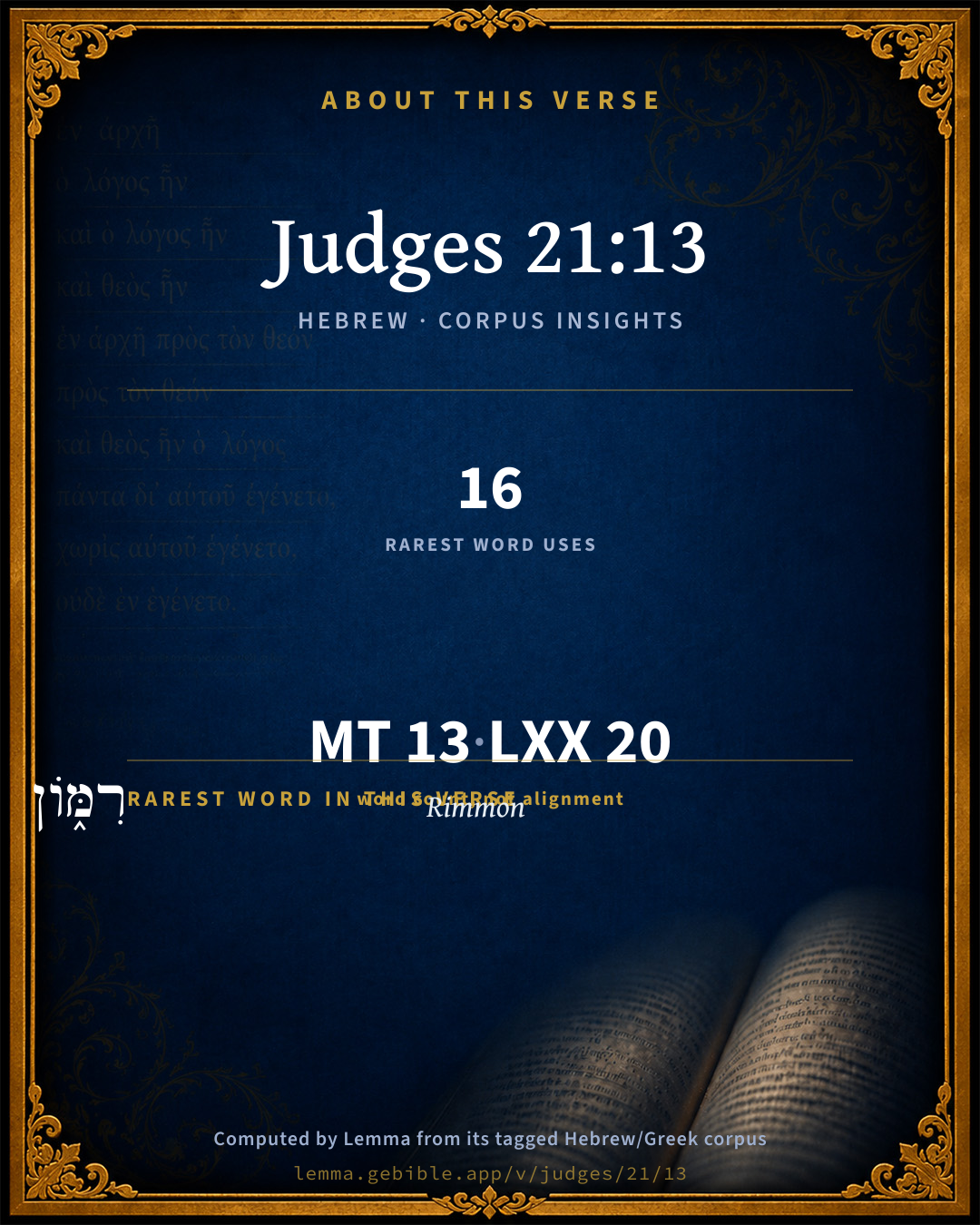
The rarest word here is רִמּ֑וֹן Rimmon H7417 — appearing just 16 times in the whole Hebrew Bible.

Shared distinctive vocabulary

רִמּ֑וֹן Rimmon H7417 occurs in 13 verses of the Hebrew Bible. Also found in:

Grammatical profile

  • 3 verbs
  • 7 nouns
  • 2 prepositions
  • 1 particle

Verb forms

  • וַֽיִּשְׁלְחוּ֙ Qal · Sequential Imperfect
  • וַֽיְדַבְּרוּ֙ Piel · Sequential Imperfect
  • וַיִּקְרְא֥וּ Qal · Sequential Imperfect

Hebrew & Septuagint length

In English translation the verse runs 23 words from the Hebrew and 22 from the Septuagint (LXX English) — closely comparable.

A rough comparison of the two English renderings, which tokenize alike — not a word-level alignment.

Word counts can differ between the Hebrew and the Greek without any difference in meaning — e.g. the Hebrew direct-object marker אֵת has no separate Greek word, and Greek often adds the article ὁ.

In the original languages it is 13 Hebrew tokens and 20 Greek tokens — but the two are counted differently (Hebrew bundles its prefixes and suffixes into one token; the Greek is in lemma form), so that isn’t a like-for-like length.

Cross-references

6

Topical passages linked to Judges 21:13 in the Treasury of Scripture Knowledge — connected by theme and wording, ordered by reader-vote popularity; previews shown in the World English Bible.

  • Deuteronomy 20:10 When you draw near to a city to fight against it, then proclaim peace to it.
  • Judges 20:47 But six hundred men turned and fled toward the wilderness to the rock of Rimmon, and abode in the rock of Rimmon four months.
  • Joshua 15:32 and Lebaoth, and Shilhim, and Ain, and Rimmon: all the cities are twenty-nine, with their villages.
  • Isaiah 57:19 I create the fruit of the lips: Peace, peace, to him who is far off and to him who is near, says Yahweh; and I will heal him.
  • Luke 10:5 Into whatever house you enter, first say, 'Peace be to this house.'
  • Ephesians 2:17 He came and preached peace to you who were far off and to those who were near.

Cross-references courtesy of OpenBible.info (CC BY 4.0).

Hebrew and Greek witnesses Masoretic Hebrew ↔ Greek Septuagint

The same verse in the two great witnesses to the Old Testament, shown verse-for-verse.

These are two independent witnesses, not word-aligned to each other, and the Septuagint is shown in lemma (dictionary) form.

Hebrew Judges 21:13 Masoretic · Westminster Leningrad Codex

וַֽיִּשְׁלְחוּ֙ כָּל הָ֣עֵדָ֔ה וַֽיְדַבְּרוּ֙ אֶל בְּנֵ֣י בִנְיָמִ֔ן אֲשֶׁ֖ר בְּסֶ֣לַע רִמּ֑וֹן וַיִּקְרְא֥וּ לָהֶ֖ם שָׁלֽוֹם

The whole congregation sent and spoke to the children of Benjamin who were in the rock of Rimmon, and proclaimed peace to them.

World English Bible · Public Domain

Greek LXX Judges 21:13 Septuagint · lemma form

καί ἀποστέλλω πᾶς ὁ συναγωγή καί λαλέω πρός ὁ υἱός βενιαμίν ἐν ὁ πέτρα ρεμμων καί καλέω αὐτός εἰς εἰρήνη

And all the congregation sent and spoke to the children of Benjamin in the rock Remmon, and invited them to make peace.

LXX2012 (modern English Septuagint) · Public Domain

Hebrew: Westminster Leningrad Codex (CC BY 4.0). Greek: Septuagint (public domain); English from LXX2012 (modern English Septuagint) (Public Domain). How the Septuagint differs from the Hebrew →

Targum (Aramaic paraphrase)

1

The Targum is the ancient Jewish Aramaic paraphrase of the Hebrew Scriptures — an interpretive translation, not the Hebrew text itself. Onkelos (literal) and Pseudo-Jonathan (expansive) render the Torah, and Jonathan the Prophets. Coverage is partial: where no permissively-licensed English translation exists for a verse, only the Aramaic is shown. This is verse-level text, not a word-by-word alignment to the Hebrew.

  1. Targum Jonathan Prophets (Joshua–Malachi)
    וּשְׁלָחוּ כָּל כְּנִשְׁתָּא וּמַלִילוּ עִם בְּנֵי בִנְיָמִין דִי בְּכֵיף רִמוֹן וּקְרוֹ לְהוֹן מִלִין דִשְׁלָם:

    (no public-domain English translation for this verse)

    Targum Jonathan — Aramaic: “Mikraot Gedolot” (public domain). English: “Sefaria Community Translation” (CC0 1.0 (public-domain dedication)); “London "Chaldee Paraphrase," 1871” (public domain). Text via Sefaria.

Commentary

Notes on Judges 21:13 from classic Christian and Jewish commentators (each source and its license shown beneath its notes). The classic Christian expositions comment on the surrounding passage and are grouped to its opening verse, so a note may address several verses; the Jewish commentaries on the Tanakh (Rashi and others) are per-verse, so they appear only where the commentator wrote on this verse.

Lemma curates 59 commentaries, every one of them public domain or Creative Commons licensed, each selected and text-cleaned for this edition rather than reprinted as found. About our sources →

Trapp's Complete Commentary

John Trapp

Jdg 21:13 And the whole congregation sent [some] to speak to the children of Benjamin that [were] in the rock Rimmon, and to call peaceably unto them.

Ver. 13. And to call peaceably unto them.] God retaineth not his anger forever; - he here graciously provideth for these sinners against their own souls, the remaining Benjamites; - no more must men. The Athenians are justly blamed for this, that their anger was αειμνηστος, long-lasting; memor ira, as Virgil hath it. They hated all barbarians for the Persians’ sake, and forbade them their sacrifices, as they used to do murderers. It is a grievous sin to be implacable, irreconcilable. {Rom 1:31 2Ti 3:3} Men should piece again, and not be as broken glass, that cannot be made whole any more.

John Trapp, A Commentary or Exposition upon All the Books of the Old and New Testament (1647–1656) — public domain. Text from a community e-Sword module.

Geneva Bible (1599)

Geneva Bible translators

Or, friendly.

To wit, about four months after the discomfiture, Judg. 20:47.

Geneva Bible (1599) marginal notes — public domain. Text via Bolls.life.

Adam Clarke's Commentary

Verse 13. And to call peaceably unto them.] To proclaim peace to them; to assure them that the enmity was all over, and that they might with safety leave their strong hold.

Adam Clarke's Commentary on the Bible (1810–1826) — public domain. Text from a community e-Sword/MySword module.

Ellicott's Commentary for English Readers

(13) To call peaceably—i.e., proclaim peace.

A Bible Commentary for English Readers, edited by Charles John Ellicott (1878–1897) — public domain. Text from a community e-Sword module.

The Cambridge Bible for Schools and Colleges

gen. ed. J. J. S. Perowne

13. in the rock of Rimmon] Cf. Jdg_20:45.

The Cambridge Bible for Schools and Colleges (gen. ed. J. J. S. Perowne; Cambridge University Press, 1878–1918) — public domain. Text from a community e-Sword module.

John Gill's Exposition

And the whole congregation sent some to speak to the children of Benjamin,.... Sent some messengers to them, to call them, and desire them to come to them:

that were in the rock Rimmon; the six hundred men who had hid themselves in a cave in it, of which the people of Israel were informed:

and to call peaceably unto them; to proclaim peace to them, and assure them of it, and to let them know that they had no ill design against them, that they might come safely to them, and would be kindly received and protected by them.

John Gill's Exposition of the Whole Bible (1746–1763) — public domain (CC PDM 1.0). Text via the HelloAO Bible API.

Haydock's Catholic Bible Commentary

Them, the messengers to, &c. Hebrew, "and to make unto them a proclamation of peace." (Haydock)

George Leo Haydock (1774–1849), Haydock's Catholic Family Bible and Commentary, 1859 edition — public domain. Excludes Psalms (Douay-Rheims chapter numbering differs from Protestant) and Deuterocanonical books (Catholic canon only).

Whedon's Commentary on the Bible

Daniel D. Whedon

13. Call peaceably unto them — That is, proclaim to them a proclamation of peace, and invite them to their homes again.

Daniel D. Whedon (gen. ed.), Commentary on the Old and New Testaments (1874–1909) — public domain. Text from a community e-Sword module.

The Pulpit Commentary

Translate the whole verse thus: And the whole congregation sent and shake to the children of Benjamin, etc. , and proclaimed peace to them. (see Deu_20:10) They sent ambassadors or heralds to them as it were with a flag of truce.

The Pulpit Commentary (1880–1919), ed. H.D.M. Spence-Jones & Joseph S. Exell — public domain. Text from a community e-Sword module.

unfoldingWord translationNotes

Door43 World Missions Community

they were offering them peace

The abstract noun "peace" can be translated with a verb phrase. AT: "they wanted to stop fighting with them" (See: Abstract Nouns)

Jabesh Gilead

This is the name of a city. See how you translated this in Judges 21:8.

there were not enough women for all of them

There were six hundred Benjamite men, and only four hundred women from Jabesh Gilead.

made a division between the tribes of Israel

"had caused the tribes of Israel not to be unified"

translationWords

assembly

Benjamin

Rimmon

peace

Yahweh

tribe

Israel

unfoldingWord translationNotes — © Distant Shores Media and the Door43 World Missions Community, licensed CC BY-SA 4.0. Source: git.door43.org/Door43/en_tn.

Lesson kit

Teaching starters — assembled from the data on this page, not authored interpretation. Every prompt links to the verse data it draws on. Edit before teaching.

Judges, in the Historical, opens this verse with 13 words (12 distinct Hebrew lemmas). Its most distinctive word is Rimmôwn (“Rimmon”). A historical commentator’s framing appears above. Read the whole chapter for the surrounding context.

Discussion questions

  1. The word Rimmôwn carries the sense “Rimmon.” How does it shape the verse?
  2. How does Joshua 15:32, which shares the word «Rimmon», read alongside this verse?
  3. These translations render this verse differently; the difference is in the English rendering, not the original. What questions does that raise?
  4. «וַֽיִּשְׁלְחוּ֙» is a Qal Sequential Imperfect verb. How does that grammatical form shape the action described?
  5. Compare how Trapp's Complete Commentary and Geneva Bible (1599) read this verse. Where do they agree or differ?

Things to notice

Reading settings

Reading text

Shown beneath each verse's original-language words.

Old Testament
Old Testament edition

Read the OT as the Masoretic Hebrew (MT) or the Greek Septuagint (LXX).

English shown for the Greek Septuagint (in the Hebrew ↔ Greek comparison).

Comparing translations? Open the Compare panel on any verse page to stack up to four side by side.