
Isaiah 55:12

Hebrew (Westminster Leningrad Codex) Isaiah 55:12 appears in the Hebrew Old Testament. The text above is from the Westminster Leningrad Codex. Each word links to its Strong’s number, a concise gloss, and parsing drawn from the Open Scriptures Hebrew Bible morphology. Click any word for its full Brown-Driver-Briggs (BDB) entry.
Download image
Cite this verse

Isaiah 55:12 (World English Bible). Public Domain. Lemma interlinear Bible study tool, https://lemma.gebible.app/v/isaiah/55/12.

Show BibTeX & RIS
BibTeX
RIS
English Translation
For you shall go out with joy, and be led forth with peace: the mountains and the hills shall break forth before you into singing; and all the trees of the fields shall clap their hands.
World English Bible · Public Domain
Download a study sheet

One document with this verse’s original text, its word-by-word gloss line, the meaning frame, cross-references with their text, attributed commentary, and full source and license credits — printable, and it pastes into notes with its structure intact.

This verse Autodidact and up

Study sheet (.html) Plain text (.txt)

A passage Seminary Student

Up to 50 verses in one chapter. A passage sheet keeps up to 6 commentary sources and 12 cross-references per verse, in the order this page ranks them, and says so on the sheet whenever that leaves anything out. Ask for a single verse and you get the Autodidact verse sheet above.

Everything on this page stays free to read, with no account — the sheet is a download of what is already on screen, not access to it.

Want to remove ads? Support Godless Engineer
Compare translations 3

The same verse in 3 English versions, stacked beneath the original-language interlinear above. Click any original word for its lexicon entry.

Each is an independent rendering of the whole verse — the interlinear is not word-aligned to these translations.

Highlighted words mark where these versions differ — a whole-verse word diff, not a word-by-word alignment.

  • World English Bible Public Domain
    For you shall go out with joy, and be led forth with peace: the mountains and the hills shall break forth before you into singing; and all the trees of the fields shall clap their hands.
  • King James Version Public Domain
    For ye shall go out with joy, and be led forth with peace: the mountains and the hills shall break forth before you into singing, and all the trees of the field shall clap their hands.
  • unfoldingWord Literal Text CC BY-SA 4.0
    For you will go out in joy, and you will be led in peace. The mountains and the hills will break out to your faces singing, and all of the trees of the field will clap the palm.

unfoldingWord Literal Text — © unfoldingWord, licensed CC BY-SA 4.0. Word-aligned USFM3 via Door43 (git.door43.org/unfoldingWord/en_ult).

Versions to compare (up to 4)

3 of 4 selected

Show all 18 translations

Every available English version of this verse, each an independent rendering of the whole verse.

  • World English Bible Public Domain
    For you shall go out with joy, and be led forth with peace: the mountains and the hills shall break forth before you into singing; and all the trees of the fields shall clap their hands.
  • Berean Standard Bible Public Domain
    You will indeed go out with joy and be led forth in peace; the mountains and hills will burst into song before you, and all the trees of the field will clap their hands.
  • Majority Standard Bible Public Domain
    You will indeed go out with joy and be led forth in peace; the mountains and hills will burst into song before you, and all the trees of the field will clap their hands.
  • King James Version Public Domain
    For ye shall go out with joy, and be led forth with peace: the mountains and the hills shall break forth before you into singing, and all the trees of the field shall clap their hands.
  • American Standard Version (1901) Public Domain
    For ye shall go out with joy, and be led forth with peace: the mountains and the hills shall break forth before you into singing; and all the trees of the fields shall clap their hands.
  • Revised Version (1885) Public Domain
    For ye shall go out with joy, and be led forth with peace: the mountains and the hills shall break forth before you into singing, and all the trees of the field shall clap their hands.
  • Geneva Bible (1599) Public Domain
    Therefore ye shall go out with ioy, and be led forth with peace: the mountaines and the hilles shall breake foorth before you into ioye, and all the trees of the fielde shall clap their handes.
  • Douay-Rheims (1899) Public Domain
    For you shall go out with joy, and be led forth with peace: the mountains and the hills shall sing praise before yen, and all the trees of the country shah clap their hands.
  • Young's Literal Translation Public Domain
    For with joy ye go forth, And with peace ye are brought in, The mountains and the hills Break forth before you `with' singing, And all trees of the field clap the hand.
  • Literal Standard Version CC BY-SA 4.0
    For you go forth with joy, || And you are brought in with peace, || The mountains and the hills || Break forth before you [with] singing, || And all trees of the field clap the hand.
  • Unlocked Literal Bible CC BY-SA 4.0
    For you will go out in joy and be led along peacefully; the mountains and the hills will break out in joyful shouts before you, and all the trees of the fields will clap their hands.
  • unfoldingWord Literal Text CC BY-SA 4.0
    For you will go out in joy, and you will be led in peace. The mountains and the hills will break out to your faces singing, and all of the trees of the field will clap the palm.
  • Darby Bible Public Domain
    For ye shall go out with joy, and be led forth with peace; the mountains and the hills shall break forth before you into singing, and all the trees of the field shall clap their hands.
  • World Messianic Bible Public Domain
    For you shall go out with joy, and be led out with peace. The mountains and the hills will break out before you into singing; and all the trees of the fields will clap their hands.
  • Webster's Bible Public Domain
    For ye shall go out with joy, and be led forth with peace: the mountains and the hills shall break forth before you into singing, and all the trees of the field shall clap their hands.
  • Free Bible Version CC BY-SA 4.0
    You will live happily, taught the ways of peace. Mountains and hills will celebrate, singing beside you; and all the trees will clap their hands!
  • Bible in Basic English Public Domain
    For you will go out with joy, and be guided in peace: the mountains and the hills will make melody before you, and all the trees of the fields will make sounds of joy.
  • JPS Tanakh (1917) Public Domain
    For ye shall go out with joy, and be led forth with peace; the mountains and the hills shall break forth before you into singing, and all the trees of the field shall clap their hands.

Literal Standard Version (2020), Covenant Press — licensed CC BY-SA 4.0. Text via the HelloAO Bible API (eBible.org). Unlocked Literal Bible (unfoldingWord) — licensed CC BY-SA 4.0. Text via the HelloAO Bible API (eBible.org). unfoldingWord Literal Text — © unfoldingWord, licensed CC BY-SA 4.0. Word-aligned USFM3 via Door43 (git.door43.org/unfoldingWord/en_ult). Free Bible Version, Dr. Jonathan Gallagher — licensed CC BY-SA 4.0. Text via the HelloAO Bible API (eBible.org).

Word by word

More ways to search: Search by grammar → Find every occurrence → Compare this word →

Practice this passage: Drill this verse → Learn its vocabulary →

יִמְחֲאוּ
mâchâʼ
H4222
“to clap”
Verb, Qal, Imperfect, 3rd Person, Masculine, Plural
Part of Speech
Verb
Stem
Qal
Form
Imperfect
Person
3rd Person
Gender
Masculine
Number
Plural
Full BDB Definition

Origin: a primitive root

TWOT: 1177

to strike, clap (the hands) - (Qal) to clap (of joy) - (Piel) to clap (of exultation)
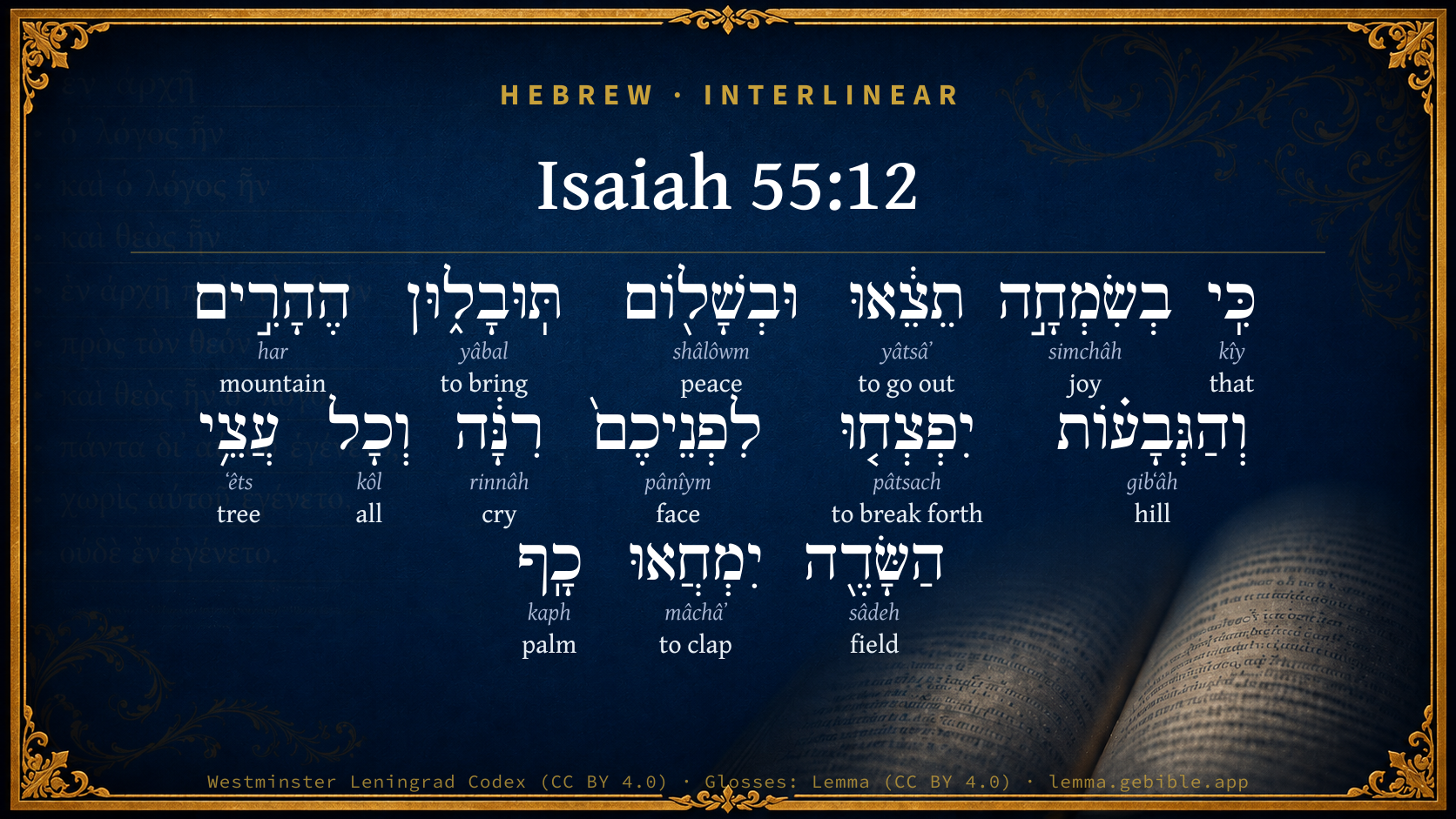
  1. כִּֽי kîy H3588 “that” Conjunction
  2. בְשִׂמְחָ֣ה simchâh H8057 “in/at · joy” Preposition + Noun, Common, Feminine, Singular, Absolute
  3. תֵצֵ֔אוּ yâtsâʼ H3318 “to go out” Verb, Qal, Imperfect, 2nd Person, Masculine, Plural
  4. וּבְשָׁל֖וֹם shâlôwm H7965 “and · in/at · peace” Conjunction + Preposition + Noun, Common, Masculine, Singular, Absolute
  5. תּֽוּבָל֑וּן yâbal H2986 “to bring” Verb, Hophal, Imperfect, 2nd Person, Masculine, Plural + Suffix, n
  6. הֶהָרִ֣ים har H2022 “the · mountains” Particle, Definite Article + Noun, Common, Masculine, Plural, Absolute
  7. וְהַגְּבָע֗וֹת gibʻâh H1389 “and · the · hills” Conjunction + Particle, Definite Article + Noun, Common, Feminine, Plural, Absolute
  8. יִפְצְח֤וּ pâtsach H6476 “to break forth” Verb, Qal, Imperfect, 3rd Person, Masculine, Plural
  9. לִפְנֵיכֶם֙ pânîym H6440 “to/for · face(s) · your” Preposition + Noun, Common, Both, Plural, Construct + Suffix, Personal, 2nd Person, Masculine, Plural
  10. רִנָּ֔ה rinnâh H7440 “cry” Noun, Common, Feminine, Singular, Absolute
  11. וְכָל kôl H3605 “and · all of” Conjunction + Noun, Common, Masculine, Singular, Construct
  12. עֲצֵ֥י ʻêts H6086 “trees of” Noun, Common, Masculine, Plural, Construct
  13. הַשָּׂדֶ֖ה sâdeh H7704 “the · field” Particle, Definite Article + Noun, Common, Masculine, Singular, Absolute
  14. כָֽף kaph H3709 “palm” Noun, Common, Feminine, Singular, Absolute

About this verse

These counts appear in no published source. They are computed here, from the morphology-tagged text and Lemma’s own curated glosses. What Lemma adds →

15
words
15
distinct lemmas
Prophets
section

Notable vocabulary

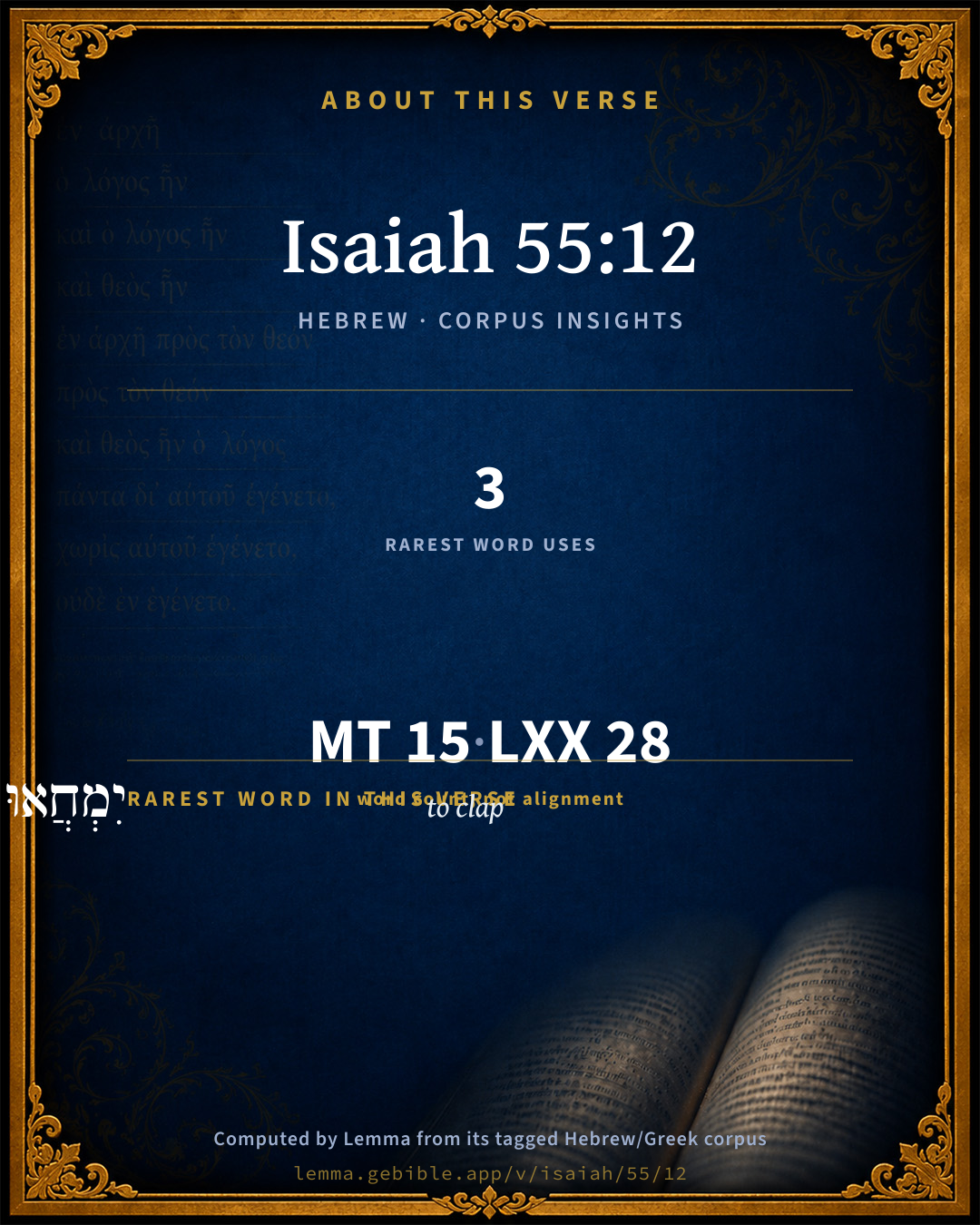
The rarest word here is יִמְחֲאוּ to clap H4222 — appearing just 3 times in the whole Hebrew Bible.

Shared distinctive vocabulary

יִמְחֲאוּ to clap H4222 occurs in 3 verses of the Hebrew Bible. Also found in:

Grammatical profile

  • 4 verbs
  • 10 nouns
  • 1 conjunction

Verb forms

  • תֵצֵ֔אוּ Qal · Imperfect
  • תּֽוּבָל֑וּן Hophal · Imperfect
  • יִפְצְח֤וּ Qal · Imperfect
  • יִמְחֲאוּ Qal · Imperfect

Hebrew & Septuagint length

In English translation the verse runs 36 words from the Hebrew and 38 from the Septuagint (LXX English) — closely comparable.

A rough comparison of the two English renderings, which tokenize alike — not a word-level alignment.

Word counts can differ between the Hebrew and the Greek without any difference in meaning — e.g. the Hebrew direct-object marker אֵת has no separate Greek word, and Greek often adds the article ὁ.

In the original languages it is 15 Hebrew tokens and 28 Greek tokens — but the two are counted differently (Hebrew bundles its prefixes and suffixes into one token; the Greek is in lemma form), so that isn’t a like-for-like length.

Cross-references

31

Topical passages linked to Isaiah 55:12 in the Treasury of Scripture Knowledge — connected by theme and wording, ordered by reader-vote popularity; previews shown in the World English Bible.

  • Galatians 5:22 But the fruit of the Spirit is love, joy, peace, patience, kindness, goodness, faithfulness,
  • Romans 15:13 Now may the God of hope fill you with all joy and peace in believing, that you may abound in hope, in the power of the Holy Spirit.
  • Isaiah 44:23 Sing, you heavens, for Yahweh has done it; shout, you lower parts of the earth; break forth into singing, you mountains, O forest, and every tree therein: for Yahweh has redeemed Jacob, and will glorify himself in Israel.
  • Psalms 105:43 He brought forth his people with joy, His chosen with singing.
  • Psalms 96:11–13 Let the heavens be glad, and let the earth rejoice. Let the sea roar, and it's fullness!
  • Psalms 98:7–9 Let the sea roar with its fullness; The world, and those who dwell therein.
  • Revelation 19:1–6 After these things I heard something like a loud voice of a great multitude in heaven, saying, "Hallelujah! Salvation, power, and glory belong to our God:
  • Isaiah 49:13 Sing, heavens; and be joyful, earth; and break forth into singing, mountains: for Yahweh has comforted his people, and will have compassion on his afflicted.
  • 1 Chronicles 16:32–33 Let the sea roar, and the fullness of it; Let the field exult, and all that is therein;
  • Isaiah 35:10 and the ransomed of Yahweh shall return, and come with singing to Zion; and everlasting joy shall be on their heads: they shall obtain gladness and joy, and sorrow and sighing shall flee away.
  • Psalms 65:13 The pastures are covered with flocks. The valleys also are clothed with grain. They shout for joy! They also sing.
  • Isaiah 35:1–2 The wilderness and the dry land shall be glad; and the desert shall rejoice, and blossom as the rose.
  • Psalms 148:4–13 Praise him, you heavens of heavens, You waters that are above the heavens.
  • Isaiah 48:20 Go you forth from Babylon, flee you from the Chaldeans; with a voice of singing declare you, tell this, utter it even to the end of the earth: say you, Yahweh has redeemed his servant Jacob.
  • Isaiah 54:10 For the mountains may depart, and the hills be removed; but my loving kindness shall not depart from you, neither shall my covenant of peace be removed, says Yahweh who has mercy on you.
  • Jeremiah 33:6 Behold, I will bring it health and cure, and I will cure them; and I will reveal to them abundance of peace and truth.
  • Romans 5:1 Being therefore justified by faith, we have peace with God through our Lord Jesus Christ;
  • Isaiah 14:8 Yes, the fir trees rejoice at you, [and] the cedars of Lebanon, [saying], Since you are laid low, no lumberjack is come up against us.
  • Isaiah 51:11 The ransomed of Yahweh shall return, and come with singing to Zion; and everlasting joy shall be on their heads: they shall obtain gladness and joy; [and] sorrow and sighing shall flee away.
  • Isaiah 54:13 All your children shall be taught of Yahweh; and great shall be the peace of your children.
  • Jeremiah 30:19 Out of them shall proceed thanksgiving and the voice of those who make merry: and I will multiply them, and they shall not be few; I will also glorify them, and they shall not be small.
  • Colossians 1:11 strengthened with all power, according to the might of his glory, for all endurance and perseverance with joy;
  • Isaiah 42:10–11 Sing to Yahweh a new song, and his praise from the end of the earth; you who go down to the sea, and all that is therein, the isles, and the inhabitants of it.
  • Jeremiah 33:11 the voice of joy and the voice of gladness, the voice of the bridegroom and the voice of the bride, the voice of those who say, Give thanks to Yahweh of Hosts, for Yahweh is good, for his loving kindness endures forever; [and of them] who bring [sacrifices of] thanksgiving into the house of Yahweh. For I will cause the captivity of the land to return as at the first, says Yahweh.
  • Luke 15:10 Even so, I tell you, there is joy in the presence of the angels of God over one sinner repenting."
  • Psalms 47:1 Oh clap your hands, all you nations. Shout to God with the voice of triumph!
  • Isaiah 65:13–14 Therefore thus says the Lord Yahweh, Behold, my servants shall eat, but you shall be hungry; behold, my servants shall drink, but you shall be thirsty; behold, my servants shall rejoice, but you shall be disappointed;
  • Zechariah 2:7–10 'Come, Zion! Escape, you who dwell with the daughter of Babylon.'
  • Romans 5:11 Not only so, but we also rejoice in God through our Lord Jesus Christ, through whom we have now received the reconciliation.
  • Isaiah 49:9–10 saying to those who are bound, Go forth; to those who are in darkness, Show yourselves. They shall feed in the ways, and on all bare heights shall be their pasture.
  • Jeremiah 31:12–14 They shall come and sing in the height of Zion, and shall flow to the goodness of Yahweh, to the grain, and to the new wine, and to the oil, and to the young of the flock and of the herd: and their soul shall be as a watered garden; and they shall not sorrow any more at all.

Cross-references courtesy of OpenBible.info (CC BY 4.0).

Hebrew and Greek witnesses Masoretic Hebrew ↔ Greek Septuagint

The same verse in the two great witnesses to the Old Testament, shown verse-for-verse.

These are two independent witnesses, not word-aligned to each other, and the Septuagint is shown in lemma (dictionary) form.

Hebrew Isaiah 55:12 Masoretic · Westminster Leningrad Codex

כִּֽי בְשִׂמְחָ֣ה תֵצֵ֔אוּ וּבְשָׁל֖וֹם תּֽוּבָל֑וּן הֶהָרִ֣ים וְהַגְּבָע֗וֹת יִפְצְח֤וּ לִפְנֵיכֶם֙ רִנָּ֔ה וְכָל עֲצֵ֥י הַשָּׂדֶ֖ה יִמְחֲאוּ כָֽף

For you shall go out with joy, and be led forth with peace: the mountains and the hills shall break forth before you into singing; and all the trees of the fields shall clap their hands.

World English Bible · Public Domain

Greek LXX Isaiah 55:12 Septuagint · lemma form

ἐν γάρ εὐφροσύνη ἐκἔρχομαι καί ἐν χαρά διδάσκω ὁ γάρ ὄρος καί ὁ βουνός ἐκἅλλομαι προςδέχομαι σύ ἐν χαρά καί πᾶς ὁ ξύλον ὁ ἀγρός ἐπικροτέω ὁ κλάδος

For you⌃ shall go forth with joy, and shall be taught with gladness: for the mountains and the hills shall exult to welcome you with joy, and all the trees of the field shall applaud with their branches.

LXX2012 (modern English Septuagint) · Public Domain

On this verse, Keil & Delitzsch discusses the Septuagint’s reading. Read the note in Commentary ↓

Hebrew: Westminster Leningrad Codex (CC BY 4.0). Greek: Septuagint (public domain); English from LXX2012 (modern English Septuagint) (Public Domain). How the Septuagint differs from the Hebrew →

Targum (Aramaic paraphrase)

1

The Targum is the ancient Jewish Aramaic paraphrase of the Hebrew Scriptures — an interpretive translation, not the Hebrew text itself. Onkelos (literal) and Pseudo-Jonathan (expansive) render the Torah, and Jonathan the Prophets. Coverage is partial: where no permissively-licensed English translation exists for a verse, only the Aramaic is shown. This is verse-level text, not a word-by-word alignment to the Hebrew.

  1. Targum Jonathan Prophets (Joshua–Malachi)
    אֲרֵי בְחֶדְוָא תִפְקוּן מִבֵּינֵי עַמְמַיָא וּבִשְׁלָמָא תִּתּוֹבְלוּן לְאַרְעֲכוֹן טוּרַיָא וְרָמָתָא יְבוּעוּן קֳדָמֵיכוֹן תּוּשְׁבְּחָא וְכָל אִילָנֵי חַקְלָא יִשְׁעֲנוּן בְּעַנְפֵיהוֹן:

    For ye shall go out with joy from among the nations, and with peace ye shall be carried to your land: the mountains and the hills shall rejoice before you with praise, and all the trees of the field shall clap with their branches.

    Targum Jonathan — Aramaic: “Mikraot Gedolot” (public domain). English: “Sefaria Community Translation” (CC0 1.0 (public-domain dedication)); “London "Chaldee Paraphrase," 1871” (public domain). Text via Sefaria.

Commentary

Notes on Isaiah 55:12 from classic Christian and Jewish commentators (each source and its license shown beneath its notes). The classic Christian expositions comment on the surrounding passage and are grouped to its opening verse, so a note may address several verses; the Jewish commentaries on the Tanakh (Rashi and others) are per-verse, so they appear only where the commentator wrote on this verse.

Lemma curates 59 commentaries, every one of them public domain or Creative Commons licensed, each selected and text-cleaned for this edition rather than reprinted as found. About our sources →

Trapp's Complete Commentary

John Trapp

Isa 55:12 For ye shall go out with joy, and be led forth with peace: the mountains and the hills shall break forth before you into singing, and all the trees of the field shall clap [their] hands.

Ver. 12. For ye shall go out with joy,] sc., Out of your spiritual bondage, worse than that of Babylon.

The mountains and the hills.] The mute and brute creatures, as they seem to groan together with the faithful, {Rom 8:21-22} so here, by a prosopopeia, they are brought in as congratulating and applauding their deliverance.

John Trapp, A Commentary or Exposition upon All the Books of the Old and New Testament (1647–1656) — public domain. Text from a community e-Sword module.

The Biblical Illustrator

Joseph S. Exell

Isa_55:12-13

For ye shall go out with joy

The reversals of pardoning mercy

The wealth of Gods abundant pardon is here set forth in metaphors which the least imaginative can understand.

Not only were the exiles forgiven, their warfare accomplished, their iniquity pardoned; but they would be restored to the land of their fathers--Ye shall go out . . . ye shall be led forth . . . Not only were they to be restored; but their return was to be one long triumphal march. Nature herself would celebrate it with joyful demonstration; mountains and hills would break forth into singing, and all the trees of the field would clap their hands. But even this was not all. One of the necessary results of the depopulation of the land of Israel was the deterioration of the soil. Vast tracts had passed out of cultivation; the terraces, reared on the slopes of the hills with so much care, had become heaps of stones; where corn had waved in the rustling breeze, or luscious fruits had ripened in the autumn sunshine, there was the sad fulfilment of the prediction, They shall smite upon their breasts for the pleasant fields,,, for the fruitful vine. Upon the land of My people shall come up thorns and briars (Isa_32:12-13).But this, too, was to be reversed. Literally and metaphorically, there was to be a complete reversal of the results of former sins and backslidings. (F. B.Meyer, B. A.)

Gods dealings with the soul in grace

To the Jew in Isaiahs time this promise doubtless bore reference to three things: the return from the seventy years captivity; their ultimate restoration, first to their own land, and then to Christ; and Gods way of dealing with each individuals own soul. To us it stands only in the last reference; to us the words are simply spiritual.

I. THE GOING GUY appears to relate to that great moral exodus when a man emerges from a state of nature into a state of grace, from bondage to liberty, from darkness to light, from the world to Christ, This is indeed to be with joy.

II. THE BEING LED FORTH denotes the further experiences of the Christian,--Gods conduct of him by the way; his future courses, and especially themanner in which he is brought out at last--out of this life into a better; and all this is to be with peace. (J. Vaughan, M. A.)

What is joy?

1. Novelty of perception. It is a wonderfully new feeling when a soul first tastes the promises and grasps its own interest in Christ.

2. Keenness of perception. Keen is the first sense of sin to a penitent, and keen is the first sense of pardon to a believer. In that early dawn the souls atmosphere is so clear that every object stands out in its distinctness.

3. Sweetness of perception. Sweeter are those perceptions than they are keen. Are they not the touches of the Holy Ghost They are all about beautiful things--saints and angels, a holy heaven, and a perfect Jesus. (J. Vaughan, M. A.)

And be led forth with peace:

As we go on in the spiritual life the sense of sin grows deeper and deeper; and a deep sense of weakness, nothingness, and guilt, combining with a fuller sense of pardon and love, makes joy peace. To a mind led and taught of God all the changes and chances of life lend themselves to peace. A great affliction is a deep fountain of peace; the very agitation hushes, and it makes all troubles afterwards so very small. Another and another promise fulfilled every day is always enlarging the rock underneath our feet. Another and another answer to prayer is always strengthening the arguments for the future. Another and another new drop of the knowledge of Christ is always swelling the tide, till the peace flows like a river, because we see the righteousness of Christ as the waves of the sea. (J. Vaughan, M. A.)

The effect produced by the Gospel

I. AN EFFECT THE MOST JOYFUL. Joy to whom?

1. To themselves. The redeemed of the Lord shall return, and come with singing unto Zion; and everlasting joy shall be upon their head. Lord Chesterfield said, I hope I shall never be what they call converted, for I should be the most miserable man upon earth; not considering that this change would have produced a change in his taste, and that he would have been able to relish things which he disliked before. He to talk of religion making him miserable! Why, does he not, in one of his letters, tell us that he had always been wretched--that he had always found the world a cheat--and that he was now leaving it, not because he was reconciled to it, but because he was compelled; and that, since time had become his enemy, he was endeavouring to sleep away the remainder of it in a carriage? Bolingbroke, too, said, I now find in my affliction that my philosophy fails me. But the Christians religion does not fail him in the day of trouble.

2. To their fellow-Christians. There is no room for envy here, for there is enough for others as well as for yourselves, and enough for all.

3. To their pious friends, connections and relations. They had given them many a pang before.

4. Joy to ministers. When they observe the success of their labours, they resemble the husbandman, who, after his ploughing, manuring and sowing, goes forth and sees, first the blade, then the ear, and after that the full corn in the ear.

5. Joy to the angels.

6. Joy to the Mediator.

7. Joy to God Himself. The pleasure of the Lord, says Isaiah, shall prosper in his hand. The Lord thy Go-d in the midst of thee is mighty; He will save, He will rejoice over thee with joy; He will rest in His love; He will joy over thee with singing.

II. AN EFFECT THE MOST TRANSFORMING. Instead of the thorn shall come up the fir tree, etc.

III. AN EFFECT THE MOST HONOURABLE TO GOD. It shall be to the Lord for a name, for an everlasting sign, that shall not be cut off. (W. Jay.)

The Biblical Illustrator, edited by Joseph S. Exell (c. 1880s–1900s) — public domain. Text from a community e-Sword module.

The Preacher's Complete Homiletical Commentary

Joseph S. Exell (gen. ed.)

THE CHEERFUL COURSE OF THE GODLY

Isa_55:12. Ye shall go out with joy, and be led forth with peace, &c.

There is resolution and effort on our part, and help and guidance on God’s part. We “go out” and we are “led.” We must not forget either side of the truth. The farmer works in harmony with the rains and sunshine; the sailor in harmony with the winds and the sea. These two things, “going out” and “joy,” do not naturally agree. Going out is naturally more or less painful. Even although it is to make your position better, there is yet pain in leaving. But God says to the believer: “These two incompatible things will meet in your case; nay, the one shall be the occasion of the other.” The text also speaks of leading forth, and says of it that it shall be “with peace.” The Christian’s course is like a stream bounding forth from its native darkness with joy, and then gradually acquiring the tranquil flow of the broad river in the plain. Some applications—

I. In conversion, the soul goes out with joy and is led forth with peace. Conversion is the soul’s first and great “going out.” That is the essential idea of conversion. It is not so many prayers and tears and resolutions. It is turning our back on the old life of sin and selfishness, and coming out into the light of God, as really as the emigrant leaves one country and goes to another. This coming out is a joyful thing. The Israelites celebrated their leaving of Egypt by a feast; and surely the coming out of the soul from darkness to light, from condemnation to life, may well be the signal of joy. And in the case of the soul delivered from death there is the peaceful leading, as well as the joyful departure. “Thou wilt keep him in perfect peace,” &c.

II. In the varied changes of life, the Christian goes out with joy and is led forth with peace. If we are the people of God, if we meet all changes in a spirit of faith and obedience, we may go forth with joy. Let us meet all our changes clinging to God’s guidance, taking a firmer hold of God as the scenes get stranger and stranger, as a child takes a firmer hold of his father the further he is from home.

III. At death the believer goes out with joy, and is led forth with peace. He may have looked forward to it with misgiving, with something like dismay. But at midnight, when the cry comes, he rejoices greatly because he hears the Bridegroom’s voice. Like a tired labourer, he goes thankfully home, like a welcome and expectant guest, he goes rejoicing to the banquet.—The Homiletical Library, vol. ii. p. 122.

The Preacher's Complete Homiletical Commentary (gen. ed. Joseph S. Exell; Funk & Wagnalls, c. 1892) — public domain (pre-1929). A full-Bible homiletical/sermon-outline anthology covering 65 of 66 books (2 John is absent from the source module). Text from a community e-Sword module.

Tyndale Open Study Notes

Tyndale Open Resources

55:12-13 The prophet encourages his people to forget the past, to leave Babylon, and to accept the perspective of the coming age.

55:12 Joy is found in being redeemed from bondage. • Godly people experience an inner peace not known to the wicked (48:22). • mountains and hills . . . trees of the field: Creation participates in the freedom of the children of God (44:23; 49:11, 13; see Rom 8:19-23).

Tyndale Open Study Notes — © Tyndale Open Resources, licensed CC BY-SA 4.0. Text via the HelloAO Bible API.

Geneva Bible (1599)

Geneva Bible translators

Read Isa. 44:23 and 49:13.

Geneva Bible (1599) marginal notes — public domain. Text via Bolls.life.

Jamieson, Fausset & Brown

Robert Jamieson, A. R. Fausset & David Brown

go out--from the various countries in which ye (the Jews) are scattered, to your own land (Eze 11:17).

led--by Messiah, your "Leader" (Isa 55:4; Isa 52:12; Mic 2:12-13).

mountains . . . trees, &c.--images justly used to express the seeming sympathy of nature with the joy of God's people. For, when sin is removed, the natural world shall be delivered from "vanity," and be renewed, so as to be in unison with the regenerated moral world (Isa 44:23; Psa 98:8; Rom 8:19-22).

Jamieson, Fausset & Brown — Commentary Critical and Explanatory on the Whole Bible (1871) — public domain (CC PDM 1.0). Text via the HelloAO Bible API.

Adam Clarke's Commentary

Verse 12. The mountains and the hills] These are highly poetical images to express a happy state attended with joy and exultation.

Ipsi laetitia voces ad sidera jactant

Intonsi montes: ipsae jam carmina rupes,

Ipsa sonant arbusta.

VIRG. Ecl. v. 61.

"The mountain tops unshorn, the rocks rejoice;

The lowly shrubs partake of human voice."

DRYDEN.

Adam Clarke's Commentary on the Bible (1810–1826) — public domain. Text from a community e-Sword/MySword module.

Ellicott's Commentary for English Readers

(12) The mountains and the hills . . .—Cheyne aptly compares—

“Ipsi lætitia voces ad sidera jactant

Intonsi montes.” VIRG., Æclog.

(The very hills, no more despoiled of trees,

Shall to the stars break forth in minstrelsies.)

The waving of the branches of the trees is, in the poet’s thoughts, what the clapping of hands is with men, a sign of jubilant exultation (Psa_96:12).

A Bible Commentary for English Readers, edited by Charles John Ellicott (1878–1897) — public domain. Text from a community e-Sword module.

The Cambridge Bible for Schools and Colleges

gen. ed. J. J. S. Perowne

12, 13. The joyful exodus from Babylon; this is the “thing whereto Jehovah has sent” His word.

and be led forth] by Jehovah in person, ch. Isa_40:10, Isa_52:12. Cf. Mic_2:13.

shall clap their hands] Psa_98:8; Eze_25:6.

The Cambridge Bible for Schools and Colleges (gen. ed. J. J. S. Perowne; Cambridge University Press, 1878–1918) — public domain. Text from a community e-Sword module.

John Gill's Exposition

For ye shall go out with joy, and be led forth with peace,.... Though these words may literally respect the Jews' return from captivity to their own land, attended with joy and peace; as the preceding verse may respect the word of promise concerning it; as it is interpreted by the Targum,

"for with joy shall ye go out from among the people, and with peace shall ye be brought to your own land;''

yet they may be spiritually applied to the conversion of men, in consequence of the word being made effectual, of which the deliverance from the Babylonish thraldom was a type; when men "go out" of a state of bondage to sin, Satan, and the law; out of a state of darkness and ignorance; out of the pit of nature's misery and distress; out of themselves and their own righteousness; out of their own sinful ways, and from among the men of the world: and though here is a divine power exerted in all this, yet they go out freely, being led by the Spirit of God; who takes them by the hand as it were, and leads them in ways before unknown to them; he leads them to Christ, his person, fulness, blood, and righteousness; to the house of God, and to the ordinances of it; and from one degree of grace to another, till he brings them to glory: all which is attended with "joy and peace" to themselves; finding themselves released from bondage, in a state of light and comfort, out of the horrible pit, and on a rock; brought to Christ, and clothed with his righteousness; to the angels in heaven, who rejoice over every sinner that repenteth; to the ministers of the Gospel, who are the instruments of their conversion; and to all the saints into whose fellowship they are brought; which joy is further illustrated by the following strong figures:

the mountains and the hills shall break forth before you into singing; or the people that dwell upon them: and all the trees of the field shall clap their hands; or clap with their branches; as the Targum, the tops of them, being moved with gentle breezes of wind, bow themselves, and the branches intertwining and clasping each other like hands and arms. Kimchi observes, that "mountains and hills" may signify the kings of the nations; and "the trees of the field" the people rejoicing at the deliverance of the Jews, as they pass along: it may be as well applied to the ministers of the word, and common believers rejoicing at the conversion of sinners, in whom as wonderful a change is wrought, as in the following cases. Vitringa interprets this of the apostles and ministers of the word going forth into the Gentile world, attended with joy in themselves, and among the converts there.

John Gill's Exposition of the Whole Bible (1746–1763) — public domain (CC PDM 1.0). Text via the HelloAO Bible API.

Albert Barnes' Notes on the Bible

For ye shall go out with joy - This language is that which is properly applicable to the exiles in Babylon, but there can be no doubt that the prophet looks also to the future happier times of the Messiah (compare the notes at Isa 52:7).

The mountains and the hills - Language like this is common in Isaiah, where all nature is called on to rejoice, or where inanimate objects are represented as expressing their sympathy with the joy of the people of God (see the note at Isa 14:8; Isa 35:1-2, Isa 35:10; Isa 42:10-11; Isa 44:23). Indeed, this imagery is common in all poetry. Thus, Virgil:

Ipsi laetitia voces ad sidera jactant,

Intonsi montes: ipsae jam carmina rupes,

Ipsa sonant arhusta.

Ec. v. 62ff.

The untill’d mountains strike the echoing sky;

And rocks and towers the triumph speed abroad.

Wrangham

Such language occurs especially in the poetry of the Orientals. Thus, when the god Ramar was going to the desert, says Roberts, it was said to him, ‘The trees will watch for you; they will say, He is come, he is come; and the white flowers will clap their hands. The leaves as they shake will say, Come, come, and the thorny places will be changed into gardens of flowers.’

And all the trees of the field shall clap their hands - To clap the hands is expressive of joy and rejoicing (compare 2Ki 11:12; Psa 47:1). Thus, in Psa 98:8, it is said:

Let the floods clap their hands;

Let the hills be joyful together.

Among the Jews the language was sometimes used to express malignant joy at the calamity of others (compare Job 27:3; Job 34:37; Lam 2:15; Eze 25:6). Here it is an expression of the universal rejoicing which would attend the extension of the kingdom of God on the earth.

Albert Barnes' Notes on the Bible (1834–1885) — public domain. Text from a community e-Sword/MySword module.

Haydock's Catholic Bible Commentary

Peace, by strangers, chap. xlix. 22. --- Hands, for joy. (Calmet) --- Ipsa sonant arbusta Deus Deus ille, Menacla. (Virgil, Eclogues v.)

George Leo Haydock (1774–1849), Haydock's Catholic Family Bible and Commentary, 1859 edition — public domain. Excludes Psalms (Douay-Rheims chapter numbering differs from Protestant) and Deuterocanonical books (Catholic canon only).

Matthew Poole's English Annotations

For; or, Therefore; because God hath promised it, and therefore will effect it.

Ye shall go out; ye shall be released from the place and state of your bondage. He alludes to their going out of Egypt, which was a type of their succeeding deliverances, and especially of their redemption by Christ from the power of sin and of the devil.

Be led forth; or, be led along; be conducted by the gracious and powerful presence of God, as you were in the wilderness. With peace; safely and triumphantly, without fear of being retaken and brought back into slavery by your enemies.

And all the trees of the field shall clap their hands; there shall be a great and general rejoicing at your deliverance, so that even the senseless creatures shall seem to rejoice with you and for you.

Matthew Poole's English Annotations on the Holy Bible (1683–1685) — public domain. Text from a community e-Sword/MySword module.

Whedon's Commentary on the Bible

Daniel D. Whedon

12, 13. The comparison just drawn (Isa_55:10-11) is truly beautiful, but its chief point is the energy with which the divine word is realized. (Delitzsch.) On receiving the word, or Gospel, ye are as those gladdened by a joyful deliverance.

Ye shall go out with joy — Possibly the allusion here is to the exodus from Egypt, or more directly from Babylon, though neither can be the primary thought of the passage. The words are used as simply illustrative of the people of God emancipated from under old Mosaic tutelage into gospel privileges under the Messiah, or Christ. They go forth, bounding with “joy,” for conquest of the whole world to Christ; and all nature — all mountains, and hills, and trees — take on the happy complexion of the buoyant spirit of the Church. The result shall be the world’s renewal. The regenerating effects of the Gospel shall operate on the masses of mankind. Evil shall be eradicated; a blessed civilization shall be built up: for these are what the prophet means in his favourite figure of exchange from the noxious and the forbidding to the beautiful and the useful in the world’s physical aspect. See chap. 35, ff.; Isa_41:18, ff.; Isa_44:23, Isa_49:13; Isa_52:9. See also the Hebrew of the word thorn, נעצוצ, na’tsuts, only once before used, (in Isa_7:19,) and therefore a genuine Isaiahic word.

Daniel D. Whedon (gen. ed.), Commentary on the Old and New Testaments (1874–1909) — public domain. Text from a community e-Sword module.

The Pulpit Commentary

Ye shall go out with joy, and be led forth with peace. (Isa_35:10 Isa_40:9-11 Isa_43:3-6, Isa_43:19-21, etc.) A strong contrast is frequently drawn between the exodus from Babylon and that from Egypt. On the former occasion all was hurry, alarm, disquiet, danger. The later exodus will be accompanied with "peace" and "joy". (see Isa_51:9-16, etc.) (For the fulfilment, see Ezr 1 Ezr 2, and Ezr 7 Ezr 8) The mountains and the hills shall break forth before you into singing. All nature shall rejoice at your deliverance, especially the noblest and the grandest parts of nature mountains and the hills." Isaiah"s admiration of mountains continually reveals itself throughout the work. (Isa_5:25 Isa_13:2, 4 14:25 22:5 30:17, 25 34:3 40:4, 9, 12 42:11, 15, etc.) It is quite in his manner to speak of nature as bursting forth into singing. (Isa_35:2 Isa_44:23 Isa_49:13) All the trees of the field shall clap their hands. The metaphor is not found elsewhere in Isaiah, but appears in Psa_98:8.

The Pulpit Commentary (1880–1919), ed. H.D.M. Spence-Jones & Joseph S. Exell — public domain. Text from a community e-Sword module.

John Wesley's Explanatory Notes

Therefore - Ye shall be released from your bondage. Peace - Safely and triumphantly. Clap - There shall be a general rejoicing, so that even the senseless creatures shall seem to rejoice with you.

John Wesley, Explanatory Notes Upon the Whole Bible (1754–1765) — public domain. Text via the GEBible commentary corpus.

Keil & Delitzsch

C. F. Keil & F. Delitzsch

The true point of comparison, however, is the energy with which the word is realized. Assuredly and irresistibly will the word of redemption be fulfilled. "For ye will go out with joy, and be led forth in peace: the mountains and the hills will break out before you into shouting, and all the trees of the field will clap their hands. Instead of the thorn will cypresses shoot up, and instead of the fleabane will myrtles shoot up: and it will be to Jehovah for a name, for an everlasting memorial that will not be swept away." "With joy," i.e., without the hurry of fear (Isa 52:12); "in peace," i.e., without having to fight their way through or flee. The idea of the sufferer falls back in הוּבל behind that of a festal procession (Psa 45:15-16). In applying the term kaph (hand) to the trees, the prophet had in his mind their kippōth, or branches. The psalmist in Psa 98:8 transfers the figure created by our prophet to the waves of the streams. Na‛ătsūts (from nâ‛ats, to sting) is probably no particular kind of thorn, such, for example, as the fuller's thistle, but, as in Isa 7:19, briers and thorns generally. On sirpad, see Ges. Thes.; we have followed the rendering, κόυζα, of the lxx. That this transformation of the vegetation of the desert is not to be taken literally, any more than in Isa 41:17-20, is evident from the shouting of the mountains, and the clapping of hands on the part of the trees. On the other hand, however, the prophet says something more than that Israel will return home with such feelings of joy as will cause everything to appear transformed. Such promises as those which we find here and in Isa 41:19 and Isa 35:1-2, and such exhortations as those which we find in Isa 44:23; Isa 49:13, and Isa 52:9, arise from the consciousness, which was common to both prophets and apostles, that the whole creation will one day share in the liberty and glory of the children of God (Rom 8:21). This thought is dressed up sometimes in one for, and sometimes in another. The psalmists after the captivity borrowed the colours in which they painted it from our prophet (see at Psa 96:1-13 and Psa 98:1-9). והיה is construed as a neuter (cf., בּראתיו, Isa 45:8), referring to this festal transformation of the outer world on the festive return of the redeemed. אות is treated in the attributive clause as a masculine, as if it came from אוּת, to make an incision, to crimp, as we have already indicated; but the Arabic âyat, shows that it comes from אוה, to point out, and is contracted from ăwăyat, and therefore was originally a feminine.

Keil & Delitzsch — Biblical Commentary on the Old Testament (1861–1891) — public domain (CC PDM 1.0). Text via the HelloAO Bible API. (Old Testament only.)

J. A. Alexander on Isaiah

Joseph Addison Alexander

“For with joy shall ye go forth, and in peace shall ye be led; the mountains and the hills shall break out before you into a shout, and all the trees of the field shall clap the hand.” Here as in many other places the idea of joyful change is expressed by representing all nature as rejoicing. The expression ‘go forth’ is eagerly seized upon by some interpreters as justifying the restriction of the passage to the restoration from the Babylonish exile. But the real allusion in such cases is to the deliverance from Egypt, which is constantly referred to as a type of deliverance in general, so that every signal restoration or deliverance is represented as another exodus.

Joseph Addison Alexander, The Prophecies of Isaiah (1846–1847; New York: Scribner, 1870–1878) — public domain. Text from a community e-Sword module.

unfoldingWord translationNotes

Door43 World Missions Community

General Information:

Yahweh continues speaking to the people of Jerusalem.

be led along peacefully

This can be stated in active form. AT: "I will lead you along peacefully" (See: Active or Passive)

the mountains and the hills will break out in joyful shouts before you, and all the trees of the fields will clap their hands

Yahweh speaks of the mountains, hills, and trees as if they were people with voices and hands, celebrating as Yahweh rescues his people. (See: Personification)

Instead of the thornbushes, the cypress will grow; and instead of the brier, the myrtle tree will grow

The words "thornbushes" and "brier" refer to species of plants that have sharp thorns growing on them. The words "cypress" and "myrtle" refer to species of evergreen trees. The thorny plants symbolize desolation, while the evergreens symbolize life and prosperity. (See: Translate Unknowns)

for his name

Here the word "name" represents Yahweh's fame. AT: "for his fame" or "for his honor" (See: Metonymy)

that will not be cut off

Something ceasing to exist is spoken of as if it were cut off, as a branch is cut off of a tree or a piece of fabric is cut off of clothing. This can be stated in active form. AT: "that will never end" or "that will last forever" (See: Metaphor and Active or Passive)

translationWords

joy

peace

Yahweh

name

eternity

sign

cut off

unfoldingWord translationNotes — © Distant Shores Media and the Door43 World Missions Community, licensed CC BY-SA 4.0. Source: git.door43.org/Door43/en_tn.

Rashi

Rabbi Shlomo Yitzchaki (Rashi)

For with joy shall you go forth from the exile.

the mountains and the hills shall burst into song before you for they will give you their fruit and their plants, and their inhabitants shall derive benefit. ([Some editions read:] And their inhabitants shall sing.)

Rashi on the Tanakh — English translations: “The Judaica Press complete Tanach with Rashi, translated by A. J. Rosenberg” (CC BY 4.0); “Pentateuch with Rashi's commentary by M. Rosenbaum and A.M. Silbermann, 1929-1934” (public domain); “The Metsudah Tanach series, Lakewood, N.J” (CC BY 4.0); and “The Book of Joshua, Metsudah Publications, 1997” (CC BY 4.0). Text via Sefaria.

Ibn Ezra

Rabbi Abraham ibn Ezra

For you shall go out with joy. You will go out from the exile joyfully.

And be led forth with peace to your land on horses and mules. If this passage be referred to the Babylonian exile, it was indeed literally fulfilled. But if it is understood to allude to a future redemption, in that case comp. And they shall bring all your brethren upon horses, etc. (66:20). Some refer it to both.

ימחאו Shall clap. This verb is frequently met with in the Chaldee. ומחה and shall reach (Num. 34:11) is of the same root.

Ibn Ezra on the Tanakh — English translations: “Sefaria Community Translation” (CC0 1.0 (public-domain dedication)); “Yalkut, Sifsei Chachomim Chumash, Metsudah Publications, 2009” (CC BY 4.0); and “Commentary of Ibn Ezra on Isaiah - trans. by M. Friedlander, 1873” (public domain). Text via Sefaria.

Lesson kit

Teaching starters — assembled from the data on this page, not authored interpretation. Every prompt links to the verse data it draws on. Edit before teaching.

Isaiah, in the Prophets, opens this verse with 15 words (15 distinct Hebrew lemmas). Its most distinctive word is mâchâʼ (“to clap”). A historical commentator’s framing appears above. Read the whole chapter for the surrounding context.

Discussion questions

  1. What does “to clap” (mâchâʼ) contribute to the verse as a whole?
  2. Psalms 98:8 shares the word «to clap» with this verse. How do the two illuminate each other?
  3. These translations render this verse differently. What is at stake in choosing one wording over another?
  4. The verb «תֵצֵ֔אוּ» is Qal Imperfect. How does its form color the action?
  5. Reading how Trapp's Complete Commentary and The Biblical Illustrator read this verse, where do the two commentators agree and where do they part?

Things to notice

Reading settings

Reading text

Shown beneath each verse's original-language words.

Old Testament
Old Testament edition

Read the OT as the Masoretic Hebrew (MT) or the Greek Septuagint (LXX).

English shown for the Greek Septuagint (in the Hebrew ↔ Greek comparison).

Comparing translations? Open the Compare panel on any verse page to stack up to four side by side.