
Isaiah 57:21

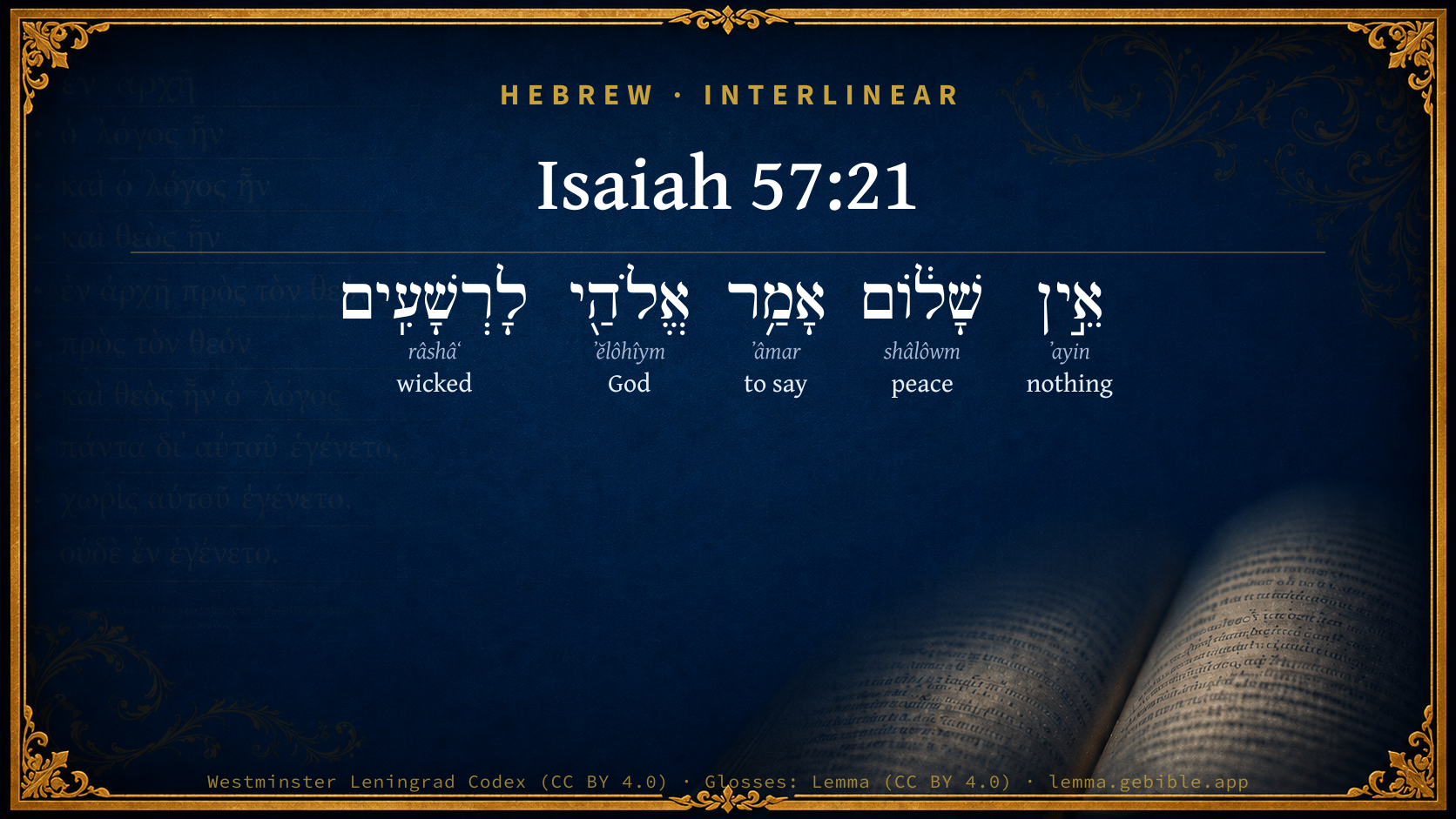
Hebrew (Westminster Leningrad Codex) Isaiah 57:21 appears in the Hebrew Old Testament. The text above is from the Westminster Leningrad Codex. Each word links to its Strong’s number, a concise gloss, and parsing drawn from the Open Scriptures Hebrew Bible morphology. Click any word for its full Brown-Driver-Briggs (BDB) entry.
Download image
Cite this verse

Isaiah 57:21 (World English Bible). Public Domain. Lemma interlinear Bible study tool, https://lemma.gebible.app/v/isaiah/57/21.

Show BibTeX & RIS
BibTeX
RIS
English Translation
There is no peace, says my God, to the wicked.
World English Bible · Public Domain
Download a study sheet

One document with this verse’s original text, its word-by-word gloss line, the meaning frame, cross-references with their text, attributed commentary, and full source and license credits — printable, and it pastes into notes with its structure intact.

This verse Autodidact and up

Study sheet (.html) Plain text (.txt)

A passage Seminary Student

Up to 50 verses in one chapter. A passage sheet keeps up to 6 commentary sources and 12 cross-references per verse, in the order this page ranks them, and says so on the sheet whenever that leaves anything out. Ask for a single verse and you get the Autodidact verse sheet above.

Everything on this page stays free to read, with no account — the sheet is a download of what is already on screen, not access to it.

Want to remove ads? Support Godless Engineer
Compare translations 3

The same verse in 3 English versions, stacked beneath the original-language interlinear above. Click any original word for its lexicon entry.

Each is an independent rendering of the whole verse — the interlinear is not word-aligned to these translations.

Highlighted words mark where these versions differ — a whole-verse word diff, not a word-by-word alignment.

  • World English Bible Public Domain
    There is no peace, says my God, to the wicked.
  • King James Version Public Domain
    There is no peace, saith my God, to the wicked.
  • unfoldingWord Literal Text CC BY-SA 4.0
    There is no peace,” says my God, “for the wicked.”

unfoldingWord Literal Text — © unfoldingWord, licensed CC BY-SA 4.0. Word-aligned USFM3 via Door43 (git.door43.org/unfoldingWord/en_ult).

Versions to compare (up to 4)

3 of 4 selected

Show all 18 translations

Every available English version of this verse, each an independent rendering of the whole verse.

  • World English Bible Public Domain
    There is no peace, says my God, to the wicked.
  • Berean Standard Bible Public Domain
    “There is no peace,” says my God, “for the wicked.”
  • Majority Standard Bible Public Domain
    “There is no peace,” says my God, “for the wicked.”
  • King James Version Public Domain
    There is no peace, saith my God, to the wicked.
  • American Standard Version (1901) Public Domain
    There is no peace, saith my God, to the wicked.
  • Revised Version (1885) Public Domain
    There is no peace, saith my God, to the wicked.
  • Geneva Bible (1599) Public Domain
    There is no peace, sayth my God, to the wicked.
  • Douay-Rheims (1899) Public Domain
    There is no peace to the wicked, saith the Lord God.
  • Young's Literal Translation Public Domain
    There is no peace, said my God, to the wicked!
  • Literal Standard Version CC BY-SA 4.0
    “There is no peace,” said my God, “for the wicked!”
  • Unlocked Literal Bible CC BY-SA 4.0
    There is no peace for the wicked one—says God.”
  • unfoldingWord Literal Text CC BY-SA 4.0
    There is no peace,” says my God, “for the wicked.”
  • Darby Bible Public Domain
    There is no peace, saith my God, to the wicked.
  • World Messianic Bible Public Domain
    “There is no peace”, says my God, “for the wicked.”
  • Webster's Bible Public Domain
    There is no peace, saith my God, to the wicked.
  • Free Bible Version CC BY-SA 4.0
    There's no peace for the wicked, says my God.
  • Bible in Basic English Public Domain
    There is no peace, says my God, for the evil-doers.
  • JPS Tanakh (1917) Public Domain
    There is no peace, saith my God concerning the wicked.

Literal Standard Version (2020), Covenant Press — licensed CC BY-SA 4.0. Text via the HelloAO Bible API (eBible.org). Unlocked Literal Bible (unfoldingWord) — licensed CC BY-SA 4.0. Text via the HelloAO Bible API (eBible.org). unfoldingWord Literal Text — © unfoldingWord, licensed CC BY-SA 4.0. Word-aligned USFM3 via Door43 (git.door43.org/unfoldingWord/en_ult). Free Bible Version, Dr. Jonathan Gallagher — licensed CC BY-SA 4.0. Text via the HelloAO Bible API (eBible.org).

Word by word

More ways to search: Search by grammar → Find every occurrence → Compare this word →

Practice this passage: Drill this verse → Learn its vocabulary →

שָׁל֔וֹם
shâlôwm
H7965
“peace”
Noun, Common, Masculine, Singular, Absolute
Part of Speech
Noun
Type
Common
Gender
Masculine
Number
Singular
State
Absolute
Full BDB Definition

Origin: from H7999

TWOT: 2401a

completeness, soundness, welfare, peace - completeness (in number) - safety, soundness (in body) - welfare, health, prosperity - peace, quiet, tranquillity, contentment - peace, friendship - of human relationships - with God especially in covenant relationship - peace (from war) - peace (as adjective)
  1. אֵ֣ין ʼayin H369 “nothing” Particle, Negative
  2. אָמַ֥ר ʼâmar H559 “to say” Verb, Qal, Perfect, 3rd Person, Masculine, Singular
  3. אֱלֹהַ֖י ʼĕlôhîym H430 “God(s) · my” Noun, Common, Masculine, Plural, Construct + Suffix, Personal, 1st Person, Common, Singular
  4. לָרְשָׁעִֽים râshâʻ H7563 “to/for the · wicked” Preposition, Determined + Adjective, Adjective, Masculine, Plural, Absolute

About this verse

These counts appear in no published source. They are computed here, from the morphology-tagged text and Lemma’s own curated glosses. What Lemma adds →

5
words
5
distinct lemmas
Prophets
section

Grammatical profile

  • 1 verb
  • 2 nouns
  • 1 adjective
  • 1 particle

Verb forms

  • אָמַ֥ר Qal · Perfect

Hebrew & Septuagint length

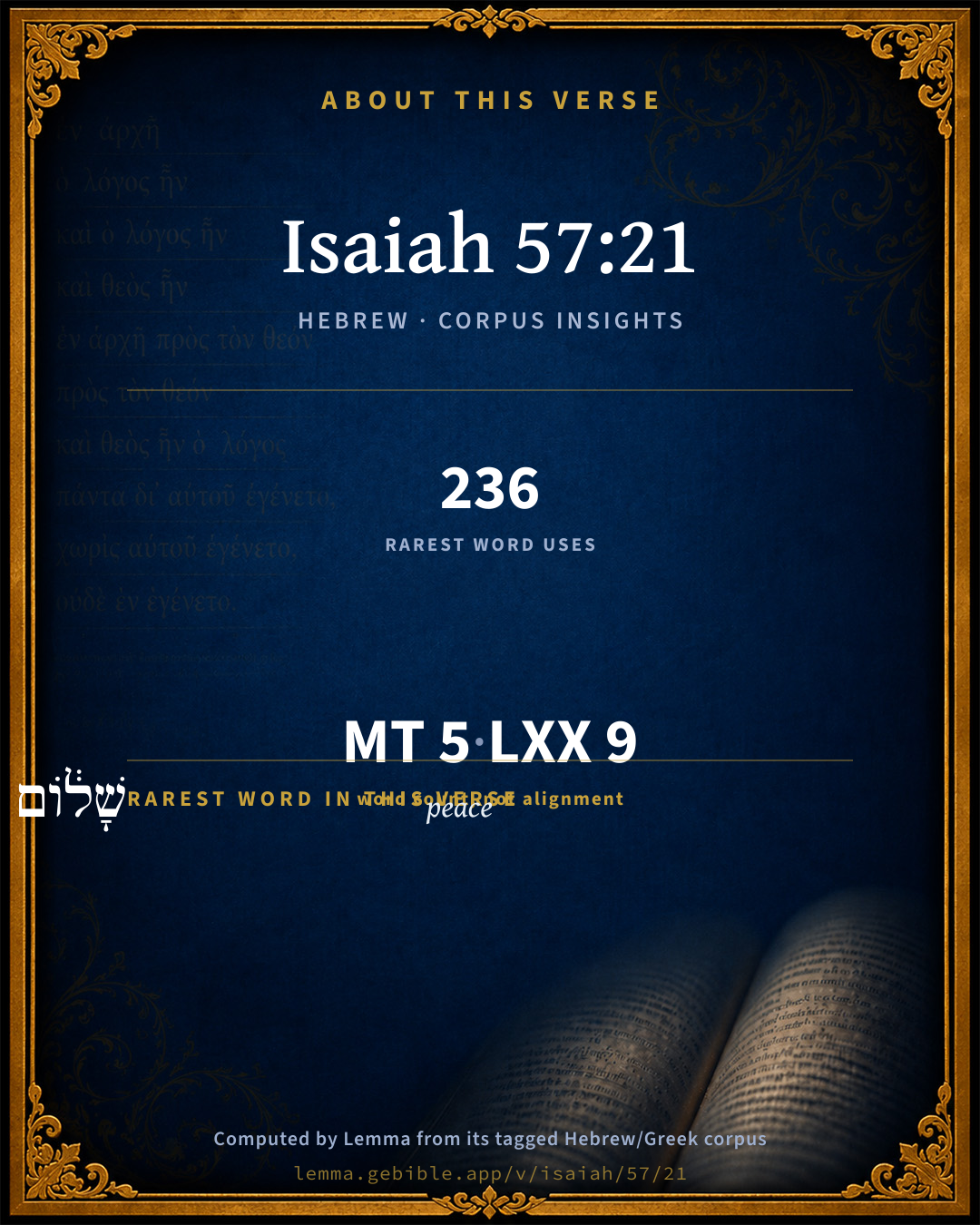
In English translation the verse runs 10 words from the Hebrew and 9 from the Septuagint (LXX English) — closely comparable.

A rough comparison of the two English renderings, which tokenize alike — not a word-level alignment.

Word counts can differ between the Hebrew and the Greek without any difference in meaning — e.g. the Hebrew direct-object marker אֵת has no separate Greek word, and Greek often adds the article ὁ.

In the original languages it is 5 Hebrew tokens and 9 Greek tokens — but the two are counted differently (Hebrew bundles its prefixes and suffixes into one token; the Greek is in lemma form), so that isn’t a like-for-like length.

Cross-references

5

Topical passages linked to Isaiah 57:21 in the Treasury of Scripture Knowledge — connected by theme and wording, ordered by reader-vote popularity; previews shown in the World English Bible.

  • Isaiah 48:22 There is no peace, says Yahweh, to the wicked.
  • Isaiah 3:11 Woe to the wicked! Disaster is upon them; For the deeds of his hands will be paid back to him.
  • 2 Kings 9:22 It happened, when Joram saw Jehu, that he said, Is it peace, Jehu? He answered, What peace, so long as the prostitution of your mother Jezebel and her witchcraft abound?
  • Isaiah 59:8 The way of peace they don't know; and there is no justice in their goings: they have made them crooked paths; whoever goes therein does not know peace.
  • Romans 3:16–17 Destruction and misery are in their ways.

Cross-references courtesy of OpenBible.info (CC BY 4.0).

Hebrew and Greek witnesses Masoretic Hebrew ↔ Greek Septuagint

The same verse in the two great witnesses to the Old Testament, shown verse-for-verse.

These are two independent witnesses, not word-aligned to each other, and the Septuagint is shown in lemma (dictionary) form.

Hebrew Isaiah 57:21 Masoretic · Westminster Leningrad Codex

אֵ֣ין שָׁל֔וֹם אָמַ֥ר אֱלֹהַ֖י לָרְשָׁעִֽים

There is no peace, says my God, to the wicked.

World English Bible · Public Domain

Greek LXX Isaiah 57:21 Septuagint · lemma form

οὐ εἰμί χαίρω ὁ ἀσεβής εἶπον κύριος ὁ θεός

There is no joy to the ungodly, said God.

LXX2012 (modern English Septuagint) · Public Domain

On this verse, Adam Clarke's Commentary discusses the Septuagint’s reading. Read the note in Commentary ↓

Hebrew: Westminster Leningrad Codex (CC BY 4.0). Greek: Septuagint (public domain); English from LXX2012 (modern English Septuagint) (Public Domain). How the Septuagint differs from the Hebrew →

Targum (Aramaic paraphrase)

1

The Targum is the ancient Jewish Aramaic paraphrase of the Hebrew Scriptures — an interpretive translation, not the Hebrew text itself. Onkelos (literal) and Pseudo-Jonathan (expansive) render the Torah, and Jonathan the Prophets. Coverage is partial: where no permissively-licensed English translation exists for a verse, only the Aramaic is shown. This is verse-level text, not a word-by-word alignment to the Hebrew.

  1. Targum Jonathan Prophets (Joshua–Malachi)
    לֵית שְׁלָמָא אֲמַר אֱלָהּ לְרַשִׁיעַיָא:

    There is no peace, saith my God, to the wicked.

    Targum Jonathan — Aramaic: “Mikraot Gedolot” (public domain). English: “Sefaria Community Translation” (CC0 1.0 (public-domain dedication)); “London "Chaldee Paraphrase," 1871” (public domain). Text via Sefaria.

Commentary

Notes on Isaiah 57:21 from classic Christian and Jewish commentators (each source and its license shown beneath its notes). The classic Christian expositions comment on the surrounding passage and are grouped to its opening verse, so a note may address several verses; the Jewish commentaries on the Tanakh (Rashi and others) are per-verse, so they appear only where the commentator wrote on this verse.

Lemma curates 59 commentaries, every one of them public domain or Creative Commons licensed, each selected and text-cleaned for this edition rather than reprinted as found. About our sources →

Trapp's Complete Commentary

John Trapp

Isa 57:21 [There is] no peace, saith my God, to the wicked.

Ver. 21. There is no peace.] A truce there may be for a time, and a seeming peace; but it is pax infida, pax incerta, {a} peace, no peace. The sea may seem sometimes still, but it is never so; no more are the wicked. And this is twice here affirmed for more assurance; like as he had twice said, "I will heal them"; {Isa 57:18-19} and as he had promised peace, peace to the mourners (ib.), who, having soaked themselves in godly sorrow, are washed from their wickedness by the blood of Jesus Christ; and being justified by faith, have peace with God. This is a peerless pearl, which no cock on the dunghill ever knew the worth of.

{a} Liv.

John Trapp, A Commentary or Exposition upon All the Books of the Old and New Testament (1647–1656) — public domain. Text from a community e-Sword module.

The Biblical Illustrator

Joseph S. Exell

Isa_57:21

There is no peace, saith my God, to the wicked

The standard of righteousness maintained

The fifty-seventh chapter ends with a declaration which shows that amid all the goodness and graciousness of the Divine way the standard of righteousness is never lowered: never is the dignity of law impaired.

Read these awful yet gracious words: There is no peace, saith my. God, to the wicked. If we thought that God was about to lose righteousness in sentiment, we are thus suddenly, with a very startling abruptness, brought back to the remembrance of the fact that wickedness is infinitely and eternally hateful to God, and that peace and wickedness are mutually destructive terms. The wicked man may create a wilderness and call it peace, but real contentment, benignity, resignation, or harmony, he can never know in wickedness. Herein we find the testimony of the Divine presence, the assertion and glory of the Divine law. God does not take away peace from the wicked in any arbitrary sense. Wickedness is itself incompatible with peace: the wicked are like the troubled sea when it cannot rest, whose waters cast up mire and dirt. The unrest is actually in the wickedness; the tumult does not come from without, it comes from within. (J. Parker, D. D.)

The character and misery of the wicked

I. WHO COME UNDER THE DESCRIPTION OF THE WICKED? In general, all who have never undergone a change of heart.

1. Some are grossly ignorant of the plain and essential doctrines of the Christian religion, amidst the best means to gain an acquaintance with them.

2. Some break out into open acts of wickedness.

3. Others, though free from gross immoralities, are yet wicked, because they neglect the duties of religion. There are sins of commission, and there are sins of omission.

4. There are some who adopt loose and dangerous principles, who allege, either that the Scripture is not true, or that the great doctrines, as generally taught, are not contained in it.

5. Among the wicked we must also rank the formalist and hypocrite.

6. They are impatient of restraint and reproof.

II. IN WHAT RESPECTS THERE IS NO PEACE TO SUCH.

1. There is no peace to them with God. By their wickedness they wage war with Heaven, and the almighty King is angry with them every day.

2. There is no peace in their own conscience.

3. There is no peace to the wicked in a dying hour. By this is not meant that they shall undergo more pain of body than others. The pangs of dissolution are the same to all. Those, indeed, of whom the world was not worthy, have often suffered the most cruel and violent deaths. Nor is it meant that the wicked have never any composure in death, or hope of well-being hereafter. Some of them die as they have lived, stupid and thoughtless as beasts. Some good men may have fears and perplexities to the very last; and some bad men may remain unshaken, and die with more apparent confidence than the others. The fears of the good man cannot render his state less safe, nor the confidence of the bad render his less dangerous. Whatever their own sentiments are, it shall be well with the righteous, and ill with the wicked. What awful spectacles have some of the wicked exhibited on a death-bed!

4. There is no peace to the wicked after death. They enjoyed with others the common bounties of Providence, and were sensible of pleasure. In these they placed their only happiness; but now all is gone, and they are tormented. Conscience can be quieted no more. (W. Linn, D. D.)

No comfort for the wicked

The wicked would not be healed by the grace of God, and therefore shall not be healed by His comforts. (M. Henry.)

No peace to the wicked

1. The man who lives in a habitual course of sinning has no real comfort of mind from the pleasures of this world.

2. He must necessarily want all effectual support under the many evils and calamities of life.

3. He cannot but be sometimes troubled with the reproofs of his conscience.

4. He can never get rid of all the unwelcome thoughts of death, and of what is to be his portion in a future state. (Bishop Pearce.)

No peace to the wicked

I. WHO ARE THE CHARACTERS DESCRIBED? The wicked. This description includes the outwardly immoral and profane--those who seem lost to every principle of virtue and religion--who have not the fear of God before their eyes--and who are equally indifferent to the censure and approbation of their fellow-creatures. But the words of the text are applicable to all those whose hearts have not been renewed by the Holy Spirit.

II. THE AFFECTING DECLARATION RESPECTING SUCH CHARACTERS. There is no peace, etc.

1. They cannot, while in this state, enjoy peace with God. Peace includes in it mutual reconciliation and agreement.

2. The wicked cannot enjoy peace with themselves. As the favour and presence of God are the only sources of real happiness, a state of enmity and separation from Him must be attended with misery. Subjection to His authority, and conformity to His will and image, promotes peace and order, but where these do not exist, there must be confusion and discord. The unruly passions will then agitate and distress the mind; pride, and envy, and hatred, and other unholy affections will struggle for the ascendency. Having no principle to check or govern them, they will increase in violence and hurry their possessor onward in the path of sin and danger. Conscience will also exert its influence to alarm and terrify them. In vain do the wicked seek peace of conscience by partial reformation or by the performance of outward duties. The accusations of a guilty conscience can be silenced only by an application to the blood of sprinkling.

3. There is no peace to the wicked in the world. Alienation from God necessarily leads to strife among men. It excites those corrupt passions and principles which render man the enemy of his fellow-man, as well as the source of misery to himself.

4. The wicked have no peace under the various afflictions of life. In the season of worldly prosperity, they may appear to others peaceful and happy, but no sooner does adversity come upon them, than we see the transient and unsubstantial nature of their enjoyment.

5. There is no peace to the wicked in the hour of death.

6. There is no peace to the wicked through eternity. (Essex Congregational Remembrancer.)

Wickedness an obstruction to social peace and happiness

In order to the proving of this, I shall insist on these three arguments

I. THE NATURAL TENDENCY OF WICKEDNESS.

II. THE CONSIDERATION OF GODS PROVIDENCE, AND HIS RIGHTEOUS GOVERNMENT OF TRY. WORLD.

III. THE EXPERIENCE OF ALL AGES. (B. Calamy, D. D.)

No peace to the wicked

I. A POSITIVE ASSERTION, an unlimited proposition, There is no peace to the wicked.

II. THE AUTHORITY UPON WHICH THE PROPOSITION IS ESTABLISHED, even the testimony of God Himself, There is no peace, saith my God, to the wicked. (J. Lambe.)

The dismal reflections of the unbelieving mind

It is said of the infidel Hobbes, that though he would speak very strange and unbecoming things of God, yet in his study in the dark, and in his retired thoughts, he trembled before Him. If his candle happened to go out in the night, he awoke in terror and amazement. He was unable to bear the dismal reflections of his dark and desolate mind; and knew not how to extinguish, nor how to bear the light of the candle of the, Lord within him. Mr. False Peace, so John, Bunyan has it in his Holy War, was the son of Mr. Flatterer, and his mothers name before she was married was Mrs. Sooth-up. He liked to be called Mr. Peace, but there were witnesses enough to prove that time was when he delighted to boast that his real name was not Peace, but False Peace. There is no peace (except false peace), saith my God, to the wicked. (T. Spurgeon.)

The Biblical Illustrator, edited by Joseph S. Exell (c. 1880s–1900s) — public domain. Text from a community e-Sword module.

Tyndale Open Study Notes

Tyndale Open Resources

57:21 no peace: Cp. 57:2; see also 48:22.

Tyndale Open Study Notes — © Tyndale Open Resources, licensed CC BY-SA 4.0. Text via the HelloAO Bible API.

Jamieson, Fausset & Brown

Robert Jamieson, A. R. Fausset & David Brown

(Isa 48:22; Kg2 9:22).

my God--The prophet, having God as his God, speaks in the person of Israel, prophetically regarded as having now appropriated God and His "peace" (Isa 11:1-3), warning the impenitent that, while they continue so, they can have no peace.

Next: Isaiah Chapter 58

Jamieson, Fausset & Brown — Commentary Critical and Explanatory on the Whole Bible (1871) — public domain (CC PDM 1.0). Text via the HelloAO Bible API.

Adam Clarke's Commentary

Verse 21. There is no peace, saith my God] For אלהי Elohai, twenty-two MSS. (five ancient) of Kennicott's, thirty of De Rossi's, and one ancient of my own, read יהוה Yehovah; the Vulgate, Septuagint, Alex., and Arabic, and three MSS. have both. This verse has reference to the nineteenth. The perseveringly wicked and impenitent are excluded from all share in that peace above mentioned, that reconcilement and pardon which is promised to the penitent only. The forty-eighth chapter ends with the same declaration, to express the exclusion of the unbelievers and impenitent from the benefit of the foregoing promises. - L.

Adam Clarke's Commentary on the Bible (1810–1826) — public domain. Text from a community e-Sword/MySword module.

The Cambridge Bible for Schools and Colleges

gen. ed. J. J. S. Perowne

21. There is no peace &c.] see on ch. Isa_48:22.

The Cambridge Bible for Schools and Colleges (gen. ed. J. J. S. Perowne; Cambridge University Press, 1878–1918) — public domain. Text from a community e-Sword module.

John Gill's Exposition

There is no peace, saith my God, to the wicked. They have no share in the peace made by the blood of Christ; they have no true, solid, inward peace of conscience; nor will they have any part in the happiness and prosperity of the church and people of God in the latter day, which will but add to their uneasiness; and will have no lot and portion in the eternal peace which saints enjoy in the world to come; and of this there is the strongest assurance, since God, the covenant God of his people, has said it.

Next: Isaiah Chapter 58

John Gill's Exposition of the Whole Bible (1746–1763) — public domain (CC PDM 1.0). Text via the HelloAO Bible API.

Albert Barnes' Notes on the Bible

There is no peace - (see the note at Isa 48:22).

Albert Barnes' Notes on the Bible (1834–1885) — public domain. Text from a community e-Sword/MySword module.

Matthew Poole's English Annotations

Though they may have as great a share of prosperity as the best of men have, as appears from Psa 37:35; 73:3, &c.; Ecc 8:14; 9:2; yet they have no share in this inward, and spiritual, and everlasting peace.

Matthew Poole's English Annotations on the Holy Bible (1683–1685) — public domain. Text from a community e-Sword/MySword module.

The Pulpit Commentary

Comp. Isa_48:22, where the prophet ends another section of this part of his work with almost the same words.

The Pulpit Commentary (1880–1919), ed. H.D.M. Spence-Jones & Joseph S. Exell — public domain. Text from a community e-Sword module.

John Wesley's Explanatory Notes

No peace - Though they may have a great share of prosperity, yet they have no share in this inward, and spiritual, and everlasting peace.

John Wesley, Explanatory Notes Upon the Whole Bible (1754–1765) — public domain. Text via the GEBible commentary corpus.

J. A. Alexander on Isaiah

Joseph Addison Alexander

“There is no peace, saith my God, to the wicked.” That peace is here to be taken in its strict sense, and not in that of welfare or prosperity, is clear from the comparison in the preceding verse. This verse, according to some writers, closes the second great division of the Later Prophecies. For the true sense of the words themselves, see above, on Isa 48:22.

Joseph Addison Alexander, The Prophecies of Isaiah (1846–1847; New York: Scribner, 1870–1878) — public domain. Text from a community e-Sword module.

Rashi

Rabbi Shlomo Yitzchaki (Rashi)

There is no peace In contrast to what he said to the righteous and the repentant, “Peace, peace to the far, etc.,” he returned and said, “There is no peace for the wicked.”

Rashi on the Tanakh — English translations: “The Judaica Press complete Tanach with Rashi, translated by A. J. Rosenberg” (CC BY 4.0); “Pentateuch with Rashi's commentary by M. Rosenbaum and A.M. Silbermann, 1929-1934” (public domain); “The Metsudah Tanach series, Lakewood, N.J” (CC BY 4.0); and “The Book of Joshua, Metsudah Publications, 1997” (CC BY 4.0). Text via Sefaria.

Ibn Ezra

Rabbi Abraham ibn Ezra

There is no peace, etc. No peace shall be to them, because they cannot rest.

Ibn Ezra on the Tanakh — English translations: “Sefaria Community Translation” (CC0 1.0 (public-domain dedication)); “Yalkut, Sifsei Chachomim Chumash, Metsudah Publications, 2009” (CC BY 4.0); and “Commentary of Ibn Ezra on Isaiah - trans. by M. Friedlander, 1873” (public domain). Text via Sefaria.

Lesson kit

Teaching starters — assembled from the data on this page, not authored interpretation. Every prompt links to the verse data it draws on. Edit before teaching.

Isaiah, in the Prophets, opens this verse with 5 words (5 distinct Hebrew lemmas). Its most distinctive word is shâlôwm (“peace”). A historical commentator’s framing appears above. Read the whole chapter for the surrounding context.

Discussion questions

  1. How does “peace” (shâlôwm) shape what this verse is saying?
  2. Isaiah 48:22 shares this passage’s theme. How do the two illuminate each other?
  3. These translations render this verse differently. What is at stake in choosing one wording over another?
  4. The verb «אָמַ֥ר» is Qal Perfect. How does its form color the action?
  5. Reading how Trapp's Complete Commentary and The Biblical Illustrator read this verse, where do the two commentators agree and where do they part?

Things to notice

Reading settings

Reading text

Shown beneath each verse's original-language words.

Old Testament
Old Testament edition

Read the OT as the Masoretic Hebrew (MT) or the Greek Septuagint (LXX).

English shown for the Greek Septuagint (in the Hebrew ↔ Greek comparison).

Comparing translations? Open the Compare panel on any verse page to stack up to four side by side.