
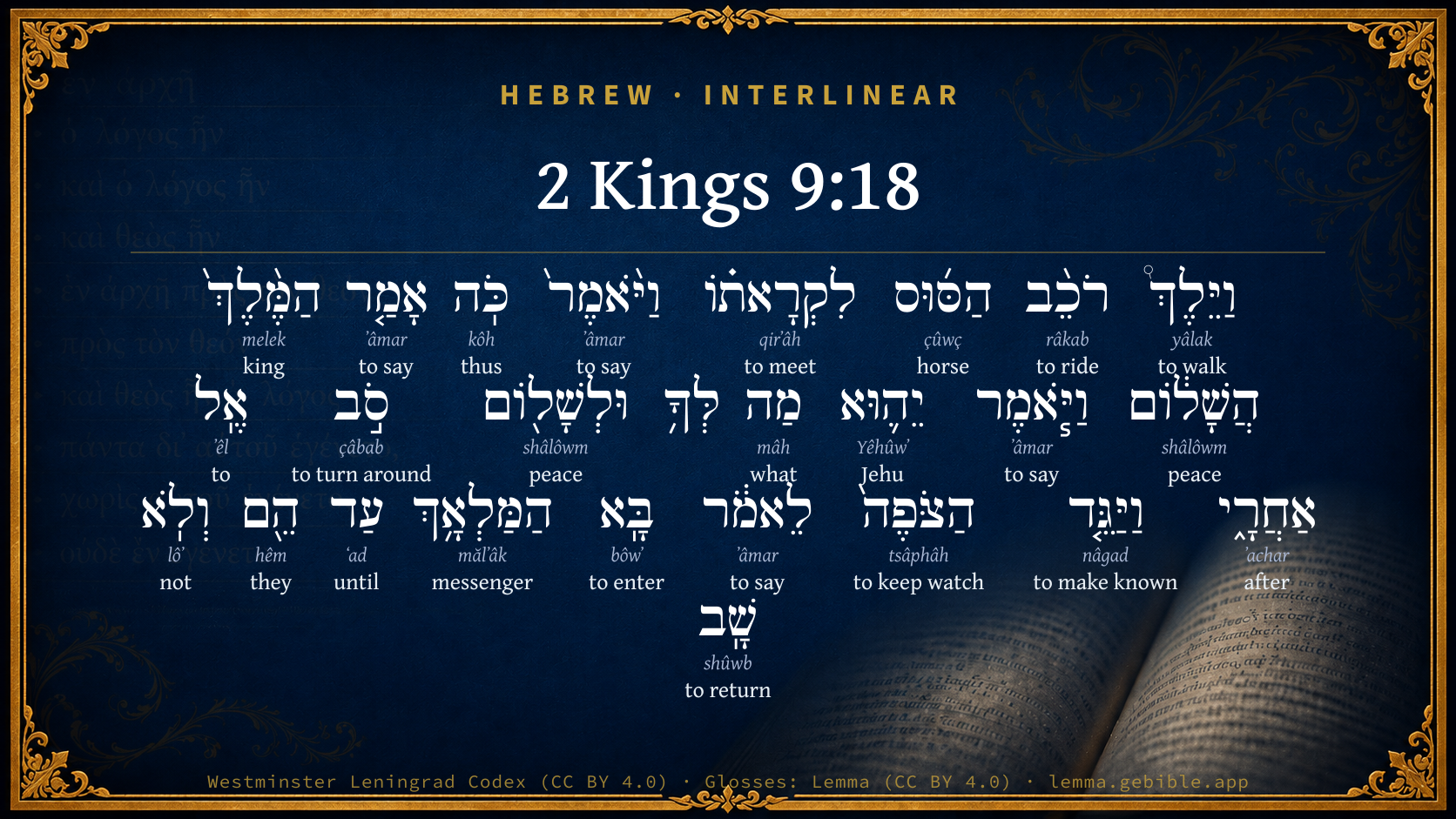
2 Kings 9:18

Hebrew (Westminster Leningrad Codex) 2 Kings 9:18 appears in the Hebrew Old Testament. The text above is from the Westminster Leningrad Codex. Each word links to its Strong’s number, a concise gloss, and parsing drawn from the Open Scriptures Hebrew Bible morphology. Click any word for its full Brown-Driver-Briggs (BDB) entry.
Download image
Cite this verse

2 Kings 9:18 (World English Bible). Public Domain. Lemma interlinear Bible study tool, https://lemma.gebible.app/v/2-kings/9/18.

Show BibTeX & RIS
BibTeX
RIS
English Translation
So there went one on horseback to meet him, and said, Thus says the king, Is it peace? Jehu said, What have you to do with peace? turn you behind me. The watchman told, saying, The messenger came to them, but he isn't coming back.
World English Bible · Public Domain
Download a study sheet

One document with this verse’s original text, its word-by-word gloss line, the meaning frame, cross-references with their text, attributed commentary, and full source and license credits — printable, and it pastes into notes with its structure intact.

This verse Autodidact and up

Study sheet (.html) Plain text (.txt)

A passage Seminary Student

Up to 50 verses in one chapter. A passage sheet keeps up to 6 commentary sources and 12 cross-references per verse, in the order this page ranks them, and says so on the sheet whenever that leaves anything out. Ask for a single verse and you get the Autodidact verse sheet above.

Everything on this page stays free to read, with no account — the sheet is a download of what is already on screen, not access to it.

Want to remove ads? Support Godless Engineer
Compare translations 3

The same verse in 3 English versions, stacked beneath the original-language interlinear above. Click any original word for its lexicon entry.

Each is an independent rendering of the whole verse — the interlinear is not word-aligned to these translations.

Highlighted words mark where these versions differ — a whole-verse word diff, not a word-by-word alignment.

  • World English Bible Public Domain
    So there went one on horseback to meet him, and said, Thus says the king, Is it peace? Jehu said, What have you to do with peace? turn you behind me. The watchman told, saying, The messenger came to them, but he isn't coming back.
  • King James Version Public Domain
    So there went one on horseback to meet him, and said, Thus saith the king, Is it peace? And Jehu said, What hast thou to do with peace? turn thee behind me. And the watchman told, saying, The messenger came to them, but he cometh not again.
  • unfoldingWord Literal Text CC BY-SA 4.0
    And the rider of the horse went to meet him, and he said, “Thus says the king, ‘Peace?’” And Jehu said, “What to you and to peace? Turn around to after me.” And the watchman declared, saying, “The messenger has come to them, but he has not returned.”

unfoldingWord Literal Text — © unfoldingWord, licensed CC BY-SA 4.0. Word-aligned USFM3 via Door43 (git.door43.org/unfoldingWord/en_ult).

Versions to compare (up to 4)

3 of 4 selected

Show all 18 translations

Every available English version of this verse, each an independent rendering of the whole verse.

  • World English Bible Public Domain
    So there went one on horseback to meet him, and said, Thus says the king, Is it peace? Jehu said, What have you to do with peace? turn you behind me. The watchman told, saying, The messenger came to them, but he isn't coming back.
  • Berean Standard Bible Public Domain
    So a horseman rode off to meet Jehu and said, “This is what the king asks: ‘Have you come in peace?’” “What do you know about peace?” Jehu replied. “Fall in behind me.” And the watchman reported, “The messenger reached them, but he is not coming back.”
  • Majority Standard Bible Public Domain
    So a horseman rode off to meet Jehu and said, “This is what the king asks: ‘Have you come in peace?’” “What do you know about peace?” Jehu replied. “Fall in behind me.” And the watchman reported, “The messenger reached them, but he is not coming back.”
  • King James Version Public Domain
    So there went one on horseback to meet him, and said, Thus saith the king, Is it peace? And Jehu said, What hast thou to do with peace? turn thee behind me. And the watchman told, saying, The messenger came to them, but he cometh not again.
  • American Standard Version (1901) Public Domain
    So there went one on horseback to meet him, and said, Thus saith the king, Is it peace? And Jehu said, What hast thou to do with peace? turn thee behind me. And the watchman told, saying, The messenger came to them, but he cometh not back.
  • Revised Version (1885) Public Domain
    So there went one on horseback to meet him, and said, Thus saith the king, Is it peace? And Jehu said, What hast thou to do with peace? turn thee behind me. And the watchman told, saying, The messenger came to them, but he cometh not again.
  • Geneva Bible (1599) Public Domain
    So there went one on horseback to meete him, and sayde, Thus sayth the King, Is it peace? And Iehu sayd, What hast thou to do with peace? Turne behinde me. And the watchman tolde, saying, The messenger came to them, but he commeth not againe.
  • Douay-Rheims (1899) Public Domain
    So there went one in a chariot to meet him, and said: Thus saith the king: Are all things peaceable? And Jehu said: What hast thou to do with peace? go behind and follow me. And the watchman told, saying: The messenger came to them, but he returneth not.
  • Young's Literal Translation Public Domain
    and the rider on the horse goeth to meet him, and saith, `Thus said the king, Is there peace?' and Jehu saith, `What -- to thee and to peace? turn round behind me.' And the watchman declareth, saying, `The messenger came unto them, and he hath not returned.'
  • Literal Standard Version CC BY-SA 4.0
    And the rider on the horse goes to meet him and says, “Thus said the king: Is there peace?” And Jehu says, “And what is peace to you? Turn around behind me.” And the watchman declares, saying, “The messenger came to them, and he has not returned.”
  • Unlocked Literal Bible CC BY-SA 4.0
    So a man was sent on horseback to meet him; he said, “The king says this: 'Are coming in peace?'” So Jehu said, “What have you to do with peace? Turn and ride behind me.” Then the watchman told the king, “The messenger has met them, but he is not coming back.”
  • unfoldingWord Literal Text CC BY-SA 4.0
    And the rider of the horse went to meet him, and he said, “Thus says the king, ‘Peace?’” And Jehu said, “What to you and to peace? Turn around to after me.” And the watchman declared, saying, “The messenger has come to them, but he has not returned.”
  • Darby Bible Public Domain
    So there went one on horseback to meet him; and he said, Thus saith the king: Is it peace? And Jehu said, What hast thou to do with peace? turn thee behind me. And the watchman told saying, The messenger came to them, and he does not return.
  • World Messianic Bible Public Domain
    So one went on horseback to meet him, and said, “the king says, ‘Is it peace?’” Jehu said, “What do you have to do with peace? Fall in behind me!” The watchman said, “The messenger came to them, but he isn’t coming back.”
  • Webster's Bible Public Domain
    So there went one on horseback to meet him, and said, Thus saith the king, Is it peace? And Jehu said, What hast thou to do with peace? turn thee behind me. And the watchman told, saying, The messenger came to them, but he doth not return.
  • Free Bible Version CC BY-SA 4.0
    So a horseman rode off to meet Jehu, and said, “This is what the king asks: ‘Do you come in peace?’” “What has peace got to do with you?” Jehu replied. “Turn around and follow me.” The watchman reported, “The messenger has reached them, but he's not returning.”
  • Bible in Basic English Public Domain
    So a horseman went out to them and said, The king says, Is it peace? And Jehu said, What have you to do with peace? come after me. And the watchman gave them word, saying, The horseman went up to them, but has not come back.
  • JPS Tanakh (1917) Public Domain
    So there went one on horseback to meet him, and said: 'Thus saith the king: Is it peace?' And Jehu said: 'What hast thou to do with peace? turn thee behind me.' And the watchman told, saying: 'The messenger came to them, but he cometh not back.'

Literal Standard Version (2020), Covenant Press — licensed CC BY-SA 4.0. Text via the HelloAO Bible API (eBible.org). Unlocked Literal Bible (unfoldingWord) — licensed CC BY-SA 4.0. Text via the HelloAO Bible API (eBible.org). unfoldingWord Literal Text — © unfoldingWord, licensed CC BY-SA 4.0. Word-aligned USFM3 via Door43 (git.door43.org/unfoldingWord/en_ult). Free Bible Version, Dr. Jonathan Gallagher — licensed CC BY-SA 4.0. Text via the HelloAO Bible API (eBible.org).

Word by word

More ways to search: Search by grammar → Find every occurrence → Compare this word →

Practice this passage: Drill this verse → Learn its vocabulary →

הַצֹּפֶה֙
tsâphâh
H6822
“the · keeping watch”
Particle, Definite Article + Verb, Qal, Participle Active, Masculine, Singular, Absolute
Part of Speech
Particle + Verb
Stem
Qal
Form
Participle Active
Gender
Masculine
Number
Singular
State
Absolute
Full BDB Definition

Origin: a primitive root

TWOT: 1950

to look out or about, spy, keep watch, observe, watch - (Qal) to keep watch, spy - (Piel) to watch, watch closely
  1. וַיֵּלֶךְ֩ yâlak H3212 “and · to walk” Conjunction + Verb, Qal, Sequential Imperfect, 3rd Person, Masculine, Singular
  2. רֹכֵ֨ב râkab H7392 “riding” Verb, Qal, Participle Active, Masculine, Singular, Construct
  3. הַסּ֜וּס çûwç H5483 “the · horse” Particle, Definite Article + Noun, Common, Masculine, Singular, Absolute
  4. לִקְרָאת֗וֹ qirʼâh H7125 “to meet · him” Preposition + Verb, Qal, Infinitive Construct + Suffix, Personal, 3rd Person, Masculine, Singular
  5. וַיֹּ֨אמֶר֙ ʼâmar H559 “and · to say” Conjunction + Verb, Qal, Sequential Imperfect, 3rd Person, Masculine, Singular
  6. כֹּֽה kôh H3541 “thus” Adverb
  7. אָמַ֤ר ʼâmar H559 “to say” Verb, Qal, Perfect, 3rd Person, Masculine, Singular
  8. הַמֶּ֨לֶךְ֙ melek H4428 “the · king” Particle, Definite Article + Noun, Common, Masculine, Singular, Absolute
  9. הֲשָׁל֔וֹם shâlôwm H7965 “peace” Particle, Interrogative + Noun, Common, Masculine, Singular, Absolute
  10. וַיֹּ֧אמֶר ʼâmar H559 “and · to say” Conjunction + Verb, Qal, Sequential Imperfect, 3rd Person, Masculine, Singular
  11. יֵה֛וּא Yêhûwʼ H3058 “Jehu” Noun, Proper
  12. מַה mâh H4100 “what” Particle, Interrogative
  13. וּלְשָׁל֖וֹם shâlôwm H7965 “and · to/for · peace” Conjunction + Preposition + Noun, Common, Masculine, Singular, Absolute
  14. סֹ֣ב çâbab H5437 “turn around” Verb, Qal, Imperative, 2nd Person, Masculine, Singular
  15. אֶֽל ʼêl H413 “to” Preposition
  16. אַחֲרָ֑י ʼachar H310 “after · me” Preposition + Suffix, Personal, 1st Person, Common, Singular
  17. וַיַּגֵּ֤ד nâgad H5046 “and · to make known” Conjunction + Verb, Hiphil, Sequential Imperfect, 3rd Person, Masculine, Singular
  18. לֵאמֹ֔ר ʼâmar H559 “to say” Preposition + Verb, Qal, Infinitive Construct
  19. בָּֽא bôwʼ H935 “to enter” Verb, Qal, Perfect, 3rd Person, Masculine, Singular
  20. הַמַּלְאָ֥ךְ mălʼâk H4397 “the · messenger” Particle, Definite Article + Noun, Common, Masculine, Singular, Absolute
  21. עַד ʻad H5704 “until” Preposition
  22. הֵ֖ם hêm H1992 “they” Pronoun, Personal, 3rd Person, Masculine, Plural
  23. וְלֹֽא lôʼ H3808 “and · not” Conjunction + Particle, Negative
  24. שָֽׁב shûwb H7725 “to return” Verb, Qal, Perfect, 3rd Person, Masculine, Singular

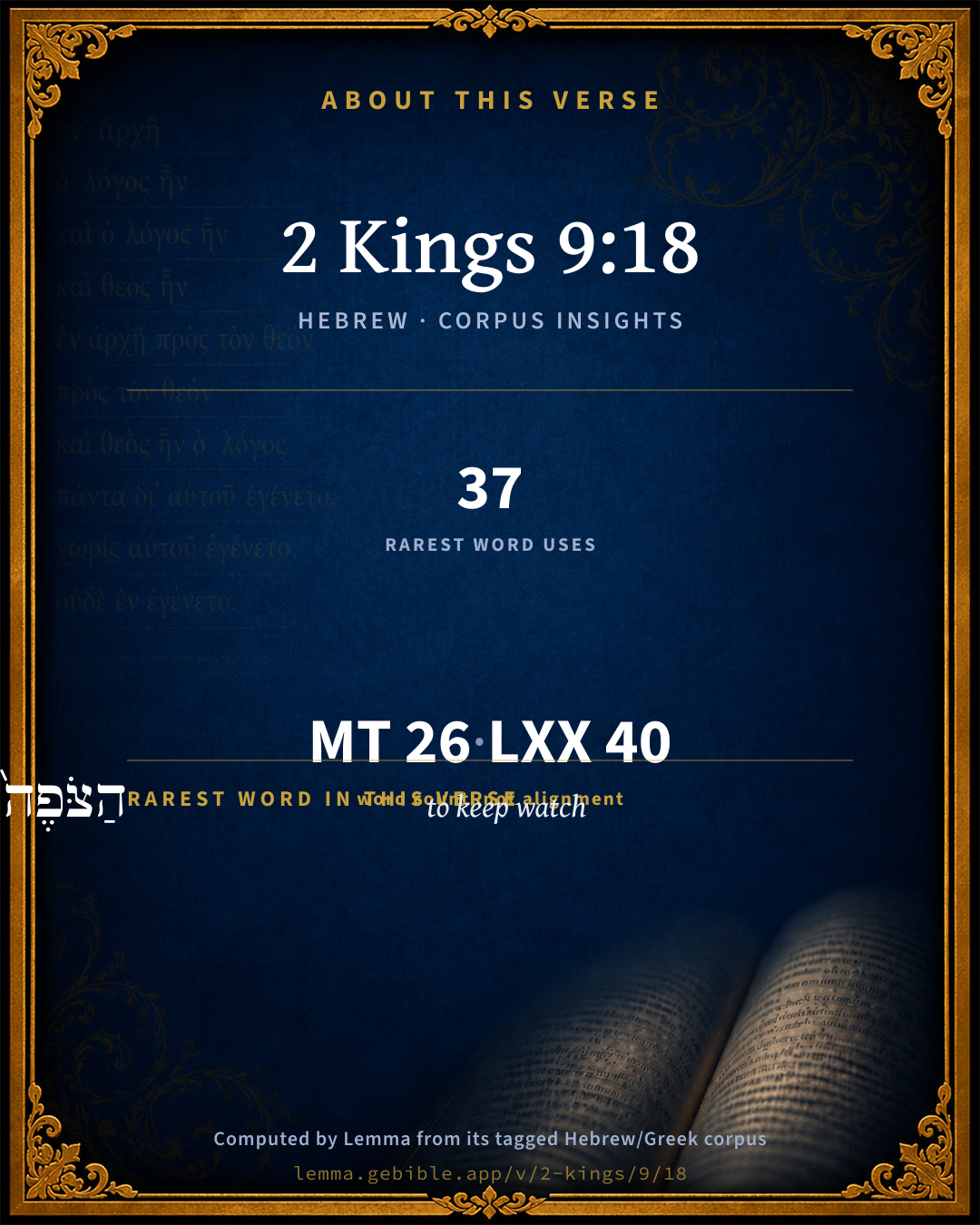
About this verse

These counts appear in no published source. They are computed here, from the morphology-tagged text and Lemma’s own curated glosses. What Lemma adds →

26
words
21
distinct lemmas
Historical
section

Shared distinctive vocabulary

הַצֹּפֶה֙ to keep watch H6822 occurs in 33 verses of the Hebrew Bible. Also found in:

Grammatical profile

  • 12 verbs
  • 6 nouns
  • 1 pronoun
  • 4 prepositions
  • 1 adverb
  • 2 particles

Verb forms

  • וַיֵּלֶךְ֩ Qal · Sequential Imperfect
  • רֹכֵ֨ב Qal · Participle Active
  • לִקְרָאת֗וֹ Qal · Infinitive Construct
  • וַיֹּ֨אמֶר֙ Qal · Sequential Imperfect
  • אָמַ֤ר Qal · Perfect
  • וַיֹּ֧אמֶר Qal · Sequential Imperfect
  • סֹ֣ב Qal · Imperative
  • וַיַּגֵּ֤ד Hiphil · Sequential Imperfect
  • הַצֹּפֶה֙ Qal · Participle Active
  • לֵאמֹ֔ר Qal · Infinitive Construct
  • בָּֽא Qal · Perfect
  • שָֽׁב Qal · Perfect

Repetition

Words recur within this verse — often emphatic in Hebrew:

  • וַיֹּ֨אמֶר֙ to say H559 ×4
  • הֲשָׁל֔וֹם peace H7965 ×2

Hebrew & Septuagint length

In English translation the verse runs 45 words from the Hebrew and 43 from the Septuagint (LXX English) — closely comparable.

A rough comparison of the two English renderings, which tokenize alike — not a word-level alignment.

Word counts can differ between the Hebrew and the Greek without any difference in meaning — e.g. the Hebrew direct-object marker אֵת has no separate Greek word, and Greek often adds the article ὁ.

In the original languages it is 26 Hebrew tokens and 40 Greek tokens — but the two are counted differently (Hebrew bundles its prefixes and suffixes into one token; the Greek is in lemma form), so that isn’t a like-for-like length.

Cross-references

6

Topical passages linked to 2 Kings 9:18 in the Treasury of Scripture Knowledge — connected by theme and wording, ordered by reader-vote popularity; previews shown in the World English Bible.

  • 2 Kings 9:19 Then he sent out a second on horseback, who came to them, and said, Thus says the king, Is it peace? Jehu answered, What have you to do with peace? turn you behind me.
  • 2 Kings 9:22 It happened, when Joram saw Jehu, that he said, Is it peace, Jehu? He answered, What peace, so long as the prostitution of your mother Jezebel and her witchcraft abound?
  • Isaiah 48:22 There is no peace, says Yahweh, to the wicked.
  • Isaiah 59:8 The way of peace they don't know; and there is no justice in their goings: they have made them crooked paths; whoever goes therein does not know peace.
  • Jeremiah 16:5 For thus says Yahweh, Don't enter into the house of mourning, neither go to lament, neither bemoan them; for I have taken away my peace from this people, says Yahweh, even loving kindness and tender mercies.
  • Romans 3:17 The way of peace, they haven't known."

Cross-references courtesy of OpenBible.info (CC BY 4.0).

Hebrew and Greek witnesses Masoretic Hebrew ↔ Greek Septuagint

The same verse in the two great witnesses to the Old Testament, shown verse-for-verse.

These are two independent witnesses, not word-aligned to each other, and the Septuagint is shown in lemma (dictionary) form.

Hebrew 2 Kings 9:18 Masoretic · Westminster Leningrad Codex

וַיֵּלֶךְ֩ רֹכֵ֨ב הַסּ֜וּס לִקְרָאת֗וֹ וַיֹּ֨אמֶר֙ כֹּֽה אָמַ֤ר הַמֶּ֨לֶךְ֙ הֲשָׁל֔וֹם וַיֹּ֧אמֶר יֵה֛וּא מַה לְּךָ֥ וּלְשָׁל֖וֹם סֹ֣ב אֶֽל אַחֲרָ֑י וַיַּגֵּ֤ד הַצֹּפֶה֙ לֵאמֹ֔ר בָּֽא הַמַּלְאָ֥ךְ עַד הֵ֖ם וְלֹֽא שָֽׁב

So there went one on horseback to meet him, and said, Thus says the king, Is it peace? Jehu said, What have you to do with peace? turn you behind me. The watchman told, saying, The messenger came to them, but he isn't coming back.

World English Bible · Public Domain

Greek LXX 2 Kings 9:18 Septuagint · lemma form

καί πορεύομαι ἐπιβάτης ἵππος εἰς ἀπαντή αὐτός καί εἶπον ὅδε λέγω ὁ βασιλεύς εἰ εἰρήνη καί εἶπον ιου τίς σύ καί εἰρήνη ἐπιστρέφω εἰς ὁ ὀπίσω ἐγώ καί ἀποἀγγέλλω ὁ σκοπός λέγω ἔρχομαι ὁ ἄγγελος ἕως αὐτός καί οὐ ἀναστρέφω

And there went a horseman to meet them, and said, Thus says the king, Peace. And Ju said, What have you to do with peace? turn behind me. And the watchman reported, saying, The messenger came up to them, and has not returned.

LXX2012 (modern English Septuagint) · Public Domain

Hebrew: Westminster Leningrad Codex (CC BY 4.0). Greek: Septuagint (public domain); English from LXX2012 (modern English Septuagint) (Public Domain). How the Septuagint differs from the Hebrew →

Targum (Aramaic paraphrase)

1

The Targum is the ancient Jewish Aramaic paraphrase of the Hebrew Scriptures — an interpretive translation, not the Hebrew text itself. Onkelos (literal) and Pseudo-Jonathan (expansive) render the Torah, and Jonathan the Prophets. Coverage is partial: where no permissively-licensed English translation exists for a verse, only the Aramaic is shown. This is verse-level text, not a word-by-word alignment to the Hebrew.

  1. Targum Jonathan Prophets (Joshua–Malachi)
    וַאֲזַל רָכִיב סוּסְיָא לָקֳדָמוּתֵיהּ וַאֲמַר כִּדְנַן אֲמַר מַלְכָּא הַשְׁלָם וַאֲמַר יֵהוּא מַה לָךְ וְלִשְׁלָם אִסְתְּחַר לַאֲחוֹרָי וְחַוֵי סַכְוָאָה לְמֵימַר אֲתָא אִזְגַדָא עַד לְוַתְהוֹן וְלָא תָב:

    (no public-domain English translation for this verse)

    Targum Jonathan — Aramaic: “Mikraot Gedolot” (public domain). English: “Sefaria Community Translation” (CC0 1.0 (public-domain dedication)); “London "Chaldee Paraphrase," 1871” (public domain). Text via Sefaria.

Commentary

Notes on 2 Kings 9:18 from classic Christian and Jewish commentators (each source and its license shown beneath its notes). The classic Christian expositions comment on the surrounding passage and are grouped to its opening verse, so a note may address several verses; the Jewish commentaries on the Tanakh (Rashi and others) are per-verse, so they appear only where the commentator wrote on this verse.

Lemma curates 59 commentaries, every one of them public domain or Creative Commons licensed, each selected and text-cleaned for this edition rather than reprinted as found. About our sources →

Trapp's Complete Commentary

John Trapp

2Ki 9:18 So there went one on horseback to meet him, and said, Thus saith the king, [Is it] peace? And Jehu said, What hast thou to do with peace? turn thee behind me. And the watchman told, saying, The messenger came to them, but he cometh not again.

Ver. 18. Is it peace?] See 2Ki 9:17.

John Trapp, A Commentary or Exposition upon All the Books of the Old and New Testament (1647–1656) — public domain. Text from a community e-Sword module.

Geneva Bible (1599)

Geneva Bible translators

Or, follow me.

Geneva Bible (1599) marginal notes — public domain. Text via Bolls.life.

Adam Clarke's Commentary

Verse 18. What hast thou to do with peace?] "What is it to thee whether there be peace or war? Join my company, and fall into the rear."

Adam Clarke's Commentary on the Bible (1810–1826) — public domain. Text from a community e-Sword/MySword module.

Ellicott's Commentary for English Readers

(18) One on horseback.—Literally, the rider of the horse.

What hast thou to do with peace?—A rough evasion: “What business is it of yours, on what ground I am come?” Conscious of his strength, Jehu can despise the royal message, and the messenger durst not disobey the fierce general, when ordered summarily to the rear. Of course Jehu wished to prevent an alarm being raised in Jezreel.

Came to them.—Literally, came right up to them. (The Hebrew text should be corrected from 2Ki_9:20.)

A Bible Commentary for English Readers, edited by Charles John Ellicott (1878–1897) — public domain. Text from a community e-Sword module.

The Cambridge Bible for Schools and Colleges

gen. ed. J. J. S. Perowne

18. What hast thou to do with peace?] What concern is it of thine whether I come peaceably or not? My errand is not to thee. Josephus says the messenger’s enquiry was about affairs in the camp, for that the king’s questions were about them. Jehu bade him not to worry about these things but to follow him (Ant. IX. 6. 3). The design of Jehu’s order was that no information should be brought to Joram.

The Cambridge Bible for Schools and Colleges (gen. ed. J. J. S. Perowne; Cambridge University Press, 1878–1918) — public domain. Text from a community e-Sword module.

John Gill's Exposition

And Joram said, make ready,.... The chariot, put to the horses; bind them, as the word signifies, to the chariot:

and his chariot was made ready; by his servants immediately:

and Joram king of Israel and Ahaziah king of Judah went out, each in his chariot; not both in the same chariot, but each in his own, for the sake of greater magnificence:

and they went out against Jehu; not in an hostile manner, for they had no notion of him as an enemy; though it is much they had no suspicion of him by his detaining the messengers; but Joram perhaps thought he was desirous of delivering his message himself; and in honour to him, and also being eager to know what it was, went out to meet him:

and met him in the portion of Naboth the Jezreelite; which had been his, and where, or near it, he was stoned, and his blood shed; a very inauspicious place to meet him in.

John Gill's Exposition of the Whole Bible (1746–1763) — public domain (CC PDM 1.0). Text via the HelloAO Bible API.

Albert Barnes' Notes on the Bible

What hast thou to do with peace? - i. e., “What does it matter to thee whether my errand is one of peace or not?”

Albert Barnes' Notes on the Bible (1834–1885) — public domain. Text from a community e-Sword/MySword module.

Haydock's Catholic Bible Commentary

Peace? As this expression sufficiently vindicated the designs of Jehu, he would not suffer the messenger to return before him. (Haydock)

George Leo Haydock (1774–1849), Haydock's Catholic Family Bible and Commentary, 1859 edition — public domain. Excludes Psalms (Douay-Rheims chapter numbering differs from Protestant) and Deuterocanonical books (Catholic canon only).

Matthew Poole's English Annotations

What hast thou to do with peace? what right hast thou, or thy master that sent thee, to peace?

Matthew Poole's English Annotations on the Holy Bible (1683–1685) — public domain. Text from a community e-Sword/MySword module.

Whedon's Commentary on the Bible

Daniel D. Whedon

18. What hast thou to do with peace — The supercilious language of a conqueror who is perfect master of the situation, and can dictate the course to be pursued.

Daniel D. Whedon (gen. ed.), Commentary on the Old and New Testaments (1874–1909) — public domain. Text from a community e-Sword module.

The Pulpit Commentary

So there went one on horseback to meet him, and said, Thus saith the king, Is it peace? And Jehu said, What hast thou to do with peace! turn thee behind me. Jehu chooses to accept the messenger"s words as if they were his own, and not those of the king. "What does it matter to such a one as thee, a mere common man, whether my tidings are peaceful or the contrary? I shall not tell thee my errand. Turn and follow in my train." The messenger had no choice but to obey. An attempt at flight would have led to his being seized or slain. And the watchman told, saying, The messenger came to them, but he cometh not again. The watchman evidently thought his not returning suspicious, and reported it at once. Joram should now have taken alarm, but he did not. He appears to have had no notion that any danger could be approaching.

The Pulpit Commentary (1880–1919), ed. H.D.M. Spence-Jones & Joseph S. Exell — public domain. Text from a community e-Sword module.

Lesson kit

Teaching starters — assembled from the data on this page, not authored interpretation. Every prompt links to the verse data it draws on. Edit before teaching.

2 Kings, in the Historical, opens this verse with 26 words (21 distinct Hebrew lemmas). Its most distinctive word is tsâphâh (“to keep watch”). A historical commentator’s framing appears above. Read the whole chapter for the surrounding context.

Discussion questions

  1. How does “to keep watch” (tsâphâh) shape what this verse is saying?
  2. Genesis 31:49 shares the word «to keep watch» with this verse. How do the two illuminate each other?
  3. “to say” occurs 4× in this one verse. What is the effect of the repetition?
  4. These translations render this verse differently. What is at stake in choosing one wording over another?
  5. The verb «וַיֵּלֶךְ֩» is Qal Sequential Imperfect. How does its form color the action?
  6. Reading how Trapp's Complete Commentary and Geneva Bible (1599) read this verse, where do the two commentators agree and where do they part?

Things to notice

Reading settings

Reading text

Shown beneath each verse's original-language words.

Old Testament
Old Testament edition

Read the OT as the Masoretic Hebrew (MT) or the Greek Septuagint (LXX).

English shown for the Greek Septuagint (in the Hebrew ↔ Greek comparison).

Comparing translations? Open the Compare panel on any verse page to stack up to four side by side.