
2 Kings 9:11

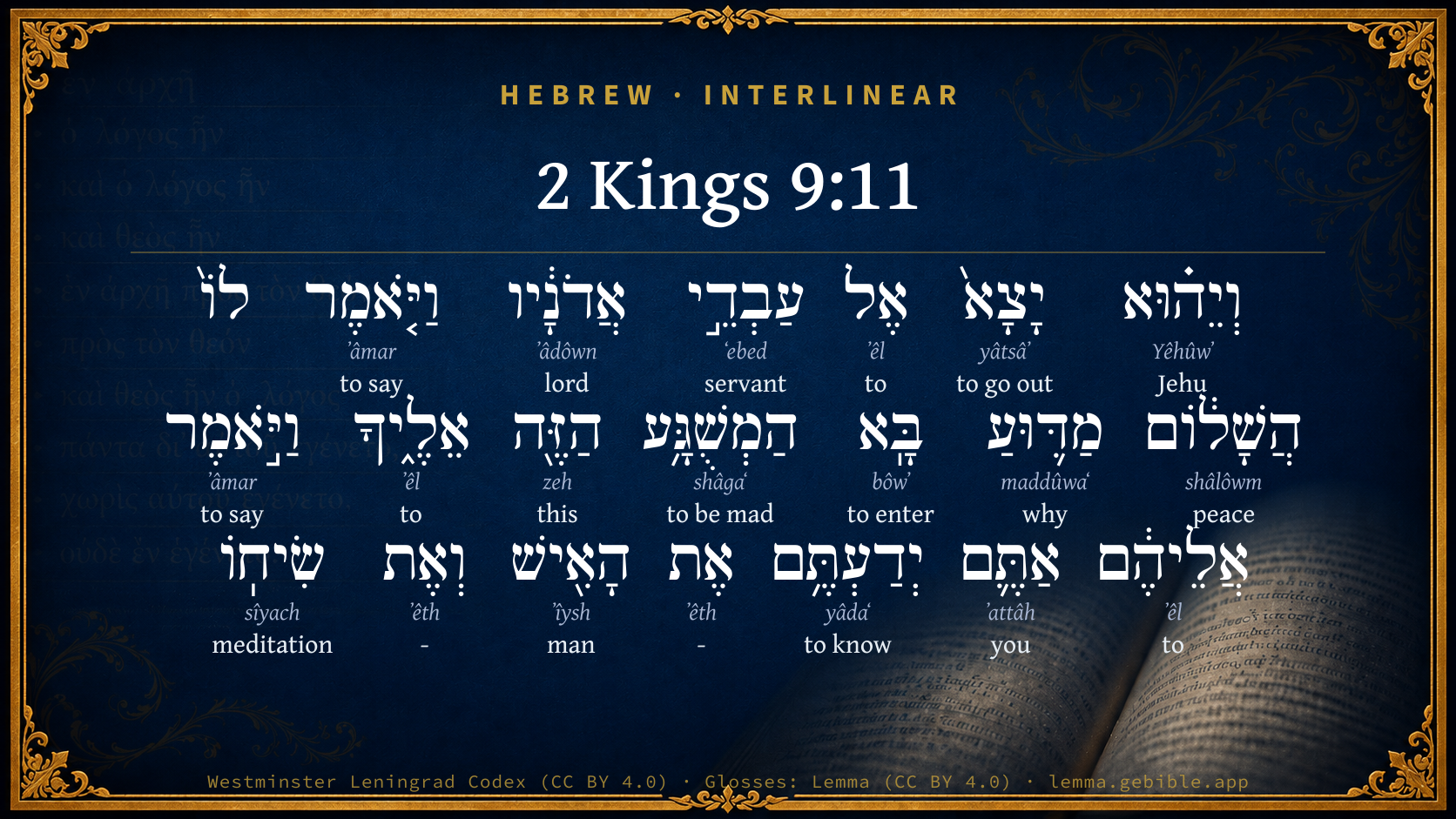
Hebrew (Westminster Leningrad Codex) 2 Kings 9:11 appears in the Hebrew Old Testament. The text above is from the Westminster Leningrad Codex. Each word links to its Strong’s number, a concise gloss, and parsing drawn from the Open Scriptures Hebrew Bible morphology. Click any word for its full Brown-Driver-Briggs (BDB) entry.
Download image
Cite this verse

2 Kings 9:11 (World English Bible). Public Domain. Lemma interlinear Bible study tool, https://lemma.gebible.app/v/2-kings/9/11.

Show BibTeX & RIS
BibTeX
RIS
English Translation
Then Jehu came forth to the servants of his lord: and one said to him, Is all well? why came this mad fellow to you? He said to them, You know the man and what his talk was.
World English Bible · Public Domain
Download a study sheet

One document with this verse’s original text, its word-by-word gloss line, the meaning frame, cross-references with their text, attributed commentary, and full source and license credits — printable, and it pastes into notes with its structure intact.

This verse Autodidact and up

Study sheet (.html) Plain text (.txt)

A passage Seminary Student

Up to 50 verses in one chapter. A passage sheet keeps up to 6 commentary sources and 12 cross-references per verse, in the order this page ranks them, and says so on the sheet whenever that leaves anything out. Ask for a single verse and you get the Autodidact verse sheet above.

Everything on this page stays free to read, with no account — the sheet is a download of what is already on screen, not access to it.

Want to remove ads? Support Godless Engineer
Compare translations 3

The same verse in 3 English versions, stacked beneath the original-language interlinear above. Click any original word for its lexicon entry.

Each is an independent rendering of the whole verse — the interlinear is not word-aligned to these translations.

Highlighted words mark where these versions differ — a whole-verse word diff, not a word-by-word alignment.

  • World English Bible Public Domain
    Then Jehu came forth to the servants of his lord: and one said to him, Is all well? why came this mad fellow to you? He said to them, You know the man and what his talk was.
  • King James Version Public Domain
    Then Jehu came forth to the servants of his lord: and one said unto him, Is all well? wherefore came this mad fellow to thee? And he said unto them, Ye know the man, and his communication.
  • unfoldingWord Literal Text CC BY-SA 4.0
    And Jehu came out to the servants of his master, and one said to him, “Peace? Why did this madman come to you?” And he said to them, “You, you know the man and his talk.”

unfoldingWord Literal Text — © unfoldingWord, licensed CC BY-SA 4.0. Word-aligned USFM3 via Door43 (git.door43.org/unfoldingWord/en_ult).

Versions to compare (up to 4)

3 of 4 selected

Show all 18 translations

Every available English version of this verse, each an independent rendering of the whole verse.

  • World English Bible Public Domain
    Then Jehu came forth to the servants of his lord: and one said to him, Is all well? why came this mad fellow to you? He said to them, You know the man and what his talk was.
  • Berean Standard Bible Public Domain
    When Jehu went out to the servants of his master, they asked, “Is everything all right? Why did this madman come to you?” “You know his kind and their babble,” he replied.
  • Majority Standard Bible Public Domain
    When Jehu went out to the servants of his master, they asked, “Is everything all right? Why did this madman come to you?” “You know his kind and their babble,” he replied.
  • King James Version Public Domain
    Then Jehu came forth to the servants of his lord: and one said unto him, Is all well? wherefore came this mad fellow to thee? And he said unto them, Ye know the man, and his communication.
  • American Standard Version (1901) Public Domain
    Then Jehu came forth to the servants of his lord: and one said unto him, Is all well? wherefore came this mad fellow to thee? And he said unto them, Ye know the man and what his talk was.
  • Revised Version (1885) Public Domain
    Then Jehu came forth to the servants of his lord: and one said unto him, Is all well? wherefore came this mad fellow to thee? And he said unto them, Ye know the man and what his talk was.
  • Geneva Bible (1599) Public Domain
    Then Iehu came out to the seruants of his lord. And one sayd vnto him, Is all well? wherefore came this mad fellowe to thee? And hee sayde vnto them, Ye knowe the man, and what his talke was.
  • Douay-Rheims (1899) Public Domain
    Then Jehu went forth to the servants of his lord: and they said to him: Are all things well? why came this mad man to thee? And he said to them: You know the man, and what he said.
  • Young's Literal Translation Public Domain
    And Jehu hath gone out unto the servants of his lord, and `one' saith to him, `Is there peace? wherefore came this madman unto thee?' and he saith unto them, `Ye have known the man and his talk.'
  • Literal Standard Version CC BY-SA 4.0
    And Jehu has gone out to the servants of his lord, and [one] says to him, “Is there peace? Why did this madman come to you?” And he says to them, “You have known the man and his talk.”
  • Unlocked Literal Bible CC BY-SA 4.0
    Then Jehu came out to the servants of his master, and one said to him, “Is everything alright? Why did this mad fellow come to you?” Jehu answered them, “You know the man and the kinds of things he says.”
  • unfoldingWord Literal Text CC BY-SA 4.0
    And Jehu came out to the servants of his master, and one said to him, “Peace? Why did this madman come to you?” And he said to them, “You, you know the man and his talk.”
  • Darby Bible Public Domain
    And Jehu came forth to the servants of his lord. And one said to him, Is all well? why came this madman to thee? And he said to them, Ye know the man, and his mind.
  • World Messianic Bible Public Domain
    When Jehu came out to the servants of his lord and one said to him, “Is all well? Why did this madman come to you?” He said to them, “You know the man and how he talks.”
  • Webster's Bible Public Domain
    Then Jehu came forth to the servants of his lord: and one said to him, Is all well? Why came this mad man to thee? And he said to them, Ye know the man, and his communication.
  • Free Bible Version CC BY-SA 4.0
    When Jehu went back out to the other officers of his master, they asked him, “Is everything fine? Why did this crazy man come to you?” “You know what he's like, and how he goes on and on,” he replied.
  • Bible in Basic English Public Domain
    Then Jehu came out again to the servants of his lord, and one said to him, Is all well? why did this man, who is off his head, come to you? And he said to them, You have knowledge of the man and of his talk.
  • JPS Tanakh (1917) Public Domain
    Then Jehu came forth to the servants of his lord; and one said unto him: 'Is all well? wherefore came this mad fellow to thee?' And he said unto them: 'Ye know the man and what his talk was.'

Literal Standard Version (2020), Covenant Press — licensed CC BY-SA 4.0. Text via the HelloAO Bible API (eBible.org). Unlocked Literal Bible (unfoldingWord) — licensed CC BY-SA 4.0. Text via the HelloAO Bible API (eBible.org). unfoldingWord Literal Text — © unfoldingWord, licensed CC BY-SA 4.0. Word-aligned USFM3 via Door43 (git.door43.org/unfoldingWord/en_ult). Free Bible Version, Dr. Jonathan Gallagher — licensed CC BY-SA 4.0. Text via the HelloAO Bible API (eBible.org).

Word by word

More ways to search: Search by grammar → Find every occurrence → Compare this word →

Practice this passage: Drill this verse → Learn its vocabulary →

הַמְשֻׁגָּ֥ע
shâgaʻ
H7696
“the · mad”
Particle, Definite Article + Verb, Pual, Participle Passive, Masculine, Singular, Absolute
Part of Speech
Particle + Verb
Stem
Pual
Form
Participle Passive
Gender
Masculine
Number
Singular
State
Absolute
Full BDB Definition

Origin: a primitive root

TWOT: 2328

to be mad - (Pual) - to be mad - to be maddened (participle) - (Hithpael) to show madness
  1. וְיֵה֗וּא Yêhûwʼ H3058 “and · Jehu” Conjunction + Noun, Proper
  2. יָצָא֙ yâtsâʼ H3318 “to go out” Verb, Qal, Perfect, 3rd Person, Masculine, Singular
  3. אֶל ʼêl H413 “to” Preposition
  4. עַבְדֵ֣י ʻebed H5650 “servants of” Noun, Common, Masculine, Plural, Construct
  5. אֲדֹנָ֔יו ʼâdôwn H113 “lords · his” Noun, Common, Masculine, Plural, Construct + Suffix, Personal, 3rd Person, Masculine, Singular
  6. וַיֹּ֤אמֶר ʼâmar H559 “and · to say” Conjunction + Verb, Qal, Sequential Imperfect, 3rd Person, Masculine, Singular
  7. הֲשָׁל֔וֹם shâlôwm H7965 “peace” Particle, Interrogative + Noun, Common, Masculine, Singular, Absolute
  8. מַדּ֛וּעַ maddûwaʻ H4069 “why” Particle, Interrogative
  9. בָּֽא bôwʼ H935 “to enter” Verb, Qal, Perfect, 3rd Person, Masculine, Singular
  10. הַזֶּ֖ה zeh H2088 “the · this” Particle, Definite Article + Pronoun, Demonstrative, Masculine, Singular
  11. אֵלֶ֑יךָ ʼêl H413 “to · you” Preposition + Suffix, Personal, 2nd Person, Masculine, Singular
  12. וַיֹּ֣אמֶר ʼâmar H559 “and · to say” Conjunction + Verb, Qal, Sequential Imperfect, 3rd Person, Masculine, Singular
  13. אֲלֵיהֶ֔ם ʼêl H413 “to · them” Preposition + Suffix, Personal, 3rd Person, Masculine, Plural
  14. אַתֶּ֛ם ʼattâh H859 “you” Pronoun, Personal, 2nd Person, Masculine, Plural
  15. יְדַעְתֶּ֥ם yâdaʻ H3045 “to know” Verb, Qal, Perfect, 2nd Person, Masculine, Plural
  16. אֶת ʼêth H853 “-” Particle, Direct Object
  17. הָאִ֖ישׁ ʼîysh H376 “the · man” Particle, Definite Article + Noun, Common, Masculine, Singular, Absolute
  18. וְאֶת ʼêth H853 “and · -” Conjunction + Particle, Direct Object
  19. שִׂיחֽוֹ sîyach H7879 “meditation · his” Noun, Common, Masculine, Singular, Construct + Suffix, Personal, 3rd Person, Masculine, Singular

About this verse

These counts appear in no published source. They are computed here, from the morphology-tagged text and Lemma’s own curated glosses. What Lemma adds →

21
words
16
distinct lemmas
Historical
section

Notable vocabulary

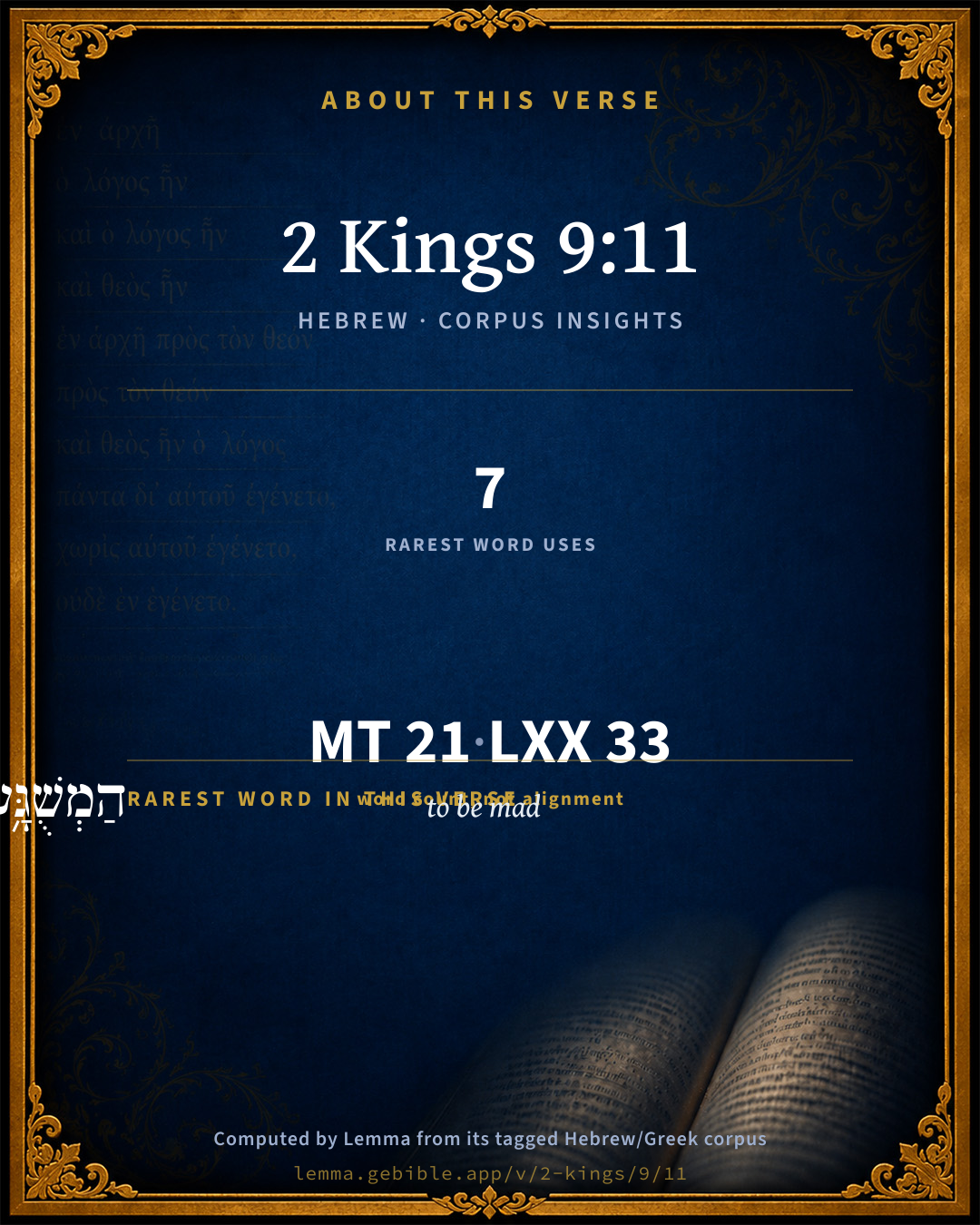
The rarest word here is הַמְשֻׁגָּ֥ע to be mad H7696 — appearing just 7 times in the whole Hebrew Bible.

Shared distinctive vocabulary

הַמְשֻׁגָּ֥ע to be mad H7696 occurs in 6 verses of the Hebrew Bible. Also found in:

Grammatical profile

  • 6 verbs
  • 6 nouns
  • 2 pronouns
  • 4 prepositions
  • 3 particles

Verb forms

  • יָצָא֙ Qal · Perfect
  • וַיֹּ֤אמֶר Qal · Sequential Imperfect
  • בָּֽא Qal · Perfect
  • הַמְשֻׁגָּ֥ע Pual · Participle Passive
  • וַיֹּ֣אמֶר Qal · Sequential Imperfect
  • יְדַעְתֶּ֥ם Qal · Perfect

Repetition

Words recur within this verse — often emphatic in Hebrew:

  • וַיֹּ֤אמֶר to say H559 ×2
  • אֶל to H413 ×3

Hebrew & Septuagint length

In English translation the verse runs 38 words from the Hebrew and 38 from the Septuagint (LXX English) — the same length.

A rough comparison of the two English renderings, which tokenize alike — not a word-level alignment.

Word counts can differ between the Hebrew and the Greek without any difference in meaning — e.g. the Hebrew direct-object marker אֵת has no separate Greek word, and Greek often adds the article ὁ.

In the original languages it is 21 Hebrew tokens and 33 Greek tokens — but the two are counted differently (Hebrew bundles its prefixes and suffixes into one token; the Greek is in lemma form), so that isn’t a like-for-like length.

Cross-references

14

Topical passages linked to 2 Kings 9:11 in the Treasury of Scripture Knowledge — connected by theme and wording, ordered by reader-vote popularity; previews shown in the World English Bible.

  • Jeremiah 29:26 Yahweh has made you priest in the place of Jehoiada the priest, that there may be officers in the house of Yahweh, for every man who is mad, and makes himself a prophet, that you should put him in the stocks and in shackles.
  • Hosea 9:7 The days of visitation have come. The days of reckoning have come. Israel will consider the prophet to be a fool, And the man who is inspired to be insane, Because of the abundance of your sins, And because your hostility is great.
  • John 10:20 Many of them said, "He has a demon, and is insane! Why do you listen to him?"
  • Acts 26:24 As he thus made his defense, Festus said with a loud voice, "Paul, you are crazy! Your great learning is driving you insane!"
  • 2 Kings 5:21 So Gehazi followed after Naaman. When Naaman saw one running after him, he alighted from the chariot to meet him, and said, Is all well?
  • 2 Kings 9:17 Now the watchman was standing on the tower in Jezreel, and he spied the company of Jehu as he came, and said, I see a company. Joram said, Take a horseman, and send to meet them, and let him say, Is it peace?
  • 2 Kings 9:19 Then he sent out a second on horseback, who came to them, and said, Thus says the king, Is it peace? Jehu answered, What have you to do with peace? turn you behind me.
  • 2 Kings 9:22 It happened, when Joram saw Jehu, that he said, Is it peace, Jehu? He answered, What peace, so long as the prostitution of your mother Jezebel and her witchcraft abound?
  • Mark 3:21 When his friends heard it, they went out to seize him: for they said, "He is insane."
  • 2 Kings 4:26 please run now to meet her, and ask her, Is it well with you? is it well with your husband? is it well with the child? She answered, It is well.
  • Isaiah 59:15 Yes, truth is lacking; and he who departs from evil makes himself a prey. Yahweh saw it, and it displeased him who there was no justice.
  • Acts 17:18 Some of the Epicurean and Stoic philosophers also were conversing with him. Some said, "What does this babbler want to say?" Others said, "He seems to be advocating foreign deities," because he preached Jesus and the resurrection.
  • 1 Corinthians 4:10 We are fools for Christ's sake, but you are wise in Christ. We are weak, but you are strong. You have honor, but we have dishonor.
  • 2 Corinthians 5:13 For if we are beside ourselves, it is for God. Or if we are of sober mind, it is for you.

Cross-references courtesy of OpenBible.info (CC BY 4.0).

Hebrew and Greek witnesses Masoretic Hebrew ↔ Greek Septuagint

The same verse in the two great witnesses to the Old Testament, shown verse-for-verse.

These are two independent witnesses, not word-aligned to each other, and the Septuagint is shown in lemma (dictionary) form.

Hebrew 2 Kings 9:11 Masoretic · Westminster Leningrad Codex

וְיֵה֗וּא יָצָא֙ אֶל עַבְדֵ֣י אֲדֹנָ֔יו וַיֹּ֤אמֶר לוֹ֙ הֲשָׁל֔וֹם מַדּ֛וּעַ בָּֽא הַמְשֻׁגָּ֥ע הַזֶּ֖ה אֵלֶ֑יךָ וַיֹּ֣אמֶר אֲלֵיהֶ֔ם אַתֶּ֛ם יְדַעְתֶּ֥ם אֶת הָאִ֖ישׁ וְאֶת שִׂיחֽוֹ

Then Jehu came forth to the servants of his lord: and one said to him, Is all well? why came this mad fellow to you? He said to them, You know the man and what his talk was.

World English Bible · Public Domain

Greek LXX 2 Kings 9:11 Septuagint · lemma form

καί ιου ἐκἔρχομαι πρός ὁ παῖς ὁ κύριος αὐτός καί εἶπον αὐτός εἰ εἰρήνη τίς ὅτι εἰςἔρχομαι ὁ ἐπίληπτος οὗτος πρός σύ καί εἶπον αὐτός σύ οἶδα ὁ ἀνήρ καί ὁ ἀδολεσχία αὐτός

And Ju went forth to the servants of his lord, and they said to him, Is all well? Why came this mad fellow in to you? And he said to them, You⌃ know the man, and his communication.

LXX2012 (modern English Septuagint) · Public Domain

On this verse, Ellicott's Commentary for English Readers discusses the Septuagint’s reading. Read the note in Commentary ↓

Hebrew: Westminster Leningrad Codex (CC BY 4.0). Greek: Septuagint (public domain); English from LXX2012 (modern English Septuagint) (Public Domain). How the Septuagint differs from the Hebrew →

Targum (Aramaic paraphrase)

1

The Targum is the ancient Jewish Aramaic paraphrase of the Hebrew Scriptures — an interpretive translation, not the Hebrew text itself. Onkelos (literal) and Pseudo-Jonathan (expansive) render the Torah, and Jonathan the Prophets. Coverage is partial: where no permissively-licensed English translation exists for a verse, only the Aramaic is shown. This is verse-level text, not a word-by-word alignment to the Hebrew.

  1. Targum Jonathan Prophets (Joshua–Malachi)
    וְיֵהוּא נְפַק לְוַת עַבְדֵי רִבּוֹנֵיהּ וַאֲמַר לֵיהּ הַשְׁלָם מַה דֵין אֲתָא שַׁטְיָא הָדֵין לְוָתָךְ וַאֲמַר לְהוֹן אַתּוּן יְדַעְתּוּן יַת גַבְרָא וְיַת שׁוּעִיתֵיהּ:

    (no public-domain English translation for this verse)

    Targum Jonathan — Aramaic: “Mikraot Gedolot” (public domain). English: “Sefaria Community Translation” (CC0 1.0 (public-domain dedication)); “London "Chaldee Paraphrase," 1871” (public domain). Text via Sefaria.

Commentary

Notes on 2 Kings 9:11 from classic Christian and Jewish commentators (each source and its license shown beneath its notes). The classic Christian expositions comment on the surrounding passage and are grouped to its opening verse, so a note may address several verses; the Jewish commentaries on the Tanakh (Rashi and others) are per-verse, so they appear only where the commentator wrote on this verse.

Lemma curates 59 commentaries, every one of them public domain or Creative Commons licensed, each selected and text-cleaned for this edition rather than reprinted as found. About our sources →

Matthew Henry's Commentary

Jehu, after some pause, returned to his place at the board, taking no notice of what had passed, but, as it should seem, designing, for the present, to keep it to himself, if they had not urged him to disclose it. Let us therefore see what passed between him and the captains.

I. With what contempt the captains speak of the young prophet (Kg2 9:11): "Wherefore came this mad fellow to thee? What business had he with thee? And why wouldst thou humour him so far as to retire for conversation with him? Are prophets company for captains?" They are called him a mad fellow, because he was one of those that would not run with them to an excess of riot (Pe1 4:4), but lived a life of self-denial, mortification, and contempt of the world, and spent their time in devotion; for these things they thought the prophets were fools and the spiritual men were mad, Hos 9:7. Note, Those that have no religion commonly speak with disdain of those that are religious, and look upon them as mad. They said of our Saviour, He is beside himself, of John Baptist, He has a devil (is a poor melancholy man), of St. Paul, Much learning has made him mad. The highest wisdom is thus represented as folly, and those that best understand themselves are looked upon as beside themselves. Perhaps Jehu intended it for a rebuke to his friends when he said, "You know the man to be a prophet, why then do you call him a mad fellow? You know the way of his communication to be not from madness, but inspiration." Or, "Being a prophet, you may guess what his business is, to tell me of my faults, and to teach me my duty; I need not inform you concerning it." Thus he thought to put them off, but they urged him to tell them. "It is false," say they, "we cannot conjecture what was his errand, and therefore tell us." Being thus pressed to it, he told them that the prophet had anointed him king, and it is probable showed them the oil upon his head, Kg2 9:12. He knew not but some of them either out of loyalty to Joram or envy of him, might oppose him, and go near to crush his interest in its infancy; but he relied on the divine appointment, and was not afraid to own it, knowing whom he had trusted: he that raised him would stand by him.

II. With what respect they compliment the new king upon the first notice of his advancement, Kg2 9:13. How meanly soever they thought of the prophet that anointed him, and of his office, they expressed a grat veneration for the royal dignity of him that was anointed, and were very forward to proclaim him and sound of trumpet. In token of their subjection and allegiance to him, their affection to his person and government, and their desire to see him high and easy in it, they put their garments under him, that he might stand or sit upon them on the top of the stairs, in sight of the soldiers, who, upon the first intimation, came together to grace the solemnity. God put it into their hearts thus readily to own him, for he turns the hearts of people as well as kings, like the rivers of water, into what channel he pleases. Perhaps they were disquieted at Joram's government or had a particular affection for Jehu; or, however this might be, things it seems were ripe for the revolution, and they all came into Jehu's interest and conspired against Joram, Kg2 9:14.

III. With what caution Jehu proceeded. He had advantages against Joram, and he knew how to improve them. He had the army with him. Joram had left it, and had gone home badly wounded. Jehu's good conduct appears in two things: - 1. That he complimented the captains, and would do nothing without their advice and consent ("If it be your minds, we will do so and so, else not"), thereby intimating the deference he paid to their judgment and the confidence he had in their fidelity, both which tended to please and fix them. It is the wisdom of those that would rise fast, and stand firm, to take their friends along with them. 2. That he contrived to surprise Joram; and, in order thereto, to come upon him with speed, and to prevent his having notice of what was now done: "Let none go forth to tell it in Jezereel, that, as a snare, the ruin may come on him and his house." The suddenness of an attack sometimes turns to as good an account as the force of it.

Matthew Henry's Commentary on the Whole Bible (1708–1710) — public domain (CC PDM 1.0). Text via the HelloAO Bible API.

Trapp's Complete Commentary

John Trapp

2Ki 9:11 Then Jehu came forth to the servants of his lord: and [one] said unto him, [Is] all well? wherefore came this mad [fellow] to thee? And he said unto them, Ye know the man, and his communication.

Ver. 11. Wherefore came this mad fellow to thee?] So God’s prophets were ever counted and called by the mad world, always besides itself in point of salvation. See Jer 29:26 Hos 9:7 Act 26:24 2Co 5:13. These profane ruffians could not name such a one without a flout, because the prophets declaimed against their wickedness, and condemned the world’s vanities, which they so much esteemed. But though their tongues thus spake after the wicked guise of it, miscalling the prophet’s innocency, yet their desire to know what he said and did, did abundantly show what credit they gave him secretly; and after, they make him king whom that mad fellow had anointed, to the hazard of their own lives. God giveth a secret authority to his despised servants, so as they which hate their persons yet reverence their truth; even very scorners cannot but believe them.

Ye know the man, and his communication,] viz., That he is, as you say, a kind of a madman, and that what he saith is not much to be heeded. Or, That he is a prophet, and comes with a message from the Lord.

John Trapp, A Commentary or Exposition upon All the Books of the Old and New Testament (1647–1656) — public domain. Text from a community e-Sword module.

The Biblical Illustrator

Joseph S. Exell

2Ki_9:11

Wherefore came this mad fellow to thee?

The reproach of true religion

The man who was spoken of in this contemptuous manner was a prophet of God, sent by another prophet to a fellow-subject, with the present of a kingdom in his hand. Before night (so it appears) that kingdom had been secured; two confederate kings had been swept out of the way; and a queen-mother, stronger than either, had been literally cast to the dogs. Such was the brief history of this message from heaven. No one called the prophet a madman at the close of that day. Many another true message from heaven has had a similar fate; and all such messages may expect it. They may expect a similar reproach in the first instance; and a similar vindication in the end.

I. Concerning the reproach. God hath spoken at sundry times and in divers manners to the world; but the messengers by whom He has spoken have seldom been recognised as such at the first. From the days of Noah to those of St. Paul, experience testifies this. Wherever God sends a special message to men, it clearly must be because a special message is required; in other words, because the knowledge and wisdom of man are not sufficient in his then existing circumstances to guide him. God sends him counsel because his own counsel is worthless, or worse. But this is just the thing which mans pride is unwilling to allow. Again, Gods counsel, like Himself, is certain to be holy; and mans natural purposes, on the other hand, are sure to be ungodly and sinful. Further yet, Gods wisdom is sure to be far-sighted and profound, while the faculties which attempt to scan it are always short-sighted and shallow. On all these grounds, therefore, the message, when it comes, will be something unwelcome and perplexing at the first. Its pretensions will be humiliating to mans pride; its tendency will be offensive to his nature; its contents will be confounding to his mind. I know you that ye have not the love of God in you. It is an aggravated illustration of the same principle which causes frivolity to despise enthusiasm; selfishness, generosity; the savage, mercy and truth; and the clown, the highest efforts of literature, science, and art. Men hate to believe in anything superior to themselves.

II. Concerning the vindication. Wisdom is justified of all her children. Where a message is really from God, it compels belief at the last. This may be easily seen in all the cases already referred to. The flood of waters justified Noah; the fire from heaven justified Lot; the Exodus justified Moses; and the victory over the Philistines justified David. Exactly in proportion to the original contempt was the final honour in each case. It was the same with the apparently habitual scorn of all true prophecy in old days; true prophecy has long been fully revenged. Similar justice, also, has long been measured out to the once despised evangelists and apostles, and to that equally despised Master whom they obeyed. In proof of this you have only to consider that no greater praise can now be given to any man, than to say his conduct is truly apostolical, or his character really Christian. It is nothing that, in short, but the old proverb, Magna est veritas, et praevalebit. A true message from heaven has heavenly resources behind it. It is like a bank with very large liabilities, but with assets much larger still. Consequently, whatever it dares, it can do; whatever the doubts, and surmises, and panic, it can meet them all with a smile. We may apply this as an excellent test of the various religions of the world. There are some that make no pretensions, that do not oppose mens desires, nor perplex their minds, nor offend their prejudices. That is condemnation enough by itself. God would hardly have sent us a message which we could have devised for ourselves. There are other religions which are all pretensions; which go on shouting for centuries that the Diana they worship is very great; and which are perpetually singing in chorus, We are right, and you are wrong, we are saved, and you are lost; but without any real proof of it all. Such religions offer no reason, and so require no reply. They are simply gigantic systems of self-praise; and it is no recommendation to them. These are not the marks of the true message--If I honour myself, my honour is nothing. (Homilist.)

The Biblical Illustrator, edited by Joseph S. Exell (c. 1880s–1900s) — public domain. Text from a community e-Sword module.

Joseph Benson's Commentary

2Ki 9:11-12. Wherefore came this mad fellow to thee? — What business has he with thee? And why wouldst thou gratify him so far as to retire to converse with him? They perceived him to be a prophet by his air, habit, and manner of speech, as well as by his accosting Jehu so boldly, and so suddenly vanishing when he had done his business. And these profane soldiers accounted the Lord’s prophets madmen, judging their neglect of themselves, and their contempt of temporal wealth and honours, which the wise men of this world so eagerly seek, with their rigid and obscure course of life, to be a kind of infatuation: and considering the holy exercises to which they devoted themselves as the effects of a religious phrensy. Indeed; those that have no religion commonly speak of those that are religious with disdain, and look upon them as crack-brained. They said of our Lord, He is beside himself, and of St. Paul, that much learning had made him mad. The highest wisdom is thus represented as folly, and they that best understand themselves, as persons beside themselves. He said, You know the man, and his communication — You know him to be a prophet: why then do you call him a mad fellow? And, being a prophet, you may guess what his business is with me; that it is to teach me my duty. Thus he thought to have put them off; but they said, It is false — We do not know, and cannot conjecture, what was his errand: but that there is something extraordinary and of great importance in it we plainly perceive, by his calling thee into an inner chamber, by his great expedition, and by his gesture and carriage. Tell us now — His concealing the matter made them the more eager to know it.

Joseph Benson's Commentary on the Old and New Testaments (1811–1818) — public domain. Text from a community e-Sword module.

Keil & Delitzsch

C. F. Keil & F. Delitzsch

Jehu's Conspiracy against Joram. - Kg2 9:11. When Jehu came out again to his comrades in arms, after the departure of the pupil of the prophets, they inquired השׁלום, i.e., "is it all well? why did this madman come to thee?" not because they were afraid that he might have done him some injury (Ewald), or that he might have brought some evil tidings (Thenius), but simply because they conjectured that he had brought some important news. They called the prophet משׁגּע, a madman, in derision, with reference to the ecstatic utterances of the prophets when in a state of holy inspiration. Jehu answered evasively, "Ye know the man and his muttering," i.e., ye know that he is mad and says nothing rational. שׂיה includes both meditating and speaking.

Kg2 9:12

They were not contented with this answer, however, but said שׁקר, i.e., thou dost not speak truth. Jehu thereupon informed them that he had anointed him king over Israel in the name of Jehovah.

Kg2 9:13

After hearing this, they took quickly every man his garment, laid it under hi upon the steps, blew the trumpet, and proclaimed him king. The clothes, which consisted simply of a large piece of cloth for wrapping round the body (see at Kg1 11:29), they spread out in the place of carpets upon the steps, which served as a throne, to do homage to Jehu. For these signs of homage compare Mat 21:7 and Wetstein, N. Test. ad h. l. The difficult words המּעלות אל־גּרם, as to the meaning of which the early translators have done nothing but guess, can hardly be rendered in any other way than that proposed by Kimchi (lib. rad.), super ipsosmet gradus, upon the steps themselves = upon the bare steps; גּרם being taken according to Chaldee usage like the Hebrew עצם in the sense of substantia rei, whereas the rendering given by Lud. de Dieu, after the Arabic jarm, sectio - super aliquem e gradibus, is without analogy in Hebrew usage (vid., L. de Dieu ad h. l., and Ges. Thes. p. 303).

(Note: The objection raised by Thenius, that it is only in combination with personal pronouns that the Chaldaic גרם signifies self either in the Chaldee or Samaritan versions, is proved to be unfounded by לגרם in Job 1:3 (Targ.). Still less can the actual circumstances be adduced as an objection, since there is no evidence to support the assertion that there was no staircase in front of the house. The perfectly un-Hebraic conjecture המּעלות אל־גּרם, "as a figure (or representation) of the necessary ascent" (Thenius), has not the smallest support in the Vulgate rendering, ad similitudinem tribunalis.)

The meaning is, that without looking for a suitable place on which to erect a throne, they laid their clothes upon the bare steps, or the staircase of the house in which they were assembled, and set him thereon to proclaim him king.

Kg2 9:14-15

Thus Jehu conspired against Joram, who (as is related again in the circumstantial clause which follows from היה ויורם to ארם מלך; cf. Kg2 8:28-29) had been keeping guard at Ramoth in Gilead, i.e., had defended this city against the attacks of Hazael, and had returned to Jezreel to be healed of the wounds which he had received; and said, "If it is your wish (נפשׁכם), let no fugitive go from the city, to announce it in Jezreel (viz., what had taken place, the conspiracy or the proclamation of Jehu as king)." It is evident from this, that the Israelites were in possession of the city of Ramoth, and were defending it against the attacks of the Syrians, so that שׁמר in Kg2 9:14 cannot be understood as relating to the siege of Ramoth. The Chethb לגּיד for להגּיד is not to be altered according to the Keri, as there are many examples to be found of syncope in cases of this kind (vid., Olshausen, Lehrb. d. Hebr. Spr. p. 140).

Keil & Delitzsch — Biblical Commentary on the Old Testament (1861–1891) — public domain (CC PDM 1.0). Text via the HelloAO Bible API. (Old Testament only.)

The Annotated Bible

Arno C. Gaebelein

III. THE PERIOD OF DECLENSION AND APOSTASY

1. Jehu, King of Israel and His Deeds

CHAPTER 9:11-37

1. Jehu is king (2Ki 9:11-13)

2. Jehoram, King of Israel slain (2Ki 9:14-26)

3. Ahaziah slain (2Ch 22:9)

4. Jezebel and her end (2Ki 9:30-37)

Jehu revealed the secret anointing as King over Israel, and under the blare of the trumpets the army hails him as King. “Jehu is King!” Oh! for that day when our Lord Jesus will be hailed as King to begin His righteous judgment over the earth.

The Assyrian monuments bear interesting testimony to a good deal of the history contained in 2 Kings. Our space forbids a fuller mention of this. The name of Jehu has a place in the obelisk of black marble which Layard discovered at Nimrood. The Assyrian form of his name is “Yahua.” Shalmaneser II (860- 825 B.C.) erected this obelisk and inscribed on it the annals of his reign in 190 lines in cuneiform characters. Five rows of bas-relief illustrate the annals. The second row pictures the bearers of the tribute of Jehu to the Assyrian King. The obelisk is in the British Museum.

He begins at once his awful judgment-work. He is just an instrument used by a holy and righteous God to execute His vengeance. Of real communion with the Lord he knew nothing. Nothing of the fear of the Lord or exercise of soul towards Him is recorded, nor do we read that he ever worshipped or called upon the name of the Lord. There was zeal and obedience in the execution of the judgments of the Lord.

“But how awful in its character! On what a fearful journey does it send this sword of the Lord! From Ramoth to the vineyard of Naboth, from thence to the going up to Gur, from thence to Jezreel, from thence to the shearinghouse, and from thence to Samaria, and all the road marked by blood!--blood, too, appointed in righteousness to be shed! For though the sword that shed it cared not for righteousness, yet in its action the Lord was pleading with the flesh of Ahab and his house--as, by and by, He will have a greater pleading, even with all flesh, and the slain of the Lord shall be many. And what shall be the rapidity and the stretch of the divine judgment then! What will be the journey of the sword of the Lord, or the ‘grounded staff’ in that day, when ‘as the lightning cometh out of the east and shineth even unto the west, so shall also the coming of the Son of Man be!’“

The record itself of how Joram and Ahaziah fell under the judgment executed by Jehu needs but little comment. Jehoram sent messengers from Jezreel, which Jehu detained, while he drove on furiously. Then Joram, with his nephew Ahaziah, King of Judah, went to meet Jehu. When they met, the arrow of Jehu, pierced Joram’s heart and his body was cast into the field of Naboth, the Jezreelite, “according to the word of the LORD.” Ahaziah fled, but was smitten “at the going up of Gur.” He tried to reach Megiddo and there he died.

Then comes Jezebel, the wicked. She died as she had lived, in wickedness and pride. She knew she had to die. The evil tidings had reached Jezreel, where once in younger days she was queen and mistress. She painted her face to make herself look beautiful. Did she attempt to attract Jehu? Hardly that, for she was an old woman, having a grandson twenty-two years old (2Ki 8:26). It was a proud defiance--she would meet death like a queen. The miserable, doomed woman, the dunghill of all vileness (Jezebel means “dunghill”), the instigator of crimes, looked out of the window, while Jehu’s chariot came thundering on. Then she spoke, “Is it peace--Zimri! murderer of his master?” It was a bold taunt. Zimri had murdered his master, but reigned only seven days (1Ki 16:9-19). She reminds him of Zimri’s deed and Zimri’s fate. Eunuchs threw her out of the window. The blood bespattered the wall and the prancing horses. The chariot of Jehu rushed on over her body. He did not pay any attention to her mangled body. Jehu entered the royal palace to feast and afterwards gave command to bury the cursed woman. But little was left of her. And Jehu said, “This is the word of the LORD, which He spake by His servant Elijah the Tishbite, saying, In the portion of Jezreel shall dogs eat the flesh of Jezebel.” God’s judgments are often slow, but they are sure.

Arno C. Gaebelein, The Annotated Bible (1913–1922) — public domain. Text from a community e-Sword module.

Tyndale Open Study Notes

Tyndale Open Resources

9:11 madman: God’s faithful servants are often disdained as mad by others (see Jer 29:26; Hos 9:7).

Tyndale Open Study Notes — © Tyndale Open Resources, licensed CC BY-SA 4.0. Text via the HelloAO Bible API.

Geneva Bible (1599)

Geneva Bible translators

That is, the rest of the army, whom he called before, his brethren, verse 2.

In this estimation the world hath the ministers of God: notwithstanding forasmuch as the world hath ever slandered the children of God (yea they called the Son of God a deceiver, and said he had the devil) therefore they ought not to be discouraged.

Geneva Bible (1599) marginal notes — public domain. Text via Bolls.life.

Jamieson, Fausset & Brown

Robert Jamieson, A. R. Fausset & David Brown

Is all well? &c.--Jehu's attendants knew that the stranger belonged to the order of the prophets by his garb, gestures, and form of address; and soldiers such as they very readily concluded such persons to be crackbrained, not only from the sordid negligence of their personal appearance and their open contempt of the world, but from the religious pursuits in which their whole lives were spent, and the grotesque actions which they frequently performed (compare Jer 29:26).

Jamieson, Fausset & Brown — Commentary Critical and Explanatory on the Whole Bible (1871) — public domain (CC PDM 1.0). Text via the HelloAO Bible API.

Adam Clarke's Commentary

Verse 11. Wherefore came this mad fellow to thee?] Was it because he was a holy man of God that he was reputed by a club of irreligious officers to be a madman? In vain do such pretend that they fight for religion, and are the guardians of the public welfare and morals, if they persecute religion and scoff at holy men. But this has been an old custom with all the seed - the sons, of the serpent. As to religious soldiers, they are far to seek, and ill to find, according to the old proverb.

Ye know the man, and his communication.] Ye know that he is a madman, and that his message must be a message of folly. Jehu did not appear willing to tell them what had been done, lest it should promote jealousy and envy.

Adam Clarke's Commentary on the Bible (1810–1826) — public domain. Text from a community e-Sword/MySword module.

Ellicott's Commentary for English Readers

(11) The servants of his lord.—Jehoram’s captains.

And one said.—Many MSS. and all the versions, except the Targum, have “and they said.”

Is all well?—They dreaded some sinister news.

This mad fellow.—They were struck by his wild demeanour and furious haste. Or, perhaps, “this inspired one,” in a tone of ridicule. (Comp. Hos_9:7.)

Ye know the man.—There is emphasis on the ye. Jehu apparently implies that the man was sent to him by his fellow-generals—that they had planned the whole thing. His purpose is to find out their disposition. Or, more probably, his reply may simply mean: “Why ask me, when you yourselves must have divined the right answer to your question?”

His communication.—Or, his meditation (comp. 1Ki_18:27)—i.e., the thing he had in his mind, his purpose in coming. Corn, à Lapide: “Ye know that he is mad, and accordingly what he says is mad, and therefore neither to be credited nor repeated.” LXX., “Ye know the man and his babble;” the Targum, “and his story;” the Syriac, “and his folly;” the Vulg., “and what he said;” the Arabic, “and his news.”

A Bible Commentary for English Readers, edited by Charles John Ellicott (1878–1897) — public domain. Text from a community e-Sword module.

The Cambridge Bible for Schools and Colleges

gen. ed. J. J. S. Perowne

11–26. Jehu is proclaimed, and goes to Jezreel. Joram is slain, and his body cast into the portion of Naboth the Jezreelite (Not in Chronicles)

11. to the servants of his lord] i.e. To the other captains with whom he had before been in conference. They were all Joram’s officers.

wherefore came this mad fellow to thee?] The visit had been made abruptly and in much haste, and amid the camp there would be but little respect for the garb of the prophet. We can see too from the words of the next verse that there was much of bluntness and rudeness in the speech of these soldiers to one another. We need not then suppose that they deemed the prophet a madman, but this is the term they are pleased to apply to him owing to his sudden movements.

Ye know the man] No doubt this applies to the appearance and dress of the prophets which distinguished them from others. It means, ‘Ye know to what class the man belongs, and so you can guess at the nature of his communication.’ Such a man in such haste comes only with a message. ‘Thus saith the Lord’. Others have referred the words to what the officers had before said, calling the messenger ‘mad’. This would make Jehu’s reply mean, ‘You call him mad, and of course then his communication must be only a madman’s raving.’ So R.V., and what his talk was.

The Cambridge Bible for Schools and Colleges (gen. ed. J. J. S. Perowne; Cambridge University Press, 1878–1918) — public domain. Text from a community e-Sword module.

John Gill's Exposition

Then they hasted, and took every man his garment, and put it under him on the top of the stairs,.... That is, under Jehu, that he might be raised higher, and put on an eminence above them, agreeably to the high rank and dignity he was raised unto, and which they hereby acknowledged; and that he might be conspicuous to others: and this was done upon the top of the stairs, the first and highest of them, which led up either to an upper room, or to a scaffold erected for this purpose; the Targum is, on the degree of hours, a sun dial, a stone on which were engraven the twelve hours of the day, and which, by the sun's shadow on it, it might be known what hour it was; and at, or upon this stone, they laid their clothes, for Jehu to sit upon; not their wearing apparel, but carpets, or pieces of tapestry, or such like things:

and blew with trumpets, saying, Jehu is king; and they might come the more easily into such an acknowledgment of him as such, though he was anointed by one whom they had just called a mad fellow; being not so well affected to Ahab's family, and having a great respect for Jehu, the chief commander of the army, and especially being under a particular influence of the divine Providence, which moved them to take such a step.

John Gill's Exposition of the Whole Bible (1746–1763) — public domain (CC PDM 1.0). Text via the HelloAO Bible API.

Albert Barnes' Notes on the Bible

This mad fellow - The captains, seeing his excited look, his strange action, and his extreme haste, call him (as soldiers would) “this wild fellow.”

Albert Barnes' Notes on the Bible (1834–1885) — public domain. Text from a community e-Sword/MySword module.

Haydock's Catholic Bible Commentary

Madman. The extravagant motions of the false prophets caused even the true ones to be treated with contempt. Warriors are but too apt to give way to sentiments of irreligion, (Menochius) and to despise men who lead a retired and penitential life. (Haydock) --- How often were Ezechiel and Jeremias treated as fools, (Ezechiel xxxiii. 30., and Jeremias xxix. 26.; Calmet) as well as our divine Saviour? The pagans looked upon those who were inspired by Apollo in the same light. (Haydock) --- Ut primum cessit furor & rabida ora quierunt, Virgil, Æneid vi. "What authority has this fury, which you call divine, that the insane should behold what escapes the observation of the wise, and that he who has lost common (human) sense should possess divine?" ea videat insanus, & is qui humanos sensus amiserit, divinos assecutus sit? (Cicero, Divin. ii.)

George Leo Haydock (1774–1849), Haydock's Catholic Family Bible and Commentary, 1859 edition — public domain. Excludes Psalms (Douay-Rheims chapter numbering differs from Protestant) and Deuterocanonical books (Catholic canon only).

Matthew Poole's English Annotations

To the servants of his lord; to the rest of the commanders and officers there present.

Is all well? is not this unlucky messenger come with some ill tidings?

Wherefore came this mad fellow? they perceived him to be a prophet by his habit, and gestures, and manner of speech. And these profane soldiers esteemed the Lord’s prophets madmen; partly, because of their neglect of themselves, and contempt of all worldly wealth and honour, which the wise men of this world so greedily seek, and of their strange and uncouth manner of living; partly, because of their holy exercises to which they devoted themselves, which they esteemed nothing but a religious frenzy; and partly, because of those unusual and seemingly ridiculous gestures and actions which the prophets sometimes used in raptures of spirit, or in the fervours of devotion. Compare Jer 29:26; Joh 10:20; Act 26:24.

Ye know the man, and his communication; you rightly guess that he was a madman, and so it appears by his discourse with me, which was, after the manner of that sort of man, vain and impertinent, to tell me of my sins, or of my duty, or such things as are not worth my speaking, or your hearing.

Matthew Poole's English Annotations on the Holy Bible (1683–1685) — public domain. Text from a community e-Sword/MySword module.

Whedon's Commentary on the Bible

Daniel D. Whedon

11. His lord — King Joram.

This mad fellow — משׁגע, pual part. of שׁגע; one who raves, or is frenzied and furious. This was spoken contemptuously of the prophet, though doubtless his hurried manner, his emotional bearing, and sudden departure and flight, gave occasion for the term mad or crazy.

Ye know the man, and his communication — That is, ye know him to be mad, and his discourse is according to his wild character. Jehu wished at first to keep the matter to himself, and so avoided answering their question.

Daniel D. Whedon (gen. ed.), Commentary on the Old and New Testaments (1874–1909) — public domain. Text from a community e-Sword module.

The Pulpit Commentary

Vers. 11-22. Conspiracy of Jehu against Jehoram.

Then Jehu came forth to the servants of his lord. After the young man the prophet had made his precipitate retreat, Jehu, too, quitted the inner chamber, and "came forth returned to the place where he had been sitting with "the servants of his lord the other captains of the host (ver. 5) and rejoined their company. And one said unto him, Is all well? One of the other captains of the host took the word and asked, in the ordinary phraseology of the time, "Is it peace?" (comp. vers. 17, 18, 19, 22) or, in other words, u Is all right?" "Is all well?" The sudden appearance and disappearance of the messenger had evidently created an impression that all was not well. Wherefore came this mad fellow to thee? He did not suppose the man to be actually mad. He calls him "this wild fellow scatterbrain," on account of the haste and strangeness of his conduct; but he quite expects to hear that there was "method in the madness," and that the communication had some serious import. And hei.e. Jehusaid unto them, Ye know the man, and his communication. Jehu suspected that the whole scene had been arranged beforehand; that Elisha and the young prophet and the captains of the host were in league, and had concerted a way of offering him the throne. He may have had reason to regard the captains as disaffected towards Jehoram, though this does not appear at all distinctly in the very brief narrative.

Vers. 11-24. Political revolutions justifiable under certain circumstances.

In a general way, revolution, resistance to constituted authority, rebellions, risings against the civil power, seem to be condemned, or at any rate discountenanced, by the teaching of Scripture, whether in the Old Testament or the New. They arise, for the most part, from human ambitions, from lust of power, from greed, from unrestrained passions, from selfishness; they involve in their course untold sufferings to large numbers; they issue commonly in a condition of social and political life, not better, but worse, than that from which they sprang. "Let every soul be subject to the higher powers;" "Fear God: honor the king;" "Ye must needs be subject, not only for wrath, but for conscience" sake," are precepts of wide application and of great force, deriving additional weight from the fact that, when they were uttered, a Nero occupied the throne. Still, their force may be overstrained. Scripture does not require, under all circumstances, an absolute and entire submission to the civil rulers, but justifies resistance, and allows of the resistance being pushed, in extreme cases, to rebellion. Examples are:

1. The resistance offered by David, first to Saul, and then to Ishbosheth. According to human law, Ishbosheth was the legitimate ruler, against whom David rebelled. (2Sa_2:1-10)

2. The rebellion of Jeroboam. (1Ki_12:12-20)

3. The present instance the rebellion of Jehu.

4. The rebellion of the Maceabee princes, related in the first and second Books of the Maccabees, which enlist our sympathy strongly in their behalf, and are set before her members by the Church "for example of life, and instruction in morals." If we ask, "When is rebellion justifiable?" the answer would seem to be

I IN THE LAST RESORT, WHEN THE NATION MUST OTHERWISE BE IRRETRIEVABLY INJURED. In Jehu"s case "a family was on the throne which had introduced a licentious worship, had fostered it, and had persecuted the older and purer religion, which, if it had not succeeded in taking so firm a hold upon the people as to bind them to purity and virtue, at any rate had not been itself a deeply corrupting influence. The mischief had spread so far that it was time to try the last and severest measures, or to give up the contest entirely. The indictment was made out against the ruling house of corrupting the national honor, and undermining the national existence, of depriving the nation of a religion whose spirit was pure and elevating, and giving it one whose spirit was corrupting and licentious" (Bahr). In the case of the Maccabees, a foreign power, dominant over the country by right of conquest, had formed the design of completely sweeping away the Jewish religion and substituting for it the Greek, or rather the Syrian, polytheism and idolatry. The crisis was even more terrible than that in Jehu"s time, the danger more pressing and greater. In both these cases the nation seems to have waited with the utmost patience, until there was no other remedy. Either a convulsion had to be faced, or the national religion, the national morality, and the national self-respect, would have been swept away. The nation in each case preferred revolution to submission; and the sympathies of the sacred writers evidently go with them in their choice.

II WHEN THERE IS A FAIR PROSPECT OF SUCCESS IF A STAND IS MADE. Nemo tenetur ad impossibilia. If the force on the side of authority is overwhelming, if the national spirit opposed to it is weak and faint, if there is no reasonable hope that resistance may be effectual and save the nation from the evils suffered and apprehended, then, whatever their reluctance, though it be "pain and grief to them," patriots are hound to restrain themselves and to remain quiescent. As Plato says, they must shelter themselves under a wall while the storm rages; they must be content to keep themselves pure, as the seven thousand, who had not bowed the knee to Baal, did in Ahab"s reign; they must wait for better days. If, however, there be a fair chance of success, if it be reasonable to hope that the yoke which is doing deadly hurt to the nation may be thrown off, then no considerations of their own convenience or ease, no fear of blame, no shrinking from disturbance, or even bloodshed, should deter patriotic souls from initiating the struggle by which alone their country can be saved. Desperate diseases require desperate remedies. If Elisha and Jehu had waited with folded hands for Joram and Jezebel to work out their wicked will, the Baal-worship would have been riveted upon the northern, perhaps even upon the southern, kingdom. If the Maccabee family had submitted to the agents of Antiochus Ephiphanes, and failed to raise the standard of revolt, Judaism would have been merged in heathenism, and have perished from the earth. It may be added that if, in our own country, no resistance had been offered to James II, but his commands had been submitted to and carried out, then Great Britain would have been recovered to the Roman obedience, and the witness to a purer Christianity than that of Rome, which has been held up to the world by the English Church during the last two centuries, would have been extinguished and crushed, with what loss to the nation, to Europe, and to the world generally, it is impossible to estimate.

The Pulpit Commentary (1880–1919), ed. H.D.M. Spence-Jones & Joseph S. Exell — public domain. Text from a community e-Sword module.

John Wesley's Explanatory Notes

Mad fellow - They perceived him to be a prophet by his habit, and gestures, and manner of speech. And these prophane soldiers esteemed the prophets mad-men. Those that have no religion, commonly speak of those that are religious with disdain, and look upon them as crack-brained. They said of our Lord, He is beside himself; of St. Paul, that much learning had made him mad. The highest wisdom is thus represented as folly, and they that best understand themselves, as men beside themselves.

John Wesley, Explanatory Notes Upon the Whole Bible (1754–1765) — public domain. Text via the GEBible commentary corpus.

Kretzmann's Popular Commentary

Paul E. Kretzmann

Death of Joram

v. 11. Then Jehu came forth, out of the inner chamber, to the servants of his lord, his fellow-councilors and companions in arms; and one said unto him, Is all well? They all were anxious to know whether it was a favorable message which he had received. Wherefore came this mad fellow to thee? The young prophet had been wild and unusual in his behavior, a fact which naturally did not escape their observation. And he said unto them, Ye know the man and his communication. He wanted to sound them out whether they had already received notice of the information which he had received and his promised elevation to the position of king.

v. 12. And they said, It is false; tell us now. They denied the charge, but on their part demanded the truth. He could not escape them so easily. And he, unable to help himself against their importunities, said, Thus and thus spake he to me, saying, Thus saith the Lord, I have anointed thee king over Israel.

v. 13. Then they hasted, and took every man his garment, the upper garment, which was really only a large square piece of cloth, and put it under him on the top of the stairs, namely, those of the house in which their meeting had been held, thus improvising a throne and stairway and giving him homage,and blew with trumpets, saying, Jehu is king! Thus the garments of the generals served both as a pathway and as a carpet from the place where Jehu was standing when he made his announcement to the head of the stairway.

v. 14. So Jehu, the son of Jehoshaphat, the son of Nimshi, conspired against Joram, for by permitting himself to be proclaimed as king he rebelled against the authority of the reigning monarch. (Now Joram had kept Ramoth-gilead, he and all Israel, because of Hazael, king of Syria, who had again made an attempt to gain control of the city.

v. 15. But King Joram, just at the time when this incident occurred, was returned to be healed in Jezreel of the wounds which the Syrians had given him, when he fought with Hazael, king of Syria, 2Ki 8:29. ) And Jehu said, If it be your minds, if they agreed with him, if they were sincere in their rebellion against King Joram, then let none go forth nor escape out of the city to go to tell it in Jezreel, to make known the fact that Jehu had been proclaimed king and thus to warn Joram.

v. 16. So Jehu rode in a chariot and went to Jezreel; for Joram lay there, practically recovered from his wounds, but still unable or unwilling to return to the army. And Ahaziah. king of Judah, was come down to see Joram, 2Ki 8:29.

v. 17. And there stood a watchman on the tower in Jezreel, and he, faithful in the performance of his duty while the kings were enjoying their visit in the palace, spied the company of Jehu as he came and said, making a report at once as his work required, I see a company. And Joram said, Take an horseman, and send to meet them, and let him say, Is it peace? The question referred to the condition of affairs in camp, whether his coming had the purpose of announcing a new attack by the Syrians.

v. 18. So there went one on horseback to meet him and said, Thus saith the king, Is it peace? And Jehu, energetic and resourceful as he was, said, What hast thou to do with peace? He should not worry about it, should not make it his business. Turn thee behind me; for by joining his little band he would be prevented from bringing any alarming report to the king. And the watchman, observing the actions of Jehu and the messenger from his post, told, saying, The messenger came to them, but he cometh not again.

v. 19. Then he sent out a second on horseback, which came to them, Jehu and his men, and said, Thus saith the king, Is it peace? And Jehu, with the same energy and intention as before, answered, What hast thou to do with peace? Turn thee behind me.

v. 20. And the watchman, again observing the strange behavior of the messenger, told, saying, He came even unto them and cometh not again; and the driving, the advancing of the small band with the chariot of Jehu in the lead, is like the driving of Jehu, the son of Nimshi; for he driveth furiously, with the fierce recklessness which characterized him.

v. 21. And Joram said, Make ready, equivalent to our: Put on the harness, hitch up! And his chariot was made ready. And Joram, king of Israel, and Ahaziah, king of Judah, went out, each in his chariot, and they went out against Jehu, that is, to meet him as quickly as possible, for they had now grown apprehensive, and met him in the portion of Naboth the Jezreelite, which was now a part of the royal park.

v. 22. And it came to pass, when Joram saw Jehu, that he said, Is it peace, Jehu? He was anxious to know the state of affairs, still believing that Jehu’s strange behavior concerned the campaign against the Syrians. And he, boldly laying bare his hostility to the king, answered, What peace so long as the whoredoms of thy mother Jezebel and her witchcrafts are so many? Most of the guilt really fell upon her, for she had introduced idolatry in its worst forms, which also included the practice of immoral customs and other heathen rites and ceremonies.

v. 23. And Joram turned his hands and fled, he tried to get away with all speed, for he suddenly realized the seriousness of the situation, and said to Ahaziah, There is treachery, O Ahaziah! They had been deceived, betrayed, they had fallen a prey to treason.

v. 24. And Jehu, as the king turned to flee, drew a bow with his full strength and smote Jehoram between his arms, between the shoulder-blades, and the arrow went out at his heart, and he sunk down in his chariot.

v. 25. Then said Jehu to Bidkar, his captain, Take up and cast him in the portion of the field of Naboth the Jezreelite, the part of the royal park which had formerly been his vineyard; for remember how that, when I and thou rode together after Ahab, his father, the Lord laid this burden upon him, 1Ki 21:29.

v. 26. Surely, that was the Lord’s oath, I have seen yesterday the blood of Naboth and the blood of his sons, saith the Lord, for the sons had evidently also been put to death at the time when Naboth was executed; and I will requite thee in this plat, saith the Lord, the punishment would strike the house of Ahab on this very piece of ground. Now, therefore, take and cast him into the plat of ground, according to the word of the Lord. Cf 1Ki 21:19. Thus the sin of Ahab was visited upon his son Joram, who followed his father in his wickedness, just as God today visits the sins of the fathers upon the children unto the third and fourth generation of them that hate Him.

Paul E. Kretzmann, Popular Commentary of the Bible (1921–1924) — public domain. Text from a community e-Sword module.

unfoldingWord translationNotes

Door43 World Missions Community

the servants of his master

This refers to the other officers who were serving King Ahab.

mad fellow

"crazy man"

You know the man and the kinds of things he says

Jehu says that he is a young prophet and they all are familiar with the kinds of things young prophets generally say. AT: "You know what kinds of things young prophets like him say"

Tell us

"Tell us what he said"

He said this and that to me

"He talked about some things"

took off his outer garment and put it under Jehu

In this culture, putting clothing on the ground was a way of honoring the king, so that his feet would not touch the dirty ground. AT: "took off their outer clothes and put them in front of Jehu for him to walk on" (See: Assumed Knowledge and Implicit Information)

They blew the trumpet and said

Not every man blew a trumpet. It is likely only one man blew a trumpet. AT: "One of them blew the trumpet and they all said" (See: Synecdoche)

translationWords

Jehu

anoint

king

kingdom of Israel

trumpet

unfoldingWord translationNotes — © Distant Shores Media and the Door43 World Missions Community, licensed CC BY-SA 4.0. Source: git.door43.org/Door43/en_tn.

Rashi

Rabbi Shlomo Yitzchaki (Rashi)

“You know the man.” You recognize the man, that he is insane.

Rashi on the Tanakh — English translations: “The Judaica Press complete Tanach with Rashi, translated by A. J. Rosenberg” (CC BY 4.0); “Pentateuch with Rashi's commentary by M. Rosenbaum and A.M. Silbermann, 1929-1934” (public domain); “The Metsudah Tanach series, Lakewood, N.J” (CC BY 4.0); and “The Book of Joshua, Metsudah Publications, 1997” (CC BY 4.0). Text via Sefaria.

Lesson kit

Teaching starters — assembled from the data on this page, not authored interpretation. Every prompt links to the verse data it draws on. Edit before teaching.

2 Kings, in the Historical, opens this verse with 21 words (16 distinct Hebrew lemmas). Its most distinctive word is shâgaʻ (“to be mad”). A historical commentator’s framing appears above. Read the whole chapter for the surrounding context.

Discussion questions

  1. What does “to be mad” (shâgaʻ) contribute to the verse as a whole?
  2. How does Deuteronomy 28:34, which shares the word «to be mad», read alongside this verse?
  3. What does the repetition of “to say” (2× in this one verse) do in this verse?
  4. These translations render this verse differently. What is at stake in choosing one wording over another?
  5. «יָצָא֙» is a Qal Perfect verb. How does that grammatical form shape the action described?
  6. Compare how Matthew Henry's Commentary and Trapp's Complete Commentary read this verse. Where do they agree or differ?

Things to notice

Reading settings

Reading text

Shown beneath each verse's original-language words.

Old Testament
Old Testament edition

Read the OT as the Masoretic Hebrew (MT) or the Greek Septuagint (LXX).

English shown for the Greek Septuagint (in the Hebrew ↔ Greek comparison).

Comparing translations? Open the Compare panel on any verse page to stack up to four side by side.