
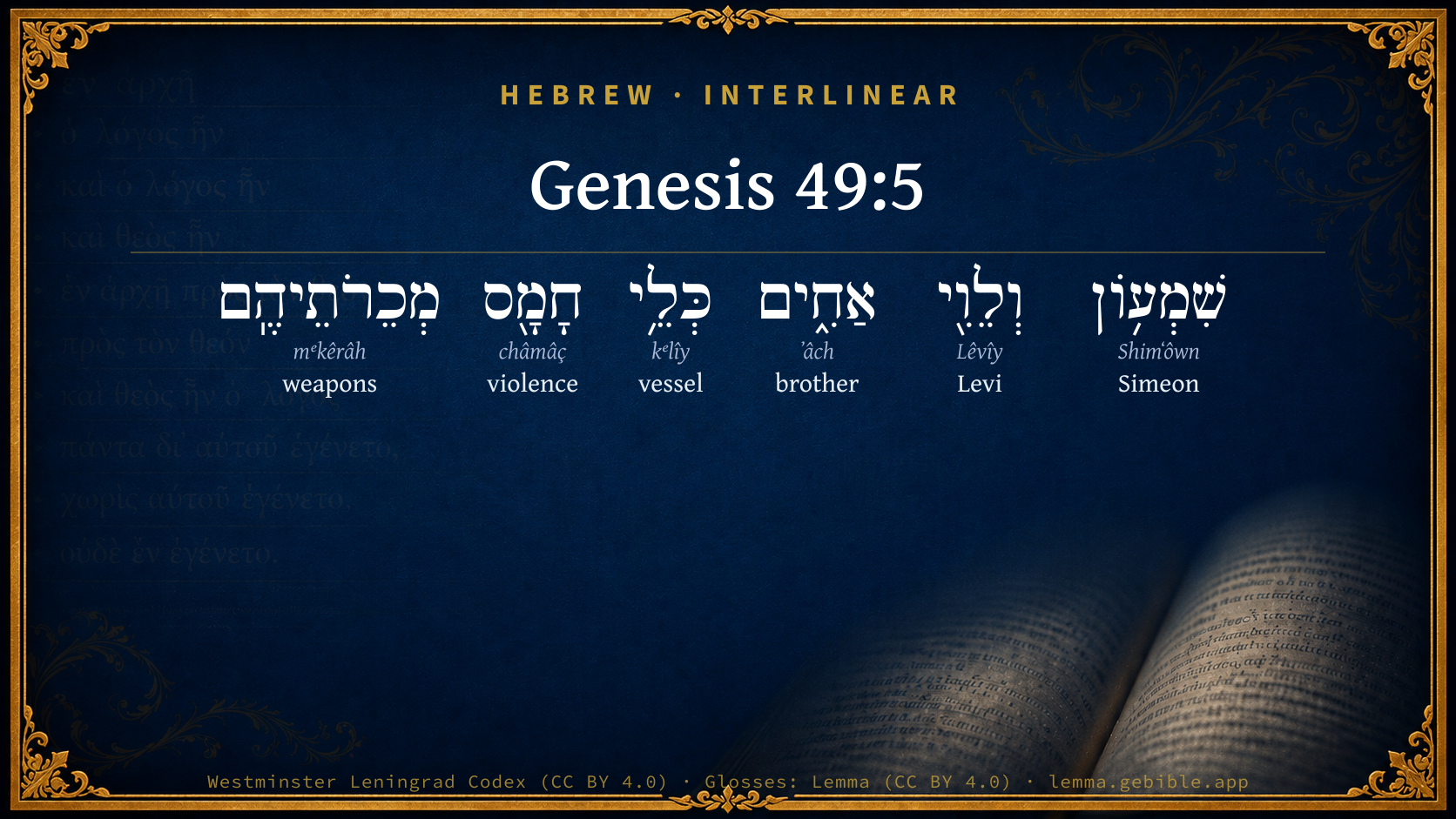
Genesis 49:5

Hebrew (Westminster Leningrad Codex) Genesis 49:5 appears in the Hebrew Old Testament. The text above is from the Westminster Leningrad Codex. Each word links to its Strong’s number, a concise gloss, and parsing drawn from the Open Scriptures Hebrew Bible morphology. Click any word for its full Brown-Driver-Briggs (BDB) entry.
Download image
Cite this verse

Genesis 49:5 (World English Bible). Public Domain. Lemma interlinear Bible study tool, https://lemma.gebible.app/v/genesis/49/5.

Show BibTeX & RIS
BibTeX
RIS
English Translation
"Simeon and Levi are brothers; Weapons of violence are their swords.
World English Bible · Public Domain
Highlights
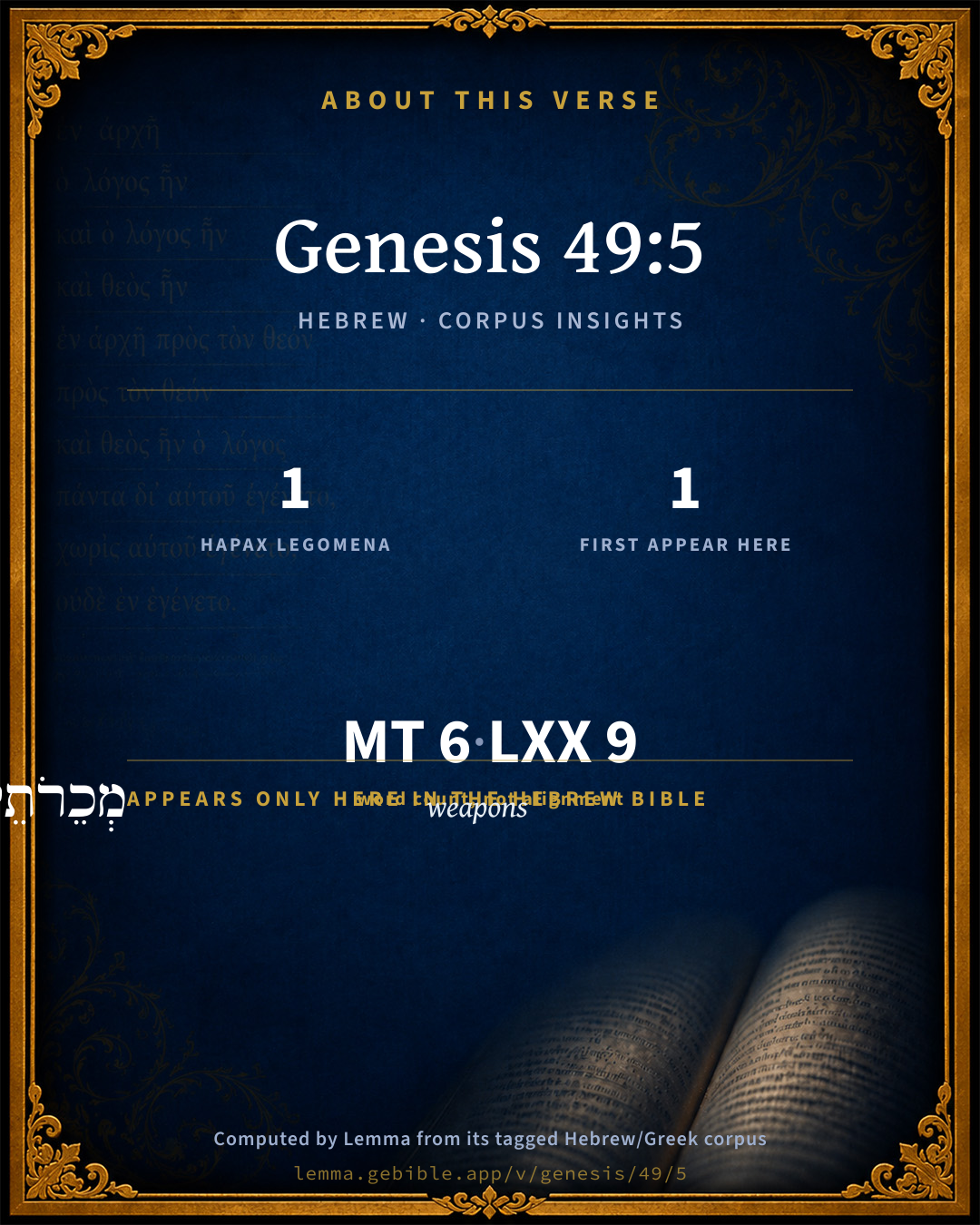
  • 1 hapax legomenon — only here in the Hebrew Bible
  • 1 first appearance in the Hebrew Bible
Full analysis ↓
Download a study sheet

One document with this verse’s original text, its word-by-word gloss line, the meaning frame, cross-references with their text, attributed commentary, and full source and license credits — printable, and it pastes into notes with its structure intact.

This verse Autodidact and up

Study sheet (.html) Plain text (.txt)

A passage Seminary Student

Up to 50 verses in one chapter. A passage sheet keeps up to 6 commentary sources and 12 cross-references per verse, in the order this page ranks them, and says so on the sheet whenever that leaves anything out. Ask for a single verse and you get the Autodidact verse sheet above.

Everything on this page stays free to read, with no account — the sheet is a download of what is already on screen, not access to it.

Want to remove ads? Support Godless Engineer
Compare translations 3

The same verse in 3 English versions, stacked beneath the original-language interlinear above. Click any original word for its lexicon entry.

Each is an independent rendering of the whole verse — the interlinear is not word-aligned to these translations.

Highlighted words mark where these versions differ — a whole-verse word diff, not a word-by-word alignment.

  • World English Bible Public Domain
    "Simeon and Levi are brothers; Weapons of violence are their swords.
  • King James Version Public Domain
    Simeon and Levi are brethren; instruments of cruelty are in their habitations.
  • unfoldingWord Literal Text CC BY-SA 4.0
    Simeon and Levi brothers. Their swords weapons of violence.

unfoldingWord Literal Text — © unfoldingWord, licensed CC BY-SA 4.0. Word-aligned USFM3 via Door43 (git.door43.org/unfoldingWord/en_ult).

Versions to compare (up to 4)

3 of 4 selected

Show all 18 translations

Every available English version of this verse, each an independent rendering of the whole verse.

  • World English Bible Public Domain
    "Simeon and Levi are brothers; Weapons of violence are their swords.
  • Berean Standard Bible Public Domain
    Simeon and Levi are brothers; their swords are weapons of violence.
  • Majority Standard Bible Public Domain
    Simeon and Levi are brothers; their swords are weapons of violence.
  • King James Version Public Domain
    Simeon and Levi are brethren; instruments of cruelty are in their habitations.
  • American Standard Version (1901) Public Domain
    Simeon and Levi are brethren; Weapons of violence are their swords.
  • Revised Version (1885) Public Domain
    Simeon and Levi are brethren; Weapons of violence are their swords.
  • Geneva Bible (1599) Public Domain
    Simeon and Leui, brethren in euill, the instruments of crueltie are in their habitations.
  • Douay-Rheims (1899) Public Domain
    Simeon and Levi brethren: vessels of iniquity, waging war.
  • Young's Literal Translation Public Domain
    Simeon and Levi `are' brethren! Instruments of violence -- their espousals!
  • Literal Standard Version CC BY-SA 4.0
    Simeon and Levi [are] brothers! Instruments of violence—their espousals!
  • Unlocked Literal Bible CC BY-SA 4.0
    Simeon and Levi are brothers. Weapons of violence are their swords.
  • unfoldingWord Literal Text CC BY-SA 4.0
    Simeon and Levi brothers. Their swords weapons of violence.
  • Darby Bible Public Domain
    Simeon and Levi are brethren: Instruments of violence their swords.
  • World Messianic Bible Public Domain
    “Simeon and Levi are brothers. Their swords are weapons of violence.
  • Webster's Bible Public Domain
    Simeon and Levi are brethren: instruments of cruelty are in, their habitations.
  • Free Bible Version CC BY-SA 4.0
    Simeon and Levi are two of the same kind—they use their weapons for destructive violence.
  • Bible in Basic English Public Domain
    Simeon and Levi are brothers; deceit and force are their secret designs.
  • JPS Tanakh (1917) Public Domain
    Simeon and Levi are brethren; weapons of violence their kinship.

Literal Standard Version (2020), Covenant Press — licensed CC BY-SA 4.0. Text via the HelloAO Bible API (eBible.org). Unlocked Literal Bible (unfoldingWord) — licensed CC BY-SA 4.0. Text via the HelloAO Bible API (eBible.org). unfoldingWord Literal Text — © unfoldingWord, licensed CC BY-SA 4.0. Word-aligned USFM3 via Door43 (git.door43.org/unfoldingWord/en_ult). Free Bible Version, Dr. Jonathan Gallagher — licensed CC BY-SA 4.0. Text via the HelloAO Bible API (eBible.org).

Word by word

More ways to search: Search by grammar → Find every occurrence → Compare this word →

Practice this passage: Drill this verse → Learn its vocabulary →

About this verse

These counts appear in no published source. They are computed here, from the morphology-tagged text and Lemma’s own curated glosses. What Lemma adds →

6
words
6
distinct lemmas
Pentateuch
section

Notable vocabulary

1 hapax legomenon — a word that appears only here in the entire Hebrew Bible:

  • מְכֵרֹתֵיהֶֽם weapons H4380

First appearance in Scripture

This word makes its first canonical appearance in the Hebrew Bible here:

  • מְכֵרֹתֵיהֶֽם weapons H4380

Shared distinctive vocabulary

שִׁמְע֥וֹן Simeon H8095 occurs in 39 verses of the Hebrew Bible. Also found in:

Grammatical profile

  • 6 nouns

Hebrew & Septuagint length

In English translation the verse runs 11 words from the Hebrew and 11 from the Septuagint (LXX English) — the same length.

A rough comparison of the two English renderings, which tokenize alike — not a word-level alignment.

Word counts can differ between the Hebrew and the Greek without any difference in meaning — e.g. the Hebrew direct-object marker אֵת has no separate Greek word, and Greek often adds the article ὁ.

In the original languages it is 6 Hebrew tokens and 9 Greek tokens — but the two are counted differently (Hebrew bundles its prefixes and suffixes into one token; the Greek is in lemma form), so that isn’t a like-for-like length.

Cross-references

4

Topical passages linked to Genesis 49:5 in the Treasury of Scripture Knowledge — connected by theme and wording, ordered by reader-vote popularity; previews shown in the World English Bible.

  • Genesis 34:25–31 It happened on the third day, when they were sore, that two of Jacob's sons, Simeon and Levi, Dinah's brothers, each took his sword, came upon the unsuspecting city, and killed all the males.
  • Genesis 29:33–34 She conceived again, and bare a son, and said, "Because Yahweh has heard that I am hated, he has therefore given me this son also." She named him Simeon.
  • Genesis 46:10–11 The sons of Simeon: Jemuel, Jamin, Ohad, Jachin, Zohar, and Shaul the son of a Canaanite woman.
  • Proverbs 18:9 One who is slack in his work Is brother to him who is a master of destruction.

Cross-references courtesy of OpenBible.info (CC BY 4.0).

Hebrew and Greek witnesses Masoretic Hebrew ↔ Greek Septuagint

The same verse in the two great witnesses to the Old Testament, shown verse-for-verse.

These are two independent witnesses, not word-aligned to each other, and the Septuagint is shown in lemma (dictionary) form.

Hebrew Genesis 49:5 Masoretic · Westminster Leningrad Codex

שִׁמְע֥וֹן וְלֵוִ֖י אַחִ֑ים כְּלֵ֥י חָמָ֖ס מְכֵרֹתֵיהֶֽם

"Simeon and Levi are brothers; Weapons of violence are their swords.

World English Bible · Public Domain

Greek LXX Genesis 49:5 Septuagint · lemma form

συμεων καί λευί ἀδελφός συντελέω ἀδικία ἐκ αἵρεσις αὐτός

Symeon and Levi, brethren, accomplished the injustice of their cutting off.

LXX2012 (modern English Septuagint) · Public Domain

On this verse, The Preacher's Complete Homiletical Commentary discusses the Septuagint’s reading. Read the note in Commentary ↓

Hebrew: Westminster Leningrad Codex (CC BY 4.0). Greek: Septuagint (public domain); English from LXX2012 (modern English Septuagint) (Public Domain). How the Septuagint differs from the Hebrew →

Targum (Aramaic paraphrase)

2

The Targum is the ancient Jewish Aramaic paraphrase of the Hebrew Scriptures — an interpretive translation, not the Hebrew text itself. Onkelos (literal) and Pseudo-Jonathan (expansive) render the Torah, and Jonathan the Prophets. Coverage is partial: where no permissively-licensed English translation exists for a verse, only the Aramaic is shown. This is verse-level text, not a word-by-word alignment to the Hebrew.

  1. Targum Onkelos Torah (Genesis–Deuteronomy)
    שִׁמְעוֹן וְלֵוִי אַחִין גַּבְרִין גִּבָּרִין בְּאַרַע תּוֹתָבוּתְהוֹן עֲבָדוּ גְּבוּרָא

    (no public-domain English translation for this verse)

    Targum Onkelos — Aramaic: “Onkelos Genesis” (public domain); “Onkelos Exodus” (public domain); “Onkelos Leviticus” (public domain); “Onkelos Numbers” (public domain); “Onkelos Deuteronomy” (public domain). English: “Sefaria Community Translation” (CC0 1.0 (public-domain dedication)); “J.W. Etheridge. The Targums of Onkelos and Jonathan Ben Uzziel on the Pentateuch. London: Longmans, Green, 1862” (public domain). Text via Sefaria.

  2. Targum Pseudo-Jonathan Torah (Genesis–Deuteronomy)
    שִׁמְעוֹן וְלֵוִי אָחִין תְּלָאמִין מָאנֵי זַיְינָא שְׁנִינָא לְמַחְטוֹב הוּא אִשְׁתְּמוֹדְעוּתְהוֹן

    Shimeon and Levi are brothers of the womb; their thoughts are of sharp weapons for rapine.

    Targum Pseudo-Jonathan — Aramaic: “Targum Jonathan on Genesis” (public domain); “Targum Jonathan on Exodus” (public domain); “Targum Jonathan on Leviticus” (public domain); “Targum Jonathan on Numbers” (public domain); “Targum Jonathan on Deuteronomy” (public domain). English: “The Targum of Jonathan ben Uzziel, trans. J. W. Etheridge, London, 1862” (public domain). Text via Sefaria.

Commentary

Notes on Genesis 49:5 from classic Christian and Jewish commentators (each source and its license shown beneath its notes). The classic Christian expositions comment on the surrounding passage and are grouped to its opening verse, so a note may address several verses; the Jewish commentaries on the Tanakh (Rashi and others) are per-verse, so they appear only where the commentator wrote on this verse.

Lemma curates 59 commentaries, every one of them public domain or Creative Commons licensed, each selected and text-cleaned for this edition rather than reprinted as found. About our sources →

Matthew Henry's Commentary

These were next in age to Reuben, and they also had been a grief and shame to Jacob, when they treacherously and barbarously destroyed the Shechemites, which he here remembers against them. Children should be afraid of incurring their parents' just displeasure, lest they fare the worse for it long afterwards, and, when they would inherit the blessing, be rejected. Observe, 1. The character of Simeon and Levi: they were brethren in disposition; but, unlike their father, they were passionate and revengeful, fierce and uncontrollable; their swords, which should have been only weapons of defence, were (as the margin reads it, Gen 49:5) weapons of violence, to do wrong to others, not to save themselves from wrong. Note, It is no new thing for the temper of children to differ very much from that of their parents. We need not think this strange: it was so in Jacob's family. It is not in the power of parents, no, not by education, to form the dispositions of their children; Jacob bred his sons to every thing that was mild and quiet, and yet they proved to be thus furious. 2. A proof of this is the murder of the Shechemites, which Jacob deeply resented at the time (Gen 34:30) and still continued to resent. They slew a man, Shechem himself, and many others; and, to effect that, they digged down a wall, broke the houses, to plunder them, and murder the inhabitants. Note, The best governors cannot always restrain those under their charge from committing the worst villanies. And when two in a family are mischievous they commonly make one another so much the worse, and it were wisdom to part them. Simeon and Levi, it is probable, were most active in the wrong done to Joseph, to which some think Jacob has here some reference; for in their anger they would have slain that man. Observe what a mischievous thing self-will is in young people: Simeon and Levi would not be advised by their aged and experienced father; no, they would be governed by their own passion rather than by his prudence. Young people would better consult their own interests if they would less indulge their own will. 3. Jacob's protestation against this barbarous act of theirs: O my soul, come not thou into their secret. Hereby he professes not only his abhorrence of such practices in general, but his innocence particularly in that matter. Perhaps he had been suspected as, under-hand, aiding and abetting; he therefore thus solemnly expresses his detestation of the fact, that he might not die under that suspicion. Note, Our soul is our honour; by its powers and faculties we are distinguished from, and dignified above, the beasts that perish. Note, further, We ought, from our hearts, to detest and abhor all society and confederacy with bloody and mischievous men. We must not be ambitious of coming into their secret, or knowing the depths of Satan. 4. His abhorrence of those brutish lusts that led them to this wickedness: Cursed be their anger. He does not curse their persons, but their lusts. Note, (1.) Anger is the cause and original of a great deal of sin, and exposes us to the curse of God, and his judgment, Mat 5:22. (2.) We ought always, in the expressions of our zeal, carefully to distinguish between the sinner and the sin, so as not to love nor bless the sin for the sake of the person, nor to hate nor curse the person for the sake of the sin. 5. A token of displeasure which he foretels their posterity should lie under for this: I will divide them. The Levites were scattered throughout all the tribes, and Simeon's lot lay not together, and was so strait that many of the tribe were forced to disperse themselves in quest of settlements and subsistence. This curse was afterwards turned into a blessing to the Levites; but the Simeonites, for Zimri's sin (Num 25:14), had it bound on. Note, Shameful dispersions are the just punishment of sinful unions and confederacies.

Matthew Henry's Commentary on the Whole Bible (1708–1710) — public domain (CC PDM 1.0). Text via the HelloAO Bible API.

Trapp's Complete Commentary

John Trapp

Gen 49:5 Simeon and Levi [are] brethren; instruments of cruelty [are in] their habitations.

Ver. 5. Simeon and Levi are brethren.] Nobile par fratrum {a} not more in nature than in iniquity. Here Moses blancheth not over the blemishes of his progenitors, but wrote as he was inspired by the impartial Spirit of truth. If it could be said of Suetonius, {b} that in writing the lives of the twelve Caesars, he took the same liberty to set down their faults that they took to commit them; how much more truly may this be said of the holy penmen, they spared not themselves, much less their friends. See my "True Treasure," page 21.

Instruments of cruelty are in their habitations.] Or, Are their swords. {c} Barbarous and brutish peraons they were; skilful to destroy. {Eze 21:31} Such a one was Drusus, the son of Tiberius the Emperor; so set upon bloodshed that the sharpest swords were from him called in Rome, Drusians. {d} The Spaniards are said to try the goodness of their swords upon the bodies of the poor Indians: and they suppose, saith Sir Francis Drake, {e} that they show the wretches great favour, when they do not, for their pleasure, whip them with cords; and day by day drop their naked bodies with burning bacon, which is one of their least cruelties.

{a} Horat. Metaphora et latens Antanaclasis. - Piscat.

{b} Ea libertate scripsit Imperatorum vitas, qua ipsi vixerunt.

{c} Mekerah [ מכרה] alii reddunt per Graecam vocem, Machoeroe eorum. Non incommode. - Pareus.

{d} ωστερ και τα οξυτατα των ξιφων Dρουσιανα απ αυτου κληθηναι. - Dio.

{e} The World Encomp., by Sir Fr. Drake, p. 53.

John Trapp, A Commentary or Exposition upon All the Books of the Old and New Testament (1647–1656) — public domain. Text from a community e-Sword module.

The Biblical Illustrator

Joseph S. Exell

Gen_49:5-7

Simeon and Levi are brethren

The blessing of Simeon and Levi:

I.

THEIR SIN.

1. Immoderate revenge.

2. Cruelty to unoffending beasts.

3. Their cruelty was deliberate.

II. THEIR PENALTY.

1. To be disavowed by the good.

2. Their deed is branded with a curse.

3. They are condemned to moral and political weakness. (T. H.Leale.)

Simeon and Levi

The passage begins by declaring Simeon and Levi are brethren. Brethren not merely as having the same parents, but in thought, feeling, action. Instruments of cruelty are in their habitations. Such wickedness had these two brothers committed (see chap. 34. 25th and following verses) that Jacob could have no sympathy with it. As they had joined together to commit it, so righteous retribution was to follow. They were to be divided and scattered. Thus the murderous propensity of their nature would bring untold trouble upon Israel, and only by breaking this union and scattering them throughout Israel could their power for evil be weakened. They should form no independent or compact tribes. This sentence was so strikingly fulfilled when Canaan was conquered, that on the second numbering under Moses, Simeon had become the weakest of all the tribes (see Num_26:14).

1. Among the many lessons taught by the conduct of this tribe let us notice first, that though men may be brethren, there may be underneath this hallowed term principles utterly at variance with it. How sacred may be the outward sign, how suggestive of all that is commendable and holy, how hideous the principles it covers! The whited sepulchre may indeed cover the revolting sight of dead mens bones. Such terms are the outward memorials of what should be, but too often they serve to represent their very opposite. One bearing the holiest of all names, Christian, may have a devil at heart.

2. Mark another truth. Their swords are weapons of violence, the patriarch says--the anger was fierce, the wrath was cruel. The sword is a lawful weapon. Anger may be right and wrath too. It is when they degenerate into violence, fierceness, and cruelty that they become sin. From being instruments of righteousness it is an easy transition to become instruments of Satan. And let not our inveterate self-righteousness take refuge under the covering that because no such crime as houghing the oxen is ours, therefore we are all right before God. Is it possible for such an easy self-deception: Yes, possible, and the thought of many, yea of most. What I is there not adultery in a look? Is there not murder in a feeling?

3. And observe, it is the sin that is cursed and not the sinner: Cursed be their anger, for it was fierce; and their wrath, for it was cruel. It is the same all through the Bible. The sinner is never cursed apart from the sin that is in him. And for this sin which draws down that curse God has made a rich provision in Christs precious blood. If the sinner is cursed it is because he loves his sin, and clings to it, and will not have it removed. The blood of Jesus Christ cleanseth from all sin. Sin must be cursed. And if the sinner will not avail himself of the remedy, but still cleave to his sin, then he may be cursed with it--the wrath of God abideth on him.

4. Observe another truth in the history of these tribes in conjunction with that of Reuben in the last chapter. It is this, that the result of all sin, all living to the flesh, is diminution. Reubens sin led to it, for Moses had to pray that he might have a few men left, and not become altogether extinct. Simeon and Levi were to be divided and scattered; and both traceable to one cause--giving way to the flesh, to sensuality and self-will. Yes, living to self, to sin, to anything lower than Christ, does diminish. It makes us little--increasingly little. It banishes every vestige of largeness and greatness and grandness from our character, and from everything about us. We become little hearted, little souled, little in our ways of looking at things.

5. Lastly, let Jacobs word of warning go forth to every Christian: O my soul, come not thou into their secret; unto their assembly, mine honour, be not thou united. The patriarch, as he thinks of their sin, traces its source to a secret spring, and its manifestation in an assembly. He warns us to have nothing to do with one or the other. The outward association and the secret spring are both alike dangerous to the soul. Like the Psalmist in his first Psalm, he would, as a faithful sentinel, warn us against coming in the way of either. And it is well, when evil is around us, to talk to ones own soul about it all. O my soul, come not thou into their secret; mine honour, be not thou united. To make a clamour is easy. But let us watch our own souls, and all such meditation should have one effect--one of solemnity, separation, holiness: Come not thou into their secret; unto their assembly, mine honour, be not thou united. If there is anything of God in you, then, be not thou united. No union with the flesh, or with aught that is contrary to God. (F. Whitfield, M. A.)

The tutors prediction respecting Tiberius

Theodorus Gaddaraeus, who was tutor to Tiberius the Roman Emperor, observing in him, while a boy, a very sanguinary nature and disposition, which lay lurking under a show of levity, was wont to call him a lump of clay steeped and soaked in blood. His predictions of him did not fail in the event. Tiberius thought death was too light a punishment for any one that displeased him. Hearing that one Carnulius who had displeased him had cut his own throat, Carnulius, said he, has escaped me. To another, who begged of him that he might die quickly, No, said he, you are not so much in favour as that yet. (Moral and Religious Anecdotal.)

A curse or a blessing

I would remind you of the different histories of the tribes of Simeon and Levi, as being alike fulfilments of one and the same prophecy. That was not because the prediction itself was, like some of the heathen oracles, so vague or so ambiguous that it could not be falsified by any event, for the phrases, I will divide them in Jacob and scatter them in Israel, are both definite and clear. But the explanation is to be found in the subsequent conduct of the men of Levi, as contrasted with that of the men of Simeon, whereby in the one case the prophecy took the ultimate character of a blessing, and in the other it kept that of a curse. Now this was in the lifetime of a tribe which extended over hundreds of years, but something not dissimilar may occur in the lifetime of an individual. Let us suppose that two men have been guilty of the same sin, and that as the penal consequence they have both had to bear the same thing, namely, separation from their native land and virtual transportation to a new and strange country. But the one, unwarned thereby, continues in his wicked ways, and goes down and down in iniquity, until he ceases to be recognizable even by those who look for him; while the other, moved to penitence, begins a new career, earns an honourable independence, gives himself to public affairs, and becomes a benefactor to the colony or the state, so that at length his name is everywhere mentioned with gratitude and respect. Here the proximate results in both cases were the same, but the ultimate how different! and all owing to the different dispositions of the two men. Nor is this an improbable supposition; you may have come on many eases like it, and they are all full of warning to some and encouragement to others, not only for the present life, but also for that which is to come. Up to a certain point we have power, by our penitence, to make blessing for ourselves for the life that now is and for that which is to come; nay, even after we have lost the first opportunity, there may come another on a lower plane; but at length there is a limit, beyond which all such opportunities cease, and we must dree our weird eternally. (W. M. Taylor, D. D.)

The Biblical Illustrator, edited by Joseph S. Exell (c. 1880s–1900s) — public domain. Text from a community e-Sword module.

Joseph Benson's Commentary

Gen 49:5. Simeon and Levi are brethren — In disposition, but unlike their father: they were passionate and revengeful, fierce and wilful; instruments of cruelty are in their inhabitations, or, as מכרתיהםmecherotheihem rather signifies, their counsels, or compacts, alluding to their treacherous agreement with the Shechemites: their swords, which should have been only weapons of defence, were (as the margin reads it) weapons of violence, to do wrong to others, not to save themselves from wrong.

Joseph Benson's Commentary on the Old and New Testaments (1811–1818) — public domain. Text from a community e-Sword module.

The Preacher's Complete Homiletical Commentary

Joseph S. Exell (gen. ed.)

CRITICAL NOTES.—

Gen_49:4. Unstable as water.] Heb. Boiling over as water. Another form of this word is rendered lightness, in Jer_23:32; Zep_3:2, referring to the character of false prophets. The image points to the heated passions which led Reuben into disgrace. Thou shalt not excel.] He shall have no share in the dignity and privileges of the firstborn—the birthright supremacy. The double portion was transferred to Joseph, the chieftainship to Judah, and the priesthood to Levi.

Gen_49:6. In their self-will they digged down a wall.] The LXX has, they have hamstrung oxen. “The true rendering refers to a process of wantonly cutting the tendons of oxen so as to make them useless. In Chron. Gen_34:28, the carrying off of the cattle is mentioned. This wanton cruelty was doubtless added.” (Jacobus.)—

MAIN HOMILETICS OF THE PARAGRAPH.—Gen_49:5-7

THE BLESSING OF SIMEON AND LEVI

I. Their sin.

1. Immoderate revenge. (Gen_49:5-6.) They were justified in feeling anger, and even in avenging the outrage upon the family honour. They must have been less than men had they been indifferent. And as religious men they were bound to feel a righteous indignation. In that state of society, when there were no regular modes of trial, the avenger of blood was an instrument of justice. It is the excess of their anger that is blamed. “For it was fierce.” “For it was cruel.” Not content with taking vengeance upon the man who did the deed, they slew a whole tribe of men.

2. Cruelty to unoffending beasts. They wantonly cut the tendons of animals so as to make them useless. This was an uncalled for ferocity.

3. Their cruelty was deliberate. They were, indeed, “brethren” both in sympathy and co-operation. They supported and counselled each other in their cruel designs. They had their “secret,” their “assembly.” They were men capable of framing dark plots. They wrought iniquity by a law.

II. Their penalty.

1. To be disavowed by the good. “O my soul, come not thou into their secret; unto their assembly, mine honour, be not thou united.” Jacob could not prevent their deed, but he would have no fellowship with the unfruitful works of darkness.

2. Their deed is branded with a curse. He curses their wrath and their cruelty, not their persons.

3. They are condemned to moral and political weakness. “I will divide them in Jacob, and scatter them in Israel.” The penalty was appropriate. As they had worked together in wickedness, they are to be divided. Simeon’s tribe was weak, his territory scattered. Levi was likewise scattered in Israel, and had no territorial allotment; yet his was a privileged tribe, being the tribe of priests. The penalty is by grace transmuted into blessing. “The Lord keeps the execution of the sentence in His own hands. Simeon’s sons continue to be like himself—doing the same works. On them the sentence falls with unmitigated severity. In the tribe of Levi there are indications of a better mind. And the sentence is graciously sanctified.”—(Candlish.)

SUGGESTIVE COMMENTS ON THE VERSES

Gen_49:5. His two next sons were guilty of a crime still worse than Reuben’s. If it did not wound their father in a part so tender, it gave him not less pain, and exposed him to greater mischief. If a merciful providence had not wonderfully preserved him, he and all his family must have been destroyed, in consequence of the revenge of the enraged Canaanites.—(Bush).

Gen_49:6. Time had not changed Jacob’s feelings with regard to the crime of his sons. His soul had the same abhorrence of the act now, as it had then.

Gen_49:7. There is a kind of anger which deserves not to be cursed, but to be blessed. Such was the anger of Moses when he came down from the Mount, and seeing the idolatries of the camp of Israel, broke the tables of the law which he held in his hands. But the anger of Simeon and Levi was entitled neither to commendation nor apology. Sharp rebuke is necessary for those who have greatly offended.—(Bush).

The Preacher's Complete Homiletical Commentary (gen. ed. Joseph S. Exell; Funk & Wagnalls, c. 1892) — public domain (pre-1929). A full-Bible homiletical/sermon-outline anthology covering 65 of 66 books (2 John is absent from the source module). Text from a community e-Sword module.

Tyndale Open Study Notes

Tyndale Open Resources

49:5-7 Simeon and Levi were violent and lawless; instead of serving justice, they indulged their uncontrolled anger and disregarded life (34:24-29). • I will scatter them: Simeon’s land was largely absorbed into Judah’s (Josh 19:1, 9); Levi was given a more honorable future because the Levites became the priestly tribe (see Exod 32:25-29), but they had no region of their own (Josh 21).

Tyndale Open Study Notes — © Tyndale Open Resources, licensed CC BY-SA 4.0. Text via the HelloAO Bible API.

Geneva Bible (1599)

Geneva Bible translators

Or, their swords were instruments of violence.

Geneva Bible (1599) marginal notes — public domain. Text via Bolls.life.

Adam Clarke's Commentary

5. Simeon and Levi, brethren:

They have accomplished their fraudulent purposes.

6. Into their secret council my soul did not come;

In their confederacy my honour was not united:

For in their anger they slew a man, (איש ish, a noble,)

And in their pleasure they murdered a prince.

7. Cursed was their anger, for it was fierce!

And their excessive wrath, for it was inflexible!

I will divide them out in Jacob,

And I will disperse them in Israel.

Verse 5. Simeon and Levi are brethren] Not only springing from the same parents, but they have the same kind or disposition, head-strong, deceitful, vindictive, and cruel.

They have accomplished, c.] Our margin has it, Their swords are weapons of violence, i. e., Their swords, which they should have used in defence of their persons or the honourable protection of their families, they have employed in the base and dastardly murder of an innocent people.

The Septuagint gives a different turn to this line from our translation, and confirms the translation given above: Συνετελεσαν αδικια εξαιρεσεως αυτων· They have accomplished the iniquity of their purpose with which the Samaritan Version agrees. In the Samaritan text we read [Samaritan] calu, they have accomplished, instead of the Hebrew כלי keley, weapons or instruments, which reading most critics prefer: and as to מכרתיהם mecherotheyhem, translated above their fraudulent purposes, and which our translation on almost no authority renders their habitations, it must either come from the AEthiopic מכר macar, he counselled, devised stratagems, &c., (see Castel,) or from the Arabic [Arabic] macara, he deceived, practised deceit, plotted, &c., which is nearly of the same import. This gives not only a consistent but evidently the true sense.

Adam Clarke's Commentary on the Bible (1810–1826) — public domain. Text from a community e-Sword/MySword module.

John Calvin's Commentaries

5. Simeon and Levi are brethren. He condemns the massacre of the city of Shechem by his two sons Simon and Levi, and denounces the punishment of so great a crime. Whence we learn how hateful cruelty is to God, seeing that the blood of man is precious in his sight. For it is as if he would cite to his own tribunal those two men, and would demand vengeance on them, when they thought they had already escaped. It may, however, be asked, whether pardon had not been granted to them long ago; and if God had already forgiven them, why does he recall them again to punishment? I answer, it was both privately useful to themselves, and was also necessary as an example, that this slaughter should not remain unpunished, although they might have obtained previous forgiveness. For we have seen before, when they were admonished by their father, how far they were from that sorrow which is the commencement of true repentance; and it may be believed that afterwards they became stupefied more and more, with a kind of brutish torpor, in their wickedness; or at least, that they had not been seriously affected with bitter grief for their sin. It was also to be feared lest their posterity might become addicted to the same brutality, unless divinely impressed with horror at the deed. Therefore the Lord, partly for the purpose of humbling them, partly for that of making them an example to all ages, inflicted on them the punishment of perpetual ignominy. Moreover, by thus acting, he did not retain the punishment while remitting the guilt, as the Papists foolishly dream: but though truly and perfectly appeased, he administered a correction suitable for future times. The Papists imagine that sins are only half remitted by God; because he is not willing to absolve sinners gratuitously. But Scripture speaks far otherwise. It teaches us that God does not exact punishments which shall compensate for offenses; but such as shall purge hearts from hypocrisy, and shall invite the elect — the allurements of the world being gradually shaken off — to repentance, shall stir them up to vigilant solicitude, and shall keep them under restraint by the bridle of fear and reverence. Whence it follows that nothing is more preposterous, than that the punishments which we have deserved, should be redeemed by satisfactions, as if God, after the manner of men, would have what was owing paid to him; nay, rather there is the best possible agreement between the gratuitous remission of punishments and those chastening of the rod, which rather prevent future evils, than follow such as have been already committed.

To return to Simeon and Levi. How is it that God, by inflicting a punishment which had been long deferred, should drag them back as guilty fugitives to judgment; unless because impunity would have been hurtful to them? And yet he fulfills the office of a physician rather than of a judge, who refuses to spare, because he intends to heal; and who not only heals two who are sick, but, by an antidote, anticipates the diseases of others, in order that they may beware of cruelty. This also is highly worthy to be remembered, that Moses, in publishing the infamy of his own people, acts as the herald of God: and not only does he proclaim a disgrace common to the whole nation, but brands with infamy, the special tribe from which he sprung. Whence it plainly appears, that he paid no respect to his own flesh and blood; nor was he to be induced, by favor or hatred, to give a false color to anything, or to decline from historical fidelity: but, as a chosen minister and witness of the Lord, he was mindful of his calling, which was that he should declare the truth of God sincerely and confidently. A comparison is here made not only between the sons of Jacob personally; but also between the tribes which descended from them. This certainly was a specially opportune occasion for Moses to defend the nobility of his own people. But so far is he from heaping encomiums upon them, that he frankly stamps the progenitor of his own tribe with an everlasting dishonor, which should redound to his whole family. Those Lucianist dogs, who carp at the doctrine of Moses, pretend that he was a vain man who wished to acquire for himself the command over the rude common people. But had this been his project, why did he not also make provision for his own family? Those sons whom ambition would have persuaded him to endeavor to place in the highest rank, he puts aside from the honor of the priesthood, and consigns them to a lowly and common service. Who does not see that these impious calumnies have been anticipated by a divine counsel rather than by merely human prudence, and that the heirs of this great and extraordinary man were deprived of honor, for this reason, that no sinister suspicion might adhere to him? But to say nothing of his children and grandchildren, we may perceive that, by censuring his whole tribe in the person of Levi, he acted not as a man, but as an angel speaking under the impulse of the Holy Spirit, and free from all carnal affection. Moreover, in the former clause, he announces the crime: afterwards, he subjoins the punishment. The crime is, that the arms of violence are in their tabernacles; and therefore he declares, both by his tongue and in his heart, that he holds their counsel in abhorrence, because, in their desire of revenge, they cut off a city with its inhabitants. Respecting the meaning of the words commentators differ. For some take the word מכרות (makroth) to mean swords; as if Jacob had said, that their swords had been wickedly polluted with innocent blood. But they think more correctly, who translate the word habitations; as if he had said, that unjust violence dwelt among them, because they had been so sanguinary. I do not doubt that the word כבד (chabod) is put for the tongue, as in other places; and thus the sense is clear, that Jacob, from his heart, so detests the crime perpetrated by his sons, that his tongue shall not give any assent to it whatever. Which he does, for this end, that they may begin to be dissatisfied with themselves, and that all others may learn to abhor perfidy combined with cruelty. Fury, beyond doubt, signifies a perverse and blind impulse of anger: and lust is opposed to rational moderation; because they are governed by no law. Interpreters also differ respecting the meaning of the word שור (shor.) Some translate it “bullock,” and think that the Shechemites are allegorically denoted by it, seeing they were sufficiently robust and powerful to defend their lives, had not Simon and Levi enervated them by fraud and perfidy. But a different exposition is far preferable, namely, that they “overturned a wall.” For Jacob magnifies the atrociousness of their crime, from the fact, that they did not even spare buildings in their rage.

John Calvin's Commentaries (1540-1563) — public domain. Text from the Calvin Translation Society English edition (1840s-50s) via the Christian Classics Ethereal Library (ccel.org). Calvin's coverage is partial (roughly two-thirds of the Bible); uncommented books and verses are honest gaps, never fabricated. The 19th-century editor's footnotes and remarks are omitted so the notes are faithfully Calvin's own voice.

Ellicott's Commentary for English Readers

(5) Simeon and Levi are brethren.—That is, they are alike in character and disposition. Despising the feeble Reuben, they seem to have been close friends and allies, and probably tried to exercise a tyrannical authority over their younger brethren, Judah being the only one near them in age.

Their habitations.—This translation is universally abandoned, but there is much difference of opinion as to the real meaning of the word. The most probable explanation is that given by Jerome and Rashi, who render it swords. Apparently it is the Greek word machaera, a knife; and as neither the Hebrews nor the Canaanites were metallurgists, such articles were imported by merchants from Ionia. Long before the days of Jacob, caravans of traders traversed the whole country, and the goods which they brought would carry with them their own foreign names. The sentence, therefore, should be translated, “weapons of violence are their knives.” The other meaning given by some competent critics, namely, compacts, if the word could be formed at all from the supposed root, would mean marriage contracts, and this gives no intelligible sense.

A Bible Commentary for English Readers, edited by Charles John Ellicott (1878–1897) — public domain. Text from a community e-Sword module.

The Cambridge Bible for Schools and Colleges

gen. ed. J. J. S. Perowne

5. Simeon and Levi] These two brothers were associated in the massacre of the Shechemites, to which reference is possibly here made in language of indignation. (See ch. Gen_34:25; Gen_34:30.)

swords] The Hebrew word (m’khêrâh) occurs only here. Its similarity in sound to the Greek μάχαιρα, “a sword,” has suggested the English rendering. If it be rightly derived from a root meaning “to dig,” possibly the traditional rendering denoting “a weapon” is correct. The R.V. marg., compacts, gives another conjecture. Driver (Add. xl.) says the word “must come from karar, prob. to turn round; hence Dillm. suggests a curved knife, or sabre.” The obscurity accounts for the following variant renderings: LXX συνετέλεσαν ἀδικίαν ἐξ αἱρέσεως αὐτῶν; Lat. vasa iniquitatis bellantia; Targ. Onkelos, “mighty men in the land they dwelled in, they did a mighty deed”; Spurrell, “weapons of violence are their shepherds’ staves”; Gunkel, “deceit and violence are their pitfalls.”

The Cambridge Bible for Schools and Colleges (gen. ed. J. J. S. Perowne; Cambridge University Press, 1878–1918) — public domain. Text from a community e-Sword module.

John Gill's Exposition

Simeon and Levi are brothers,.... Not because they were so in a natural sense, being brethren both by father and mother's side, for there were others so besides them; but because they were of like tempers, dispositions, and manners (f), bold, wrathful, cruel, revengeful, and deceitful, and joined together in their evil counsels and evil actions, and so are joined together in the evils predicted of them:

instruments of cruelty are in their habitations: or vessels, utensils, household goods gotten by violence and rapine, and through the cruel usage of the Shechemites; these were in their dwellings, their houses were full of such mammon of unrighteousness, or spoil; or, as others, "instruments of cruelty" are "their swords" (g); what they should only have used in their own defence, with these they shed the blood of the Shechemites very barbarously, Gen 34:25. Some think the word here used is the Greek word for a sword; and the Jews say (h) that Jacob cursed the swords of Simeon and Levi in the Greek tongue; and others say it is Persic, being used by Xenophon for Persian swords; but neither of them seems probable: rather this word was originally Hebrew, and so passed from thence into other languages; but perhaps the sense of it, which Aben Ezra gives, may be most agreeable, if the first sense is not admitted, that it signifies covenants, compacts, agreements (i), such as these men made with the Shechemites, even nuptial contracts; for the root of the word, in the Chaldee language, signifies to espouse (k); and these they abused to cruelty, bloodshed, and slaughter, in a most deceitful manner: in the Ethiopic language, the word signifies counsels; so De Dieu takes it here.

(f) "--------par nobile fratrum Nequitia et nugis pravorum et amore gemellum." Horat. Sermon. l. 2. Satyr. 3. (g) "Machaerae eorum", Montanus, Tigurine version, Schmidt; and so R. Sol. Urbin Ohel Moed, fol. 31. 2. (h) Pirke Eliezer, c. 38. (i) So Castell. Lexic. col. 2058. Junius & Tremellius, Piscator. (k) Chald. & Syr. "despondit", "desponsavit", Schindler. Lex. col. 998.

John Gill's Exposition of the Whole Bible (1746–1763) — public domain (CC PDM 1.0). Text via the HelloAO Bible API.

Haydock's Catholic Bible Commentary

Brethren. Born of the same parents; similar in disposition. --- Vessels; instruments. Septuagint and Chaldean, "they have completed wickedness," as they read calu, instead of the present Hebrew cele, which is adopted by Aquila. (Calmet)

George Leo Haydock (1774–1849), Haydock's Catholic Family Bible and Commentary, 1859 edition — public domain. Excludes Psalms (Douay-Rheims chapter numbering differs from Protestant) and Deuterocanonical books (Catholic canon only).

Matthew Poole's English Annotations

Simeon and Levi are brethren; not only by nature, but in iniquity; of like cruel and bloody disposition, confederate in the same wicked design, Gen 34:25. So the word brother is elsewhere used, for him that agrees much with another in his temper, or employment, or designs, as Job 30:29; Pro 18:9, &c.

Their bloody swords are yet in their dwellings, to bear witness against them for their barbarous cruelty. But these words may be, and are by some both ancient and later interpreters, rendered otherwise. For the Hebrew word mecheroth, here rendered habitations, is never so used, nor indeed is found elsewhere in Scripture. Nor doth that signification agree with the Hebrew root from whence this comes, which is machar, and signifies to bargain, or sell, or exchange. And accordingly this word is by the Samaritan translator, and by other learned interpreters, rendered, their conventions, or compacts, or civil contracts, or agreements. And, which is more, the Chaldee verb mechar, from whence this word may very well be deduced, signifies to espouse; and the noun mechirah, derived from it, signifies a spouse. And so the words may be rendered thus, their contracts, or agreements, ( or their nuptial contracts, ) were instruments of cruelty. Which translation seems better than the other,

1. Because it keeps closest to the words of the text, and leaves out that particle in, which is not in the Hebrew text, but was added by our translators to complete the sense.

2. Because this best agrees with the history recorded, Gen 34:1-31, where we read that they did cover their bloody design with a pretence of an agreement and nuptial contract with the Shechemites, which was a great aggravation of their villany, that those things which to others are bonds of love and peace, were made by them instruments of cruelty.

Matthew Poole's English Annotations on the Holy Bible (1683–1685) — public domain. Text from a community e-Sword/MySword module.

Whedon's Commentary on the Bible

Daniel D. Whedon

5. Simeon and Levi are named together, because they were brothers in the twofold sense of being sons of the same mother, and so much alike in disposition and character. Hence, after pronouncing their names, the patriarch pauses, and then emphatically adds the word brothers. Their similar spirit was seen and became historical in their cruel slaughter of the Shechemites, (Gen_34:25-31,) for in that massacre they led the way. The memory and fear of that act never departed from Jacob’s soul, and as Reuben’s incest cost him the rights and glory of the firstborn, so the bloody deed of Simeon and Levi colours all this oracle, and brought them cursing where they might have had blessing.

Instruments of violence their swords — The word מכרת, rendered swords, occurs here only, and manifestly means some instrument of violence; but its derivation is uncertain. The ancient versions differ widely, and the word has been variously explained, as machinations, (De Dieu,) betrothals, (Dathe,) habitations, (Eng. version.) But the rendering swords, (perhaps from כור, to pierce, or penetrate,) seems most in harmony with the context, and is adopted by many of the best interpreters. According to Rashi, the Greek word μαχαιρα, sword, was derived from this. According to Gesenius, Rabbi Eliezer says: “Jacob cursed their swords in the Greek tongue.” According to Gen_34:25, Simeon and Levi “took each man his sword” (חרב) and slaughtered all the men of Shechem.

Daniel D. Whedon (gen. ed.), Commentary on the Old and New Testaments (1874–1909) — public domain. Text from a community e-Sword module.

The Pulpit Commentary

Vers. 5-7. Simeon and Levi are brethren (not in parentage alone, but also in their deeds; e.g. their massacre of the Shechemites, (Gen_34:25) to which undoubtedly the next words allude); instruments of cruelty are in their habitations literally, instruments of violence their tdokem, an apax legom. which has been variously rendered

(1) their dwellings, or habitations (Kimchi, A. V, Calvin, Ainsworth), in the land of their sojourning (Onkelos), for which, however, there does not seem to be much authority;

(2) their machinations or wicked counsels, deriving from rkm; to string together, to take in a net, to ensnare, (Nah_3:4) the cognate Arabic root signifying to deceive or practice stratagems (De Dieu, Schultens, Castelli, Tayler Lewis, and others);

(3) their betrothals, or compacts of marriage, connecting with the same root as the preceding in the sense of "binding together" (Dathius, Clericus, Michaelis, Knobel, Furst, et alii);

(4) their rage, as suggested by the unused root dyKi, to boil or seethe (Kalisch);

(5) their swords, from rWK hrK to dig or pierce through, cf. macaira (Vulgate, Luther, Gesenius, Rosenm Keil, Murphy, and others). The preponderance of authority appears to be in favor of this last. O my soul, come not thou into their secret; literally, into their council or assembly (dwOs, from dsy; to set or sit) come not, my soul, or my soul shall not come (cf. Pro_1:15, Pro_1:16) unto their assembly, mine honor, be not thou united: literally, with or in their assembly or congregation (lheq from lhq to call together: cf., (Gen_28:3 Gen_35:11 Gen_48:4) mine honor or glory (i.e. the soul as being the noblest part of man: (Psa_16:9 Psa_57:9 Psa_108:2 the term ydiboK is parallel with the preceding yvipn), do not join (Keil), or shall not join (Kalisch) for in their anger they slew a man, literally, man, a collective, singular for "men," the plural form of XXX occurring rarely; only in Psa_141:4; Pro_8:4; Isa_53:3 and in their self will they digged down a wall literally, they houghed ox (LXX, Gesenius, Furst, Rosenm Keil, Kalisch, Lange, Gerlach, T. Lewis, Murphy, &c., &e.), the singular rwOv, the plural of which is only found once, in Hos_12:12, being retained here to correspond with vyai. The received rendering, which is not without sanction (Onkelos, Targnm of Jonathan, Syriac, Arabic, Aquila, Symmachus, Vulgate, Dathius, Calvin) reads rWv instead of rwOv, and takes rq; in the primary sense of destruere, evertexe. Cursed be their anger, for it was fierce; and their wrath, for it was cruel: the second synonym "wrath," literally, outpourings, indicates the fullness and intensity of the tide of fury which by Simeon and Levi was let loose upon the unsuspecting ShechemitesI will divide them in Jacob, and scatter them in Israel. While for the sin (the deed, not the doers) Jacob has a curse, for the sinners themselves he has a well-merited chastisement. They had been confederate in their wickedness, they should in future, when returning to occupy their God. assigned inheritance, be disjoined. That this prediction was exactly fulfilled Scripture testifies. At the second census in the wilderness, shortly before the conquest, the tribe of Simeon had become so reduced in its numbers (reckoning only 22, 000 as against 76, 500 in Judah) as to be the smallest of the twelve; (Num_26:14) to be passed over entirely in the last blessing of Moses; (De 33) to be accorded no independent allotment of territory in Canaan on the completion of the conquest, having only a few cities granted to it within the borders of Judah; (Jos_19:1-9) and to be ultimately absorbed inthe more powerful and distinguished tribe under whose protection and tutelage, so to speak, it had been placed. (1Ch_4:27) The tribe of Levi also was deprived of a separate inheritance, receiving only a number of cities scattered here and there among the possessions of their brethren; (Jos_21:1, Jos_21:40) and, though by its election to the priesthood the curse may be said to have been turned into a blessing, yet of this signal honor which was waiting Levi Jacob was completely silent, showing both that no prophecy was of any private interpretation (the seer seeing no further than the Holy Spirit helped him), and that Jacob spoke before the days of Moses. It is almost incredible that a late writer would have omitted to forecast the latter-day glory of the tribe of Levi; and this opinion is confirmed by observing the very different strain in which, after Levi s calling had been revealed, the benediction of Moses himself proceeds. (Deu_33:8-11)

The Pulpit Commentary (1880–1919), ed. H.D.M. Spence-Jones & Joseph S. Exell — public domain. Text from a community e-Sword module.

John Wesley's Explanatory Notes

Simeon and Levi are brethren -- brethren in disposition, but unlike their father: they were passionate and revengeful, fierce and wilful; their swords, that should have been only weapons of defense, were (as the margin reads it) weapons of violence, to do wrong to others, not to save themselves from wrong.

John Wesley, Explanatory Notes Upon the Whole Bible (1754–1765) — public domain. Text via the GEBible commentary corpus.

Keil & Delitzsch

C. F. Keil & F. Delitzsch

"Simeon and Levi are brethren:" emphatically brethren in the full sense of the word; not merely as having the same parents, but in their modes of thought and action. "Weapons of wickedness are their swords." The ἅπαξ lec. מכרת is rendered by Luther, etc., weapons or swords, from כּוּר = כּרה, to dig, dig through, pierce: not connected with μάχαιρα. L. de Dieu and others follow the Arabic and Aethiopic versions: "plans;" but חמס כּלי, utensils, or instruments, of wickedness, does not accord with this. Such wickedness had the two brothers committed upon the inhabitants of Shechem (Gen 34:25.), that Jacob would have no fellowship with it. "Into their counsel come not, my soul; with their assembly let not my honour unite." סוד, a council, or deliberative consensus. תּחד, imperf. of יחד; כּבודי, like Psa 7:6; Psa 16:9, etc., of the soul as the noblest part of man, the centre of his personality as the image of God. "For in their wrath have they slain men, and in their wantonness houghed oxen." The singular nouns אישׁ and שׁור, in the sense of indefinite generality, are to be regarded as general rather than singular, especially as the plural form of both is rarely met with; of אישׁ, only in Psa 141:4; Pro 8:4, and Isa 53:3; of שׁור־שׁור, only in Hos 12:12. רצון: inclination, here in a bad sense, wantonness. עקּר: νευροκοπεῖν, to sever the houghs (tendons of the hind feet), - a process by which animals were not merely lamed, but rendered useless, since the tendon once severed could never be healed again, whilst as a rule the arteries were not cut so as to cause the animal to bleed to death (cf. Jos 11:6, Jos 11:9; Sa2 8:4). In Gen 34:28 it is merely stated that the cattle of the Shechemites were carried off, not that they were lamed. But the one is so far from excluding the other, that it rather includes it in such a case as this, where the sons of Jacob were more concerned about revenge than booty. Jacob mentions the latter only, because it was this which most strikingly displayed their criminal wantonness. On this reckless revenge Jacob pronounces the curse, "Cursed be their anger, for it was fierce; and their wrath, for it was cruel: I shall divide them in Jacob, and scatter them in Israel." They had joined together to commit this crime, and as a punishment they should be divided or scattered in the nation of Israel, should form no independent or compact tribes. This sentence of the patriarch was so fulfilled when Canaan was conquered, that on the second numbering under Moses, Simeon had become the weakest of all the tribes (Num 26:14); in Moses' blessing (Deut 33) it was entirely passed over; and it received no separate assignment of territory as an inheritance, but merely a number of cities within the limits of Judah (Jos 19:1-9). Its possessions, therefore, became an insignificant appendage to those of Judah, into which they were eventually absorbed, as most of the families of Simeon increased but little (Ch1 4:27); and those which increased the most emigrated in two detachments, and sought out settlements for themselves and pasture for their cattle outside the limits of the promised land (Ch1 4:38-43). Levi also received no separate inheritance in the land, but merely a number of cities to dwell in, scattered throughout the possessions of his brethren (Josh 21:1-40). But the scattering of Levi in Israel was changed into a blessing for the other tribes through its election to the priesthood. Of this transformation of the curse into a blessing, there is not the slightest intimation in Jacob's address; and in this we have a strong proof of its genuineness. After this honourable change had taken place under Moses, it would never have occurred to any one to cast such a reproach upon the forefather of the Levites. How different is the blessing pronounced by Moses upon Levi (Deu 33:8.)! But though Jacob withdrew the rights of primogeniture from Reuben, and pronounced a curse upon the crime of Simeon and Levi, he deprived none of them of their share in the promised inheritance. They were merely put into the background because of their sins, but they were not excluded from the fellowship and call of Israel, and did not lose the blessing of Abraham, so that their father's utterances with regard to them might still be regarded as the bestowal of a blessing (Gen 49:28).

Keil & Delitzsch — Biblical Commentary on the Old Testament (1861–1891) — public domain (CC PDM 1.0). Text via the HelloAO Bible API. (Old Testament only.)

Kretzmann's Popular Commentary

Paul E. Kretzmann

The blessing upon Simeon and Levi

v. 5. Simeon and Levi are brethren, not only by parentage, but also in character; they also were unfit for leadership. Instruments of cruelty are in their habitations, the swords which they used in their revenge upon the Shechemites were weapons of wickedness, and Jacob does not wish to be identified with outrages of this kind.

v. 6. O my soul, come not thou into their secret; unto their assembly, mine honor, be not thou united; the thought of being closely identified with them fills Jacob with horrified dismay. For in their anger they slew a man, their murdering of the helpless Shechemites was an infamous trick; and in their self-will they digged down a wall, rather, houghed oxen; the cattle of the people of Shechem which they had not taken with them after their raid, Gen 34:28, they had cruelly mutilated and caused to die a slow death by cutting the sinews of the hinder feet.

v. 7. Cursed be their anger, for it was fierce; the anger in itself may have been justified at the time, but the fact that its violence sought such an outlet is beyond excuse; and their wrath, for it was cruel; they went to excess in their angry impetuosity. I will divide them in Jacob, and scatter them in Israel. This prophecy was fulfilled in such a way as to make Simeon the weakest among the tribes even before the entry into Canaan, Num 26:14, to omit the tribe in the blessing of Moses, Deuteronomy 33, and to give to the tribe only a few cities within the boundaries of Judah, Joshua 19, l-9; 1Ch 4:27-43, while Levi also, redeemed in some measure by the heroic act of a member of the tribe, Num 25:11-13, received no section of Canaan for his portion, but lived in cities ceded by the other tribes. Thus a whole family, and even a whole nation, may have to bear the guilt of a few sinners whom the Lord was obliged to condemn.

Paul E. Kretzmann, Popular Commentary of the Bible (1921–1924) — public domain. Text from a community e-Sword module.

unfoldingWord translationNotes

Door43 World Missions Community

Simeon and Levi are brothers

This does not just mean they are brothers by birth. Jacob is emphasizing that they worked together to kill the people of Shechem.

Weapons of violence are their swords

"They use their swords to hurt and to kill people"

O my soul ... my heart

Jacob uses the words "soul" and "heart" to refer to himself and is saying that other people,and perhaps God also, honor him so much that he does not wish to join with those who make plans to do evil. (See: Synecdoche)

do not come into their council; do not join in their meetings

These two phrases mean basically the same thing. Jacob combines them to emphasize that he does not want to participate in their wicked plans. AT: "I certainly will not join with them to make any plans" (See: Parallelism)

they hamstrung oxen

This refers to Simeon and Levi crippling oxen just for fun.

hamstrung

This refers to cutting the sinews of an animal's leg so that it cannot walk.

translationWords

Simeon

Levi

sword

soul

council

heart

anger

cow

unfoldingWord translationNotes — © Distant Shores Media and the Door43 World Missions Community, licensed CC BY-SA 4.0. Source: git.door43.org/Door43/en_tn.

Rashi

Rabbi Shlomo Yitzchaki (Rashi)

שמעון ולוי אחים SIMEON AND LEVI WERE BRETHREN in the plot against Shechem and against Joseph. Scripture states, (Genesis 37:19—20) “And they said one to another… (literally, one to his brother) come now therefore and let us slay him” (Midrash Tanchuma, Vayechi 9). Now, who were these? Should you say Reuben or Judah was one of them — but they were not consenting parties to slaying him (cf. Genesis 37:21, Genesis 37:22 and Genesis 37:26). Should you say they were the sons of the handmaids (Dan, Naphtali, Gad or Asher) — their hatred of Joseph was not so perfect a hatred that they would wish to kill him for it is said, (Genesis 37:2) “whilst a lad he used to be with the sons of Bilhah and with the sons of Zilpah etc.” Issachar and Zebulun would certainly not have spoken thus in the presence of their elder brothers. Consequently one must needs say that they were Simeon and Levi whom their father called “brethren” (Midrash Tanchuma, Vayechi 9).

כלי חמס INSTRUMENTS OF VIOLENCE (חמס may mean something that has been usurped from another) — This business of murdering is חמס, not rightly theirs; it is part of the blessing conferred upon Esau; it is his business and you have usurped (חמסתם) it from him (Midrash Tanchuma, Vayechi 9).

מכרתיהם denotes weapons. In the Greek language the word for a sword is μάχαιρα (Midrash Tanchuma, Vayechi 9). Another interpretation of מכרתיהם is: (taking מכרתיהם as מגרתיהם their sojournings with an interchange of כ and ג) in the land of their sojournings they got into the habit of using weapons of violence, מכרתיהם being of the same root as (Ezekiel 16:3) “Thine habitation (מכרתיך) and thy nativity [is in the land of the Canaanite].” This is how Onkelos renders it.

Rashi on the Tanakh — English translations: “The Judaica Press complete Tanach with Rashi, translated by A. J. Rosenberg” (CC BY 4.0); “Pentateuch with Rashi's commentary by M. Rosenbaum and A.M. Silbermann, 1929-1934” (public domain); “The Metsudah Tanach series, Lakewood, N.J” (CC BY 4.0); and “The Book of Joshua, Metsudah Publications, 1997” (CC BY 4.0). Text via Sefaria.

Ramban (Nachmanides)

Rabbi Moshe ben Nachman (Ramban / Nachmanides)

SIMEON AND LEVI ARE BRETHREN. Jacob is saying that they possess the attribute of kinship for their hearts were inflamed concerning their sister., 34:25-26. He is thus stating in their defense that they acted as they did out of their brotherly zeal, thus suggesting [that were it not for this extenuating circumstance], they would have been deserving of great punishment and their sin would have been unforgivable since what they did to the people of Shechem was an act of violence.The correct interpretation appears to me to be that he is saying that Simeon and Levi are real brothers, uniting in fraternity and brotherhood in counsel and deed. Now I have already explained, 34:13. that Jacob was angry with Simeon and Levi for having committed violence when they killed the people of the city of Shechem, for they had not sinned against them at all. They even made a covenant with them and they were circumcised, thus being enabled to return to G-d and become included within the people of the household of Abraham, part of the souls that they had gotten in Haran. ” (Rashi, ibid.) Jacob was additionally angry with them lest people say that the matter was done at his suggestion, thus creating a profaning of G-d’s Name, as people will say that the prophet has committed violence and plunder. This is the intent of the verse, Let my soul not come into their council— this is an excuse for he was not in their council when they answered the people of Shechem with subtlety, and he was not united in their assembly when they came upon the people of the city and killed them. It was for this reason that he cursed their anger and wrath. And so did Onkelos translate: “My soul was not in their council when they assembled to strike, etc.”

INSTRUMENTS OF VIOLENCE ‘M’CHEIROTHEIHEM.’ According to Onkelos and all commentators, the meaning of the verse is as if it were written: instruments of violence ‘m’garotheihem’ (in their sojournings). This is similar to the verses: Thy sojourning (‘m’chorothayich’) and thy nativity, is as if it were written m’gorothayich. into the land of their sojourn (‘m’churatham’)., 29:14. Thus the commentators said that the meaning of the verse is that they did violence in the land of their sojourn. Now if so, the approximate sense of the verse is as follows: “They had instruments of violence in the land of their sojournings,” it being referred to as “the land of their sojournings” since they lived there afterwards. But in my opinion Jacob is saying that “the instruments of violence are their dwelling places,” i.e., the essence of their lives, even as the expression, the days of my pilgrimage (‘m’gurai’). He is thus saying that the very instruments of violence are their dwelling places for they live and sustain themselves by them. A similar expression is found in the verse: The desert yieldeth them bread for their children. And it is on account of this that their father divided them in Jacob so that they should not unite and scattered them in Israel so that they should not assemble. This was indeed so, for Simeon’s inheritance in the Land was contained in the inheritance of the children of Judah, as it is written, And their inheritance was in the midst of the inheritance of the children of Judah, with the cities of Simeon set apart from one another throughout the entire tribe of Judah. And Levi’s inheritance consisted of the Cities of Refuge, which were scattered through all Israel.

Ramban (Nachmanides) on the Tanakh — English translation: “Commentary on the Torah by Ramban (Nachmanides). Translated and annotated by Charles B. Chavel. New York, Shilo Pub. House, 1971-1976” (CC BY 4.0). Text via Sefaria.

Sforno

Rabbi Ovadia Sforno

Brothers. Because of your brotherhood you should have received the kingship after Reuvein lost it, but a king, who is charged with establishing justice, cannot be a violent person.

Sforno on the Tanakh — English translation: “Yalkut, Sifsei Chachomim Chumash, Metsudah Publications, 2009” (CC BY 4.0). Text via Sefaria.

Radak

Rabbi David Kimhi (Radak)

שמעון ולוי אחים, they had acted like brothers in their concern for their sister Dinah, as the Torah credits them in Genesis 34,25.

כלי חמס, their swords, (weapons) have become instruments of violence. [used aggressively instead of defensively. Ed.] Yaakov considered the slaying of the male population of Shechem as having been illegal. He did not consider the men of the city responsible for the sin of rape committed by their crown prince Shechem. Seeing that their act was illegal they endangered their whole family, including their father, as they could not count on G’d’s protection against the avengers of Shechem when the wrong they had committed themselves had brought that attack upon them. The fact that in the event, G’d did protect them, was not thanks to these two brothers.

מכרותיהם, as if the Torah had written במכרותיהם. The construction is parallel to ארץ מגוריהם, the land of their sojourn, i.e. the land in which they sojourned. The people of Shechem had lived peaceably side by side with the family of Yaakov, there being no war-like actions between them. [The author apparently sees in the word מכרותיהם the root הכר, “to recognise someone, i.e. to know him well.” Yaakov describes the deed of Shimon and Levi against the people of Shechem as having been perpetrated on friendly unsuspecting neighbours. Ed.] Ezekiel 21,35 as well as 29,14 also speaks of מכורותיך meaning מגורים the place where one resides. Onkelos also translates it in this sense. Midrash Tanchuma Vayechi 9 understands the word as applying to their swords. In Greek a sword is known as makirin.

Radak on the Tanakh — English translations: “Sefaria Community Translation” (CC0 1.0 (public-domain dedication)); “Eliyahu Munk, HaChut Hameshulash” (CC BY 4.0); “Rabbi Mike Feuer, Jerusalem Anthology” (CC BY 4.0); and “R. David Kimhi on the first book of Psalms, Translated by R.G. Finch, London, 1919” (public domain). Text via Sefaria.

Lesson kit

Teaching starters — assembled from the data on this page, not authored interpretation. Every prompt links to the verse data it draws on. Edit before teaching.

Genesis, in the Pentateuch, opens this verse with 6 words (6 distinct Hebrew lemmas). Its most distinctive word is mᵉkêrâh (“weapons”). A historical commentator’s framing appears above. Read the whole chapter for the surrounding context.

Discussion questions

  1. What does “weapons” (mᵉkêrâh) contribute to the verse as a whole?
  2. This verse holds 1 word here found nowhere else in the Hebrew Bible. What might the rare word draw attention to?
  3. The word “weapons” first appears here in Scripture. What is being introduced at this debut?
  4. Genesis 29:33 shares the word «Simeon» with this verse. How do the two illuminate each other?
  5. These translations render this verse differently. What is at stake in choosing one wording over another?
  6. Reading how Matthew Henry's Commentary and Trapp's Complete Commentary read this verse, where do the two commentators agree and where do they part?

Things to notice

Reading settings

Reading text

Shown beneath each verse's original-language words.

Old Testament
Old Testament edition

Read the OT as the Masoretic Hebrew (MT) or the Greek Septuagint (LXX).

English shown for the Greek Septuagint (in the Hebrew ↔ Greek comparison).

Comparing translations? Open the Compare panel on any verse page to stack up to four side by side.