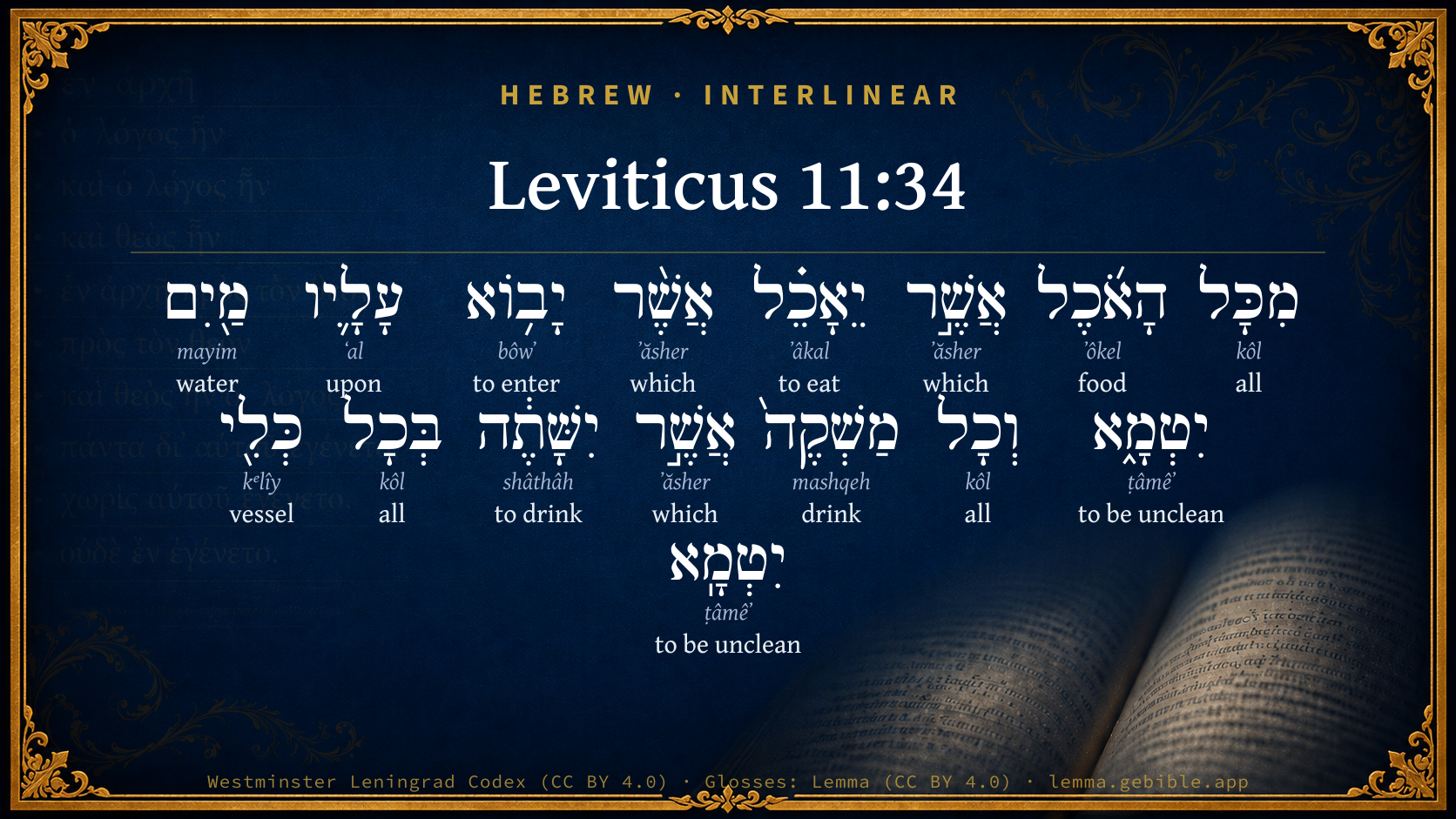
Leviticus 11:34

Hebrew (Westminster Leningrad Codex) Leviticus 11:34 appears in the Hebrew Old Testament. The text above is from the Westminster Leningrad Codex. Each word links to its Strong’s number, a concise gloss, and parsing drawn from the Open Scriptures Hebrew Bible morphology. Click any word for its full Brown-Driver-Briggs (BDB) entry.
Download image
Cite this verse

Leviticus 11:34 (World English Bible). Public Domain. Lemma interlinear Bible study tool, https://lemma.gebible.app/v/leviticus/11/34.

Show BibTeX & RIS
BibTeX
RIS
English Translation
All food which may be eaten, that on which water comes, shall be unclean; and all drink that may be drunk in every such vessel shall be unclean.
World English Bible · Public Domain
Download a study sheet

One document with this verse’s original text, its word-by-word gloss line, the meaning frame, cross-references with their text, attributed commentary, and full source and license credits — printable, and it pastes into notes with its structure intact.

This verse Autodidact and up

Study sheet (.html) Plain text (.txt)

A passage Seminary Student

Up to 50 verses in one chapter. A passage sheet keeps up to 6 commentary sources and 12 cross-references per verse, in the order this page ranks them, and says so on the sheet whenever that leaves anything out. Ask for a single verse and you get the Autodidact verse sheet above.

Everything on this page stays free to read, with no account — the sheet is a download of what is already on screen, not access to it.

Want to remove ads? Support Godless Engineer
Compare translations 3

The same verse in 3 English versions, stacked beneath the original-language interlinear above. Click any original word for its lexicon entry.

Each is an independent rendering of the whole verse — the interlinear is not word-aligned to these translations.

Highlighted words mark where these versions differ — a whole-verse word diff, not a word-by-word alignment.

  • World English Bible Public Domain
    All food which may be eaten, that on which water comes, shall be unclean; and all drink that may be drunk in every such vessel shall be unclean.
  • King James Version Public Domain
    Of all meat which may be eaten, that on which such water cometh shall be unclean: and all drink that may be drunk in every such vessel shall be unclean.
  • unfoldingWord Literal Text CC BY-SA 4.0
    Any food that is eaten that water comes onto, it will become unclean. And any drink that is drunk from any vessel will become unclean,

unfoldingWord Literal Text — © unfoldingWord, licensed CC BY-SA 4.0. Word-aligned USFM3 via Door43 (git.door43.org/unfoldingWord/en_ult).

Versions to compare (up to 4)

3 of 4 selected

Show all 18 translations

Every available English version of this verse, each an independent rendering of the whole verse.

  • World English Bible Public Domain
    All food which may be eaten, that on which water comes, shall be unclean; and all drink that may be drunk in every such vessel shall be unclean.
  • Berean Standard Bible Public Domain
    Any food coming into contact with water from that pot will be unclean, and any drink in such a container will be unclean.
  • Majority Standard Bible Public Domain
    Any food coming into contact with water from that pot will be unclean, and any drink in such a container will be unclean.
  • King James Version Public Domain
    Of all meat which may be eaten, that on which such water cometh shall be unclean: and all drink that may be drunk in every such vessel shall be unclean.
  • American Standard Version (1901) Public Domain
    All food `therein' which may be eaten, that on which water cometh, shall be unclean; and all drink that may be drunk in every `such' vessel shall be unclean.
  • Revised Version (1885) Public Domain
    All food therein which may be eaten, that on which water cometh, shall be unclean: and all drink that may be drunk in every such vessel shall be unclean.
  • Geneva Bible (1599) Public Domain
    Al meate also that shalbe eaten, if any such water come vpon it, shalbe vncleane: and all drinke that shalbe drunke in al such vessels shalbe vncleane.
  • Douay-Rheims (1899) Public Domain
    Any meat which you eat, if water from such a vessel be poured upon it, shall be unclean; and every liquor that is drunk out of any such vessel, shall be unclean.
  • Young's Literal Translation Public Domain
    `Of all the food which is eaten, that on which cometh `such' water, is unclean, and all drink which is drunk in any `such' vessel is unclean;
  • Literal Standard Version CC BY-SA 4.0
    Of all the food which is eaten, that on which comes [such] water, is unclean, and all drink which is drunk in any [such] vessel is unclean;
  • Unlocked Literal Bible CC BY-SA 4.0
    Any food that could be eaten but has water on it from such a pot is unclean. Any liquid that is for drinking from such a pot is unclean.
  • unfoldingWord Literal Text CC BY-SA 4.0
    Any food that is eaten that water comes onto, it will become unclean. And any drink that is drunk from any vessel will become unclean,
  • Darby Bible Public Domain
    All food that is eaten on which [such] water hath come shall be unclean; and all drink that is drunk shall be unclean, in every [such] vessel.
  • World Messianic Bible Public Domain
    All food which may be eaten which is soaked in water shall be unclean. All drink that may be drunk in every such vessel shall be unclean.
  • Webster's Bible Public Domain
    Of all meat which may be eaten, that on which such water cometh shall be unclean: and all drink that may be drank in every such vessel, shall be unclean.
  • Free Bible Version CC BY-SA 4.0
    If water from that pot touches any food, that food becomes unclean, and any drink from a pot like that also becomes unclean.
  • Bible in Basic English Public Domain
    Any food in it, and anything on which water from it comes, will be unclean: any drink taken from such a vessel will be unclean.
  • JPS Tanakh (1917) Public Domain
    All food therein which may be eaten, that on which water cometh, shall be unclean; and all drink in every such vessel that may be drunk shall be unclean.

Literal Standard Version (2020), Covenant Press — licensed CC BY-SA 4.0. Text via the HelloAO Bible API (eBible.org). Unlocked Literal Bible (unfoldingWord) — licensed CC BY-SA 4.0. Text via the HelloAO Bible API (eBible.org). unfoldingWord Literal Text — © unfoldingWord, licensed CC BY-SA 4.0. Word-aligned USFM3 via Door43 (git.door43.org/unfoldingWord/en_ult). Free Bible Version, Dr. Jonathan Gallagher — licensed CC BY-SA 4.0. Text via the HelloAO Bible API (eBible.org).

Word by word

More ways to search: Search by grammar → Find every occurrence → Compare this word →

Practice this passage: Drill this verse → Learn its vocabulary →

מַשְׁקֶה֙
mashqeh
H4945
“drink”
Noun, Common, Masculine, Singular, Absolute
Part of Speech
Noun
Type
Common
Gender
Masculine
Number
Singular
State
Absolute
Full BDB Definition

Origin: from H8248

TWOT: 2452c

irrigation, drink - irrigation - drink, drinking vessels - butlership (office of butler) - butler, cup-bearer
  1. מִכָּל kôl H3605 “from · all of” Preposition + Noun, Common, Masculine, Singular, Construct
  2. הָאֹ֜כֶל ʼôkel H400 “the · food” Particle, Definite Article + Noun, Common, Masculine, Singular, Absolute
  3. אֲשֶׁ֣ר ʼăsher H834 “which” Particle, Relative
  4. יֵאָכֵ֗ל ʼâkal H398 “to eat” Verb, Niphal, Imperfect, 3rd Person, Masculine, Singular
  5. אֲשֶׁ֨ר ʼăsher H834 “which” Particle, Relative
  6. יָב֥וֹא bôwʼ H935 “to enter” Verb, Qal, Imperfect, 3rd Person, Masculine, Singular
  7. עָלָ֛יו ʻal H5921 “upon · him” Preposition + Suffix, Personal, 3rd Person, Masculine, Singular
  8. מַ֖יִם mayim H4325 “water(s)” Noun, Common, Masculine, Plural, Absolute
  9. יִטְמָ֑א ṭâmêʼ H2930 “to be unclean” Verb, Qal, Imperfect, 3rd Person, Masculine, Singular
  10. וְכָל kôl H3605 “and · all of” Conjunction + Noun, Common, Masculine, Singular, Construct
  11. אֲשֶׁ֣ר ʼăsher H834 “which” Particle, Relative
  12. יִשָּׁתֶ֔ה shâthâh H8354 “to drink” Verb, Niphal, Imperfect, 3rd Person, Masculine, Singular
  13. בְּכָל kôl H3605 “in/at · all of” Preposition + Noun, Common, Masculine, Singular, Construct
  14. כְּלִ֖י kᵉlîy H3627 “vessel” Noun, Common, Masculine, Singular, Absolute
  15. יִטְמָֽא ṭâmêʼ H2930 “to be unclean” Verb, Qal, Imperfect, 3rd Person, Masculine, Singular

About this verse

These counts appear in no published source. They are computed here, from the morphology-tagged text and Lemma’s own curated glosses. What Lemma adds →

16
words
11
distinct lemmas
Pentateuch
section

Notable vocabulary

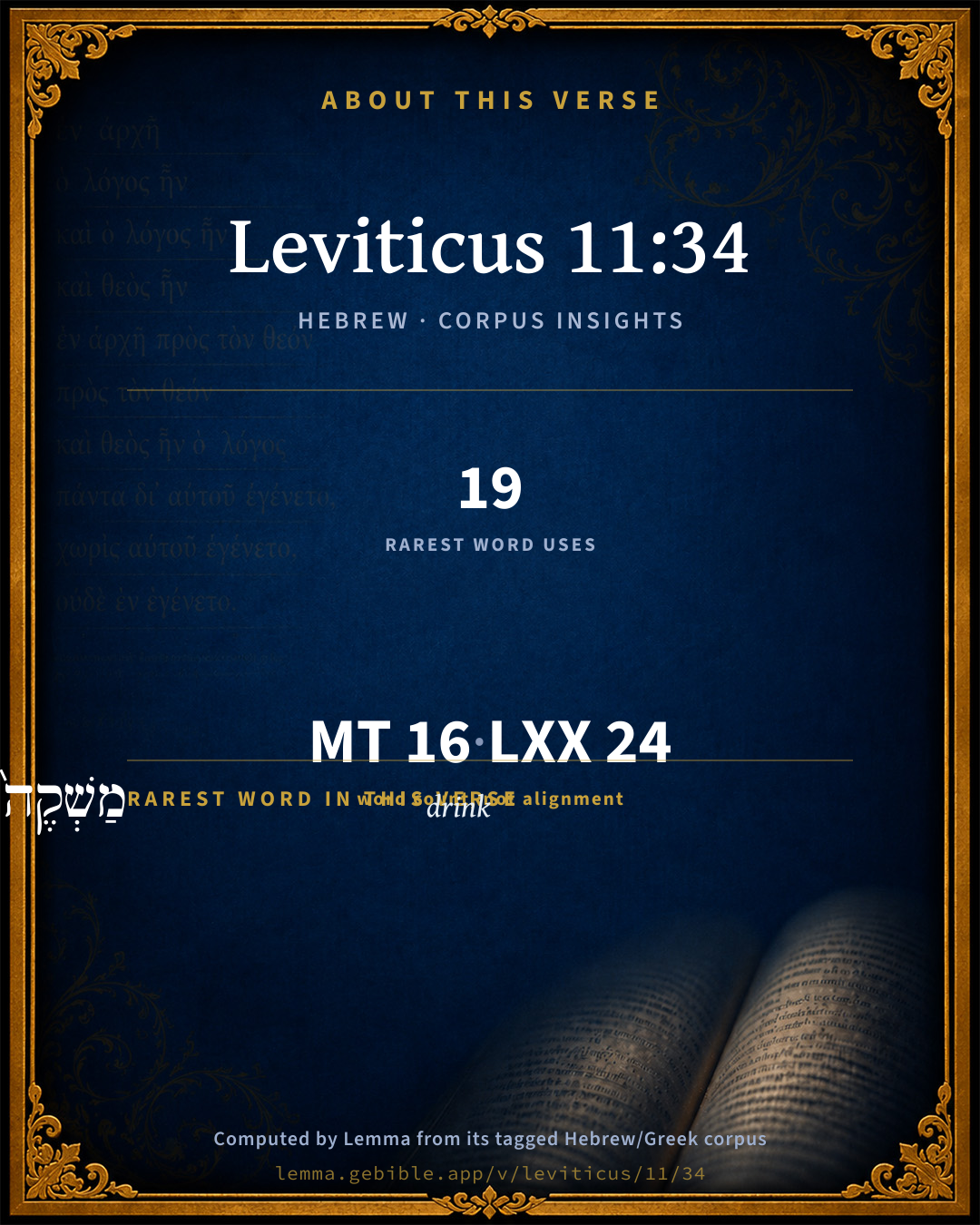
The rarest word here is מַשְׁקֶה֙ drink H4945 — appearing just 19 times in the whole Hebrew Bible.

Shared distinctive vocabulary

מַשְׁקֶה֙ drink H4945 occurs in 18 verses of the Hebrew Bible. Also found in:

Grammatical profile

  • 5 verbs
  • 7 nouns
  • 1 preposition
  • 3 particles

Verb forms

  • יֵאָכֵ֗ל Niphal · Imperfect
  • יָב֥וֹא Qal · Imperfect
  • יִטְמָ֑א Qal · Imperfect
  • יִשָּׁתֶ֔ה Niphal · Imperfect
  • יִטְמָֽא Qal · Imperfect

Repetition

Words recur within this verse — often emphatic in Hebrew:

  • מִכָּל all H3605 ×3
  • יִטְמָ֑א to be unclean H2930 ×2
  • אֲשֶׁ֣ר which H834 ×3

Hebrew & Septuagint length

In English translation the verse runs 28 words from the Hebrew and 31 from the Septuagint (LXX English) — closely comparable.

A rough comparison of the two English renderings, which tokenize alike — not a word-level alignment.

Word counts can differ between the Hebrew and the Greek without any difference in meaning — e.g. the Hebrew direct-object marker אֵת has no separate Greek word, and Greek often adds the article ὁ.

In the original languages it is 16 Hebrew tokens and 24 Greek tokens — but the two are counted differently (Hebrew bundles its prefixes and suffixes into one token; the Greek is in lemma form), so that isn’t a like-for-like length.

Cross-references

5

Topical passages linked to Leviticus 11:34 in the Treasury of Scripture Knowledge — connected by theme and wording, ordered by reader-vote popularity; previews shown in the World English Bible.

  • Proverbs 15:8 The sacrifice made by the wicked is an abomination to Yahweh, But the prayer of the upright is his delight.
  • Proverbs 21:4 A high look, and a proud heart, The lamp of the wicked, is sin.
  • Proverbs 21:27 The sacrifice of the wicked is an abomination: How much more, when he brings it with a wicked mind!
  • Proverbs 28:8 He who increases his wealth by excessive interest Gathers it for one who has pity on the poor.
  • Titus 1:15 To the pure, all things are pure; but to those who are defiled and unbelieving, nothing is pure; but both their mind and their conscience are defiled.

Cross-references courtesy of OpenBible.info (CC BY 4.0).

Hebrew and Greek witnesses Masoretic Hebrew ↔ Greek Septuagint

The same verse in the two great witnesses to the Old Testament, shown verse-for-verse.

These are two independent witnesses, not word-aligned to each other, and the Septuagint is shown in lemma (dictionary) form.

Hebrew Leviticus 11:34 Masoretic · Westminster Leningrad Codex

מִכָּל הָאֹ֜כֶל אֲשֶׁ֣ר יֵאָכֵ֗ל אֲשֶׁ֨ר יָב֥וֹא עָלָ֛יו מַ֖יִם יִטְמָ֑א וְכָל מַשְׁקֶה֙ אֲשֶׁ֣ר יִשָּׁתֶ֔ה בְּכָל כְּלִ֖י יִטְמָֽא

All food which may be eaten, that on which water comes, shall be unclean; and all drink that may be drunk in every such vessel shall be unclean.

World English Bible · Public Domain

Greek LXX Leviticus 11:34 Septuagint · lemma form

καί πᾶς βρῶμα ὅς ἐσθίω εἰς ὅς ἐάν ἐπιἔρχομαι ἐπί αὐτός ὕδωρ ἀκάθαρτος εἰμί καί πᾶς ποτός ὅς πίνω ἐν πᾶς ἀγγεῖον ἀκάθαρτος εἰμί

And all food that is eaten, on which water shall come from such a vessel, shall be unclean; and every beverage which is drunk in any such vessel, shall be unclean.

LXX2012 (modern English Septuagint) · Public Domain

Hebrew: Westminster Leningrad Codex (CC BY 4.0). Greek: Septuagint (public domain); English from LXX2012 (modern English Septuagint) (Public Domain). How the Septuagint differs from the Hebrew →

Targum (Aramaic paraphrase)

2

The Targum is the ancient Jewish Aramaic paraphrase of the Hebrew Scriptures — an interpretive translation, not the Hebrew text itself. Onkelos (literal) and Pseudo-Jonathan (expansive) render the Torah, and Jonathan the Prophets. Coverage is partial: where no permissively-licensed English translation exists for a verse, only the Aramaic is shown. This is verse-level text, not a word-by-word alignment to the Hebrew.

  1. Targum Onkelos Torah (Genesis–Deuteronomy)
    מִכָּל מֵיכְלָא דְמִתְאֲכֵל דִי יַעֲלוּן עֲלוֹהִי מַיָא יְהֵי מְסָאָב וְכָל מַשְׁקֵה דִי יִשְׁתֵּתֵי בְּכָל מָאן יְהֵי מְסָאָב

    (no public-domain English translation for this verse)

    Targum Onkelos — Aramaic: “Onkelos Genesis” (public domain); “Onkelos Exodus” (public domain); “Onkelos Leviticus” (public domain); “Onkelos Numbers” (public domain); “Onkelos Deuteronomy” (public domain). English: “Sefaria Community Translation” (CC0 1.0 (public-domain dedication)); “J.W. Etheridge. The Targums of Onkelos and Jonathan Ben Uzziel on the Pentateuch. London: Longmans, Green, 1862” (public domain). Text via Sefaria.

  2. Targum Pseudo-Jonathan Torah (Genesis–Deuteronomy)
    מִכָּל מֵיכְלָא דְמִתְאֲכֵיל דִי יֵיעָלוּן עֲלוֹי מוֹי יְהֵי מְסָאָב וְכָל מַשְׁקֵי דְיִשְׁתֵּיתֵי בְּכָל מָאן יְהֵי מְסָאָב

    all food for eating upon which (such) water cometh shall be unclean, and any fluid which is used for drinking in any such vessel shall be unclean.

    Targum Pseudo-Jonathan — Aramaic: “Targum Jonathan on Genesis” (public domain); “Targum Jonathan on Exodus” (public domain); “Targum Jonathan on Leviticus” (public domain); “Targum Jonathan on Numbers” (public domain); “Targum Jonathan on Deuteronomy” (public domain). English: “The Targum of Jonathan ben Uzziel, trans. J. W. Etheridge, London, 1862” (public domain). Text via Sefaria.

Commentary

Notes on Leviticus 11:34 from classic Christian and Jewish commentators (each source and its license shown beneath its notes). The classic Christian expositions comment on the surrounding passage and are grouped to its opening verse, so a note may address several verses; the Jewish commentaries on the Tanakh (Rashi and others) are per-verse, so they appear only where the commentator wrote on this verse.

Lemma curates 59 commentaries, every one of them public domain or Creative Commons licensed, each selected and text-cleaned for this edition rather than reprinted as found. About our sources →

Trapp's Complete Commentary

John Trapp

Lev 11:34 Of all meat which may be eaten, [that] on which [such] water cometh shall be unclean: and all drink that may be drunk in every [such] vessel shall be unclean.

Ver. 34. Such water.] Coming out of such an unclean place, or vessel.

John Trapp, A Commentary or Exposition upon All the Books of the Old and New Testament (1647–1656) — public domain. Text from a community e-Sword module.

Joseph Benson's Commentary

Lev 11:34. That on which such water cometh — That flesh, or herbs, or other food which is dressed in water, in a vessel so polluted, shall be unclean: not so, if it be food which is eaten dry, as bread, or fruits; the reason of which difference seems to be this, that the water did sooner receive the pollution in itself, and convey it to the food so dressed. All this was intended to teach them to avoid carefully every thing that was polluted in their common actions. Not only the vessels of the sanctuary, but every pot in Jerusalem and Judah must be holiness to the Lord, Zec 14:20. The laws in these cases were very critical, and the observance of them would be difficult, and the exceptions also were very nice: but it was all designed to exercise them to a constant care and exactness in their obedience. And we, who by Christ are delivered from these burdensome observances, are hereby taught not to be less circumspect in the more weighty matters of the law. We ought as industriously to preserve our precious souls from the pollutions of sin, and as speedily to cleanse them when they are polluted, as they were to preserve and cleanse their bodies and household goods from these ceremonial pollutions.

Joseph Benson's Commentary on the Old and New Testaments (1811–1818) — public domain. Text from a community e-Sword module.

Ellicott's Commentary for English Readers

(34) That on which such water cometh.—Better, upon which water cometh, that is, all food which is prepared with water for eating becomes defiled when the carcase of such an unclean reptile falls on it. The same is the case with any beverage which is drank from any kind of vessel; if the said carcase falls into it, it is rendered unclean. According, however, to the canons which obtained during the second Temple, the import of the first part of this verse is that things which constitute man’s meat, only then become defiled by the carcase in question when any water whatsoever has been poured upon them, though these articles of food have afterwards become dry; but when they have not been moistened they do not become defiled. By water these authorities understand any of the following seven liquids :—water, dew, oil, wine, milk, blood, and honey.

A Bible Commentary for English Readers, edited by Charles John Ellicott (1878–1897) — public domain. Text from a community e-Sword module.

The Cambridge Bible for Schools and Colleges

gen. ed. J. J. S. Perowne

34. Any food mixed with or put in water (for cooking or eating) and any drink into or upon which one of these swarming things has fallen is unclean.

The Cambridge Bible for Schools and Colleges (gen. ed. J. J. S. Perowne; Cambridge University Press, 1878–1918) — public domain. Text from a community e-Sword module.

John Gill's Exposition

Of all meat which may be eaten,.... Which otherwise is lawful to eat and fit for food, whether herbs, or whether the flesh of clean creatures:

that on which such water cometh shall be unclean; that is, such water as is put into an unclean vessel, become so by the fall of any unclean reptile into it; wherefore such water poured out upon any sort of food, clean and fit to eat, or that is put into such water, to be dressed, it becomes unclean and unfit to eat; for the vessel, being unclean, defiles the water, and the water defiles the food: Jarchi interprets this of water in general, which coming upon anything eatable, prepares it for uncleanness; "we learn (says he) that no food is fit and prepared to receive defilement until water comes upon it once; and after it is come upon it once, it receives defilement for ever, even though it becomes dry;'' but the former seems to be the true sense:

and all drink that may be drank in every such vessel shall be unclean; whatever otherwise might be lawfully drank, yet being put into such a vessel, into which any unclean reptile was fallen, or being in it when it fell into it, became unclean and not fit to be drank; and those liquors which receive uncleanness, and make meats unclean by coming on them, according to the Misnic doctors (w), are these seven, dew, water, wine, oil, blood, milk, and honey. (w) Misn. Machshirin, c. 6. sect. 4.

John Gill's Exposition of the Whole Bible (1746–1763) — public domain (CC PDM 1.0). Text via the HelloAO Bible API.

Haydock's Catholic Bible Commentary

Water, unclean, or in a polluted vessel.

George Leo Haydock (1774–1849), Haydock's Catholic Family Bible and Commentary, 1859 edition — public domain. Excludes Psalms (Douay-Rheims chapter numbering differs from Protestant) and Deuterocanonical books (Catholic canon only).

Matthew Poole's English Annotations

That on which such water cometh: the meaning is, that flesh or herbs, or other food which is dressed in water, to wit, in a vessel so polluted, shall be unclean; not so, if it be food which is eaten dry, as bread, fruits, &c., the reason of which difference seems to be this, that the water did sooner receive the pollution in itself, and convey it to the food so dressed.

Matthew Poole's English Annotations on the Holy Bible (1683–1685) — public domain. Text from a community e-Sword/MySword module.

John Wesley's Explanatory Notes

That on which such water cometh - That flesh or herbs or other food which is dressed in water, in a vessel so polluted, shall be unclean; not so, if it be food which is eaten dry, as bread, or fruits; the reason of which difference seems to be this, that the water did sooner receive the pollution in itself, and convey it to the food so dressed.

John Wesley, Explanatory Notes Upon the Whole Bible (1754–1765) — public domain. Text via the GEBible commentary corpus.

unfoldingWord translationNotes

Door43 World Missions Community

unclean

Food becomes unacceptable for the people to eat because unclean water has fallen on it is spoken of as if it were physically unclean. (See: Metaphor)

carcasses

dead bodies

must be broken to pieces

This can be translated in active form. AT: "You must break it to pieces" or "You must shatter it" (See: Active or Passive)

translationWords

clean

water

clean

unfoldingWord translationNotes — © Distant Shores Media and the Door43 World Missions Community, licensed CC BY-SA 4.0. Source: git.door43.org/Door43/en_tn.

Rashi

Rabbi Shlomo Yitzchaki (Rashi)

מכל האכל אשר יאכל OF ALL THE FOOD WHICH MAY BE EATEN — This is to be connected with the preceding verse (consequently the words ואתו תשברו v. 33 are a parenthesis): “whatsoever is in it shall be unclean”; viz., anything of all food which may be eaten upon which water has once come, if it is in an earthen vessel which is unclean, itself becomes unclean. [And similarly all drink that may be drunk in any vessel, if it is in an earthen vessel that is unclean, itself becomes unclean]. From this we learn several things: we learn that food is not fitted and liable to become unclean until water has once come upon it, and after water has once come on it it can any time after become unclean, and even after it has become dry; that wine and oil and anything which is termed משקה, liquid, (besides the three mentioned, also blood, milk, dew and honey of bees; cf. Mishnah Makhshirin 6:4) makes vegetation fitted to become unclean even as water does, for thus must the verse be expounded: any food upon which there cometh water or any liquid which may be drunk out of any vessel, that food shall become unclean. Further our Rabbis derive from here the law that a “secondary uncleanness” (ולד הטומאה) cannot render “vessels” (a term used to denote anything except food and animate beings) unclean. For thus we read in a Boraitha (Pesachim 20a): One might think, since Scripture states v. 33: anything that is inside it shall be unclean, that all “vessels” that are placed inside an earthen vessel become unclean through the medium of the interior of an earthen vessel (i. e. because they are in contact with the earthen vessel which has itself become unclean through something unclean having been inside it)! It, however, says: all that is within it shall become unclean … of any food etc., — i.e., food [and liquids] may become unclean through the medium of the interior of an unclean earthen vessel, but no “vessels” can become unclean through the medium of the interior of an unclean earthen vessel. Now since a dead שרץ, “reptile” (which causes the uncleanness to the earthen vessel) is a primary source of uncleanness (אב הטומאה) and the object which has been rendered unclean by it (in this case the כלי חרס) is a secondary uncleanness (ולד הטומאה), consequently we have the rule that the latter a secondary uncleanness — cannot in turn render unclean “vessels” which are in it. And we further learn from this (Pesachim 20a) that if a dead reptile (שרץ) falls into the interior of an earthen oven in which there is bread, but the reptile does not come in contact with the bread, the oven becomes a secondary source of uncleanness of the first degree (ראשון לטומאה) and the bread one of the second degree (because the bread only becomes unclean through having come in contact with the oven which is only a secondary source of uncleanness of the first degree, and not a primary source): and we do not say that we regard the oven which contains the primary source as though it were full of uncleanness, and is itself a primary source, so that the bread should be a secondary uncleanness of the first degree (תחלה), as though it had itself touched the primary source; for if you argue so, then any article which is in an earthen vessel is not excluded from becoming unclean through the medium of its interior (whilst we have just stated that “vessels” are excluded — that in such a case they do not become unclean), because you see, if we assume that the whole interior is full of a primary source of uncleanness, it would be as though this uncleanness itself has touched them (the objects) on their outside and then the objects would indeed have become unclean: we, however, have stated that in such a case they do not become unclean; therefore we do not assume that the primary source of uncleanness fills the whole interior: the bread therefore receives the uncleanness not from the carcass but from the oven and is thus a secondary uncleanness of the second degree which does not further transfer its uncleanness to things which have no sacred character. — And we further learn (Chullin 118b; cf. Sifra, Shemini, Section 8 2) in regard to the “coming of water”, that this does not render vegetation fitted to become unclean unless it falls upon them after they have been plucked; because if you say that they (the vegetation) can acquire this fitness whilst still attached to the soil, then the law has no significance at all, for you have no growing vegetation upon which water does not fall at some time or other, and what, then, is the sense of Scripture saying, “upon which water cometh”? — And we further learn (Yoma 80a) that articles of food which are unclean do not render other food unclean unless the former contains at least a volume equal to that of an egg, for it says: “[food] which may be eaten”, i.e. food which may be eaten at one time, and our Rabbis calculated that the gullet does not hold more than a hen’s egg (Sifra, Shemini, Chapter 9 1; cf. also Yoma 80a).

Rashi on the Tanakh — English translations: “The Judaica Press complete Tanach with Rashi, translated by A. J. Rosenberg” (CC BY 4.0); “Pentateuch with Rashi's commentary by M. Rosenbaum and A.M. Silbermann, 1929-1934” (public domain); “The Metsudah Tanach series, Lakewood, N.J” (CC BY 4.0); and “The Book of Joshua, Metsudah Publications, 1997” (CC BY 4.0). Text via Sefaria.

Ramban (Nachmanides)

Rabbi Moshe ben Nachman (Ramban / Nachmanides)

OF ALL THE FOOD WHICH MAY BE EATEN, THAT ON WHICH WATER COMETH, SHALL BE UNCLEAN. Rashi commented: “This verse according to its [Rabbinical] interpretations teaches many things. We learn that food does not become fit to be susceptible of impurity until water has once come upon it, and once water has come upon it, it can subsequently at any time become impure, even after it has become dry, etc. Our Rabbis have further learned from this verse that ‘a secondary impurity’ does not render vessels impure, for so we are taught etc. Again we learn that the coming of water upon vegetation makes it susceptible to impurity only after it has been plucked from the soil etc.” And included among the principles [we learn from this verse], Rashi said: “And we further learn that impure foodstuff does not convey impurity to other objects unless it [the former] consists of at least the size of an egg, for it says, of all the food which may be eaten, which means food which can be eaten in one gulp, and the Sages calculated that the esophagus does not hold more than a hen’s egg.” This is the language of the Rabbi [Rashi.].But there is [too great a] brevity in Rashi’s comment. For this verse speaks about foodstuff itself becoming impure, and does not refer to its conveying impurity to others. The Rabbi [Rashi], however, derived this principle from what the Rabbis have said in the Torath Kohanim: 9:1. “Of all the food etc. shall be unclean. This teaches that food [upon which a dead creeping thing falls], is rendered impure even if it be of the smallest quantity. Now I might think that it can also convey impurity to other objects if the [original] impure food was of the smallest quantity; Scripture therefore says, which may be eaten. Thus you learn that it cannot render other things impure unless it is itself the size of an egg.” as applying to “impure” food conveying impurity to others, the verse teaching us that the conveyor of the impurity must be of the size which may be eaten, which is, as explained above, the size of an egg. The verse could not refer to the original foodstuff itself becoming impure because of having touched a dead creeping thing [or any “father of impurity” — see above Note 251], for in that case even the smallest quantity of food suffices to be rendered impure. — But, Ramban continues, other scholars have already differed with Rashi on this point, bringing proof etc. (see text). But other authorities have already differed with the Rabbi [Rashi], and they brought proofs that by Scriptural law foodstuffs do not [even] become impure at all unless they are of the size of an egg. Thus the interpretation of the Torath Kohanim [mentioned above] is merely a Scriptural support for a Rabbinic law, p. 314, Note 449. the Rabbis having added [the stricture] that foodstuffs of even the smallest size also become impure [although they cannot convey impurity to others unless they themselves are the size of an egg]. The main interpretation of the verse is as the Rabbis have said there [in the Torath Kohanim]: 9:1. “The food. This is to exclude food for cattle [that it is not susceptible to impurity]. Of all the food — this is to include food for cattle which one intended to use for human consumption. Which may be eaten, excepting decomposed foods.”

Ramban (Nachmanides) on the Tanakh — English translation: “Commentary on the Torah by Ramban (Nachmanides). Translated and annotated by Charles B. Chavel. New York, Shilo Pub. House, 1971-1976” (CC BY 4.0). Text via Sefaria.

Lesson kit

Teaching starters — assembled from the data on this page, not authored interpretation. Every prompt links to the verse data it draws on. Edit before teaching.

Leviticus, in the Pentateuch, opens this verse with 16 words (11 distinct Hebrew lemmas). Its most distinctive word is mashqeh (“drink”). A historical commentator’s framing appears above. Read the whole chapter for the surrounding context.

Discussion questions

  1. What does “drink” (mashqeh) contribute to the verse as a whole?
  2. How does Genesis 13:10, which shares the word «drink», read alongside this verse?
  3. What does the repetition of “all” (3× in this one verse) do in this verse?
  4. These translations render this verse differently; the difference is in the English rendering, not the original. What questions does that raise?
  5. «יֵאָכֵ֗ל» is a Niphal Imperfect verb. How does that grammatical form shape the action described?
  6. Compare how Trapp's Complete Commentary and Joseph Benson's Commentary read this verse. Where do they agree or differ?

Things to notice

Reading settings

Reading text

Shown beneath each verse's original-language words.

Old Testament
Old Testament edition

Read the OT as the Masoretic Hebrew (MT) or the Greek Septuagint (LXX).

English shown for the Greek Septuagint (in the Hebrew ↔ Greek comparison).

Comparing translations? Open the Compare panel on any verse page to stack up to four side by side.