
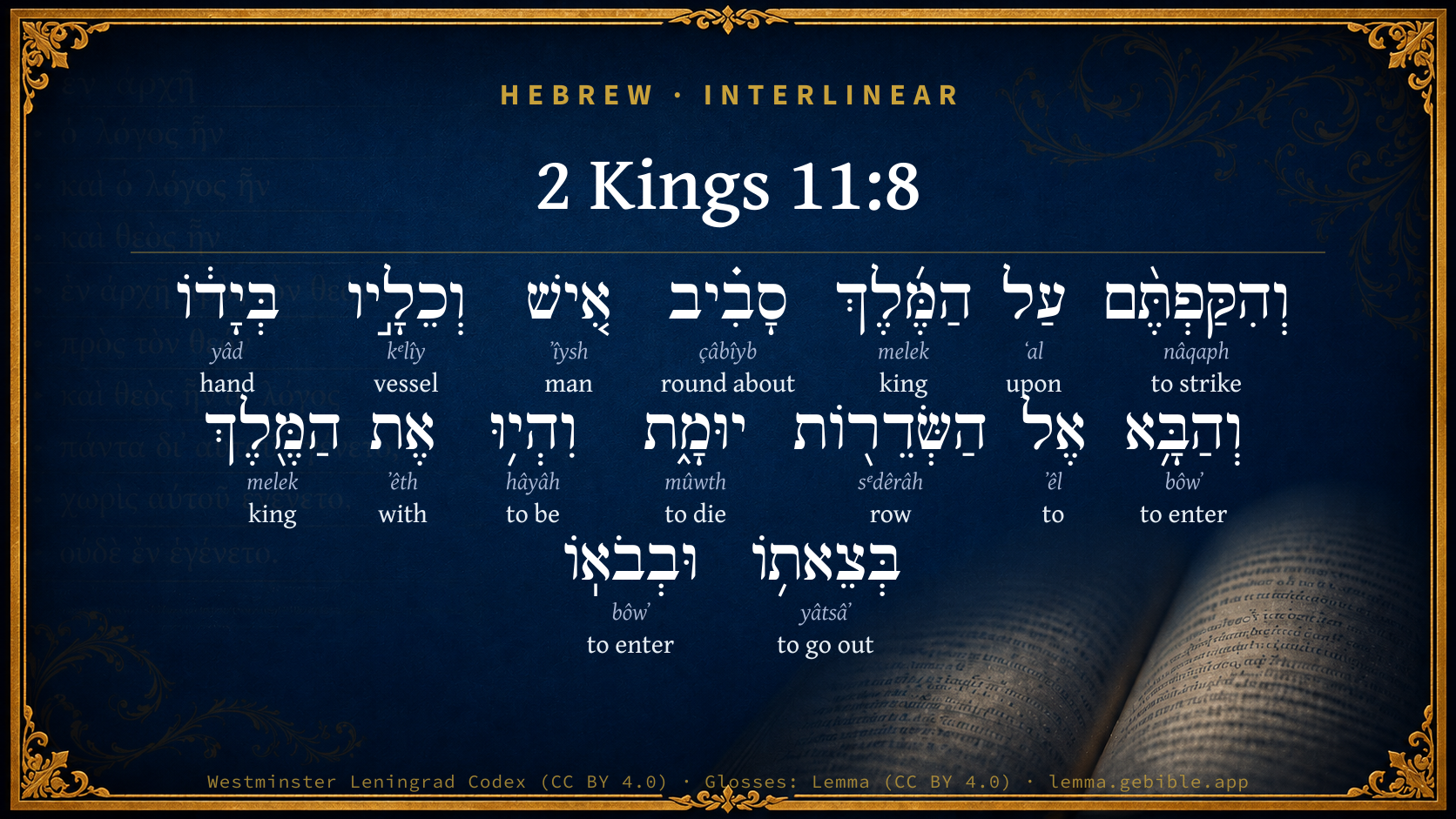
2 Kings 11:8

Hebrew (Westminster Leningrad Codex) 2 Kings 11:8 appears in the Hebrew Old Testament. The text above is from the Westminster Leningrad Codex. Each word links to its Strong’s number, a concise gloss, and parsing drawn from the Open Scriptures Hebrew Bible morphology. Click any word for its full Brown-Driver-Briggs (BDB) entry.
Download image
Cite this verse

2 Kings 11:8 (World English Bible). Public Domain. Lemma interlinear Bible study tool, https://lemma.gebible.app/v/2-kings/11/8.

Show BibTeX & RIS
BibTeX
RIS
English Translation
You shall compass the king round about, every man with his weapons in his hand; and he who comes within the ranks, let him be slain: and be you with the king when he goes out, and when he comes in.
World English Bible · Public Domain
Download a study sheet

One document with this verse’s original text, its word-by-word gloss line, the meaning frame, cross-references with their text, attributed commentary, and full source and license credits — printable, and it pastes into notes with its structure intact.

This verse Autodidact and up

Study sheet (.html) Plain text (.txt)

A passage Seminary Student

Up to 50 verses in one chapter. A passage sheet keeps up to 6 commentary sources and 12 cross-references per verse, in the order this page ranks them, and says so on the sheet whenever that leaves anything out. Ask for a single verse and you get the Autodidact verse sheet above.

Everything on this page stays free to read, with no account — the sheet is a download of what is already on screen, not access to it.

Want to remove ads? Support Godless Engineer
Compare translations 3

The same verse in 3 English versions, stacked beneath the original-language interlinear above. Click any original word for its lexicon entry.

Each is an independent rendering of the whole verse — the interlinear is not word-aligned to these translations.

Highlighted words mark where these versions differ — a whole-verse word diff, not a word-by-word alignment.

  • World English Bible Public Domain
    You shall compass the king round about, every man with his weapons in his hand; and he who comes within the ranks, let him be slain: and be you with the king when he goes out, and when he comes in.
  • King James Version Public Domain
    And ye shall compass the king round about, every man with his weapons in his hand: and he that cometh within the ranges, let him be slain: and be ye with the king as he goeth out and as he cometh in.
  • unfoldingWord Literal Text CC BY-SA 4.0
    And you shall surround around the king all around, a man with his weapons in his hand, and one coming to the ranks shall be killed. And be with the king when he goes out and when he comes in.”

unfoldingWord Literal Text — © unfoldingWord, licensed CC BY-SA 4.0. Word-aligned USFM3 via Door43 (git.door43.org/unfoldingWord/en_ult).

Versions to compare (up to 4)

3 of 4 selected

Show all 18 translations

Every available English version of this verse, each an independent rendering of the whole verse.

  • World English Bible Public Domain
    You shall compass the king round about, every man with his weapons in his hand; and he who comes within the ranks, let him be slain: and be you with the king when he goes out, and when he comes in.
  • Berean Standard Bible Public Domain
    You must surround the king with weapons in hand, and anyone who approaches the ranks must be put to death. You must stay close to the king wherever he goes.”
  • Majority Standard Bible Public Domain
    You must surround the king with weapons in hand, and anyone who approaches the ranks must be put to death. You must stay close to the king wherever he goes.”
  • King James Version Public Domain
    And ye shall compass the king round about, every man with his weapons in his hand: and he that cometh within the ranges, let him be slain: and be ye with the king as he goeth out and as he cometh in.
  • American Standard Version (1901) Public Domain
    And ye shall compass the king round about, every man with his weapons in his hand; and he that cometh within the ranks, let him be slain: and be ye with the king when he goeth out, and when he cometh in.
  • Revised Version (1885) Public Domain
    And ye shall compass the king round about, every man with his weapons in his hand; and he that cometh within the ranks, let him be slain: and be ye with the king when he goeth out, and when he cometh in.
  • Geneva Bible (1599) Public Domain
    And ye shall compasse the King rounde about, euery man with his weapon in his hande, and whosoeuer commeth within the ranges, let him be slayne: be you with the King, as he goeth out and in.
  • Douay-Rheims (1899) Public Domain
    And you shall compass him round about, having weapons in your hands: and if any man shall enter the precinct of the temple, let him be slain: and you shall be with the king coming in and going out.
  • Young's Literal Translation Public Domain
    and ye have compassed the king round about, each with his weapons in his hand, and he who is coming unto the ranges is put to death; and be ye with the king in his going out and in his coming in.'
  • Literal Standard Version CC BY-SA 4.0
    and you have surrounded the king all around, each with his weapons in his hand, and he who is coming to the ranges is put to death; and be with the king in his going out and in his coming in.”
  • Unlocked Literal Bible CC BY-SA 4.0
    You must surround the king, every man with his weapons in his hand. Whoever enters within your ranks, let him be killed. You must stay with the king when he goes out, and when he comes in.
  • unfoldingWord Literal Text CC BY-SA 4.0
    And you shall surround around the king all around, a man with his weapons in his hand, and one coming to the ranks shall be killed. And be with the king when he goes out and when he comes in.”
  • Darby Bible Public Domain
    And ye shall encompass the king round about, every man with his weapons in his hand; and he that comes within the ranks shall be put to death; and ye shall be with the king when he goes out and when he comes in.
  • World Messianic Bible Public Domain
    You shall surround the king, every man with his weapons in his hand; and he who comes within the ranks, let him be slain. Be with the king when he goes out, and when he comes in.”
  • Webster's Bible Public Domain
    And ye shall compass the king around, every man with his weapons in his hand: and he that cometh within the ranges, let him be slain. And be ye with the king as he goeth out and as he cometh in.
  • Free Bible Version CC BY-SA 4.0
    Surround the king with weapons drawn, and anyone who approaches this line must be killed. Stay close to the king wherever he goes.”
  • Bible in Basic English Public Domain
    Will make a circle round the king, every man being armed; and whoever comes inside your lines is to be put to death; keep with the king, when he goes out and when he comes in.
  • JPS Tanakh (1917) Public Domain
    And ye shall compass the king round about, every man with his weapons in his hand; and he that cometh within the ranks, let him be slain; and be ye with the king when he goeth out, and when he cometh in.'

Literal Standard Version (2020), Covenant Press — licensed CC BY-SA 4.0. Text via the HelloAO Bible API (eBible.org). Unlocked Literal Bible (unfoldingWord) — licensed CC BY-SA 4.0. Text via the HelloAO Bible API (eBible.org). unfoldingWord Literal Text — © unfoldingWord, licensed CC BY-SA 4.0. Word-aligned USFM3 via Door43 (git.door43.org/unfoldingWord/en_ult). Free Bible Version, Dr. Jonathan Gallagher — licensed CC BY-SA 4.0. Text via the HelloAO Bible API (eBible.org).

Word by word

More ways to search: Search by grammar → Find every occurrence → Compare this word →

Practice this passage: Drill this verse → Learn its vocabulary →

הַשְּׂדֵר֖וֹת
sᵉdêrâh
H7713
“the · rows”
Particle, Definite Article + Noun, Common, Feminine, Plural, Absolute
Part of Speech
Particle + Noun
Type
Common
Gender
Feminine
Number
Plural
State
Absolute
Full BDB Definition

Origin: from an unused root meaning to regulate

TWOT: 1467b

row, rank (of soldiers) - rows, ranks - technical term of building - meaning unknown
  1. וְהִקַּפְתֶּ֨ם nâqaph H5362 “and · to strike” Conjunction + Verb, Hiphil, Sequential Perfect, 2nd Person, Masculine, Plural
  2. עַל ʻal H5921 “upon” Preposition
  3. הַמֶּ֜לֶךְ melek H4428 “the · king” Particle, Definite Article + Noun, Common, Masculine, Singular, Absolute
  4. סָבִ֗יב çâbîyb H5439 “round about” Noun, Common, Both, Singular, Absolute
  5. אִ֚ישׁ ʼîysh H376 “man” Noun, Common, Masculine, Singular, Absolute
  6. וְכֵלָ֣יו kᵉlîy H3627 “and · vessels · his” Conjunction + Noun, Common, Masculine, Plural, Construct + Suffix, Personal, 3rd Person, Masculine, Singular
  7. בְּיָד֔וֹ yâd H3027 “in/at · hand · his” Preposition + Noun, Common, Both, Singular, Construct + Suffix, Personal, 3rd Person, Masculine, Singular
  8. וְהַבָּ֥א bôwʼ H935 “and · the · entering” Conjunction + Particle, Definite Article + Verb, Qal, Participle Active, Masculine, Singular, Absolute
  9. אֶל ʼêl H413 “to” Preposition
  10. יוּמָ֑ת mûwth H4191 “to die” Verb, Hophal, Imperfect, 3rd Person, Masculine, Singular
  11. וִהְי֥וּ hâyâh H1961 “and · be” Conjunction + Verb, Qal, Imperative, 2nd Person, Masculine, Plural
  12. אֶת ʼêth H854 “with” Preposition
  13. הַמֶּ֖לֶךְ melek H4428 “the · king” Particle, Definite Article + Noun, Common, Masculine, Singular, Absolute
  14. בְּצֵאת֥וֹ yâtsâʼ H3318 “in/at · to go out · him” Preposition + Verb, Qal, Infinitive Construct + Suffix, Personal, 3rd Person, Masculine, Singular
  15. וּבְבֹאֽוֹ bôwʼ H935 “and · in/at · to enter · him” Conjunction + Preposition + Verb, Qal, Infinitive Construct + Suffix, Personal, 3rd Person, Masculine, Singular

About this verse

These counts appear in no published source. They are computed here, from the morphology-tagged text and Lemma’s own curated glosses. What Lemma adds →

16
words
14
distinct lemmas
Historical
section

Notable vocabulary

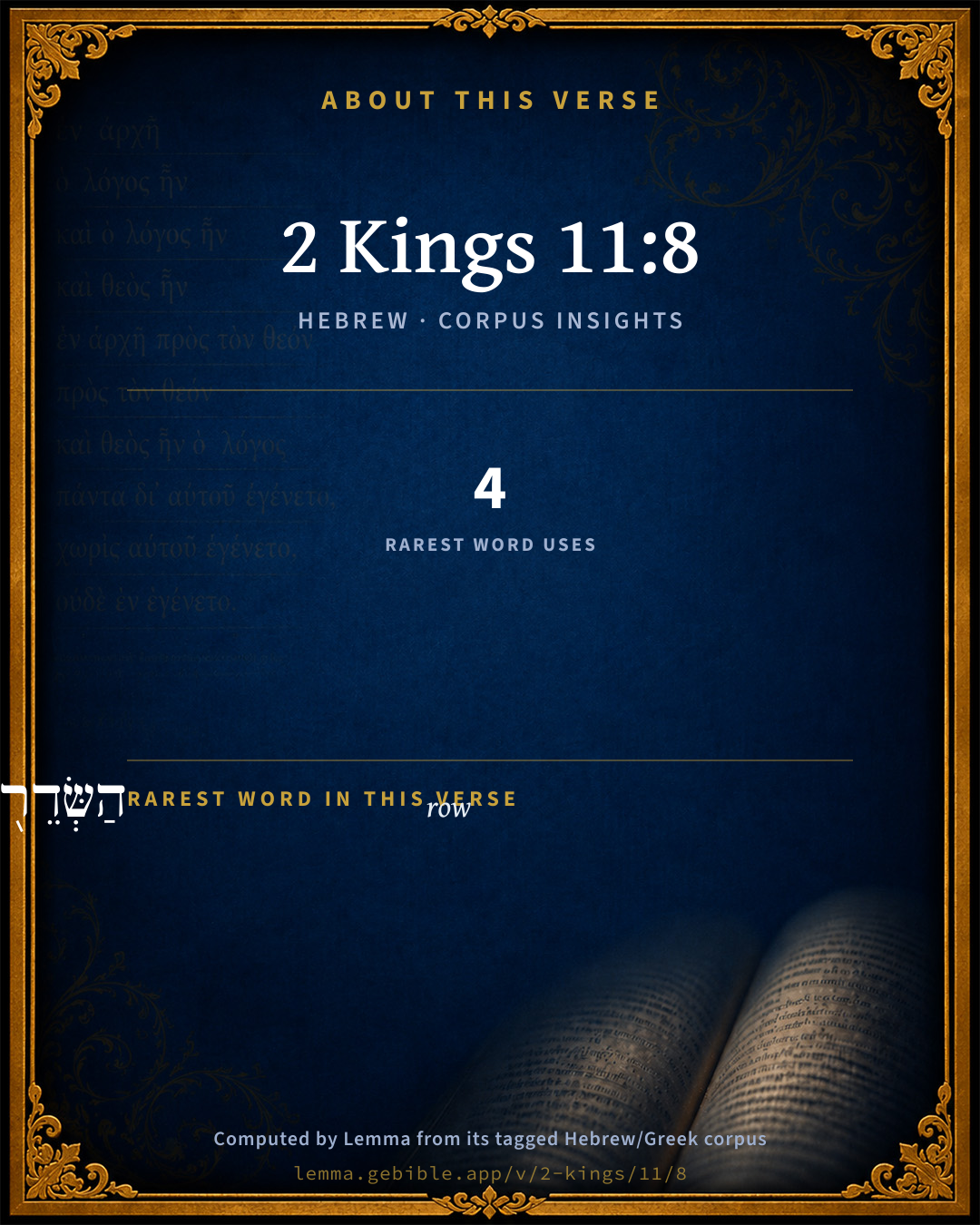
The rarest word here is הַשְּׂדֵר֖וֹת row H7713 — appearing just 4 times in the whole Hebrew Bible.

Shared distinctive vocabulary

הַשְּׂדֵר֖וֹת row H7713 occurs in 4 verses of the Hebrew Bible. Also found in:

Grammatical profile

  • 6 verbs
  • 7 nouns
  • 3 prepositions

Verb forms

  • וְהִקַּפְתֶּ֨ם Hiphil · Sequential Perfect
  • וְהַבָּ֥א Qal · Participle Active
  • יוּמָ֑ת Hophal · Imperfect
  • וִהְי֥וּ Qal · Imperative
  • בְּצֵאת֥וֹ Qal · Infinitive Construct
  • וּבְבֹאֽוֹ Qal · Infinitive Construct

Repetition

Words recur within this verse — often emphatic in Hebrew:

  • הַמֶּ֜לֶךְ king H4428 ×2
  • וְהַבָּ֥א to enter H935 ×2

Hebrew & Septuagint length

In English translation the verse runs 41 words from the Hebrew and 40 from the Septuagint (LXX English) — closely comparable.

A rough comparison of the two English renderings, which tokenize alike — not a word-level alignment.

Word counts can differ between the Hebrew and the Greek without any difference in meaning — e.g. the Hebrew direct-object marker אֵת has no separate Greek word, and Greek often adds the article ὁ.

Cross-references

5

Topical passages linked to 2 Kings 11:8 in the Treasury of Scripture Knowledge — connected by theme and wording, ordered by reader-vote popularity; previews shown in the World English Bible.

  • Exodus 21:14 If a man schemes and comes presumptuously on his neighbor to kill him, you shall take him from my altar, that he may die.
  • Numbers 27:17 who may go out before them, and who may come in before them, and who may lead them out, and who may bring them in; that the congregation of Yahweh not be as sheep which have no shepherd.
  • 1 Kings 2:28–31 The news came to Joab; for Joab had turned after Adonijah, though he didn't turn after Absalom. Joab fled to the Tent of Yahweh, and caught hold on the horns of the altar.
  • 2 Kings 11:15 Jehoiada the priest commanded the captains of hundreds who were set over the host, and said to them, Have her forth between the ranks; and him who follows her kill with the sword. For the priest said, Don't let her be slain in the house of Yahweh.
  • 2 Chronicles 23:7 The Levites shall compass the king round about, every man with his weapons in his hand; and whoever comes into the house, let him be slain: and be you with the king when he comes in, and when he goes out.

Cross-references courtesy of OpenBible.info (CC BY 4.0).

Hebrew and Greek witnesses Masoretic Hebrew ↔ Greek Septuagint

The same verse in the two great witnesses to the Old Testament, shown verse-for-verse.

These are two independent witnesses, not word-aligned to each other, and the Septuagint is shown in lemma (dictionary) form.

Hebrew 2 Kings 11:8 Masoretic · Westminster Leningrad Codex

וְהִקַּפְתֶּ֨ם עַל הַמֶּ֜לֶךְ סָבִ֗יב אִ֚ישׁ וְכֵלָ֣יו בְּיָד֔וֹ וְהַבָּ֥א אֶל הַשְּׂדֵר֖וֹת יוּמָ֑ת וִהְי֥וּ אֶת הַמֶּ֖לֶךְ בְּצֵאת֥וֹ וּבְבֹאֽוֹ

You shall compass the king round about, every man with his weapons in his hand; and he who comes within the ranks, let him be slain: and be you with the king when he goes out, and when he comes in.

World English Bible · Public Domain

Greek LXX 2 Kings 11:8 Septuagint · lemma form

καί κυκλόω ἐπί ὁ βασιλεύς κύκλος ἀνήρ καί ὁ σκεῦος αὐτός ἐν χείρ αὐτός καί ὁ εἰςπορεύομαι εἰς ὁ σαδηρωθ ἀποθνήσκω καί γίγνομαι μετά ὁ βασιλεύς ἐν ὁ ἐκπορεύομαι αὐτός καί ἐν ὁ εἰςπορεύομαι αὐτός

And do you⌃ compass the king about every man with his weapon in his hand, and he that goes into the ranges shall die: and they shall be with the king in his going out and in his coming in.

LXX2012 (modern English Septuagint) · Public Domain

Hebrew: Westminster Leningrad Codex (CC BY 4.0). Greek: Septuagint (public domain); English from LXX2012 (modern English Septuagint) (Public Domain). How the Septuagint differs from the Hebrew →

Targum (Aramaic paraphrase)

1

The Targum is the ancient Jewish Aramaic paraphrase of the Hebrew Scriptures — an interpretive translation, not the Hebrew text itself. Onkelos (literal) and Pseudo-Jonathan (expansive) render the Torah, and Jonathan the Prophets. Coverage is partial: where no permissively-licensed English translation exists for a verse, only the Aramaic is shown. This is verse-level text, not a word-by-word alignment to the Hebrew.

  1. Targum Jonathan Prophets (Joshua–Malachi)
    וְתַקְפוּן עַל מַלְכָּא סְחוֹר סְחוֹר גְבַּר וּזְיָנֵיהּ בִּידֵיהּ וּדְיֵעוּל לְגוֹ מִן סִדְרָא יִתְקְטֵיל וַהֲווֹ עִם מַלְכָּא בְּמִפְקֵיהּ וּבְמֵיעֲלֵיהּ:

    (no public-domain English translation for this verse)

    Targum Jonathan — Aramaic: “Mikraot Gedolot” (public domain). English: “Sefaria Community Translation” (CC0 1.0 (public-domain dedication)); “London "Chaldee Paraphrase," 1871” (public domain). Text via Sefaria.

Commentary

Notes on 2 Kings 11:8 from classic Christian and Jewish commentators (each source and its license shown beneath its notes). The classic Christian expositions comment on the surrounding passage and are grouped to its opening verse, so a note may address several verses; the Jewish commentaries on the Tanakh (Rashi and others) are per-verse, so they appear only where the commentator wrote on this verse.

Lemma curates 59 commentaries, every one of them public domain or Creative Commons licensed, each selected and text-cleaned for this edition rather than reprinted as found. About our sources →

Trapp's Complete Commentary

John Trapp

2Ki 11:8 And ye shall compass the king round about, every man with his weapons in his hand: and he that cometh within the ranges, let him be slain: and be ye with the king as he goeth out and as he cometh in.

Ver. 8. Let him be slain.] Military discipline was in this case most necessary to be observed; neither would bloodshed have been any profanation of the temple.

John Trapp, A Commentary or Exposition upon All the Books of the Old and New Testament (1647–1656) — public domain. Text from a community e-Sword module.

The Cambridge Bible for Schools and Colleges

gen. ed. J. J. S. Perowne

8. And ye shall compass the king round about] Though the pronoun is changed, the same persons are intended, who were to be a bodyguard for the young king in every movement at this critical time.

he that cometh within the ranges] R.V. ranks. This is the point where the distinction is most marked between the duties to be discharged by the soldiers and by the Levites. In 2Ch_23:7 it is said: ‘And the Levites shall compass the king round about, every man with his weapons in his hand; and whosoever cometh into the house, he shall be put to death’. From this we find that the Levites were to form a guard for the king’s person within the temple, while the soldiers discharged the same office in the court, and when he was conducted from the temple to the palace. So the one body is bidden to take summary vengeance on any intruder within the sacred building, the other on any who should break through their ranks to get within the enclosure and so draw near to the king after he had come forth.

as [R.V. when] he goeth out and as [R.V. when] he cometh in] This change assimilates the rendering to 2 Chronicles.

The Cambridge Bible for Schools and Colleges (gen. ed. J. J. S. Perowne; Cambridge University Press, 1878–1918) — public domain. Text from a community e-Sword module.

John Gill's Exposition

And ye shall compass the king round about, every man with his weapons in his hand,.... Afterwards given them, Kg2 11:10,

and he that cometh within the ranges, let him be slain; any strange man that was not of them, that came into the ranks in which they were formed, was to be put to death as a spy, who might go and inform the queen what was doing; according to Jarchi, the word for "ranges" signifies the place through which the king went from his own house to the house of God (d); and here it seems the guards were placed:

and be ye with the king as he goeth out and as he cometh in when brought forth to be crowned and anointed, and returned again.

(d) Vid. David. de Pomis Lexic. fol. 205. 3.

John Gill's Exposition of the Whole Bible (1746–1763) — public domain (CC PDM 1.0). Text via the HelloAO Bible API.

Haydock's Catholic Bible Commentary

Temple, to cause confusion, Syriac, &c. The court of the priests, (Ezechiel xli 9.) and that of Israel, (Josephus, [Antiquities?] viii. 4.) were separated by walls, beyond which strangers were not allowed to pass. (Calmet) --- Slain, being first cast out, ver. 15. (Menochius) --- Great respect is due to holy places, and hence comes the privilege of sanctuaries. (Worthington)

George Leo Haydock (1774–1849), Haydock's Catholic Family Bible and Commentary, 1859 edition — public domain. Excludes Psalms (Douay-Rheims chapter numbering differs from Protestant) and Deuterocanonical books (Catholic canon only).

Matthew Poole's English Annotations

When you have set your watches and guards, all the rest of you shall draw near to the king to preserve his royal person from all assaults and dangers.

The ranges, or fences, i.e. the walls wherewith the courts of the temple were environed: see 2Ki 11:15. Or, your ranks, or order. If any of Athaliah’s guards shall attempt to break in upon you, or within your bounds.

Be ye with the king as he goeth out and as he cometh in; whether the king shall go out of the temple, to offend or subdue his enemies, or retire hither to defend himself, do you always accompany him.

Matthew Poole's English Annotations on the Holy Bible (1683–1685) — public domain. Text from a community e-Sword/MySword module.

Whedon's Commentary on the Bible

Daniel D. Whedon

8. The ranges — Ranks of armed men.

Daniel D. Whedon (gen. ed.), Commentary on the Old and New Testaments (1874–1909) — public domain. Text from a community e-Sword module.

The Pulpit Commentary

And ye shall compass the king round about; every man with his weapons in his hand. The guard was to take up a position, partly in front of the king, and partly behind him; interposing themselves between his person and any danger, and at the same time extending themselves across the entire court of the temple (ver. 11) from one wall to the other. They were, of course, to have their weapons in their hands, ready for use. And he that cometh within the ranges, let him be slain; rather, within the ranks. The order was that if any one entered the temple, and attempted to break through the ranks of the guard, either in front of the king or behind him, he should instantly be put to death. No attempt of the kind was made; and so the order re-rosined a dead letter. And be ye with the king as he goeth out and as he cometh in; accompany him, i.e. in all his movements let him never for a moment stray outside your ranks continue to surround him whithersoever he goes. Boys are restless, and curiosity would lead the young prince to move from place to place in order to see what was going on.

The Pulpit Commentary (1880–1919), ed. H.D.M. Spence-Jones & Joseph S. Exell — public domain. Text from a community e-Sword module.

John Wesley's Explanatory Notes

Ranges - Or, fences, the wall wherewith the courts of the temple were environed.

John Wesley, Explanatory Notes Upon the Whole Bible (1754–1765) — public domain. Text via the GEBible commentary corpus.

Rashi

Rabbi Shlomo Yitzchaki (Rashi)

And whoever breaks the ranks. A stranger who comes within the boundary called “שדרות,” which is the place of the king’s entry from his palace to the Beis [Hamikdosh] of Adonoy. I do not know the origin of the word “שְׂדֵרוֹת,” but [Targum] Yonoson rendered it “סוּדְרִיָא.”

Rashi on the Tanakh — English translations: “The Judaica Press complete Tanach with Rashi, translated by A. J. Rosenberg” (CC BY 4.0); “Pentateuch with Rashi's commentary by M. Rosenbaum and A.M. Silbermann, 1929-1934” (public domain); “The Metsudah Tanach series, Lakewood, N.J” (CC BY 4.0); and “The Book of Joshua, Metsudah Publications, 1997” (CC BY 4.0). Text via Sefaria.

Lesson kit

Teaching starters — assembled from the data on this page, not authored interpretation. Every prompt links to the verse data it draws on. Edit before teaching.

2 Kings, in the Historical, opens this verse with 16 words (14 distinct Hebrew lemmas). Its most distinctive word is sᵉdêrâh (“row”). A historical commentator’s framing appears above. Read the whole chapter for the surrounding context.

Discussion questions

  1. The word sᵉdêrâh carries the sense “row.” How does it shape the verse?
  2. 1 Kings 6:9 shares the word «row» with this verse. How do the two illuminate each other?
  3. “king” occurs 2× in this one verse. What is the effect of the repetition?
  4. These translations render this verse differently; the difference is in the English rendering, not the original. What questions does that raise?
  5. The verb «וְהִקַּפְתֶּ֨ם» is Hiphil Sequential Perfect. How does its form color the action?
  6. Reading how Trapp's Complete Commentary and The Cambridge Bible for Schools and Colleges read this verse, where do the two commentators agree and where do they part?

Things to notice

Reading settings

Reading text

Shown beneath each verse's original-language words.

Old Testament
Old Testament edition

Read the OT as the Masoretic Hebrew (MT) or the Greek Septuagint (LXX).

English shown for the Greek Septuagint (in the Hebrew ↔ Greek comparison).

Comparing translations? Open the Compare panel on any verse page to stack up to four side by side.