Exodus 12:35

Hebrew (Westminster Leningrad Codex) Exodus 12:35 appears in the Hebrew Old Testament. The text above is from the Westminster Leningrad Codex. Each word links to its Strong’s number, a concise gloss, and parsing drawn from the Open Scriptures Hebrew Bible morphology. Click any word for its full Brown-Driver-Briggs (BDB) entry.
Download image
Cite this verse

Exodus 12:35 (World English Bible). Public Domain. Lemma interlinear Bible study tool, https://lemma.gebible.app/v/exodus/12/35.

Show BibTeX & RIS
BibTeX
RIS
English Translation
The children of Israel did according to the word of Moses; and they asked of the Egyptians jewels of silver, and jewels of gold, and clothing.
World English Bible · Public Domain
Download a study sheet

One document with this verse’s original text, its word-by-word gloss line, the meaning frame, cross-references with their text, attributed commentary, and full source and license credits — printable, and it pastes into notes with its structure intact.

This verse Autodidact and up

Study sheet (.html) Plain text (.txt)

A passage Seminary Student

Up to 50 verses in one chapter. A passage sheet keeps up to 6 commentary sources and 12 cross-references per verse, in the order this page ranks them, and says so on the sheet whenever that leaves anything out. Ask for a single verse and you get the Autodidact verse sheet above.

Everything on this page stays free to read, with no account — the sheet is a download of what is already on screen, not access to it.

Want to remove ads? Support Godless Engineer
Compare translations 3

The same verse in 3 English versions, stacked beneath the original-language interlinear above. Click any original word for its lexicon entry.

Each is an independent rendering of the whole verse — the interlinear is not word-aligned to these translations.

Highlighted words mark where these versions differ — a whole-verse word diff, not a word-by-word alignment.

  • World English Bible Public Domain
    The children of Israel did according to the word of Moses; and they asked of the Egyptians jewels of silver, and jewels of gold, and clothing.
  • King James Version Public Domain
    And the children of Israel did according to the word of Moses; and they borrowed of the Egyptians jewels of silver, and jewels of gold, and raiment:
  • unfoldingWord Literal Text CC BY-SA 4.0
    And the sons of Israel did according to the word of Moses. And they asked from the Egyptians items of silver and items of gold and clothing.

unfoldingWord Literal Text — © unfoldingWord, licensed CC BY-SA 4.0. Word-aligned USFM3 via Door43 (git.door43.org/unfoldingWord/en_ult).

Versions to compare (up to 4)

3 of 4 selected

Show all 18 translations

Every available English version of this verse, each an independent rendering of the whole verse.

  • World English Bible Public Domain
    The children of Israel did according to the word of Moses; and they asked of the Egyptians jewels of silver, and jewels of gold, and clothing.
  • Berean Standard Bible Public Domain
    Furthermore, the Israelites acted on Moses’ word and asked the Egyptians for articles of silver and gold, and for clothing.
  • Majority Standard Bible Public Domain
    Furthermore, the Israelites acted on Moses’ word and asked the Egyptians for articles of silver and gold, and for clothing.
  • King James Version Public Domain
    And the children of Israel did according to the word of Moses; and they borrowed of the Egyptians jewels of silver, and jewels of gold, and raiment:
  • American Standard Version (1901) Public Domain
    And the children of Israel did according to the word of Moses; and they asked of the Egyptians jewels of silver, and jewels of gold, and raiment.
  • Revised Version (1885) Public Domain
    And the children of Israel did according to the word of Moses; and they asked of the Egyptians jewels of silver, and jewels of gold, and raiment:
  • Geneva Bible (1599) Public Domain
    And the children of Israel did according to the saying of Moses, and they asked of ye Egyptians iewels of siluer and iewels of gold, and raiment.
  • Douay-Rheims (1899) Public Domain
    And the children of Israel did as Moses had commanded: and they asked of the Egyptians vessels of silver and gold, and very much raiment.
  • Young's Literal Translation Public Domain
    And the sons of Israel have done according to the word of Moses, and they ask from the Egyptians vessels of silver and vessels of gold, and garments;
  • Literal Standard Version CC BY-SA 4.0
    And the sons of Israel have done according to the word of Moses, and they ask for vessels of silver and vessels of gold, and garments, from the Egyptians;
  • Unlocked Literal Bible CC BY-SA 4.0
    Now the people of Israel did as Moses told them. They asked the Egyptians for articles of silver, articles of gold, and clothing.
  • unfoldingWord Literal Text CC BY-SA 4.0
    And the sons of Israel did according to the word of Moses. And they asked from the Egyptians items of silver and items of gold and clothing.
  • Darby Bible Public Domain
    And the children of Israel had done according to the word of Moses, and they had asked of the Egyptians utensils of silver, and utensils of gold, and clothing.
  • World Messianic Bible Public Domain
    The children of Israel did according to the word of Moses; and they asked of the Egyptians jewels of silver, and jewels of gold, and clothing.
  • Webster's Bible Public Domain
    And the children of Israel did according to the word of Moses: and they borrowed of the Egyptians jewels of silver, and jewels of gold, and raiment.
  • Free Bible Version CC BY-SA 4.0
    In addition, the Israelites did what Moses had told them and asked the Egyptians for objects of silver and gold, and for clothing.
  • Bible in Basic English Public Domain
    And the children of Israel had done as Moses had said; and they got from the Egyptians ornaments of silver and of gold, and clothing:
  • JPS Tanakh (1917) Public Domain
    And the children of Israel did according to the word of Moses; and they asked of the Egyptians jewels of silver, and jewels of gold, and raiment.

Literal Standard Version (2020), Covenant Press — licensed CC BY-SA 4.0. Text via the HelloAO Bible API (eBible.org). Unlocked Literal Bible (unfoldingWord) — licensed CC BY-SA 4.0. Text via the HelloAO Bible API (eBible.org). unfoldingWord Literal Text — © unfoldingWord, licensed CC BY-SA 4.0. Word-aligned USFM3 via Door43 (git.door43.org/unfoldingWord/en_ult). Free Bible Version, Dr. Jonathan Gallagher — licensed CC BY-SA 4.0. Text via the HelloAO Bible API (eBible.org).

Word by word

More ways to search: Search by grammar → Find every occurrence → Compare this word →

Practice this passage: Drill this verse → Learn its vocabulary →

וּשְׂמָלֹֽת
simlâh
H8071
“and · garments”
Conjunction + Noun, Common, Feminine, Plural, Absolute
Part of Speech
Conjunction + Noun
Type
Common
Gender
Feminine
Number
Plural
State
Absolute
Full BDB Definition

Origin: perhaps by permutation for the fem. of H5566 (through the idea of a cover assuming the shape of the object beneath)

TWOT: 2270a

wrapper, mantle, covering garment, garments, clothes, raiment, a cloth
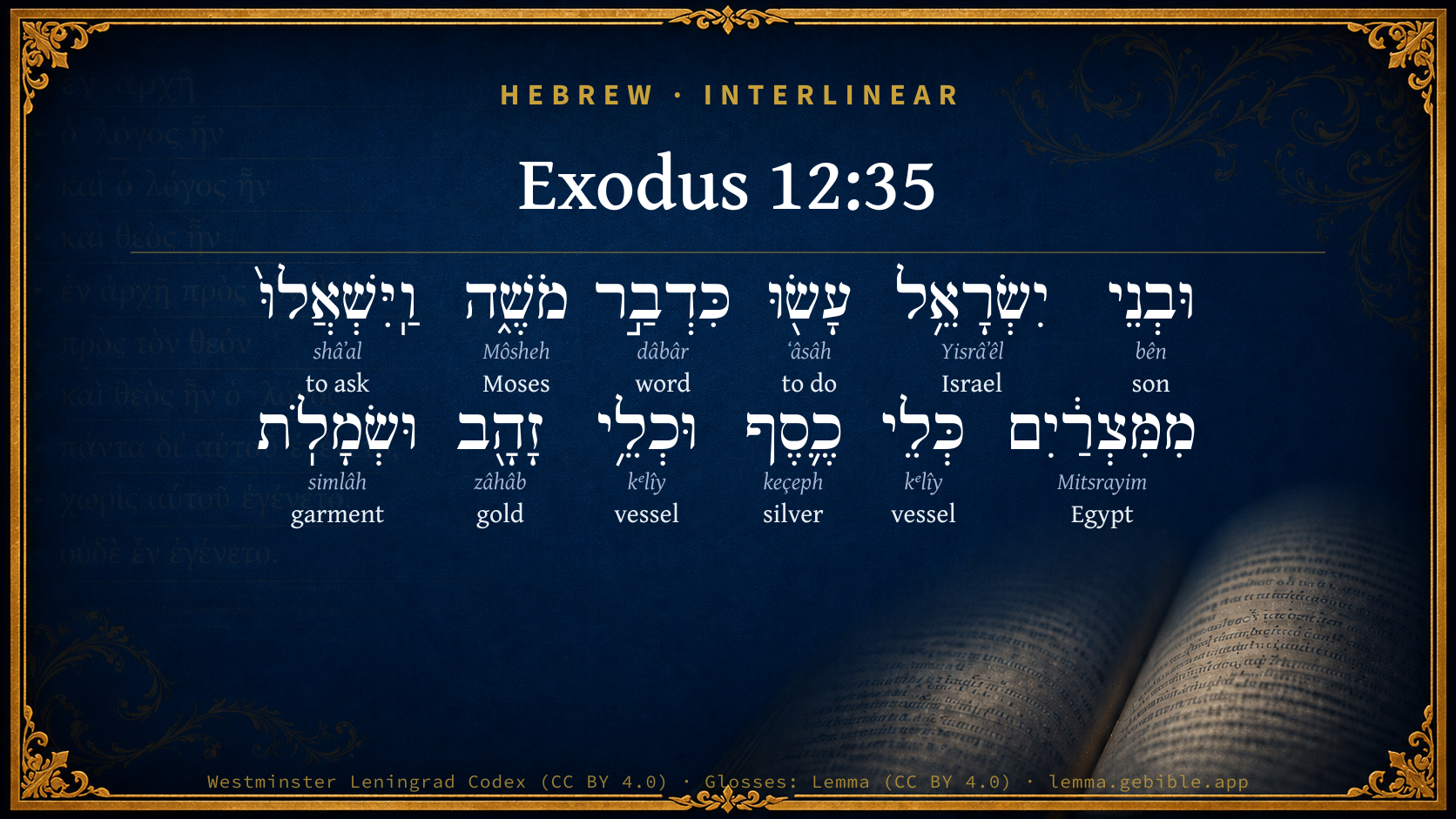
  1. וּבְנֵי bên H1121 “and · sons of” Conjunction + Noun, Common, Masculine, Plural, Construct
  2. יִשְׂרָאֵ֥ל Yisrâʼêl H3478 “Israel” Noun, Proper
  3. עָשׂ֖וּ ʻâsâh H6213 “to do” Verb, Qal, Perfect, 3rd Person, Common, Plural
  4. כִּדְבַ֣ר dâbâr H1697 “like/as · word of” Preposition + Noun, Common, Masculine, Singular, Construct
  5. מֹשֶׁ֑ה Môsheh H4872 “Moses” Noun, Proper
  6. וַֽיִּשְׁאֲלוּ֙ shâʼal H7592 “and · to ask” Conjunction + Verb, Qal, Sequential Imperfect, 3rd Person, Masculine, Plural
  7. מִמִּצְרַ֔יִם Mitsrayim H4714 “from · Egypt” Preposition + Noun, Proper
  8. כְּלֵי kᵉlîy H3627 “vessels of” Noun, Common, Masculine, Plural, Construct
  9. כֶ֛סֶף keçeph H3701 “silver” Noun, Common, Masculine, Singular, Absolute
  10. וּכְלֵ֥י kᵉlîy H3627 “and · vessels of” Conjunction + Noun, Common, Masculine, Plural, Construct
  11. זָהָ֖ב zâhâb H2091 “gold” Noun, Common, Masculine, Singular, Absolute

About this verse

These counts appear in no published source. They are computed here, from the morphology-tagged text and Lemma’s own curated glosses. What Lemma adds →

12
words
11
distinct lemmas
Pentateuch
section

Shared distinctive vocabulary

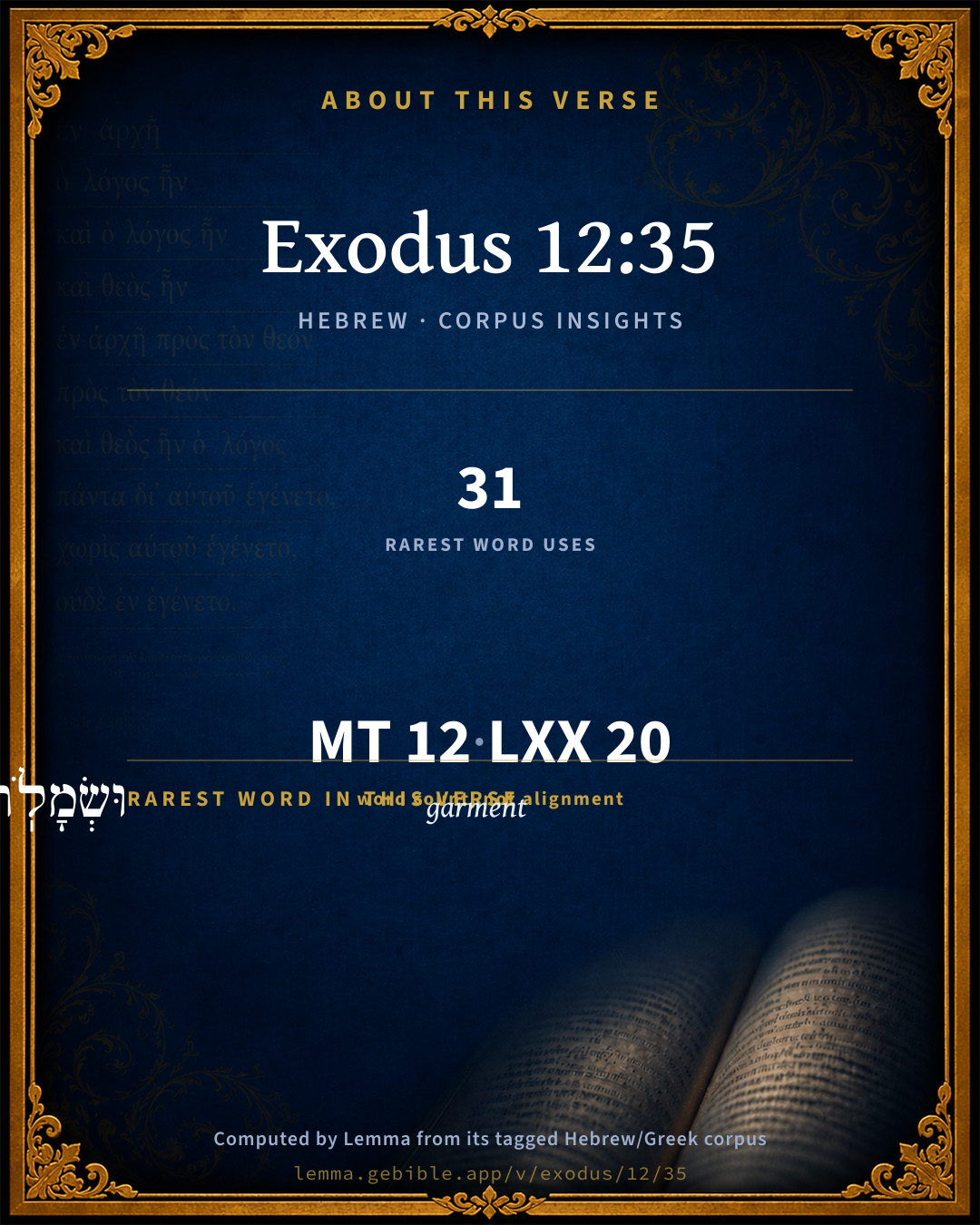
וּשְׂמָלֹֽת garment H8071 occurs in 28 verses of the Hebrew Bible. Also found in:

Grammatical profile

  • 2 verbs
  • 10 nouns

Verb forms

  • עָשׂ֖וּ Qal · Perfect
  • וַֽיִּשְׁאֲלוּ֙ Qal · Sequential Imperfect

Repetition

A word recurs within this verse — often emphatic in Hebrew:

  • כְּלֵי vessel H3627 ×2

Hebrew & Septuagint length

In English translation the verse runs 26 words from the Hebrew and 23 from the Septuagint (LXX English) — closely comparable.

A rough comparison of the two English renderings, which tokenize alike — not a word-level alignment.

Word counts can differ between the Hebrew and the Greek without any difference in meaning — e.g. the Hebrew direct-object marker אֵת has no separate Greek word, and Greek often adds the article ὁ.

In the original languages it is 12 Hebrew tokens and 20 Greek tokens — but the two are counted differently (Hebrew bundles its prefixes and suffixes into one token; the Greek is in lemma form), so that isn’t a like-for-like length.

Cross-references

4

Topical passages linked to Exodus 12:35 in the Treasury of Scripture Knowledge — connected by theme and wording, ordered by reader-vote popularity; previews shown in the World English Bible.

  • Exodus 3:21–22 I will give this people favor in the sight of the Egyptians, and it will happen that when you go, you shall not go empty-handed.
  • Exodus 11:2–3 Speak now in the ears of the people, and let them ask every man of his neighbor, and every woman of her neighbor, jewels of silver, and jewels of gold."
  • Genesis 15:14 I will also judge that nation, whom they will serve. Afterward they will come out with great substance.
  • Psalms 105:37 He brought them forth with silver and gold. There was not one feeble person among his tribes.

Cross-references courtesy of OpenBible.info (CC BY 4.0).

Hebrew and Greek witnesses Masoretic Hebrew ↔ Greek Septuagint

The same verse in the two great witnesses to the Old Testament, shown verse-for-verse.

These are two independent witnesses, not word-aligned to each other, and the Septuagint is shown in lemma (dictionary) form.

Hebrew Exodus 12:35 Masoretic · Westminster Leningrad Codex

וּבְנֵי יִשְׂרָאֵ֥ל עָשׂ֖וּ כִּדְבַ֣ר מֹשֶׁ֑ה וַֽיִּשְׁאֲלוּ֙ מִמִּצְרַ֔יִם כְּלֵי כֶ֛סֶף וּכְלֵ֥י זָהָ֖ב וּשְׂמָלֹֽת

The children of Israel did according to the word of Moses; and they asked of the Egyptians jewels of silver, and jewels of gold, and clothing.

World English Bible · Public Domain

Greek LXX Exodus 12:35 Septuagint · lemma form

ὁ δέ υἱός ἰσραήλ ποιέω καθά συντάσσω αὐτός μωυσῆς καί αἰτέω παρά ὁ αἰγύπτιος σκεῦος ἀργυροῦς καί χρυσοῦς καί ἱματισμός

And the children of Israel did as Moses commanded them, and they asked of the Egyptians articles of silver and gold and apparel.

LXX2012 (modern English Septuagint) · Public Domain

Hebrew: Westminster Leningrad Codex (CC BY 4.0). Greek: Septuagint (public domain); English from LXX2012 (modern English Septuagint) (Public Domain). How the Septuagint differs from the Hebrew →

Targum (Aramaic paraphrase)

2

The Targum is the ancient Jewish Aramaic paraphrase of the Hebrew Scriptures — an interpretive translation, not the Hebrew text itself. Onkelos (literal) and Pseudo-Jonathan (expansive) render the Torah, and Jonathan the Prophets. Coverage is partial: where no permissively-licensed English translation exists for a verse, only the Aramaic is shown. This is verse-level text, not a word-by-word alignment to the Hebrew.

  1. Targum Onkelos Torah (Genesis–Deuteronomy)
    וּבְנֵי יִשְׂרָאֵל עֲבָדוּ כְּפִתְגָמָא דְמשֶׁה וּשְׁאִילוּ מִמִצְרַיִם מָנִין דִכְסַף וּמָנִין דִדְהַב וּלְבוּשִׁין:

    (no public-domain English translation for this verse)

    Targum Onkelos — Aramaic: “Onkelos Genesis” (public domain); “Onkelos Exodus” (public domain); “Onkelos Leviticus” (public domain); “Onkelos Numbers” (public domain); “Onkelos Deuteronomy” (public domain). English: “Sefaria Community Translation” (CC0 1.0 (public-domain dedication)); “J.W. Etheridge. The Targums of Onkelos and Jonathan Ben Uzziel on the Pentateuch. London: Longmans, Green, 1862” (public domain). Text via Sefaria.

  2. Targum Pseudo-Jonathan Torah (Genesis–Deuteronomy)
    וּבְנֵי יִשְרָאֵל עָבָדוּ כְּפִתְגָמָא דְמשֶׁה וְשַׁיְילוּ מִן מִצְרָאֵי מָנִין דִּכְסַף וּמָנִין דִּדְהַב

    And the sons of Israel did according to the word of Mosheh, and asked of the Mizraee vessels of silver and vessels of gold.

    Targum Pseudo-Jonathan — Aramaic: “Targum Jonathan on Genesis” (public domain); “Targum Jonathan on Exodus” (public domain); “Targum Jonathan on Leviticus” (public domain); “Targum Jonathan on Numbers” (public domain); “Targum Jonathan on Deuteronomy” (public domain). English: “The Targum of Jonathan ben Uzziel, trans. J. W. Etheridge, London, 1862” (public domain). Text via Sefaria.

Commentary

Notes on Exodus 12:35 from classic Christian and Jewish commentators (each source and its license shown beneath its notes). The classic Christian expositions comment on the surrounding passage and are grouped to its opening verse, so a note may address several verses; the Jewish commentaries on the Tanakh (Rashi and others) are per-verse, so they appear only where the commentator wrote on this verse.

Lemma curates 59 commentaries, every one of them public domain or Creative Commons licensed, each selected and text-cleaned for this edition rather than reprinted as found. About our sources →

Trapp's Complete Commentary

John Trapp

Exo 12:35 And the children of Israel did according to the word of Moses; and they borrowed of the Egyptians jewels of silver, and jewels of gold, and raiment:

Ver. 35. And they borrowed.] For their use at that solemn feast they were to keep in the wilderness. The Egyptians denied them nothing; as willing to be rid of them upon any terms. {a}

{a} Pons aureus fugienti hosti extruendus

John Trapp, A Commentary or Exposition upon All the Books of the Old and New Testament (1647–1656) — public domain. Text from a community e-Sword module.

The Biblical Illustrator

Joseph S. Exell

Exo_12:33; Exo_12:35

The Egyptians were urgent upon the people that they might send them out of the land.

Hastened out of Egypt

1. Note the reason of this urgency. Fear lest death overtake them all.

2. Note the utter selfishness of the motive. No true repentance in it.

3. Urgency is fitting when there is imminent danger.

4. There is the greatest need of urgency in every sinners case. Doom and death are at hand. (Homiletic Review.)

The Israelites going out of Egyptian bondage; or, the freedom of the Church

I. That the Israelites were given their freedom by those who had long oppressed them; and so the Church shall be freed by those who have long enslaved it.

II. That the Israelites, in availing themselves of their freedom, had to make many temporary shifts; and so the Church, in stepping into liberty, will have to encounter many perplexities.

III. That the Israelites, going into freedom, took with them all the wealth they could get from the Egyptians; and so the Church, in entering upon its liberty, should avail itself of all the valuables it can obtain from the world. (J. S. Exell, M. A.)

Borrowed from the Egyptians.

Borrowing from the enemy

I remember, when visiting Denmark some twenty years ago, I learned a little incident in the history of a great Danish admiral. On one occasion, when commanding a little sloop--it was before he was admiral--he had the audacity to engage an English frigate in battle. They both fired away, but after a little time the captain of the frigate noticed that the firing from the sloop ceased. A flag of truce was hoisted; a boat was lowered, and the Danish captain came alongside. Addressing his opponent, he said, Sir, our powder is all done, and we have come to borrow some from you! The devil has been using money against the cause of God for many years; let us take it from him, and turn his guns against himself. (Dr. Sinclair Patterson.)

The Biblical Illustrator, edited by Joseph S. Exell (c. 1880s–1900s) — public domain. Text from a community e-Sword module.

Tyndale Open Study Notes

Tyndale Open Resources

12:35 they asked the Egyptians: See 3:22; 11:2.

Tyndale Open Study Notes — © Tyndale Open Resources, licensed CC BY-SA 4.0. Text via the HelloAO Bible API.

Jamieson, Fausset & Brown

Robert Jamieson, A. R. Fausset & David Brown

children of Israel borrowed of the Egyptians jewels of silver--When the Orientals go to their sacred festivals, they always put on their best jewels. The Israelites themselves thought they were only going three days' journey to hold a feast unto the Lord, and in these circumstances it would be easy for them to borrow what was necessary for a sacred festival. But borrow conveys a wrong meaning. The word rendered borrow signifies properly to ask, demand, require. The Israelites had been kept in great poverty, having received little or no wages. They now insisted on full remuneration for all their labor, and it was paid in light and valuable articles adapted for convenient carriage.

Jamieson, Fausset & Brown — Commentary Critical and Explanatory on the Whole Bible (1871) — public domain (CC PDM 1.0). Text via the HelloAO Bible API.

Adam Clarke's Commentary

Verse 35. They borrowed of the Egyptians] See Clarke on Ex 3:22, where the very exceptionable term borrow is largely explained.

Adam Clarke's Commentary on the Bible (1810–1826) — public domain. Text from a community e-Sword/MySword module.

Ellicott's Commentary for English Readers

(35) They borrowed.—See the comment on Exo_3:22.

A Bible Commentary for English Readers, edited by Charles John Ellicott (1878–1897) — public domain. Text from a community e-Sword module.

The Cambridge Bible for Schools and Colleges

gen. ed. J. J. S. Perowne

35. did &c.] had done …, and asked,—before viz. the events just narrated (vv. 29–34). Cf. Exo_11:3.

35, 36. Carrying out of the instructions given in Exo_3:21-22 (cf. Exo_11:2).

The Cambridge Bible for Schools and Colleges (gen. ed. J. J. S. Perowne; Cambridge University Press, 1878–1918) — public domain. Text from a community e-Sword module.

John Gill's Exposition

And the children of Israel journeyed from Rameses to Succoth,.... Rameses was a place in Goshen, or rather the land of Goshen, from whence the country was so called; See Gill on Gen 47:11. The Targum of Jonathan takes it to be Pelusium, or Sin, now called Tinah, formerly the strength of Egypt, and which lay at the entrance of it, and says it was one hundred and thirty miles to Succoth; and Jarchi says one hundred and twenty. But the distance between these two places was not so great; for Succoth from Rameses it is computed was eight miles (f) only. The latter place is so called by anticipation; for it was now a desert, as Josephus (g) says, which he calls Latopolis, but had its name Succoth from the children of Israel pitching their tents there; for the word signifies tents or tabernacles. The number of the children of Israel when they came out of Egypt

were about six hundred thousand on foot, that were men, besides children; and which is confirmed by the account that Chaeremon (h) the Heathen gives, who makes the number of those drove out of Egypt, as he calls them, 250,000; and says that when they came to Pelusium, they found there 380,000 left there by Amenophis; which makes in all 630,000. And so Philo the Jew says (i), they were above 600,000, besides old men, children, and women, that could not easily be numbered; and the word "about" will admit of it, since it may be used not to diminish, but to increase the number; and it is certain that in the second year after they were come out of Egypt, their number was 600,550 without the Levites, who were not numbered; and they that were numbered were such as were twenty years old and upward, and able to go forth to war, Num 1:9 and such were those here, as Jarchi observes; so that if there were 600,000 men of twenty years old and upwards, able to bear arms, besides women, children, and old men, it may well be thought that in all there were no less than near two millions and a half; for, according to the ordinary proportion allowed in other nations of four to one between the number of the whole people in a nation, and those men fit to bear arms, that the number of the Israelites alone, of all ages and sexes which went out of Egypt along with Moses, will amount to 2,400,000 souls (j); which was a prodigious increase of seventy persons in little more than two hundred years, and a most marvellous thing it was, that in so large a number of persons there was not one feeble among them, Psa 105:37.

(f) See Bunting's Travels, p. 81. (g) Ut supra, (antiqu. l. 2.) c. 15. sect. 1. (h) Apud Joseph. contr. Apion, l. 1. sect. 32. (i) De Vita Mosis, l. 1. p. 625. (j) Bp. of Clogher's Chronology of the Hebrew Bible, p. 271. See Judah Leon's Relation of Memorable Things, &c. p. 2.

John Gill's Exposition of the Whole Bible (1746–1763) — public domain (CC PDM 1.0). Text via the HelloAO Bible API.

Albert Barnes' Notes on the Bible

Borrowed - “Asked of.” See Exo 3:22 note.

Albert Barnes' Notes on the Bible (1834–1885) — public domain. Text from a community e-Sword/MySword module.

Matthew Poole's English Annotations

They borrowed of the Egyptians, either before this time, as they had opportunity, when their hearts were mollified by the foregoing plagues; or even at this time, when the Israelites might well take confidence to borrow, and the Egyptians would be willing to lend them, partly that they might gain their affections and prayers, and partly that they might more readily depart from them.

Jewels, wherewith they used to adorn themselves in the worship of their idols, and therefore supposed the Israelites might use them in the worship of their God. Or, vessels; of which see on Exo 11:2.

Matthew Poole's English Annotations on the Holy Bible (1683–1685) — public domain. Text from a community e-Sword/MySword module.

Whedon's Commentary on the Bible

Daniel D. Whedon

35, 36. See on Exo_3:22, and Exo_11:2.

Daniel D. Whedon (gen. ed.), Commentary on the Old and New Testaments (1874–1909) — public domain. Text from a community e-Sword module.

The Pulpit Commentary

The children of Israel did according to the word of Moses. See above, Exo_11:2. They borrowed. On this mistranslation, see the comment upon Exo_3:22. It is plain that the gold and silver articles and the raiment, were free-will gifts, which the Egyptians never expected to see again, and which the Hebrews asked and took, but in no sense "borrowed." Hengstenberg and Kurtz have shown clearly that the primary meaning of the words translated "borrowed" and "lent," is "asked" and "granted," and that the sense of "borrowing" and "lending" is only to be assigned them when it is required by the context.

The Pulpit Commentary (1880–1919), ed. H.D.M. Spence-Jones & Joseph S. Exell — public domain. Text from a community e-Sword module.

Rashi

Rabbi Shlomo Yitzchaki (Rashi)

כדבר משה [THEY DID] ACCORDING TO THE WORD OF MOSES which he had spoken to them in Egypt, viz., (Exodus 11:2) “And let every man ask his fellow…”

ושמלות AND GARMENTS — These were even more valued by them than the silver and than the gold: the later a thing is mentioned in the text the more valued it is (cf. Mekhilta) (i. e. the fact that silver is mentioned before gold shows that the text is mentioning the objects in the ascending scale of value and consequently the garments, as being mentioned last, must have been most valued by them).

Rashi on the Tanakh — English translations: “The Judaica Press complete Tanach with Rashi, translated by A. J. Rosenberg” (CC BY 4.0); “Pentateuch with Rashi's commentary by M. Rosenbaum and A.M. Silbermann, 1929-1934” (public domain); “The Metsudah Tanach series, Lakewood, N.J” (CC BY 4.0); and “The Book of Joshua, Metsudah Publications, 1997” (CC BY 4.0). Text via Sefaria.

Ibn Ezra

Rabbi Abraham ibn Ezra

The B’nei Yisrael. The requests that each of the B’nei Yisrael made of his Egyptian neighbors were commensurate with his stature. Thus we find that in the construction of the Mishkon only the leaders brought precious stones, spices and oil.

Ibn Ezra on the Tanakh — English translations: “Sefaria Community Translation” (CC0 1.0 (public-domain dedication)); “Yalkut, Sifsei Chachomim Chumash, Metsudah Publications, 2009” (CC BY 4.0); and “Commentary of Ibn Ezra on Isaiah - trans. by M. Friedlander, 1873” (public domain). Text via Sefaria.

Lesson kit

Teaching starters — assembled from the data on this page, not authored interpretation. Every prompt links to the verse data it draws on. Edit before teaching.

Exodus, in the Pentateuch, opens this verse with 12 words (11 distinct Hebrew lemmas). Its most distinctive word is simlâh (“garment”). A historical commentator’s framing appears above. Read the whole chapter for the surrounding context.

Discussion questions

  1. The word simlâh carries the sense “garment.” How does it shape the verse?
  2. How does Genesis 9:23, which shares the word «garment», read alongside this verse?
  3. What does the repetition of “vessel” (2× in this one verse) do in this verse?
  4. These translations render this verse differently; the difference is in the English rendering, not the original. What questions does that raise?
  5. «עָשׂ֖וּ» is a Qal Perfect verb. How does that grammatical form shape the action described?
  6. Compare how Trapp's Complete Commentary and The Biblical Illustrator read this verse. Where do they agree or differ?

Things to notice

Reading settings

Reading text

Shown beneath each verse's original-language words.

Old Testament
Old Testament edition

Read the OT as the Masoretic Hebrew (MT) or the Greek Septuagint (LXX).

English shown for the Greek Septuagint (in the Hebrew ↔ Greek comparison).

Comparing translations? Open the Compare panel on any verse page to stack up to four side by side.