Deuteronomy 23:24

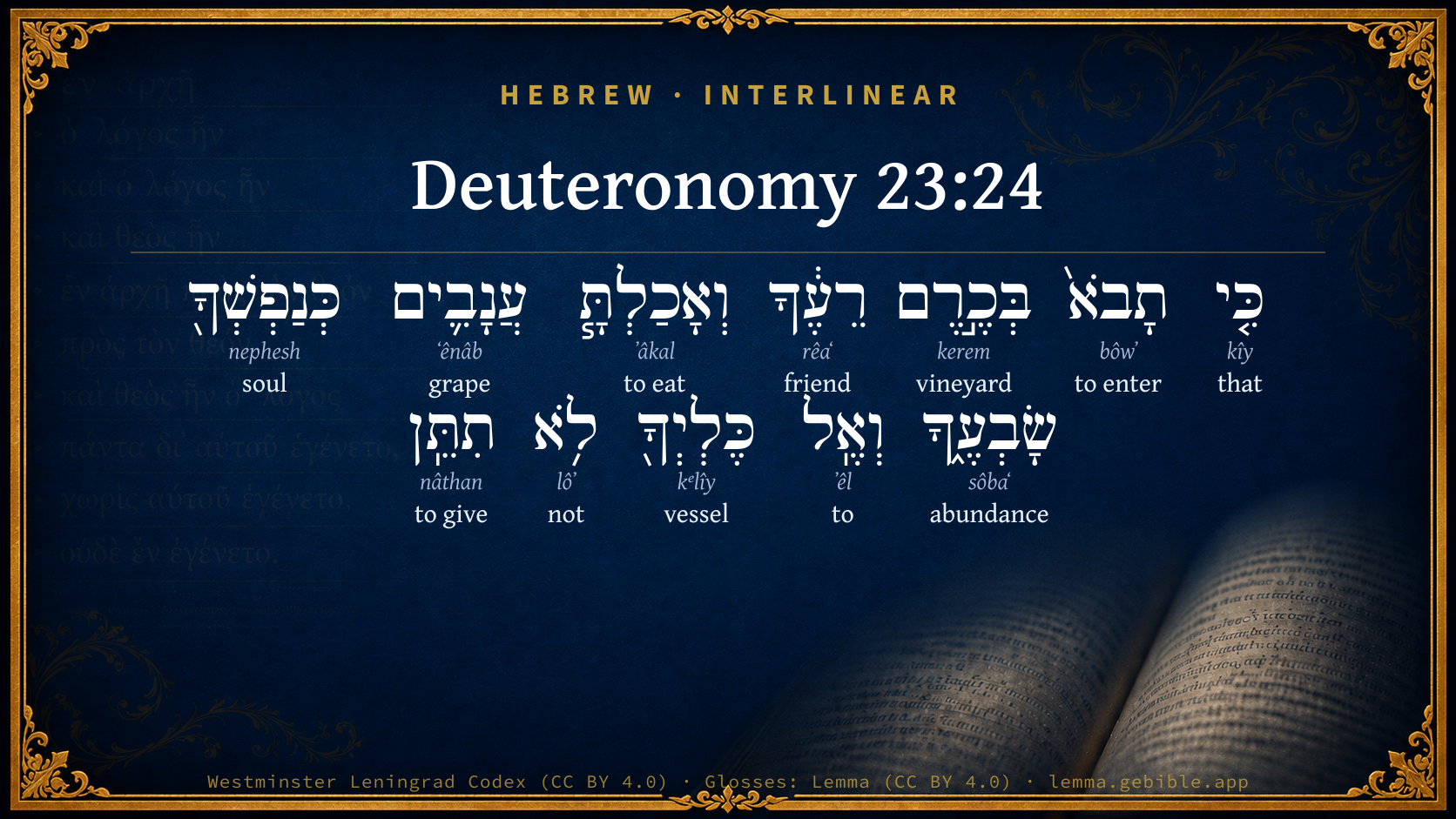
Hebrew (Westminster Leningrad Codex) Deuteronomy 23:24 appears in the Hebrew Old Testament. The text above is from the Westminster Leningrad Codex. Each word links to its Strong’s number, a concise gloss, and parsing drawn from the Open Scriptures Hebrew Bible morphology. Click any word for its full Brown-Driver-Briggs (BDB) entry.
Download image
Cite this verse

Deuteronomy 23:24 (World English Bible). Public Domain. Lemma interlinear Bible study tool, https://lemma.gebible.app/v/deuteronomy/23/24.

Show BibTeX & RIS
BibTeX
RIS
English Translation
When you come into your neighbor's vineyard, then you may eat of grapes your fill at your own pleasure; but you shall not put any in your vessel.
World English Bible · Public Domain
Download a study sheet

One document with this verse’s original text, its word-by-word gloss line, the meaning frame, cross-references with their text, attributed commentary, and full source and license credits — printable, and it pastes into notes with its structure intact.

This verse Autodidact and up

Study sheet (.html) Plain text (.txt)

A passage Seminary Student

Up to 50 verses in one chapter. A passage sheet keeps up to 6 commentary sources and 12 cross-references per verse, in the order this page ranks them, and says so on the sheet whenever that leaves anything out. Ask for a single verse and you get the Autodidact verse sheet above.

Everything on this page stays free to read, with no account — the sheet is a download of what is already on screen, not access to it.

Want to remove ads? Support Godless Engineer
Compare translations 3

The same verse in 3 English versions, stacked beneath the original-language interlinear above. Click any original word for its lexicon entry.

Each is an independent rendering of the whole verse — the interlinear is not word-aligned to these translations.

Highlighted words mark where these versions differ — a whole-verse word diff, not a word-by-word alignment.

  • World English Bible Public Domain
    When you come into your neighbor's vineyard, then you may eat of grapes your fill at your own pleasure; but you shall not put any in your vessel.
  • King James Version Public Domain
    When thou comest into thy neighbor's vineyard, then thou mayest eat grapes thy fill at thine own pleasure; but thou shalt not put any in thy vessel.
  • unfoldingWord Literal Text CC BY-SA 4.0
    When you go into the vineyard of your neighbor, then you may eat grapes as your spirit satisfied, but you shall not put in your vessel.

unfoldingWord Literal Text — © unfoldingWord, licensed CC BY-SA 4.0. Word-aligned USFM3 via Door43 (git.door43.org/unfoldingWord/en_ult).

Versions to compare (up to 4)

3 of 4 selected

Show all 18 translations

Every available English version of this verse, each an independent rendering of the whole verse.

  • World English Bible Public Domain
    When you come into your neighbor's vineyard, then you may eat of grapes your fill at your own pleasure; but you shall not put any in your vessel.
  • Berean Standard Bible Public Domain
    When you enter your neighbor’s vineyard, you may eat your fill of grapes, but you must not put any in your basket.
  • Majority Standard Bible Public Domain
    When you enter your neighbor’s vineyard, you may eat your fill of grapes, but you must not put any in your basket.
  • King James Version Public Domain
    When thou comest into thy neighbor's vineyard, then thou mayest eat grapes thy fill at thine own pleasure; but thou shalt not put any in thy vessel.
  • American Standard Version (1901) Public Domain
    When thou comest into thy neighbor's vineyard, then thou mayest eat of grapes thy fill at thine own pleasure; but thou shalt not put any in thy vessel.
  • Revised Version (1885) Public Domain
    When thou comest into thy neighbour’s vineyard, then thou mayest eat grapes thy fill at thine own pleasure; but thou shalt not put any in thy vessel.
  • Geneva Bible (1599) Public Domain
    When thou commest vnto thy neighbours vineyard, then thou mayest eate grapes at thy pleasure, as much as thou wilt: but thou shalt put none in thy vessell.
  • Douay-Rheims (1899) Public Domain
    Going into thy neighbour's vineyard, thou mayst eat as many grapes as thou pleasest: but must carry none out with thee:
  • Young's Literal Translation Public Domain
    `When thou comest in unto the vineyard of thy neighbour, then thou hast eaten grapes, according to thy desire, thy sufficiency; but into thy vessel thou dost not put `any'.
  • Literal Standard Version CC BY-SA 4.0
    When you come into the vineyard of your neighbor, then you have eaten grapes according to your desire, your sufficiency, but you do not put [any] into your vessel.
  • Unlocked Literal Bible CC BY-SA 4.0
    When you go into your neighbor's vineyard, you may eat as many grapes as you desire, but do not put any in your basket.
  • unfoldingWord Literal Text CC BY-SA 4.0
    When you go into the vineyard of your neighbor, then you may eat grapes as your spirit satisfied, but you shall not put in your vessel.
  • Darby Bible Public Domain
    When thou comest into thy neighbour's vineyard, thou mayest eat grapes thy fill, according to thy desire, but thou shalt not put any in thy vessel.
  • World Messianic Bible Public Domain
    When you come into your neighbor’s vineyard, then you may eat your fill of grapes at your own pleasure; but you shall not put any in your container.
  • Webster's Bible Public Domain
    When thou comest into thy neighbor's vineyard, then thou mayest satisfy thy appetite with grapes at thy own pleasure; but thou shalt not put any in thy vessel.
  • Free Bible Version CC BY-SA 4.0
    When you walk through your neighbor's vineyard, you can eat as many grapes as you want, but you must not collect any to take with you.
  • Bible in Basic English Public Domain
    When you go into your neighbour's vine-garden, you may take of his grapes at your pleasure, but you may not take them away in your vessel.
  • JPS Tanakh (1917) Public Domain
    (23-25) When thou comest into thy neighbour's vineyard, then thou mayest eat grapes until thou have enough at thine own pleasure; but thou shalt not put any in thy vessel.

Literal Standard Version (2020), Covenant Press — licensed CC BY-SA 4.0. Text via the HelloAO Bible API (eBible.org). Unlocked Literal Bible (unfoldingWord) — licensed CC BY-SA 4.0. Text via the HelloAO Bible API (eBible.org). unfoldingWord Literal Text — © unfoldingWord, licensed CC BY-SA 4.0. Word-aligned USFM3 via Door43 (git.door43.org/unfoldingWord/en_ult). Free Bible Version, Dr. Jonathan Gallagher — licensed CC BY-SA 4.0. Text via the HelloAO Bible API (eBible.org).

Word by word

More ways to search: Search by grammar → Find every occurrence → Compare this word →

Practice this passage: Drill this verse → Learn its vocabulary →

שָׂבְעֶ֑ךָ
sôbaʻ
H7648
“abundance · your”
Noun, Common, Masculine, Singular, Construct + Suffix, Personal, 2nd Person, Masculine, Singular
Part of Speech
Noun
Type
Common
Gender
Masculine
Number
Singular
State
Construct
Full BDB Definition

Origin: from H7646

TWOT: 2231a

satiety, abundance, fulness - satiety - abundance
  1. כִּ֤י kîy H3588 “that” Conjunction
  2. תָבֹא֙ bôwʼ H935 “to enter” Verb, Qal, Imperfect, 2nd Person, Masculine, Singular
  3. בְּכֶ֣רֶם kerem H3754 “in/at · vineyard of” Preposition + Noun, Common, Both, Singular, Construct
  4. רֵעֶ֔ךָ rêaʻ H7453 “friend · your” Noun, Common, Masculine, Singular, Construct + Suffix, Personal, 2nd Person, Masculine, Singular
  5. וְאָכַלְתָּ֧ ʼâkal H398 “and · to eat” Conjunction + Verb, Qal, Sequential Perfect, 2nd Person, Masculine, Singular
  6. עֲנָבִ֛ים ʻênâb H6025 “grapes” Noun, Common, Masculine, Plural, Absolute
  7. כְּנַפְשְׁךָ֖ nephesh H5315 “like/as · soul · your” Preposition + Noun, Common, Both, Singular, Construct + Suffix, Personal, 2nd Person, Masculine, Singular
  8. וְאֶֽל ʼêl H413 “and · to” Conjunction + Preposition
  9. כֶּלְיְךָ֖ kᵉlîy H3627 “vessel · your” Noun, Common, Masculine, Singular, Construct + Suffix, Personal, 2nd Person, Masculine, Singular
  10. לֹ֥א lôʼ H3808 “not” Particle, Negative
  11. תִתֵּֽן nâthan H5414 “to give” Verb, Qal, Imperfect, 2nd Person, Masculine, Singular

About this verse

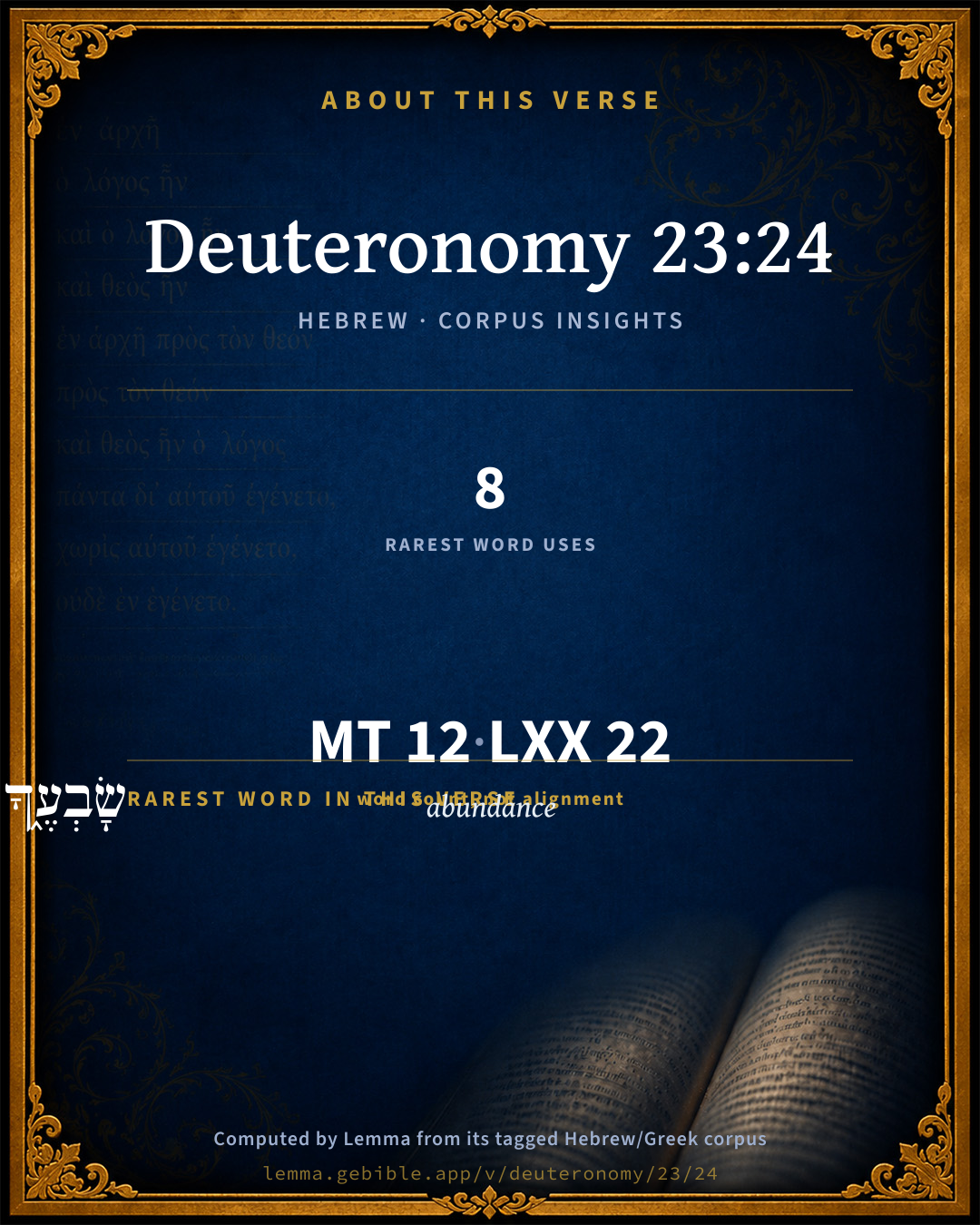
These counts appear in no published source. They are computed here, from the morphology-tagged text and Lemma’s own curated glosses. What Lemma adds →

12
words
12
distinct lemmas
Pentateuch
section

Notable vocabulary

The rarest word here is שָׂבְעֶ֑ךָ abundance H7648 — appearing just 8 times in the whole Hebrew Bible.

Shared distinctive vocabulary

שָׂבְעֶ֑ךָ abundance H7648 occurs in 8 verses of the Hebrew Bible. Also found in:

Grammatical profile

  • 3 verbs
  • 6 nouns
  • 1 preposition
  • 1 conjunction
  • 1 particle

Verb forms

  • תָבֹא֙ Qal · Imperfect
  • וְאָכַלְתָּ֧ Qal · Sequential Perfect
  • תִתֵּֽן Qal · Imperfect

Hebrew & Septuagint length

In the original languages it is 12 Hebrew tokens and 22 Greek tokens — but the two are counted differently (Hebrew bundles its prefixes and suffixes into one token; the Greek is in lemma form), so that isn’t a like-for-like length.

Cross-references

3

Topical passages linked to Deuteronomy 23:24 in the Treasury of Scripture Knowledge — connected by theme and wording, ordered by reader-vote popularity; previews shown in the World English Bible.

  • 1 Corinthians 10:26 for "the earth is the Lord's, and its fullness."
  • Romans 12:13 contributing to the needs of the saints; given to hospitality.
  • Hebrews 13:5 Be free from the love of money, content with such things as you have, for he has said, "I will in no way leave you, neither will I in any way forsake you."

Cross-references courtesy of OpenBible.info (CC BY 4.0).

Hebrew and Greek witnesses Masoretic Hebrew ↔ Greek Septuagint

The same verse in the two great witnesses to the Old Testament, shown verse-for-verse.

These are two independent witnesses, not word-aligned to each other, and the Septuagint is shown in lemma (dictionary) form.

Hebrew Deuteronomy 23:24 Masoretic · Westminster Leningrad Codex

כִּ֤י תָבֹא֙ בְּכֶ֣רֶם רֵעֶ֔ךָ וְאָכַלְתָּ֧ עֲנָבִ֛ים כְּנַפְשְׁךָ֖ שָׂבְעֶ֑ךָ וְאֶֽל כֶּלְיְךָ֖ לֹ֥א תִתֵּֽן

When you come into your neighbor's vineyard, then you may eat of grapes your fill at your own pleasure; but you shall not put any in your vessel.

World English Bible · Public Domain

Greek LXX Deuteronomy 23:24 Septuagint · lemma form

ὁ ἐκπορεύομαι διά ὁ χεῖλος σύ φυλάσσω καί ποιέω ὅς τρόπος εὔχομαι κύριος ὁ θεός σύ δόμα ὅς λαλέω ὁ στόμα σύ

No English rendering of this Greek verse — the small residue in the structurally divergent books.

Hebrew: Westminster Leningrad Codex (CC BY 4.0). Greek: Septuagint (public domain); English from a public-domain English Septuagint. How the Septuagint differs from the Hebrew →

Targum (Aramaic paraphrase)

2

The Targum is the ancient Jewish Aramaic paraphrase of the Hebrew Scriptures — an interpretive translation, not the Hebrew text itself. Onkelos (literal) and Pseudo-Jonathan (expansive) render the Torah, and Jonathan the Prophets. Coverage is partial: where no permissively-licensed English translation exists for a verse, only the Aramaic is shown. This is verse-level text, not a word-by-word alignment to the Hebrew.

  1. Targum Onkelos Torah (Genesis–Deuteronomy)
    אַפָּקוּת סִפְוָתָךְ תִּטַר וְתַעְבֵּד כְּמָא דִי נְדַרְתָּא קֳדָם יְיָ אֱלָהָךְ נְדַבְתָּא דִי מַלֶלְתָּא בְּפוּמָךְ

    (no public-domain English translation for this verse)

    Targum Onkelos — Aramaic: “Onkelos Genesis” (public domain); “Onkelos Exodus” (public domain); “Onkelos Leviticus” (public domain); “Onkelos Numbers” (public domain); “Onkelos Deuteronomy” (public domain). English: “Sefaria Community Translation” (CC0 1.0 (public-domain dedication)); “J.W. Etheridge. The Targums of Onkelos and Jonathan Ben Uzziel on the Pentateuch. London: Longmans, Green, 1862” (public domain). Text via Sefaria.

  2. Targum Pseudo-Jonathan Torah (Genesis–Deuteronomy)
    מוֹמָתָא דְתִפּוֹק מִן שִפְוַותְכוֹן תְּקִימוּן מִצְוָותָא דְכַשְׁרִין לְאִתְעוֹבָדָא תַּעַבְדוּן וּדְלָא כַשְׁרִין לְאִתְעוֹבָדָא לָא תַעַבְדוּן וְהֵיכְמָא דִנְדַרְתּוּן תְּשַׁלְּמוּן חַטָּאתָא וְאַשְׁמָא עֲלַוָּון וְנִכְסְתָא קוּדְשִׁין תְּקַרְבוּן קֳדָם יְיָ אֱלָהָכוֹן וְנִיכְסְתָא תֵּיהוֹן וּנְבִזְבְּיַית בֵּית מוּקְדְּשָׁא דְמַלֵּילְתּוּן תִּתְּנוּן וּלְעַנְיֵי צִדְקָתָא מַה דְּאָמַרְתּוּן בְּפוּמְכוֹן

    the oath which goeth from your lips you shall confirm. The precepts of integrity you shall verily perform, but that which is not right to do ye shall not do; and according as you have vowed shall you fulfil; sin offerings, trespass offerings, burnt sacrifices, and consecrated victims shall you present before the Lord your God, and bring the libations and the gifts of the sanctuary of which you have spoken (in promises), and alms for the poor which your lips have declared.

    Targum Pseudo-Jonathan — Aramaic: “Targum Jonathan on Genesis” (public domain); “Targum Jonathan on Exodus” (public domain); “Targum Jonathan on Leviticus” (public domain); “Targum Jonathan on Numbers” (public domain); “Targum Jonathan on Deuteronomy” (public domain). English: “The Targum of Jonathan ben Uzziel, trans. J. W. Etheridge, London, 1862” (public domain). Text via Sefaria.

Commentary

Notes on Deuteronomy 23:24 from classic Christian and Jewish commentators (each source and its license shown beneath its notes). The classic Christian expositions comment on the surrounding passage and are grouped to its opening verse, so a note may address several verses; the Jewish commentaries on the Tanakh (Rashi and others) are per-verse, so they appear only where the commentator wrote on this verse.

Lemma curates 59 commentaries, every one of them public domain or Creative Commons licensed, each selected and text-cleaned for this edition rather than reprinted as found. About our sources →

Trapp's Complete Commentary

John Trapp

Deu 23:24 When thou comest into thy neighbour’s vineyard, then thou mayest eat grapes thy fill at thine own pleasure; but thou shalt not put [any] in thy vessel.

Ver. 24. When thou comest, &c.] As a passenger; {Mat 12:1-2} how much more as a labourer; {1Co 9:7} thou mayest take what thou wilt for necessity, but not for superfluity.

John Trapp, A Commentary or Exposition upon All the Books of the Old and New Testament (1647–1656) — public domain. Text from a community e-Sword module.

The Biblical Illustrator

Joseph S. Exell

Deu_23:24-25

Thou mayest eat grapes.

Grapes and ears of corn free

Thus a privilege was granted, but one strictly limited. A man who was thirsty might help himself to as many grapes as he cared to eat, but he was not to take any away. A man who was hungry might pluck ears of corn, as the disciples of Jesus did, and eat the grains, but he was not to carry a sheaf from the field. In this manner property was guarded. This is in harmony with the biblical law of property generally honoured at the present time. Even those who denounce individual property in land and minerals, and wish to nationalise them, do not advocate such nationalisation without payment to the proprietors. If ownership in land were set aside, the poor might lose the farm or the field bequeathed for their benefit. If ownership in money or goods were set aside, the widow might lose her small annuity, and even have to give up the old watch she values as having belonged to her husband and the treasured curiosities brought by her sailor son from a foreign land. Still, the best property human beings possess is the mental and spiritual wealth they carry in their mind and heart. In other words, they may have history, biography, poetry, religion as the treasures of their inner life. The owners of property are not to be greedily selfish. Nothing was said by Moses to the proprietor or tenant of the vineyard or corn field, but much was implied. If he saw a man, woman, or child pulling a cluster of grapes, he was not to be in a tempest of wrath, as though some great wrong had been done him, or to threaten the intruder with a criminal action. The man was rather to be glad that out of his abundance thirsty and hungry wayfarers could have their needs so readily supplied. Those who have are to be generous to those who have not. Every rich man in the country who does not value his riches as power to do good is an enemy to himself and the country. The limitation of privilege in the vineyard and the corn field enjoined by Moses was an implied exhortation to industry. Grapes might be eaten in the vineyard, but no vessel was to be filled with them and carried away. Those who wanted grapes for the wine press were to grow grapes. Ears of corn might be plucked, but the sickle was not to be used in the field. Those who wanted corn to grind were to plough, to sow, and reap in their own fields; there was to be no greedy appropriation of the fruit for which other men had laboured. It is much better for human beings to act for themselves than indolently to lean on others. There is no food so good as that which a man earns with his own hands. Labour is the law of the spiritual as well as of the temporal sphere. Those who wish to attain a good degree in the Church, and to win the eulogiums pronounced on Christs faithful servants, must work hard for themselves, that they may learn how to work hard for others. They must read much, think much, pray much. In one of his books Lord Beaconsfield represents a youth as saying, I should like to be a great man. The counsel given him was: You must nourish your mind with great thoughts. Those who wish to rank high in Christs service must appropriate great thoughts, and make them their own by reflection and meditation. There is no way to usefulness except by ardent toil. It is only by setting ourselves to work that we shall be able to afford grapes and corn to famishing souls. (J. Marrat.)

.

The Biblical Illustrator, edited by Joseph S. Exell (c. 1880s–1900s) — public domain. Text from a community e-Sword module.

Joseph Benson's Commentary

Deu 23:24. At thy pleasure — Which was allowed in those parts, because of the great plenty and fruitfulness of vines there.

Joseph Benson's Commentary on the Old and New Testaments (1811–1818) — public domain. Text from a community e-Sword module.

Tyndale Open Study Notes

Tyndale Open Resources

23:24 your neighbor’s vineyard: In a certain sense, God owned all the land and provided it to its human occupants. Therefore, no one had the right to make an exclusive claim to it. On the other hand, renters had rights to privacy and to a measure of control over what had been allotted to them. Trespassing was permitted within this context but not with the intention of theft. One could, however, pluck a few grapes or kernels of grain to eat along the way (see Matt 12:1-8; Mark 2:23-28; Luke 6:1-5).

Tyndale Open Study Notes — © Tyndale Open Resources, licensed CC BY-SA 4.0. Text via the HelloAO Bible API.

Geneva Bible (1599)

Geneva Bible translators

To bring home to thine house.

Being hired for to labor.

Geneva Bible (1599) marginal notes — public domain. Text via Bolls.life.

Jamieson, Fausset & Brown

Robert Jamieson, A. R. Fausset & David Brown

When thou comest into thy neighbour's vineyard, then thou mayest eat grapes thy fill at thine own pleasure--Vineyards, like cornfields mentioned in the next verse [Deu 23:25], were often unenclosed. In vine-growing countries grapes are amazingly cheap; and we need not wonder, therefore, that all within reach of a person's arm, was free; the quantity plucked was a loss never felt by the proprietor, and it was a kindly privilege afforded to the poor and wayfaring man.

Next: Deuteronomy Chapter 24

Jamieson, Fausset & Brown — Commentary Critical and Explanatory on the Whole Bible (1871) — public domain (CC PDM 1.0). Text via the HelloAO Bible API.

Adam Clarke's Commentary

Verse 24. Thou shalt not put any in thy vessel.] Thou shalt carry none away with thee. The old English proverb, Eat thy fill but pocket none, seems to have been founded on this law.

Adam Clarke's Commentary on the Bible (1810–1826) — public domain. Text from a community e-Sword/MySword module.

Ellicott's Commentary for English Readers

(24) When thou comest into thy neighbour’s vineyard.—Rashi tries to limit both this and the following precept to the labourer engaged in gathering the vintage or the harvest, when vessels are used and sickles employed. But the plain meaning will stand, and is accepted by our Lord in the Gospel. The objection made to His disciples was not that they plucked their neighbour’s corn, but that they did it on the Sabbath (a kind of harvesting, and therefore unlawful according to the scribes).

A Bible Commentary for English Readers, edited by Charles John Ellicott (1878–1897) — public domain. Text from a community e-Sword module.

John Gill's Exposition

When thou comest into thy neighbour's vineyard,.... To take a walk in it for recreation, and to see how the vines flourish, and what sort of fruit and what quantity of it they bear; being invited thither by the owner, or occasionally passing that way stepped in, and even it may be on purpose to taste the fruits of the vine and quench thirst and satisfy appetite:

then thou mayest eat grapes thy fill, at thine own pleasure; as many as they would, till nature was satisfied:

but thou shall not put any in thy vessel; to carry away, to be eaten by them or theirs at another time and place; they were to put none into their pockets or into their baskets, as the Targum of Jonathan, or whatsoever vessel they might have with them in the vineyard. Jarchi says, the Scripture speaks of a workman, and only at the time of gathering the grapes, when he was putting into his master's vessels, and might not put any into his own, and carry away; so the Jewish writers (i) generally interpret it of a workman only, and of his eating those things in which he works, and not of such as pass by the way; so the Targums: and there are many traditions in the Misnah (k) concerning this affair; as that by this law a workman might eat while in his work, as the ox may while it is treading out the corn, and when his work is perfect; and that he may eat of what he is employed about; only if he is at work upon figs, he may not eat of grapes, and if on grapes, he may not eat of figs; nor might he eat more than his hire came to; and that he might make a covenant for his son and daughter, servant and handmaid, adult (that they shall take money and not eat), and for his wife, because they are endowed with knowledge; but not for his son and daughter, servant and maidservant, minors, because they are not: but Josephus (l), their countryman, better interprets this law, who says, that travellers, of those that passed by the way, were not forbidden tasting ripe fruits, and even were permitted to fill themselves with them as if their own, whether they were of the country or strangers.

(i) Maimon. & Bartenora in Misn. Maaserot, c. 2. sect. 7. (k) Misn. Bava Metzia, c. 7. sect. 2, 4, 5, 6. (l) Antiqu. l. 4. c. 8. sect. 21.

John Gill's Exposition of the Whole Bible (1746–1763) — public domain (CC PDM 1.0). Text via the HelloAO Bible API.

Haydock's Catholic Bible Commentary

Thee. Hebrew, "thou shalt not put into thy vessel," or basket. This privilege is restrained by the Chaldean, &c., to vintagers. But Josephus ([Antiquities?] iv. 8) extends it to all; and he says that those who did not even invite travellers to partake of their grapes, and other fruit, were to be punished with 39 lashes.

George Leo Haydock (1774–1849), Haydock's Catholic Family Bible and Commentary, 1859 edition — public domain. Excludes Psalms (Douay-Rheims chapter numbering differs from Protestant) and Deuterocanonical books (Catholic canon only).

Matthew Poole's English Annotations

Thou mayest eat grapes thy fill; which was allowed in those parts, because of the great plenty and fruitfulness of vines there.

Matthew Poole's English Annotations on the Holy Bible (1683–1685) — public domain. Text from a community e-Sword/MySword module.

Whedon's Commentary on the Bible

Daniel D. Whedon

24. Thou mayest eat — It was allowable to eat grain or fruit in the field of a neighbour, but not to carry away grain from the field nor grapes from the vineyard. Compare Mat_12:1; Luk_6:1, where we read that the disciples of Jesus plucked and ate the grain as they passed through the fields. At the present day in the East the right of a hungry person to eat fruit or grain in the field of another is recognised. See Biblical Researches, vol. ii, p. 192, and Bible Lands, 12 mo, p. 128.

Daniel D. Whedon (gen. ed.), Commentary on the Old and New Testaments (1874–1909) — public domain. Text from a community e-Sword module.

The Pulpit Commentary

Vers. 24, 25. In the vineyard or cornfield of a neighbor they might eat to appease hunger, but no store of grapes or of grain might be carried away. At thine own pleasure; literally, according to thy soul, i.e. desire or appetite (cf. Deu_14:26) Pluck the ears with thine hand (Mat_12:1; Luk_6:1) Among the Arabs of the present day the right of a hungry person to pluck ears of corn in a field and eat the grains is still recognized (Robinson, "Bib. Res.," 2:192; Thomson, "Land and the Book," 2:510).

Vers, 24, 25. Kindliness to neighbors a duty of the holders of property.

This is a very instructive precept. "In vine-growing countries grapes are amazingly cheap; and we need not wonder, therefore, that all within the reach of a passenger"s arm were free. The quantity plucked was a loss never felt by the proprietor, and it was a kindly privilege afforded to the poor and wayfaring man" (Jameson). "Thou mayest take for necessity, not for superfluity" (Trapp).

Vers. 24, 25. The vineyard and corn-field.

This law may be regarded:

1. As another check on covetousness. It restricted the operation of covetousness in the owner, and taught him to be generous and charitable.

2. As part of the Jewish provision for the poor (cf. Deu_24:19, Deu_24:20)

3. As a lesson in honesty. It taught those who used the privilege to restrain themselves to their immediate wants, and to respect on principle the rest of their neighbor"s property. It taught them to be honest by trusting them.

4. As giving every one an interest in the fruitfulness of the land. Custom and the force of public opinion would guard the law from abuse. J.O.

Vers. 24, 25. Possession of earthly things only partial

The mode and condition of human life in this world serve a moral purpose. A material body requires material food; material food implies material possessions. The use of these affords fine scope for the development of many virtues. Without material possessions, selfishness would scarcely be possible; nor could some moral qualities, as generosity, find a field for exercise.

I EARTHLY ESTATE ADMITS ONLY OF A PARTIAL POSSESSION. We cannot retain for our exclusive use the beauty of the hills, or the fragrance of the flowers within territory called "our own." It is not possible for us to appropriate to our personal use all the products of our fields. Restrict the enjoyment as we may, we can succeed only to a limited extent. And why should we make the attempt? It adds immensely to our real pleasure to share the products with others. Indiscriminate appropriation of harvests would do good to no one. It would diminish productiveness. It would create waste; it would promote idleness. But profuse generosity is not only pleasurable: it is profitable. We gain the esteem of men. The whole community bands together to protect our crops. God smiles on our fields and our toil.

II HUNGER HAS UNQUESTIONABLE CLAIM ON NATURE"S PRODUCTS. Be our skilful labor to secure a harvest what it may, the largest possible, yet we cannot forget that God too has contributed largely to make our fields productive. In God"s contribution to the result, his poor ones ought to share. Lest the ordinary philanthropy of men might not suffice for this need of poverty, God himself has taken the poor under his sheltering wing; he has become their Champion, he has proclaimed a law for the protection of the needy. Inasmuch as God retains absolute proprietorship over all created things, and counts the richest men as his chief stewards, he has fullest right to determine on what conditions his bounty shall be enjoyed. When man has added his labor to the result, when he has garnered his crops, the condition is changed; but so long as it is standing in the field, hunger may find a meal.

III THOUGH HUNGER HAS A CLAIM, COVETOUSNESS HAS NONE. The laborer or the weary traveler had a statutory right to relieve his existing hunger; he had no right to carry any fruit or corn away. This would be to abuse a precious privilege. "Thus far might they go, and no farther." The path of obedience always has been narrow. Here was a test of trust in God. He who has provided a meal for the hungry man today can also provide another meal tomorrow. Or, if one door is closed, cannot God open another? Covetousness is suicidal. In the long run it defeats its own ends. Careful obedience is a first fruit of genuine trust. Give a bad man an inch, and he will take an ell. By this he may be known. But a good man is as careful of another man"s possessions as of his own. This is but another outcome of the command, "Thou shalt love thy neighbor as thyself. D.

The Pulpit Commentary (1880–1919), ed. H.D.M. Spence-Jones & Joseph S. Exell — public domain. Text from a community e-Sword module.

John Wesley's Explanatory Notes

At thy pleasure - Which was allowed in those parts, because of the great plenty and fruitfulness of vines there.

John Wesley, Explanatory Notes Upon the Whole Bible (1754–1765) — public domain. Text via the GEBible commentary corpus.

Keil & Delitzsch

C. F. Keil & F. Delitzsch

In the vineyard and cornfield of a neighbour they might eat at pleasure to still their hunger, but they were not to put anything into a vessel, or swing a sickle upon another's corn, that is to say, carry away any store of grapes or ears of corn. כּנפשׁך, according to thy desire, or appetite (cf. Deu 14:26). "Pluck the ears:" cf. Mat 12:1; Luk 6:1. - The right of hungry persons, when passing through a field, to pluck ears of corn, and rub out the grains and eat, is still recognised among the Arabs (vid., Rob. Pal. ii. 192).

Keil & Delitzsch — Biblical Commentary on the Old Testament (1861–1891) — public domain (CC PDM 1.0). Text via the HelloAO Bible API. (Old Testament only.)

unfoldingWord translationNotes

Door43 World Missions Community

General Information:

Moses speaks to the Israelites as if they were one man, so the words "you" and "your" here are singular. (See: Forms of You)

you may eat as many grapes as you desire

"then you may enjoy eating grapes until you are full"

but do not put any in your basket

The full meaning of this statement can be made explicit. AT: "but you may not put any grapes in your bag to take them away with you" (See: Assumed Knowledge and Implicit Information)

When you go into your neighbor's ripe grain

"When you walk through your neighbor's field where there is grain growing"

you may pluck the heads of grain with your hand

"then you may eat the kernels of grain with your hand"

but do not put a sickle to your neighbor's ripe grain

"but do not cut down your neighbor's ripe grain and take it with you"

sickle

a sharp tool that farmers use to harvest wheat

translationWords

neighbor

vineyard

grape

grain

unfoldingWord translationNotes — © Distant Shores Media and the Door43 World Missions Community, licensed CC BY-SA 4.0. Source: git.door43.org/Door43/en_tn.

Rashi

Rabbi Shlomo Yitzchaki (Rashi)

מוצא שפתיך תשמר THAT WHICH HATH GONE OUT OF THY LIPS THOU SHALT KEEP — This is intended to add a positive command to the prohibition of delaying one’s vows (mentioned in the previous verse) (Rosh Hashanah 6a).

Rashi on the Tanakh — English translations: “The Judaica Press complete Tanach with Rashi, translated by A. J. Rosenberg” (CC BY 4.0); “Pentateuch with Rashi's commentary by M. Rosenbaum and A.M. Silbermann, 1929-1934” (public domain); “The Metsudah Tanach series, Lakewood, N.J” (CC BY 4.0); and “The Book of Joshua, Metsudah Publications, 1997” (CC BY 4.0). Text via Sefaria.

Lesson kit

Teaching starters — assembled from the data on this page, not authored interpretation. Every prompt links to the verse data it draws on. Edit before teaching.

Deuteronomy, in the Pentateuch, opens this verse with 12 words (12 distinct Hebrew lemmas). Its most distinctive word is sôbaʻ (“abundance”). A historical commentator’s framing appears above. Read the whole chapter for the surrounding context.

Discussion questions

  1. The word sôbaʻ carries the sense “abundance.” How does it shape the verse?
  2. Exodus 16:3 shares the word «abundance» with this verse. How do the two illuminate each other?
  3. The translations on this page render this verse differently — a whole-verse word diff, not a word-by-word alignment. What might account for the different wordings?
  4. The verb «תָבֹא֙» is Qal Imperfect. How does its form color the action?
  5. Reading how Trapp's Complete Commentary and The Biblical Illustrator read this verse, where do the two commentators agree and where do they part?

Things to notice

Reading settings

Reading text

Shown beneath each verse's original-language words.

Old Testament
Old Testament edition

Read the OT as the Masoretic Hebrew (MT) or the Greek Septuagint (LXX).

English shown for the Greek Septuagint (in the Hebrew ↔ Greek comparison).

Comparing translations? Open the Compare panel on any verse page to stack up to four side by side.