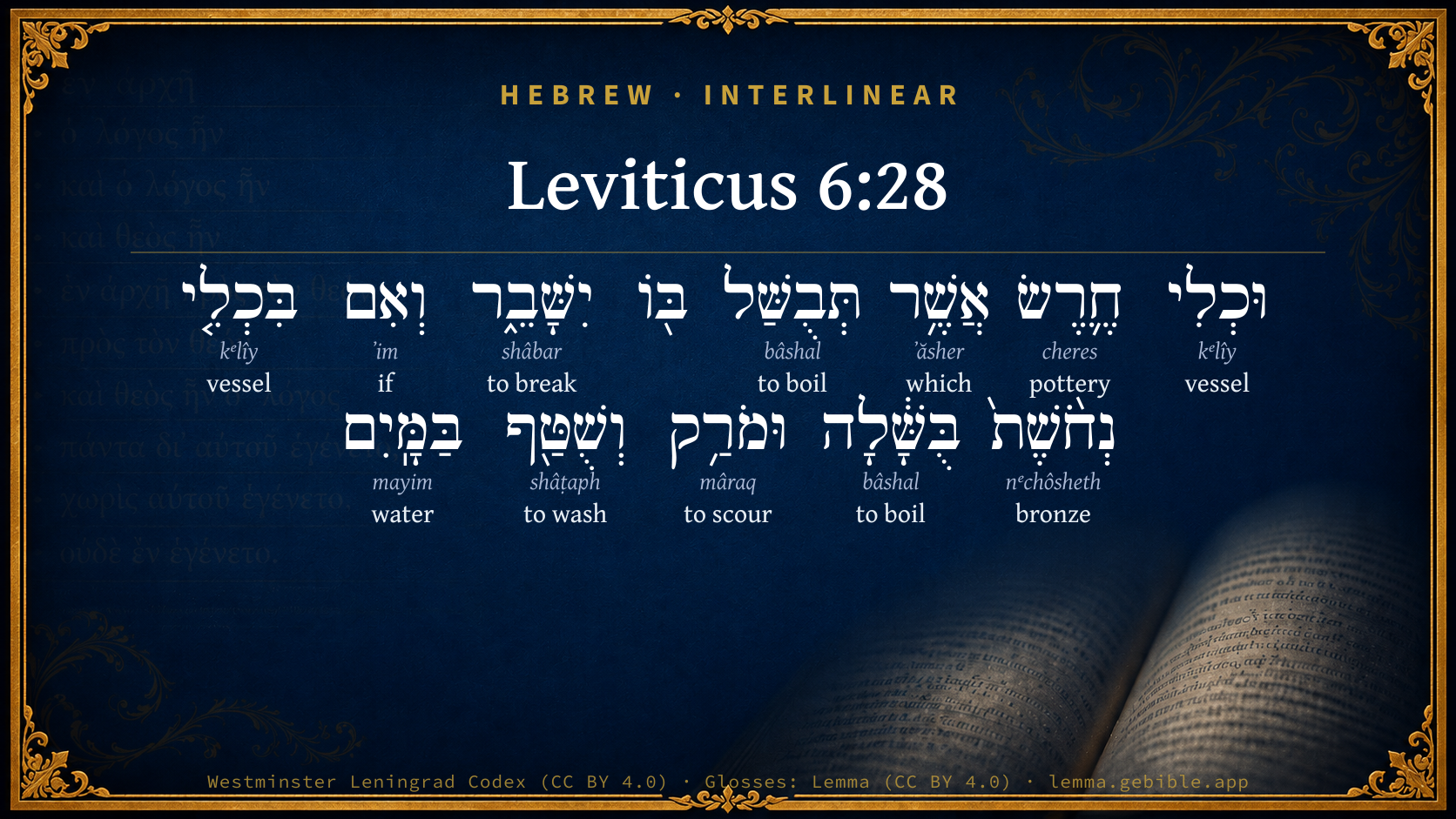
Leviticus 6:28

Hebrew (Westminster Leningrad Codex) Leviticus 6:28 appears in the Hebrew Old Testament. The text above is from the Westminster Leningrad Codex. Each word links to its Strong’s number, a concise gloss, and parsing drawn from the Open Scriptures Hebrew Bible morphology. Click any word for its full Brown-Driver-Briggs (BDB) entry.
Download image
Cite this verse

Leviticus 6:28 (World English Bible). Public Domain. Lemma interlinear Bible study tool, https://lemma.gebible.app/v/leviticus/6/28.

Show BibTeX & RIS
BibTeX
RIS
English Translation
But the earthen vessel in which it is boiled shall be broken; and if it is boiled in a brazen vessel, it shall be scoured, and rinsed in water.
World English Bible · Public Domain
Highlights
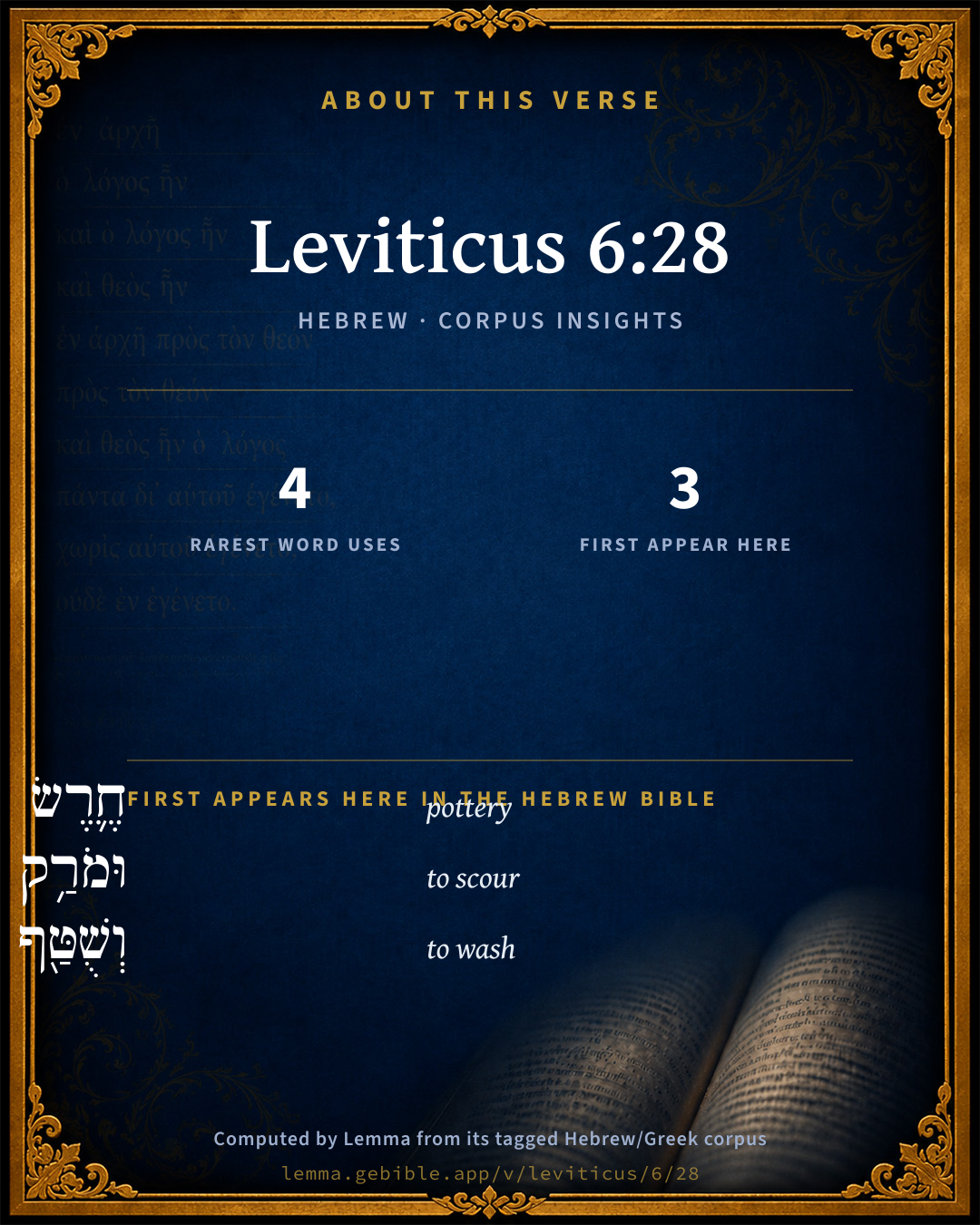
  • 3 first appearances in the Hebrew Bible
Full analysis ↓
Download a study sheet

One document with this verse’s original text, its word-by-word gloss line, the meaning frame, cross-references with their text, attributed commentary, and full source and license credits — printable, and it pastes into notes with its structure intact.

This verse Autodidact and up

Study sheet (.html) Plain text (.txt)

A passage Seminary Student

Up to 50 verses in one chapter. A passage sheet keeps up to 6 commentary sources and 12 cross-references per verse, in the order this page ranks them, and says so on the sheet whenever that leaves anything out. Ask for a single verse and you get the Autodidact verse sheet above.

Everything on this page stays free to read, with no account — the sheet is a download of what is already on screen, not access to it.

Want to remove ads? Support Godless Engineer
Compare translations 3

The same verse in 3 English versions, stacked beneath the original-language interlinear above. Click any original word for its lexicon entry.

Each is an independent rendering of the whole verse — the interlinear is not word-aligned to these translations.

Highlighted words mark where these versions differ — a whole-verse word diff, not a word-by-word alignment.

  • World English Bible Public Domain
    But the earthen vessel in which it is boiled shall be broken; and if it is boiled in a brazen vessel, it shall be scoured, and rinsed in water.
  • King James Version Public Domain
    But the earthen vessel wherein it is sodden shall be broken: and if it be sodden in a brazen pot, it shall be both scoured, and rinsed in water.
  • unfoldingWord Literal Text CC BY-SA 4.0
    And a container of earthenware, which it is boiled in it, shall be shattered. But if it is boiled in a container of bronze, then it shall be scoured and it shall be rinsed with water.

unfoldingWord Literal Text — © unfoldingWord, licensed CC BY-SA 4.0. Word-aligned USFM3 via Door43 (git.door43.org/unfoldingWord/en_ult).

Versions to compare (up to 4)

3 of 4 selected

Show all 16 translations

Every available English version of this verse, each an independent rendering of the whole verse.

  • World English Bible Public Domain
    But the earthen vessel in which it is boiled shall be broken; and if it is boiled in a brazen vessel, it shall be scoured, and rinsed in water.
  • Berean Standard Bible Public Domain
    The clay pot in which the sin offering is boiled must be broken; if it is boiled in a bronze pot, the pot must be scoured and rinsed with water.
  • Majority Standard Bible Public Domain
    The clay pot in which the sin offering is boiled must be broken; if it is boiled in a bronze pot, the pot must be scoured and rinsed with water.
  • King James Version Public Domain
    But the earthen vessel wherein it is sodden shall be broken: and if it be sodden in a brazen pot, it shall be both scoured, and rinsed in water.
  • American Standard Version (1901) Public Domain
    But the earthen vessel wherein it is boiled shall be broken; and if it be boiled in a brazen vessel, it shall be scoured, and rinsed in water.
  • Revised Version (1885) Public Domain
    But the earthen vessel wherein it is sodden shall be broken: and if it be sodden in a brasen vessel, it shall be scoured, and rinsed in water.
  • Geneva Bible (1599) Public Domain
    Also the earthen pot that it is sodden in, shalbe broken, but if it be sodden in a brasen pot, it shall both be scoured and washed with water.
  • Douay-Rheims (1899) Public Domain
    And the earthen vessel, wherein it was sodden, shall be broken, but if the vessel be of brass, it shall be scoured, and washed with water.
  • Young's Literal Translation Public Domain
    and an earthen vessel in which it is boiled is broken, and if in a brass vessel it is boiled, then it is scoured and rinsed with water.
  • Literal Standard Version CC BY-SA 4.0
    and an earthen vessel in which it is boiled is broken, and if it is boiled in a bronze vessel, then it is scoured and rinsed with water.
  • Unlocked Literal Bible CC BY-SA 4.0
    But the clay pot in which it is boiled must be broken. If it is boiled in a bronze pot, it must be scrubbed and rinsed clean in water.
  • unfoldingWord Literal Text CC BY-SA 4.0
    And a container of earthenware, which it is boiled in it, shall be shattered. But if it is boiled in a container of bronze, then it shall be scoured and it shall be rinsed with water.
  • Darby Bible Public Domain
    And the earthen vessel wherein it hath been sodden shall be broken; and if it have been sodden in a copper pot, it shall be both scoured and rinsed with water.
  • World Messianic Bible Public Domain
    But the earthen vessel in which it is boiled shall be broken; and if it is boiled in a bronze vessel, it shall be scoured, and rinsed in water.
  • Free Bible Version CC BY-SA 4.0
    The clay pot used to boil the sin offering must be broken. If it's boiled in a bronze pot, the pot must be thoroughly cleaned and washed out with water.
  • JPS Tanakh (1917) Public Domain
    (6-21) But the earthen vessel wherein it is sodden shall be broken; and if it be sodden in a brazen vessel, it shall be scoured, and rinsed in water.

Literal Standard Version (2020), Covenant Press — licensed CC BY-SA 4.0. Text via the HelloAO Bible API (eBible.org). Unlocked Literal Bible (unfoldingWord) — licensed CC BY-SA 4.0. Text via the HelloAO Bible API (eBible.org). unfoldingWord Literal Text — © unfoldingWord, licensed CC BY-SA 4.0. Word-aligned USFM3 via Door43 (git.door43.org/unfoldingWord/en_ult). Free Bible Version, Dr. Jonathan Gallagher — licensed CC BY-SA 4.0. Text via the HelloAO Bible API (eBible.org).

Word by word

More ways to search: Search by grammar → Find every occurrence → Compare this word →

Practice this passage: Drill this verse → Learn its vocabulary →

וּמֹרַ֥ק
mâraq
H4838
“and · to scour”
Conjunction + Verb, Pual, Sequential Perfect, 3rd Person, Masculine, Singular
Part of Speech
Conjunction + Verb
Stem
Pual
Form
Sequential Perfect
Person
3rd Person
Gender
Masculine
Number
Singular
Full BDB Definition

Origin: a primitive root

TWOT: 1246

to scour, polish - (Qal) to scour, polish - (Pual) to be scoured
  1. וּכְלִי kᵉlîy H3627 “and · vessel of” Conjunction + Noun, Common, Masculine, Singular, Construct
  2. חֶ֛רֶשׂ cheres H2789 “pottery” Noun, Common, Masculine, Singular, Absolute
  3. אֲשֶׁ֥ר ʼăsher H834 “which” Particle, Relative
  4. תְּבֻשַּׁל bâshal H1310 “to boil” Verb, Pual, Imperfect, 3rd Person, Feminine, Singular
  5. יִשָּׁבֵ֑ר shâbar H7665 “to break” Verb, Niphal, Imperfect, 3rd Person, Masculine, Singular
  6. וְאִם ʼim H518 “and · if” Conjunction + Conjunction
  7. בִּכְלִ֤י kᵉlîy H3627 “in/at · vessel of” Preposition + Noun, Common, Masculine, Singular, Construct
  8. נְחֹ֨שֶׁת֙ nᵉchôsheth H5178 “bronze” Noun, Common, Feminine, Singular, Absolute
  9. בֻּשָּׁ֔לָה bâshal H1310 “to boil” Verb, Pual, Perfect, 3rd Person, Feminine, Singular
  10. וְשֻׁטַּ֖ף shâṭaph H7857 “and · to wash” Conjunction + Verb, Pual, Sequential Perfect, 3rd Person, Masculine, Singular
  11. בַּמָּֽיִם mayim H4325 “in/at the · water(s)” Preposition, Determined + Noun, Common, Masculine, Plural, Absolute

About this verse

These counts appear in no published source. They are computed here, from the morphology-tagged text and Lemma’s own curated glosses. What Lemma adds →

13
words
10
distinct lemmas
Pentateuch
section

Notable vocabulary

The rarest word here is וּמֹרַ֥ק to scour H4838 — appearing just 4 times in the whole Hebrew Bible.

First appearance in Scripture

These words make their first canonical appearance in the Hebrew Bible here:

  • חֶ֛רֶשׂ pottery H2789
  • וּמֹרַ֥ק to scour H4838
  • וְשֻׁטַּ֖ף to wash H7857

Shared distinctive vocabulary

וּמֹרַ֥ק to scour H4838 occurs in 4 verses of the Hebrew Bible. Also found in:

Grammatical profile

  • 5 verbs
  • 5 nouns
  • 1 preposition
  • 1 conjunction
  • 1 particle

Verb forms

  • תְּבֻשַּׁל Pual · Imperfect
  • יִשָּׁבֵ֑ר Niphal · Imperfect
  • בֻּשָּׁ֔לָה Pual · Perfect
  • וּמֹרַ֥ק Pual · Sequential Perfect
  • וְשֻׁטַּ֖ף Pual · Sequential Perfect

Repetition

Words recur within this verse — often emphatic in Hebrew:

  • וּכְלִי vessel H3627 ×2
  • תְּבֻשַּׁל to boil H1310 ×2

Hebrew & Septuagint length

In English translation the verse runs 29 words from the Hebrew and 34 from the Septuagint (LXX English) — closely comparable.

A rough comparison of the two English renderings, which tokenize alike — not a word-level alignment.

Word counts can differ between the Hebrew and the Greek without any difference in meaning — e.g. the Hebrew direct-object marker אֵת has no separate Greek word, and Greek often adds the article ὁ.

Cross-references

3

Topical passages linked to Leviticus 6:28 in the Treasury of Scripture Knowledge — connected by theme and wording, ordered by reader-vote popularity; previews shown in the World English Bible.

  • Leviticus 11:33 Every earthen vessel, into which any of them falls, all that is in it shall be unclean, and you shall break it.
  • Leviticus 15:12 "'The earthen vessel, which he who has the discharge touches, shall be broken; and every vessel of wood shall be rinsed in water.
  • Hebrews 9:9–10 which is a symbol of the present age, where gifts and sacrifices are offered that are incapable, concerning the conscience, of making the worshipper perfect;

Cross-references courtesy of OpenBible.info (CC BY 4.0).

Hebrew and Greek witnesses Masoretic Hebrew ↔ Greek Septuagint

The same verse in the two great witnesses to the Old Testament, shown verse-for-verse.

These are two independent witnesses, not word-aligned to each other, and the Septuagint is shown in lemma (dictionary) form.

Hebrew Leviticus 6:28 Masoretic · Westminster Leningrad Codex

וּכְלִי חֶ֛רֶשׂ אֲשֶׁ֥ר תְּבֻשַּׁל בּ֖וֹ יִשָּׁבֵ֑ר וְאִם בִּכְלִ֤י נְחֹ֨שֶׁת֙ בֻּשָּׁ֔לָה וּמֹרַ֥ק וְשֻׁטַּ֖ף בַּמָּֽיִם

But the earthen vessel in which it is boiled shall be broken; and if it is boiled in a brazen vessel, it shall be scoured, and rinsed in water.

World English Bible · Public Domain

Greek LXX Leviticus 6:28 Septuagint · lemma form
And the earthen vessel, in whichever it shall have been sodden, shall be broken; and if it shall have been sodden in a brazen vessel, he shall scour it and wash it with water.

LXX2012 (modern English Septuagint) · Public Domain

On this verse, Adam Clarke's Commentary discusses the Septuagint’s reading. Read the note in Commentary ↓

Hebrew: Westminster Leningrad Codex (CC BY 4.0). Greek: Septuagint (public domain); English from LXX2012 (modern English Septuagint) (Public Domain). How the Septuagint differs from the Hebrew →

Commentary

Notes on Leviticus 6:28 from classic Christian and Jewish commentators (each source and its license shown beneath its notes). The classic Christian expositions comment on the surrounding passage and are grouped to its opening verse, so a note may address several verses; the Jewish commentaries on the Tanakh (Rashi and others) are per-verse, so they appear only where the commentator wrote on this verse.

Lemma curates 59 commentaries, every one of them public domain or Creative Commons licensed, each selected and text-cleaned for this edition rather than reprinted as found. About our sources →

Trapp's Complete Commentary

John Trapp

Lev 6:28 But the earthen vessel wherein it is sodden shall be broken: and if it be sodden in a brasen pot, it shall be both scoured, and rinsed in water.

Ver. 28. But the earthen vessel.] So contagious a thing is sin, that it defileth the very visible heaven and earth: which therefore must be likewise purged by the last fire, as the earthen pot which held the sin offering was broken, and the brazen scoured and rinsed in water.

John Trapp, A Commentary or Exposition upon All the Books of the Old and New Testament (1647–1656) — public domain. Text from a community e-Sword module.

Joseph Benson's Commentary

Lev 6:28. The earthen vessel shall be broken — This relates, not to the consecrated vessels of the tabernacle, for none of these were of earth, Exo 27:19; but to such vessels as were sometimes employed by private persons in dressing the meat of their sacrifices, whereof we have an example, 1Sa 2:13-14. These, after the flesh of the sacrifice had been boiled in them, were to be broken, in order that what retained the smallest tincture of the holy things might not be profaned by being afterward employed in common use. If it be sodden in a brazen pot, it shall be scoured — Vessels of brass, being more solid, and less apt to imbibe the moisture, might be thoroughly cleansed from all tincture of the sacrifice by washing and scouring, and therefore were not to be broken. Besides, being of considerable value, God would not have them destroyed unnecessarily.

Joseph Benson's Commentary on the Old and New Testaments (1811–1818) — public domain. Text from a community e-Sword module.

Tyndale Open Study Notes

Tyndale Open Resources

6:28 A clay pot was porous and could not be cleansed as thoroughly as a metal one—some of the holy food might stick to it or soak in. Reuse would cause an act of sacrilege. However, a bronze pot could be thoroughly scoured to prevent this problem (see also 11:33; 15:12).

Tyndale Open Study Notes — © Tyndale Open Resources, licensed CC BY-SA 4.0. Text via the HelloAO Bible API.

Geneva Bible (1599)

Geneva Bible translators

Which was in the laver, Exod. 30:18.

Geneva Bible (1599) marginal notes — public domain. Text via Bolls.life.

Adam Clarke's Commentary

Verse 28. The earthen vessel - shall be broken] Calmet states that this should be considered as implying the vessels brought by individuals to the court of the temple or tabernacle, and not of the vessels that belonged to the priests for the ordinary service. That the people dressed their sacrifices sometimes in the court of the tabernacle, he gathers from 1Sa 2:13-14, to which the reader is desired to refer.

In addition to what has been already said on the different subjects in this chapter, it may be necessary to notice a few more particulars. The perpetual meat-offering, מנחה תמיד minchah tamid, Le 6:20, the perpetual fire, אש תמיד esh tamid, Le 6:13, and the perpetual burnt-offering, עלת תמיד olath tamid, Ex 29:42, translated by the Septuagint θυσια διαπαντος, πυο διαπαντος, and ὁλοκαυτωσις and ὁλοκαυτωμα διαπαντος, all cast much light on Heb 7:25, where it is said, Christ is able to save them to the uttermost (εισ το παντελες, perpetually, to all intents and purposes) that come unto God by him; seeing he ever liveth (παντοτε ζων, he is perpetually living) to make intercession for them; in which words there is a manifest allusion to the perpetual minchah, the perpetual fire, and the perpetual burnt-offering, mentioned here by Moses. As the minchah, or gratitude-offering should be perpetual, so our gratitude for the innumerable mercies of God should be perpetual. As the burnt-offering must be perpetual, so should the sacrifice of our blessed Lord be considered as a perpetual offering, that all men, in all ages, should come unto God through him who is ever living, in his sacrificial character, to make intercession for men; and who is therefore represented even in the heavens as the Lamb just slain, standing before the throne, Re 5:6; Heb 10:19-22. And as the fire on the altar must be perpetual, so should the influences of the Holy Spirit in every member of the Church, and the flame of pure devotion in the hearts of believers, be ever energetic and permanent. A continual sacrifice for continual successive generations of sinners was essentially necessary. Continual influences of the Holy Spirit on the souls of men were essentially necessary to apply and render effectual this atonement, to the salvation of the soul. And incessant gratitude for the ineffable love of God, manifested by his unspeakable gift, is surely required of all those who have tasted that the Lord is gracious. Reader, dost thou feel thy obligations to thy Maker? Does the perpetual fire burn on the altar of thy heart? Art thou ever looking unto Jesus, and beholding, by faith, the Lamb of God which taketh away the sin of the world? And dost thou feel the influences of his Spirit, at all times witnessing with thy spirit that thou art his child, and exciting thee to acts of gratitude and obedience? If not, of what benefit has the religion of Christ been to thee to the present day? Of a contrary state to that referred to above, it may be well said, This is not the way to heaven, for the way of life is above to the wise, that they may depart from the snares of death beneath. Arise, therefore, and shake thyself from the dust; and earnestly call upon the Lord thy God, that he may save thy soul, and that thou fall not into the bitter pains of an eternal death.

Adam Clarke's Commentary on the Bible (1810–1826) — public domain. Text from a community e-Sword/MySword module.

Ellicott's Commentary for English Readers

(28) But the earthen vessel.—The earthen vessels need by the Hebrews were unglazed. The ordinary domestic vessels throughout the East are so to this day. From their porous character, therefore, they would absorb some of the fat juices of the flesh which was boiled in them for the priests to eat. And as the absorbed juices could not be washed out, the inexpensive earthenware was to be broken up. (See Lev_11:33; Lev_11:35). During the second Temple the fragments were carefully buried in the ground when there was a large accumulation of them.

And if it be sodden in a brasen pot.—Being a solid metal, no juices could sink into it, and any of the most holy flesh that might adhere to it could easily be removed by washing. During the second Temple the scouring was done with hot water, and the rinsing with cold.

A Bible Commentary for English Readers, edited by Charles John Ellicott (1878–1897) — public domain. Text from a community e-Sword module.

The Cambridge Bible for Schools and Colleges

gen. ed. J. J. S. Perowne

28. The reason for breaking the earthen vessel was that, not being glazed as in modern fashion, it was absorbent; a brazen pot could be scoured, and all trace of the substance with which it had been in contact removed (cp. Lev_11:33, Lev_15:12). The remains of the broken earthen vessels were buried.

The Cambridge Bible for Schools and Colleges (gen. ed. J. J. S. Perowne; Cambridge University Press, 1878–1918) — public domain. Text from a community e-Sword module.

John Gill's Exposition

And all the males among the priests shall eat thereof,.... As of the meat offerings, Lev 6:18 and this shows that not the single priest that offered only ate of it, Lev 6:26 but his male children, and not those only, but those of other priests then upon duty, or in the court:

it is most holy; See Gill on Lev 6:25.

John Gill's Exposition of the Whole Bible (1746–1763) — public domain (CC PDM 1.0). Text via the HelloAO Bible API.

Albert Barnes' Notes on the Bible

The earthen vessel - Unglazed pottery would absorb some of the juices of the meat: and a vessel made holy could not be put to any other purpose.

Albert Barnes' Notes on the Bible (1834–1885) — public domain. Text from a community e-Sword/MySword module.

Haydock's Catholic Bible Commentary

Sodden, or boiled. Such vessels, of private people, as had been used to boil part of the victim, (1 Kings ii. 13,) were either to be abandoned to the service of the altar, or broken, &c. (Calmet) --- Earthen vessels might imbibe some part of the consecrated juice. (Menochius)

George Leo Haydock (1774–1849), Haydock's Catholic Family Bible and Commentary, 1859 edition — public domain. Excludes Psalms (Douay-Rheims chapter numbering differs from Protestant) and Deuterocanonical books (Catholic canon only).

Matthew Poole's English Annotations

The earthen vessel shall be broken, because being full of pores, the liquor in which it was sodden might easily sink into it, whereby it was ceremonially holy, and therefore was broken, lest afterwards it should be abused to profane or common uses.

It shall be both scoured, and not broken, as being of considerable value, which therefore God would not have unnecessarily wasted. And this being of a more solid substance than an earthen vessel, was not so apt to drink in the humour.

Matthew Poole's English Annotations on the Holy Bible (1683–1685) — public domain. Text from a community e-Sword/MySword module.

John Wesley's Explanatory Notes

Broken - Because being full of pores, the liquor in which it was sodden might easily sink into it, whereby it was ceremonially holy, and therefore was broken, lest afterwards it should be abused to common uses. Rinsed - And not broken, as being of considerable value, which therefore God would not have unnecessarily wasted. And this being of a more solid substance than an earthen vessel, was not so apt to drink in the moisture.

John Wesley, Explanatory Notes Upon the Whole Bible (1754–1765) — public domain. Text via the GEBible commentary corpus.

Keil & Delitzsch

C. F. Keil & F. Delitzsch

The flesh was equally holy. The vessel, in which it was boiled for the priests to eat, was to be broken in pieces if it were of earthenware, and scoured (מרק Pual) and overflowed with water, i.e., thoroughly rinsed out, if it were of copper, lest any of the most holy flesh should adhere to the vessel, and be desecrated by its being used in the preparation of common food, or for other earthly purposes. It was possible to prevent this desecration in the case of copper vessels by a thorough cleansing; but not so with earthen vessels, which absorb the fat, so that it cannot be removed by washing. The latter therefore were to be broken in pieces, i.e., thoroughly destroyed. On the other hand, earthen vessels that had been defiled were also ordered to be broken to pieces, though for the very opposite reason (see Lev 11:33, Lev 11:35).

Keil & Delitzsch — Biblical Commentary on the Old Testament (1861–1891) — public domain (CC PDM 1.0). Text via the HelloAO Bible API. (Old Testament only.)

Lesson kit

Teaching starters — assembled from the data on this page, not authored interpretation. Every prompt links to the verse data it draws on. Edit before teaching.

Leviticus, in the Pentateuch, opens this verse with 13 words (10 distinct Hebrew lemmas). Its most distinctive word is mâraq (“to scour”). A historical commentator’s framing appears above. Read the whole chapter for the surrounding context.

Discussion questions

  1. The word mâraq carries the sense “to scour.” How does it shape the verse?
  2. 3 words here appear for the first time in Scripture. What is being introduced at this debut?
  3. 2 Chronicles 4:16 shares the word «to scour» with this verse. How do the two illuminate each other?
  4. “vessel” occurs 2× in this one verse. What is the effect of the repetition?
  5. These translations render this verse differently. What is at stake in choosing one wording over another?
  6. The verb «תְּבֻשַּׁל» is Pual Imperfect. How does its form color the action?
  7. Reading how Trapp's Complete Commentary and Joseph Benson's Commentary read this verse, where do the two commentators agree and where do they part?

Things to notice

  • 3 words make their first canonical appearance in Scripture here.
  • These translations choose different wording for 14 words in this verse.
  • “vessel” occurs 2× in this single verse.
  • 10 distinct Hebrew lemmas span 13 words in this verse.

Reading settings

Reading text

Shown beneath each verse's original-language words.

Old Testament
Old Testament edition

Read the OT as the Masoretic Hebrew (MT) or the Greek Septuagint (LXX).

English shown for the Greek Septuagint (in the Hebrew ↔ Greek comparison).

Comparing translations? Open the Compare panel on any verse page to stack up to four side by side.