
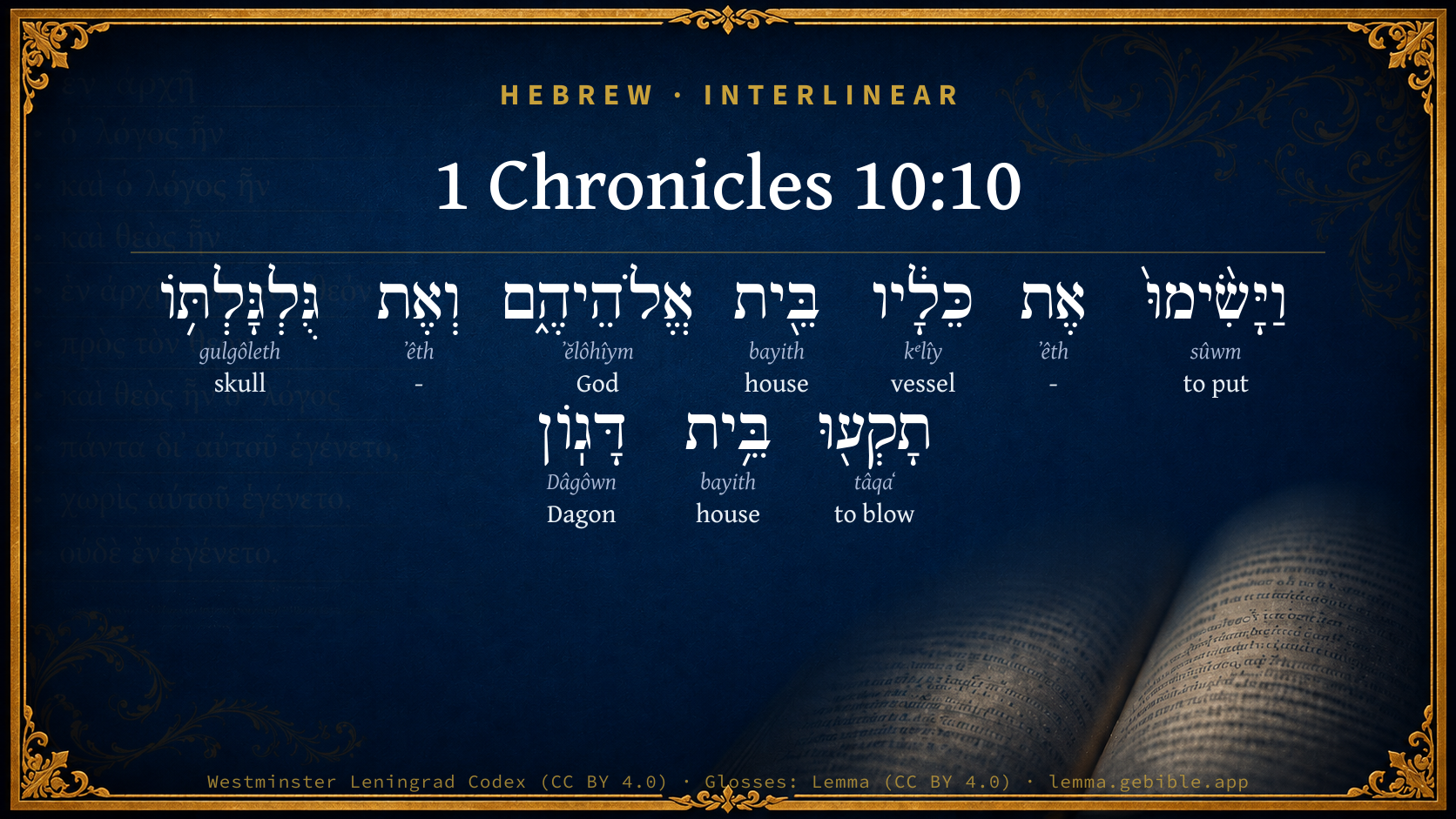
1 Chronicles 10:10

Hebrew (Westminster Leningrad Codex) 1 Chronicles 10:10 appears in the Hebrew Old Testament. The text above is from the Westminster Leningrad Codex. Each word links to its Strong’s number, a concise gloss, and parsing drawn from the Open Scriptures Hebrew Bible morphology. Click any word for its full Brown-Driver-Briggs (BDB) entry.
Download image
Cite this verse

1 Chronicles 10:10 (World English Bible). Public Domain. Lemma interlinear Bible study tool, https://lemma.gebible.app/v/1-chronicles/10/10.

Show BibTeX & RIS
BibTeX
RIS
English Translation
They put his armor in the house of their gods, and fastened his head in the house of Dagon.
World English Bible · Public Domain
Download a study sheet

One document with this verse’s original text, its word-by-word gloss line, the meaning frame, cross-references with their text, attributed commentary, and full source and license credits — printable, and it pastes into notes with its structure intact.

This verse Autodidact and up

Study sheet (.html) Plain text (.txt)

A passage Seminary Student

Up to 50 verses in one chapter. A passage sheet keeps up to 6 commentary sources and 12 cross-references per verse, in the order this page ranks them, and says so on the sheet whenever that leaves anything out. Ask for a single verse and you get the Autodidact verse sheet above.

Everything on this page stays free to read, with no account — the sheet is a download of what is already on screen, not access to it.

Want to remove ads? Support Godless Engineer
Compare translations 3

The same verse in 3 English versions, stacked beneath the original-language interlinear above. Click any original word for its lexicon entry.

Each is an independent rendering of the whole verse — the interlinear is not word-aligned to these translations.

Highlighted words mark where these versions differ — a whole-verse word diff, not a word-by-word alignment.

  • World English Bible Public Domain
    They put his armor in the house of their gods, and fastened his head in the house of Dagon.
  • King James Version Public Domain
    And they put his armor in the house of their gods, and fastened his head in the temple of Dagon.
  • unfoldingWord Literal Text CC BY-SA 4.0
    And they put his weapons the house of their gods, and they fastened his head the house of Dagon.

unfoldingWord Literal Text — © unfoldingWord, licensed CC BY-SA 4.0. Word-aligned USFM3 via Door43 (git.door43.org/unfoldingWord/en_ult).

Versions to compare (up to 4)

3 of 4 selected

Show all 18 translations

Every available English version of this verse, each an independent rendering of the whole verse.

  • World English Bible Public Domain
    They put his armor in the house of their gods, and fastened his head in the house of Dagon.
  • Berean Standard Bible Public Domain
    They put his armor in the temple of their gods and hung his head in the temple of Dagon.
  • Majority Standard Bible Public Domain
    They put his armor in the temple of their gods and hung his head in the temple of Dagon.
  • King James Version Public Domain
    And they put his armor in the house of their gods, and fastened his head in the temple of Dagon.
  • American Standard Version (1901) Public Domain
    And they put his armor in the house of their gods, and fastened his head in the house of Dagon.
  • Revised Version (1885) Public Domain
    And they put his armour in the house of their gods, and fastened his head in the house of Dagon.
  • Geneva Bible (1599) Public Domain
    And they layd vp his armour in the house of their god, and set vp his head in the house of Dagon.
  • Douay-Rheims (1899) Public Domain
    And his armour they dedicated in the temple of their god, and his head they fastened up in the temple of Dagon.
  • Young's Literal Translation Public Domain
    and put his weapons in the house of their gods, and his skull they have fixed in the house of Dagon.
  • Literal Standard Version CC BY-SA 4.0
    and they put his weapons in the house of their gods, and have fixed his skull in the house of Dagon.
  • Unlocked Literal Bible CC BY-SA 4.0
    They put his armor in the temple of their gods, and fastened his head to the temple of Dagon.
  • unfoldingWord Literal Text CC BY-SA 4.0
    And they put his weapons the house of their gods, and they fastened his head the house of Dagon.
  • Darby Bible Public Domain
    And they put his armour in the house of their god, and fastened his head in the house of Dagon.
  • World Messianic Bible Public Domain
    They put his armor in the house of their gods, and fastened his head in the house of Dagon.
  • Webster's Bible Public Domain
    And they put his armor in the house of their gods, and fastened his head in the temple of Dagon.
  • Free Bible Version CC BY-SA 4.0
    They put Saul's armor in the temple of their idols and fixed his head to the temple of Dagon.
  • Bible in Basic English Public Domain
    And they put his war-dress in the house of their gods, and put up his head in the house of Dagon.
  • JPS Tanakh (1917) Public Domain
    And they put his armour in the house of their gods, and fastened his head in the house of Dagon.

Literal Standard Version (2020), Covenant Press — licensed CC BY-SA 4.0. Text via the HelloAO Bible API (eBible.org). Unlocked Literal Bible (unfoldingWord) — licensed CC BY-SA 4.0. Text via the HelloAO Bible API (eBible.org). unfoldingWord Literal Text — © unfoldingWord, licensed CC BY-SA 4.0. Word-aligned USFM3 via Door43 (git.door43.org/unfoldingWord/en_ult). Free Bible Version, Dr. Jonathan Gallagher — licensed CC BY-SA 4.0. Text via the HelloAO Bible API (eBible.org).

Word by word

More ways to search: Search by grammar → Find every occurrence → Compare this word →

Practice this passage: Drill this verse → Learn its vocabulary →

גֻּלְגָּלְתּ֥וֹ
gulgôleth
H1538
“skull · his”
Noun, Common, Feminine, Singular, Construct + Suffix, Personal, 3rd Person, Masculine, Singular
Part of Speech
Noun
Type
Common
Gender
Feminine
Number
Singular
State
Construct
Full BDB Definition

Origin: by reduplication from H1556

TWOT: 353l

head, poll, skull - skull - head, poll (of census)
  1. וַיָּשִׂ֨ימוּ֙ sûwm H7760 “and · to put” Conjunction + Verb, Qal, Sequential Imperfect, 3rd Person, Masculine, Plural
  2. אֶת ʼêth H853 “-” Particle, Direct Object
  3. כֵּלָ֔יו kᵉlîy H3627 “vessels · his” Noun, Common, Masculine, Plural, Construct + Suffix, Personal, 3rd Person, Masculine, Singular
  4. בֵּ֖ית bayith H1004 “house of” Noun, Common, Masculine, Singular, Construct
  5. אֱלֹהֵיהֶ֑ם ʼĕlôhîym H430 “God(s) · their” Noun, Common, Masculine, Plural, Construct + Suffix, Personal, 3rd Person, Masculine, Plural
  6. וְאֶת ʼêth H853 “and · -” Conjunction + Particle, Direct Object
  7. תָקְע֖וּ tâqaʻ H8628 “to blow” Verb, Qal, Perfect, 3rd Person, Common, Plural
  8. בֵּ֥ית bayith H1004 “house of” Noun, Common, Masculine, Singular, Construct
  9. דָּגֽוֹן Dâgôwn H1712 “Dagon” Noun, Proper

About this verse

These counts appear in no published source. They are computed here, from the morphology-tagged text and Lemma’s own curated glosses. What Lemma adds →

10
words
8
distinct lemmas
Historical
section

Notable vocabulary

The rarest word here is גֻּלְגָּלְתּ֥וֹ skull H1538 — appearing just 12 times in the whole Hebrew Bible.

Shared distinctive vocabulary

גֻּלְגָּלְתּ֥וֹ skull H1538 occurs in 12 verses of the Hebrew Bible. Also found in:

Grammatical profile

  • 2 verbs
  • 6 nouns
  • 2 particles

Verb forms

  • וַיָּשִׂ֨ימוּ֙ Qal · Sequential Imperfect
  • תָקְע֖וּ Qal · Perfect

Repetition

A word recurs within this verse — often emphatic in Hebrew:

  • בֵּ֖ית house H1004 ×2

Hebrew & Septuagint length

In English translation the verse runs 19 words from the Hebrew and 21 from the Septuagint (LXX English) — closely comparable.

A rough comparison of the two English renderings, which tokenize alike — not a word-level alignment.

Word counts can differ between the Hebrew and the Greek without any difference in meaning — e.g. the Hebrew direct-object marker אֵת has no separate Greek word, and Greek often adds the article ὁ.

In the original languages it is 10 Hebrew tokens and 17 Greek tokens — but the two are counted differently (Hebrew bundles its prefixes and suffixes into one token; the Greek is in lemma form), so that isn’t a like-for-like length.

Cross-references

2

Topical passages linked to 1 Chronicles 10:10 in the Treasury of Scripture Knowledge — connected by theme and wording, ordered by reader-vote popularity; previews shown in the World English Bible.

  • 1 Samuel 5:2–7 The Philistines took the ark of God, and brought it into the house of Dagon, and set it by Dagon.
  • 1 Samuel 31:10 They put his armor in the house of the Ashtaroth; and they fastened his body to the wall of Beth-shan.

Cross-references courtesy of OpenBible.info (CC BY 4.0).

Hebrew and Greek witnesses Masoretic Hebrew ↔ Greek Septuagint

The same verse in the two great witnesses to the Old Testament, shown verse-for-verse.

These are two independent witnesses, not word-aligned to each other, and the Septuagint is shown in lemma (dictionary) form.

Hebrew 1 Chronicles 10:10 Masoretic · Westminster Leningrad Codex

וַיָּשִׂ֨ימוּ֙ אֶת כֵּלָ֔יו בֵּ֖ית אֱלֹהֵיהֶ֑ם וְאֶת גֻּלְגָּלְתּ֥וֹ תָקְע֖וּ בֵּ֥ית דָּגֽוֹן

They put his armor in the house of their gods, and fastened his head in the house of Dagon.

World English Bible · Public Domain

Greek LXX 1 Chronicles 10:10 Septuagint · lemma form

καί τίθημι ὁ σκεῦος αὐτός ἐν οἶκος θεός αὐτός καί ὁ κεφαλή αὐτός τίθημι ἐν οἶκος δαγων

And they put their armor in the house of their god, and they put his head in the house of Dagon.

LXX2012 (modern English Septuagint) · Public Domain

On this verse, Ellicott's Commentary for English Readers discusses the Septuagint’s reading. Read the note in Commentary ↓

Hebrew: Westminster Leningrad Codex (CC BY 4.0). Greek: Septuagint (public domain); English from LXX2012 (modern English Septuagint) (Public Domain). How the Septuagint differs from the Hebrew →

Commentary

Notes on 1 Chronicles 10:10 from classic Christian and Jewish commentators (each source and its license shown beneath its notes). The classic Christian expositions comment on the surrounding passage and are grouped to its opening verse, so a note may address several verses; the Jewish commentaries on the Tanakh (Rashi and others) are per-verse, so they appear only where the commentator wrote on this verse.

Lemma curates 59 commentaries, every one of them public domain or Creative Commons licensed, each selected and text-cleaned for this edition rather than reprinted as found. About our sources →

Trapp's Complete Commentary

John Trapp

1Ch 10:10 And they put his armour in the house of their gods, and fastened his head in the temple of Dagon.

Ver. 10. And fastened his head.] In way of abuse and mockage; so, that which Saul feared came upon him. {1Ch 10:4}

John Trapp, A Commentary or Exposition upon All the Books of the Old and New Testament (1647–1656) — public domain. Text from a community e-Sword module.

Joseph Benson's Commentary

1Ch 10:10. In the temple of Dagon — If we give not God the glory of our successes, even Philistines will rise up in judgment with us, and condemn us. Shall Dagon have so great a place in their triumphs, and the true God be forgotten in ours?

Joseph Benson's Commentary on the Old and New Testaments (1811–1818) — public domain. Text from a community e-Sword module.

Geneva Bible (1599)

Geneva Bible translators

Which was the idol of the Philistines, and from the belly downward had the form of a fish, and upward of a man.

Geneva Bible (1599) marginal notes — public domain. Text via Bolls.life.

Jamieson, Fausset & Brown

Robert Jamieson, A. R. Fausset & David Brown

THE PHILISTINES TRIUMPH OVER HIM. (Ch1 10:8-14)

put his armour in the house of their gods--It was common among the heathen to vow to a national or favorite deity, that, in the event of a victory, the armor of the enemy's king, or of some eminent leader, should be dedicated to him as an offering of gratitude. Such trophies were usually suspended on the pillars of the temple.

fastened his head in the temple of Dagon--while the trunk or headless corpse was affixed to the wall of Beth-shan (Sa1 31:10).

Jamieson, Fausset & Brown — Commentary Critical and Explanatory on the Whole Bible (1871) — public domain (CC PDM 1.0). Text via the HelloAO Bible API.

Ellicott's Commentary for English Readers

(10) In the house of their gods.—Or god, as LXX. Samuel, “house of Ashtaroth,” which the chronicler or his source paraphrases, perhaps from a repugnance to mentioning the idol’s name. Ashtoreth had a great temple at Ascalon, as “Heavenly Aphrodite” (Herod., Hist i. 108). The “Queen of Heaven” (Jer_7:18) was worshipped by the Semitic races generally. Under the name of Ishtar, she was a chief goddess of the Assyrians, and had famous temples at Nineveh and Arbela. The Sabæans worshipped her as Athtâr; and the name Ashtâr is coupled with Chemosh on the Moabite Stone.

Fastened his head in the temple of Dagon.—Literally, and his skull (gulgôleth—comp. Golgotha, Mat_27:33) they fastened in the house of Dagon. Instead of this, we read in Samuel, “and his corpse they fastened to the wall of Beth-shan.” It is hardly likely that the one reading is a corruption of the other. The chronicler has omitted the statement about Saul’s corpse, which is not mentioned in 1Ch_10:9, and supplied one respecting his head, which has been already spoken of in that verse. He found the fact in his additional source, if the clause in question has not dropt out of the text of Samuel.

The Accadians worshipped Dagon, as we learn from the cuneiform inscriptions: comp. the name Ismi-Dagan (Dagon hears).

A Bible Commentary for English Readers, edited by Charles John Ellicott (1878–1897) — public domain. Text from a community e-Sword module.

The Cambridge Bible for Schools and Colleges

gen. ed. J. J. S. Perowne

10. in the house of their gods] In Samuel (more definitely) “in the house (or houses) of Ashtaroth,” Ashtaroth being the plural of Ashtoreth, a goddess, who seems here to bear a martial character. She was apparently consort of the Phœnician Baal (Jdg_2:13; Jdg_10:6).

fastened his head in the temple of Dagon (lit. Beth-Dagon)] In Sam. fastened his body to the wall of Beth-shan. The reading of Chron. is almost certainly a misreading of the text of Sam., yet the fact stated by the Chronicler is probably true. Saul’s body was fixed to the wall of Beth-shan (Sam.), but his head (lit. his skull) and his armour (Chron.; cp. 1Sa_31:9) were probably sent into Philistia to be distributed as trophies among the Philistine temples. Beth-shan is N.E. of Gilboa, about four miles distant from the Jordan, and about a day’s march (1Sa_31:12) from Jabesh (1Ch_10:11), which was situated on the other side of Jordan in Gilead.

The Cambridge Bible for Schools and Colleges (gen. ed. J. J. S. Perowne; Cambridge University Press, 1878–1918) — public domain. Text from a community e-Sword module.

Haydock's Catholic Bible Commentary

Head, while his body was hung on the walls of Bethsan, 1 Kings xxxi. 10. (Calmet) --- The temple of Dagon was contiguous to the wall. (Du Hamel)

George Leo Haydock (1774–1849), Haydock's Catholic Family Bible and Commentary, 1859 edition — public domain. Excludes Psalms (Douay-Rheims chapter numbering differs from Protestant) and Deuterocanonical books (Catholic canon only).

Matthew Poole's English Annotations

And his body severed from his head to the wall of Beth-shan, 1Sa 31:10.

Matthew Poole's English Annotations on the Holy Bible (1683–1685) — public domain. Text from a community e-Sword/MySword module.

Whedon's Commentary on the Bible

Daniel D. Whedon

10. They… fastened his head in the temple of Dagon — In Samuel we are merely told that “they cut off his head,” but no account is there given of what they did with it. This act of the Philistines was, perhaps, a retaliation for the disposition made of the head of Goliath. 1Sa_17:54.

Daniel D. Whedon (gen. ed.), Commentary on the Old and New Testaments (1874–1909) — public domain. Text from a community e-Sword module.

The Pulpit Commentary

The house of their gods. In place of this general designation, the parallel (1Sa_31:10) designates the house more exactly as "the house of Ashtaroth" (Gen_14:5; the Phoenician female deity, as Baal was their male deity. The Greek form of the name is Astarte. See also Cic., "De. Nat. Deo.," 3:23). And fastened his head in the temple of Dagon. The parallel, as above, gives us, "And fastened his body to the wall of Beth-shah" (which account is corroborated in, 2Sa_21:12-14) and does not say what further was done with the head. It is no doubt remarkable that one historian puts on record the one fact and the other the other; and it is one of the clearer indications that both took from some common sources. It is perhaps something to be remarked also that, while the historian in Samuel says nothing further about the head (though allusion to it is probably included in the "body" and the "bones," the further account of which is given in vers. 12, 13, as well as in, (2Sa_21:12-14) the compiler of Chronicles does revert to mention of "the body of Saul," ver. 12, infra, though without any corresponding naming of Beth-shah. Bertheau finds little difficulty in the question, by simply supposing that the omission in Chronicles is another instance of the desire to compress; while others suppose corruption in our text, or, as Thenius and Ewald, the loss of a sentence to our text. After all said, the omission in Samuel of the fate of the head would seem to be fully as remarkable as the omission, so far as this verse is concerned, in Chronicles of the fate of the body. It is reasonable to suppose that the head and trunk of the body of Saul were brought together again, or it were likely some allusion to the contrary would have transpired in the following verses of this chapter or in 2Sa_21:12-14. With regard to the act of the Philistines in dedicating the armour of Saul, and fixing his head in the temple of Dagon, as though trophies, the custom was both ancient and not uncommon (Jud 16:21-30; 1Sa_5:1-5 1Sa_21:9) The house of Dagon (Jos_15:41 Jos_19:27) here spoken of was that at Ashdod, (Jos_15:47) between Gaza and Joppa. Though belonging to Judah"s lot, it was never subdued by Israel, and remained throughout their history one of their worst foes. It is the Azotus of Act_8:40. There was another Dagon temple at Gaza. (Jud 16:21-31) Dagon"s representation was the figure of a man, as to head, hands, and bust, but for the rest that of a fish, which was a symbol of fruitfulness. As Ashdod was situate on the extreme west of Palestine, so Beth-shah generally written Beth-shean, a city of Manasseh (ch. 7:29), though within the borders of Issachar, (Jos_17:11) flora which the Canaanites were not expelled (Jud 1:27) was on the extreme east near the Jordan. It was afterwards called Scythopolis. Considering the distance these were apart, and their contrary directions, we may suppose that some suggestion was intended by the fixing the head in the one place and the body in the other.

The Pulpit Commentary (1880–1919), ed. H.D.M. Spence-Jones & Joseph S. Exell — public domain. Text from a community e-Sword module.

John Wesley's Explanatory Notes

Temple of Dagon - If we give not God the glory of our successes, even Philistines will rise up in judgment with us and condemn us. Shall Dagon have so great a place in their triumphs, and the true God be forgotten in ours?

John Wesley, Explanatory Notes Upon the Whole Bible (1754–1765) — public domain. Text via the GEBible commentary corpus.

Lesson kit

Teaching starters — assembled from the data on this page, not authored interpretation. Every prompt links to the verse data it draws on. Edit before teaching.

1 Chronicles, in the Historical, opens this verse with 10 words (8 distinct Hebrew lemmas). Its most distinctive word is gulgôleth (“skull”). A historical commentator’s framing appears above. Read the whole chapter for the surrounding context.

Discussion questions

  1. How does “skull” (gulgôleth) shape what this verse is saying?
  2. How does Exodus 16:16, which shares the word «skull», read alongside this verse?
  3. What does the repetition of “house” (2× in this one verse) do in this verse?
  4. These translations render this verse differently; the difference is in the English rendering, not the original. What questions does that raise?
  5. «וַיָּשִׂ֨ימוּ֙» is a Qal Sequential Imperfect verb. How does that grammatical form shape the action described?
  6. Compare how Trapp's Complete Commentary and Joseph Benson's Commentary read this verse. Where do they agree or differ?

Things to notice

Reading settings

Reading text

Shown beneath each verse's original-language words.

Old Testament
Old Testament edition

Read the OT as the Masoretic Hebrew (MT) or the Greek Septuagint (LXX).

English shown for the Greek Septuagint (in the Hebrew ↔ Greek comparison).

Comparing translations? Open the Compare panel on any verse page to stack up to four side by side.