Psalms 71:22

Hebrew (Westminster Leningrad Codex) Psalms 71:22 appears in the Hebrew Old Testament. The text above is from the Westminster Leningrad Codex. Each word links to its Strong’s number, a concise gloss, and parsing drawn from the Open Scriptures Hebrew Bible morphology. Click any word for its full Brown-Driver-Briggs (BDB) entry.
Download image
Cite this verse

Psalms 71:22 (World English Bible). Public Domain. Lemma interlinear Bible study tool, https://lemma.gebible.app/v/psalms/71/22.

Show BibTeX & RIS
BibTeX
RIS
English Translation
I will also praise you with the harp for your faithfulness, my God. I sing praises to you with the lyre, Holy One of Israel.
World English Bible · Public Domain
Download a study sheet

One document with this verse’s original text, its word-by-word gloss line, the meaning frame, cross-references with their text, attributed commentary, and full source and license credits — printable, and it pastes into notes with its structure intact.

This verse Autodidact and up

Study sheet (.html) Plain text (.txt)

A passage Seminary Student

Up to 50 verses in one chapter. A passage sheet keeps up to 6 commentary sources and 12 cross-references per verse, in the order this page ranks them, and says so on the sheet whenever that leaves anything out. Ask for a single verse and you get the Autodidact verse sheet above.

Everything on this page stays free to read, with no account — the sheet is a download of what is already on screen, not access to it.

Want to remove ads? Support Godless Engineer
Compare translations 3

The same verse in 3 English versions, stacked beneath the original-language interlinear above. Click any original word for its lexicon entry.

Each is an independent rendering of the whole verse — the interlinear is not word-aligned to these translations.

Highlighted words mark where these versions differ — a whole-verse word diff, not a word-by-word alignment.

  • World English Bible Public Domain
    I will also praise you with the harp for your faithfulness, my God. I sing praises to you with the lyre, Holy One of Israel.
  • King James Version Public Domain
    I will also praise thee with the psaltery, even thy truth, O my God: unto thee will I sing with the harp, O thou Holy One of Israel.
  • unfoldingWord Literal Text CC BY-SA 4.0
    Also I, I will praise you with the instrument of the lute your faithfulness, my God; Let me make music to you with the harp, Holy of Israel.

unfoldingWord Literal Text — © unfoldingWord, licensed CC BY-SA 4.0. Word-aligned USFM3 via Door43 (git.door43.org/unfoldingWord/en_ult).

Versions to compare (up to 4)

3 of 4 selected

Show all 18 translations

Every available English version of this verse, each an independent rendering of the whole verse.

  • World English Bible Public Domain
    I will also praise you with the harp for your faithfulness, my God. I sing praises to you with the lyre, Holy One of Israel.
  • Berean Standard Bible Public Domain
    So I will praise You with the harp for Your faithfulness, O my God; I will sing praise to You with the lyre, O Holy One of Israel.
  • Majority Standard Bible Public Domain
    So I will praise You with the harp for Your faithfulness, O my God; I will sing praise to You with the lyre, O Holy One of Israel.
  • King James Version Public Domain
    I will also praise thee with the psaltery, even thy truth, O my God: unto thee will I sing with the harp, O thou Holy One of Israel.
  • American Standard Version (1901) Public Domain
    I will also praise thee with the psaltery, `Even' thy truth, O my God: Unto thee will I sing praises with the harp, O thou Holy One of Israel.
  • Revised Version (1885) Public Domain
    I will also praise thee with the psaltery, even thy truth, O my God: unto thee will I sing praises with the harp, O thou Holy One of Israel.
  • Geneva Bible (1599) Public Domain
    Therefore will I praise thee for thy faithfulnesse, O God, vpon instrument and viole: vnto thee will I sing vpon the harpe, O Holy one of Israel.
  • Douay-Rheims (1899) Public Domain
    For I will also confess to thee thy truth with the instruments of psaltery: O God, I will sing to thee with the harp, thou holy one of Israel.
  • Young's Literal Translation Public Domain
    I also thank Thee with a vessel of psaltery, Thy truth, O my God, I sing to Thee with a harp, O Holy One of Israel,
  • Literal Standard Version CC BY-SA 4.0
    I also thank You with a vessel of stringed instrument, || Your truth, O my God, I sing to You with a harp, || O Holy One of Israel,
  • Unlocked Literal Bible CC BY-SA 4.0
    I will also give thanks to you with the harp for your trustworthiness, my God; to you I will sing praises with the harp, Holy One of Israel.
  • unfoldingWord Literal Text CC BY-SA 4.0
    Also I, I will praise you with the instrument of the lute your faithfulness, my God; Let me make music to you with the harp, Holy of Israel.
  • Darby Bible Public Domain
    I will also praise thee with the psaltery, even thy truth, my God; unto thee will I sing psalms with the harp, thou holy One of Israel.
  • World Messianic Bible Public Domain
    I will also praise you with the harp for your faithfulness, my God. I sing praises to you with the lyre, Holy One of Israel.
  • Webster's Bible Public Domain
    I will also praise thee with the psaltery, even thy truth, O my God: to thee will I sing with the harp, O thou Holy One of Israel.
  • Free Bible Version CC BY-SA 4.0
    Then I will praise you on the harp for your trustworthiness, my God. I will sing praises to you on the lyre, Holy One of Israel.
  • Bible in Basic English Public Domain
    I will give praise to you with instruments of music, O my God, for you are true; I will make songs to you with music, O Holy One of Israel.
  • JPS Tanakh (1917) Public Domain
    I also will give thanks unto Thee with the psaltery, even unto Thy truth, O my God; I will sing praises unto Thee with the harp, O Thou Holy One of Israel.

Literal Standard Version (2020), Covenant Press — licensed CC BY-SA 4.0. Text via the HelloAO Bible API (eBible.org). Unlocked Literal Bible (unfoldingWord) — licensed CC BY-SA 4.0. Text via the HelloAO Bible API (eBible.org). unfoldingWord Literal Text — © unfoldingWord, licensed CC BY-SA 4.0. Word-aligned USFM3 via Door43 (git.door43.org/unfoldingWord/en_ult). Free Bible Version, Dr. Jonathan Gallagher — licensed CC BY-SA 4.0. Text via the HelloAO Bible API (eBible.org).

Word by word

More ways to search: Search by grammar → Find every occurrence → Compare this word →

Practice this passage: Drill this verse → Learn its vocabulary →

נֶבֶל֮
nebel
H5035
“skin bottle”
Noun, Common, Masculine, Singular, Absolute
Part of Speech
Noun
Type
Common
Gender
Masculine
Number
Singular
State
Absolute
Full BDB Definition

Origin: from H5034

TWOT: 1284a , 1284b

a skin-bag, jar, pitcher - skin-bottle, skin - jar, pitcher (earthen) - harp, lute, guitar, musical instrument
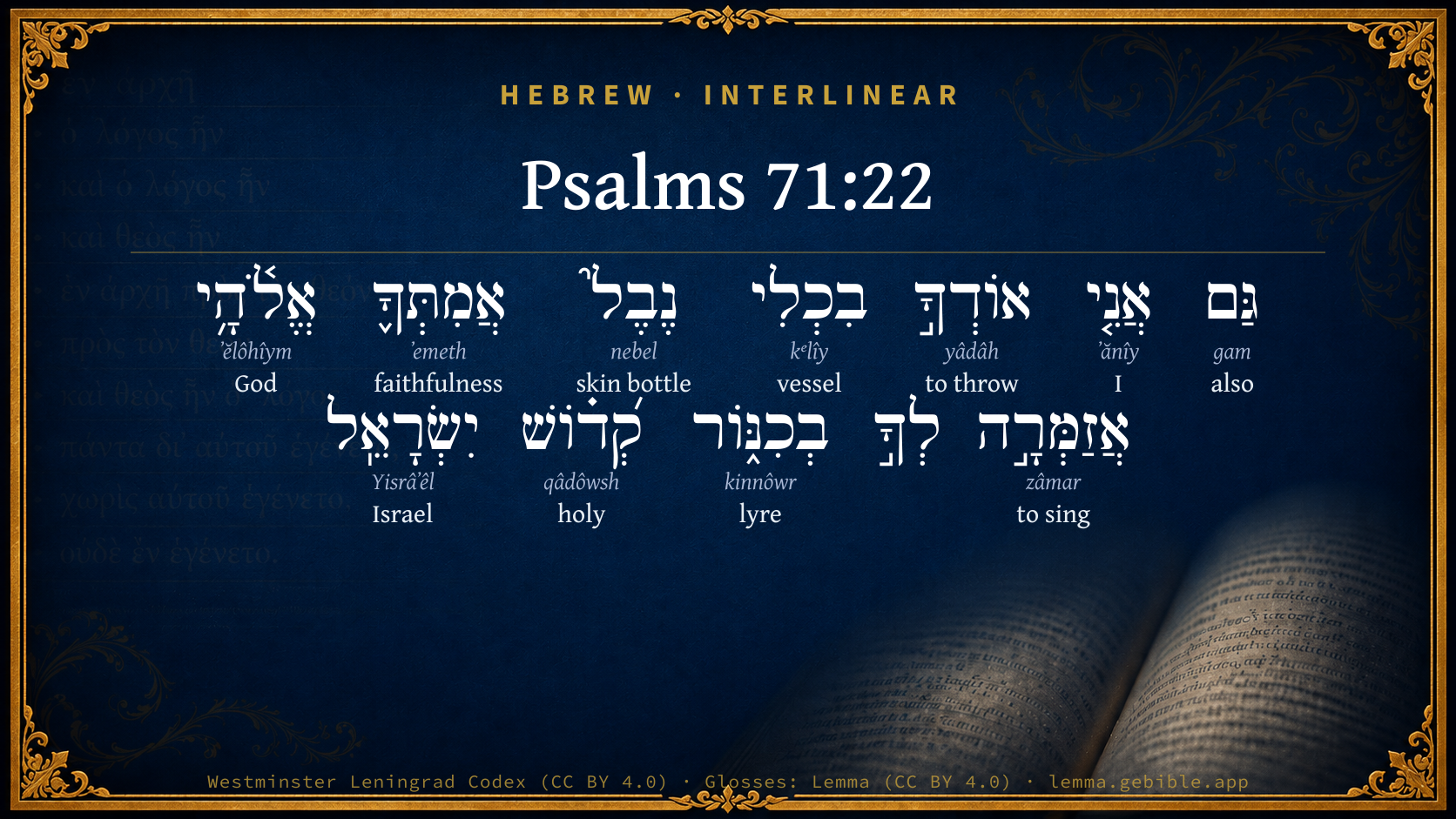
  1. גַּם gam H1571 “also” Particle, Accusative
  2. אֲנִ֤י ʼănîy H589 “I” Pronoun, Personal, 1st Person, Common, Singular
  3. אוֹדְךָ֣ yâdâh H3034 “to throw · you” Verb, Hiphil, Imperfect, 1st Person, Common, Singular + Suffix, Personal, 2nd Person, Masculine, Singular
  4. בִכְלִי kᵉlîy H3627 “in/at · vessel of” Preposition + Noun, Common, Masculine, Singular, Construct
  5. אֲמִתְּךָ֪ ʼemeth H571 “faithfulness · your” Noun, Common, Feminine, Singular, Construct + Suffix, Personal, 2nd Person, Masculine, Singular
  6. אֱלֹ֫הָ֥י ʼĕlôhîym H430 “God(s) · my” Noun, Common, Masculine, Plural, Construct + Suffix, Personal, 1st Person, Common, Singular
  7. אֲזַמְּרָ֣ה zâmar H2167 “to sing” Verb, Piel, Imperfect, 1st Person, Common, Singular
  8. בְכִנּ֑וֹר kinnôwr H3658 “in/at · lyre” Preposition + Noun, Common, Masculine, Singular, Absolute
  9. קְ֝ד֗וֹשׁ qâdôwsh H6918 “holy of” Adjective, Adjective, Masculine, Singular, Construct
  10. יִשְׂרָאֵֽל Yisrâʼêl H3478 “Israel” Noun, Proper

About this verse

These counts appear in no published source. They are computed here, from the morphology-tagged text and Lemma’s own curated glosses. What Lemma adds →

12
words
11
distinct lemmas
Wisdom
section

Shared distinctive vocabulary

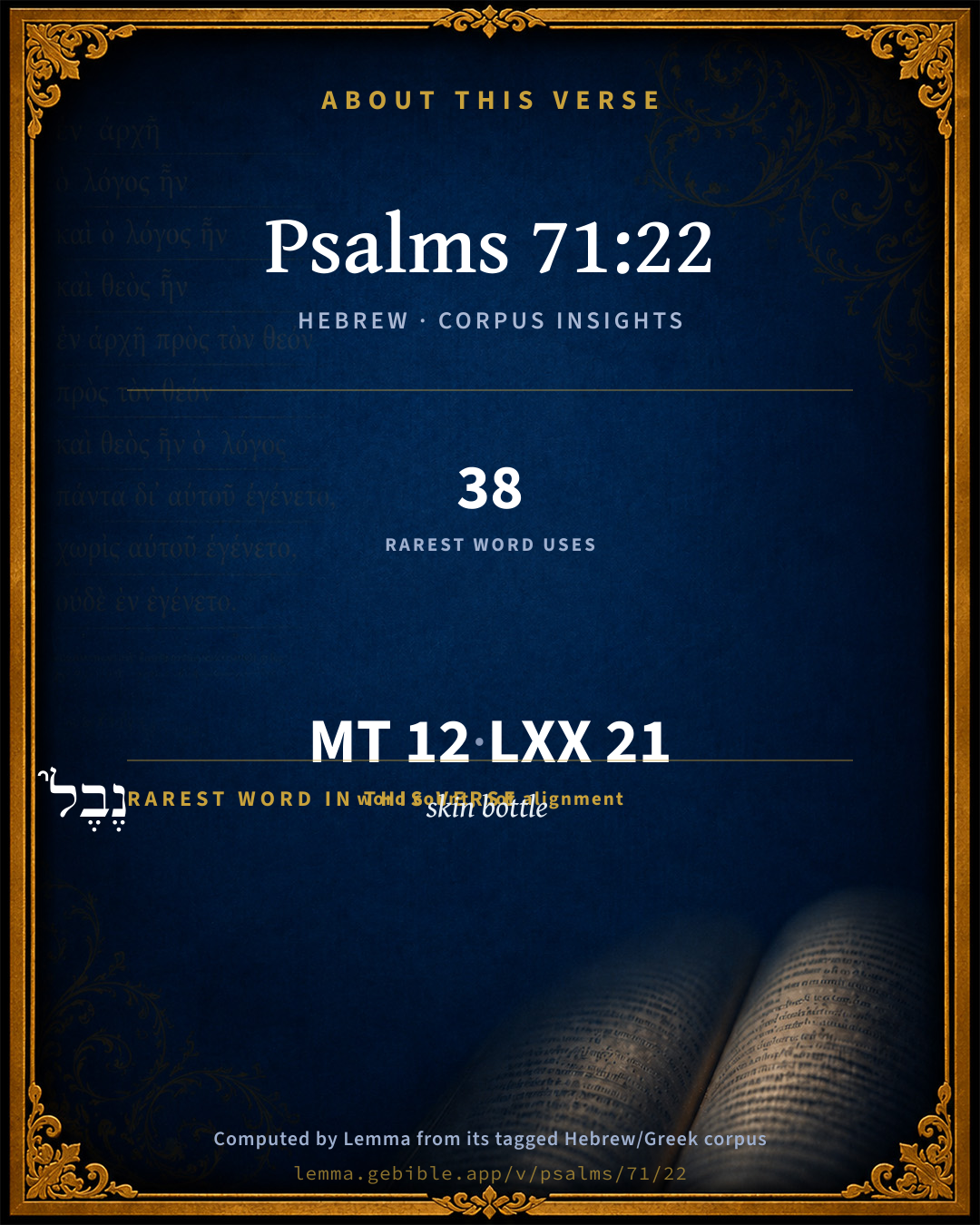
נֶבֶל֮ skin bottle H5035 occurs in 37 verses of the Hebrew Bible. Also found in:

Grammatical profile

  • 2 verbs
  • 6 nouns
  • 1 adjective
  • 1 pronoun
  • 1 preposition
  • 1 particle

Verb forms

  • אוֹדְךָ֣ Hiphil · Imperfect
  • אֲזַמְּרָ֣ה Piel · Imperfect

Hebrew & Septuagint length

In English translation the verse runs 25 words from the Hebrew and 33 from the Septuagint (LXX English) — closely comparable.

A rough comparison of the two English renderings, which tokenize alike — not a word-level alignment.

Word counts can differ between the Hebrew and the Greek without any difference in meaning — e.g. the Hebrew direct-object marker אֵת has no separate Greek word, and Greek often adds the article ὁ.

In the original languages it is 12 Hebrew tokens and 21 Greek tokens — but the two are counted differently (Hebrew bundles its prefixes and suffixes into one token; the Greek is in lemma form), so that isn’t a like-for-like length.

Cross-references

23

Topical passages linked to Psalms 71:22 in the Treasury of Scripture Knowledge — connected by theme and wording, ordered by reader-vote popularity; previews shown in the World English Bible.

  • Psalms 92:1–3 It is a good thing to give thanks to Yahweh, To sing praises to your name, Most High;
  • 2 Kings 19:22 Whom have you defied and blasphemed? and against whom have you exalted your voice and lifted up your eyes on high? [even] against the Holy One of Israel.
  • Psalms 33:2 Give thanks to Yahweh with the lyre. Sing praises to him with the harp of ten strings.
  • Psalms 89:18 For our shield belongs to Yahweh; Our king to the Holy One of Israel.
  • Isaiah 12:6 Cry aloud and shout, you inhabitant of Zion; for great in the midst of you is the Holy One of Israel!"
  • Isaiah 57:15 For thus says the high and lofty One who inhabits eternity, whose name is Holy: I dwell in the high and holy place, with him also who is of a contrite and humble spirit, to revive the spirit of the humble, and to revive the heart of the contrite.
  • Habakkuk 3:18–19 Yet I will rejoice in Yahweh. I will be joyful in the God of my salvation!
  • Psalms 98:3 He has remembered his loving kindness and his faithfulness toward the house of Israel. All the ends of the earth have seen the salvation of our God.
  • Isaiah 5:24 Therefore as the tongue of fire devours the stubble, And as the dry grass sinks down in the flame, So their root shall be as rottenness, And their blossom shall go up as dust; Because they have rejected the law of Yahweh of Hosts, And despised the word of the Holy One of Israel.
  • Isaiah 60:9 Surely the isles shall wait for me, and the ships of Tarshish first, to bring your sons from far, their silver and their gold with them, for the name of Yahweh your God, and for the Holy One of Israel, because he has glorified you.
  • Psalms 25:10 All the paths of Yahweh are loving kindness and truth To such as keep his covenant and his testimonies.
  • Psalms 56:4 In God, I praise his word. In God, I put my trust. I will not be afraid. What can flesh do to me?
  • Psalms 78:41 They turned again and tempted God, And provoked the Holy One of Israel.
  • Psalms 89:1 I will sing of the loving kindness of Yahweh forever. With my mouth, I will make known your faithfulness to all generations.
  • Psalms 138:2 I will bow down toward your holy temple, And give thanks to your Name for your loving kindness and for your truth; For you have exalted your Name and your Word above all.
  • Psalms 144:9 I will sing a new song to you, God. On a ten-stringed lyre, I will sing praises to you.
  • Psalms 150:3–5 Praise him with the sounding of the trumpet! Praise him with harp and lyre!
  • Isaiah 5:16 But Yahweh of Hosts is exalted in justice, And God the Holy One is sanctified in righteousness.
  • Isaiah 5:19 Who say, "Let him make speed, let him hasten his work, that we may see it; And let the counsel of the Holy One of Israel draw near and come, That we may know it!"
  • Isaiah 30:11–12 get out of the way, turn aside out of the path, cause the Holy One of Israel to cease from before us."
  • Isaiah 43:3 For I am Yahweh your God, the Holy One of Israel, your Savior; I have given Egypt as your ransom, Ethiopia and Seba in your place.
  • Micah 7:20 You will give truth to Jacob, and mercy to Abraham, As you have sworn to our fathers from the days of old.
  • Romans 15:8 Now I say that Christ has been made a minister of the circumcision for the truth of God, that he might confirm the promises given to the fathers,

Cross-references courtesy of OpenBible.info (CC BY 4.0).

Hebrew and Greek witnesses Masoretic Hebrew ↔ Greek Septuagint

The same verse in the two great witnesses to the Old Testament, shown verse-for-verse.

You’re reading Greek Psalm 70 (Hebrew Psalm 71). The Septuagint counts the superscription, so verse numbers can differ from the Hebrew — chapter-level alignment, not verse-by-verse. Numbering follows Rahlfs.

These are two independent witnesses, not word-aligned to each other, and the Septuagint is shown in lemma (dictionary) form.

Hebrew Psalms 71:22 Masoretic · Westminster Leningrad Codex

גַּם אֲנִ֤י אוֹדְךָ֣ בִכְלִי נֶבֶל֮ אֲמִתְּךָ֪ אֱלֹ֫הָ֥י אֲזַמְּרָ֣ה לְךָ֣ בְכִנּ֑וֹר קְ֝ד֗וֹשׁ יִשְׂרָאֵֽל

I will also praise you with the harp for your faithfulness, my God. I sing praises to you with the lyre, Holy One of Israel.

World English Bible · Public Domain

Greek LXX Greek Psalm 70:22 Septuagint · lemma form

καί γάρ ἐγώ ἐκὁμολογέω σύ ἐν σκεῦος ψαλμός ὁ ἀλήθεια σύ ὁ θεός ψάλλω σύ ἐν κιθάρα ὁ ἅγιος ὁ ἰσραήλ

I will also therefore give thanks to you, O God, because of your truth, on an instrument of psalmody: I will sing psalms to you on the harp, O Holy One of Israel.

LXX2012 (modern English Septuagint) · Public Domain

Hebrew: Westminster Leningrad Codex (CC BY 4.0). Greek: Septuagint (public domain); English from LXX2012 (modern English Septuagint) (Public Domain). How the Septuagint differs from the Hebrew →

Commentary

Notes on Psalms 71:22 from classic Christian and Jewish commentators (each source and its license shown beneath its notes). The classic Christian expositions comment on the surrounding passage and are grouped to its opening verse, so a note may address several verses; the Jewish commentaries on the Tanakh (Rashi and others) are per-verse, so they appear only where the commentator wrote on this verse.

Lemma curates 59 commentaries, every one of them public domain or Creative Commons licensed, each selected and text-cleaned for this edition rather than reprinted as found. About our sources →

Trapp's Complete Commentary

John Trapp

Psa 71:22 I will also praise thee with the psaltery, [even] thy truth, O my God: unto thee will I sing with the harp, O thou Holy One of Israel.

Ver. 22. I will also praise thee with the psaltery] In organo natali, with an instrument made like a bottle.

O thou Holy One of Israel] Who sanctifiest thine throughout, and art to be sanctified of thine throughout all eternity, Isa 5:16.

John Trapp, A Commentary or Exposition upon All the Books of the Old and New Testament (1647–1656) — public domain. Text from a community e-Sword module.

The Biblical Illustrator

Joseph S. Exell

Psa_71:22-24

I will also praise Thee with the psaltery, even Thy truth, O my God: unto Thee will I sing with the harp, O Thou Holy One of Israel.

The praises of a Hebrew saint

Dr. Sanday has remarked that, on the great world-stage different races have different functions, and that for the Hebrew it was reserved beyond all other peoples to teach the world what it knew of religion.

I. Three features of the Divine character.

1. Holiness. O Thou Holy One of Israel. The root idea is separation. The Most High forbids the people to follow certain practices then in vogue among the surrounding heathen, and the reason given is because He is holy, and they, His people, are to be like Him (Lev_19:2). In every case where such prohibitions occur, we find that the practices condemned are morally alike, that they are mischievous and vile; and therefore by such teaching the Hebrew rose to the conception of a God altogether different from the gods of the heathen--of a Being who had no pleasure in selfishness or cruelty or hatred. Further, it is clear that such a doctrine put honour upon men as well as upon God. When the command was understood, Ye shall be holy: for I am holy, the Jews must have seen that they were created for better things than hatred, malice, or lust. They were fulfilling the end of their creation when they conquered such passions, when they were ruled by kindness, honour, and purity.

2. Truth. I will praise Thee with the psaltery, even Thy truth, O my God. The want of this virtue has often made the world a pandemonium. We can scarcely conceive a worse condition of things than when men are unable to trust their fellows--when mens word is not their bond, and their most solemn pledges are no guarantee whatever that they will act accordingly. Sir Richard Burton once said that to the Oriental lying was meat and drink and the roof that covered him. Strong words, and yet a statement confirmed by multitudes of others who have lived in the midst of them. Such a condition of things undoubtedly existed among the neighbours of the Jews; they were false in word and deed, cunning, deceitful, treacherous. Here again the Hebrew stood alone in splendid isolation from his neighbours. His God was the Strength of Israel, who will not lie, the God of truth, and without iniquity. His promises held good; His threats were fulfilled. No wonder, then, when men believed thus, that their conduct should differ from that of others; and hence we find, among the characteristics of the perfect man of the Scriptures, truthfulness both without and within: he that sweareth to his own hurt, and changeth not; he that speaketh the truth in his heart.

3. Love. Notice the boldness of the psalmists claim--my God; and his grateful acknowledgment of the redemption of his soul--my soul, which Thou hast redeemed. To the writer of this psalm, God was the Father of His creatures, One who had lovingly watched over the psalmist himself from his birth, and to whom in distress he could turn with the certain assurance of help.

II. The characteristics of the praise which the psalmist resolved to offer.

1. Sincere. My lips shall greatly rejoice, etc. Let us see that we do not grieve our heavenly Father by insincere praise; however successful song may be as an artistic performance, it is abhorrent to God if words which mean so much are uttered with lips which do not greatly rejoice--lips which would be as readily used in the service of him who is the great Fathers adversary and ours.

2. Hearty. Not merely should the psalmists lips be made to rejoice, but all the powers of his redeemed soul; and, that he might present a worthy offering to God, both psaltery and harp should be called into service Evidently he believed that music might be the handmaid of worship, and that the skill of man in the production of sweet sounds ought to be consecrated to the service of God. (W. Scott Page.)

.

Psa_72:1-20

The Biblical Illustrator, edited by Joseph S. Exell (c. 1880s–1900s) — public domain. Text from a community e-Sword module.

Joseph Benson's Commentary

Psa 71:22-24. I will also praise thee, &c. — And then surely I shall be no less forward to bless thee than thou art to bestow thy benefits on me. My lips shall greatly rejoice, and my soul, &c. — It is not possible to express the joy wherewith, not merely my lips, but my heart and soul shall sing triumphant songs for the extraordinary deliverance which I expect from thee. My tongue also shall talk of thy righteousness all the day long — Which shall not only be the subject of my solemn songs, but of my constant discourse; wherein I will perpetually magnify thy goodness and truth toward me, and thy just vengeance upon mine enemies. How much more is “the truth of God, in accomplishing his promises, by the redemption of our souls, and the confusion of our spiritual enemies, a subject which demands a never ceasing tribute of gratitude and love, of praise and thanksgiving. To celebrate it aright, with the melody of voices and affections, all in perfect concord, is the duty and delight of the church militant; which, when thus employed, affords the best resemblance of the church triumphant.” — Horne.

Joseph Benson's Commentary on the Old and New Testaments (1811–1818) — public domain. Text from a community e-Sword module.

J. A. Alexander on Psalms

Joseph Addison Alexander

Psa 71:22. Also I will thank thee with a harp-instrument, i.e. with a harp or lyre as the instrument of praise, (for) thy truth, or as to thy truth, veracity and faithfulness; I will play to thee, make music to thee, praise or celebrate thee, with a lyre, (thou) Holy (One) of Israel, i.e. his peculiar God, possessed of all divine perfections. See above, on Psa 22:3. From this place the title has been borrowed by the prophets, and by none so frequently as by Isaiah.

Joseph Addison Alexander, The Psalms Translated and Explained (1850) — public domain. Text from a community e-Sword module.

Tyndale Open Study Notes

Tyndale Open Resources

71:22-24 As he awaits God’s rescue, the psalmist prepares himself to declare with instruments and voice that God is faithful and righteous.

Tyndale Open Study Notes — © Tyndale Open Resources, licensed CC BY-SA 4.0. Text via the HelloAO Bible API.

Geneva Bible (1599)

Geneva Bible translators

He confesseth that his long tarriance was well recompensed, when God performed his promise.

Geneva Bible (1599) marginal notes — public domain. Text via Bolls.life.

Adam Clarke's Commentary

Verse 22. I will also praise thee with the psaltery] בכלי נבל bichli nebel, with the instrument nebel. Unto thee will I sing with the harp; בכנור bechinnor, with the kinnor. Both were stringed instruments, and the principal used in the Jewish worship; and with which, or any thing like them, in Divine worship, we, as Christians, have nothing to do.

Adam Clarke's Commentary on the Bible (1810–1826) — public domain. Text from a community e-Sword/MySword module.

John Calvin's Commentaries

22. I will also, O my God! praise thee. He again breaks forth into thanksgiving; for he was aware that the design of God, in so liberally succouring his servants, is, that his goodness may be celebrated. In speaking of employing the psaltery and the harp in this exercise, he alludes to the generally prevailing custom of that time. To sing the praises of God upon the harp and psaltery unquestionably formed a part of the training of the law, and of the service of God under that dispensation of shadows and figures; but they are not now to be used in public thanksgiving. We are not, indeed, forbidden to use, in private, musical instruments, but they are banished out of the churches by the plain command of the Holy Spirit, when Paul, in 1 Corinthians 14:13, lays it down as an invariable rule, that we must praise God, and pray to him only in a known tongue. By the word truth, the Psalmist means that the hope which he reposed in God was rewarded, when God preserved him in the midst of dangers. The promises of God, and his truth in performing them, are inseparably joined together. Unless we depend upon the word of God, all the benefits which he confers upon us will be unsavoury or tasteless to us; nor will we ever be stirred up either to prayer or thanksgiving, if we are not previously illuminated by the Divine word. So much the more revolting, then, is the folly of that diabolical man, Servetus, who teaches that the rule of praying is perverted, if faith is fixed upon the promises; as if we could have any access into the presence of God, until he first invited us by his own voice to come to him.

John Calvin's Commentaries (1540-1563) — public domain. Text from the Calvin Translation Society English edition (1840s-50s) via the Christian Classics Ethereal Library (ccel.org). Calvin's coverage is partial (roughly two-thirds of the Bible); uncommented books and verses are honest gaps, never fabricated. The 19th-century editor's footnotes and remarks are omitted so the notes are faithfully Calvin's own voice.

Ellicott's Commentary for English Readers

(22) With the psaltery.—See Psa_57:8, Note.

A Bible Commentary for English Readers, edited by Charles John Ellicott (1878–1897) — public domain. Text from a community e-Sword module.

The Cambridge Bible for Schools and Colleges

gen. ed. J. J. S. Perowne

22. I will also &c.] I also will give thanks unto thee: in response to this new proof of Thy love. psaltery] See on Psa_57:8.

thy truth] For in this manifestation of mercy to Israel God has shewn Himself true to His promises. Cp. Mic_7:20.

unto thee &c.] Unto thee will I make melody.

O thou Holy One of Israel] A title which is found frequently in the Book of Isaiah, but elsewhere only twice again in the Psalter (Psa_78:41; Psa_89:18), twice in the Book of Jeremiah (Jer_50:29; Jer_51:5), and once in a modified form in Ezekiel (Eze_39:7). Cp. too Hos_11:9; Hab_1:12. Its use here in connexion with the redemption of Israel is significant. It denotes that God in His character of a Holy God has entered into covenant with Israel, and His holiness is pledged to redeem His people. For a fuller explanation of this title the present writer may be allowed to refer to his Doctrine of the Prophets, pp. 177 ff.

The Cambridge Bible for Schools and Colleges (gen. ed. J. J. S. Perowne; Cambridge University Press, 1878–1918) — public domain. Text from a community e-Sword module.

John Gill's Exposition

I will also praise thee with the psaltery,.... An instrument of music; See Gill on Psa 33:2;

even thy truth, O my God; that is, his faithfulness in fulfilling his promises, which is never suffered to fail;

unto thee will I sing with the harp; another instrument of music; and both typical of the spiritual melody in the heart, which believers make in praising the Lord, when they sing the Lamb's new song; see Rev 14:2;

O thou Holy One of Israel; the God of Israel, that dwells among them, and sanctifies them; and who is essentially and perfectly holy in himself, and in all his ways and works; the remembrance of which occasions praise and thankfulness, Psa 97:12.

John Gill's Exposition of the Whole Bible (1746–1763) — public domain (CC PDM 1.0). Text via the HelloAO Bible API.

Albert Barnes' Notes on the Bible

I will also praise thee with the psaltery - Margin, as in Hebrew, “with the instrument of psaltery.” The Hebrew word is נבל nebel. In Isa 5:12 it is rendered “viol.” See the notes at that passage. It is rendered “psaltery” in 1Sa 10:5; 2Sa 6:5; 1Ki 10:12; and elsewhere. Compare the notes at Psa 33:2.

Even thy truth - I will make mention of thy truth and faithfulness in my songs of praise; or, I will celebrate these in connection with appropriate music.

Unto thee will I sing with the harp - Hebrew, כנור kinnôr. See the notes at Isa 5:12. Compare the notes at Psa 33:2.

O thou Holy One of Israel - The God of Israel or the Hebrew people; the God regarded by them as most holy, and worshipped by them as their God. This is the first time that this title occurs in the Psalms, but it is common in the prophets, particularly in Isaiah. See Isa 1:4; Isa 5:19, Isa 5:24; Isa 10:20; Isa 12:6. It occurs also in Psa 78:41; Psa 89:18.

Albert Barnes' Notes on the Bible (1834–1885) — public domain. Text from a community e-Sword/MySword module.

The Treasury of David

Charles H. Spurgeon

Ver. 22. I will also praise thee with the psaltery. Love so amazing calls for sweetest praise. David would give his best music, both vocal and instrumental, to the Best of Masters. His harp should not be silent, nor his voice.

Even thy truth, O my God. This is ever a most enchanting attribute--viz., the truth or faithfulness of our covenant God. On this we rest, and from it we draw streams of richest consolation. His promises are sure, his love unalterable, his veracity indisputable. What saint will not praise him as he remembers this?

Unto thee will I sing with the harp, O thou Holy One of Israel. Here is a new name, and, as it were, a new song. The Holy One of Israel is at once a lofty and an endearing name, full of teaching. Let us resolve, by all means within our power, to honour him.

Ver. 22. With the psaltery... with the harp. There was a typical signification in them; and upon this account they are not only rejected and condemned by the whole army of Protestant divines, as for instance, by Zuinglius, Calvin, Peter Martyr, Zepperus, Paraeus, Willet, Ainsworth, Ames, Calderwood, and Cotton; who do, with one mouth, testify against them, most of them expressly affirming that they are a part of the abrogated legal pedagogy; so that we might as well recall the incense, tapers, sacrifices, new moons, circumcision, and all the other shadows of the law into use again. But Aquinas himself also, though a Popish schoolman, pleads against them upon the same account, quia aliquid figurabant, and saith, the Church in his time did not use them, ne videatur judaizare, lest they should seem to judaize. Samuel Mather, on The Types.

Ver. 22. Psaltery... harp. Suppose singing with instruments were not typical, but only an external solemnity of worship, fitted to the solace of the outward senses of children under age, such as the Israelites were in the Old Testament (Ga 4:1-3); yet now, in the grown age of the heirs of the New Testament, such external pompous solemnities are ceased, and no external worship reserved, but such as holdeth forth simplicity and gravity; nor is any voice now to be heard in the church of Christ, but such as is significant and edifying by signification (1Co 14:10-11, 26), which the voice of instruments is not. John Cotton, 1585-1652.

Ver. 22. Holy One of Israel. This name of God occurs in the Psalms only in two other places, Ps 71:78, 41 89:18 these last two being, according to Delitzsch, older Psalms than this. In Isaiah, this name of God occurs thirty times; in Habakkuk once; in Jeremiah (who may have adopted it from Isaiah) twice (Jer 50:29 51:5). J. J. Stewart Perowne.

Ver. 22. A choice subject for song--"thy truth, "which may mean either doctrinal truth, or the attribute of faithfulness, its manifestation in history, and in our own experience.

Ver. 22-23.

I. The soul of music: Not in the instrument or the voice,

but in the soul. "I will sing with the understanding

also." "Making melody in the heart, "etc.

II. The music of the soul. The soul which thou hast

redeemed. Redemption is the music of souls once lost.

Their only song in heaven.

Psalms 71:23*

Here is the final vow of praise.

Ver. 22-23.

I. The soul of music: Not in the instrument or the voice,

but in the soul. "I will sing with the understanding

also." "Making melody in the heart, "etc.

II. The music of the soul. The soul which thou hast

redeemed. Redemption is the music of souls once lost.

Their only song in heaven.

Psalms 71:24*

Here is the final vow of praise.

Charles H. Spurgeon's The Treasury of David (1869–1885) — public domain. Psalms only. Text from a community e-Sword/MySword module.

Whedon's Commentary on the Bible

Daniel D. Whedon

22. Thy truth—Or, thy faithfulness. David’s salvation would cause him to praise not only the mercy and pity of God, but his truth, righteousness, holiness, because with these he was in harmony, and without these God could extend no mercy. See note on Psa_71:19.

Daniel D. Whedon (gen. ed.), Commentary on the Old and New Testaments (1874–1909) — public domain. Text from a community e-Sword module.

The Pulpit Commentary

I will also praise thee with the psaltery, even thy truth, O my God: unto thee will I sing with the harp, O thou Holy One of Israel. (On the psaltery, and its use as a devotional instrument, see the comment on Psa_33:2) The conjunction of the psaltery and harp seems to imply that the "praise," of which the writer here speaks, is to be public praise in the sanctuary, accompanied by the usual sacred music.

The Pulpit Commentary (1880–1919), ed. H.D.M. Spence-Jones & Joseph S. Exell — public domain. Text from a community e-Sword module.

Lesson kit

Teaching starters — assembled from the data on this page, not authored interpretation. Every prompt links to the verse data it draws on. Edit before teaching.

Psalms, in the Wisdom, opens this verse with 12 words (11 distinct Hebrew lemmas). Its most distinctive word is nebel (“skin bottle”). A historical commentator’s framing appears above. Read the whole chapter for the surrounding context.

Discussion questions

  1. The word nebel carries the sense “skin bottle.” How does it shape the verse?
  2. 1 Samuel 1:24 shares the word «skin bottle» with this verse. How do the two illuminate each other?
  3. These translations render this verse differently. What is at stake in choosing one wording over another?
  4. The verb «אוֹדְךָ֣» is Hiphil Imperfect. How does its form color the action?
  5. Reading how Trapp's Complete Commentary and The Biblical Illustrator read this verse, where do the two commentators agree and where do they part?

Things to notice

Reading settings

Reading text

Shown beneath each verse's original-language words.

Old Testament
Old Testament edition

Read the OT as the Masoretic Hebrew (MT) or the Greek Septuagint (LXX).

English shown for the Greek Septuagint (in the Hebrew ↔ Greek comparison).

Comparing translations? Open the Compare panel on any verse page to stack up to four side by side.