
Jeremiah 32:14

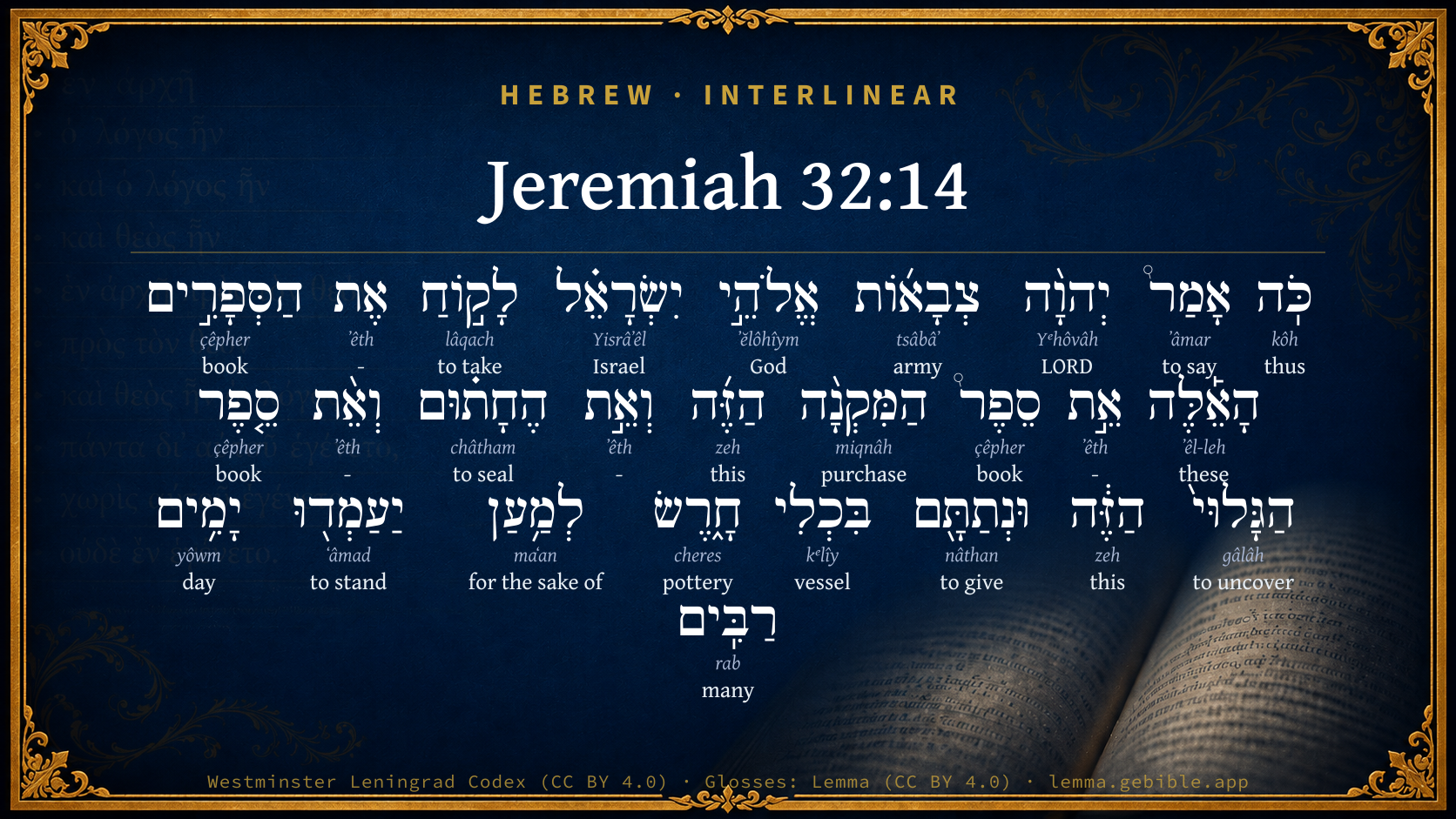
Hebrew (Westminster Leningrad Codex) Jeremiah 32:14 appears in the Hebrew Old Testament. The text above is from the Westminster Leningrad Codex. Each word links to its Strong’s number, a concise gloss, and parsing drawn from the Open Scriptures Hebrew Bible morphology. Click any word for its full Brown-Driver-Briggs (BDB) entry.
Download image
Cite this verse

Jeremiah 32:14 (World English Bible). Public Domain. Lemma interlinear Bible study tool, https://lemma.gebible.app/v/jeremiah/32/14.

Show BibTeX & RIS
BibTeX
RIS
English Translation
Thus says Yahweh of Hosts, the God of Israel: Take these deeds, this deed of the purchase which is sealed, and this deed which is open, and put them in an earthen vessel; that they may continue many days.
World English Bible · Public Domain
Download a study sheet

One document with this verse’s original text, its word-by-word gloss line, the meaning frame, cross-references with their text, attributed commentary, and full source and license credits — printable, and it pastes into notes with its structure intact.

This verse Autodidact and up

Study sheet (.html) Plain text (.txt)

A passage Seminary Student

Up to 50 verses in one chapter. A passage sheet keeps up to 6 commentary sources and 12 cross-references per verse, in the order this page ranks them, and says so on the sheet whenever that leaves anything out. Ask for a single verse and you get the Autodidact verse sheet above.

Everything on this page stays free to read, with no account — the sheet is a download of what is already on screen, not access to it.

Want to remove ads? Support Godless Engineer
Compare translations 3

The same verse in 3 English versions, stacked beneath the original-language interlinear above. Click any original word for its lexicon entry.

Each is an independent rendering of the whole verse — the interlinear is not word-aligned to these translations.

Highlighted words mark where these versions differ — a whole-verse word diff, not a word-by-word alignment.

  • World English Bible Public Domain
    Thus says Yahweh of Hosts, the God of Israel: Take these deeds, this deed of the purchase which is sealed, and this deed which is open, and put them in an earthen vessel; that they may continue many days.
  • King James Version Public Domain
    Thus saith the LORD of hosts, the God of Israel; Take these evidences, this evidence of the purchase, both which is sealed, and this evidence which is open; and put them in an earthen vessel, that they may continue many days.
  • unfoldingWord Literal Text CC BY-SA 4.0
    “Yahweh of hosts, God of Israel, says this: Take these documents, both this receipt of purchase that is sealed and the unsealed copies of the deed of purchase, and put them in a clay jar so they will last for a long time.

unfoldingWord Literal Text — © unfoldingWord, licensed CC BY-SA 4.0. Word-aligned USFM3 via Door43 (git.door43.org/unfoldingWord/en_ult).

Versions to compare (up to 4)

3 of 4 selected

Show all 18 translations

Every available English version of this verse, each an independent rendering of the whole verse.

  • World English Bible Public Domain
    Thus says Yahweh of Hosts, the God of Israel: Take these deeds, this deed of the purchase which is sealed, and this deed which is open, and put them in an earthen vessel; that they may continue many days.
  • Berean Standard Bible Public Domain
    “This is what the LORD of Hosts, the God of Israel, says: Take these deeds—both the sealed copy and the open copy of the deed of purchase—and put them in a clay jar to preserve them for a long time.
  • Majority Standard Bible Public Domain
    “This is what the LORD of Hosts, the God of Israel, says: Take these deeds—both the sealed copy and the open copy of the deed of purchase—and put them in a clay jar to preserve them for a long time.
  • King James Version Public Domain
    Thus saith the LORD of hosts, the God of Israel; Take these evidences, this evidence of the purchase, both which is sealed, and this evidence which is open; and put them in an earthen vessel, that they may continue many days.
  • American Standard Version (1901) Public Domain
    Thus saith Jehovah of hosts, the God of Israel: Take these deeds, this deed of the purchase which is sealed, and this deed which is open, and put them in an earthen vessel; that they may continue many days.
  • Revised Version (1885) Public Domain
    Thus saith the LORD of hosts, the God of Israel: Take these deeds, this deed of the purchase, both that which is sealed, and this deed which is open, and put them in an earthen vessel; that they may continue many days.
  • Geneva Bible (1599) Public Domain
    Thus saith the Lord of hostes, the God of Israel, Take the writings, euen this booke of the possession, both that is sealed, and this booke that is open, and put them in an earthen vessell, that they may continue a long time.
  • Douay-Rheims (1899) Public Domain
    Thus saith the Lord of hosts the God of Israel: Take these writings, this deed of the purchase that is sealed up, and this deed that is open: and put them in an earthen vessel, that they may continue many days.
  • Young's Literal Translation Public Domain
    `Thus said Jehovah of Hosts, God of Israel, Take these books, this purchase-book, both the sealed one and the open one, and thou hast put them in an earthen vessel, that they may remain many days;
  • Literal Standard Version CC BY-SA 4.0
    “Thus said YHWH of Hosts, God of Israel: Take these scrolls, this purchase scroll, both the sealed one and the open one, and you have put them in an earthen vessel, that they may remain many days.
  • Unlocked Literal Bible CC BY-SA 4.0
    “Yahweh of hosts, God of Israel, says this: Take these documents, both this receipt of purchase that is sealed and the unsealed copies of the deed of purchase, and put them in a clay jar so they will last for a long time.
  • unfoldingWord Literal Text CC BY-SA 4.0
    “Yahweh of hosts, God of Israel, says this: Take these documents, both this receipt of purchase that is sealed and the unsealed copies of the deed of purchase, and put them in a clay jar so they will last for a long time.
  • Darby Bible Public Domain
    Thus saith Jehovah of hosts, the God of Israel: Take these writings, this writing of the purchase, both that which is sealed and this writing which is open; and put them in an earthen vessel, that they may remain many days.
  • World Messianic Bible Public Domain
    the LORD of Hosts, the God of Israel, says: ‘Take these deeds, this deed of the purchase which is sealed, and this deed which is open, and put them in an earthen vessel, that they may last many days.’
  • Webster's Bible Public Domain
    Thus saith the LORD of hosts, the God of Israel; Take these evidences, this evidence of the purchase, both that which is sealed, and this evidence which is open; and put them in an earthen vessel, that they may continue many days.
  • Free Bible Version CC BY-SA 4.0
    “This is what the Lord Almighty, the God of Israel, says: Put these deeds of sale, the sealed original and the open copy, in a clay jar so they can be kept safe for a long time.
  • Bible in Basic English Public Domain
    This is what the Lord of armies, the God of Israel, has said: Take these papers, the witness of this business, the one which is rolled up and stamped, and the one which is open; and put them in a vessel of earth so that they may be kept for a long time.
  • JPS Tanakh (1917) Public Domain
    'Thus saith the LORD of hosts, the God of Israel: Take these deeds, this deed of the purchase, both that which is sealed, and this deed which is open, and put them in an earthen vessel; that they may continue many days.

Literal Standard Version (2020), Covenant Press — licensed CC BY-SA 4.0. Text via the HelloAO Bible API (eBible.org). Unlocked Literal Bible (unfoldingWord) — licensed CC BY-SA 4.0. Text via the HelloAO Bible API (eBible.org). unfoldingWord Literal Text — © unfoldingWord, licensed CC BY-SA 4.0. Word-aligned USFM3 via Door43 (git.door43.org/unfoldingWord/en_ult). Free Bible Version, Dr. Jonathan Gallagher — licensed CC BY-SA 4.0. Text via the HelloAO Bible API (eBible.org).

Word by word

More ways to search: Search by grammar → Find every occurrence → Compare this word →

Practice this passage: Drill this verse → Learn its vocabulary →

הַמִּקְנָ֨ה
miqnâh
H4736
“the · purchase”
Particle, Definite Article + Noun, Common, Feminine, Singular, Absolute
Part of Speech
Particle + Noun
Type
Common
Gender
Feminine
Number
Singular
State
Absolute
Full BDB Definition

Origin: from H4735

TWOT: 2039c

purchase - purchase - purchase-price - possession (gained by purchase)
  1. כֹּֽה kôh H3541 “thus” Adverb
  2. אָמַר֩ ʼâmar H559 “to say” Verb, Qal, Perfect, 3rd Person, Masculine, Singular
  3. יְהוָ֨ה Yᵉhôvâh H3068 “LORD” Noun, Proper
  4. צְבָא֜וֹת tsâbâʼ H6635 “armies” Noun, Common, Both, Plural, Absolute
  5. אֱלֹהֵ֣י ʼĕlôhîym H430 “God(s) of” Noun, Common, Masculine, Plural, Construct
  6. יִשְׂרָאֵ֗ל Yisrâʼêl H3478 “Israel” Noun, Proper
  7. לָק֣וֹחַ lâqach H3947 “to take” Verb, Qal, Infinitive Absolute
  8. אֶת ʼêth H853 “-” Particle, Direct Object
  9. הַסְּפָרִ֣ים çêpher H5612 “the · books” Particle, Definite Article + Noun, Common, Masculine, Plural, Absolute
  10. הָאֵ֡לֶּה ʼêl-leh H428 “the · these” Particle, Definite Article + Pronoun, Demonstrative, Common, Plural
  11. אֵ֣ת ʼêth H853 “-” Particle, Direct Object
  12. סֵפֶר֩ çêpher H5612 “book of” Noun, Common, Masculine, Singular, Construct
  13. הַזֶּ֜ה zeh H2088 “the · this” Particle, Definite Article + Pronoun, Demonstrative, Masculine, Singular
  14. וְאֵ֣ת ʼêth H853 “and · -” Conjunction + Particle, Direct Object
  15. הֶחָת֗וּם châtham H2856 “the · sealed” Particle, Definite Article + Verb, Qal, Participle Passive, Masculine, Singular, Absolute
  16. וְאֵ֨ת ʼêth H853 “and · -” Conjunction + Particle, Direct Object
  17. סֵ֤פֶר çêpher H5612 “book of” Noun, Common, Masculine, Singular, Construct
  18. הַגָּלוּי֙ gâlâh H1540 “the · uncovered” Particle, Definite Article + Verb, Qal, Participle Passive, Masculine, Singular, Absolute
  19. הַזֶּ֔ה zeh H2088 “the · this” Particle, Definite Article + Pronoun, Demonstrative, Masculine, Singular
  20. וּנְתַתָּ֖ם nâthan H5414 “and · to give · them” Conjunction + Verb, Qal, Sequential Perfect, 2nd Person, Masculine, Singular + Suffix, Personal, 3rd Person, Masculine, Plural
  21. בִּכְלִי kᵉlîy H3627 “in/at · vessel of” Preposition + Noun, Common, Masculine, Singular, Construct
  22. חָ֑רֶשׂ cheres H2789 “pottery” Noun, Common, Masculine, Singular, Absolute
  23. לְמַ֥עַן maʻan H4616 “for the sake of” Preposition
  24. יַעַמְד֖וּ ʻâmad H5975 “to stand” Verb, Qal, Imperfect, 3rd Person, Masculine, Plural
  25. יָמִ֥ים yôwm H3117 “days” Noun, Common, Masculine, Plural, Absolute
  26. רַבִּֽים rab H7227 “many” Adjective, Adjective, Masculine, Plural, Absolute

About this verse

These counts appear in no published source. They are computed here, from the morphology-tagged text and Lemma’s own curated glosses. What Lemma adds →

27
words
21
distinct lemmas
Prophets
section

Notable vocabulary

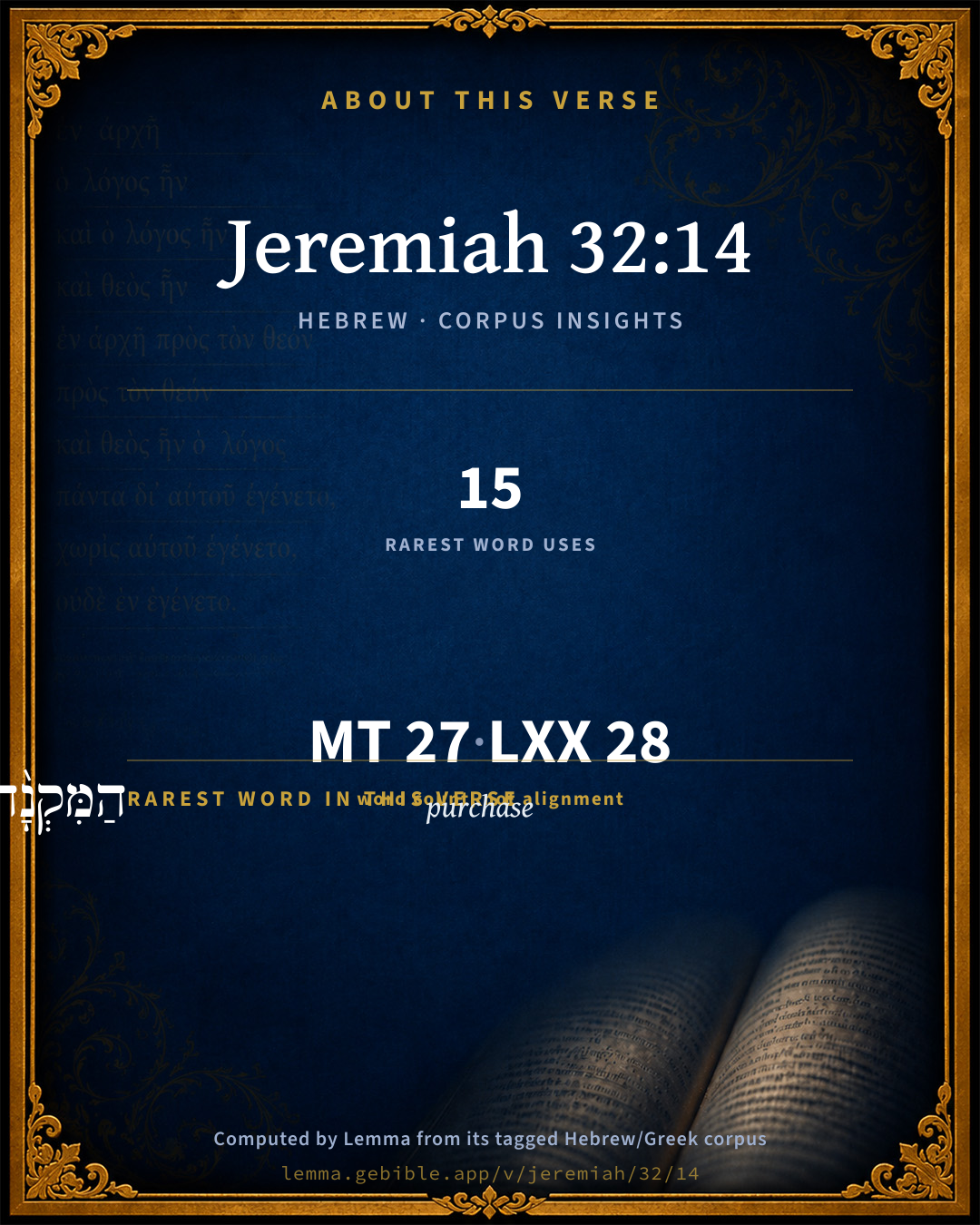
The rarest word here is הַמִּקְנָ֨ה purchase H4736 — appearing just 15 times in the whole Hebrew Bible.

Shared distinctive vocabulary

הַמִּקְנָ֨ה purchase H4736 occurs in 13 verses of the Hebrew Bible. Also found in:

Grammatical profile

  • 6 verbs
  • 11 nouns
  • 1 adjective
  • 3 pronouns
  • 1 preposition
  • 1 adverb
  • 4 particles

Verb forms

  • אָמַר֩ Qal · Perfect
  • לָק֣וֹחַ Qal · Infinitive Absolute
  • הֶחָת֗וּם Qal · Participle Passive
  • הַגָּלוּי֙ Qal · Participle Passive
  • וּנְתַתָּ֖ם Qal · Sequential Perfect
  • יַעַמְד֖וּ Qal · Imperfect

Repetition

Words recur within this verse — often emphatic in Hebrew:

  • הַסְּפָרִ֣ים book H5612 ×3
  • הַזֶּ֜ה this H2088 ×2

Hebrew & Septuagint length

In the original languages it is 27 Hebrew tokens and 28 Greek tokens — but the two are counted differently (Hebrew bundles its prefixes and suffixes into one token; the Greek is in lemma form), so that isn’t a like-for-like length.

Hebrew and Greek witnesses Masoretic Hebrew ↔ Greek Septuagint

The same verse in the two great witnesses to the Old Testament, shown verse-for-verse.

These are two independent witnesses, not word-aligned to each other, and the Septuagint is shown in lemma (dictionary) form.

Hebrew Jeremiah 32:14 Masoretic · Westminster Leningrad Codex

כֹּֽה אָמַר֩ יְהוָ֨ה צְבָא֜וֹת אֱלֹהֵ֣י יִשְׂרָאֵ֗ל לָק֣וֹחַ אֶת הַסְּפָרִ֣ים הָאֵ֡לֶּה אֵ֣ת סֵפֶר֩ הַמִּקְנָ֨ה הַזֶּ֜ה וְאֵ֣ת הֶחָת֗וּם וְאֵ֨ת סֵ֤פֶר הַגָּלוּי֙ הַזֶּ֔ה וּנְתַתָּ֖ם בִּכְלִי חָ֑רֶשׂ לְמַ֥עַן יַעַמְד֖וּ יָמִ֥ים רַבִּֽים

Thus says Yahweh of Hosts, the God of Israel: Take these deeds, this deed of the purchase which is sealed, and this deed which is open, and put them in an earthen vessel; that they may continue many days.

World English Bible · Public Domain

Greek LXX Structure differs

In the Septuagint, Jeremiah is about an eighth shorter than the Hebrew and arranges its material differently — the Oracles Against the Nations (Hebrew chapters 46–51) appear in the middle of the Greek book, after 25:13. Because the chapter and verse boundaries do not line up, a verse-for-verse comparison with the Hebrew is not shown.

A verse-for-verse comparison isn’t shown here because the chapters and verses don’t line up. Switch to the LXX edition with the MT / LXX toggle above to read the Greek directly.

Hebrew: Westminster Leningrad Codex (CC BY 4.0). Greek: Septuagint (public domain); English from a public-domain English Septuagint. How the Septuagint differs from the Hebrew →

Targum (Aramaic paraphrase)

1

The Targum is the ancient Jewish Aramaic paraphrase of the Hebrew Scriptures — an interpretive translation, not the Hebrew text itself. Onkelos (literal) and Pseudo-Jonathan (expansive) render the Torah, and Jonathan the Prophets. Coverage is partial: where no permissively-licensed English translation exists for a verse, only the Aramaic is shown. This is verse-level text, not a word-by-word alignment to the Hebrew.

  1. Targum Jonathan Prophets (Joshua–Malachi)
    כִּדְנַן אֲמַר יְיָ צְבָאוֹת אֱלָהָא דְיִשְׂרָאֵל סַב יַת שִׁטְרַיָא הָאִלֵין יַת שִׁטְרָא דִזְבֵינָא הָדֵין יַת דִכְתִיב בְּעֵיץ וַחֲתֵים וְיַת שִׁטְרָא פְּתִיחָא הָדֵין וְתִתְּנִינוּן בְּמַן דַחֲסַף בְּדִיל דְיִתְקַיְימוּן יוֹמִין סַגִיאִין:

    (no public-domain English translation for this verse)

    Targum Jonathan — Aramaic: “Mikraot Gedolot” (public domain). English: “Sefaria Community Translation” (CC0 1.0 (public-domain dedication)); “London "Chaldee Paraphrase," 1871” (public domain). Text via Sefaria.

Commentary

Notes on Jeremiah 32:14 from classic Christian and Jewish commentators (each source and its license shown beneath its notes). The classic Christian expositions comment on the surrounding passage and are grouped to its opening verse, so a note may address several verses; the Jewish commentaries on the Tanakh (Rashi and others) are per-verse, so they appear only where the commentator wrote on this verse.

Lemma curates 59 commentaries, every one of them public domain or Creative Commons licensed, each selected and text-cleaned for this edition rather than reprinted as found. About our sources →

Trapp's Complete Commentary

John Trapp

Jer 32:14 Thus saith the LORD of hosts, the God of Israel; Take these evidences, this evidence of the purchase, both which is sealed, and this evidence which is open; and put them in an earthen vessel, that they may continue many days.

Ver. 14. That they may continue many days.] Even beyond the seventy years of captivity, and then be produced again.

John Trapp, A Commentary or Exposition upon All the Books of the Old and New Testament (1647–1656) — public domain. Text from a community e-Sword module.

The Biblical Illustrator

Joseph S. Exell

Jer_32:14

Take these evidences,. . . and put them in an earthen vessel.

Sealed and open evidences

I am going to make a parable, not to bring out what the text teaches, but to use it parable-wise. When Jeremiah bought this piece of land, it was transferred to him by two documents. The first was a title-deed, drawn up and signed by witnesses and then sealed up, not to be opened any more unless required to settle a dispute. That was his real title-deed. Then there was a counterpart of this transfer made, and signed by witnesses. This was not rolled up, and not sealed; but left open, so that Jeremiah might refer to it, and that, when desired, the open deed might be read and examined by others. Now, with regard to our redemption, our inheritance which Christ has bought for us, at a price immense, we, too, have two sets of evidences. The one is sealed up from all eyes but our own; in part, too, I might say that it is sealed up from our own eyes. The other, the counterpart of that, equally valid, is open to ourselves and open to others.

I. The Sealed Evidences Of Our Faith, the evidences which are sealed, at least in a measure, from our fellow-men.

1. And, first, I would say, among the sealed evidences is this: the Word of the Lord has come to us with power. If anyone asked himself, Have I a right to the covenant of grace, and to the all things which are ours if we are in that covenant? Have I a right to the purchased possession? Have I a right to the Lord Jesus Christ, and all that comes to believers in Him?--in part, the answer must be, Has the Word of the Lord come to you with power, not as the word of man, but as it is in truth, the Word of God? There is a mystic influence, a Divine unction, which really goes with the Word of God, in many cases, so that it enters the heart, sheds a radiance upon the understanding, pours a flood of delightful peace and joy upon the soul, and affects the whole mental and spiritual being m a way which nothing else does. You cannot explain this to others; do you know it yourself? If so, that will be to you the sealed evidence that the eternal heritage is yours. The Lord has given you the spiritual perception of these things.

2. The next one of these sealed evidences is this, if indeed this heavenly heritage is ours, we have a living faith in the Lord Jesus Christ. As many as received Him, to them gave He power to become the sons of God, even to them that believe on His name.

3. Another sealed evidence of our interest in Christ is that we have life in Jesus. You have risen from the lower sphere of mere soulish life into the higher condition of spiritual life, and now you consort with God, you speak with Christ, you have become familiar with heavenly things, and are raised up to sit in the heavenlies with Christ Jesus.

4. This leads me to the fourth evidence, which is that now we have communion with God in prayer. The prophet Micah said, My God will hear me, and if you can truly, from your soul, say the same, you have a blessed evidence that you are an heir of heaven.

5. I rank very highly among the sealed evidences of our inheritance the fact that we have the fear of God before our eyes. That holy awe of God, that consciousness of His majestic presence, that dread of doing anything contrary to His will, that tender, loving, filial fear, which love does not cast out, but rather nourishes and cherishes, he that has this holy fear is a child of God.

6. Another evidence is this: we have secret supports in the time of trouble. Underneath are the everlasting arms; you are sustained when enduring awful pain, comforted under deep depression of spirit, strengthened for the work for which in yourself alone you are quite unequal, borne upward with holy joy in the midst of cruel slander; surely that is enough evidence for you.

7. Another sealed evidence is the secret love which the child of God has to all others of the children of God We know that we have passed from death unto life, because we love the brethren. As to the love we have to Jesus, We love Him because He first loved us, and our love to Him is one of the evidences of His love to us. We also joy in God through our Lord Jesus Christ.

8. Those inward conflicts which you now have, that struggling in your soul between right and wrong, the new man seeking to get the victory over the old corrupt nature, all these are your sealed evidences. So, also, are the victories which God gives you, when He treads evil passions beneath the feet of the new-born Man-child, who is the image of Christ within you, when you conquer yourself, when you subdue anger, when you go forth to do, by the strength of God, what else your nature would shrink from; all these are blessed evidences, signed, and sealed, to be rolled up, and put away, to be seen by no eye but your own, and the eye of the Most High.

II. The open evidences of our faith.

1. The first of such evidences that we are the children of God must be the open Word of God itself. I read the Bible, and I say, Well, if this Book be true, I am a saved man: if this is really a Divine revelation, then I am saved. Beloved, have you that open evidence of your salvation? That is the best evidence in the whole world.

2. Next to that, the open evidence of our right to the inheritance is a thorough change of life such as other people can see. Is it so with you? Has there been a distinct crisis in your being? Have you been turned from darkness unto light? Have you been brought from the power of Satan unto God?

3. Another open evidence is separation from the world. A man who is really a child of God cannot, after his conversion, consort with his old companions.

4. The next open evidence is found in union with the people of God, making them your companions, taking a delight in them.

5. One very clear open evidence is strict honesty, uprightness, and integrity in business. Your word must be your bond, and you must sooner fail in business than do the smallest thing that would be contrary to the strictest integrity.

6. One very open evidence of a change of heart, and of our possession of the inheritance, is a readiness to forgive.

7. Another open evidence is one which we often get, and do not like, that is, the opposition of the world. Thank God, Isaac, when Ishmael mocks you; for it is a mark that you are of the true seed, and that Ishmael is not.

8. Another open evidence, and one that is very sweet, is a holy patience in time of trouble, and especially in the hour of death.

III. The uses to which we put these evidences.

1. One of them is that they often yield us comfort. It takes the sting out of every trouble when we know that the heavenly inheritance is surely ours.

2. Then again, these evidences answer the unjust charges of Satan when he comes and says, You are not a child of God.

3. And above all things, I think that we ought to value these evidences because they will be produced in court at the last day. That is the most solemn thing of all. I was an hungered and ye gave Me meat: I was thirsty, and ye gave Me drink: and so on. He produces this evidence of a work of grace in their hearts, and says to them, Come, ye blessed of My Father, &c. (C. H. Spurgeon.)

The Biblical Illustrator, edited by Joseph S. Exell (c. 1880s–1900s) — public domain. Text from a community e-Sword module.

Geneva Bible (1599)

Geneva Bible translators

And so to hide them in the ground, that they might be preserved as a token of their deliverance.

Geneva Bible (1599) marginal notes — public domain. Text via Bolls.life.

Jamieson, Fausset & Brown

Robert Jamieson, A. R. Fausset & David Brown

in an earthen vessel--that the documents might not be injured by the moisture of the surrounding earth; at the same time, being buried, they could not be stolen, but would remain as a pledge of the Jews' deliverance until God's time should come.

Jamieson, Fausset & Brown — Commentary Critical and Explanatory on the Whole Bible (1871) — public domain (CC PDM 1.0). Text via the HelloAO Bible API.

John Calvin's Commentaries

He says, That they may continue for many days By these words he intimates that the prophecy would not only be profitable to the Jews, who were to be driven soon after into captivity, but also to their posterity, who were not yet born, and that they might know that this prophecy would stand valid after their death, for we ought not to measure the faithfulness of God by the extent of our life. This, then, was the reason why this clause was added: the prophecy was to be preserved in earthen vessels, that it might remain safe and secure for many days, that is, until God delivered his people.

John Calvin's Commentaries (1540-1563) — public domain. Text from the Calvin Translation Society English edition (1840s-50s) via the Christian Classics Ethereal Library (ccel.org). Calvin's coverage is partial (roughly two-thirds of the Bible); uncommented books and verses are honest gaps, never fabricated. The 19th-century editor's footnotes and remarks are omitted so the notes are faithfully Calvin's own voice.

Ellicott's Commentary for English Readers

(14) Put them in an earthen vessel . . .—We are reminded of the “earthen vessels” in which men kept their most precious treasures (2Co_4:7). Such a vessel was obviously a better protection against damp or decay than one of wood, and was, as it were, the “safe” of a Jewish household. (See Note on Jer_41:8.) In the “many days” we have an implied warning to the listeners that they were not to expect a speedy deliverance or restoration, however certain might be their assurance that it would come at last.

A Bible Commentary for English Readers, edited by Charles John Ellicott (1878–1897) — public domain. Text from a community e-Sword module.

John Gill's Exposition

For thus saith the Lord of hosts, the God of Israel,.... Who is the Lord God Almighty, and can do what he pleases; and is the covenant God of his people, and therefore will do them good by all his providences in the issue of things:

houses, and fields, and vineyards, shall be possessed in this land; or "bought" (y) in it; of which the prophet's buying this field was a pledge and earnest; signifying, that though the city now besieged should be taken, and the people carried captive, yet they should return to their own land, and purchase and enjoy houses, fields, and vineyards again, as at the present time.

(y) "ementur", Cocceius, Piscator; "vedentur", Schmidt.

John Gill's Exposition of the Whole Bible (1746–1763) — public domain (CC PDM 1.0). Text via the HelloAO Bible API.

Haydock's Catholic Bible Commentary

Days, safe from dampness, &c. Thus Origen found a version of the Bible preserved at Jericho. (Calmet) --- After the captivity, the owners shall claim their land.

George Leo Haydock (1774–1849), Haydock's Catholic Family Bible and Commentary, 1859 edition — public domain. Excludes Psalms (Douay-Rheims chapter numbering differs from Protestant) and Deuterocanonical books (Catholic canon only).

Rashi

Rabbi Shlomo Yitzchaki (Rashi)

So said, etc. Do not say that I am concealing them for nothing since everyone is going into exile.

Rashi on the Tanakh — English translations: “The Judaica Press complete Tanach with Rashi, translated by A. J. Rosenberg” (CC BY 4.0); “Pentateuch with Rashi's commentary by M. Rosenbaum and A.M. Silbermann, 1929-1934” (public domain); “The Metsudah Tanach series, Lakewood, N.J” (CC BY 4.0); and “The Book of Joshua, Metsudah Publications, 1997” (CC BY 4.0). Text via Sefaria.

Lesson kit

Teaching starters — assembled from the data on this page, not authored interpretation. Every prompt links to the verse data it draws on. Edit before teaching.

Jeremiah, in the Prophets, opens this verse with 27 words (21 distinct Hebrew lemmas). Its most distinctive word is miqnâh (“purchase”). A historical commentator’s framing appears above. Read the whole chapter for the surrounding context.

Discussion questions

  1. The word miqnâh carries the sense “purchase.” How does it shape the verse?
  2. How does Genesis 17:12, which shares the word «purchase», read alongside this verse?
  3. What does the repetition of “book” (3× in this one verse) do in this verse?
  4. These translations render this verse differently; the difference is in the English rendering, not the original. What questions does that raise?
  5. «אָמַר֩» is a Qal Perfect verb. How does that grammatical form shape the action described?
  6. Compare how Trapp's Complete Commentary and The Biblical Illustrator read this verse. Where do they agree or differ?

Things to notice

Reading settings

Reading text

Shown beneath each verse's original-language words.

Old Testament
Old Testament edition

Read the OT as the Masoretic Hebrew (MT) or the Greek Septuagint (LXX).

English shown for the Greek Septuagint (in the Hebrew ↔ Greek comparison).

Comparing translations? Open the Compare panel on any verse page to stack up to four side by side.