
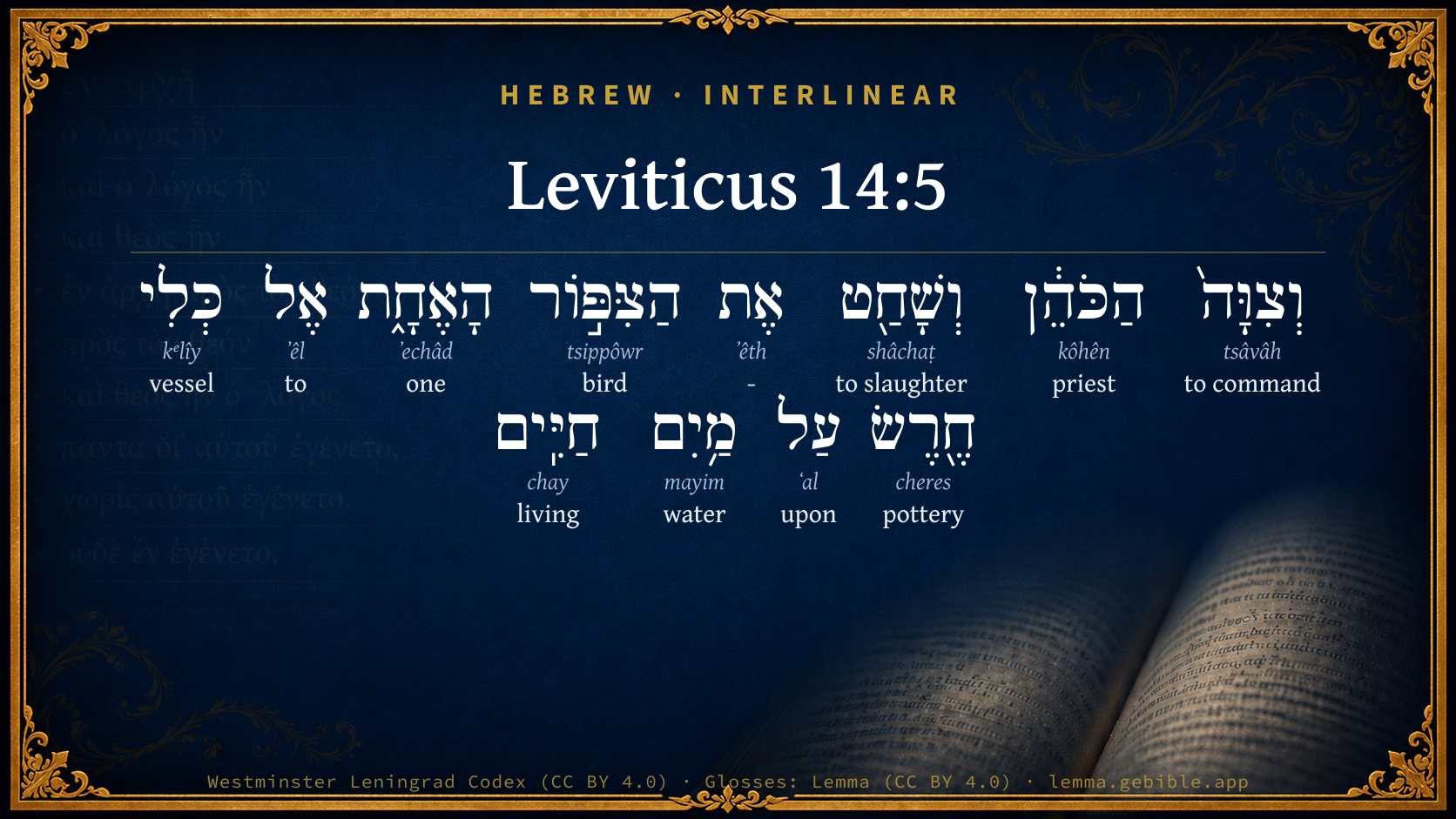
Leviticus 14:5

Hebrew (Westminster Leningrad Codex) Leviticus 14:5 appears in the Hebrew Old Testament. The text above is from the Westminster Leningrad Codex. Each word links to its Strong’s number, a concise gloss, and parsing drawn from the Open Scriptures Hebrew Bible morphology. Click any word for its full Brown-Driver-Briggs (BDB) entry.
Download image
Cite this verse

Leviticus 14:5 (World English Bible). Public Domain. Lemma interlinear Bible study tool, https://lemma.gebible.app/v/leviticus/14/5.

Show BibTeX & RIS
BibTeX
RIS
English Translation
The priest shall command them to kill one of the birds in an earthen vessel over running water.
World English Bible · Public Domain
Download a study sheet

One document with this verse’s original text, its word-by-word gloss line, the meaning frame, cross-references with their text, attributed commentary, and full source and license credits — printable, and it pastes into notes with its structure intact.

This verse Autodidact and up

Study sheet (.html) Plain text (.txt)

A passage Seminary Student

Up to 50 verses in one chapter. A passage sheet keeps up to 6 commentary sources and 12 cross-references per verse, in the order this page ranks them, and says so on the sheet whenever that leaves anything out. Ask for a single verse and you get the Autodidact verse sheet above.

Everything on this page stays free to read, with no account — the sheet is a download of what is already on screen, not access to it.

Want to remove ads? Support Godless Engineer
Compare translations 3

The same verse in 3 English versions, stacked beneath the original-language interlinear above. Click any original word for its lexicon entry.

Each is an independent rendering of the whole verse — the interlinear is not word-aligned to these translations.

Highlighted words mark where these versions differ — a whole-verse word diff, not a word-by-word alignment.

  • World English Bible Public Domain
    The priest shall command them to kill one of the birds in an earthen vessel over running water.
  • King James Version Public Domain
    And the priest shall command that one of the birds be killed in an earthen vessel over running water:
  • unfoldingWord Literal Text CC BY-SA 4.0
    And the priest shall command, and he shall slaughter one bird into a container of clay, over living water.

unfoldingWord Literal Text — © unfoldingWord, licensed CC BY-SA 4.0. Word-aligned USFM3 via Door43 (git.door43.org/unfoldingWord/en_ult).

Versions to compare (up to 4)

3 of 4 selected

Show all 18 translations

Every available English version of this verse, each an independent rendering of the whole verse.

  • World English Bible Public Domain
    The priest shall command them to kill one of the birds in an earthen vessel over running water.
  • Berean Standard Bible Public Domain
    Then the priest shall command that one of the birds be slaughtered over fresh water in a clay pot.
  • Majority Standard Bible Public Domain
    Then the priest shall command that one of the birds be slaughtered over fresh water in a clay pot.
  • King James Version Public Domain
    And the priest shall command that one of the birds be killed in an earthen vessel over running water:
  • American Standard Version (1901) Public Domain
    And the priest shall command to kill one of the birds in an earthen vessel over running water.
  • Revised Version (1885) Public Domain
    And the priest shall command to kill one of the birds in an earthen vessel over running water:
  • Geneva Bible (1599) Public Domain
    And the Priest shall commaund to kill one of the birdes ouer pure water in an earthen vessell.
  • Douay-Rheims (1899) Public Domain
    And he shall command one of the sparrows to be immolated in an earthen vessel over living waters:
  • Young's Literal Translation Public Domain
    `And the priest hath commanded, and he hath slaughtered the one bird upon an earthen vessel, over running water;
  • Literal Standard Version CC BY-SA 4.0
    And the priest has commanded, and he has slaughtered one bird on an earthen vessel, over running water;
  • Unlocked Literal Bible CC BY-SA 4.0
    The priest will command him to kill one of the birds over fresh water that is in a clay pot.
  • unfoldingWord Literal Text CC BY-SA 4.0
    And the priest shall command, and he shall slaughter one bird into a container of clay, over living water.
  • Darby Bible Public Domain
    And the priest shall command that one bird be killed in an earthen vessel over running water:
  • World Messianic Bible Public Domain
    The priest shall command them to kill one of the birds in an earthen vessel over running water.
  • Webster's Bible Public Domain
    And the priest shall command that one of the birds be killed in an earthen vessel, over running water.
  • Free Bible Version CC BY-SA 4.0
    The priest will order one of the birds to be killed over a clay pot filled with fresh water.
  • Bible in Basic English Public Domain
    And the priest will give orders for one of the birds to be put to death in a vessel made of earth, over flowing water.
  • JPS Tanakh (1917) Public Domain
    And the priest shall command to kill one of the birds in an earthen vessel over running water.

Literal Standard Version (2020), Covenant Press — licensed CC BY-SA 4.0. Text via the HelloAO Bible API (eBible.org). Unlocked Literal Bible (unfoldingWord) — licensed CC BY-SA 4.0. Text via the HelloAO Bible API (eBible.org). unfoldingWord Literal Text — © unfoldingWord, licensed CC BY-SA 4.0. Word-aligned USFM3 via Door43 (git.door43.org/unfoldingWord/en_ult). Free Bible Version, Dr. Jonathan Gallagher — licensed CC BY-SA 4.0. Text via the HelloAO Bible API (eBible.org).

Word by word

More ways to search: Search by grammar → Find every occurrence → Compare this word →

Practice this passage: Drill this verse → Learn its vocabulary →

חֶ֖רֶשׂ
cheres
H2789
“pottery”
Noun, Common, Masculine, Singular, Absolute
Part of Speech
Noun
Type
Common
Gender
Masculine
Number
Singular
State
Absolute
Full BDB Definition

Origin: a collateral form mediating between H2775 and H2791

TWOT: 759a

earthenware, clay pottery, shard, potsherd, earthen vessel
  1. וְצִוָּה֙ tsâvâh H6680 “and · to command” Conjunction + Verb, Piel, Sequential Perfect, 3rd Person, Masculine, Singular
  2. הַכֹּהֵ֔ן kôhên H3548 “the · priest” Particle, Definite Article + Noun, Common, Masculine, Singular, Absolute
  3. וְשָׁחַ֖ט shâchaṭ H7819 “and · to slaughter” Conjunction + Verb, Qal, Sequential Perfect, 3rd Person, Masculine, Singular
  4. אֶת ʼêth H853 “-” Particle, Direct Object
  5. הַצִּפּ֣וֹר tsippôwr H6833 “the · bird” Particle, Definite Article + Noun, Common, Both, Singular, Absolute
  6. הָאֶחָ֑ת ʼechâd H259 “the · one” Particle, Definite Article + Adjective, Cardinal number, Feminine, Singular, Absolute
  7. אֶל ʼêl H413 “to” Preposition
  8. כְּלִי kᵉlîy H3627 “vessel of” Noun, Common, Masculine, Singular, Construct
  9. עַל ʻal H5921 “upon” Preposition
  10. מַ֥יִם mayim H4325 “water(s)” Noun, Common, Masculine, Plural, Absolute
  11. חַיִּֽים chay H2416 “living” Adjective, Adjective, Masculine, Plural, Absolute

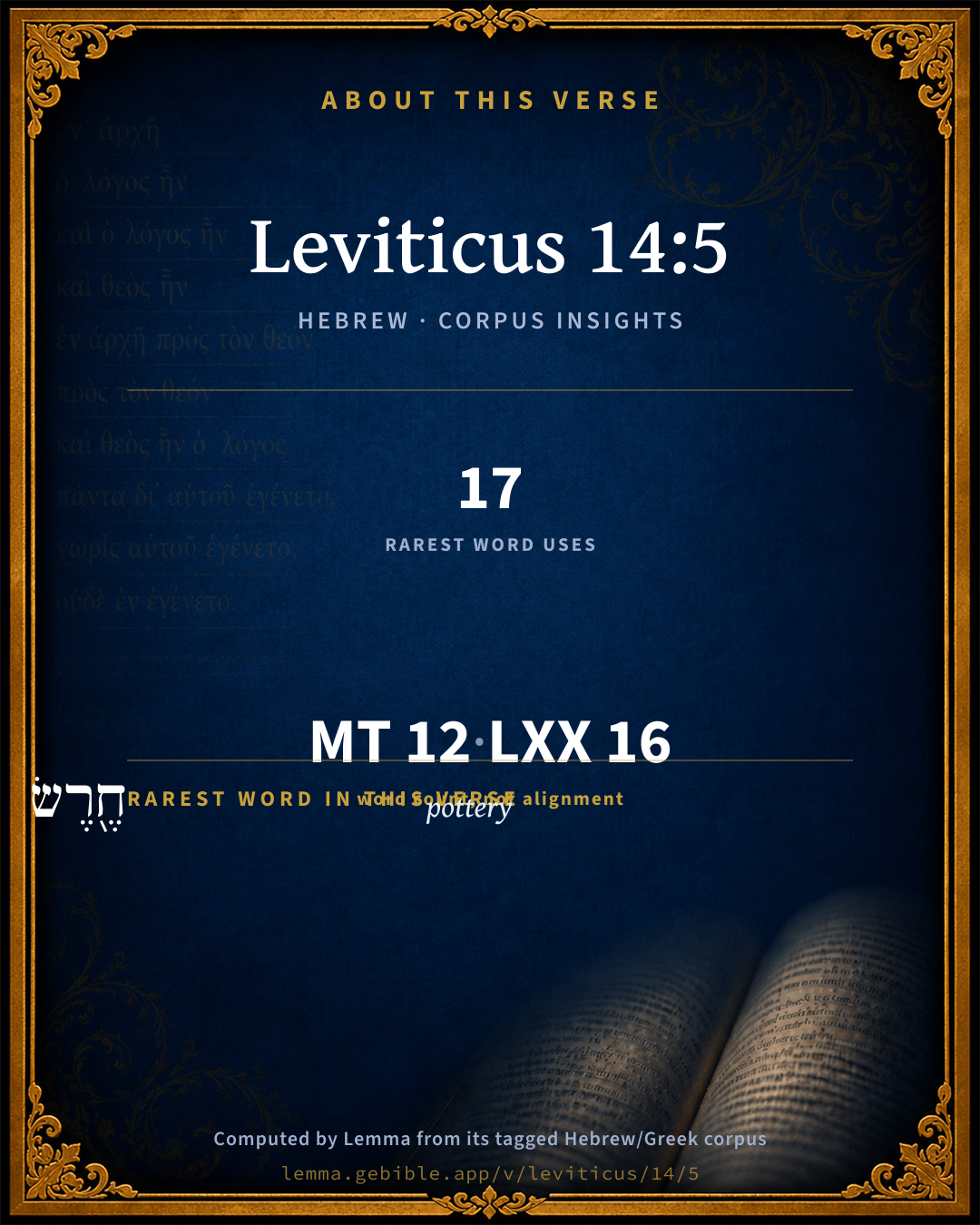
About this verse

These counts appear in no published source. They are computed here, from the morphology-tagged text and Lemma’s own curated glosses. What Lemma adds →

12
words
12
distinct lemmas
Pentateuch
section

Notable vocabulary

The rarest word here is חֶ֖רֶשׂ pottery H2789 — appearing just 17 times in the whole Hebrew Bible.

Shared distinctive vocabulary

חֶ֖רֶשׂ pottery H2789 occurs in 16 verses of the Hebrew Bible. Also found in:

Grammatical profile

  • 2 verbs
  • 5 nouns
  • 2 adjectives
  • 2 prepositions
  • 1 particle

Verb forms

  • וְצִוָּה֙ Piel · Sequential Perfect
  • וְשָׁחַ֖ט Qal · Sequential Perfect

Hebrew & Septuagint length

In English translation the verse runs 18 words from the Hebrew and 19 from the Septuagint (LXX English) — closely comparable.

A rough comparison of the two English renderings, which tokenize alike — not a word-level alignment.

Word counts can differ between the Hebrew and the Greek without any difference in meaning — e.g. the Hebrew direct-object marker אֵת has no separate Greek word, and Greek often adds the article ὁ.

In the original languages it is 12 Hebrew tokens and 16 Greek tokens — but the two are counted differently (Hebrew bundles its prefixes and suffixes into one token; the Greek is in lemma form), so that isn’t a like-for-like length.

Cross-references

6

Topical passages linked to Leviticus 14:5 in the Treasury of Scripture Knowledge — connected by theme and wording, ordered by reader-vote popularity; previews shown in the World English Bible.

  • Leviticus 14:50 He shall kill one of the birds in an earthen vessel over running water.
  • Hebrews 2:14 Since then the children have shared in flesh and blood, he also himself in like manner partook of the same, that through death he might bring to nothing him who had the power of death, that is, the devil,
  • Numbers 5:17 and the priest shall take holy water in an earthen vessel; and of the dust that is on the floor of the tabernacle the priest shall take, and put it into the water.
  • 2 Corinthians 4:7 But we have this treasure in clay vessels, that the exceeding greatness of the power may be of God, and not from ourselves.
  • 2 Corinthians 5:1 For we know that if the earthly house of our tent is dissolved, we have a building from God, a house not made with hands, eternal, in the heavens.
  • 2 Corinthians 13:4 For he was crucified through weakness, yet he lives through the power of God. For we also are weak in him, but we will live with him through the power of God toward you.

Cross-references courtesy of OpenBible.info (CC BY 4.0).

Hebrew and Greek witnesses Masoretic Hebrew ↔ Greek Septuagint

The same verse in the two great witnesses to the Old Testament, shown verse-for-verse.

These are two independent witnesses, not word-aligned to each other, and the Septuagint is shown in lemma (dictionary) form.

Hebrew Leviticus 14:5 Masoretic · Westminster Leningrad Codex

וְצִוָּה֙ הַכֹּהֵ֔ן וְשָׁחַ֖ט אֶת הַצִּפּ֣וֹר הָאֶחָ֑ת אֶל כְּלִי חֶ֖רֶשׂ עַל מַ֥יִם חַיִּֽים

The priest shall command them to kill one of the birds in an earthen vessel over running water.

World English Bible · Public Domain

Greek LXX Leviticus 14:5 Septuagint · lemma form

καί προςτάσσω ὁ ἱερεύς καί σφάζω ὁ ὀρνίθιον ὁ εἷς εἰς ἀγγεῖον ὀστράκινος ἐπί ὕδωρ ζάω

And the priest shall give direction, and they shall kill one bird over an earthen vessel over running water.

LXX2012 (modern English Septuagint) · Public Domain

Hebrew: Westminster Leningrad Codex (CC BY 4.0). Greek: Septuagint (public domain); English from LXX2012 (modern English Septuagint) (Public Domain). How the Septuagint differs from the Hebrew →

Targum (Aramaic paraphrase)

2

The Targum is the ancient Jewish Aramaic paraphrase of the Hebrew Scriptures — an interpretive translation, not the Hebrew text itself. Onkelos (literal) and Pseudo-Jonathan (expansive) render the Torah, and Jonathan the Prophets. Coverage is partial: where no permissively-licensed English translation exists for a verse, only the Aramaic is shown. This is verse-level text, not a word-by-word alignment to the Hebrew.

  1. Targum Onkelos Torah (Genesis–Deuteronomy)
    וִיפַקֵד כַּהֲנָא וְיִכּוֹס יָת צִפְּרָא חֲדָא לְמָאן דַחֲסַף עַל מֵי מַבּוּעַ

    (no public-domain English translation for this verse)

    Targum Onkelos — Aramaic: “Onkelos Genesis” (public domain); “Onkelos Exodus” (public domain); “Onkelos Leviticus” (public domain); “Onkelos Numbers” (public domain); “Onkelos Deuteronomy” (public domain). English: “Sefaria Community Translation” (CC0 1.0 (public-domain dedication)); “J.W. Etheridge. The Targums of Onkelos and Jonathan Ben Uzziel on the Pentateuch. London: Longmans, Green, 1862” (public domain). Text via Sefaria.

  2. Targum Pseudo-Jonathan Torah (Genesis–Deuteronomy)
    וְיַפְקֵד כַּהֲנָא לְטַבְּחָא וְיִכּוֹס יַת צִיפּוֹרָא חֲדָא לְמָן דַחֲסַף עַל מֵי מַבּוּעַ

    And the priest shall instruct the killer to kill one of the birds in an earthen vessel with spring water.

    Targum Pseudo-Jonathan — Aramaic: “Targum Jonathan on Genesis” (public domain); “Targum Jonathan on Exodus” (public domain); “Targum Jonathan on Leviticus” (public domain); “Targum Jonathan on Numbers” (public domain); “Targum Jonathan on Deuteronomy” (public domain). English: “The Targum of Jonathan ben Uzziel, trans. J. W. Etheridge, London, 1862” (public domain). Text via Sefaria.

Commentary

Notes on Leviticus 14:5 from classic Christian and Jewish commentators (each source and its license shown beneath its notes). The classic Christian expositions comment on the surrounding passage and are grouped to its opening verse, so a note may address several verses; the Jewish commentaries on the Tanakh (Rashi and others) are per-verse, so they appear only where the commentator wrote on this verse.

Lemma curates 59 commentaries, every one of them public domain or Creative Commons licensed, each selected and text-cleaned for this edition rather than reprinted as found. About our sources →

Trapp's Complete Commentary

John Trapp

Lev 14:5 And the priest shall command that one of the birds be killed in an earthen vessel over running water:

Ver. 5. Over running water.] Heb., Living water. Life consists in motion, in action: hence waters that spring and run, are, for their continual motion, called living waters. O Lord, saith Hezekiah, "By these things men live, and in all these things is the life of my spirit." {Isa 38:16}

John Trapp, A Commentary or Exposition upon All the Books of the Old and New Testament (1647–1656) — public domain. Text from a community e-Sword module.

Joseph Benson's Commentary

Lev 14:5. That one of the birds be killed — By some other man. The priest did not kill it himself, because it was not properly a sacrifice, as being killed without the camp, and not in that place to which all sacrifices were confined. In an earthen vessel — That is, over running water put in an earthen vessel. Thus the blood of the bird and the water were mixed together, partly for the convenience of sprinkling, and partly to signify Christ, who came by water and blood, 1Jn 5:6. The running water, (that is, spring or river water,) by its liveliness and motion, did fitly signify the restoring of liveliness to the leper, who was in a manner dead before.

Joseph Benson's Commentary on the Old and New Testaments (1811–1818) — public domain. Text from a community e-Sword module.

Tyndale Open Study Notes

Tyndale Open Resources

14:5-7 Killing the bird and sprinkling its blood (14:7) reflects Exod 24:6-8, where all of Israel was sprinkled with blood to establish the people as God’s covenant community. Here the individual was cleansed by being sprinkled with blood and allowed to return to community membership. Fresh water was also used in cleansing ceremonies (Num 8:7) and in sacrifice preparation (Lev 1:9, 13).

Tyndale Open Study Notes — © Tyndale Open Resources, licensed CC BY-SA 4.0. Text via the HelloAO Bible API.

Geneva Bible (1599)

Geneva Bible translators

Running water, or of the fountains.

Geneva Bible (1599) marginal notes — public domain. Text via Bolls.life.

Jamieson, Fausset & Brown

Robert Jamieson, A. R. Fausset & David Brown

the priest shall command that one of the birds be killed . . . over running water--As the blood of a single bird would not have been sufficient to immerse the body of another bird, it was mingled with spring water to increase the quantity necessary for the appointed sprinklings, which were to be repeated seven times, denoting a complete purification. (See Kg2 5:10; Psa 51:2; Mat 8:4; Luk 5:14). The living bird being then set free, in token of the leper's release from quarantine, the priest pronounced him clean; and this official declaration was made with all solemnity, in order that the mind of the leper might be duly impressed with a sense of the divine goodness, and that others might be satisfied they might safely hold intercourse with him. Several other purifications had to be gone through during a series of seven days, and the whole process had to be repeated on the seventh, ere he was allowed to re-enter the camp. The circumstance of a priest being employed seems to imply that instruction suitable to the newly recovered leper would be given, and that the symbolical ceremonies used in the process of cleansing leprosy would be explained. How far they were then understood we cannot tell. But we can trace some instructive analogies between the leprosy and the disease of sin, and between the rites observed in the process of cleansing leprosy and the provisions of the Gospel. The chief of these analogies is that as it was only when a leper exhibited a certain change of state that orders were given by the priest for a sacrifice, so a sinner must be in the exercise of faith and penitence ere the benefits of the gospel remedy can be enjoyed by him. The slain bird and the bird let loose are supposed to typify, the one the death, and the other the resurrection of Christ; while the sprinklings on him that had been leprous typified the requirements which led a believer to cleanse himself from all filthiness of the flesh and spirit, and to perfect his holiness in the fear of the Lord.

Jamieson, Fausset & Brown — Commentary Critical and Explanatory on the Whole Bible (1871) — public domain (CC PDM 1.0). Text via the HelloAO Bible API.

Adam Clarke's Commentary

Verse 5. Over running water.] Literally, living, that is, spring water. The meaning appears to be this: Some water (about a quarter of a log, an eggshell and a half full, according to the rabbins) was taken from a spring, and put into a clean earthen vessel, and they killed the bird over this water, that the blood might drop into it; and in this blood and water mixed, they dipped the instrument before described, and sprinkled it seven times upon the person who was to be cleansed. The living or spring water was chosen because it was purer than what was taken from pits or wells, the latter being often in a putrid or corrupt state; for in a ceremony of purifying or cleansing, every thing must be as pure and perfect as possible.

Adam Clarke's Commentary on the Bible (1810–1826) — public domain. Text from a community e-Sword/MySword module.

Ellicott's Commentary for English Readers

(5) And the priest shall command that one of the birds be killed.—Rather, And the priest shall command, and he shall kill the one bird, that is, upon the priest ordering it, the cured leper is to kill the one which is the fairer and better bird of the two, as was the rule during the second Temple. Not being a sacrifice, the victim was killed outside the camp.

In an earthen vessel over running water.—Better, over an earthen vessel upon (or into) living water, that is, the bird was killed over the dish, so as to let the blood flow into the water. The vessel had to be a new one; into it was poured a fourth part of a log, or as much as an egg and a-half of “living water:” that is, water taken from a running stream or a perennial spring, where its continual motion resembles life, in contradistinction to stale or stagnant water. Water which had already been used for other purposes, salt water, rain water, or water which had been melted or warmed, was illegal. When the blood had thus been wrung into it, a hole was dug, and the bird was buried in the presence of the priest and the patient.

A Bible Commentary for English Readers, edited by Charles John Ellicott (1878–1897) — public domain. Text from a community e-Sword module.

The Cambridge Bible for Schools and Colleges

gen. ed. J. J. S. Perowne

5. in an earthen vessel over running water] The word ‘running’ is somewhat misleading. The Heb. expression is ‘living water,’ i.e. water from a spring. It was to be put into the vessel over which the bird was killed: the water served as a medium for conveying the blood of the slain bird (Lev_14:6); so the ashes of the red heifer were mixed with water (Num_19:9; Num_19:17).

The Cambridge Bible for Schools and Colleges (gen. ed. J. J. S. Perowne; Cambridge University Press, 1878–1918) — public domain. Text from a community e-Sword module.

John Gill's Exposition

And the priest shall command that one of the birds be killed,.... That is, shall command another priest to kill one of them, or an Israelite, as Aben Ezra; and who also observes, that some say the leper, or the butcher, as the Targum of Jonathan; the killing of this bird, not being a sacrifice, might be done without the camp, as it was, and not at the altar, near to which sacrifices were slain, and where they were offered: and this was to be done

in an earthen vessel over running water: this vessel, according to the Jewish traditions (a), was to be a new one, and a fourth part of a log of running water was to be put into it, and then the bird was to be killed over it, and its blood squeezed into it, and then a hole was dug, and it was buried before the leprous person; and so it should be rendered, "over an earthen vessel", as it is in the Tigurine version, and by Noldius (b); for how could it be killed in it, especially when water was in it? the killing of this bird may have respect to the sufferings, death, and bloodshed of Christ, which were necessary for the purging and cleansing of leprous sinners, and which were endured in his human nature, comparable to an earthen vessel, as an human body sometimes is; see Co2 4:7; for he was crucified through weakness, and was put to death in the flesh, Co2 13:4; and the running or living water mixed with blood may denote both the sanctification and justification of Christ's people by the water and blood which sprung from his pierced side, and the continual virtue thereof to take away sin, and free from it; or the active and passive obedience of Christ, which both together are the matter of a sinner's justification before God.

(a) Negaim, c. 14. sect. 1. (b) Ebr. Concord. part. p. 64. No. 318.

John Gill's Exposition of the Whole Bible (1746–1763) — public domain (CC PDM 1.0). Text via the HelloAO Bible API.

Albert Barnes' Notes on the Bible

Running water - literally, living water, i. e. water fresh from the spring Gen 26:19; Num 19:17.

Albert Barnes' Notes on the Bible (1834–1885) — public domain. Text from a community e-Sword/MySword module.

Haydock's Catholic Bible Commentary

Living waters. That is, waters taken from a spring, brook, or river: (Challoner) not stagnant or rain water.

George Leo Haydock (1774–1849), Haydock's Catholic Family Bible and Commentary, 1859 edition — public domain. Excludes Psalms (Douay-Rheims chapter numbering differs from Protestant) and Deuterocanonical books (Catholic canon only).

Matthew Poole's English Annotations

To wit, by some other man. The priest did not kill it himself, because it was not properly a sacrifice, as being killed without the camp, and not in that place to which all sacrifices were confined; and if it had been a sacrifice, that might be killed by another, so long as the sprinkling of the blood of it, which was the most proper and essential act in the sacrifice, was done by the priest.

Over running water; it seems to be a metathesis or transplacing of words, for over running water put

in an earthen vessel. Thus the blood of the bird and the water were mixed together, partly for the conveniency of sprinkling, and partly to signify Christ, who came by water and blood, 1Jo 5:6. The running water, i.e. spring or river water, by its liveliness and motion did fitly. signify the restoring of liveliness to the leper, who was in a manner dead with his leprosy, as was noted before.

Matthew Poole's English Annotations on the Holy Bible (1683–1685) — public domain. Text from a community e-Sword/MySword module.

Whedon's Commentary on the Bible

Daniel D. Whedon

5. The priest shall command — The person commanded is the leper. The offerer killed his own sacrifice, (Lev_1:5, note,) for it is a true sacrifice though the altar is absent and the burning does not take place, for the priest, the sprinkling, and the atonement (Lev_14:53) are the essential elements.

An earthen vessel — This takes the place of the altar. It symbolizes the human body, weak, frail, and decaying. 2Co_4:7.

Over running water — The English translators have made a needless difficulty here, making a running brook necessary to the rite of cleansing. The Hebrew reads living water, in the vessel with which the blood of the bird is to mingle. Blood and water, the emblems of expiation and sanctification, are here blended together as they flowed from the pierced side of Jesus, and as they influence the experience of the believer. Joh_19:34; 1Jn_5:6; Heb_10:22, and Lev_8:30, note.

Daniel D. Whedon (gen. ed.), Commentary on the Old and New Testaments (1874–1909) — public domain. Text from a community e-Sword module.

The Pulpit Commentary

One of the birds be killed in an earthen vessel over running water. A small quantity of water was placed in an earthenware dish, and one of the birds was killed over the dish in such a way that the blood dripped into the water. The water was needed, as there would not have been sufficient blood in the bird for the seven sprinklings which were to be made. It was to be running, literally, living, water; that is, fresh water taken from a fountain or a running stream, in order that it might be as pure as possible. Symbolically, the cleansing power of water as well as of blood is indicated.

The Pulpit Commentary (1880–1919), ed. H.D.M. Spence-Jones & Joseph S. Exell — public domain. Text from a community e-Sword module.

John Wesley's Explanatory Notes

Killed - By some other man. The priest did not kill it himself, because it was not properly a sacrifice, as being killed without the camp, and not in that place to which all sacrifices were confined. In an earthen-vessel - That is, over running water put in an earthen-vessel - Thus the blood of the bird and the water were mixed together, partly for the conveniency of sprinkling, and partly to signify Christ, who came by water and blood, 1 John v, 6. The running water, that is, spring or river water by its liveliness and motion did fitly signify the restoring of liveliness to the leper, who was in a manner dead before.

John Wesley, Explanatory Notes Upon the Whole Bible (1754–1765) — public domain. Text via the GEBible commentary corpus.

Scofield Reference Notes

C. I. Scofield

vessel

The earthen vessel typifies the humanity of Christ, as the running water typifies the Holy Spirit as the "Spirit of life" Rom 8:2 "put to death in the flesh, but quickened by the Spirit." 1Pe 3:18

The Scofield Reference Bible (1917 edition), notes by C. I. Scofield — public domain. Text from a community e-Sword module.

Rashi

Rabbi Shlomo Yitzchaki (Rashi)

אל מים חיים OVER RUNNING WATER — He first places it (the water) in the vessel but only, just enough that the bird’s blood may remain discernible in it. And how much is this? The fourth of a log (Sotah 16b).

Rashi on the Tanakh — English translations: “The Judaica Press complete Tanach with Rashi, translated by A. J. Rosenberg” (CC BY 4.0); “Pentateuch with Rashi's commentary by M. Rosenbaum and A.M. Silbermann, 1929-1934” (public domain); “The Metsudah Tanach series, Lakewood, N.J” (CC BY 4.0); and “The Book of Joshua, Metsudah Publications, 1997” (CC BY 4.0). Text via Sefaria.

Lesson kit

Teaching starters — assembled from the data on this page, not authored interpretation. Every prompt links to the verse data it draws on. Edit before teaching.

Leviticus, in the Pentateuch, opens this verse with 12 words (12 distinct Hebrew lemmas). Its most distinctive word is cheres (“pottery”). A historical commentator’s framing appears above. Read the whole chapter for the surrounding context.

Discussion questions

  1. What does “pottery” (cheres) contribute to the verse as a whole?
  2. Leviticus 6:28 shares the word «pottery» with this verse. How do the two illuminate each other?
  3. These translations render this verse differently; the difference is in the English rendering, not the original. What questions does that raise?
  4. The verb «וְצִוָּה֙» is Piel Sequential Perfect. How does its form color the action?
  5. Reading how Trapp's Complete Commentary and Joseph Benson's Commentary read this verse, where do the two commentators agree and where do they part?

Things to notice

Reading settings

Reading text

Shown beneath each verse's original-language words.

Old Testament
Old Testament edition

Read the OT as the Masoretic Hebrew (MT) or the Greek Septuagint (LXX).

English shown for the Greek Septuagint (in the Hebrew ↔ Greek comparison).

Comparing translations? Open the Compare panel on any verse page to stack up to four side by side.