
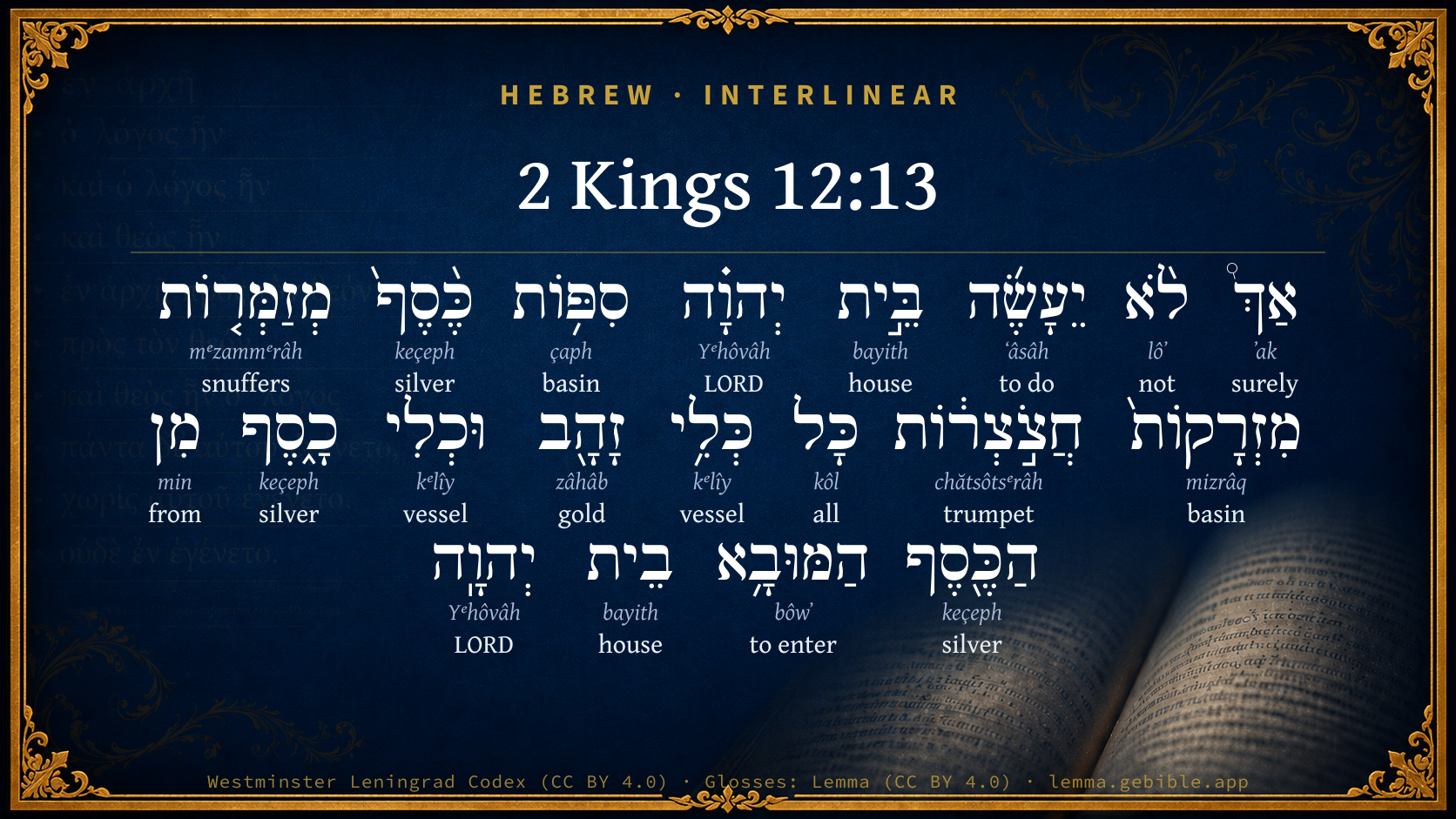
2 Kings 12:13

Hebrew (Westminster Leningrad Codex) 2 Kings 12:13 appears in the Hebrew Old Testament. The text above is from the Westminster Leningrad Codex. Each word links to its Strong’s number, a concise gloss, and parsing drawn from the Open Scriptures Hebrew Bible morphology. Click any word for its full Brown-Driver-Briggs (BDB) entry.
Download image
Cite this verse

2 Kings 12:13 (World English Bible). Public Domain. Lemma interlinear Bible study tool, https://lemma.gebible.app/v/2-kings/12/13.

Show BibTeX & RIS
BibTeX
RIS
English Translation
But there were not made for the house of Yahweh cups of silver, snuffers, basins, trumpets, any vessels of gold, or vessels of silver, of the money that was brought into the house of Yahweh;
World English Bible · Public Domain
Download a study sheet

One document with this verse’s original text, its word-by-word gloss line, the meaning frame, cross-references with their text, attributed commentary, and full source and license credits — printable, and it pastes into notes with its structure intact.

This verse Autodidact and up

Study sheet (.html) Plain text (.txt)

A passage Seminary Student

Up to 50 verses in one chapter. A passage sheet keeps up to 6 commentary sources and 12 cross-references per verse, in the order this page ranks them, and says so on the sheet whenever that leaves anything out. Ask for a single verse and you get the Autodidact verse sheet above.

Everything on this page stays free to read, with no account — the sheet is a download of what is already on screen, not access to it.

Want to remove ads? Support Godless Engineer
Compare translations 3

The same verse in 3 English versions, stacked beneath the original-language interlinear above. Click any original word for its lexicon entry.

Each is an independent rendering of the whole verse — the interlinear is not word-aligned to these translations.

Highlighted words mark where these versions differ — a whole-verse word diff, not a word-by-word alignment.

  • World English Bible Public Domain
    But there were not made for the house of Yahweh cups of silver, snuffers, basins, trumpets, any vessels of gold, or vessels of silver, of the money that was brought into the house of Yahweh;
  • King James Version Public Domain
    Howbeit there were not made for the house of the LORD bowls of silver, snuffers, basins, trumpets, any vessels of gold, or vessels of silver, of the money that was brought into the house of the LORD:
  • unfoldingWord Literal Text CC BY-SA 4.0
    However, the house of Yahweh, bowls of silver, snuffers, basins, trumpets, any articles of gold or articles of silver were not made from the silver brought the house of Yahweh,

unfoldingWord Literal Text — © unfoldingWord, licensed CC BY-SA 4.0. Word-aligned USFM3 via Door43 (git.door43.org/unfoldingWord/en_ult).

Versions to compare (up to 4)

3 of 4 selected

Show all 18 translations

Every available English version of this verse, each an independent rendering of the whole verse.

  • World English Bible Public Domain
    But there were not made for the house of Yahweh cups of silver, snuffers, basins, trumpets, any vessels of gold, or vessels of silver, of the money that was brought into the house of Yahweh;
  • Berean Standard Bible Public Domain
    However, the money brought into the house of the LORD was not used for making silver basins, wick trimmers, sprinkling bowls, trumpets, or any articles of gold or silver for the house of the LORD.
  • Majority Standard Bible Public Domain
    However, the money brought into the house of the LORD was not used for making silver basins, wick trimmers, sprinkling bowls, trumpets, or any articles of gold or silver for the house of the LORD.
  • King James Version Public Domain
    Howbeit there were not made for the house of the LORD bowls of silver, snuffers, basins, trumpets, any vessels of gold, or vessels of silver, of the money that was brought into the house of the LORD:
  • American Standard Version (1901) Public Domain
    But there were not made for the house of Jehovah cups of silver, snuffers, basins, trumpets, any vessels of gold, or vessels of silver, of the money that was brought into the house of Jehovah;
  • Revised Version (1885) Public Domain
    But there were not made for the house of the LORD cups of silver, snuffers, basons, trumpets, any vessels of gold, or vessels of silver, of the money that was brought into the house of the LORD:
  • Geneva Bible (1599) Public Domain
    Howbeit there was not made for the house of the Lord bowles of siluer, instruments of musicke, basons, trumpets, nor any vessels of golde, or vessels of siluer of the money that was brought into the house of the Lord.
  • Douay-Rheims (1899) Public Domain
    But there were not made of the same money for the temple of the Lord, bowls, or fleshhooks, or censers, or trumpets, or any vessel of gold and silver, of the money that was brought into the temple of the Lord.
  • Young's Literal Translation Public Domain
    Only, there is not made for the house of Jehovah basins of silver, snuffers, bowls, trumpets, any vessel of gold, and vessel of silver, out of the money that is brought into the house of Jehovah;
  • Literal Standard Version CC BY-SA 4.0
    Only, there is not made for the house of YHWH basins of silver, snuffers, bowls, trumpets, any vessel of gold, and vessel of silver, out of the money that is brought into the house of YHWH;
  • Unlocked Literal Bible CC BY-SA 4.0
    But the money that was brought into the house of Yahweh did not pay to make for it any silver cups, lamp trimmers, basins, trumpets, or any gold or silver furnishing.
  • unfoldingWord Literal Text CC BY-SA 4.0
    However, the house of Yahweh, bowls of silver, snuffers, basins, trumpets, any articles of gold or articles of silver were not made from the silver brought the house of Yahweh,
  • Darby Bible Public Domain
    However there were not made for the house of Jehovah basons of silver, knives, bowls, trumpets, nor any utensil of gold or utensil of silver, of the money that was brought [into] the house of Jehovah;
  • World Messianic Bible Public Domain
    But there were not made for the LORD’s house cups of silver, snuffers, basins, shofars, any vessels of gold or vessels of silver, of the money that was brought into the LORD’s house;
  • Webster's Bible Public Domain
    Yet, there were not made for the house of the LORD bowls of silver, snuffers, basons, trumpets, any vessels of gold, or vessels of silver, of the money that was brought into the house of the LORD:
  • Free Bible Version CC BY-SA 4.0
    However, the money collected for the Lord's Temple was not used for making silver basins, lamp trimmers, bowls, trumpets, or any items of gold or silver for the Lord's Temple.
  • Bible in Basic English Public Domain
    But the money was not used for making silver cups or scissors or basins or wind-instruments or any vessels of gold or silver for the house of the Lord;
  • JPS Tanakh (1917) Public Domain
    (12-14) But there were not made for the house of the LORD cups of silver, snuffers, basins, trumpets, any vessels of gold, or vessels of silver, of the money that was brought into the house of the LORD;

Literal Standard Version (2020), Covenant Press — licensed CC BY-SA 4.0. Text via the HelloAO Bible API (eBible.org). Unlocked Literal Bible (unfoldingWord) — licensed CC BY-SA 4.0. Text via the HelloAO Bible API (eBible.org). unfoldingWord Literal Text — © unfoldingWord, licensed CC BY-SA 4.0. Word-aligned USFM3 via Door43 (git.door43.org/unfoldingWord/en_ult). Free Bible Version, Dr. Jonathan Gallagher — licensed CC BY-SA 4.0. Text via the HelloAO Bible API (eBible.org).

Word by word

More ways to search: Search by grammar → Find every occurrence → Compare this word →

Practice this passage: Drill this verse → Learn its vocabulary →

מְזַמְּר֤וֹת
mᵉzammᵉrâh
H4212
“snuffers”
Noun, Common, Feminine, Plural, Absolute
Part of Speech
Noun
Type
Common
Gender
Feminine
Number
Plural
State
Absolute
Full BDB Definition

Origin: from H2168

TWOT: 559d

snuffers (temple utensil)
  1. אַךְ֩ ʼak H389 “surely” Particle, Accusative
  2. לֹ֨א lôʼ H3808 “not” Particle, Negative
  3. יֵעָשֶׂ֜ה ʻâsâh H6213 “to do” Verb, Niphal, Imperfect, 3rd Person, Masculine, Singular
  4. בֵּ֣ית bayith H1004 “house of” Noun, Common, Masculine, Singular, Construct
  5. יְהוָ֗ה Yᵉhôvâh H3068 “LORD” Noun, Proper
  6. סִפּ֥וֹת çaph H5592 “basins of” Noun, Common, Masculine, Plural, Construct
  7. כֶּ֨סֶף֙ keçeph H3701 “silver” Noun, Common, Masculine, Singular, Absolute
  8. מִזְרָקוֹת֙ mizrâq H4219 “basins” Noun, Common, Masculine, Plural, Absolute
  9. חֲצֹ֣צְר֔וֹת chătsôtsᵉrâh H2689 “trumpets” Noun, Common, Feminine, Plural, Absolute
  10. כָּל kôl H3605 “all of” Noun, Common, Masculine, Singular, Construct
  11. כְּלִ֥י kᵉlîy H3627 “vessel of” Noun, Common, Masculine, Singular, Construct
  12. זָהָ֖ב zâhâb H2091 “gold” Noun, Common, Masculine, Singular, Absolute
  13. וּכְלִי kᵉlîy H3627 “and · vessel of” Conjunction + Noun, Common, Masculine, Singular, Construct
  14. כָ֑סֶף keçeph H3701 “silver” Noun, Common, Masculine, Singular, Absolute
  15. מִן min H4480 “from” Preposition
  16. הַכֶּ֖סֶף keçeph H3701 “the · silver” Particle, Definite Article + Noun, Common, Masculine, Singular, Absolute
  17. הַמּוּבָ֥א bôwʼ H935 “the · entered” Particle, Definite Article + Verb, Hophal, Participle Passive, Masculine, Singular, Absolute
  18. בֵית bayith H1004 “house of” Noun, Common, Masculine, Singular, Construct
  19. יְהוָֽה Yᵉhôvâh H3068 “LORD” Noun, Proper

About this verse

These counts appear in no published source. They are computed here, from the morphology-tagged text and Lemma’s own curated glosses. What Lemma adds →

20
words
15
distinct lemmas
Historical
section

Notable vocabulary

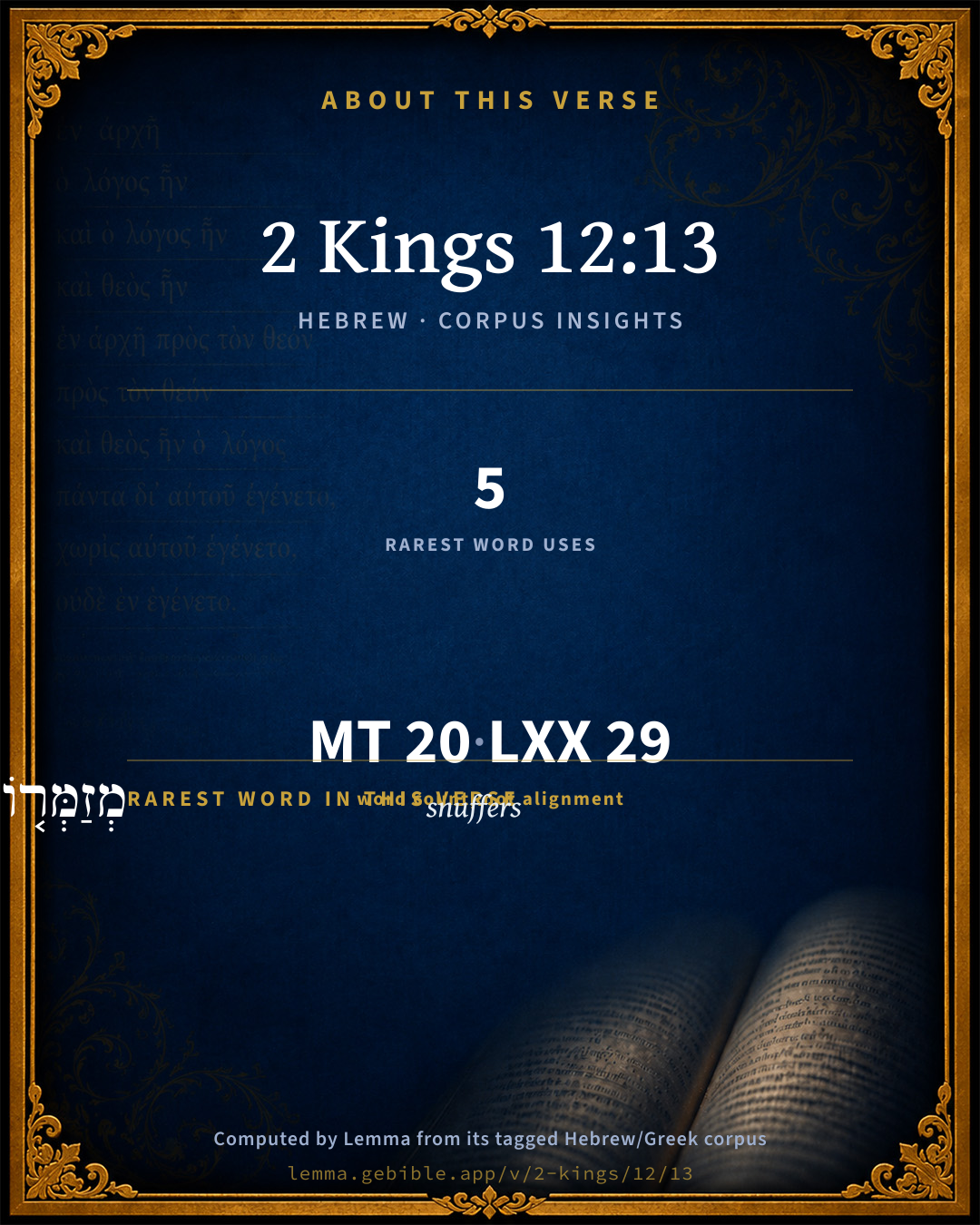
The rarest word here is מְזַמְּר֤וֹת snuffers H4212 — appearing just 5 times in the whole Hebrew Bible.

Shared distinctive vocabulary

מְזַמְּר֤וֹת snuffers H4212 occurs in 5 verses of the Hebrew Bible. Also found in:

Grammatical profile

  • 2 verbs
  • 15 nouns
  • 1 preposition
  • 2 particles

Verb forms

  • יֵעָשֶׂ֜ה Niphal · Imperfect
  • הַמּוּבָ֥א Hophal · Participle Passive

Repetition

Words recur within this verse — often emphatic in Hebrew:

  • כֶּ֨סֶף֙ silver H3701 ×3
  • בֵּ֣ית house H1004 ×2
  • יְהוָ֗ה LORD H3068 ×2
  • כְּלִ֥י vessel H3627 ×2

Hebrew & Septuagint length

In English translation the verse runs 35 words from the Hebrew and 39 from the Septuagint (LXX English) — closely comparable.

A rough comparison of the two English renderings, which tokenize alike — not a word-level alignment.

Word counts can differ between the Hebrew and the Greek without any difference in meaning — e.g. the Hebrew direct-object marker אֵת has no separate Greek word, and Greek often adds the article ὁ.

In the original languages it is 20 Hebrew tokens and 29 Greek tokens — but the two are counted differently (Hebrew bundles its prefixes and suffixes into one token; the Greek is in lemma form), so that isn’t a like-for-like length.

Cross-references

5

Topical passages linked to 2 Kings 12:13 in the Treasury of Scripture Knowledge — connected by theme and wording, ordered by reader-vote popularity; previews shown in the World English Bible.

  • 2 Chronicles 24:14 When they had made an end, they brought the rest of the money before the king and Jehoiada, of which were made vessels for the house of Yahweh, even vessels with which to minister and to offer, and spoons, and vessels of gold and silver. They offered burnt offerings in the house of Yahweh continually all the days of Jehoiada.
  • 1 Kings 7:48–50 Solomon made all the vessels that were in the house of Yahweh: the golden altar, and the table whereupon the show bread was, of gold;
  • Numbers 7:13–14 and his offering was: one silver platter, the weight of which was one hundred thirty shekels, one silver bowl of seventy shekels, after the shekel of the sanctuary; both of them full of fine flour mixed with oil for a meal offering;
  • Numbers 10:2 Make you two trumpets of silver; of beaten work shall you make them: and you shall use them for the calling of the congregation, and for the journeying of the camps.
  • Ezra 1:9–11 This is the number of them: thirty platters of gold, one thousand platters of silver, twenty-nine knives,

Cross-references courtesy of OpenBible.info (CC BY 4.0).

Hebrew and Greek witnesses Masoretic Hebrew ↔ Greek Septuagint

The same verse in the two great witnesses to the Old Testament, shown verse-for-verse.

These are two independent witnesses, not word-aligned to each other, and the Septuagint is shown in lemma (dictionary) form.

Hebrew 2 Kings 12:13 Masoretic · Westminster Leningrad Codex

אַךְ֩ לֹ֨א יֵעָשֶׂ֜ה בֵּ֣ית יְהוָ֗ה סִפּ֥וֹת כֶּ֨סֶף֙ מְזַמְּר֤וֹת מִזְרָקוֹת֙ חֲצֹ֣צְר֔וֹת כָּל כְּלִ֥י זָהָ֖ב וּכְלִי כָ֑סֶף מִן הַכֶּ֖סֶף הַמּוּבָ֥א בֵית יְהוָֽה

But there were not made for the house of Yahweh cups of silver, snuffers, basins, trumpets, any vessels of gold, or vessels of silver, of the money that was brought into the house of Yahweh;

World English Bible · Public Domain

Greek LXX 2 Kings 12:13 Septuagint · lemma form

καί ὁ τειχιστής καί ὁ λατόμος ὁ λίθος ὁ κτάομαι ξύλον καί λίθος λατόμητος ὁ καταἔχω ὁ βεδεκ οἶκος κύριος εἰς πᾶς ὅσος ἐξοδιάζω ἐπί ὁ οἶκος ὁ κραταιόω

Only there were not to be made for the house of the Lord silver plates, studs, bowls, or trumpets, any vessel of gold or vessel of silver, of the money that was brought into the house of the Lord:

LXX2012 (modern English Septuagint) · Public Domain

On this verse, The Cambridge Bible for Schools and Colleges discusses the Septuagint’s reading. Read the note in Commentary ↓

Hebrew: Westminster Leningrad Codex (CC BY 4.0). Greek: Septuagint (public domain); English from LXX2012 (modern English Septuagint) (Public Domain). How the Septuagint differs from the Hebrew →

Targum (Aramaic paraphrase)

1

The Targum is the ancient Jewish Aramaic paraphrase of the Hebrew Scriptures — an interpretive translation, not the Hebrew text itself. Onkelos (literal) and Pseudo-Jonathan (expansive) render the Torah, and Jonathan the Prophets. Coverage is partial: where no permissively-licensed English translation exists for a verse, only the Aramaic is shown. This is verse-level text, not a word-by-word alignment to the Hebrew.

  1. Targum Jonathan Prophets (Joshua–Malachi)
    וְלַארְגוּבְלַיָא וּלְפַסְלֵי אַבְנַיָא וּלְמִזְבַּן אָעִין וְאַבְנִין פְּסִילַן לְתַקָפָא יַת בִּדְקָא בֵית מַקְדְשָׁא דַייָ וּלְכֹל דְיִפּוֹק עַל בֵּיתָא לְתַקָפוּתֵיהּ:

    (no public-domain English translation for this verse)

    Targum Jonathan — Aramaic: “Mikraot Gedolot” (public domain). English: “Sefaria Community Translation” (CC0 1.0 (public-domain dedication)); “London "Chaldee Paraphrase," 1871” (public domain). Text via Sefaria.

Commentary

Notes on 2 Kings 12:13 from classic Christian and Jewish commentators (each source and its license shown beneath its notes). The classic Christian expositions comment on the surrounding passage and are grouped to its opening verse, so a note may address several verses; the Jewish commentaries on the Tanakh (Rashi and others) are per-verse, so they appear only where the commentator wrote on this verse.

Lemma curates 59 commentaries, every one of them public domain or Creative Commons licensed, each selected and text-cleaned for this edition rather than reprinted as found. About our sources →

Trapp's Complete Commentary

John Trapp

2Ki 12:13 Howbeit there were not made for the house of the LORD bowls of silver, snuffers, basons, trumpets, any vessels of gold, or vessels of silver, of the money [that was] brought into the house of the LORD:

Ver. 13. Howbeit there were not made,] viz., Till the fabric was finished; but afterwards they were. {2Ch 24:14} So earnestly they repaired, - Baruch-like. {Neh 3:20}

John Trapp, A Commentary or Exposition upon All the Books of the Old and New Testament (1647–1656) — public domain. Text from a community e-Sword module.

Geneva Bible (1599)

Geneva Bible translators

For these men had only the charge of the reparation of the Temple, and the rest of the money was brought to the king, who caused these afterward to be made, 2 Chron. 24:14.

Geneva Bible (1599) marginal notes — public domain. Text via Bolls.life.

Jamieson, Fausset & Brown

Robert Jamieson, A. R. Fausset & David Brown

Howbeit there were not made . . . bowls, &c.--When the repairs of the temple had been completed, the surplus was appropriated to the purchase of the temple furniture. The integrity of the overseers of the work being undoubted, no account was exacted of the way in which they applied the money given to them, while other moneys levied at the temple were left to the disposal of the priests as the law directed (Lev 5:16; Num 5:8).

Jamieson, Fausset & Brown — Commentary Critical and Explanatory on the Whole Bible (1871) — public domain (CC PDM 1.0). Text via the HelloAO Bible API.

Adam Clarke's Commentary

Verse 13. Howbeit there were not made - bowls, c.] That is, there were no vessels made for the service of the temple till all the outward repairs were completed but after this was done, they brought the rest of the money before the king and Jehoiada, whereof were made vessels of gold and silver; 2Ch 24:14.

Adam Clarke's Commentary on the Bible (1810–1826) — public domain. Text from a community e-Sword/MySword module.

Ellicott's Commentary for English Readers

(13) There were not made.—Rather, there used not to be made.

For the house.—Literally, in the house.

Bowls . . . basons.—Comp. 1Ki_7:50, where the same three terms occur.

Trumpets—i.e., the straight priestly trumpets.

Of the money that was brought.—The plain meaning is that the whole amount offered was expended on the necessary work of restoring the Temple fabric.

A Bible Commentary for English Readers, edited by Charles John Ellicott (1878–1897) — public domain. Text from a community e-Sword module.

The Cambridge Bible for Schools and Colleges

gen. ed. J. J. S. Perowne

13. Howbeit [R.V. But] there were not made for the house of the Lord] The compiler of Kings makes mention of certain vessels and implements which were not made at this time and from these contributions. Such were cups of silver, snuffers, basons, trumpets, and vessels of gold or vessels of silver, &c. as here recited. The Chronicler on the other hand dwells on such things as were made, and his list comprises ‘vessels to minister and to offer withal, and spoons, and vessels of gold and silver’. The one it will be seen says that vessels of gold and silver were made, the other that vessels of gold and silver were not made. But both writers are referring to the class of articles they have mentioned before. So of gold and silver there were not made cups, snuffers, basons &c., but vessels for ministration and spoons were made. They do not necessarily contradict each other.

bowls [R.V. cups] of silver] An attempt has been made in R.V., to give the same renderings to the same words in the enumeration of vessels for the temple. Hence the change here and 1Ki_7:50 and Jer_52:19. The Hebrew word is rendered ‘cup’ in Zec_12:2 by A.V., and on the margin of 2Sa_17:28. The word very frequently signifies ‘a threshold’. Hence the LXX. here has θύραι = doors.

The Cambridge Bible for Schools and Colleges (gen. ed. J. J. S. Perowne; Cambridge University Press, 1878–1918) — public domain. Text from a community e-Sword module.

John Gill's Exposition

The trespass money and sin money was not brought into the house of the Lord,.... Which was the money persons at a distance sent for their trespass and sin offerings instead of cattle, with which the sacrifices were bought; and what remained of the money was not brought into the temple, and made use of in the above manner:

it was the priest's; the overplus of it, and such of the sacrifices which by the law were appropriated to them.

John Gill's Exposition of the Whole Bible (1746–1763) — public domain (CC PDM 1.0). Text via the HelloAO Bible API.

Albert Barnes' Notes on the Bible

Comparing this verse with the marginal reference, it will be seen that the author of Kings desires to point out, that the repairs were not delayed by any deductions from the money that flowed in. The writer of Chronicles describes what became of the surplus in the chest after the last repairs were completed.

The need of supplying fresh bowls, snuffers, etc., arose from the pollution of those previously used in the temple service by their application to the Baal worship during the reigns of Ahaziah and Athaliah (see 2Ch 24:7).

Albert Barnes' Notes on the Bible (1834–1885) — public domain. Text from a community e-Sword/MySword module.

Haydock's Catholic Bible Commentary

Bowls. Chaldean, "silver chalices." The precise import of the Hebrew term is not well known. (Menochius) --- Lord. After the repairs were finished, the remaining money, which was very considerable, was however employed for these purposes, 2 Paralipomenon xxiv. 14. (Calmet) (Menochius)

George Leo Haydock (1774–1849), Haydock's Catholic Family Bible and Commentary, 1859 edition — public domain. Excludes Psalms (Douay-Rheims chapter numbering differs from Protestant) and Deuterocanonical books (Catholic canon only).

Matthew Poole's English Annotations

There were not made, to wit, until all the breaches of the house were repaired; but when that was done, they laid it out for these things, as is noted, 2Ch 24:14.

Matthew Poole's English Annotations on the Holy Bible (1683–1685) — public domain. Text from a community e-Sword/MySword module.

Whedon's Commentary on the Bible

Daniel D. Whedon

13. Not made… any vessels of gold — That is, as is explained in Chronicles, none of the money collected was used for this purpose until all the work of repairing the building was completed. After the repairs were finished the rest of the money was devoted to provide vessels for the house of the Lord. Athaliah had robbed the Lord’s house of these vessels to provide for her Baal worship.

Daniel D. Whedon (gen. ed.), Commentary on the Old and New Testaments (1874–1909) — public domain. Text from a community e-Sword module.

The Pulpit Commentary

Howbeit there was not made for the house of the Lord bowls of silver, snuffers, basins, trumpets, any vessels of gold, or vessels of silver, of the money that was brought into the house of the Lord; i.e. while the repairs were incomplete, while the work was still going on, no portion of the money taken from the chest was expended in the purchase of new sacred vessels, whether of gold or silver, whether howls, or snuffers, or basins, or trumpets the whole was rigidly applied to the renovation of the temple building. There is no contradiction between this statement and that of the writer of Chronicles, (2Ch_24:14) who tells us that, after the entire repairs were completed, the surplus money was expended in this way, on the purchase of "vessels to minister and to offer, spoons, and vessels of gold and silver." We can well understand that, after the spoiling of the temple by successive kings to buy off enemies by Rehoboam to content Shishak, (1Ki_14:26) by Asa to gratify Benhadad, (1Ki_15:18) and by Joash himself (ver. 18) to procure the retreat of Hazael from the siege of Jerusalem, the vessels of the temple must have required renovating almost as much as the fabric itself; and when it was found that there remained a surplus over and above all that was needed for building purposes, we cannot wonder that it was applied to the renewal of the vessels, absolutely essential as they were for the service of the sanctuary.

The Pulpit Commentary (1880–1919), ed. H.D.M. Spence-Jones & Joseph S. Exell — public domain. Text from a community e-Sword module.

unfoldingWord translationNotes

Door43 World Missions Community

did not pay to make for it any

"was not spent to pay for any of the temple's"

silver cups, lamp trimmers, basins, trumpets, or any gold or silver furnishing

These are items that would have been used by the priests for various temple tasks, such as sacrifices or festivals.

translationWords

silver

trumpet

gold

unfoldingWord translationNotes — © Distant Shores Media and the Door43 World Missions Community, licensed CC BY-SA 4.0. Source: git.door43.org/Door43/en_tn.

Rashi

Rabbi Shlomo Yitzchaki (Rashi)

And the masons. The builders of the wall, the architects’ apprentices.

And for the stone cutters. From the mountain.

Rashi on the Tanakh — English translations: “The Judaica Press complete Tanach with Rashi, translated by A. J. Rosenberg” (CC BY 4.0); “Pentateuch with Rashi's commentary by M. Rosenbaum and A.M. Silbermann, 1929-1934” (public domain); “The Metsudah Tanach series, Lakewood, N.J” (CC BY 4.0); and “The Book of Joshua, Metsudah Publications, 1997” (CC BY 4.0). Text via Sefaria.

Lesson kit

Teaching starters — assembled from the data on this page, not authored interpretation. Every prompt links to the verse data it draws on. Edit before teaching.

2 Kings, in the Historical, opens this verse with 20 words (15 distinct Hebrew lemmas). Its most distinctive word is mᵉzammᵉrâh (“snuffers”). A historical commentator’s framing appears above. Read the whole chapter for the surrounding context.

Discussion questions

  1. What does “snuffers” (mᵉzammᵉrâh) contribute to the verse as a whole?
  2. How does 1 Kings 7:50, which shares the word «snuffers», read alongside this verse?
  3. What does the repetition of “silver” (3× in this one verse) do in this verse?
  4. The translations on this page render this verse differently — a whole-verse word diff, not a word-by-word alignment. What might account for the different wordings?
  5. «יֵעָשֶׂ֜ה» is a Niphal Imperfect verb. How does that grammatical form shape the action described?
  6. Compare how Trapp's Complete Commentary and Geneva Bible (1599) read this verse. Where do they agree or differ?

Things to notice

Reading settings

Reading text

Shown beneath each verse's original-language words.

Old Testament
Old Testament edition

Read the OT as the Masoretic Hebrew (MT) or the Greek Septuagint (LXX).

English shown for the Greek Septuagint (in the Hebrew ↔ Greek comparison).

Comparing translations? Open the Compare panel on any verse page to stack up to four side by side.