
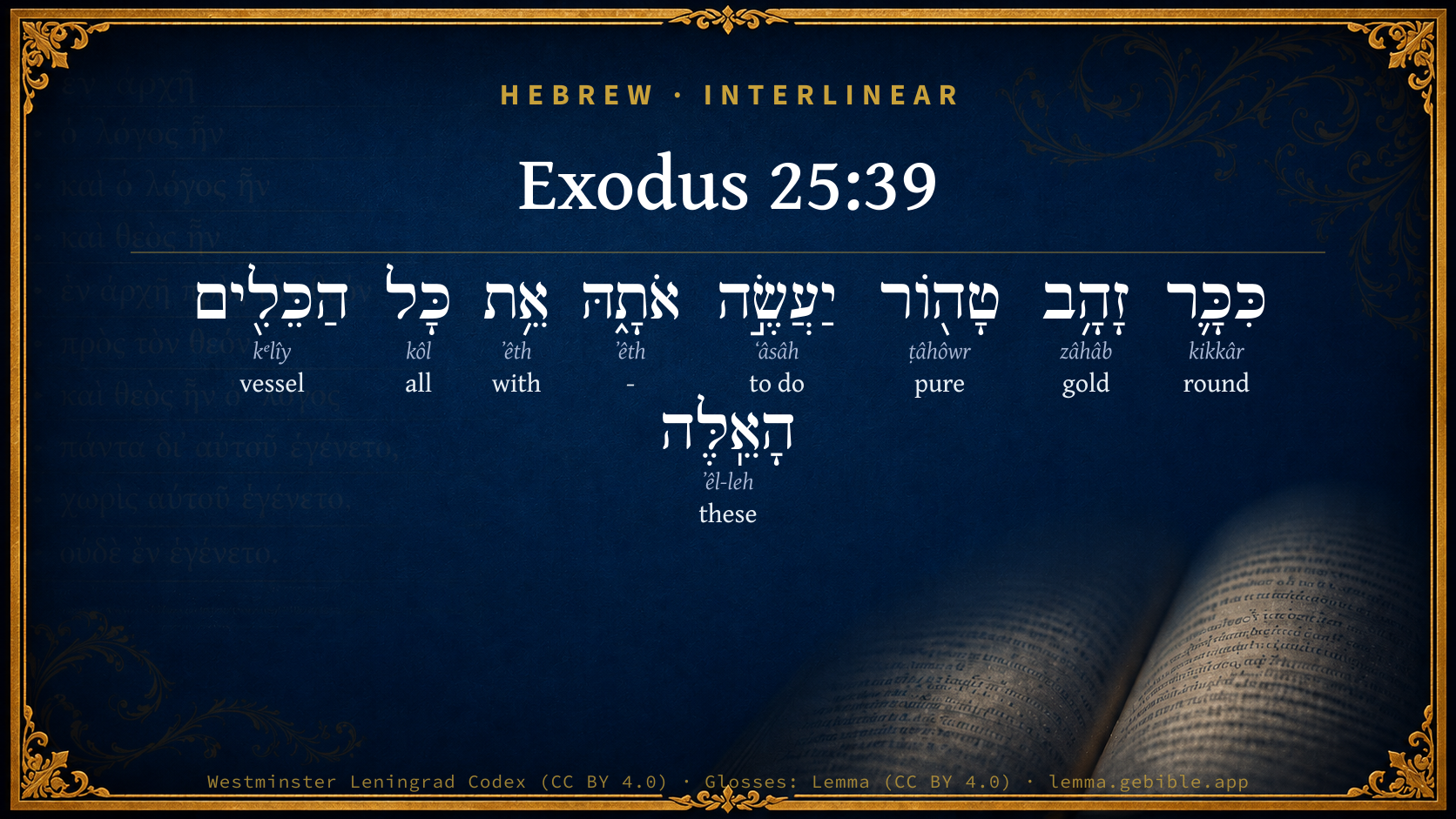
Exodus 25:39

Hebrew (Westminster Leningrad Codex) Exodus 25:39 appears in the Hebrew Old Testament. The text above is from the Westminster Leningrad Codex. Each word links to its Strong’s number, a concise gloss, and parsing drawn from the Open Scriptures Hebrew Bible morphology. Click any word for its full Brown-Driver-Briggs (BDB) entry.
Download image
Cite this verse

Exodus 25:39 (World English Bible). Public Domain. Lemma interlinear Bible study tool, https://lemma.gebible.app/v/exodus/25/39.

Show BibTeX & RIS
BibTeX
RIS
English Translation
It shall be made of a talent of pure gold, with all these accessories.
World English Bible · Public Domain
Download a study sheet

One document with this verse’s original text, its word-by-word gloss line, the meaning frame, cross-references with their text, attributed commentary, and full source and license credits — printable, and it pastes into notes with its structure intact.

This verse Autodidact and up

Study sheet (.html) Plain text (.txt)

A passage Seminary Student

Up to 50 verses in one chapter. A passage sheet keeps up to 6 commentary sources and 12 cross-references per verse, in the order this page ranks them, and says so on the sheet whenever that leaves anything out. Ask for a single verse and you get the Autodidact verse sheet above.

Everything on this page stays free to read, with no account — the sheet is a download of what is already on screen, not access to it.

Want to remove ads? Support Godless Engineer
Compare translations 3

The same verse in 3 English versions, stacked beneath the original-language interlinear above. Click any original word for its lexicon entry.

Each is an independent rendering of the whole verse — the interlinear is not word-aligned to these translations.

Highlighted words mark where these versions differ — a whole-verse word diff, not a word-by-word alignment.

  • World English Bible Public Domain
    It shall be made of a talent of pure gold, with all these accessories.
  • King James Version Public Domain
    Of a talent of pure gold shall he make it, with all these vessels.
  • unfoldingWord Literal Text CC BY-SA 4.0
    He shall make it, all these items, from a talent of pure gold.

unfoldingWord Literal Text — © unfoldingWord, licensed CC BY-SA 4.0. Word-aligned USFM3 via Door43 (git.door43.org/unfoldingWord/en_ult).

Versions to compare (up to 4)

3 of 4 selected

Show all 18 translations

Every available English version of this verse, each an independent rendering of the whole verse.

  • World English Bible Public Domain
    It shall be made of a talent of pure gold, with all these accessories.
  • Berean Standard Bible Public Domain
    The lampstand and all these utensils shall be made from a talent of pure gold.
  • Majority Standard Bible Public Domain
    The lampstand and all these utensils shall be made from a talent of pure gold.
  • King James Version Public Domain
    Of a talent of pure gold shall he make it, with all these vessels.
  • American Standard Version (1901) Public Domain
    Of a talent of pure gold shall it be made, with all these vessels.
  • Revised Version (1885) Public Domain
    Of a talent of pure gold shall it be made, with all these vessels.
  • Geneva Bible (1599) Public Domain
    Of a talent of fine gold shalt thou make it with all these instruments.
  • Douay-Rheims (1899) Public Domain
    The whole weight of the candlestick with all the furniture thereof shall be a talent of the purest gold.
  • Young's Literal Translation Public Domain
    of a talent of pure gold he doth make it, with all these vessels.
  • Literal Standard Version CC BY-SA 4.0
    he makes it of a talent of pure gold, with all these vessels.
  • Unlocked Literal Bible CC BY-SA 4.0
    Use one talent of pure gold to make the lampstand and its accessories.
  • unfoldingWord Literal Text CC BY-SA 4.0
    He shall make it, all these items, from a talent of pure gold.
  • Darby Bible Public Domain
    Of a talent of pure gold shall they make it, with all these utensils.
  • World Messianic Bible Public Domain
    It shall be made of a talent of pure gold, with all these accessories.
  • Webster's Bible Public Domain
    Of a talent of pure gold shall he make it, with all these vessels.
  • Free Bible Version CC BY-SA 4.0
    The lampstand and all these utensils will require a talent of pure gold.
  • Bible in Basic English Public Domain
    A talent of gold will be needed for it, with all these vessels.
  • JPS Tanakh (1917) Public Domain
    Of a talent of pure gold shall it be made, with all these vessels.

Literal Standard Version (2020), Covenant Press — licensed CC BY-SA 4.0. Text via the HelloAO Bible API (eBible.org). Unlocked Literal Bible (unfoldingWord) — licensed CC BY-SA 4.0. Text via the HelloAO Bible API (eBible.org). unfoldingWord Literal Text — © unfoldingWord, licensed CC BY-SA 4.0. Word-aligned USFM3 via Door43 (git.door43.org/unfoldingWord/en_ult). Free Bible Version, Dr. Jonathan Gallagher — licensed CC BY-SA 4.0. Text via the HelloAO Bible API (eBible.org).

Word by word

More ways to search: Search by grammar → Find every occurrence → Compare this word →

Practice this passage: Drill this verse → Learn its vocabulary →

About this verse

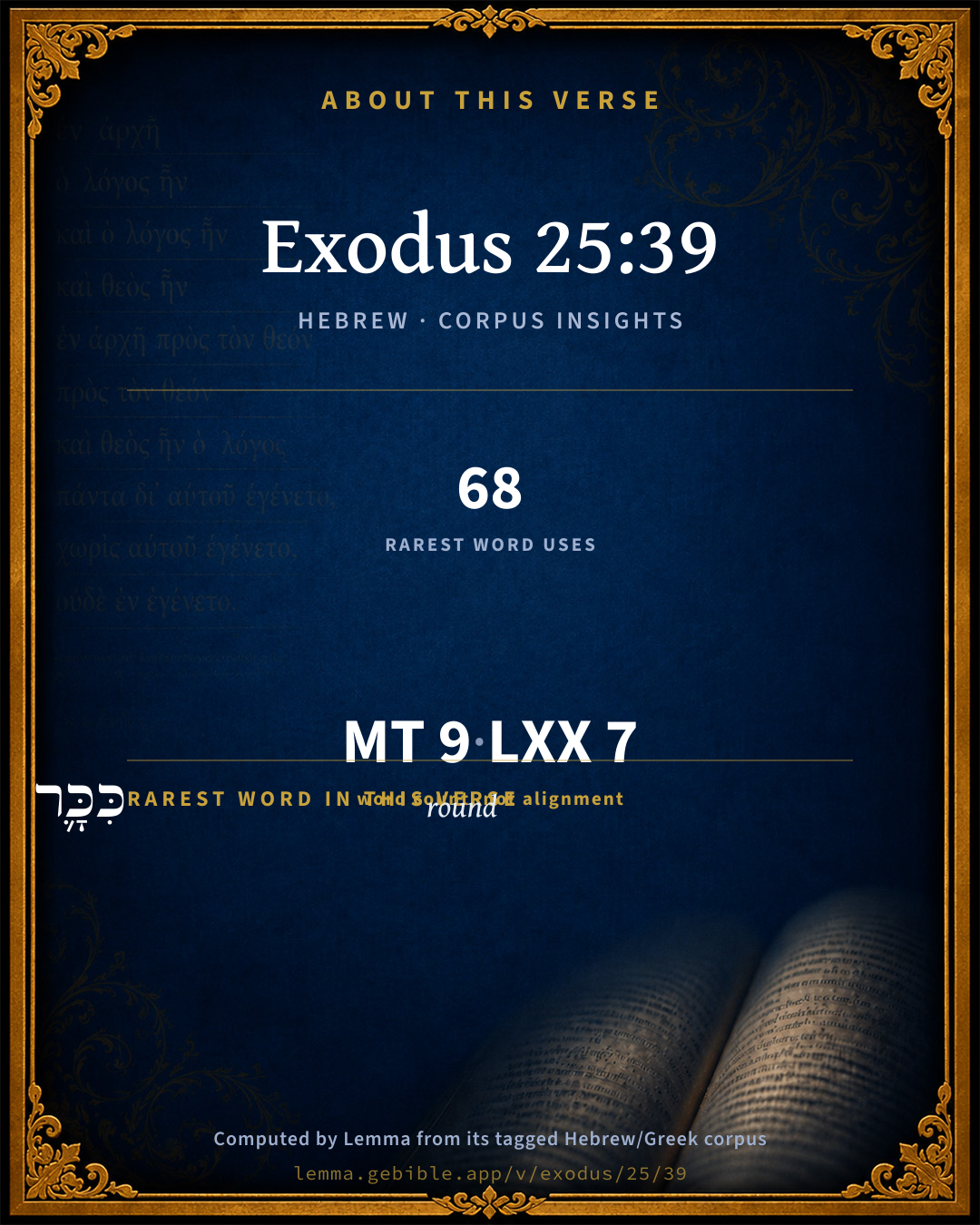
These counts appear in no published source. They are computed here, from the morphology-tagged text and Lemma’s own curated glosses. What Lemma adds →

9
words
9
distinct lemmas
Pentateuch
section

Grammatical profile

  • 1 verb
  • 4 nouns
  • 1 adjective
  • 1 pronoun
  • 1 preposition
  • 1 particle

Verb forms

  • יַעֲשֶׂ֣ה Qal · Imperfect

Hebrew & Septuagint length

In English translation the verse runs 14 words from the Hebrew and 10 from the Septuagint (LXX English) — the Septuagint runs noticeably shorter here. See the side-by-side →

A rough comparison of the two English renderings, which tokenize alike — not a word-level alignment.

Word counts can differ between the Hebrew and the Greek without any difference in meaning — e.g. the Hebrew direct-object marker אֵת has no separate Greek word, and Greek often adds the article ὁ.

In the original languages it is 9 Hebrew tokens and 7 Greek tokens — but the two are counted differently (Hebrew bundles its prefixes and suffixes into one token; the Greek is in lemma form), so that isn’t a like-for-like length.

Hebrew and Greek witnesses Masoretic Hebrew ↔ Greek Septuagint

The same verse in the two great witnesses to the Old Testament, shown verse-for-verse.

Here the Septuagint runs noticeably shorter than the Hebrew — LXX2012 (modern English Septuagint) 10 words vs World English Bible 14. A rough length comparison of the two English translations, not a word-level alignment — read both below.

These are two independent witnesses, not word-aligned to each other, and the Septuagint is shown in lemma (dictionary) form.

Hebrew Exodus 25:39 Masoretic · Westminster Leningrad Codex

כִּכָּ֛ר זָהָ֥ב טָה֖וֹר יַעֲשֶׂ֣ה אֹתָ֑הּ אֵ֥ת כָּל הַכֵּלִ֖ים הָאֵֽלֶּה

It shall be made of a talent of pure gold, with all these accessories.

World English Bible · Public Domain

Greek LXX Exodus 25:39 Septuagint · lemma form

πᾶς ὁ σκεῦος οὗτος τάλαντον χρυσίον καθαρός

All these articles shall be a talent of pure gold.

LXX2012 (modern English Septuagint) · Public Domain

Hebrew: Westminster Leningrad Codex (CC BY 4.0). Greek: Septuagint (public domain); English from LXX2012 (modern English Septuagint) (Public Domain). How the Septuagint differs from the Hebrew →

Targum (Aramaic paraphrase)

2

The Targum is the ancient Jewish Aramaic paraphrase of the Hebrew Scriptures — an interpretive translation, not the Hebrew text itself. Onkelos (literal) and Pseudo-Jonathan (expansive) render the Torah, and Jonathan the Prophets. Coverage is partial: where no permissively-licensed English translation exists for a verse, only the Aramaic is shown. This is verse-level text, not a word-by-word alignment to the Hebrew.

  1. Targum Onkelos Torah (Genesis–Deuteronomy)
    כִּכְּרָא דִדְהַב דְכֵי יַעְבֵּד יָתַהּ יָת כָּל מָנַיָא הָאִלֵין:

    (no public-domain English translation for this verse)

    Targum Onkelos — Aramaic: “Onkelos Genesis” (public domain); “Onkelos Exodus” (public domain); “Onkelos Leviticus” (public domain); “Onkelos Numbers” (public domain); “Onkelos Deuteronomy” (public domain). English: “Sefaria Community Translation” (CC0 1.0 (public-domain dedication)); “J.W. Etheridge. The Targums of Onkelos and Jonathan Ben Uzziel on the Pentateuch. London: Longmans, Green, 1862” (public domain). Text via Sefaria.

  2. Targum Pseudo-Jonathan Torah (Genesis–Deuteronomy)
    קַנְטְנַר דִּדְהַב דְּכֵי יַעֲבֵיד יָתָהּ יַת כָּל מָנַיָיא דִידָהּ הָאִלֵּין

    Of a talent of pure gold shall he make it and all these its vessels.

    Targum Pseudo-Jonathan — Aramaic: “Targum Jonathan on Genesis” (public domain); “Targum Jonathan on Exodus” (public domain); “Targum Jonathan on Leviticus” (public domain); “Targum Jonathan on Numbers” (public domain); “Targum Jonathan on Deuteronomy” (public domain). English: “The Targum of Jonathan ben Uzziel, trans. J. W. Etheridge, London, 1862” (public domain). Text via Sefaria.

Commentary

Notes on Exodus 25:39 from classic Christian and Jewish commentators (each source and its license shown beneath its notes). The classic Christian expositions comment on the surrounding passage and are grouped to its opening verse, so a note may address several verses; the Jewish commentaries on the Tanakh (Rashi and others) are per-verse, so they appear only where the commentator wrote on this verse.

Lemma curates 59 commentaries, every one of them public domain or Creative Commons licensed, each selected and text-cleaned for this edition rather than reprinted as found. About our sources →

Trapp's Complete Commentary

John Trapp

Exo 25:39 [Of] a talent of pure gold shall he make it, with all these vessels.

Ver. 39. Of a talent of pure gold,] i.e., Of a hundred and twenty pounds’ weight.

John Trapp, A Commentary or Exposition upon All the Books of the Old and New Testament (1647–1656) — public domain. Text from a community e-Sword module.

Geneva Bible (1599)

Geneva Bible translators

This was the talent weight of the Temple, and weighed 120 pounds.

Geneva Bible (1599) marginal notes — public domain. Text via Bolls.life.

Jamieson, Fausset & Brown

Robert Jamieson, A. R. Fausset & David Brown

a talent of pure gold--in weight equivalent to 125 lbs. troy.

Jamieson, Fausset & Brown — Commentary Critical and Explanatory on the Whole Bible (1871) — public domain (CC PDM 1.0). Text via the HelloAO Bible API.

Adam Clarke's Commentary

Verse 39. Of a talent of pure gold shall he make it, with all these vessels.] That is, a talent of gold in weight was used in making the candlestick, and the different vessels and instruments which belonged to it. According to Bishop Cumberland, a talent was three thousand shekels. As the Israelites brought each half a shekel, Ex 38:26, so that one hundred talents, one thousand seven hundred and seventy-five shekels, were contributed by six hundred and three thousand five hundred and fifty persons; by halving the number of the Israelites, he finds they contributed three hundred and one thousand seven hundred and seventy-five shekels in all. Now, as we find that this number of shekels made one hundred talents, and one thousand seven hundred and seventy-five shekels over, if we subtract one thousand seven hundred and seventy-five, the odd shekels, from three hundred and one thousand seven hundred and seventy-five, we shall have for a remainder three hundred thousand, the number of shekels in one hundred talents: and if this remainder be divided by one hundred, the number of talents, it quotes three thousand, the number of shekels in each talent. A silver shekel of the sanctuary, being equal, according to Dr. Prideaux, to three shillings English, three thousand such shekels will amount to four hundred and fifty pounds sterling; and, reckoning gold to silver as fifteen to one, a talent of gold will amount to six thousand seven hundred and fifty pounds sterling: to which add two hundred and sixty-three pounds for the one thousand seven hundred and seventy-five shekels, at three shillings each, and it makes a total of seven thousand and thirteen pounds, which immense sum was expended on the candlestick and its furniture. It is no wonder, then, (if the candlestick in the second temple was equal in value to that in the ancient tabernacle,) that Titus should think it of sufficient consequence to be one of the articles, with the golden table, and silver trumpets, that should be employed to grace his triumph. Their intrinsic worth was a matter of no consequence to Him whose are the silver and gold, the earth and its fulness; they had accomplished their design, and were of no farther use, either in the kingdom of providence, or the kingdom of grace. See Clarke on Ex 25:31, and "Ex 38:24".

Adam Clarke's Commentary on the Bible (1810–1826) — public domain. Text from a community e-Sword/MySword module.

Ellicott's Commentary for English Readers

(39) Of a talent of pure gold.—There are various estimates of the value and weight of the Hebrew gold talent, but none of them places it much below £4,000 of our money. Some carry the estimate as high as £10,000 or £11,000.

Shall he make it.—“He” refers to the artificer by whom the candlestick would be constructed.

A Bible Commentary for English Readers, edited by Charles John Ellicott (1878–1897) — public domain. Text from a community e-Sword module.

The Cambridge Bible for Schools and Colleges

gen. ed. J. J. S. Perowne

39. a talent] probably (DB. iv. 903b, 906a) 673, 500 grs. = c. 96 lb. avoirdupois,—worth, at the present value of gold, c. £5460.

The Cambridge Bible for Schools and Colleges (gen. ed. J. J. S. Perowne; Cambridge University Press, 1878–1918) — public domain. Text from a community e-Sword module.

Matthew Poole's English Annotations

A talent contains three thousand shekels, Exo 38 25, or one hundred and twenty-five pounds.

Matthew Poole's English Annotations on the Holy Bible (1683–1685) — public domain. Text from a community e-Sword/MySword module.

The Pulpit Commentary

Of a talent of pure gold shall he make it. The candlestick, with all its appurtenances, was to weigh exactly a talent of gold. The value of the Hebrew gold talent is supposed to have been between 10, 000 l and 11, 000 l of our money.

The Pulpit Commentary (1880–1919), ed. H.D.M. Spence-Jones & Joseph S. Exell — public domain. Text from a community e-Sword module.

Rashi

Rabbi Shlomo Yitzchaki (Rashi)

ככר זהב טהור OF A TALENT OF PURE GOLD [SHALL HE MAKE IT WITH ALL THESE VESSELS] — i. e. that its weight together with (את) all its vessels shall he exactly one talent, neither more nor less (cf. Menachot 88b). A common (not holy) kikkar (one used for weighing ordinary articles) was sixty manehs, that used for sacred purposes double as much, hundred and twenty manehs; a maneh was equal to a litra (the Roman libra, a pound) by which silver is weighed, according to the standard weight of Cologne. This is hundred denars which is the equivalent of twenty-five Sela’im, one Sela being four denars (cf. Bekhorot 5a).

Rashi on the Tanakh — English translations: “The Judaica Press complete Tanach with Rashi, translated by A. J. Rosenberg” (CC BY 4.0); “Pentateuch with Rashi's commentary by M. Rosenbaum and A.M. Silbermann, 1929-1934” (public domain); “The Metsudah Tanach series, Lakewood, N.J” (CC BY 4.0); and “The Book of Joshua, Metsudah Publications, 1997” (CC BY 4.0). Text via Sefaria.

Ramban (Nachmanides)

Rabbi Moshe ben Nachman (Ramban / Nachmanides)

OF A TALENT OF PURE GOLD SHALL HE MAKE IT WITH ALL THESE VESSELS. This means “that its weight together with all its vessels shall be exactly one talent, neither less nor more.” This is Rashi’s language. And such indeed is the simple meaning of Scripture. But if that be so, there is here a point which is greatly to be wondered about, namely that Scripture should not specify at all how much of the talent of gold should go into the candelabrum itself! For in that case half of the talent or even more could then go into the making of the tongs and the snuffdishes which are vessels separate from the candelabrum, while the candelabrum itself could be made of less than half the talent, or perhaps the candelabrum would be made of the entire talent less one maneh [a sacred talent consisted of one hundred and twenty manoth] and all these vessels would be made of the one maneh! Moreover, what reason is there that the total weight of the candelabrum with its many separate vessels should be given as one talent, and why was it not explained how many tongs and snuffdishes should be made from it?But the opinion of our Rabbis is not as the Rabbi [Rashi] stated it, for thus did the Sages teach in Tractate Menachoth: “The candelabrum and its seven lamps came from the talent, but not its tongs and snuffdishes. And if you ask how will I then explain, [Of a talent of pure gold shall he make it,] with all these vessels? Then I reply that this includes the lamps. These are the words of Rabbi Yehudah. Rabbi Nechemyah says: the candelabrum [alone] came from the talent but not its lamps, tongs, and snuffdishes. And if you ask how will I then explain the expression, with all these vessels? I answer that it teaches that they all be made of gold [aside of the talent mentioned].” There in Tractate Menachoth the Rabbis have further said, that according to Rabbi Yehudah [who says that the lamps came from the talent], the lamps were also of beaten work together with the candelabrum; yet Scripture calls them these ‘vessels,’ because they are receptacles for the oil, known by a name of their own, since in all other candelabrums they are separate from them [although here they were hammered out of the same talent of gold from which the whole candelabrum was made]. And according to Rabbi Nechemyah [who says that the lamps did not come from the talent, the Rabbis] have said there that the lamps were not of beaten work together with the candelabrum. Thus according to Rabbi Yehudah included in the weight of the talent — with that which was of beaten work with it — is only the candelabrum itself but none of the separate vessels thereof. And according to Rabbi Nechemyah the Rabbis have said there: “And if you ask how will I then explain the expression, with all these vessels? I answer, it teaches that they all be made of gold, this being necessary to be stated because of the mouth of the lamps.” According to the simple meaning of Scripture the verse states: “Of a talent of pure gold shall he make it; all these vessels he shall [also] make of pure gold,” since He did not explain at first that the lamps should be of gold. Similarly, Scripture relates at the time of the making of the candelabrum, And he made the lamps thereof, seven, and the tongs thereof, and the snuffdishes thereof, of pure gold, the expression of pure gold referring only to the tongs and the snuffdishes [but not to the lamps], and therefore He explained it further and said, Of a talent of pure gold he made it, and all the vessels thereof, Verse 24. the meaning being that all its vessels he [i.e., Bezalel] made of pure gold, not that he made them out of the talent of gold. Included in the expression all the vessels thereof are the oil vessels, for he made with the candelabrum many vessels besides those mentioned, just as it is said during the journeyings, And they shall cover the candelabrum of the light, and its lamps, and its tongs, and its snuffdishes, and all the oil vessels thereof, wherewith they minister unto it. And the verse which states, unto the base thereof, and unto the flowers thereof, it was beaten work, 8:4. likewise indicates according to its plain sense that only the candelabrum itself was of beaten work but not its lamps. All this is in accordance with the line of teaching of the Gemara.But in the Beraitha of the work of the Tabernacle it is taught in another way. “The candelabrum which Moses made in the wilderness was made of gold. It had to be made by a process of beating, and had to have cups, knops, and flowers, for it is said, And thou shalt make a candelabrum of pure gold. I might have thought that [the cups etc.] may be made separately and then soldered on to the candelabrum; Scripture therefore states, they shall be of one piece with it. How do we know that this includes lamps, so that they must also be made of one piece with it? Scripture therefore says, [Of a talent of pure gold] he shall make. I might think this also includes its cups, knops, and flowers? Scripture therefore says, it [he shall make ‘it’]. Now how do you know that you are to include its lamps and exclude its cups, knops and flowers? Since Scripture has here used a term of amplification and followed it by a term of limitation, I reason as follows: I include its lamps because they have to be made with the candelabrum, and I exclude its cups, knops and flowers because they do not always have to be made with it. And how do I know that I am to include its malkocheha are “tongs.” But from this point on it is clear [and Ramban will so clarify it further] that melkochayim are a sort of cover-like part for each of the lamps so that no impurities fall into the lamp while it is burning. Ramban’s comment that “in the same way they make today in candelabrums for kings” is obviously a reference to what he had personally seen in the royal palace of the Kingdom of Aragon which as the recognized leader of the Jews he often visited. and machtotheha? which we have translated till now as “snuffdishes.” But it is clear that Ramban interprets it now as meaning that underneath each lamp there was a small receptacle for the sparks to fall into. Scripture therefore says, [of beaten work] shall it be done. I might think I am also to include the tzvatim (tongs) and the snuffers; Scripture therefore says, [Of a talent of pure gold he shall make] it. And how do you know that you are to include the malkocheha and machtotheha and exclude the tongs and the snuffers? Since Scripture has here used a term of amplification and followed it by a term of limitation, I reason as follows: I include the malkocheha and machtotheha because they are used with the candelabrum, and I exclude the tongs and the snuffers because they are not used with it. Rabbi Yehoshua the son of Korcha says: It [i.e., the candelabrum] is made of the talent, but not its vessels, for it is said, Of a talent of pure gold he shall make ‘it.’ And if you ask how will I then explain the expression, and all its vessels? Then I reply that it means that they should be made of pure gold [but not of the talent].” Thus far is the text of the Beraitha.It appears from that which the Rabbis, of blessed memory, have said, that the lamps, the melkochayim, and the machtoth were all made of beaten work together with the candelabrum; since the melkochayim were not tongs [as we understood the word till now] to mean “tongs.” but they were rather golden lids which were made on the rim of the lamps for opening and closing, and would cover them so that nothing fell into the oil, in the same way that they make today in candelabrums for kings. This usage [of the word melkochayim] is associated with the expression, and my tongue cleaveth ‘malkochay’ — the palate and bottom parts of the mouth being called melkochayim [of the root loko’ach — “taking”] because they “take in” the tongue between them. The machtoth are receptacles under each lamp to catch the sparks of fire which might fall from them. The melkochayim and the machtoth were all of one beaten work with the candelabrum and were made out of the talent of gold. But the tongs and the snuffers, which were not used in the candelabrum itself but were instead vessels separate from it and not attached thereto, did not come from the talent at all. Similarly this Beraitha excluded its cups, knops and flowers, so that if he wanted to make them not of beaten work together with the candelabrum he was so permitted, the reason according to the Beraitha being “because they are not made with it,” that is to say, they do not invalidate the candelabrum. For if he made it of any other metal besides gold, it did not come with cups, knops and flowers, but the [six] branches [with the central shaft] always invalidated the candelabrum if lacking therefrom.According to this Beraitha then, the Scriptural expression, and all the vessels thereof, Verse 24. means that Bezalel made of gold all vessels needed for the proper use of the candelabrum and appropriate to it — these being the tongs and the snuffers that are necessary in the use of all candelabrums. Similarly, All the instruments of the Tabernacle in all the service thereof means all instruments needed for [erecting] the Tabernacle. These He did not explain but mentioned only that they were to be made of brass. But the verse before us which states, Of a talent of pure gold shall he make it, with all these vessels, refers to those vessels mentioned [in the preceding verse, namely, malkocheha and machtotheha], and they were all of beaten work with it. It is possible that the statement which Scripture uses at the construction, namely, and all the vessels thereof, Verse 24. alludes to these vessels [the malkocheha and machtotheha] mentioned there in the preceding verse, so that they were all to be made with the candelabrum of beaten work, as is the plain meaning of Scripture. But the vessels of oil were not mentioned at the construction just as they were not mentioned at the command [for making the candelabrum], but they made them on their own accord. Perhaps Bezalel did not make them but certain individuals made them and dedicated them to the public.In summary, the candelabrum itself came from the talent, but nothing outside of it came therefrom, according to the words of all authorities.

Ramban (Nachmanides) on the Tanakh — English translation: “Commentary on the Torah by Ramban (Nachmanides). Translated and annotated by Charles B. Chavel. New York, Shilo Pub. House, 1971-1976” (CC BY 4.0). Text via Sefaria.

Lesson kit

Teaching starters — assembled from the data on this page, not authored interpretation. Every prompt links to the verse data it draws on. Edit before teaching.

Exodus, in the Pentateuch, opens this verse with 9 words (9 distinct Hebrew lemmas). Its most distinctive word is kikkâr (“round”). The Greek Septuagint runs shorter here. A historical commentator’s framing appears above. Read the whole chapter for the surrounding context.

Discussion questions

  1. How does “round” (kikkâr) shape what this verse is saying?
  2. The Septuagint runs shorter here than the Hebrew. What might account for the difference?
  3. These translations render this verse differently; the difference is in the English rendering, not the original. What questions does that raise?
  4. «יַעֲשֶׂ֣ה» is a Qal Imperfect verb. How does that grammatical form shape the action described?
  5. Compare how Trapp's Complete Commentary and Geneva Bible (1599) read this verse. Where do they agree or differ?

Things to notice

Reading settings

Reading text

Shown beneath each verse's original-language words.

Old Testament
Old Testament edition

Read the OT as the Masoretic Hebrew (MT) or the Greek Septuagint (LXX).

English shown for the Greek Septuagint (in the Hebrew ↔ Greek comparison).

Comparing translations? Open the Compare panel on any verse page to stack up to four side by side.