
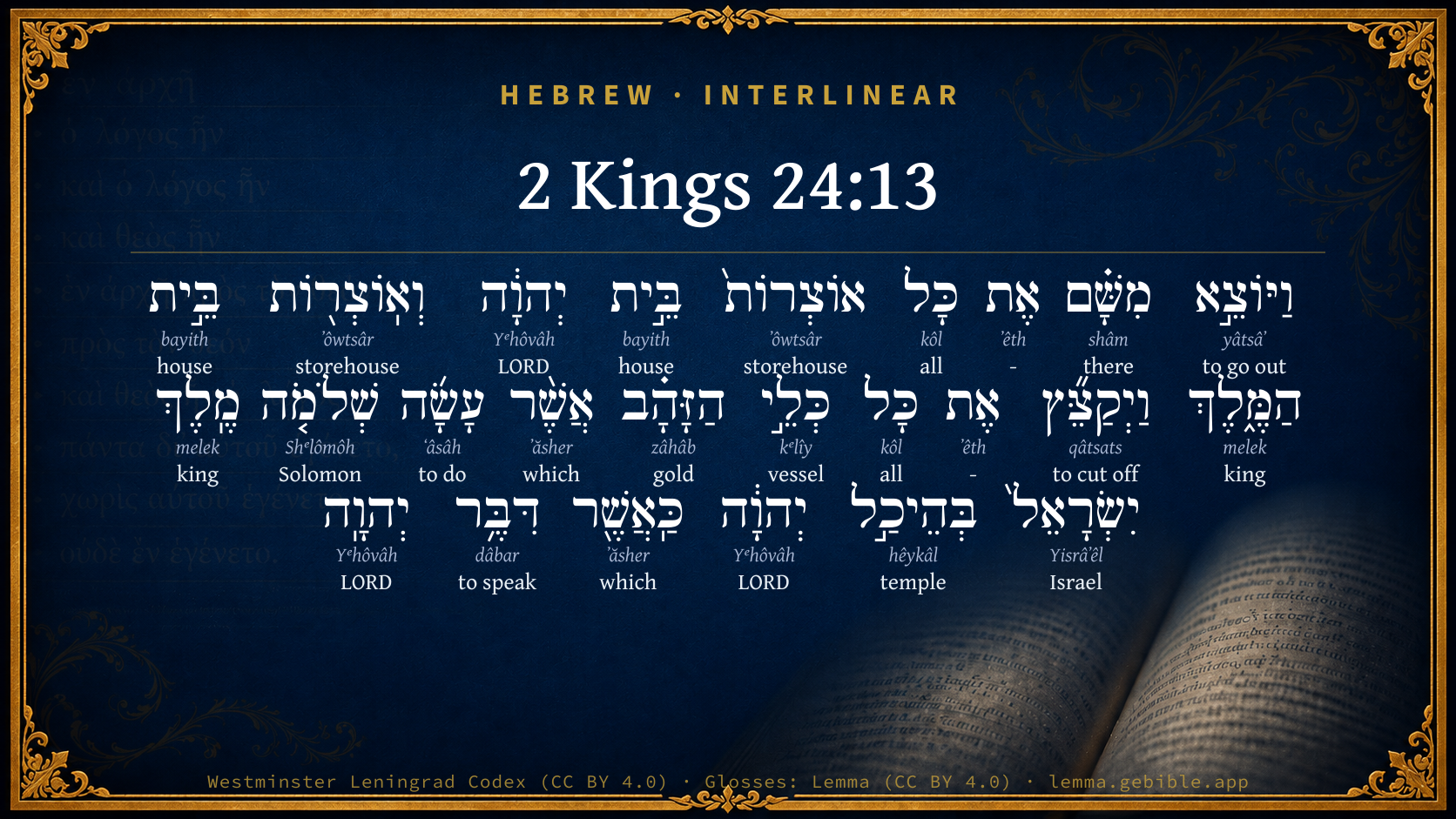
2 Kings 24:13

Hebrew (Westminster Leningrad Codex) 2 Kings 24:13 appears in the Hebrew Old Testament. The text above is from the Westminster Leningrad Codex. Each word links to its Strong’s number, a concise gloss, and parsing drawn from the Open Scriptures Hebrew Bible morphology. Click any word for its full Brown-Driver-Briggs (BDB) entry.
Download image
Cite this verse

2 Kings 24:13 (World English Bible). Public Domain. Lemma interlinear Bible study tool, https://lemma.gebible.app/v/2-kings/24/13.

Show BibTeX & RIS
BibTeX
RIS
English Translation
He carried out there all the treasures of the house of Yahweh, and the treasures of the king's house, and cut in pieces all the vessels of gold, which Solomon king of Israel had made in the temple of Yahweh, as Yahweh had said.
World English Bible · Public Domain
Download a study sheet

One document with this verse’s original text, its word-by-word gloss line, the meaning frame, cross-references with their text, attributed commentary, and full source and license credits — printable, and it pastes into notes with its structure intact.

This verse Autodidact and up

Study sheet (.html) Plain text (.txt)

A passage Seminary Student

Up to 50 verses in one chapter. A passage sheet keeps up to 6 commentary sources and 12 cross-references per verse, in the order this page ranks them, and says so on the sheet whenever that leaves anything out. Ask for a single verse and you get the Autodidact verse sheet above.

Everything on this page stays free to read, with no account — the sheet is a download of what is already on screen, not access to it.

Want to remove ads? Support Godless Engineer
Compare translations 3

The same verse in 3 English versions, stacked beneath the original-language interlinear above. Click any original word for its lexicon entry.

Each is an independent rendering of the whole verse — the interlinear is not word-aligned to these translations.

Highlighted words mark where these versions differ — a whole-verse word diff, not a word-by-word alignment.

  • World English Bible Public Domain
    He carried out there all the treasures of the house of Yahweh, and the treasures of the king's house, and cut in pieces all the vessels of gold, which Solomon king of Israel had made in the temple of Yahweh, as Yahweh had said.
  • King James Version Public Domain
    And he carried out thence all the treasures of the house of the LORD, and the treasures of the king's house, and cut in pieces all the vessels of gold which Solomon king of Israel had made in the temple of the LORD, as the LORD had said.
  • unfoldingWord Literal Text CC BY-SA 4.0
    And he brought out from there all of the treasuries of the house of Yahweh and the treasuries of the house of the king, and he cut off all of the furnishings of gold that Solomon, the king of Israel, had made for the temple of Yahweh, just as Yahweh had spoken.

unfoldingWord Literal Text — © unfoldingWord, licensed CC BY-SA 4.0. Word-aligned USFM3 via Door43 (git.door43.org/unfoldingWord/en_ult).

Versions to compare (up to 4)

3 of 4 selected

Show all 18 translations

Every available English version of this verse, each an independent rendering of the whole verse.

  • World English Bible Public Domain
    He carried out there all the treasures of the house of Yahweh, and the treasures of the king's house, and cut in pieces all the vessels of gold, which Solomon king of Israel had made in the temple of Yahweh, as Yahweh had said.
  • Berean Standard Bible Public Domain
    As the LORD had declared, Nebuchadnezzar also carried off all the treasures from the house of the LORD and the royal palace, and he cut into pieces all the gold articles that Solomon king of Israel had made in the temple of the LORD.
  • Majority Standard Bible Public Domain
    As the LORD had declared, Nebuchadnezzar also carried off all the treasures from the house of the LORD and the royal palace, and he cut into pieces all the gold articles that Solomon king of Israel had made in the temple of the LORD.
  • King James Version Public Domain
    And he carried out thence all the treasures of the house of the LORD, and the treasures of the king's house, and cut in pieces all the vessels of gold which Solomon king of Israel had made in the temple of the LORD, as the LORD had said.
  • American Standard Version (1901) Public Domain
    And he carried out thence all the treasures of the house of Jehovah, and the treasures of the king's house, and cut in pieces all the vessels of gold, which Solomon king of Israel had made in the temple of Jehovah, as Jehovah had said.
  • Revised Version (1885) Public Domain
    And he carried out thence all the treasures of the house of the LORD, and the treasures of the king’s house, and cut in pieces all the vessels of gold which Solomon king of Israel had made in the temple of the LORD, as the LORD had said.
  • Geneva Bible (1599) Public Domain
    And he caryed out thence all the treasures of the house of the Lord, and the treasures of the Kings house, and brake all the vessels of gold, which Salomon King of Israel had made in the Temple of the Lord, as the Lord had saide.
  • Douay-Rheims (1899) Public Domain
    And he brought out from thence all the treasures of the house of the Lord, and the treasures of the king's house: and he cut in pieces all the vessels of gold which Solomon king of Israel had made in the temple of the Lord, according to the word of the Lord.
  • Young's Literal Translation Public Domain
    and bringeth out thence all the treasures of the house of Jehovah, and the treasures of the house of the king, and cutteth in pieces all the vessels of gold that Solomon king of Israel made in the temple of Jehovah, as Jehovah had spoken.
  • Literal Standard Version CC BY-SA 4.0
    and brings out from there all the treasures of the house of YHWH, and the treasures of the house of the king, and cuts in pieces all the vessels of gold that Solomon king of Israel made in the temple of YHWH, as YHWH had spoken.
  • Unlocked Literal Bible CC BY-SA 4.0
    Nebuchadnezzar took out from there all the valuable things in the house of Yahweh, and those in the king's palace. He cut into pieces all the golden objects that Solomon king of Israel had made in the temple of Yahweh, as Yahweh had said would happen.
  • unfoldingWord Literal Text CC BY-SA 4.0
    And he brought out from there all of the treasuries of the house of Yahweh and the treasuries of the house of the king, and he cut off all of the furnishings of gold that Solomon, the king of Israel, had made for the temple of Yahweh, just as Yahweh had spoken.
  • Darby Bible Public Domain
    And he brought out thence all the treasures of the house of Jehovah, and the treasures of the king's house, and cut in pieces all the vessels of gold that Solomon king of Israel had made in the temple of Jehovah, as Jehovah had said.
  • World Messianic Bible Public Domain
    He carried out from there all the treasures of the LORD’s house and the treasures of the king’s house, and cut in pieces all the vessels of gold which Solomon king of Israel had made in the LORD’s temple, as the LORD had said.
  • Webster's Bible Public Domain
    And he carried out thence all the treasures of the house of the LORD, and the treasures of the king's house, and cut in pieces all the vessels of gold which Solomon king of Israel had made in the temple of the LORD, as the LORD had said.
  • Free Bible Version CC BY-SA 4.0
    Nebuchadnezzar took all the treasures from the Lord's Temple and the royal palace, and he cut up all the gold items that Solomon, king of Israel, had made for the Lord's Temple, as the Lord had said would happen.
  • Bible in Basic English Public Domain
    And he took away all the stored wealth of the Lord's house, and the goods from the king's store-house, cutting up all the gold vessels which Solomon, king of Israel, had made in the house of the Lord, as the Lord had said.
  • JPS Tanakh (1917) Public Domain
    And he carried out thence all the treasures of the house of the LORD, and the treasures of the king's house, and cut in pieces all the vessels of gold which Solomon king of Israel had made in the temple of the LORD, as the LORD had said.

Literal Standard Version (2020), Covenant Press — licensed CC BY-SA 4.0. Text via the HelloAO Bible API (eBible.org). Unlocked Literal Bible (unfoldingWord) — licensed CC BY-SA 4.0. Text via the HelloAO Bible API (eBible.org). unfoldingWord Literal Text — © unfoldingWord, licensed CC BY-SA 4.0. Word-aligned USFM3 via Door43 (git.door43.org/unfoldingWord/en_ult). Free Bible Version, Dr. Jonathan Gallagher — licensed CC BY-SA 4.0. Text via the HelloAO Bible API (eBible.org).

Word by word

More ways to search: Search by grammar → Find every occurrence → Compare this word →

Practice this passage: Drill this verse → Learn its vocabulary →

וַיְקַצֵּ֞ץ
qâtsats
H7112
“and · to cut off”
Conjunction + Verb, Piel, Sequential Imperfect, 3rd Person, Masculine, Singular
Part of Speech
Conjunction + Verb
Stem
Piel
Form
Sequential Imperfect
Person
3rd Person
Gender
Masculine
Number
Singular
Full BDB Definition

Origin: a primitive root

TWOT: 2060

to cut off - (Qal) to cut off - (Piel) to cut or hew off, cut in two, cut in pieces - (Pual) to be cut or hewn off
  1. וַיּוֹצֵ֣א yâtsâʼ H3318 “and · to go out” Conjunction + Verb, Hiphil, Sequential Imperfect, 3rd Person, Masculine, Singular
  2. מִשָּׁ֗ם shâm H8033 “from · there” Preposition + Adverb
  3. אֶת ʼêth H853 “-” Particle, Direct Object
  4. כָּל kôl H3605 “all of” Noun, Common, Masculine, Singular, Construct
  5. אוֹצְרוֹת֙ ʼôwtsâr H214 “storehouses of” Noun, Common, Masculine, Plural, Construct
  6. בֵּ֣ית bayith H1004 “house of” Noun, Common, Masculine, Singular, Construct
  7. יְהוָ֔ה Yᵉhôvâh H3068 “LORD” Noun, Proper
  8. וְאֽוֹצְר֖וֹת ʼôwtsâr H214 “and · storehouses of” Conjunction + Noun, Common, Masculine, Plural, Construct
  9. בֵּ֣ית bayith H1004 “house of” Noun, Common, Masculine, Singular, Construct
  10. הַמֶּ֑לֶךְ melek H4428 “the · king” Particle, Definite Article + Noun, Common, Masculine, Singular, Absolute
  11. אֶת ʼêth H853 “-” Particle, Direct Object
  12. כָּל kôl H3605 “all of” Noun, Common, Masculine, Singular, Construct
  13. כְּלֵ֣י kᵉlîy H3627 “vessels of” Noun, Common, Masculine, Plural, Construct
  14. הַזָּהָ֗ב zâhâb H2091 “the · gold” Particle, Definite Article + Noun, Common, Masculine, Singular, Absolute
  15. אֲשֶׁ֨ר ʼăsher H834 “which” Particle, Relative
  16. עָשָׂ֜ה ʻâsâh H6213 “to do” Verb, Qal, Perfect, 3rd Person, Masculine, Singular
  17. שְׁלֹמֹ֤ה Shᵉlômôh H8010 “Solomon” Noun, Proper
  18. מֶֽלֶךְ melek H4428 “king of” Noun, Common, Masculine, Singular, Construct
  19. יִשְׂרָאֵל֙ Yisrâʼêl H3478 “Israel” Noun, Proper
  20. בְּהֵיכַ֣ל hêykâl H1964 “in/at · temple of” Preposition + Noun, Common, Masculine, Singular, Construct
  21. יְהוָ֔ה Yᵉhôvâh H3068 “LORD” Noun, Proper
  22. כַּֽאֲשֶׁ֖ר ʼăsher H834 “like/as · which” Preposition + Particle, Relative
  23. דִּבֶּ֥ר dâbar H1696 “to speak” Verb, Piel, Perfect, 3rd Person, Masculine, Singular
  24. יְהוָֽה Yᵉhôvâh H3068 “LORD” Noun, Proper

About this verse

These counts appear in no published source. They are computed here, from the morphology-tagged text and Lemma’s own curated glosses. What Lemma adds →

25
words
17
distinct lemmas
Historical
section

Notable vocabulary

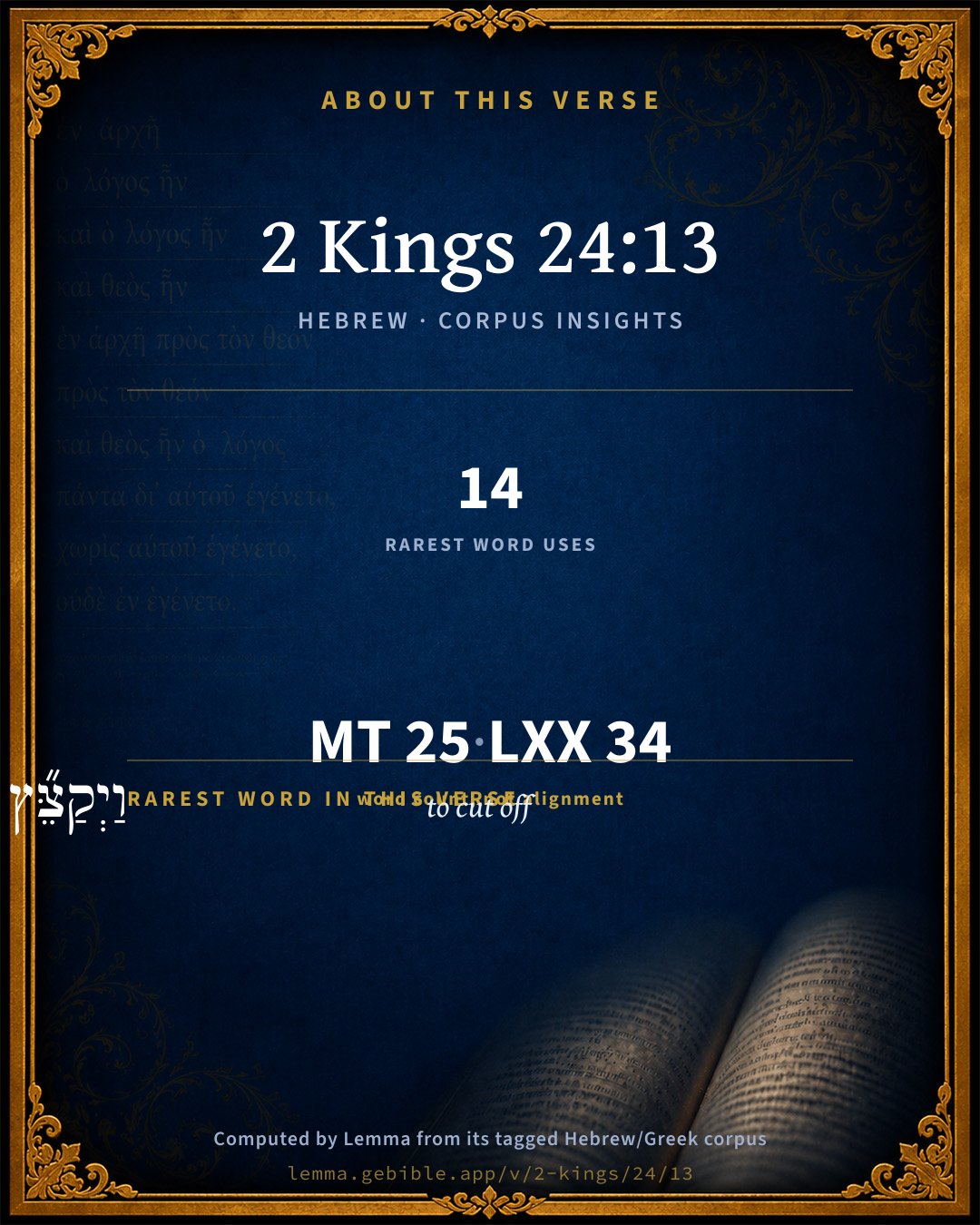
The rarest word here is וַיְקַצֵּ֞ץ to cut off H7112 — appearing just 14 times in the whole Hebrew Bible.

Shared distinctive vocabulary

וַיְקַצֵּ֞ץ to cut off H7112 occurs in 14 verses of the Hebrew Bible. Also found in:

Grammatical profile

  • 4 verbs
  • 16 nouns
  • 1 adverb
  • 4 particles

Verb forms

  • וַיּוֹצֵ֣א Hiphil · Sequential Imperfect
  • וַיְקַצֵּ֞ץ Piel · Sequential Imperfect
  • עָשָׂ֜ה Qal · Perfect
  • דִּבֶּ֥ר Piel · Perfect

Repetition

Words recur within this verse — often emphatic in Hebrew:

  • יְהוָ֔ה LORD H3068 ×3
  • כָּל all H3605 ×2
  • אוֹצְרוֹת֙ storehouse H214 ×2
  • בֵּ֣ית house H1004 ×2
  • הַמֶּ֑לֶךְ king H4428 ×2
  • אֲשֶׁ֨ר which H834 ×2

Hebrew & Septuagint length

In English translation the verse runs 44 words from the Hebrew and 50 from the Septuagint (LXX English) — closely comparable.

A rough comparison of the two English renderings, which tokenize alike — not a word-level alignment.

Word counts can differ between the Hebrew and the Greek without any difference in meaning — e.g. the Hebrew direct-object marker אֵת has no separate Greek word, and Greek often adds the article ὁ.

In the original languages it is 25 Hebrew tokens and 34 Greek tokens — but the two are counted differently (Hebrew bundles its prefixes and suffixes into one token; the Greek is in lemma form), so that isn’t a like-for-like length.

Cross-references

11

Topical passages linked to 2 Kings 24:13 in the Treasury of Scripture Knowledge — connected by theme and wording, ordered by reader-vote popularity; previews shown in the World English Bible.

  • Isaiah 39:6 Behold, the days are coming, when all that is in your house, and that which your fathers have laid up in store until this day, shall be carried to Babylon: nothing shall be left, says Yahweh.
  • 2 Kings 20:17 Behold, the days come, that all that is in your house, and that which your fathers have laid up in store to this day, shall be carried to Babylon: nothing shall be left, says Yahweh.
  • Jeremiah 20:5 Moreover I will give all the riches of this city, and all the gains of it, and all the precious things of it, yes, all the treasures of the kings of Judah will I give into the hand of their enemies; and they shall make them a prey, and take them, and carry them to Babylon.
  • 1 Kings 7:48–50 Solomon made all the vessels that were in the house of Yahweh: the golden altar, and the table whereupon the show bread was, of gold;
  • 2 Kings 25:13–15 The pillars of brass that were in the house of Yahweh, and the bases and the brazen sea that were in the house of Yahweh, did the Chaldeans break in pieces, and carried the brass of them to Babylon.
  • Daniel 5:2–3 Belshazzar, while he tasted the wine, commanded to bring the golden and silver vessels which Nebuchadnezzar his father had taken out of the temple which was in Jerusalem; that the king and his lords, his wives and his concubines, might drink from it.
  • 2 Chronicles 4:7–22 He made the ten lampstands of gold according to the ordinance concerning them; and he set them in the temple, five on the right hand, and five on the left.
  • Ezra 1:7–11 Also Cyrus the king brought forth the vessels of the house of Yahweh, which Nebuchadnezzar had brought forth out of Jerusalem, and had put in the house of his gods;
  • Jeremiah 27:16–21 Also I spoke to the priests and to all this people, saying, Thus says Yahweh: Don't listen to the words of your prophets who prophesy to you, saying, Behold, the vessels of Yahweh's house shall now shortly be brought again from Babylon; for they prophesy a lie to you.
  • Jeremiah 28:3–4 Within two full years will I bring again into this place all the vessels of Yahweh's house, that Nebuchadnezzar king of Babylon took away from this place, and carried to Babylon:
  • Jeremiah 28:6 even the prophet Jeremiah said, Amen: Yahweh do so; Yahweh perform your words which you have prophesied, to bring again the vessels of Yahweh's house, and all them of the captivity, from Babylon to this place.

Cross-references courtesy of OpenBible.info (CC BY 4.0).

Hebrew and Greek witnesses Masoretic Hebrew ↔ Greek Septuagint

The same verse in the two great witnesses to the Old Testament, shown verse-for-verse.

These are two independent witnesses, not word-aligned to each other, and the Septuagint is shown in lemma (dictionary) form.

Hebrew 2 Kings 24:13 Masoretic · Westminster Leningrad Codex

וַיּוֹצֵ֣א מִשָּׁ֗ם אֶת כָּל אוֹצְרוֹת֙ בֵּ֣ית יְהוָ֔ה וְאֽוֹצְר֖וֹת בֵּ֣ית הַמֶּ֑לֶךְ וַיְקַצֵּ֞ץ אֶת כָּל כְּלֵ֣י הַזָּהָ֗ב אֲשֶׁ֨ר עָשָׂ֜ה שְׁלֹמֹ֤ה מֶֽלֶךְ יִשְׂרָאֵל֙ בְּהֵיכַ֣ל יְהוָ֔ה כַּֽאֲשֶׁ֖ר דִּבֶּ֥ר יְהוָֽה

He carried out there all the treasures of the house of Yahweh, and the treasures of the king's house, and cut in pieces all the vessels of gold, which Solomon king of Israel had made in the temple of Yahweh, as Yahweh had said.

World English Bible · Public Domain

Greek LXX 2 Kings 24:13 Septuagint · lemma form

καί ἐκφέρω ἐκεῖθεν πᾶς ὁ θησαυρός οἶκος κύριος καί ὁ θησαυρός οἶκος ὁ βασιλεύς καί συνκόπτω πᾶς ὁ σκεῦος ὁ χρυσοῦς ὅς ποιέω σαλωμών βασιλεύς ἰσραήλ ἐν ὁ ναός κύριος κατά ὁ ῥῆμα κύριος

And he brought forth thence all the treasures of the house of the Lord, and the treasures of the king's house, and he cut up all the golden vessels which Solomon the king of Israel had made in the temple of the Lord, according to the word of the Lord.

LXX2012 (modern English Septuagint) · Public Domain

Hebrew: Westminster Leningrad Codex (CC BY 4.0). Greek: Septuagint (public domain); English from LXX2012 (modern English Septuagint) (Public Domain). How the Septuagint differs from the Hebrew →

Targum (Aramaic paraphrase)

1

The Targum is the ancient Jewish Aramaic paraphrase of the Hebrew Scriptures — an interpretive translation, not the Hebrew text itself. Onkelos (literal) and Pseudo-Jonathan (expansive) render the Torah, and Jonathan the Prophets. Coverage is partial: where no permissively-licensed English translation exists for a verse, only the Aramaic is shown. This is verse-level text, not a word-by-word alignment to the Hebrew.

  1. Targum Jonathan Prophets (Joshua–Malachi)
    וְאַפֵיק מִתַּמָן יַת כָּל אוֹצָרֵי בֵּית מַקְדְשָׁא דַייָ וְיַת אוֹצָרֵי בֵית מַלְכָּא וְקַצֵיץ יַת כָּל מָנֵי דַהֲבָא דַעֲבַד שְׁלֹמֹה מַלְכָּא דְיִשְׂרָאֵל בְּהֵיכָלָא דַייָ כְּמָא דִי מַלֵיל יְיָ:

    (no public-domain English translation for this verse)

    Targum Jonathan — Aramaic: “Mikraot Gedolot” (public domain). English: “Sefaria Community Translation” (CC0 1.0 (public-domain dedication)); “London "Chaldee Paraphrase," 1871” (public domain). Text via Sefaria.

Commentary

Notes on 2 Kings 24:13 from classic Christian and Jewish commentators (each source and its license shown beneath its notes). The classic Christian expositions comment on the surrounding passage and are grouped to its opening verse, so a note may address several verses; the Jewish commentaries on the Tanakh (Rashi and others) are per-verse, so they appear only where the commentator wrote on this verse.

Lemma curates 59 commentaries, every one of them public domain or Creative Commons licensed, each selected and text-cleaned for this edition rather than reprinted as found. About our sources →

Adam Clarke's Commentary

Verse 13. He carried out thence all the treasures] It has been remarked that Nebuchadnezzar spoiled the temple three times. -

1. He took away the greater part of those treasures when he took Jerusalem under Jehoiakim: and the vessels that he took then he placed in the temple of his god, Da 1:2. And these were the vessels which Belshazzar profaned, Da 5:2; and which Cyrus restored to Ezra, when he went up to Jerusalem, Ezr 1:2. It was at this time that he took Daniel and his companions.

2. He took the remaining part of those vessels, and broke them or cut them in pieces, when he came the second tine against Jerusalem under Jeconiah; as is mentioned here, 2Kg 24:13.

3. He pillaged the temple, took away all the brass, the brazen pillars, brazen vessels, and vessels of gold and silver, which he found there when he besieged Jerusalem under Zedekiah, 2Kg 25:13-17.

Adam Clarke's Commentary on the Bible (1810–1826) — public domain. Text from a community e-Sword/MySword module.

Trapp's Complete Commentary

John Trapp

2Ki 24:13 And he carried out thence all the treasures of the house of the LORD, and the treasures of the king’s house, and cut in pieces all the vessels of gold which Solomon king of Israel had made in the temple of the LORD, as the LORD had said.

Ver. 13. All the treasures.] That is, All that he met with, or thought meet. See 2Ki 25:13-15.

And cut in pieces all.] Yet not all neither. See Ezr 1:7.

John Trapp, A Commentary or Exposition upon All the Books of the Old and New Testament (1647–1656) — public domain. Text from a community e-Sword module.

Joseph Benson's Commentary

2Ki 24:13. He carried out thence all the treasures of the house of the Lord — Nebuchadnezzar carried away the treasures and rich furniture of the temple at three different times: First, In the third year of the reign of Jehoiakim, when he first took Jerusalem, he carried a part of the vessels of the house of God into the land of Shinar, and put them in the house of his god, Dan 1:2. These were the vessels which his son Belshazzar profaned, (Dan 5:2,) and which Cyrus restored to the Jews, (Ezr 1:7,) to be set up in the temple again, when rebuilt: Secondly, In the reign of this Jehoiachin he took the city again, and cut in pieces a great part of the vessels of gold which Solomon had made, and which, through some means, had escaped his former plunder, and the plunder of the kings of Egypt and Israel, who had rifled the city and temple more than once; perhaps being preserved from them by the care of the priests, who hid them, or by the special providence of God, disposing their hearts to leave them. Or if these vessels had been taken away by any of these kings, they might afterward be recovered at the cost of the pious kings of Judah: Thirdly, In the eleventh year of Zedekiah he pillaged the temple once more, when he broke in pieces the pillars of brass, &c., and took away all the vessels of silver and gold that he could find, and carried them to Babylon, 2Ki 25:13. It is something strange, that among all this inventory, no mention is made of the ark of the covenant, which, of all other things, was held most sacred. But it is very probable that it was burned, together with the temple, in the last desolation; for what some say of its being hidden by the Prophet Jeremiah in a certain cave in mount Nebo, is a mere fable. See Calmet’s Comment. and Dissert. on the Ark.

Joseph Benson's Commentary on the Old and New Testaments (1811–1818) — public domain. Text from a community e-Sword module.

Tyndale Open Study Notes

Tyndale Open Resources

24:13 As the Lord had said beforehand: See 20:16-17. A greater divine judgment still lay in the future (21:12-15; 22:15-20; 23:26-27). • all the treasures: In his earlier siege of Jerusalem in 605 BC, Nebuchadnezzar had taken part of the Temple treasures as spoil (2 Chr 36:7; Dan 1:2). He now carried away all the treasures. Anything left behind on this occasion was taken in his final siege of Jerusalem in 586 BC (2 Kgs 25:15).

Tyndale Open Study Notes — © Tyndale Open Resources, licensed CC BY-SA 4.0. Text via the HelloAO Bible API.

Jamieson, Fausset & Brown

Robert Jamieson, A. R. Fausset & David Brown

as the Lord had said--(compare Kg2 20:17; Isa 39:6; Jer 15:13; Jer 17:3). The elite of the nation for rank, usefulness, and moral worth, all who might be useful in Babylon or dangerous in Palestine, were carried off to Babylon, to the number of ten thousand (Kg2 24:14). These are specified (Kg2 24:15-16), warriors, seven thousand; craftsmen and smiths, one thousand; king's wives, officers, and princes, also priests and prophets (Jer 29:1; Eze 1:1), two thousand; equal to ten thousand captives in all.

Jamieson, Fausset & Brown — Commentary Critical and Explanatory on the Whole Bible (1871) — public domain (CC PDM 1.0). Text via the HelloAO Bible API.

Ellicott's Commentary for English Readers

(13) And he carried out thence . . .—It is apt said, but implied, that Nebuchadnezzar entered the city. He may have done so at the time of his invasion under Jehoiakim (2Ki_24:1). On that occasion he had carried off some of the sacred vessels (2Ch_36:7; Dan_1:2; Dan_5:2-3; comp. Ezr_1:7 seq.) It is certainly surprising to find that anything was left in the Temple treasury after the repeated spoliations which it had undergone. The fact not only indicates the probable existence of secret (subterranean) store-chambers, but also lends some support to the chronicler’s representations of the great wealth stored up in the sanctuary.

Cut in pieces.—2Ki_16:17; 2Ch_28:24. The meaning seems to be that the gold-plating was now stripped off from such “vessels” as the altar of incense, the table of shewbread, and the Ark. (Comp. 2Ki_18:16.)

As the Lord had said—e.g., to Hezekiah (2Ki_20:17; comp. Jer_15:13; Jer_17:3).

A Bible Commentary for English Readers, edited by Charles John Ellicott (1878–1897) — public domain. Text from a community e-Sword module.

The Cambridge Bible for Schools and Colleges

gen. ed. J. J. S. Perowne

13. And he carried out thence all the treasures of the house of the Lord] According to the Chronicler (2Ch_36:7) some of the vessels of the house of the Lord had been taken to Babylon in the reign of Jehoiakim. With this agrees the notice in Daniel (2Ki_1:2) where we are told that the vessels were put by Nebuchadnezzar ‘into the house of his god’, or as the Chronicler records ‘into his temple at Babylon’.

and cut in pieces all the vessels of gold which Solomon … had made] We know from Ezr_1:7-11 that Cyrus gave back to the Jews after the captivity 5400 vessels of gold and silver. We must suppose that the larger portion of these had been taken away at first. This second plundering of the temple appears to have been conducted with much more violence than the former. The verb translated here ‘cut in pieces’ is rendered ‘cut off’ in the account of Hezekiah’s stripping the gold from the temple doors (2Ki_18:16), and before that (2Ki_16:17) of Ahaz ‘cutting off’ the borders of the bases. So that here we are probably to understand that Nebuchadnezzar stripped all that was overlaid with gold. That there was a large quantity of gold so used by Solomon we see from the account in 1 Kings 6.

as the Lord had said] Formerly to Hezekiah after his ostentation (2Ki_20:17).

The Cambridge Bible for Schools and Colleges (gen. ed. J. J. S. Perowne; Cambridge University Press, 1878–1918) — public domain. Text from a community e-Sword module.

John Gill's Exposition

And he carried away Jehoiachin to Babylon,.... Where he continued at least thirty seven years, Kg2 25:27.

and the king's mother; whose name was Nehushta, Kg2 24:8.

and the king's wives; for though he was so young, it seems he had many wives, as was the custom of those times; or his "women", who were either his concubines, or servants in his family:

and his officers; in his court: and the mighty of the land; the princes and nobles thereof; or "the fools of the land", as the word is written; so the people generally were:

those carried he into captivity from Jerusalem to Babylon; which, according to Bunting (s), were six hundred and eighty miles distant from each other.

(s) Travels, &c. p. 198.

John Gill's Exposition of the Whole Bible (1746–1763) — public domain (CC PDM 1.0). Text via the HelloAO Bible API.

Albert Barnes' Notes on the Bible

On the first capture of the city in the fourth (third) year of Jehoiakim Dan 1:2; 2Ch 36:7, the vessels carried off consisted of smaller and lighter articles; while now the heavier articles, as the table of showbread, the altar of incense, the ark of the covenant were stripped of their gold, which was carried away by the conquerors. Little remained more precious than brass at the time of the final capture in the reign of Zedekiah 2Ki 25:13-17.

Albert Barnes' Notes on the Bible (1834–1885) — public domain. Text from a community e-Sword/MySword module.

Haydock's Catholic Bible Commentary

All, or a great part; for some were still left, 1 Esdras i. --- Which: or like unto those which Solomon had made. The identical vessels had been perhaps (Du Hamel) plundered. (Menochius) --- Nabuchodonosor took away the sacred vessels at three different times: 1. under Joakim. These he placed in the temple of his god; and they were afterwards profaned by Baltassar, and restored by Cyrus, Daniel i. 2., and v. 5., and 1 Esdras i. 7. 2. Many he now broke in pieces. 3. Under Sedecias, he took probably what that prince had made, chap. xxv. 13., and Baruch i. 7 --- Lord, by Isaias (xxxix. 6.; supra chap. xx. 17.) and Jeremias, xv. 13.

George Leo Haydock (1774–1849), Haydock's Catholic Family Bible and Commentary, 1859 edition — public domain. Excludes Psalms (Douay-Rheims chapter numbering differs from Protestant) and Deuterocanonical books (Catholic canon only).

Matthew Poole's English Annotations

Cut in pieces; or rather, took away, as this word elsewhere signifies; or cut off, to wit, from the temple. For why should they cut in pieces those vessels which might conveniently be carried away? And that they were not cut in pieces, but reserved whole, is manifest front Ezr 1:7; Dan 5:2,3.

All the vessels of gold, i.e. the most and choicest of them, by comparing this with 2Ki 25:14,15.

Which Solomon king of Israel had made; so he expresseth it, either, first, Because these vessels were made by the godly kings of Judah, instead of those which Solomon made, and so they go by his name; as the ship of the Argonauts was still reputed the same ship, though it was from time to time recruited with new materials, until nothing of the old was left. Or, secondly, Because though the city and temple had been rifled more than once, both by the kings of Egypt and Israel, and by the wicked kings of Judah, yet these golden vessels were preserved from them, either by the care of the priests, who hid them out of the way; or by the clemency of the conquerors, and the reverence which they bore to such sacred instruments; or by the special providence of God disposing their hearts to leave them. Or if they had been taken away by any of these kings, they might afterwards be recovered by the entreaty or at the cost of the godly kings of Judah.

Matthew Poole's English Annotations on the Holy Bible (1683–1685) — public domain. Text from a community e-Sword/MySword module.

Whedon's Commentary on the Bible

Daniel D. Whedon

13. Carried out thence — From Jerusalem, which he had triumphantly entered after Jehoiachin’s surrender.

Cut in pieces — יקצצ, he cut off, or cut loose. The same word is used of Ahaz’s removal of the borders of the bases, (2Ki_16:17,) and Hezekiah’s taking off the plating of the temple doors. 2Ki_18:16.

Vessels of gold — All that remained after the previous deportation, for in the time of Jehoiakim Nebuchadnezzar had taken a portion of the sacred vessels and deposited them in his temple at Babylon. 2Ch_36:7; Dan_1:2. These were probably the smaller vessels, such as bowls and basins, and were used by Belshazzar in his impious feast, (Dan_5:3,) and restored by Cyrus when the Jews returned from exile; (Ezr_1:7-11;) but the vessels taken on this occasion seem to have been the heavier and more costly ones, since the word rendered cut in pieces implies that they were violently removed. The less costly and valuable vessels, together with the brazen ornaments of the temple, were not at this time disturbed, (Jer_27:19.) but were seized and carried off eleven years afterwards, when the temple was destroyed. 2Ki_25:13-17.

As the Lord had said — By Jeremiah. Jer_20:5.

Daniel D. Whedon (gen. ed.), Commentary on the Old and New Testaments (1874–1909) — public domain. Text from a community e-Sword module.

The Pulpit Commentary

And he carried out thence all the treasures of the house of the Lord. "Thence" means "from Jerusalem," which he entered and plundered, notwithstanding Jehoiachin"s submission, so that not much was gained by the voluntary surrender. A beginning had been made of the carrying off the sacred vessels of the temple in Jehoiakim"s third (fourth?), (Dan_1:1) which was the first of Nebuchadnezzar. The plundering was now carried a step further; while the final complete sweep of all that remained came eleven years later, at the end of the reign of Zedekiah. (see 2Ki_25:13-17) And the treasures of the king"s house. (comp. 2Ki_20:13) If the treasures which Hezekiah showed to the envoys of Merodach-Baladan were carried off by Sennacherib, (2Ki_18:15) still there had probably been fresh accumulations made during their long reigns by Manasseh and Josiah. And out in pieces all the vessels of gold which Solomon King of Israel had made in the temple of the Lord. (For an account of these vessels, see 1Ki_7:45-50) They consisted in part of articles of furniture, like the altar of incense and the table of shrewbread, which were thickly covered with plates of gold; in part of vessels, etc., made wholly of the precious metal, as candlesticks, or rather candelabra, snuffers, tongs, basins, spoons, censers, and the like. As the Lord had said. (comp. 2Ki_20:17; Isa_39:6; Jer_15:13; Jer_17:3; Jer_20:5, etc.)

The Pulpit Commentary (1880–1919), ed. H.D.M. Spence-Jones & Joseph S. Exell — public domain. Text from a community e-Sword module.

John Wesley's Explanatory Notes

Vessels - The most and choicest of them, by comparing this with chap. xxv, 14, 15. Solomon made - Though the city and temple had been rifled more than once both by the kings of Egypt and Israel, and by the wicked kings of Judah; yet these golden vessels were preserved from them, either by the case of the priests, who hid them; or by the clemency of the conquerors, or by the special providence of God, disposing their hearts to leave them. Or, if they had been taken away by any of these kings, they might afterwards be recovered good, at the cost of the kings of Judah.

John Wesley, Explanatory Notes Upon the Whole Bible (1754–1765) — public domain. Text via the GEBible commentary corpus.

Keil & Delitzsch

C. F. Keil & F. Delitzsch

Nebuchadnezzar thereupon, that is to say, when he had forced his way into the city, plundered the treasures of the temple and palace, and broke the gold off the vessels which Solomon had made in the temple of Jehovah. קצּץ, to cut off, break off, as in Kg2 16:17, i.e., to bear off the gold plates. Nebuchadnezzar had already taken a portion of the golden vessels of the temple away with him at the first taking of Jerusalem in the fourth year of Jehoiakim, and had placed them in the temple of his god at Babylon (Ch2 36:7; Dan 1:2). They were no doubt the smaller vessels of solid gold-basins, scoops, goblets, knives, tongs, etc., - which Cyrus delivered up again to the Jews on their return to their native land (Ezr 1:7.). This time he took the gold off the larger vessels, which were simply plated with that metal, such as the altar of burnt-offering, the table of shew-bread and ark of the covenant, and carried it away as booty, so that on the third conquest of Jerusalem, in the time of Zedekiah, beside a few gold and silver basins and scoops (Kg2 25:15) there were only the large brazen vessels of the court remaining (Kg2 25:13-17; Jer 27:18.). The words, "as Jehovah had spoken," refer to Kg2 20:17 and Isa 39:6, and to the sayings of other prophets, such as Jer 15:13; Jer 17:3, etc.

Keil & Delitzsch — Biblical Commentary on the Old Testament (1861–1891) — public domain (CC PDM 1.0). Text via the HelloAO Bible API. (Old Testament only.)

unfoldingWord translationNotes

Door43 World Missions Community

Solomon king of Israel had made

You might want to translate this so the reader understands that Solomon might have had others help him do this. (See: Assumed Knowledge and Implicit Information)

He took into exile all Jerusalem

Here "Jerusalem" is a metonym for the people who lived there. And, "all" is a generalization. It means all the most important people AT: "Nebuchadnezzar took all the important people away from Jerusalem" (See: Metonymy and Hyperbole and Generalization)

the craftsmen and the smiths

"the men who knew how to make and repair things that are made from metal"

No one was left except the poorest people in the land

This can be translated as a positive statement. AT: "Only the poorest people in the land still lived there" (See: Double Negatives)

translationWords

house of God

king

palace

gold

Solomon

Israel

temple

exile

captive

unfoldingWord translationNotes — © Distant Shores Media and the Door43 World Missions Community, licensed CC BY-SA 4.0. Source: git.door43.org/Door43/en_tn.

Lesson kit

Teaching starters — assembled from the data on this page, not authored interpretation. Every prompt links to the verse data it draws on. Edit before teaching.

2 Kings, in the Historical, opens this verse with 25 words (17 distinct Hebrew lemmas). Its most distinctive word is qâtsats (“to cut off”). A historical commentator’s framing appears above. Read the whole chapter for the surrounding context.

Discussion questions

  1. The word qâtsats carries the sense “to cut off.” How does it shape the verse?
  2. Exodus 39:3 shares the word «to cut off» with this verse. How do the two illuminate each other?
  3. “LORD” occurs 3× in this one verse. What is the effect of the repetition?
  4. These translations render this verse differently; the difference is in the English rendering, not the original. What questions does that raise?
  5. The verb «וַיּוֹצֵ֣א» is Hiphil Sequential Imperfect. How does its form color the action?
  6. Reading how Adam Clarke's Commentary and Trapp's Complete Commentary read this verse, where do the two commentators agree and where do they part?

Things to notice

Reading settings

Reading text

Shown beneath each verse's original-language words.

Old Testament
Old Testament edition

Read the OT as the Masoretic Hebrew (MT) or the Greek Septuagint (LXX).

English shown for the Greek Septuagint (in the Hebrew ↔ Greek comparison).

Comparing translations? Open the Compare panel on any verse page to stack up to four side by side.