Leviticus 15:4

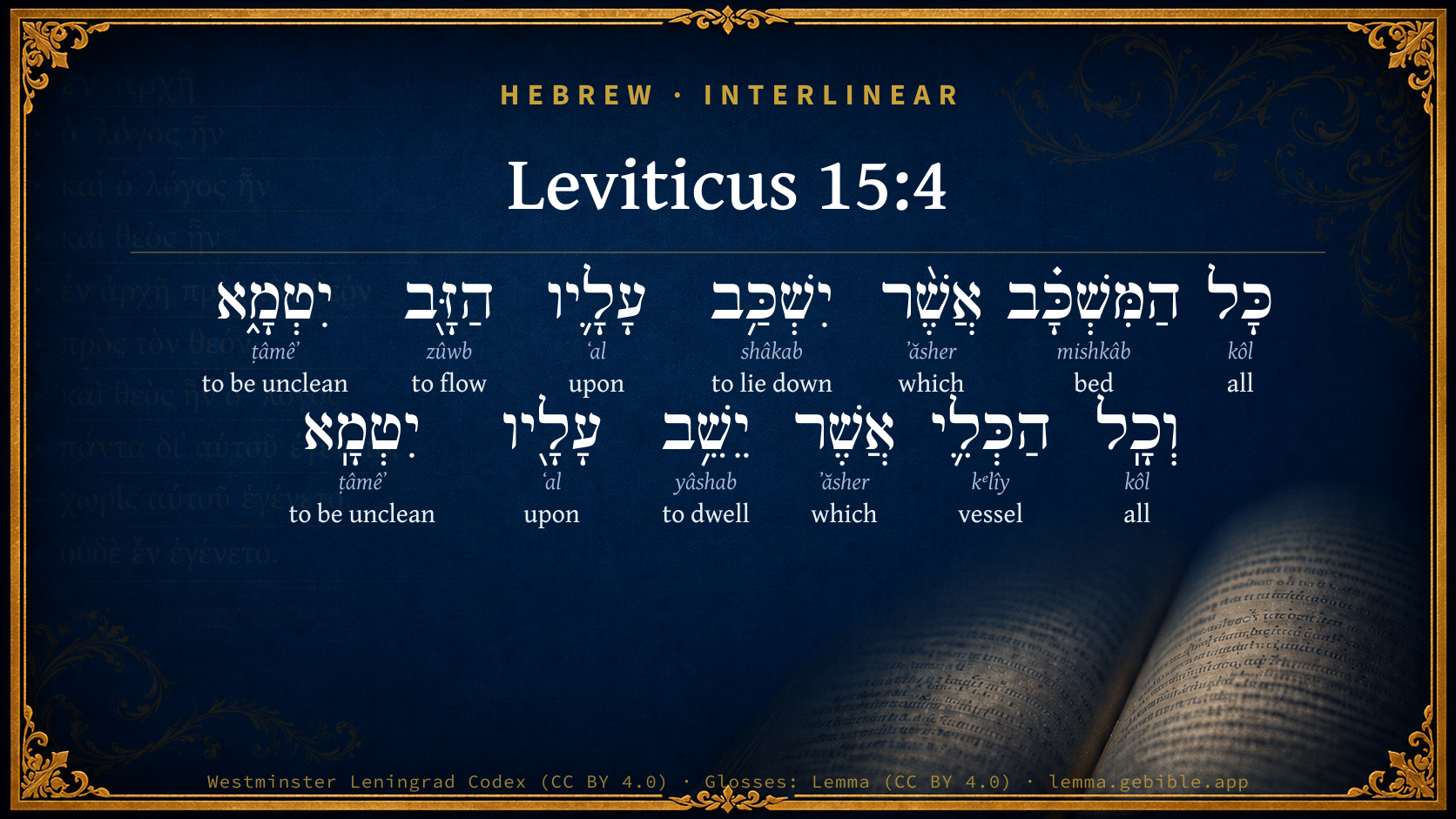
Hebrew (Westminster Leningrad Codex) Leviticus 15:4 appears in the Hebrew Old Testament. The text above is from the Westminster Leningrad Codex. Each word links to its Strong’s number, a concise gloss, and parsing drawn from the Open Scriptures Hebrew Bible morphology. Click any word for its full Brown-Driver-Briggs (BDB) entry.
Download image
Cite this verse

Leviticus 15:4 (World English Bible). Public Domain. Lemma interlinear Bible study tool, https://lemma.gebible.app/v/leviticus/15/4.

Show BibTeX & RIS
BibTeX
RIS
English Translation
"'Every bed whereon he who has the discharge lies shall be unclean; and everything he sits on shall be unclean.
World English Bible · Public Domain
Download a study sheet

One document with this verse’s original text, its word-by-word gloss line, the meaning frame, cross-references with their text, attributed commentary, and full source and license credits — printable, and it pastes into notes with its structure intact.

This verse Autodidact and up

Study sheet (.html) Plain text (.txt)

A passage Seminary Student

Up to 50 verses in one chapter. A passage sheet keeps up to 6 commentary sources and 12 cross-references per verse, in the order this page ranks them, and says so on the sheet whenever that leaves anything out. Ask for a single verse and you get the Autodidact verse sheet above.

Everything on this page stays free to read, with no account — the sheet is a download of what is already on screen, not access to it.

Want to remove ads? Support Godless Engineer
Compare translations 3

The same verse in 3 English versions, stacked beneath the original-language interlinear above. Click any original word for its lexicon entry.

Each is an independent rendering of the whole verse — the interlinear is not word-aligned to these translations.

Highlighted words mark where these versions differ — a whole-verse word diff, not a word-by-word alignment.

  • World English Bible Public Domain
    "'Every bed whereon he who has the discharge lies shall be unclean; and everything he sits on shall be unclean.
  • King James Version Public Domain
    Every bed, whereon he lieth that hath the issue, is unclean: and every thing, whereon he sitteth, shall be unclean.
  • unfoldingWord Literal Text CC BY-SA 4.0
    Any bed on which the flowing lies shall be unclean, and any furniture on which he sits shall be unclean.

unfoldingWord Literal Text — © unfoldingWord, licensed CC BY-SA 4.0. Word-aligned USFM3 via Door43 (git.door43.org/unfoldingWord/en_ult).

Versions to compare (up to 4)

3 of 4 selected

Show all 18 translations

Every available English version of this verse, each an independent rendering of the whole verse.

  • World English Bible Public Domain
    "'Every bed whereon he who has the discharge lies shall be unclean; and everything he sits on shall be unclean.
  • Berean Standard Bible Public Domain
    Any bed on which the man with the discharge lies will be unclean, and any furniture on which he sits will be unclean.
  • Majority Standard Bible Public Domain
    Any bed on which the man with the discharge lies will be unclean, and any furniture on which he sits will be unclean.
  • King James Version Public Domain
    Every bed, whereon he lieth that hath the issue, is unclean: and every thing, whereon he sitteth, shall be unclean.
  • American Standard Version (1901) Public Domain
    Every bed whereon he that hath the issue lieth shall be unclean; and everything whereon he sitteth shall be unclean.
  • Revised Version (1885) Public Domain
    Every bed whereon he that hath the issue lieth shall be unclean: and every thing whereon he sitteth shall be unclean.
  • Geneva Bible (1599) Public Domain
    Euery bed whereon he lyeth that hath the issue, shall be vncleane, and euery thing whereon he sitteth, shalbe vncleane.
  • Douay-Rheims (1899) Public Domain
    Every bed on which he sleepeth, shall be unclean, and every place on which he sitteth.
  • Young's Literal Translation Public Domain
    `All the bed on which he lieth who hath the issue is unclean, and all the vessel on which he sitteth is unclean;
  • Literal Standard Version CC BY-SA 4.0
    Every bed on which he who has the discharging lies is unclean, and every vessel on which he sits is unclean;
  • Unlocked Literal Bible CC BY-SA 4.0
    Every bed on which he lies will be unclean, and everything on which he sits will be unclean.
  • unfoldingWord Literal Text CC BY-SA 4.0
    Any bed on which the flowing lies shall be unclean, and any furniture on which he sits shall be unclean.
  • Darby Bible Public Domain
    Every bed whereon he lieth that hath the flux shall be unclean; and every object on which he sitteth shall be unclean.
  • World Messianic Bible Public Domain
    “‘Every bed on which he who has the discharge lies shall be unclean; and everything he sits on shall be unclean.
  • Webster's Bible Public Domain
    Every bed on which he lieth that hath the issue, is unclean: and every thing on which he sitteth, shall be unclean.
  • Free Bible Version CC BY-SA 4.0
    Any bed the man with the discharge lies on will be unclean, and anything he sits on will be unclean.
  • Bible in Basic English Public Domain
    Every bed on which he has been resting will be unclean, and everything on which he has been seated will be unclean.
  • JPS Tanakh (1917) Public Domain
    Every bed whereon he that hath the issue lieth shall be unclean; and every thing whereon he sitteth shall be unclean.

Literal Standard Version (2020), Covenant Press — licensed CC BY-SA 4.0. Text via the HelloAO Bible API (eBible.org). Unlocked Literal Bible (unfoldingWord) — licensed CC BY-SA 4.0. Text via the HelloAO Bible API (eBible.org). unfoldingWord Literal Text — © unfoldingWord, licensed CC BY-SA 4.0. Word-aligned USFM3 via Door43 (git.door43.org/unfoldingWord/en_ult). Free Bible Version, Dr. Jonathan Gallagher — licensed CC BY-SA 4.0. Text via the HelloAO Bible API (eBible.org).

Word by word

More ways to search: Search by grammar → Find every occurrence → Compare this word →

Practice this passage: Drill this verse → Learn its vocabulary →

הַזָּ֖ב
zûwb
H2100
“the · flowing”
Particle, Definite Article + Verb, Qal, Participle Active, Masculine, Singular, Absolute
Part of Speech
Particle + Verb
Stem
Qal
Form
Participle Active
Gender
Masculine
Number
Singular
State
Absolute
Full BDB Definition

Origin: a primitive root

TWOT: 534

to flow, gush, issue, discharge - (Qal) - to flow, gush - to die, pine away (figuratively) - to flow (of issue from woman), have an issue, flux - flowing (participle)
  1. כָּל kôl H3605 “all of” Noun, Common, Masculine, Singular, Construct
  2. הַמִּשְׁכָּ֗ב mishkâb H4904 “the · bed” Particle, Definite Article + Noun, Common, Masculine, Singular, Absolute
  3. אֲשֶׁ֨ר ʼăsher H834 “which” Particle, Relative
  4. יִשְׁכַּ֥ב shâkab H7901 “to lie down” Verb, Qal, Imperfect, 3rd Person, Masculine, Singular
  5. עָלָ֛יו ʻal H5921 “upon · him” Preposition + Suffix, Personal, 3rd Person, Masculine, Singular
  6. יִטְמָ֑א ṭâmêʼ H2930 “to be unclean” Verb, Qal, Imperfect, 3rd Person, Masculine, Singular
  7. וְכָֽל kôl H3605 “and · all of” Conjunction + Noun, Common, Masculine, Singular, Construct
  8. הַכְּלִ֛י kᵉlîy H3627 “the · vessel” Particle, Definite Article + Noun, Common, Masculine, Singular, Absolute
  9. אֲשֶׁר ʼăsher H834 “which” Particle, Relative
  10. יֵשֵׁ֥ב yâshab H3427 “to dwell” Verb, Qal, Imperfect, 3rd Person, Masculine, Singular
  11. עָלָ֖יו ʻal H5921 “upon · him” Preposition + Suffix, Personal, 3rd Person, Masculine, Singular
  12. יִטְמָֽא ṭâmêʼ H2930 “to be unclean” Verb, Qal, Imperfect, 3rd Person, Masculine, Singular

About this verse

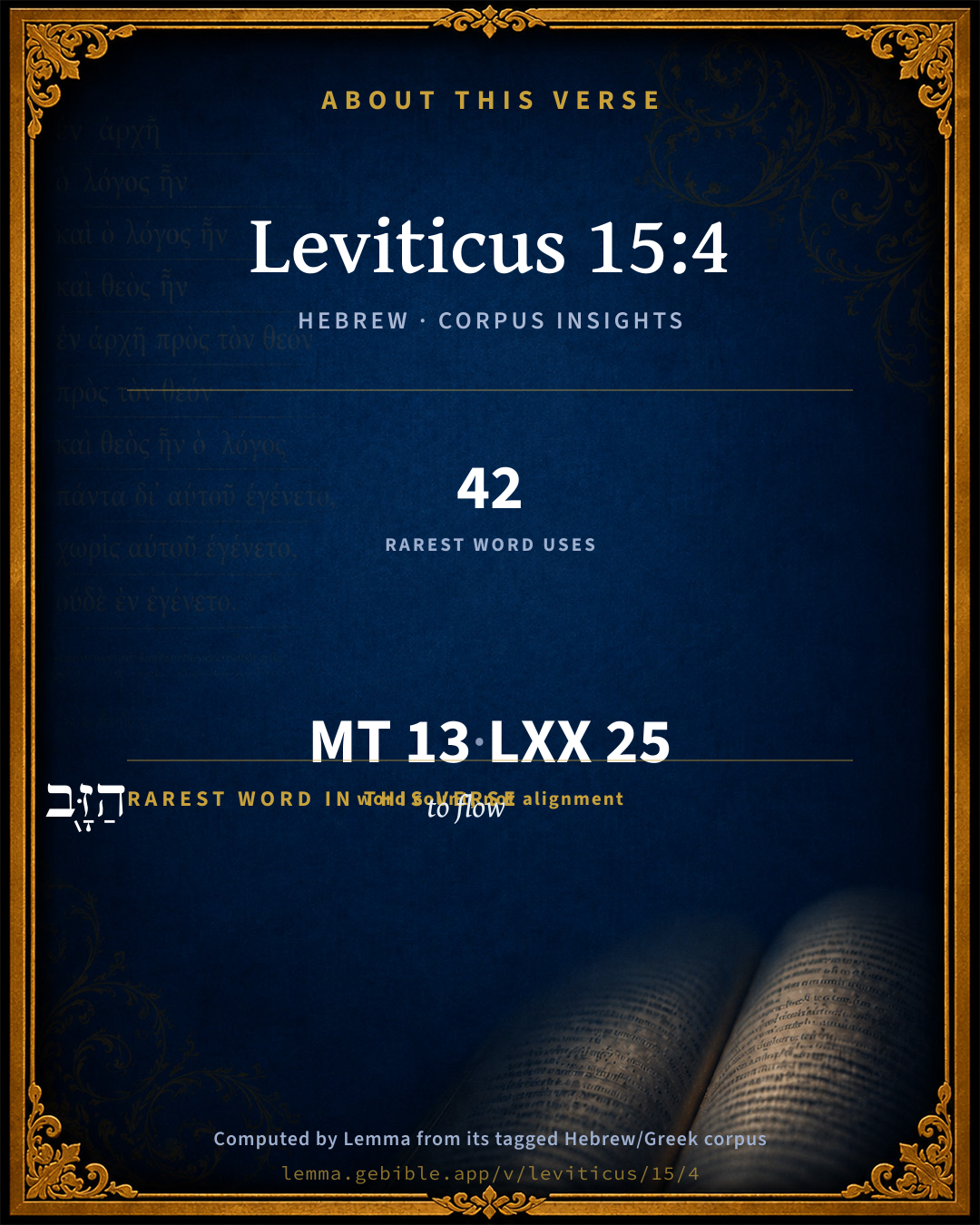
These counts appear in no published source. They are computed here, from the morphology-tagged text and Lemma’s own curated glosses. What Lemma adds →

13
words
9
distinct lemmas
Pentateuch
section

Shared distinctive vocabulary

הַזָּ֖ב to flow H2100 occurs in 41 verses of the Hebrew Bible. Also found in:

Grammatical profile

  • 5 verbs
  • 4 nouns
  • 2 prepositions
  • 2 particles

Verb forms

  • יִשְׁכַּ֥ב Qal · Imperfect
  • הַזָּ֖ב Qal · Participle Active
  • יִטְמָ֑א Qal · Imperfect
  • יֵשֵׁ֥ב Qal · Imperfect
  • יִטְמָֽא Qal · Imperfect

Repetition

Words recur within this verse — often emphatic in Hebrew:

  • כָּל all H3605 ×2
  • עָלָ֛יו upon H5921 ×2
  • יִטְמָ֑א to be unclean H2930 ×2
  • אֲשֶׁ֨ר which H834 ×2

Hebrew & Septuagint length

In English translation the verse runs 20 words from the Hebrew and 32 from the Septuagint (LXX English) — the Septuagint runs noticeably longer here. See the side-by-side →

A rough comparison of the two English renderings, which tokenize alike — not a word-level alignment.

Word counts can differ between the Hebrew and the Greek without any difference in meaning — e.g. the Hebrew direct-object marker אֵת has no separate Greek word, and Greek often adds the article ὁ.

In the original languages it is 13 Hebrew tokens and 25 Greek tokens — but the two are counted differently (Hebrew bundles its prefixes and suffixes into one token; the Greek is in lemma form), so that isn’t a like-for-like length.

Cross-references

3

Topical passages linked to Leviticus 15:4 in the Treasury of Scripture Knowledge — connected by theme and wording, ordered by reader-vote popularity; previews shown in the World English Bible.

  • 1 Corinthians 15:33 Don't be deceived! "Evil companionships corrupt good morals."
  • Ephesians 5:11 Have no fellowship with the unfruitful works of darkness, but rather even reprove them.
  • Titus 1:15 To the pure, all things are pure; but to those who are defiled and unbelieving, nothing is pure; but both their mind and their conscience are defiled.

Cross-references courtesy of OpenBible.info (CC BY 4.0).

Hebrew and Greek witnesses Masoretic Hebrew ↔ Greek Septuagint

The same verse in the two great witnesses to the Old Testament, shown verse-for-verse.

Here the Septuagint runs noticeably longer than the Hebrew — LXX2012 (modern English Septuagint) 32 words vs World English Bible 20. A rough length comparison of the two English translations, not a word-level alignment — read both below.

These are two independent witnesses, not word-aligned to each other, and the Septuagint is shown in lemma (dictionary) form.

Hebrew Leviticus 15:4 Masoretic · Westminster Leningrad Codex

כָּל הַמִּשְׁכָּ֗ב אֲשֶׁ֨ר יִשְׁכַּ֥ב עָלָ֛יו הַזָּ֖ב יִטְמָ֑א וְכָֽל הַכְּלִ֛י אֲשֶׁר יֵשֵׁ֥ב עָלָ֖יו יִטְמָֽא

"'Every bed whereon he who has the discharge lies shall be unclean; and everything he sits on shall be unclean.

World English Bible · Public Domain

Greek LXX Leviticus 15:4 Septuagint · lemma form

πᾶς κοίτη ἐπί ὅς ἐάν κοιμάω ἐπί αὐτός ὁ γονορρυής ἀκάθαρτος εἰμί καί πᾶς σκεῦος ἐπί ὅς ἐάν καταἵζω ἐπί αὐτός ὁ γονορρυής ἀκάθαρτος εἰμί

Every bed on which he that has the issue shall happen to lie, is unclean; and every seat on which he that has the issue may happen to sit, shall be unclean.

LXX2012 (modern English Septuagint) · Public Domain

Hebrew: Westminster Leningrad Codex (CC BY 4.0). Greek: Septuagint (public domain); English from LXX2012 (modern English Septuagint) (Public Domain). How the Septuagint differs from the Hebrew →

Targum (Aramaic paraphrase)

2

The Targum is the ancient Jewish Aramaic paraphrase of the Hebrew Scriptures — an interpretive translation, not the Hebrew text itself. Onkelos (literal) and Pseudo-Jonathan (expansive) render the Torah, and Jonathan the Prophets. Coverage is partial: where no permissively-licensed English translation exists for a verse, only the Aramaic is shown. This is verse-level text, not a word-by-word alignment to the Hebrew.

  1. Targum Onkelos Torah (Genesis–Deuteronomy)
    כָּל מִשְׁכְּבָא דִי יִשְׁכּוּב עֲלוֹהִי דוֹבָנָא יְהֵי מְסָאָב וְכָל מָנָא דְיֵיתֵב עֲלוֹהִי יהֵי מְסָאָב

    (no public-domain English translation for this verse)

    Targum Onkelos — Aramaic: “Onkelos Genesis” (public domain); “Onkelos Exodus” (public domain); “Onkelos Leviticus” (public domain); “Onkelos Numbers” (public domain); “Onkelos Deuteronomy” (public domain). English: “Sefaria Community Translation” (CC0 1.0 (public-domain dedication)); “J.W. Etheridge. The Targums of Onkelos and Jonathan Ben Uzziel on the Pentateuch. London: Longmans, Green, 1862” (public domain). Text via Sefaria.

  2. Targum Pseudo-Jonathan Torah (Genesis–Deuteronomy)
    כָּל מַשְׁכְּבָא דִמְיַחֵד לִמִישְׁכּוֹב עֲלוֹי דוֹבָנָא יְהֵי מְסָאָב וְכָל מָנָא דִמְיַיחֵד לְמֵיתַב עֲלוֹי יְהֵי מְסָאָב

    Every bed on which one who hath such defluxion lieth shall be unclean; and every thing on which such an one sitteth shall be unclean.

    Targum Pseudo-Jonathan — Aramaic: “Targum Jonathan on Genesis” (public domain); “Targum Jonathan on Exodus” (public domain); “Targum Jonathan on Leviticus” (public domain); “Targum Jonathan on Numbers” (public domain); “Targum Jonathan on Deuteronomy” (public domain). English: “The Targum of Jonathan ben Uzziel, trans. J. W. Etheridge, London, 1862” (public domain). Text via Sefaria.

Commentary

Notes on Leviticus 15:4 from classic Christian and Jewish commentators (each source and its license shown beneath its notes). The classic Christian expositions comment on the surrounding passage and are grouped to its opening verse, so a note may address several verses; the Jewish commentaries on the Tanakh (Rashi and others) are per-verse, so they appear only where the commentator wrote on this verse.

Lemma curates 59 commentaries, every one of them public domain or Creative Commons licensed, each selected and text-cleaned for this edition rather than reprinted as found. About our sources →

Trapp's Complete Commentary

John Trapp

Lev 15:4 Every bed, whereon he lieth that hath the issue, is unclean: and every thing, whereon he sitteth, shall be unclean.

Ver. 4. Every bed.] Sin is more catching than any plague, and more defiling than any out house; {Mar 7:23} Paul found it as noisome to his soul as a dead body to his sense, {Rom 7:24} or as the sanies; {a} of a plague sore to a rich robe. Job abhors himself for it in dust and ashes. {Job 40:4} And Isaiah looks upon himself as an undone man by reason of it. {Isa 6:5}

{a} A thin fetid pus mixed with serum or blood, secreted by a wound or ulcer.

John Trapp, A Commentary or Exposition upon All the Books of the Old and New Testament (1647–1656) — public domain. Text from a community e-Sword module.

Joseph Benson's Commentary

Lev 15:4. Every bed whereon he lieth, &c. — Thus, such persons were cut off from all communications with mankind, and were shunned and avoided by every one, as an abomination. And this could not but tend to render them all extremely careful not to bring upon themselves so loathsome a disease.

Joseph Benson's Commentary on the Old and New Testaments (1811–1818) — public domain. Text from a community e-Sword module.

Ellicott's Commentary for English Readers

(4) Every bed, whereon he lieth.—So severely did the canonical law deal with these cases that they interpreted the defilement communicated to the bed, and hence also to his seat and saddle, by the patient in five different ways: by standing, sitting, lying, hanging, or leaning on it. The patient’s polluting power is so great that even if the bed, seat, or saddle is under a stone, he defiles it through the stone by any of these actions. If he stood upon two beds, placing one foot upon each, he defiled both.

A Bible Commentary for English Readers, edited by Charles John Ellicott (1878–1897) — public domain. Text from a community e-Sword module.

John Gill's Exposition

Every bed whereon he lieth that hath the issue is unclean,.... Which he constantly makes use of; so the Targum of Jonathan, which is peculiar to him, and appointed and appropriated for him to lie upon. Jarchi says, every bed that is fit to lie upon, thou is appropriated to another service; but, he adds meaning is, which he shall lie upon (or continue to lie upon); for it is not said, which he hath laid upon, but which he lieth upon, and is used by him continually; according to the Misnah (u), a man that has an issue defiles a bed five ways, so as to defile a man, and to defile garments; standing, sitting, lying, hanging, and leaning:

and everything whereon he sitteth shall be unclean; which is appropriated to sit upon; and so the Targum, as before, what is his proper peculiar seat, what he is used to sit upon, and is fit for that purpose: and it is observed by some Jewish writers (w) that a vessel that is not fit to sit upon is excluded, as if a man was to turn up a bushel, or any other measure, to sit upon it; see Tit 1:15.

(u) Zabim, c. 2. sect. 4. (w) Maimon. & Bartenora in Misn. Niddah, c. 6. sect. 3.

John Gill's Exposition of the Whole Bible (1746–1763) — public domain (CC PDM 1.0). Text via the HelloAO Bible API.

Matthew Poole's English Annotations

Every thing, Heb. vessel, by which the Hebrews understand all sorts of household stuff.

Matthew Poole's English Annotations on the Holy Bible (1683–1685) — public domain. Text from a community e-Sword/MySword module.

Whedon's Commentary on the Bible

Daniel D. Whedon

4. Every bed — The inconveniences of ceremonial impurity are strikingly set forth in this and the following verses. The only posture in which the man did not communicate ceremonial impurity was standing without touching any vessel or utensil. The obstruction to social intercourse, business, and trade must have exceeded one’s conception. The man, while under this disability, could neither sit nor lie down without spreading impurity; nor could he eat or drink without defiling the vessel which he touched; while the grasp of friendship polluted the person of his friend and incapacitated him for the public offices of religion and for communion with his kindred until he had washed his clothes and bathed himself, and waited for the friendly shades of evening to emancipate him from ceremonial bondage. Till his purification he was to be excluded from the camp. Num_5:2. In contrast with this burdensome ritual Christianity is appropriately called “the law of liberty.”

Daniel D. Whedon (gen. ed.), Commentary on the Old and New Testaments (1874–1909) — public domain. Text from a community e-Sword module.

Keil & Delitzsch

C. F. Keil & F. Delitzsch

Every bed upon which he lay, and everything upon which he sat, was defiled in consequence; also every one who touched his bed (Lev 15:5), or sat upon it (Lev 15:6), or touched his flesh, i.e., his body (Lev 15:7), was unclean, and had to bathe himself and wash his clothes in consequence.

Keil & Delitzsch — Biblical Commentary on the Old Testament (1861–1891) — public domain (CC PDM 1.0). Text via the HelloAO Bible API. (Old Testament only.)

unfoldingWord translationNotes

Door43 World Missions Community

unclean

The bed or anything that the man sits on that other people must not touch are spoken of as if they were physically unclean. (See: Metaphor)

Whoever touches his bed ... be unclean

The person whom other people may not touch is spoken of as if he were physically unclean. (See: Metaphor)

until evening

"until sunset"

translationWords

clean

unfoldingWord translationNotes — © Distant Shores Media and the Door43 World Missions Community, licensed CC BY-SA 4.0. Source: git.door43.org/Door43/en_tn.

Rashi

Rabbi Shlomo Yitzchaki (Rashi)

כל המשכב EVERY PLACE OF REPOSE — This means: everything that is fitted for sleeping on (thus excluding a door or plank etc.). One might, however, think that it includes anything intended for some other action also, as long as it can be used for sleeping and he actually slept upon it! It, however, states אשר ישכב — it does not state אשר שכב, “upon which one has slept" but אשר ישכב, “upon which one sleeps usually" — i.e. that which is intended to be used for this always, thus excluding that of which people can say to him, “Get up and let us to our work [with that upon which you are lying]" (Sifra, Metzora Parashat Zavim, Chapter 1 1-3).

אשר ישב [EVERYTHING] WHEREON HE SITTETH — It is not said here ‎יָשַׁב ‎‏ אשר, "on which he has sat", but אשר יֵשֵׁב, “on which one sits usually" — it speaks therefore of something that is intended to be used for this always (Sifra, Metzora Parashat Zavim, Chapter 1 3; Shabbat 59a).

Rashi on the Tanakh — English translations: “The Judaica Press complete Tanach with Rashi, translated by A. J. Rosenberg” (CC BY 4.0); “Pentateuch with Rashi's commentary by M. Rosenbaum and A.M. Silbermann, 1929-1934” (public domain); “The Metsudah Tanach series, Lakewood, N.J” (CC BY 4.0); and “The Book of Joshua, Metsudah Publications, 1997” (CC BY 4.0). Text via Sefaria.

Lesson kit

Teaching starters — assembled from the data on this page, not authored interpretation. Every prompt links to the verse data it draws on. Edit before teaching.

Leviticus, in the Pentateuch, opens this verse with 13 words (9 distinct Hebrew lemmas). Its most distinctive word is zûwb (“to flow”). The Greek Septuagint runs longer here. A historical commentator’s framing appears above. Read the whole chapter for the surrounding context.

Discussion questions

  1. The word zûwb carries the sense “to flow.” How does it shape the verse?
  2. Exodus 3:8 shares the word «to flow» with this verse. How do the two illuminate each other?
  3. “all” occurs 2× in this one verse. What is the effect of the repetition?
  4. Compared with the Hebrew, the Septuagint runs longer here. What questions does that raise?
  5. The translations on this page render this verse differently — a whole-verse word diff, not a word-by-word alignment. What might account for the different wordings?
  6. The verb «יִשְׁכַּ֥ב» is Qal Imperfect. How does its form color the action?
  7. Reading how Trapp's Complete Commentary and Joseph Benson's Commentary read this verse, where do the two commentators agree and where do they part?

Things to notice

Reading settings

Reading text

Shown beneath each verse's original-language words.

Old Testament
Old Testament edition

Read the OT as the Masoretic Hebrew (MT) or the Greek Septuagint (LXX).

English shown for the Greek Septuagint (in the Hebrew ↔ Greek comparison).

Comparing translations? Open the Compare panel on any verse page to stack up to four side by side.