
Psalms 31:12

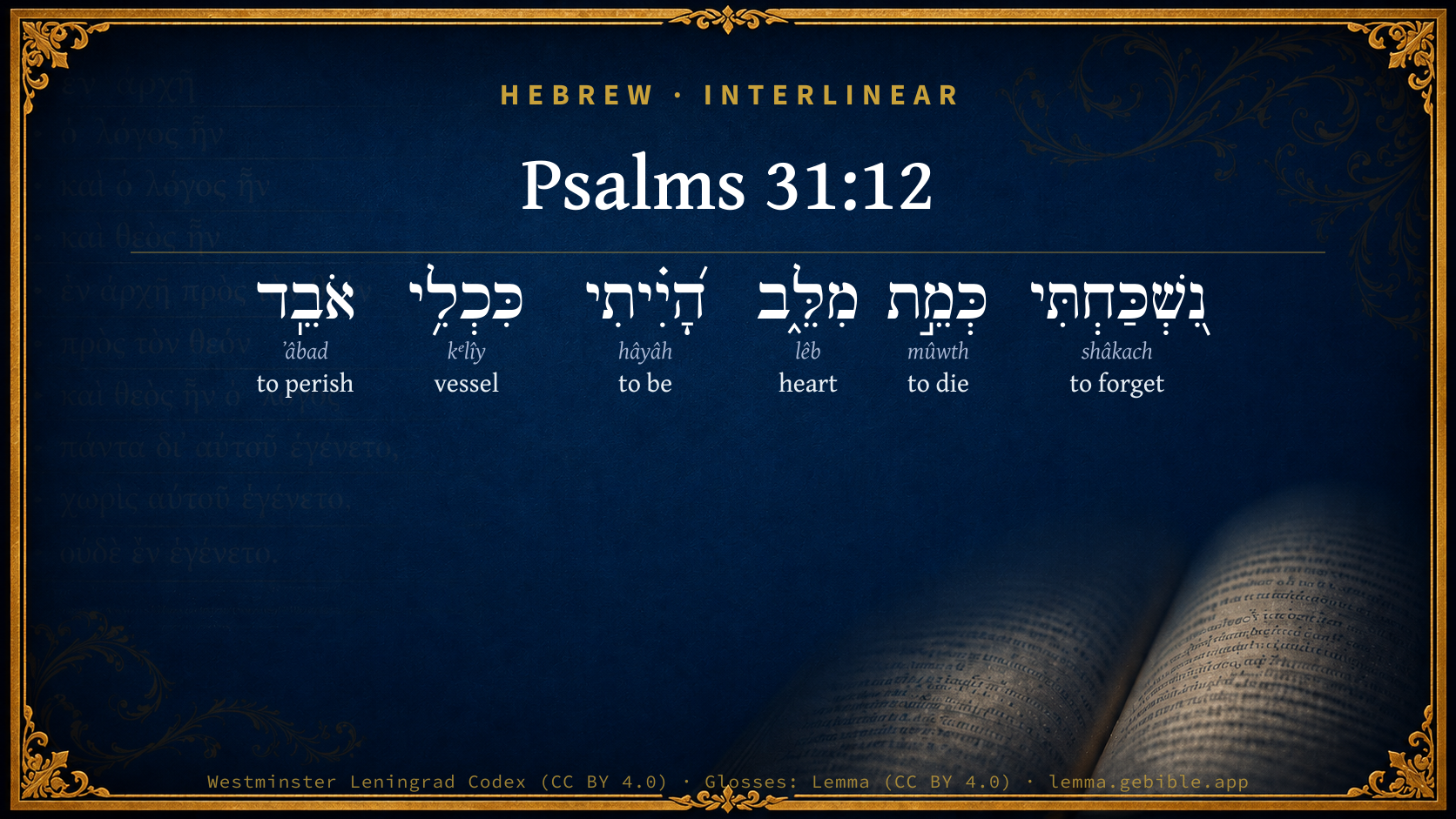
Hebrew (Westminster Leningrad Codex) Psalms 31:12 appears in the Hebrew Old Testament. The text above is from the Westminster Leningrad Codex. Each word links to its Strong’s number, a concise gloss, and parsing drawn from the Open Scriptures Hebrew Bible morphology. Click any word for its full Brown-Driver-Briggs (BDB) entry.
Download image
Cite this verse

Psalms 31:12 (World English Bible). Public Domain. Lemma interlinear Bible study tool, https://lemma.gebible.app/v/psalms/31/12.

Show BibTeX & RIS
BibTeX
RIS
English Translation
I am forgotten from their hearts like a dead man. I am like broken pottery.
World English Bible · Public Domain
Download a study sheet

One document with this verse’s original text, its word-by-word gloss line, the meaning frame, cross-references with their text, attributed commentary, and full source and license credits — printable, and it pastes into notes with its structure intact.

This verse Autodidact and up

Study sheet (.html) Plain text (.txt)

A passage Seminary Student

Up to 50 verses in one chapter. A passage sheet keeps up to 6 commentary sources and 12 cross-references per verse, in the order this page ranks them, and says so on the sheet whenever that leaves anything out. Ask for a single verse and you get the Autodidact verse sheet above.

Everything on this page stays free to read, with no account — the sheet is a download of what is already on screen, not access to it.

Want to remove ads? Support Godless Engineer
Compare translations 3

The same verse in 3 English versions, stacked beneath the original-language interlinear above. Click any original word for its lexicon entry.

Each is an independent rendering of the whole verse — the interlinear is not word-aligned to these translations.

Highlighted words mark where these versions differ — a whole-verse word diff, not a word-by-word alignment.

  • World English Bible Public Domain
    I am forgotten from their hearts like a dead man. I am like broken pottery.
  • King James Version Public Domain
    I am forgotten as a dead man out of mind: I am like a broken vessel.
  • unfoldingWord Literal Text CC BY-SA 4.0
    I have been forgotten like a dead man out of mind; I am like a broken vessel.

unfoldingWord Literal Text — © unfoldingWord, licensed CC BY-SA 4.0. Word-aligned USFM3 via Door43 (git.door43.org/unfoldingWord/en_ult).

Versions to compare (up to 4)

3 of 4 selected

Show all 18 translations

Every available English version of this verse, each an independent rendering of the whole verse.

  • World English Bible Public Domain
    I am forgotten from their hearts like a dead man. I am like broken pottery.
  • Berean Standard Bible Public Domain
    I am forgotten like a dead man, out of mind. I am like a broken vessel.
  • Majority Standard Bible Public Domain
    I am forgotten like a dead man, out of mind. I am like a broken vessel.
  • King James Version Public Domain
    I am forgotten as a dead man out of mind: I am like a broken vessel.
  • American Standard Version (1901) Public Domain
    I am forgotten as a dead man out of mind: I am like a broken vessel.
  • Revised Version (1885) Public Domain
    I am forgotten as a dead man out of mind: I am like a broken vessel.
  • Geneva Bible (1599) Public Domain
    I am forgotten, as a dead man out of minde: I am like a broken vessell.
  • Douay-Rheims (1899) Public Domain
    I am become a reproach among all my enemies, and very much to my neighbours; and a fear to my acquaintance. They that saw me without fled from me.
  • Young's Literal Translation Public Domain
    I have been forgotten as dead out of mind, I have been as a perishing vessel.
  • Literal Standard Version CC BY-SA 4.0
    I have been forgotten as dead, out of mind, || I have been as a perishing vessel.
  • Unlocked Literal Bible CC BY-SA 4.0
    I am forgotten as a dead man whom no one thinks about. I am like a broken pot.
  • unfoldingWord Literal Text CC BY-SA 4.0
    I have been forgotten like a dead man out of mind; I am like a broken vessel.
  • Darby Bible Public Domain
    I am forgotten in [their] heart as a dead man; I am become like a broken vessel.
  • World Messianic Bible Public Domain
    I am forgotten from their hearts like a dead man. I am like broken pottery.
  • Webster's Bible Public Domain
    \\31:11\\I was a reproach among all my enemies, but especially among my neighbors, and a fear to my acquaintance: they that saw me without fled from me.
  • Free Bible Version CC BY-SA 4.0
    I have been forgotten as if I were dead; I'm ignored like a broken pot.
  • Bible in Basic English Public Domain
    I have gone from men's minds and memory like a dead man; I am like a broken vessel.
  • JPS Tanakh (1917) Public Domain
    (31-13) I am forgotten as a dead man out of mind; I am like a useless vessel.

Literal Standard Version (2020), Covenant Press — licensed CC BY-SA 4.0. Text via the HelloAO Bible API (eBible.org). Unlocked Literal Bible (unfoldingWord) — licensed CC BY-SA 4.0. Text via the HelloAO Bible API (eBible.org). unfoldingWord Literal Text — © unfoldingWord, licensed CC BY-SA 4.0. Word-aligned USFM3 via Door43 (git.door43.org/unfoldingWord/en_ult). Free Bible Version, Dr. Jonathan Gallagher — licensed CC BY-SA 4.0. Text via the HelloAO Bible API (eBible.org).

Word by word

More ways to search: Search by grammar → Find every occurrence → Compare this word →

Practice this passage: Drill this verse → Learn its vocabulary →

About this verse

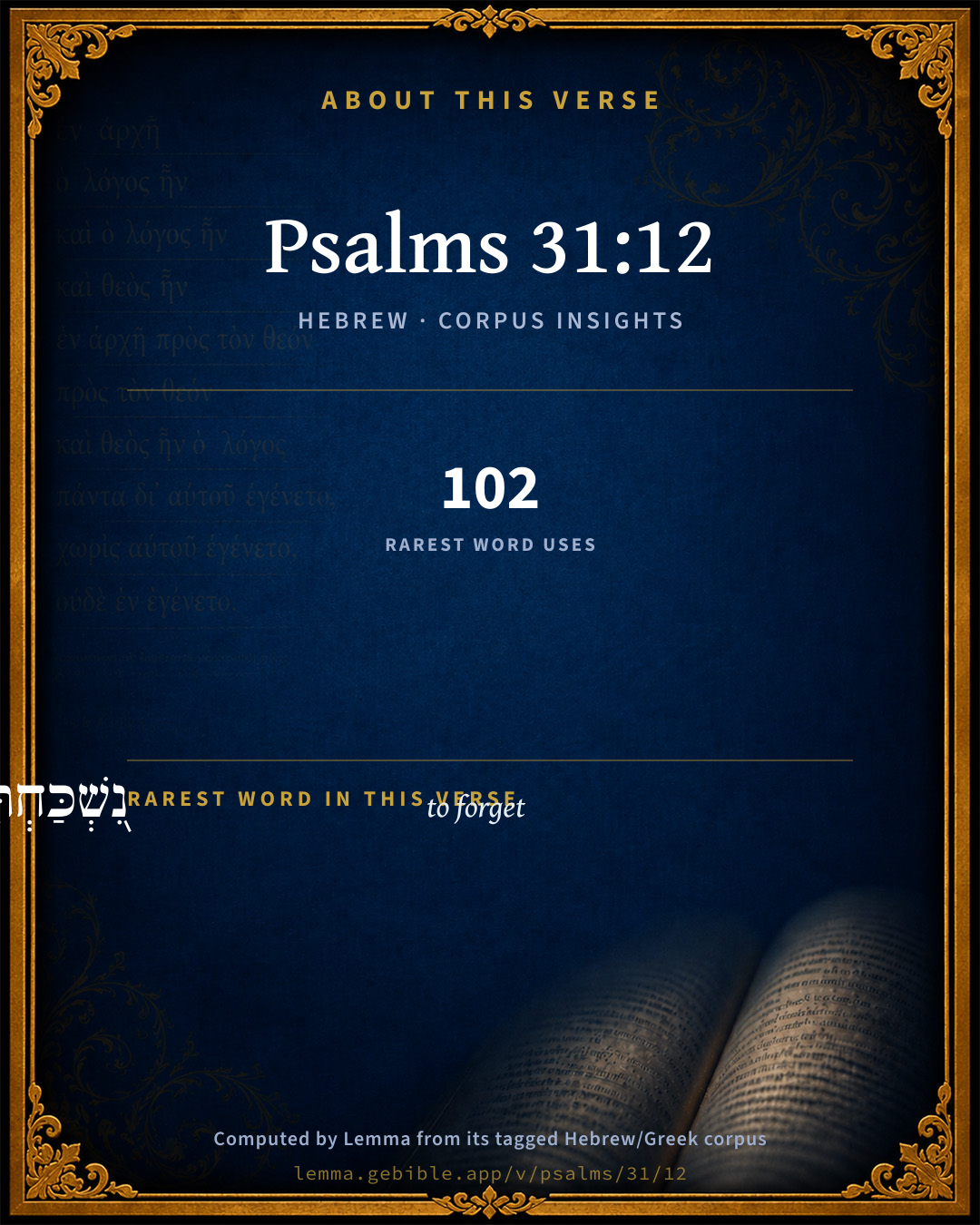
These counts appear in no published source. They are computed here, from the morphology-tagged text and Lemma’s own curated glosses. What Lemma adds →

6
words
6
distinct lemmas
Wisdom
section

Grammatical profile

  • 4 verbs
  • 2 nouns

Verb forms

  • נִ֭שְׁכַּחְתִּי Niphal · Perfect
  • כְּמֵ֣ת Qal · Participle Active
  • הָ֝יִ֗יתִי Qal · Perfect
  • אֹבֵֽד Qal · Participle Active

Hebrew & Septuagint length

In English translation the verse runs 15 words from the Hebrew and 18 from the Septuagint (LXX English) — closely comparable.

A rough comparison of the two English renderings, which tokenize alike — not a word-level alignment.

Word counts can differ between the Hebrew and the Greek without any difference in meaning — e.g. the Hebrew direct-object marker אֵת has no separate Greek word, and Greek often adds the article ὁ.

Cross-references

7

Topical passages linked to Psalms 31:12 in the Treasury of Scripture Knowledge — connected by theme and wording, ordered by reader-vote popularity; previews shown in the World English Bible.

  • Psalms 88:4–5 I am counted among those who go down into the pit. I am like a man who has no help,
  • Psalms 2:9 You shall break them with a rod of iron. You shall dash them in pieces like a potter's vessel."
  • Psalms 119:83 For I have become like a wineskin in the smoke. I don't forget your statutes.
  • Isaiah 30:14 He shall break it as a potter's vessel is broken, breaking it in pieces without sparing; so that there shall not be found among the pieces of it a broken piece with which to take fire from the hearth, or to dip up water out of the cistern."
  • Romans 9:21–22 Or hasn't the potter a right over the clay, from the same lump to make one part a vessel for honor, and another for dishonor?
  • Isaiah 38:11–12 I said, I shall not see Yah, Yah in the land of the living: I shall see man no more with the inhabitants of the world.
  • Revelation 2:27 He will rule them with a rod of iron, shattering them like clay pots; as I also have received of my Father:

Cross-references courtesy of OpenBible.info (CC BY 4.0).

Hebrew and Greek witnesses Masoretic Hebrew ↔ Greek Septuagint

The same verse in the two great witnesses to the Old Testament, shown verse-for-verse.

You’re reading Greek Psalm 30 (Hebrew Psalm 31). The Septuagint counts the superscription, so verse numbers can differ from the Hebrew — chapter-level alignment, not verse-by-verse. Numbering follows Rahlfs.

These are two independent witnesses, not word-aligned to each other, and the Septuagint is shown in lemma (dictionary) form.

Hebrew Psalms 31:12 Masoretic · Westminster Leningrad Codex

נִ֭שְׁכַּחְתִּי כְּמֵ֣ת מִלֵּ֑ב הָ֝יִ֗יתִי כִּכְלִ֥י אֹבֵֽד

I am forgotten from their hearts like a dead man. I am like broken pottery.

World English Bible · Public Domain

Greek LXX Greek Psalm 30:12 Septuagint · lemma form

παρά πᾶς ὁ ἐχθρός ἐγώ γίγνομαι ὄνειδος καί ὁ γείτων ἐγώ σφόδρα καί φόβος ὁ γνωστός ἐγώ ὁ θεωρέω ἐγώ ἔξω φεύγω ἀπό ἐγώ

I have been forgotten as a dead man out of mind: I am become as a broken vessel.

LXX2012 (modern English Septuagint) · Public Domain

On this verse, John Gill's Exposition discusses the Septuagint’s reading. Read the note in Commentary ↓

Hebrew: Westminster Leningrad Codex (CC BY 4.0). Greek: Septuagint (public domain); English from LXX2012 (modern English Septuagint) (Public Domain). How the Septuagint differs from the Hebrew →

Commentary

Notes on Psalms 31:12 from classic Christian and Jewish commentators (each source and its license shown beneath its notes). The classic Christian expositions comment on the surrounding passage and are grouped to its opening verse, so a note may address several verses; the Jewish commentaries on the Tanakh (Rashi and others) are per-verse, so they appear only where the commentator wrote on this verse.

Lemma curates 59 commentaries, every one of them public domain or Creative Commons licensed, each selected and text-cleaned for this edition rather than reprinted as found. About our sources →

Trapp's Complete Commentary

John Trapp

Psa 31:12 I am forgotten as a dead man out of mind: I am like a broken vessel.

Ver. 12. I am forgotten as a dead man out of mind] How soon dead men are forgotten, even by those that promise to remember them longest of all, experience teacheth; trust not to protestations of best friends in that case.

I am like a broken vessel] Of which there is no further use or esteem.

John Trapp, A Commentary or Exposition upon All the Books of the Old and New Testament (1647–1656) — public domain. Text from a community e-Sword module.

The Biblical Illustrator

Joseph S. Exell

Psa_31:12

I am forgotten as a dead man out of mind.

Buried alive

This title would suggest to many, terrible ideas of an awful physical calamity, such as has taken place in mines, or in actual burials ere life was extinct. But there are other senses in which men are buried alive.

I. in an unfortunate sense.

1. For want of opportunities of mental development. The human mind is like seed in the vegetable kingdom. It contains life and unbounded possibilities of increase, but unless it finds suitable soil, shower and warmth, the vital principle is buried alive, buried in the shell. And so it is too often with thousands of men. There are multitudes possessing brilliant natural capacities--mute Miltons and Shakespeares--but buried for lack of opportunity. Hence, let us rejoice at the growing determination that our children shall be educated, however poor they may be, and thus shall possess the means of stimulating life and growth.

2. Through the infirmities of age. Their day is past. They once were prominent and well known, but now are forgotten as dead men out of mind.

3. Through the envy of their contemporaries. This, perhaps, is the meaning of the psalmists words. Malice bespreads a thick cloud over a name which once has shone brightly. Now many are thus kept in the background.

II. in a criminal sense. To be carnally minded is death.

III. in a virtuous sense. We are buried with Him by baptism into death. Not the baptism of water, of course, but the baptism of that holy fire that burns up all carnalities. What is buried here? Not the mind, but the old man with its lusts. Nevertheless I live; yet not I, but Christ, etc. This is a virtuous burying alive. It means being dead indeed unto sin, but alive unto righteousness.

IV. conclusion. In which of these senses are you buried alive? Some of you may say that it is in the first sense. It may be so; ask God to guide you into a fit sphere. Or it may be by the infirmities of age. You cannot do what you once did and what you wish to do. But God accepts the will for the deed. He values service by its motive. But some of you are buried alive in the criminal sense. You are dead in the grave of depravity. Arise from the dead and Christ, etc. And others of you are so in the virtuous sense--dead to sin. You can say, God forbid that I should glory save . . . the world is crucified to me and I to the world. (D. Thomas, D. D.)

The Biblical Illustrator, edited by Joseph S. Exell (c. 1880s–1900s) — public domain. Text from a community e-Sword module.

Joseph Benson's Commentary

Psa 31:12-13. I am forgotten, &c. — Whatsoever good service I have done to the king or kingdom, or to any particular persons, which they have sometimes acknowledged and highly commended, is now quite forgotten by them all: or at least they behave toward me as if it were so. As a dead man out of mind — Whose name and memory are quite lost within a few days. I am like a broken vessel — Made of earth, which is irreparable and useless, and therefore despised by all. For I have heard — With my own ears, or learned by information from others, the slander of many — Who reproach and defame me, as a turbulent and seditious person, an enemy to the public peace, and a conspirator against the king’s life, or dignity. Fear was on every side — Just cause for fear, even of the loss of my life; while they took counsel together against me — בהוסדם יחד, behiv-vasedam jachad, in their assembling together, and holding consultations; they devised, or plotted to take away my life — Namely, unjustly and violently. This and the preceding verses are plainly applicable to the Lord Jesus, and to the life of sorrow and reproach which he led among men.

Joseph Benson's Commentary on the Old and New Testaments (1811–1818) — public domain. Text from a community e-Sword module.

J. A. Alexander on Psalms

Joseph Addison Alexander

13. (Psa 31:12). I was forgotten as a dead man out of mind; I was like a broken vessel (or a vessel perishing). The next stage of his calamity was that of contemptuous oblivion, which usually follows the acute one of disgust and shame described in the foregoing verse.—From the heart, i.e. the memory; the expression seems to correspond exactly to the second member of the English proverb, Out of sight, out of mind.—The comparison with an earthen vessel, at best of little value, easily broken, and when broken, worthless, only fit to be contemptuously thrown aside, is a favourite with Jeremiah, who appears to have derived it, with some other favourite ideas and expressions, from the psalm before us. See Jer 19:11; Jer 22:28; Jer 25:34; Jer 48:38, and compare Hos 8:8.

Joseph Addison Alexander, The Psalms Translated and Explained (1850) — public domain. Text from a community e-Sword module.

Jamieson, Fausset & Brown

Robert Jamieson, A. R. Fausset & David Brown

he is forgotten as one dead, and contemned as a useless broken vessel.

Jamieson, Fausset & Brown — Commentary Critical and Explanatory on the Whole Bible (1871) — public domain (CC PDM 1.0). Text via the HelloAO Bible API.

Adam Clarke's Commentary

Verse 12. I am forgotten as a dead man] I am considered as a person adjudged to death. I am like a broken vessel - like a thing totally useless.

Adam Clarke's Commentary on the Bible (1810–1826) — public domain. Text from a community e-Sword/MySword module.

John Calvin's Commentaries

12. I am forgotten as one dead. The Psalmist still pursues the same idea, and complains that he was as completely blotted out of all men’s remembrance as if he had been dead. The memory of some men after their death flourishes for a time among survivors, but it more frequently vanishes; for there is no longer any intercourse between the quick and the dead, nor can the living be of any farther service to the dead. David illustrates this idea by the metaphor of a broken vessel, “I am become like a broken vessel;” that is, utterly neglected as being worthless.

Horsley takes the same view. He reads, “the mighty.”

“Fearfulness on every side, or terror round about. In Heb., magor missabib, which name Jeremiah gave to Pashur the priest, signifying that he should be a terror to himself and to all his friends; Jeremiah 20:3, 4.” — Ainsworth. Horsley reads,

“Truly I heard the angry muttering of the mighty, of them that are the general dread.”

On this he has the following note: ”מסביב מגור, I take this to be a phrase describing the mighty, whose malignant threats against him he overheard, as persons universally dreaded for their power and their cruelty.”

John Calvin's Commentaries (1540-1563) — public domain. Text from the Calvin Translation Society English edition (1840s-50s) via the Christian Classics Ethereal Library (ccel.org). Calvin's coverage is partial (roughly two-thirds of the Bible); uncommented books and verses are honest gaps, never fabricated. The 19th-century editor's footnotes and remarks are omitted so the notes are faithfully Calvin's own voice.

Ellicott's Commentary for English Readers

(12) Broken vessel.—A favourite image with Jeremiah (Jer_19:11; Jer_22:28; Jer_25:34; Jer_48:38), but not peculiar to him among the prophets. (Comp. Hos_8:8, and see Introduction to this psalm.)

A Bible Commentary for English Readers, edited by Charles John Ellicott (1878–1897) — public domain. Text from a community e-Sword module.

The Cambridge Bible for Schools and Colleges

gen. ed. J. J. S. Perowne

12. As a dead man passes out of men’s minds, so he is forgotten. Cp. Job_19:14. He is like a broken (lit. perishing) vessel, flung aside contemptuously and no more remembered. Cp. (though the phrase there is different) Jer_22:28 (R.V.).

The Cambridge Bible for Schools and Colleges (gen. ed. J. J. S. Perowne; Cambridge University Press, 1878–1918) — public domain. Text from a community e-Sword module.

John Gill's Exposition

I am forgotten as a dead man out of mind,.... Either by his friends, being out of sight, out of mind; as even the nearest relations and acquaintance are, in process of time, when dead, Ecc 9:5; or by the Lord; which shows the weakness of his faith, the uncomfortable frame he was in, through darkness and desertion; see Psa 88:5;

I am like a broken vessel; or a "perishing vessel" (c); or "a vessel of perdition" (d): the Septuagint version renders it "a lost vessel" (e); one entirely useless, wholly lost, and irrecoverably so; like a broken vessel, which can never be put together again, Isa 30:14; a most sad apprehension he had of himself, as if his case was desperate, and he a vessel of wrath; compare with this, Rom 9:22.

(c) "sicut vas periens", Montanus, Cocceius, Gejerus. (d) So Ainsworth. (e) V. L. Pagninus, Musculus, Piscator.

John Gill's Exposition of the Whole Bible (1746–1763) — public domain (CC PDM 1.0). Text via the HelloAO Bible API.

Albert Barnes' Notes on the Bible

I am forgotten as a dead man out of mind - Like the man who is dead, and who has passed away from the recollection of mankind. Compare Psa 88:4-5. The Hebrew is, “as a dead man from the heart;” that is, from the memory or recollection of men, so as to be no more remembered; no more regarded. The expression is nearly the same in meaning as our common English proverb: “out of sight, out of mind.” The allusion is to the fact that a man who is dead is soon forgotten. He is missed at first by a few friends, while the rest of the world knows little about him, or cares little for him. He is no longer seen where he has been accustomed to be seen, at the place of business, in the social circle, in the scenes of amusement, in the streets, or in public assemblies. For a short period a vacancy is created which attracts attention and causes regret. But the world moves on. Another comes to fill his place, and soon his absence ceases to be a subject of remark, or a cause of regret; the world says little about him, and soon he altogether ceases to be remembered. At no distant time the rude board with his name written on it, or the marble sculptured with all the skill of art, falls down. The passing traveler casts an eye upon the “name” of him who slept his last sleep there, and neither knows nor cares who he was.

“The gay will laugh

When thou art gone, the solemn brood of care

Plod on, and each one as before will chase

His favorite phantom”

- Bryant

“On my grassy grave

The men of future times will careless tread,

And read my name upon the sculptured stone;

Nor will the sound, familiar to their ears,

Recall my vanish’d memory.”

- Henry Kirke White

It is sad to reflect that this is to be our lot; but so it is. It would cast a most gloomy shade over life if this was to be the end of man, and if he passed from existence as soon as he passes from the recollection of the living. The idea of the psalmist here is, that, in the circumstances to which he referred, he had been forgotten by mankind, and he uses the most striking image which could be employed to convey that idea.

I am like a broken vessel - Margin, as in Hebrew, “like a vessel that perisheth.” That is, like a vessel made of clay - a piece of pottery - that is easily broken and rendered worthless. This is a favorite comparison with Jeremiah. See Jer 22:28; Jer 48:38; Lam 4:2. Compare also Psa 2:9; Isa 30:14; Hos 8:8.

Albert Barnes' Notes on the Bible (1834–1885) — public domain. Text from a community e-Sword/MySword module.

Matthew Poole's English Annotations

Whatsoever good service I have done to the king, or kingdom, or to any particular persons, neighbours, friends, or others, which sometimes they have acknowledged and highly commended, is now quite forgotten by all of them; or, at least, they carry themselves to me as if it were so.

As a dead man; whose name and memory is quite lost within a few days. See Psa 88:12; Ecc 9:5.

Like a broken vessel, made of earth; which is irreparable, and useless, and therefore despised by all.

Matthew Poole's English Annotations on the Holy Bible (1683–1685) — public domain. Text from a community e-Sword/MySword module.

The Treasury of David

Charles H. Spurgeon

Ver. 12. I am forgotten as a dead man out of mind. All David's youthful prowess was now gone from remembrance; he had been the saviour of his country, but his services were buried in oblivion. Men soon forget the deepest obligations; popularity is evanescent to the last degree: he who is in every one's mouth today may be forgotten by all tomorrow. A man had better be dead than be smothered in slander. Of the dead we say nothing but good, but in the psalmist's case they said nothing but evil. We must not look for the reward of philanthropy this side of heaven, for men pay their best servants but sorry wages, and turn them out of doors when no more is to be got out of them. I am like a broken vessel, a thing useless, done for, worthless, cast aside, forgotten. Sad condition for a king! Let us see herein the portrait of the King of kings in his humiliation, when he made himself of no reputation, and took upon him the form of a servant.

Ver. 12. I am forgotten as a dead man out of mind. A striking instance of how the greatest princes are forgotten in death is found in the deathbed of Louis XIV. "The Louis that was, lies forsaken, a mass of abhorred clay; abandoned `to some poor persons, and priests of the Chapelle Ardente, 'who make haste to put him `in two lead coffins, pouring in abundant spirits of wine.' The new Louis with his court is rolling towards Choisy, through the summer afternoon: the royal tears still flow; but a word mispronounced by Monseigneur d'Artois sets them all laughing, and they weep no more." Thomas Carlyle in "The French Revolution."

Ver. 12. I am forgotten, etc. As a dying man with curtains drawn, whom friends have no hope of, and therefore look off from; or rather like a dead man laid aside out of sight and out of mind altogether, and buried more in oblivion than in his grave; when the news is, "she is dead, trouble not the Master." Lu 8:49. Anthony Tuckney, D.D., 1599-1670.

Ver. 12. I am like a broken vessel. As a vessel, how profitable soever it hath been to the owner, and how necessary for his turn, yet, when it is broken is thrown away, and regarded no longer: even so such is the state of a man forsaken of those whose friend he hath been so long as he was able to stand them in stead to be of advantage to them. Robert Cawdray.

Ver. 12-15:

Forgot as those who in the grave abide,

And as a broken vessel past repair,

Slandered by many, fear on every side.

Who counsel take and would my life ensnare.

But, Lord, my hopes on thee are fixed: I said,

Thou art my God, my days are in thy hand;

Against my furious foes oppose thy aid,

And those who persecute my soul withstand. George Sandys.

Ver. 12. The world's treatment of its best friends.

Psalms 31:13*

Charles H. Spurgeon's The Treasury of David (1869–1885) — public domain. Psalms only. Text from a community e-Sword/MySword module.

Whedon's Commentary on the Bible

Daniel D. Whedon

12. Out of mind—Hebrew, Out of heart. Perished from the affections of the living. Compare, “No man cared for my soul,” (Psa_142:4,) and the phrase, “out of the mouths,” (cease to be repeated,) Deu_31:21

Daniel D. Whedon (gen. ed.), Commentary on the Old and New Testaments (1874–1909) — public domain. Text from a community e-Sword module.

The Pulpit Commentary

I am forgotten as a dead man out of mind. (comp. Psa_88:5) I am like a broken vessel. Of no value to any one; only fit to be thrown away.

The Pulpit Commentary (1880–1919), ed. H.D.M. Spence-Jones & Joseph S. Exell — public domain. Text from a community e-Sword module.

John Wesley's Explanatory Notes

A broken vessel - Which is irreparable, and useless, and therefore despised by all.

John Wesley, Explanatory Notes Upon the Whole Bible (1754–1765) — public domain. Text via the GEBible commentary corpus.

unfoldingWord translationNotes

Door43 World Missions Community

as a dead man whom no one thinks about

People do not think about dead people. The writer does not think people think about him. (See: Simile)

like a broken pot

The writer speaks of himself as if he was completely useless. "as useless as a broken pot" (See: Simile)

the whispering of many

It is implied that "many" refers to people. AT: "many people talking about me" (See: Ellipsis)

terrifying news from every side

"scary reports from many sources"

take away my life

This idiom means to kill someone. AT: "kill me" (See: Idiom)

translationWords

die

terror

life

unfoldingWord translationNotes — © Distant Shores Media and the Door43 World Missions Community, licensed CC BY-SA 4.0. Source: git.door43.org/Door43/en_tn.

Rashi

Rabbi Shlomo Yitzchaki (Rashi)

From all my tormentors From all my tormentors [not because of my tormentors]. I have become a reproach Heb. חרפה, a reproach.

to my neighbors I am very much a reproach. and fright to my acquaintances A mes connaissances in French, to my acquaintances. They are frightened by what happens to me.

Rashi on the Tanakh — English translations: “The Judaica Press complete Tanach with Rashi, translated by A. J. Rosenberg” (CC BY 4.0); “Pentateuch with Rashi's commentary by M. Rosenbaum and A.M. Silbermann, 1929-1934” (public domain); “The Metsudah Tanach series, Lakewood, N.J” (CC BY 4.0); and “The Book of Joshua, Metsudah Publications, 1997” (CC BY 4.0). Text via Sefaria.

Lesson kit

Teaching starters — assembled from the data on this page, not authored interpretation. Every prompt links to the verse data it draws on. Edit before teaching.

Psalms, in the Wisdom, opens this verse with 6 words (6 distinct Hebrew lemmas). Its most distinctive word is shâkach (“to forget”). A historical commentator’s framing appears above. Read the whole chapter for the surrounding context.

Discussion questions

  1. The word shâkach carries the sense “to forget.” How does it shape the verse?
  2. How does Psalms 88:4–5, which shares this passage’s theme, read alongside this verse?
  3. The translations on this page render this verse differently — a whole-verse word diff, not a word-by-word alignment. What might account for the different wordings?
  4. «נִ֭שְׁכַּחְתִּי» is a Niphal Perfect verb. How does that grammatical form shape the action described?
  5. Compare how Trapp's Complete Commentary and The Biblical Illustrator read this verse. Where do they agree or differ?

Things to notice

Reading settings

Reading text

Shown beneath each verse's original-language words.

Old Testament
Old Testament edition

Read the OT as the Masoretic Hebrew (MT) or the Greek Septuagint (LXX).

English shown for the Greek Septuagint (in the Hebrew ↔ Greek comparison).

Comparing translations? Open the Compare panel on any verse page to stack up to four side by side.