
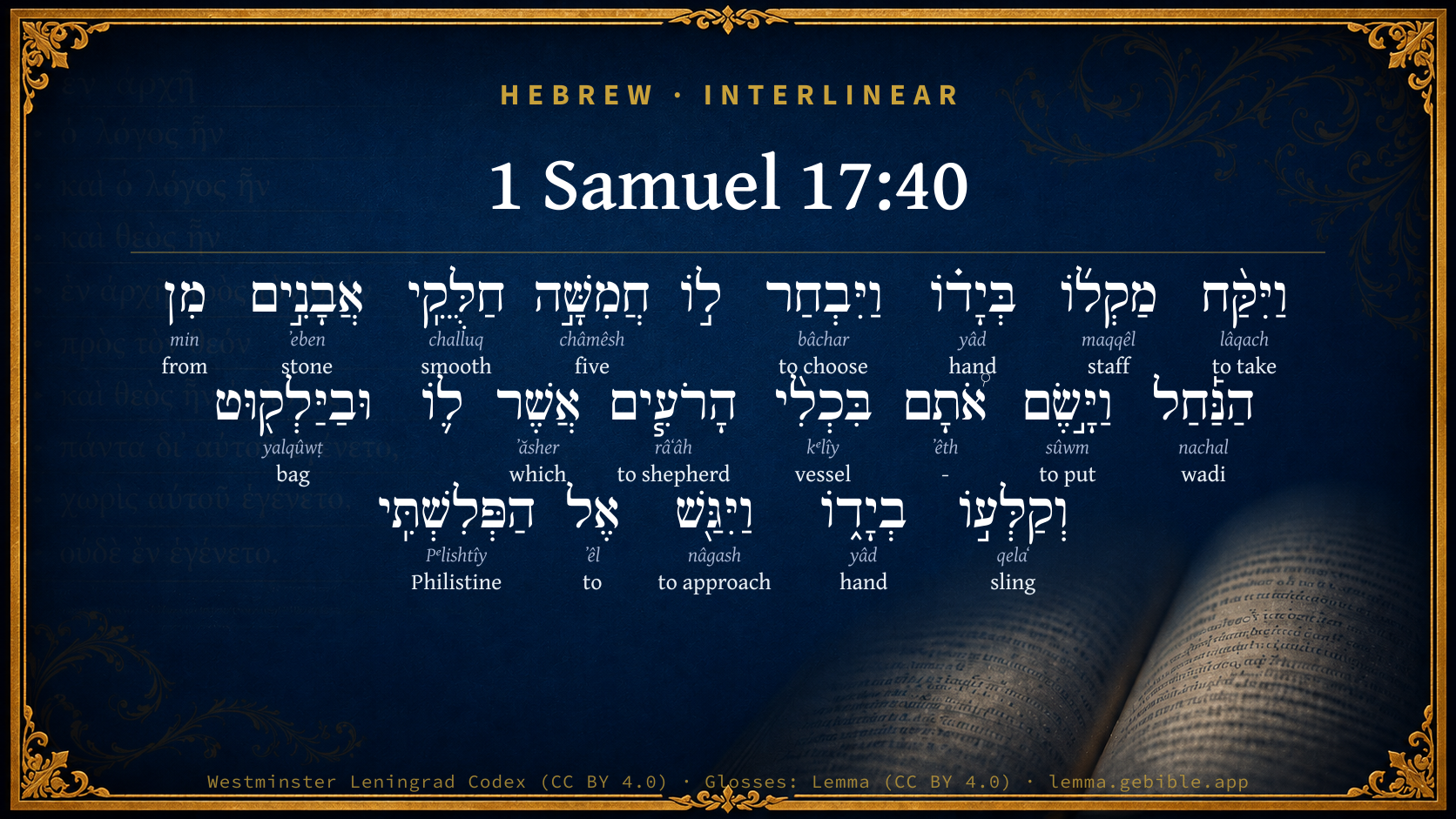
1 Samuel 17:40

Hebrew (Westminster Leningrad Codex) 1 Samuel 17:40 appears in the Hebrew Old Testament. The text above is from the Westminster Leningrad Codex. Each word links to its Strong’s number, a concise gloss, and parsing drawn from the Open Scriptures Hebrew Bible morphology. Click any word for its full Brown-Driver-Briggs (BDB) entry.
Download image
Cite this verse

1 Samuel 17:40 (World English Bible). Public Domain. Lemma interlinear Bible study tool, https://lemma.gebible.app/v/1-samuel/17/40.

Show BibTeX & RIS
BibTeX
RIS
English Translation
He took his staff in his hand, and chose him five smooth stones out of the brook, and put them in the shepherd's bag which he had, even in his wallet; and his sling was in his hand: and he drew near to the Philistine.
World English Bible · Public Domain
Highlights
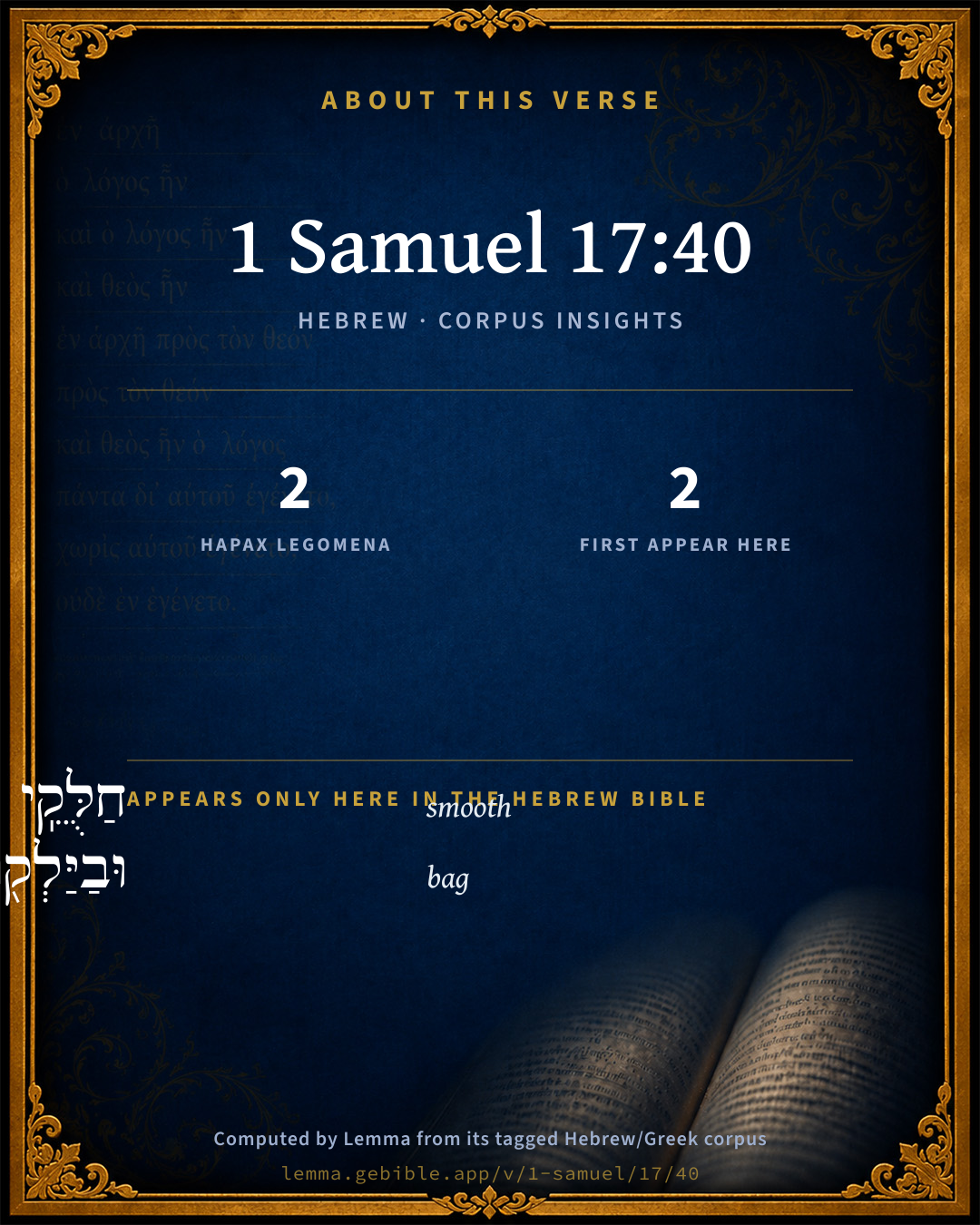
  • 2 hapax legomena — only here in the Hebrew Bible
  • 2 first appearances in the Hebrew Bible
Full analysis ↓
Download a study sheet

One document with this verse’s original text, its word-by-word gloss line, the meaning frame, cross-references with their text, attributed commentary, and full source and license credits — printable, and it pastes into notes with its structure intact.

This verse Autodidact and up

Study sheet (.html) Plain text (.txt)

A passage Seminary Student

Up to 50 verses in one chapter. A passage sheet keeps up to 6 commentary sources and 12 cross-references per verse, in the order this page ranks them, and says so on the sheet whenever that leaves anything out. Ask for a single verse and you get the Autodidact verse sheet above.

Everything on this page stays free to read, with no account — the sheet is a download of what is already on screen, not access to it.

Want to remove ads? Support Godless Engineer
Compare translations 3

The same verse in 3 English versions, stacked beneath the original-language interlinear above. Click any original word for its lexicon entry.

Each is an independent rendering of the whole verse — the interlinear is not word-aligned to these translations.

Highlighted words mark where these versions differ — a whole-verse word diff, not a word-by-word alignment.

  • World English Bible Public Domain
    He took his staff in his hand, and chose him five smooth stones out of the brook, and put them in the shepherd's bag which he had, even in his wallet; and his sling was in his hand: and he drew near to the Philistine.
  • King James Version Public Domain
    And he took his staff in his hand, and chose him five smooth stones out of the brook, and put them in a shepherd's bag which he had, even in a scrip; and his sling was in his hand: and he drew near to the Philistine.
  • unfoldingWord Literal Text CC BY-SA 4.0
    And he took his staff in his hand, and he chose for himself five smooth stones from the wadi, and he put them in the bag of shepherds that to him, even in the pouch, and his sling in his hand. And he approached toward the Philistine.

unfoldingWord Literal Text — © unfoldingWord, licensed CC BY-SA 4.0. Word-aligned USFM3 via Door43 (git.door43.org/unfoldingWord/en_ult).

Versions to compare (up to 4)

3 of 4 selected

Show all 18 translations

Every available English version of this verse, each an independent rendering of the whole verse.

  • World English Bible Public Domain
    He took his staff in his hand, and chose him five smooth stones out of the brook, and put them in the shepherd's bag which he had, even in his wallet; and his sling was in his hand: and he drew near to the Philistine.
  • Berean Standard Bible Public Domain
    And David took his staff in his hand, selected five smooth stones from the brook, and put them in the pouch of his shepherd’s bag. And with his sling in hand, he approached the Philistine.
  • Majority Standard Bible Public Domain
    And David took his staff in his hand, selected five smooth stones from the brook, and put them in the pouch of his shepherd’s bag. And with his sling in hand, he approached the Philistine.
  • King James Version Public Domain
    And he took his staff in his hand, and chose him five smooth stones out of the brook, and put them in a shepherd's bag which he had, even in a scrip; and his sling was in his hand: and he drew near to the Philistine.
  • American Standard Version (1901) Public Domain
    And he took his staff in his hand, and chose him five smooth stones out of the brook, and put them in the shepherd's bag which he had, even in his wallet; and his sling was in his hand: and he drew near to the Philistine.
  • Revised Version (1885) Public Domain
    And he took his staff in his hand, and chose him five smooth stones out of the brook, and put them in the shepherd’s bag which he had, even in his scrip; and his sling was in his hand: and he drew near to the Philistine.
  • Geneva Bible (1599) Public Domain
    Then tooke he his staffe in his hand, and chose him fiue smoothe stones out of a brooke, and put them in his shepheards bagge or skrippe, and his sling was in his hand, and he drewe neere to the Philistim.
  • Douay-Rheims (1899) Public Domain
    And he took his staff, which he had always in his hands: and chose him five smooth stones out of the brook, and put them into the shepherd's scrip, which he had with him, and he took a sling in his hand, and went forth against the Philistine.
  • Young's Literal Translation Public Domain
    And he taketh his staff in his hand, and chooseth for him five smooth stones from the brook, and putteth them in the shepherds' habiliments that he hath, even in the scrip, and his sling `is' in his hand, and he draweth nigh unto the Philistine.
  • Literal Standard Version CC BY-SA 4.0
    And he takes his staff in his hand, and chooses five smooth stones for himself from the brook, and puts them in the shepherds’ vessel that he has, even in the leather pouch, and his sling [is] in his hand, and he draws near to the Philistine.
  • Unlocked Literal Bible CC BY-SA 4.0
    He took his staff in his hand and chose five smooth stones out of the brook; he put them in his shepherd's pouch. His sling was in his hand as he approached the Philistine.
  • unfoldingWord Literal Text CC BY-SA 4.0
    And he took his staff in his hand, and he chose for himself five smooth stones from the wadi, and he put them in the bag of shepherds that to him, even in the pouch, and his sling in his hand. And he approached toward the Philistine.
  • Darby Bible Public Domain
    And he took his staff in his hand, and chose him five smooth stones out of the brook, and put them in the shepherd's bag that he had, into the pocket; and his sling was in his hand. And he drew near to the Philistine.
  • World Messianic Bible Public Domain
    He took his staff in his hand, and chose for himself five smooth stones out of the brook, and put them in the pouch of his shepherd’s bag which he had. His sling was in his hand; and he came near to the Philistine.
  • Webster's Bible Public Domain
    And he took his staff in his hand, and chose him five smooth stones out of the brook, and put them in a shepherd's bag which he had, even in a scrip; and his sling was in his hand; and he drew near to the Philistine.
  • Free Bible Version CC BY-SA 4.0
    He picked up his stick, chose five smooth stones from the stream, and put them in his shepherd's bag. Carrying his sling in his hand, he approached the Philistine.
  • Bible in Basic English Public Domain
    Then he took his stick in his hand, and got five smooth stones from the bed of the stream and put them in a bag such as is used by sheep-keepers; and in his hand was a leather band used for sending stones: and so he went in the direction of the Philistine.
  • JPS Tanakh (1917) Public Domain
    And he took his staff in his hand, and chose him five smooth stones out of the brook, and put them in the shepherd's bag which he had, even in his scrip; and his sling was in his hand; and he drew near to the Philistine.

Literal Standard Version (2020), Covenant Press — licensed CC BY-SA 4.0. Text via the HelloAO Bible API (eBible.org). Unlocked Literal Bible (unfoldingWord) — licensed CC BY-SA 4.0. Text via the HelloAO Bible API (eBible.org). unfoldingWord Literal Text — © unfoldingWord, licensed CC BY-SA 4.0. Word-aligned USFM3 via Door43 (git.door43.org/unfoldingWord/en_ult). Free Bible Version, Dr. Jonathan Gallagher — licensed CC BY-SA 4.0. Text via the HelloAO Bible API (eBible.org).

Word by word

More ways to search: Search by grammar → Find every occurrence → Compare this word →

Practice this passage: Drill this verse → Learn its vocabulary →

חַלֻּקֵֽי
challuq
H2512
“smooth of”
Adjective, Adjective, Masculine, Plural, Construct
Part of Speech
Adjective
Type
Adjective
Gender
Masculine
Number
Plural
State
Construct
Full BDB Definition

Origin: from H2505

TWOT: 670d

smooth
  1. וַיִּקַּ֨ח lâqach H3947 “and · to take” Conjunction + Verb, Qal, Sequential Imperfect, 3rd Person, Masculine, Singular
  2. מַקְל֜וֹ maqqêl H4731 “staff · his” Noun, Common, Masculine, Singular, Construct + Suffix, Personal, 3rd Person, Masculine, Singular
  3. בְּיָד֗וֹ yâd H3027 “in/at · hand · his” Preposition + Noun, Common, Both, Singular, Construct + Suffix, Personal, 3rd Person, Masculine, Singular
  4. וַיִּבְחַר bâchar H977 “and · to choose” Conjunction + Verb, Qal, Sequential Imperfect, 3rd Person, Masculine, Singular
  5. חֲמִשָּׁ֣ה châmêsh H2568 “five” Adjective, Cardinal number, Masculine, Singular, Absolute
  6. אֲבָנִ֣ים ʼeben H68 “stones” Noun, Common, Feminine, Plural, Absolute
  7. מִן min H4480 “from” Preposition
  8. הַנַּ֡חַל nachal H5158 “the · wadi” Particle, Definite Article + Noun, Common, Masculine, Singular, Absolute
  9. וַיָּ֣שֶׂם sûwm H7760 “and · to put” Conjunction + Verb, Qal, Sequential Imperfect, 3rd Person, Masculine, Singular
  10. אֹ֠תָם ʼêth H853 “- · them” Particle, Direct Object + Suffix, Personal, 3rd Person, Masculine, Plural
  11. בִּכְלִ֨י kᵉlîy H3627 “in/at · vessel of” Preposition + Noun, Common, Masculine, Singular, Construct
  12. הָרֹעִ֧ים râʻâh H7462 “the · shepherding” Particle, Definite Article + Verb, Qal, Participle Active, Masculine, Plural, Absolute
  13. אֲשֶׁר ʼăsher H834 “which” Particle, Relative
  14. וּבַיַּלְק֖וּט yalqûwṭ H3219 “and · in/at the · bag” Conjunction + Preposition, Determined + Noun, Common, Masculine, Singular, Absolute
  15. וְקַלְּע֣וֹ qelaʻ H7050 “and · sling · his” Conjunction + Noun, Common, Masculine, Singular, Construct + Suffix, Personal, 3rd Person, Masculine, Singular
  16. בְיָד֑וֹ yâd H3027 “in/at · hand · his” Preposition + Noun, Common, Both, Singular, Construct + Suffix, Personal, 3rd Person, Masculine, Singular
  17. וַיִּגַּ֖שׁ nâgash H5066 “and · to approach” Conjunction + Verb, Qal, Sequential Imperfect, 3rd Person, Masculine, Singular
  18. אֶל ʼêl H413 “to” Preposition
  19. הַפְּלִשְׁתִּֽי Pᵉlishtîy H6430 “the · Philistine” Particle, Definite Article + Noun, Gentilic, Masculine, Singular, Absolute

About this verse

These counts appear in no published source. They are computed here, from the morphology-tagged text and Lemma’s own curated glosses. What Lemma adds →

22
words
19
distinct lemmas
Historical
section

Notable vocabulary

2 hapax legomena — words that appear only here in the entire Hebrew Bible:

  • חַלֻּקֵֽי smooth H2512
  • וּבַיַּלְק֖וּט bag H3219

First appearance in Scripture

These words make their first canonical appearance in the Hebrew Bible here:

  • חַלֻּקֵֽי smooth H2512
  • וּבַיַּלְק֖וּט bag H3219

Shared distinctive vocabulary

מַקְל֜וֹ staff H4731 occurs in 16 verses of the Hebrew Bible. Also found in:

Grammatical profile

  • 5 verbs
  • 9 nouns
  • 2 adjectives
  • 4 prepositions
  • 2 particles

Verb forms

  • וַיִּקַּ֨ח Qal · Sequential Imperfect
  • וַיִּבְחַר Qal · Sequential Imperfect
  • וַיָּ֣שֶׂם Qal · Sequential Imperfect
  • הָרֹעִ֧ים Qal · Participle Active
  • וַיִּגַּ֖שׁ Qal · Sequential Imperfect

Repetition

A word recurs within this verse — often emphatic in Hebrew:

  • בְּיָד֗וֹ hand H3027 ×2

Hebrew & Septuagint length

In English translation the verse runs 45 words from the Hebrew and 45 from the Septuagint (LXX English) — the same length.

A rough comparison of the two English renderings, which tokenize alike — not a word-level alignment.

Word counts can differ between the Hebrew and the Greek without any difference in meaning — e.g. the Hebrew direct-object marker אֵת has no separate Greek word, and Greek often adds the article ὁ.

Cross-references

6

Topical passages linked to 1 Samuel 17:40 in the Treasury of Scripture Knowledge — connected by theme and wording, ordered by reader-vote popularity; previews shown in the World English Bible.

  • 1 Corinthians 1:27–29 but God chose the foolish things of the world that he might put to shame those who are wise. God chose the weak things of the world, that he might put to shame the things that are strong;
  • Judges 15:15–16 He found a fresh jawbone of a donkey, and put forth his hand, and took it, and struck a thousand men therewith.
  • Judges 20:16 Among all this people there were seven hundred chosen men left-handed; everyone could sling stones at a hair-breadth, and not miss.
  • Matthew 10:10 Take no bag for your journey, neither two coats, nor shoes, nor staff: for the laborer is worthy of his food.
  • Judges 3:31 After him was Shamgar the son of Anath, who struck of the Philistines six hundred men with an ox-goad: and he also saved Israel.
  • Judges 7:16–20 He divided the three hundred men into three companies, and he put into the hands of all of them trumpets, and empty pitchers, with torches within the pitchers.

Cross-references courtesy of OpenBible.info (CC BY 4.0).

Hebrew and Greek witnesses Masoretic Hebrew ↔ Greek Septuagint

The same verse in the two great witnesses to the Old Testament, shown verse-for-verse.

These are two independent witnesses, not word-aligned to each other, and the Septuagint is shown in lemma (dictionary) form.

Hebrew 1 Samuel 17:40 Masoretic · Westminster Leningrad Codex

וַיִּקַּ֨ח מַקְל֜וֹ בְּיָד֗וֹ וַיִּבְחַר ל֣וֹ חֲמִשָּׁ֣ה חַלֻּקֵֽי אֲבָנִ֣ים מִן הַנַּ֡חַל וַיָּ֣שֶׂם אֹ֠תָם בִּכְלִ֨י הָרֹעִ֧ים אֲשֶׁר ל֛וֹ וּבַיַּלְק֖וּט וְקַלְּע֣וֹ בְיָד֑וֹ וַיִּגַּ֖שׁ אֶל הַפְּלִשְׁתִּֽי

He took his staff in his hand, and chose him five smooth stones out of the brook, and put them in the shepherd's bag which he had, even in his wallet; and his sling was in his hand: and he drew near to the Philistine.

World English Bible · Public Domain

Greek LXX 1 Samuel 17:40 Septuagint · lemma form
And he took his staff in his hand, and he chose for himself five smooth stones out of the brook, and put them in the shepherd's scrip which he had for his store, and his sling was in his hand; and he approached the Philistine.

LXX2012 (modern English Septuagint) · Public Domain

Hebrew: Westminster Leningrad Codex (CC BY 4.0). Greek: Septuagint (public domain); English from LXX2012 (modern English Septuagint) (Public Domain). How the Septuagint differs from the Hebrew →

Targum (Aramaic paraphrase)

1

The Targum is the ancient Jewish Aramaic paraphrase of the Hebrew Scriptures — an interpretive translation, not the Hebrew text itself. Onkelos (literal) and Pseudo-Jonathan (expansive) render the Torah, and Jonathan the Prophets. Coverage is partial: where no permissively-licensed English translation exists for a verse, only the Aramaic is shown. This is verse-level text, not a word-by-word alignment to the Hebrew.

  1. Targum Jonathan Prophets (Joshua–Malachi)
    וּנְסִיב חוּטְרֵיהּ בִּידֵיהּ וּבְחַר לֵיהּ חַמְשָׁא שְׁעִיעֵי אַבְנַיָא מִן נַחֲלָא וְשַׁוִי יַתְהוֹן בְּמָאן רַעֲיָא דִי לֵיהּ וּבְתַרְמִילֵיהּ וְקַלְעֵיהּ בִּידֵיהּ וּקְרִיב לְוַת פְלִשְׁתָּאָה:

    (no public-domain English translation for this verse)

    Targum Jonathan — Aramaic: “Mikraot Gedolot” (public domain). English: “Sefaria Community Translation” (CC0 1.0 (public-domain dedication)); “London "Chaldee Paraphrase," 1871” (public domain). Text via Sefaria.

Commentary

Notes on 1 Samuel 17:40 from classic Christian and Jewish commentators (each source and its license shown beneath its notes). The classic Christian expositions comment on the surrounding passage and are grouped to its opening verse, so a note may address several verses; the Jewish commentaries on the Tanakh (Rashi and others) are per-verse, so they appear only where the commentator wrote on this verse.

Lemma curates 59 commentaries, every one of them public domain or Creative Commons licensed, each selected and text-cleaned for this edition rather than reprinted as found. About our sources →

Matthew Henry's Commentary

We are now coming near this famous combat, and have in these verses the preparations and remonstrances made on both sides.

I. The preparations made on both sides for the encounter. The Philistine was already fixed, as he had been daily for the last forty days. Well might he go with his armour, for he had sufficiently proved it. Only we are told (Sa1 17:41) that he came on and drew near, a signal, it is likely, being given that his challenge was accepted, and, as if he distrusted his helmet and coat of mail, a man went before him, carrying his shield, for his own hands were full with his sword and spear, Sa1 17:45. But what arms and ammunition is David furnished with? Truly none but what he brought with him as a shepherd; no breastplate, nor corselet, but his plain shepherd's coat; no spear, but his staff; no sword nor bow, but his sling; no quiver, but his scrip; nor any arrows, but, instead of them, five smooth stones picked up out of the brook, Sa1 17:40. By this it appeared that his confidence was purely in the power of God, and not in any sufficiency of his own, and that now at length he who put it into his heart to fight the Philistine put it into his head with what weapons to do it.

II. The conference which precedes the encounter, in which observe,

1. How very proud Goliath was, (1.) With what scorn he looked upon his adversary, Sa1 17:42. He looked about, expecting to meet some tall strong man, but, when he saw what a mean figure he made with whom he was to engage, he disdained him, thought it below him to enter the lists with him, fearing that the contemptibleness of the champion he contended with would lessen the glory of his victory. He took notice of his person, that he was but a youth, not come to his strength, ruddy and of a fair countenance, fitter to accompany the virgins of Israel in their dances (if mixed dancing was then in use) than to lead on the men of Israel in their battles. He took notice of his array with great indignation (Sa1 17:43): "Am I a dog, that thou comest to me with staves? Dost thou think to beat me as easily as thou dost thy shepherd's dog?" (2.) With what confidence he presumed upon his success. He cursed David by his gods, imprecating the impotent vengeance of his idols against him, thinking these fire-balls thrown about him would secure his success: and therefore, in confidence of that, he darts his grimaces, as if threatening words would kill (Sa1 17:44): "Come to me, and I will give thy flesh to the fowls of the air, it will be a tender and delicate feast for them." Thus the security and presumption of fools destroy them.

2. How very pious David was. His speech savours nothing of ostentation, but God is all in all in it, Sa1 17:45-47. (1.) He derives his authority from God: "I come to thee by warrant and commission from heaven, in the name of the Lord, who has called me to and anointed me for this undertaking, who, by his universal providence, is the Lord of hosts, of all hosts, and therefore has power to do what he pleases, and, by the special grace of his covenant, is the God of the armies of Israel, and therefore has engaged and will employ his power for their protection, and against thee who hast impiously defied them." The name of God David relied on, as Goliath did on his sword and spear. See Psa 20:7; Psa 118:10, Psa 118:11. (2.) He depends for success upon God, Sa1 17:46. David speaks with as much assurance as Goliath had done, but upon better ground; it is his faith that says, "This day will the Lord deliver thee into my hand, and not only thy carcase, but the carcases of the host of the Philistines, shall be given to the birds and beasts of prey." (3.) He devotes the praise and glory of all to God. He did not, like Goliath, seek his own honour, but the honour of God, not doubting but by the success of this action, [1.] All the world should be made to know that there is a God, and that the God of Israel is the one only living and true God, and all other pretended deities are vanity and a lie. [2.] All Israel (whom he calls not this army, but this assembly, or church, because they were now religiously attending the goings of their God and King, as they used to do in the sanctuary) shall know that the Lord saveth not with sword and spear (Sa1 17:47), but can, when he pleases, save without either and against both, Psa 46:9. David addresses himself to this combat rather as a priest that was going to offer a sacrifice to the justice of God than as a soldier that was going to engage an enemy of his country.

Matthew Henry's Commentary on the Whole Bible (1708–1710) — public domain (CC PDM 1.0). Text via the HelloAO Bible API.

Trapp's Complete Commentary

John Trapp

1Sa 17:40 And he took his staff in his hand, and chose him five smooth stones out of the brook, and put them in a shepherd’s bag which he had, even in a scrip; and his sling [was] in his hand: and he drew near to the Philistine.

Ver. 40. And he took his staff in his hand.] His pedum pastorale sive agolum: so Festus calleth the shepherd’s crook, ab agendis pecoribus, a poor weapon against such an antagonist. Veritas etiam indefensa est invicta: et arma victorioe eius sunt inermis patientia, bona causa, et bona conscientia. {a}

“ Qua mens plena fide sit prece iuncta Deo. ”

Even in a scrip.] Such as shepherds use, ut in ea reculas suas recordant, to put their small doings in.

{a} Bucholcer.

John Trapp, A Commentary or Exposition upon All the Books of the Old and New Testament (1647–1656) — public domain. Text from a community e-Sword module.

The Biblical Illustrator

Joseph S. Exell

1Sa_17:40

And he took his staff in his hand, and chose him five smooth stones out of the brook.

The example of David in the use of means

There is much in these particulars to furnish matter for profitable meditation. Let us take them as our subject of discourse. In the first place we will consider how David reasoned from past mercies, and grounded upon them the expectation of future aid from above. We will then consider his readiness to make use of means notwithstanding his full confidence in the succour and protection of God. He tried the armour which Saul proposed, though he felt the assurance expressed in the words--The Lord that delivered me out of the paw of the lion, and out of the paw of the bear, he will deliver me out of the hand of this Philistine.

1. Now though David was yet but a stripling, he was evidently acting on the principle which he afterwards expressed in one of his Psalms. Because Thou hast been my help, therefore in the shadow of Thy wings will! rejoice. He was already using past, mercies as a pledge or promise of future; and encouraging himself by what God had done, in expecting Him to do yet more in his behalf. There is something singularly emphatic in those words of St. Paul to Timothy, I know whom I have believed. They are the words of a man who was his own storehouse of evidence, who had gathered into himself so much of testimony to the origin of Christianity and the faithfulness, of God, that he had no need in any moment of difficulty or trial, to have recourse to books or external witness in order to be assured that he trod a safe path. I know whom I have believed; there may have been a time when I required the evidence of miracle and prophecy in order to be convinced that I followed no cunningly devised fable--when I had to turn to the registered histories of the saints of other days to satisfy myself that I served a God who would never fall His people; but now my own experience has come into the place of external testimony and Christian biography; I have but to descend into myself, end there do I find graven on the tablets of memory such records of fulfilled promises and gracious interpositions as leave me nothing to seek from the archives of creation, or the volumes of history. And there can be given no reason why this should have been the ease with St. Paul or David rather than with any amongst ourselves. We would, therefore, call on you all, to turn your own experience to account, and to go on, adding page after page to the volume whose want is not to be supplied by whole libraries of the narratives of others: for there is a warrant in the recorded account, of favours shown to ourselves which is incomparably beyond that of much greater favours shown to another. And will you tell me that nothing has happened to yourselves, of which you might make the use which David made of a former great deliverance? Aye, if this be your assertion it can only be because you receive mercies only to forget them. And we speak now to those who profess some attention to religion. Can you deny that God takes care of you in the midst of your sorrows--either wholly delivering you from the paw of the lion and from the paw of the bear, or administering such supports as enable you to feel the tribulation to be good? We are persuaded that this has been your experience, though you may have given but little heed to the storing the mind with mementoes of Divine love. You should keep the past before you if you would look the future calmly in the face. Every obstacle surmounted, every sorrow soothed, every want supplied, every fear dissipated, every tear dried, should be in reserve, ready to give evidence, on any new trial, as to the goodness and watchfulness of your Father in heaven. Shame on you if you cannot say, I know whom I have believed. It is likely that the older you grow, the sterner will be the forms of trouble which you will have to encounter, and you will encounter them confidently in proportion as you bear well in mind how the milder forms were vanquished.

2. We have shown you how strong was the faith of David. It is true that finally he went with no weapons but a stone and a sling: he went, that is, with none of those appliances which seem required, whether for his own defence or for the defeat of Goliath. But, then it is just as true, that he did not determine to go thus unequipped to the field until he had done his best to ascertain that it was not Gods will that he should wear a warriors arms. There seems no reason to suppose that David tried on Sauls armour merely out of compliance with Sauls wish: on the contrary, it appears to have been his intention to have used his armour, and the intention was only given up because, on trial, the armour proved an encumbrance. If ever man might have ventured to say means might be neglected, the result is ordained, and will be brought round without any of the common instrumentality, David might have been warranted in refusing the armour without trying it on. But this is just what David did not do: he proceeded on the principle that no expectation of a miracle should make us slack in the employment of means; but that so long as means are within reach, we are bound to employ them, though it may not be through their use that God will finally work, And can you fail to see how David thus became a great example to ourselves? I know not in what precise way God may design to effect the conversion of anyone in this assembly, or to give anyone victory over some great spiritual adversary; but I know thoroughly what is the business of every one of you, if you look to be converted, or hope to be made victor. There are appointed means through which God is ordinarily pleased to bring round such results: and the readiest mode of frustrating the results is, to take for granted, that means may be neglected. These means are prayer, the study of the Bible, and the ordinances of public worship. That you can show me that the Goliath is often finally slain by stones taken out of the brook, and not by any of the more massive weapons is nothing against our argument; for our argument is, that, though slain at last by the pebble, the slayer has commonly first put on the armour; in short, that no man has a right to have recourse to the stone and the sling until he have first made trial of the coat of mail and the sword. We are quite prepared, we say, for occasionally finding, that a casual remark in conversation, a text quoted, or a passing observation while engaged in his ordinary occupation, will effect what the public ministrations have failed to effect,--penetrate the heart, and overthrow the strongholds of pride and unbelief: and here Goliath falls before the pebble, and not before the armour of the thoroughly equipped warrior. But, nevertheless, the man of whom we speak, had recourse to the armoury before he had recourse to the brook; and, probably, had he refused to appeal to the armoury, that penetrating stone would never have been drawn from the brook; at all events, no man can have a right to be looking for miracle who is not diligent in the employment of means: man is to be trying on the armour, though God may at last use the pebble. And there is one particular case to which we would apply these more general remarks. I know not a more difficult or delicate undertaking, than that of defending the cause of God and of truth against some champion of infidelity and error. It is probably better to keep silence than to throw ones self into discussion, and have the worst of the argument. And you are not to feel sure, that because you have undoubted truth on your side, you will conquer in the struggle: the proof by which truth may be substantiated is quite different from the truth itself; just as is the guilt of a prisoner from the evidence which will make a jury determine on his conviction. Goliath is not always to be slain with a pebble, though he defy the armies of the living God to which his opponent belongs. And the question is, whether the man who has really nothing but the sling and the pebble should be forward in every company where a Philistine may be, in accepting his challenge. There are cases indeed in which the unlettered believer is distinctly called on to engage with the giant, and whenever such case arises, we have no fear but that God will strengthen him for the fight. If called like David, like David he will be protected. But the evil generally is, that our youthful champions, eager, however unprepared, to throw themselves into argument, fancy themselves imitating David, because he went forth with nothing but a sling and a stone; but they forget that he first tried to put on the armour of Saul. We want them to imitate David in each successive particular. To complete the destruction of Goliath, David ran and seized the giants sword, and with that sword he cut off his head. And how was Satan finally vanquished, and, as it were, decapitated by Christ, if not with his own sword? Was not, death emphatically the sword of the devil, seeing that he is expressly said to have had the power of death, and that it was through death that he had laid waste successive generations, and swept them into his own place of torment? And, remember ye not how it is declared that Christ died that through death he might destroy him that had the power over death, that is, the devil? It was by dying that he slew the devil; he vanquished him by taking death for his weapon: And what was this but David using Goliaths sword to cut off Goliaths head? It may therefore well be called a parable of redemption, which is written in the incidents of the chapter before us. These incidents may have furnished a significative lesson to David, just as did those of the offering up of Isaac to Abraham. And thus do we draw from our subject a lesson for the nation. But let us not overlook that which belongs to the individual. The paw of the lion, the paw of the bear, the uncircumcised Philistine, in every case, needs strength God alone can give the strength--God alone can give victory in every struggle with corruption, and in the final struggle with death. But if you will fight as followers of Christ, regarding him as the Captain of your salvation, and depending simply on the aids of His Spirit, you shall be made more than conquerors; the giants one after the other shall fall before you, and the last enemy shall do the work of a friend in consigning you to glory and honour and immortality. (H. Melvill, B. D.)

The Biblical Illustrator, edited by Joseph S. Exell (c. 1880s–1900s) — public domain. Text from a community e-Sword module.

Joseph Benson's Commentary

1Sa 17:40-41. He took his staff — His shepherd’s staff. These arms in themselves were contemptible, yet chosen by David, because he had no skill to use other arms; because he had inward assurance of the victory, even by these weapons; and because such a conquest would be more honourable to God, and most shameful and discouraging to the Philistines. He drew near — Probably a signal was made that the Philistine’s challenge was accepted. David, however, it seems, made the first motion toward him, to show he did not fear him.

Joseph Benson's Commentary on the Old and New Testaments (1811–1818) — public domain. Text from a community e-Sword module.

Tyndale Open Study Notes

Tyndale Open Resources

17:40 A stream flowed through the valley of Elah (17:2). • A sling was a leather pouch attached to two leather thongs. When the sling containing a stone was whirled rapidly, one of the thongs could be released, sending the stone toward its target. David probably became deadly accurate with a sling as a shepherd, but the sling was used by warriors as well (Judg 20:16).

Tyndale Open Study Notes — © Tyndale Open Resources, licensed CC BY-SA 4.0. Text via the HelloAO Bible API.

Geneva Bible (1599)

Geneva Bible translators

To the intent that by these weak means, God might only be known to be the author of this victory.

Geneva Bible (1599) marginal notes — public domain. Text via Bolls.life.

Jamieson, Fausset & Brown

Robert Jamieson, A. R. Fausset & David Brown

brook--wady.

bag--or scrip for containing his daily food.

sling--The sling consisted of a double rope with a thong, probably of leather, to receive the stone. The slinger held a second stone in his left hand. David chose five stones, as a reserve, in case the first should fail. Shepherds in the East carry a sling and stones still, for the purpose of driving away, or killing, the enemies that prowl about the flock.

Jamieson, Fausset & Brown — Commentary Critical and Explanatory on the Whole Bible (1871) — public domain (CC PDM 1.0). Text via the HelloAO Bible API.

Adam Clarke's Commentary

Verse 40. He took his staff] What we would call his crook.

Five smooth stones]

1. Had they been rough or angular, they would not have passed easily through the air, and their asperities would, in the course of their passage, have given them a false direction.

2. Had they not been smooth, they could not have been readily despatched from the sling.

A shepherd's bag] That in which he generally carried his provisions while keeping the sheep in the open country.

And his sling] The sling, both among the Greeks and Hebrews, has been a powerful offensive weapon. See what has been said on Jdg 20:16. It is composed of two strings and a leathern strap; the strap is in the middle, and is the place where the stone or bullet lies. The string on the right end of the strap is firmly fastened to the hand; that on the left is held between the thumb and middle joint of the fore finger. It is then whirled two or three times round the head; and when discharged, the finger and thumb let go their hold of the left end string. The velocity and force of the sling are in proportion to the distance of the strap, where the bullet lies, from the shoulder joint. Hence the ancient Baleares, or inhabitants of Majorca and Minorca, are said to have had three slings of different lengths, the longest they used when the enemy was at the greatest distance; the middle one, on their nearer approach; and the shortest, when they came into the ordinary fighting distance in the field. The shortest is the most certain, though not the most powerful. The Balearians are said to have had one of their slings constantly bound about their head, to have used the second as a girdle, and to have carried the third always in their hand. See DIOD. Sic. lib. v., c. 18, p. 286, edit. Bipont.

In the use of the sling it requires much practice to hit the mark; but when once this dexterity is acquired, the sling is nearly as fatal as the musket or bow; see on 1Sa 17:49. David was evidently an expert marksman; and his sling gave him greatly the advantage over Goliath; an advantage of which the giant does not seem to have been aware. He could hit him within any speaking distance, if he missed once, he had as many chances as he had stones; and after all, being unencumbered with armour, young, and athletic, he could have saved his life by flight. Against him the Philistine could do but little, except in close fight; it is true he appears to have had a javelin or missile spear, (see on 1Sa 17:6), but David took care to prevent the use of all such weapons, by giving him the first blow.

Adam Clarke's Commentary on the Bible (1810–1826) — public domain. Text from a community e-Sword/MySword module.

Ellicott's Commentary for English Readers

(40) And he took his staff in his hand.—It was a true stroke of military genius in David, this determination of his to fight only with the weapons, weak and unimportant though they seemed, with which he was familiar, and in the use of which he was so skilful; nor was the issue of the combat, now he had resolved to use the sling, even doubtful. It has been well said he was like one armed with a rifle, while his enemy had only a spear and a sword, and if only he could take sure aim the result was absolutely certain.

Wordsworth, again, on the words “chose him five smooth stones out of the brook,” refers to Augustine’s Commentary, who finds here a deep mystical signification. It is an admirable specimen of the Patristic School of Exposition, which, although quaint, and not unfrequently “far-fetched,” will always, and with good reason, possess great power over the minds of the earnest and devout student. “So our Divine David, the Good Shepherd of Bethlehem, when He went forth at the temptation to meet Satan—our ghostly Goliath—chose five stones out of the brook. He took the five books of Moses out of the flowing stream of Judaism. He took what was solid out of what was fluid. He took what was permanent out of what was transitory. He took what was moral and perpetual out of what was ceremonial and temporary. He took stones out of a brook, and with one of these He overthrew Satan. All Christ’s answers to the tempter are moral precepts, taken from one Book of the Law (Deuteronomy), and He prefaced His replies with the same words, ‘It is written;’ and with this sling and stone of Scripture He laid our Goliath low, and He has taught us by His example how we may also vanquish the tempter.” (See St. Augustine, Sermon 32)

A Bible Commentary for English Readers, edited by Charles John Ellicott (1878–1897) — public domain. Text from a community e-Sword module.

The Cambridge Bible for Schools and Colleges

gen. ed. J. J. S. Perowne

40. five smooth stones out of the brook] “The sides and bed of this trench [see above on 1Sa_17:3] are strewn with rounded and water-worn pebbles, which would have been well fitted for David’s sling.” Conder, II. 161.

scrip] A small bag, especially a traveller’s wallet. Cp. Mat_10:10; and Milton, Comus, 1. 626,

“And in requital ope his leathern scrip.”

his sling] “The sling has been in ail ages the favourite weapon of the shepherds of Syria. The Benjamites were especially expert In their use of it: even the left-handed could sling stones at an hair and not miss (Jdg_20:16).”

The Cambridge Bible for Schools and Colleges (gen. ed. J. J. S. Perowne; Cambridge University Press, 1878–1918) — public domain. Text from a community e-Sword module.

John Gill's Exposition

And he took his staff in his hand,.... His shepherd's staff, which he used in keeping his father's sheep, and chose rather to appear in the habit of a shepherd than of a soldier:

and chose him five smooth stones out of the brook; which ran in the valley, which became smooth by lying in the water running over them; and which being smooth were fitter for his purpose, being the more easily cast out of the sling; though De Dieu is of opinion that these were parts or pieces of stones, cleft ones, which were rough and rugged, and which would more easily and firmly be fixed in the forehead of the Philistine:

and put them in a shepherd's bag which he had, even in a scrip; in which he had been wont to put things he needed for the good of the flock, and was such as travellers put their food in; and this might also be the use of it with shepherds; but, according to the Ethiopic interpreters (k), it was that piece of the leather in the midst of the sling, in which the slingers used to put the stones, that they might stick the more firmly:

and his sling was in his hand; which he intended to use in slinging the stone or stones he had in his scrip; and which was an exercise he had been accustomed to in all likelihood, and for which the Benjaminites his neighbours, of the next tribe, were very famous:

and he drew near to the Philistine; marched towards him, thereby signifying that he accepted his challenge, and would enter the list with him.

(k) Apud Ludolf. Lexic. Ethiop. p. 84.

John Gill's Exposition of the Whole Bible (1746–1763) — public domain (CC PDM 1.0). Text via the HelloAO Bible API.

Haydock's Catholic Bible Commentary

Smooth. Louis de Dieu translates broken "pieces of stones," as he pretends, contrary to the common opinion, that rough stones are more suitable for the sling. (Calmet) --- The learned Jew, whom we have cited above, (ver. 12,) and several others, have inferred from this verse, that David seems to have just come from the flock. But Kennicott justly observes, that slingers were of great service in the army; and the "vessel of shepherds," the bag or scrip, might well be used to obtain the stones; as the staff, makel, denotes a military weapon. (Taylor, Conc.) (Diss. ii. p. 555.) David was very expert in using these weapons, and the ordinary armour was encumbering to him. (Haydock) --- "Valour depends more on its own efforts than on armour," tegumentis. (St. Ambrose, Off. i.)

George Leo Haydock (1774–1849), Haydock's Catholic Family Bible and Commentary, 1859 edition — public domain. Excludes Psalms (Douay-Rheims chapter numbering differs from Protestant) and Deuterocanonical books (Catholic canon only).

Matthew Poole's English Annotations

His staff; his shepherd’s staff. These arms were in themselves contemptible, yet chosen by David; partly, because he had no skill to use other arms; partly, because he had inward assurance of the victory, even by these weapons; and partly, because such a conquest would be most honourable to God, and most shameful and discouraging to the Philistines.

Chose him five smooth stones, that if one should fail him, he might make use of another.

Smooth stones, because such stones would go most freely out of the sling; and consequently, with more force and certainty, directly to the mark which he aimed at. The sling was a sort of weapon not unusual in the fights of ancient times, and many arrived at great dexterity of slinging stones with great certainty; of which we have instances both in Scripture, as Jdg 20:16, and in Diodorus Siculus, and Livy, and other authors.

Matthew Poole's English Annotations on the Holy Bible (1683–1685) — public domain. Text from a community e-Sword/MySword module.

Whedon's Commentary on the Bible

Daniel D. Whedon

40. Smooth stones — Such as would pass most easily and rapidly through the air. The torrent bed of the Wady es-Sumt is said to be lined with smooth pebbles.

A scrip — A pouch; a knapsack.

Sling — On the use of this instrument in ancient warfare, see note on Jdg_20:16.

Daniel D. Whedon (gen. ed.), Commentary on the Old and New Testaments (1874–1909) — public domain. Text from a community e-Sword module.

John Wesley's Explanatory Notes

Staff - His shepherd's staff. These arms in themselves were contemptible, yet chosen by David; because he had no skill to use other arms; because he had inward assurance of the victory, even by these weapons; and because such a conquest would be more honourable to God, and most shameful, and discouraging to the Philistines.

John Wesley, Explanatory Notes Upon the Whole Bible (1754–1765) — public domain. Text via the GEBible commentary corpus.

Rashi

Rabbi Shlomo Yitzchaki (Rashi)

Smooth stones. Thin and smooth stones.

And in his pouch. [Targum Yonoson renders] 'and in his pack.'

Rashi on the Tanakh — English translations: “The Judaica Press complete Tanach with Rashi, translated by A. J. Rosenberg” (CC BY 4.0); “Pentateuch with Rashi's commentary by M. Rosenbaum and A.M. Silbermann, 1929-1934” (public domain); “The Metsudah Tanach series, Lakewood, N.J” (CC BY 4.0); and “The Book of Joshua, Metsudah Publications, 1997” (CC BY 4.0). Text via Sefaria.

Lesson kit

Teaching starters — assembled from the data on this page, not authored interpretation. Every prompt links to the verse data it draws on. Edit before teaching.

1 Samuel, in the Historical, opens this verse with 22 words (19 distinct Hebrew lemmas). Its most distinctive word is challuq (“smooth”). A historical commentator’s framing appears above. Read the whole chapter for the surrounding context.

Discussion questions

  1. How does “smooth” (challuq) shape what this verse is saying?
  2. This verse holds 2 words here found nowhere else in the Hebrew Bible. What might the rare words draw attention to?
  3. 2 words here appear for the first time in Scripture. What is being introduced at this debut?
  4. Genesis 30:37 shares the word «staff» with this verse. How do the two illuminate each other?
  5. “hand” occurs 2× in this one verse. What is the effect of the repetition?
  6. These translations render this verse differently; the difference is in the English rendering, not the original. What questions does that raise?
  7. The verb «וַיִּקַּ֨ח» is Qal Sequential Imperfect. How does its form color the action?
  8. Reading how Matthew Henry's Commentary and Trapp's Complete Commentary read this verse, where do the two commentators agree and where do they part?

Things to notice

  • 2 words in this verse appear nowhere else in the Hebrew Bible.
  • 2 words make their first canonical appearance in Scripture here.
  • These translations choose different wording for 15 words in this verse.
  • “hand” occurs 2× in this single verse.
  • 19 distinct Hebrew lemmas span 22 words in this verse.

Reading settings

Reading text

Shown beneath each verse's original-language words.

Old Testament
Old Testament edition

Read the OT as the Masoretic Hebrew (MT) or the Greek Septuagint (LXX).

English shown for the Greek Septuagint (in the Hebrew ↔ Greek comparison).

Comparing translations? Open the Compare panel on any verse page to stack up to four side by side.