Numbers 19:17

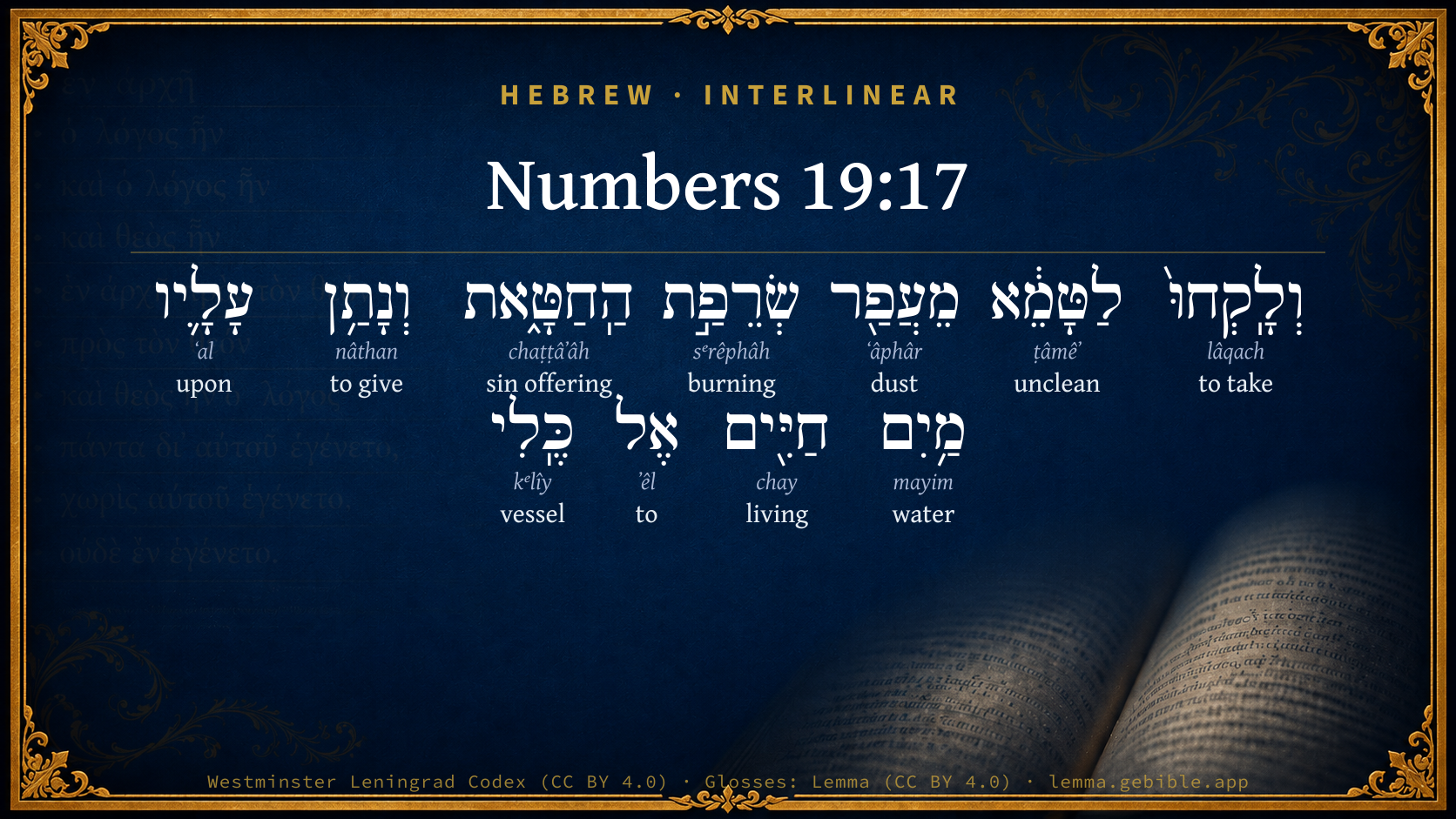
Hebrew (Westminster Leningrad Codex) Numbers 19:17 appears in the Hebrew Old Testament. The text above is from the Westminster Leningrad Codex. Each word links to its Strong’s number, a concise gloss, and parsing drawn from the Open Scriptures Hebrew Bible morphology. Click any word for its full Brown-Driver-Briggs (BDB) entry.
Download image
Cite this verse

Numbers 19:17 (World English Bible). Public Domain. Lemma interlinear Bible study tool, https://lemma.gebible.app/v/numbers/19/17.

Show BibTeX & RIS
BibTeX
RIS
English Translation
For the unclean they shall take of the ashes of the burning of the sin-offering; and running water shall be put thereto in a vessel:
World English Bible · Public Domain
Download a study sheet

One document with this verse’s original text, its word-by-word gloss line, the meaning frame, cross-references with their text, attributed commentary, and full source and license credits — printable, and it pastes into notes with its structure intact.

This verse Autodidact and up

Study sheet (.html) Plain text (.txt)

A passage Seminary Student

Up to 50 verses in one chapter. A passage sheet keeps up to 6 commentary sources and 12 cross-references per verse, in the order this page ranks them, and says so on the sheet whenever that leaves anything out. Ask for a single verse and you get the Autodidact verse sheet above.

Everything on this page stays free to read, with no account — the sheet is a download of what is already on screen, not access to it.

Want to remove ads? Support Godless Engineer
Compare translations 3

The same verse in 3 English versions, stacked beneath the original-language interlinear above. Click any original word for its lexicon entry.

Each is an independent rendering of the whole verse — the interlinear is not word-aligned to these translations.

Highlighted words mark where these versions differ — a whole-verse word diff, not a word-by-word alignment.

  • World English Bible Public Domain
    For the unclean they shall take of the ashes of the burning of the sin-offering; and running water shall be put thereto in a vessel:
  • King James Version Public Domain
    And for an unclean person they shall take of the ashes of the burnt heifer of purification for sin, and running water shall be put thereto in a vessel:
  • unfoldingWord Literal Text CC BY-SA 4.0
    And they shall take for the unclean one some of the dust of the burning of the sin offering, and he shall put living water on it into a vessel.

unfoldingWord Literal Text — © unfoldingWord, licensed CC BY-SA 4.0. Word-aligned USFM3 via Door43 (git.door43.org/unfoldingWord/en_ult).

Versions to compare (up to 4)

3 of 4 selected

Show all 18 translations

Every available English version of this verse, each an independent rendering of the whole verse.

  • World English Bible Public Domain
    For the unclean they shall take of the ashes of the burning of the sin-offering; and running water shall be put thereto in a vessel:
  • Berean Standard Bible Public Domain
    For the purification of the unclean person, take some of the ashes of the burnt sin offering, put them in a jar, and pour fresh water over them.
  • Majority Standard Bible Public Domain
    For the purification of the unclean person, take some of the ashes of the burnt sin offering, put them in a jar, and pour fresh water over them.
  • King James Version Public Domain
    And for an unclean person they shall take of the ashes of the burnt heifer of purification for sin, and running water shall be put thereto in a vessel:
  • American Standard Version (1901) Public Domain
    And for the unclean they shall take of the ashes of the burning of the sin-offering; and running water shall be put thereto in a vessel:
  • Revised Version (1885) Public Domain
    And for the unclean they shall take of the ashes of the burning of the sin offering, and running water shall be put thereto in a vessel:
  • Geneva Bible (1599) Public Domain
    Therfore for an vncleane person they shall take of the burnt ashes of the sinne offring, and pure water shalbe put thereto in a vessel.
  • Douay-Rheims (1899) Public Domain
    And they shall take of the ashes of the burning and of the sin offering, and shall pour living waters upon them into a vessel.
  • Young's Literal Translation Public Domain
    and they have taken for the unclean person of the ashes of the burning of the `cleansing', and he hath put upon it running water unto a vessel;
  • Literal Standard Version CC BY-SA 4.0
    and for the unclean person they have taken from the ashes of the burning of the [cow], and he has put running water over it into a vessel;
  • Unlocked Literal Bible CC BY-SA 4.0
    Do this for the unclean person: Take some ashes from the burnt sin offering and mix them in a jar with fresh water.
  • unfoldingWord Literal Text CC BY-SA 4.0
    And they shall take for the unclean one some of the dust of the burning of the sin offering, and he shall put living water on it into a vessel.
  • Darby Bible Public Domain
    And they shall take for the unclean of the ashes of the purification-offering that hath been burned, and shall put running water thereon in a vessel;
  • World Messianic Bible Public Domain
    “For the unclean, they shall take of the ashes of the burning of the sin offering; and running water shall be poured on them in a vessel.
  • Webster's Bible Public Domain
    And for an unclean person they shall take of the ashes of the burnt heifer of purification for sin, and running water shall be put to it in a vessel:
  • Free Bible Version CC BY-SA 4.0
    This is the process for the purification if you are unclean. Take some of the ashes of the burnt offering for purification, and put them in a jar with fresh water.
  • Bible in Basic English Public Domain
    And for the unclean, they are to take the dust of the burning of the sin-offering, and put flowing water on it in a vessel:
  • JPS Tanakh (1917) Public Domain
    And for the unclean they shall take of the ashes of the burning of the purification from sin, and running water shall be put thereto in a vessel.

Literal Standard Version (2020), Covenant Press — licensed CC BY-SA 4.0. Text via the HelloAO Bible API (eBible.org). Unlocked Literal Bible (unfoldingWord) — licensed CC BY-SA 4.0. Text via the HelloAO Bible API (eBible.org). unfoldingWord Literal Text — © unfoldingWord, licensed CC BY-SA 4.0. Word-aligned USFM3 via Door43 (git.door43.org/unfoldingWord/en_ult). Free Bible Version, Dr. Jonathan Gallagher — licensed CC BY-SA 4.0. Text via the HelloAO Bible API (eBible.org).

Word by word

More ways to search: Search by grammar → Find every occurrence → Compare this word →

Practice this passage: Drill this verse → Learn its vocabulary →

שְׂרֵפַ֣ת
sᵉrêphâh
H8316
“burning of”
Noun, Common, Feminine, Singular, Construct
Part of Speech
Noun
Type
Common
Gender
Feminine
Number
Singular
State
Construct
Full BDB Definition

Origin: from H8313

TWOT: 2292c

burning
  1. וְלָֽקְחוּ֙ lâqach H3947 “and · to take” Conjunction + Verb, Qal, Sequential Perfect, 3rd Person, Common, Plural
  2. לַטָּמֵ֔א ṭâmêʼ H2931 “to/for the · unclean” Preposition, Determined + Adjective, Adjective, Masculine, Singular, Absolute
  3. מֵעֲפַ֖ר ʻâphâr H6083 “from · dust of” Preposition + Noun, Common, Masculine, Singular, Construct
  4. הַֽחַטָּ֑את chaṭṭâʼâh H2403 “the · sin offering” Particle, Definite Article + Noun, Common, Feminine, Singular, Absolute
  5. וְנָתַ֥ן nâthan H5414 “and · to give” Conjunction + Verb, Qal, Sequential Perfect, 3rd Person, Masculine, Singular
  6. עָלָ֛יו ʻal H5921 “upon · him” Preposition + Suffix, Personal, 3rd Person, Masculine, Singular
  7. מַ֥יִם mayim H4325 “water(s)” Noun, Common, Masculine, Plural, Absolute
  8. חַיִּ֖ים chay H2416 “living” Adjective, Adjective, Masculine, Plural, Absolute
  9. אֶל ʼêl H413 “to” Preposition
  10. כֶּֽלִי kᵉlîy H3627 “vessel” Noun, Common, Masculine, Singular, Absolute

About this verse

These counts appear in no published source. They are computed here, from the morphology-tagged text and Lemma’s own curated glosses. What Lemma adds →

11
words
11
distinct lemmas
Pentateuch
section

Notable vocabulary

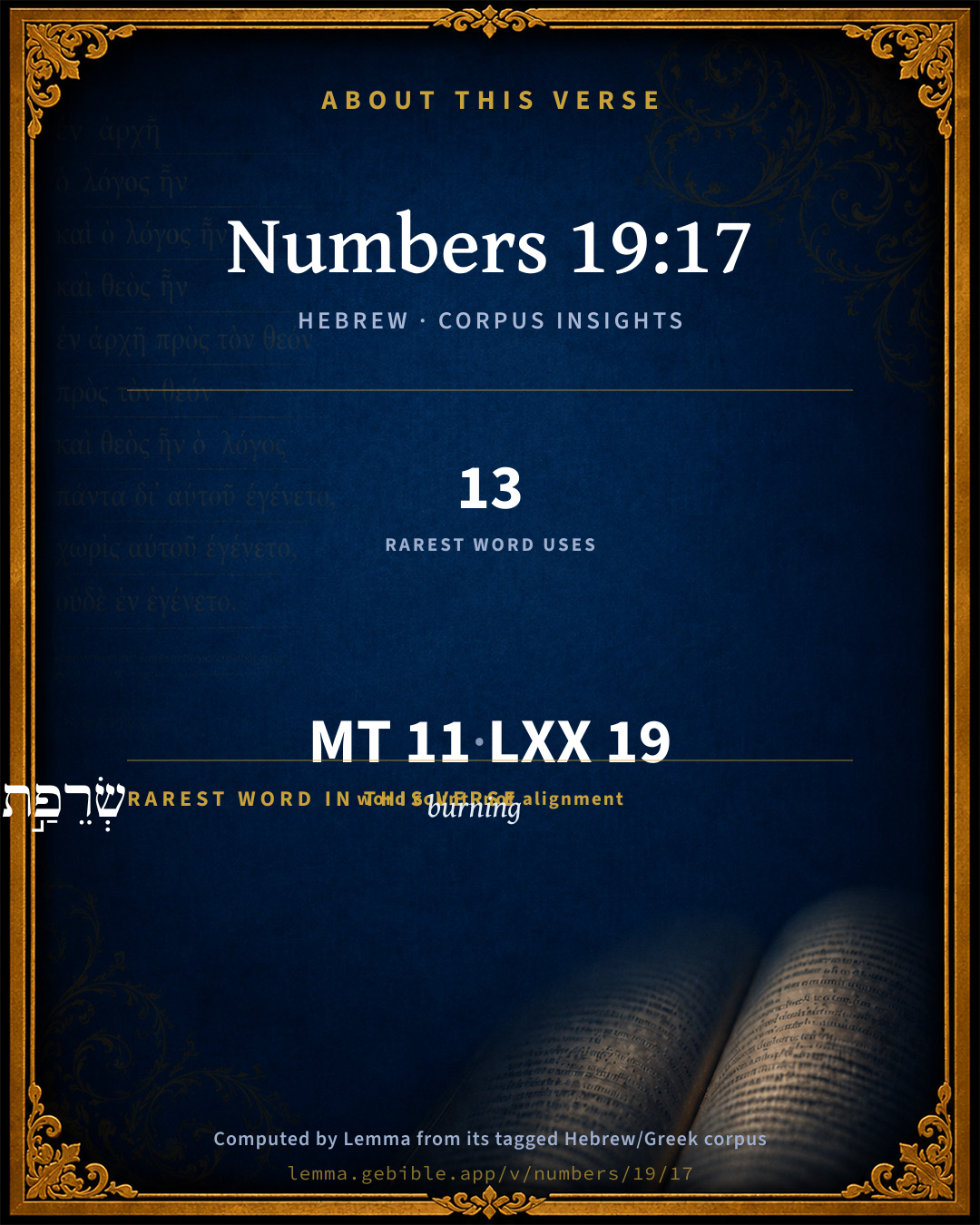
The rarest word here is שְׂרֵפַ֣ת burning H8316 — appearing just 13 times in the whole Hebrew Bible.

Shared distinctive vocabulary

שְׂרֵפַ֣ת burning H8316 occurs in 12 verses of the Hebrew Bible. Also found in:

Grammatical profile

  • 2 verbs
  • 5 nouns
  • 2 adjectives
  • 2 prepositions

Verb forms

  • וְלָֽקְחוּ֙ Qal · Sequential Perfect
  • וְנָתַ֥ן Qal · Sequential Perfect

Hebrew & Septuagint length

In English translation the verse runs 25 words from the Hebrew and 24 from the Septuagint (LXX English) — closely comparable.

A rough comparison of the two English renderings, which tokenize alike — not a word-level alignment.

Word counts can differ between the Hebrew and the Greek without any difference in meaning — e.g. the Hebrew direct-object marker אֵת has no separate Greek word, and Greek often adds the article ὁ.

In the original languages it is 11 Hebrew tokens and 19 Greek tokens — but the two are counted differently (Hebrew bundles its prefixes and suffixes into one token; the Greek is in lemma form), so that isn’t a like-for-like length.

Cross-references

6

Topical passages linked to Numbers 19:17 in the Treasury of Scripture Knowledge — connected by theme and wording, ordered by reader-vote popularity; previews shown in the World English Bible.

  • Genesis 26:19 Isaac's servants dug in the valley, and found there a well of springing water.
  • Numbers 19:9 A man who is clean shall gather up the ashes of the heifer, and lay them up outside of the camp in a clean place; and it shall be kept for the congregation of the children of Israel for a water for impurity: it is a sin-offering.
  • Song of Solomon 4:15 A fountain of gardens, A well of living waters, Flowing streams from Lebanon. Beloved
  • John 4:10–11 Jesus answered her, "If you knew the gift of God, and who it is who says to you, 'Give me a drink,' you would have asked him, and he would have given you living water."
  • John 7:38 He who believes in me, as the Scripture has said, from within him will flow rivers of living water."
  • Revelation 7:17 for the Lamb who is in the midst of the throne shepherds them, and leads them to springs of waters of life. And God will wipe away every tear from their eyes."

Cross-references courtesy of OpenBible.info (CC BY 4.0).

Hebrew and Greek witnesses Masoretic Hebrew ↔ Greek Septuagint

The same verse in the two great witnesses to the Old Testament, shown verse-for-verse.

These are two independent witnesses, not word-aligned to each other, and the Septuagint is shown in lemma (dictionary) form.

Hebrew Numbers 19:17 Masoretic · Westminster Leningrad Codex

וְלָֽקְחוּ֙ לַטָּמֵ֔א מֵעֲפַ֖ר שְׂרֵפַ֣ת הַֽחַטָּ֑את וְנָתַ֥ן עָלָ֛יו מַ֥יִם חַיִּ֖ים אֶל כֶּֽלִי

For the unclean they shall take of the ashes of the burning of the sin-offering; and running water shall be put thereto in a vessel:

World English Bible · Public Domain

Greek LXX Numbers 19:17 Septuagint · lemma form

καί λαμβάνω ὁ ἀκάθαρτος ἀπό ὁ σποδιά ὁ κατακαίω ὁ ἁγνισμός καί ἐκχέω ἐπί αὐτός ὕδωρ ζάω εἰς σκεῦος

And they shall take for the unclean of the burnt ashes of purification, and they shall pour upon them running water into a vessel.

LXX2012 (modern English Septuagint) · Public Domain

On this verse, The Pulpit Commentary discusses the Septuagint’s reading. Read the note in Commentary ↓

Hebrew: Westminster Leningrad Codex (CC BY 4.0). Greek: Septuagint (public domain); English from LXX2012 (modern English Septuagint) (Public Domain). How the Septuagint differs from the Hebrew →

Targum (Aramaic paraphrase)

2

The Targum is the ancient Jewish Aramaic paraphrase of the Hebrew Scriptures — an interpretive translation, not the Hebrew text itself. Onkelos (literal) and Pseudo-Jonathan (expansive) render the Torah, and Jonathan the Prophets. Coverage is partial: where no permissively-licensed English translation exists for a verse, only the Aramaic is shown. This is verse-level text, not a word-by-word alignment to the Hebrew.

  1. Targum Onkelos Torah (Genesis–Deuteronomy)
    וְיִסְבוּן לְדִמְסָאָב מֵעֲפַר יְקִידַת חַטָאתָא וְיִתֵּן עֲלוֹהִי מֵי מַבּוּעַ לְמָן

    (no public-domain English translation for this verse)

    Targum Onkelos — Aramaic: “Onkelos Genesis” (public domain); “Onkelos Exodus” (public domain); “Onkelos Leviticus” (public domain); “Onkelos Numbers” (public domain); “Onkelos Deuteronomy” (public domain). English: “Sefaria Community Translation” (CC0 1.0 (public-domain dedication)); “J.W. Etheridge. The Targums of Onkelos and Jonathan Ben Uzziel on the Pentateuch. London: Longmans, Green, 1862” (public domain). Text via Sefaria.

  2. Targum Pseudo-Jonathan Torah (Genesis–Deuteronomy)
    וְיִסְבוּן לְדִמְסָאָב מִן עֲפַר יְקִידַת חַטָאתָא וְיִתֵּן עֲלוֹי מֵי מַבּוּעַ לְגוֹ מַאן דְפָחַר

    And for him who is unclean, they shall take of the ashes of the burnt sin offering, and put spring water upon them in an earthen vessel.

    Targum Pseudo-Jonathan — Aramaic: “Targum Jonathan on Genesis” (public domain); “Targum Jonathan on Exodus” (public domain); “Targum Jonathan on Leviticus” (public domain); “Targum Jonathan on Numbers” (public domain); “Targum Jonathan on Deuteronomy” (public domain). English: “The Targum of Jonathan ben Uzziel, trans. J. W. Etheridge, London, 1862” (public domain). Text via Sefaria.

Commentary

Notes on Numbers 19:17 from classic Christian and Jewish commentators (each source and its license shown beneath its notes). The classic Christian expositions comment on the surrounding passage and are grouped to its opening verse, so a note may address several verses; the Jewish commentaries on the Tanakh (Rashi and others) are per-verse, so they appear only where the commentator wrote on this verse.

Lemma curates 59 commentaries, every one of them public domain or Creative Commons licensed, each selected and text-cleaned for this edition rather than reprinted as found. About our sources →

Trapp's Complete Commentary

John Trapp

Num 19:17 And for an unclean [person] they shall take of the ashes of the burnt heifer of purification for sin, and running water shall be put thereto in a vessel:

Ver. 17. And running water.] Signifying the ashes of Christ’s merit, and the water of his Spirit. See 1Co 6:11 Joh 7:38-39.

John Trapp, A Commentary or Exposition upon All the Books of the Old and New Testament (1647–1656) — public domain. Text from a community e-Sword module.

Tyndale Open Study Notes

Tyndale Open Resources

19:17-22 To cleanse with the heifer’s ashes, a special purifying mixture was made by combining ashes from the burnt purification offering with fresh water (cp. 5:17).

Tyndale Open Study Notes — © Tyndale Open Resources, licensed CC BY-SA 4.0. Text via the HelloAO Bible API.

Geneva Bible (1599)

Geneva Bible translators

Of the red cow burnt for sin.

Water of the fountain or river.

Geneva Bible (1599) marginal notes — public domain. Text via Bolls.life.

Ellicott's Commentary for English Readers

(17) of the ashes of the burnt heifer of purification for sin.—Better, of the ashes of the burnt sin-offering; literally, of the burning of the sin-offering.

A Bible Commentary for English Readers, edited by Charles John Ellicott (1878–1897) — public domain. Text from a community e-Sword module.

The Cambridge Bible for Schools and Colleges

gen. ed. J. J. S. Perowne

17. the sin-offering] The word is used in the same sense as in Num_19:9.

running water] Water fresh from a running stream. This is more explicit than the former account, in which (Num_19:9) the mixing of water with the ashes is taken for granted.

The Cambridge Bible for Schools and Colleges (gen. ed. J. J. S. Perowne; Cambridge University Press, 1878–1918) — public domain. Text from a community e-Sword module.

John Gill's Exposition

And for an unclean person,.... Defiled by any of the above means:

they shall take of the ashes of the burnt heifer of purification for sin; from the place where they were laid up for this use; See Gill on Num 19:9 and some have thought that they were laid up in various cities and places in the country, as well as at Jerusalem, that they might be come at easily upon occasion; otherwise they could not be had without great trouble and expense, and in some places not so soon as the law required for their purification, namely, on the third day after their defilement:

and running water shall be put thereto in a vessel; the Targum Jonathan is,"fountain water in the midst of earthen vessel;''for no water but fountain, spring, or river water, was made use of; and it should seem by what is said that ashes were first put into the vessel, and then the running water was put to them; and yet the Jewish writers say (s), that if the ashes were put in first, and then the water, it was not right; and the meaning of what is said here is, that the water and ashes should be mixed together; for it is urged from the words: "running water in a vessel", that it is plain, that the water is put in the vessel and not to the ashes; and therefore that which is said, "shall be put thereto", is to caution the person, that after he has put the ashes upon the water, that he mixes them well with his finger, and cause the water below to rise above (t).

(s) Maimon. Milchot, Parah Adumah, c. 9. sect. 1. (t) Bartenora in Misn. Temurah, c. 1. sect. 5.

John Gill's Exposition of the Whole Bible (1746–1763) — public domain (CC PDM 1.0). Text via the HelloAO Bible API.

Haydock's Catholic Bible Commentary

Burning of the red cow, which was also a sin-offering, ver. 9. (Haydock) --- Upon the ashes they poured some running or spring water. The pagans generally preferred the water of the sea; or if they could not procure any, they mixed salt with common water. Ovid (Fast iv,) mentions a lustration made with the ashes of a calf, mixed with horse blood; and another, which was used in honour of Pales, the goddess of harvests, by the oldest virgins present, who sprinkled the ashes of calves, populos purget ut ille cinis. Athenæus (ix. 18,) observes that a stick was taken from the fire of the altar, was extinguished in water for the purification of the unclean; and the ancient Romans, who had been at a funeral, sprinkled themselves with water, and jumped over fire for the same purpose; as the Greeks were accustomed to place a vessel full of water, at the doors where a corpse was lying, that all might purify themselves when they came out. (Calmet)

George Leo Haydock (1774–1849), Haydock's Catholic Family Bible and Commentary, 1859 edition — public domain. Excludes Psalms (Douay-Rheims chapter numbering differs from Protestant) and Deuterocanonical books (Catholic canon only).

Matthew Poole's English Annotations

Running water, i.e, waters flowing from a spring or river which are the purest. These manifestly signify God’s Spirit, which is oft compared to water, Joh 7:38,39, and by which alone true purification is obtained.

In a vessel, where they were to be mixed, and then the water was to be strained out and kept for this use.

Matthew Poole's English Annotations on the Holy Bible (1683–1685) — public domain. Text from a community e-Sword/MySword module.

Whedon's Commentary on the Bible

Daniel D. Whedon

17. Running water — Living, that is, pure water.

Daniel D. Whedon (gen. ed.), Commentary on the Old and New Testaments (1874–1909) — public domain. Text from a community e-Sword module.

The Pulpit Commentary

Running water. Septuagint, udwr zwn . (cf. Lev_14:5 Joh_4:10)

The Pulpit Commentary (1880–1919), ed. H.D.M. Spence-Jones & Joseph S. Exell — public domain. Text from a community e-Sword module.

John Wesley's Explanatory Notes

Running water - Waters flowing from a spring or river, which are the purest. These manifestly signify God's spirit, which is oft compared to water, and by which alone true purification is obtained. Those who promise themselves benefit by the righteousness of Christ, while they submit not to the influence of his spirit, do but deceive themselves; for they cannot be purified by the ashes, otherwise than in the running water.

John Wesley, Explanatory Notes Upon the Whole Bible (1754–1765) — public domain. Text via the GEBible commentary corpus.

Scofield Reference Notes

C. I. Scofield

for an unclean

(See Scofield "Num 19:2"). See Scofield "Joh 13:10".

The Scofield Reference Bible (1917 edition), notes by C. I. Scofield — public domain. Text from a community e-Sword module.

unfoldingWord translationNotes

Door43 World Missions Community

General Information:

The idea of "unclean" represents not being acceptable to God or fit for use. (See: Metaphor)

General Information:

The ideas of "clean" and "purify" here represent being acceptable to God. (See: Metaphor)

translationWords

ash

sin offering

clean

pure

unfoldingWord translationNotes — © Distant Shores Media and the Door43 World Missions Community, licensed CC BY-SA 4.0. Source: git.door43.org/Door43/en_tn.

Ramban (Nachmanides)

Rabbi Moshe ben Nachman (Ramban / Nachmanides)

AND HE SHALL PUT UPON IT RUNNING WATER INTO A VESSEL. The meaning thereof is not that he should first put the ashes [of the Red Heifer] into the vessel and then put the water upon the ashes, for our Rabbis have taught that if one places the ashes in the vessel first and then the water, it invalidates [the water, so that it may not be used as water of purification]. They derived this law from the expression, running water into a vessel, which implies that the running water [alone] should be put into the vessel [i.e., there should be nothing-such as the ashes — intervening between the water and the vessel]. Perhaps they deduced it because He did not say: “And for the unclean they shall take of the ashes of the burnt heifer of purification into a vessel, and he shall put upon it running water.” But [since Scripture put it in the reverse order: And for the unclean they shall take of the ashes of the burnt heifer of purification — and running water he shall put thereto in a vessel], the meaning of the verse is as follows: “and he shall put upon the ashes the running water which was [already] in the vessel,” meaning that he should mix the ashes with the water which was in the vessel until the water flows over them.

Ramban (Nachmanides) on the Tanakh — English translation: “Commentary on the Torah by Ramban (Nachmanides). Translated and annotated by Charles B. Chavel. New York, Shilo Pub. House, 1971-1976” (CC BY 4.0). Text via Sefaria.

Lesson kit

Teaching starters — assembled from the data on this page, not authored interpretation. Every prompt links to the verse data it draws on. Edit before teaching.

Numbers, in the Pentateuch, opens this verse with 11 words (11 distinct Hebrew lemmas). Its most distinctive word is sᵉrêphâh (“burning”). A historical commentator’s framing appears above. Read the whole chapter for the surrounding context.

Discussion questions

  1. How does “burning” (sᵉrêphâh) shape what this verse is saying?
  2. Genesis 11:3 shares the word «burning» with this verse. How do the two illuminate each other?
  3. The translations on this page render this verse differently — a whole-verse word diff, not a word-by-word alignment. What might account for the different wordings?
  4. The verb «וְלָֽקְחוּ֙» is Qal Sequential Perfect. How does its form color the action?
  5. Reading how Trapp's Complete Commentary and Tyndale Open Study Notes read this verse, where do the two commentators agree and where do they part?

Things to notice

Reading settings

Reading text

Shown beneath each verse's original-language words.

Old Testament
Old Testament edition

Read the OT as the Masoretic Hebrew (MT) or the Greek Septuagint (LXX).

English shown for the Greek Septuagint (in the Hebrew ↔ Greek comparison).

Comparing translations? Open the Compare panel on any verse page to stack up to four side by side.