
Zechariah 11:15

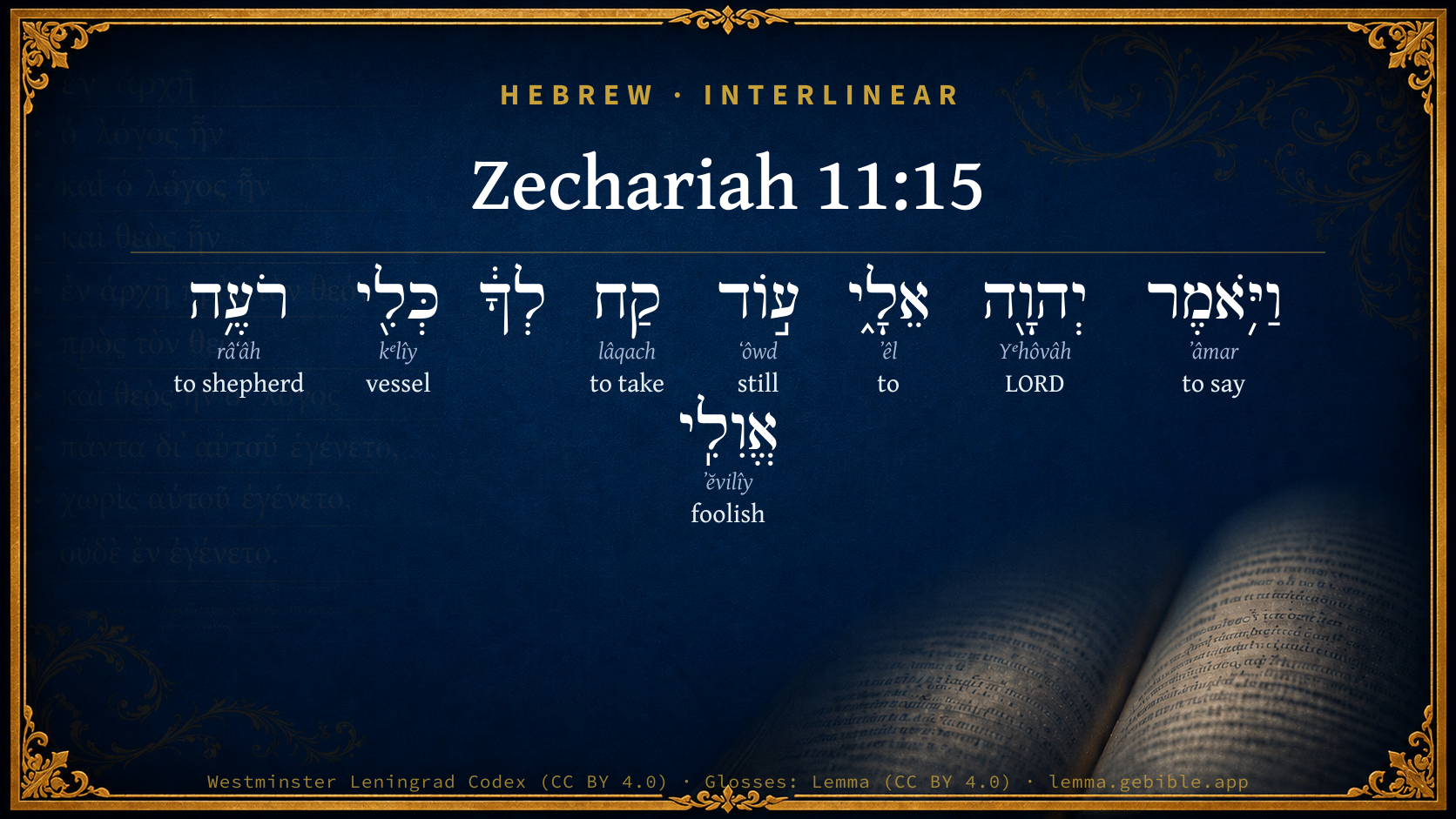
Hebrew (Westminster Leningrad Codex) Zechariah 11:15 appears in the Hebrew Old Testament. The text above is from the Westminster Leningrad Codex. Each word links to its Strong’s number, a concise gloss, and parsing drawn from the Open Scriptures Hebrew Bible morphology. Click any word for its full Brown-Driver-Briggs (BDB) entry.
Download image
Cite this verse

Zechariah 11:15 (World English Bible). Public Domain. Lemma interlinear Bible study tool, https://lemma.gebible.app/v/zechariah/11/15.

Show BibTeX & RIS
BibTeX
RIS
English Translation
Yahweh said to me, "Take for yourself yet again the equipment of a foolish shepherd.
World English Bible · Public Domain
Highlights
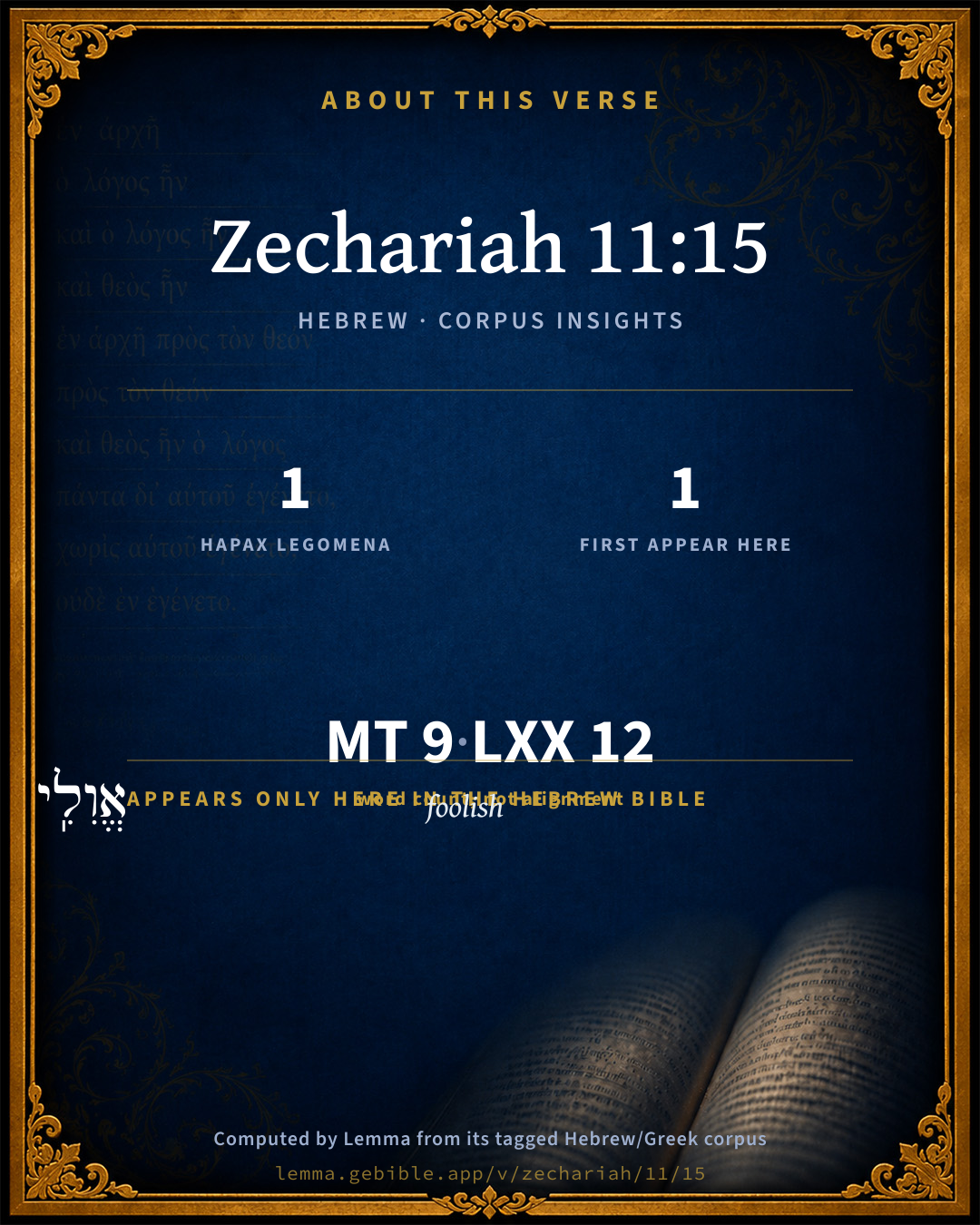
  • 1 hapax legomenon — only here in the Hebrew Bible
  • 1 first appearance in the Hebrew Bible
Full analysis ↓
Download a study sheet

One document with this verse’s original text, its word-by-word gloss line, the meaning frame, cross-references with their text, attributed commentary, and full source and license credits — printable, and it pastes into notes with its structure intact.

This verse Autodidact and up

Study sheet (.html) Plain text (.txt)

A passage Seminary Student

Up to 50 verses in one chapter. A passage sheet keeps up to 6 commentary sources and 12 cross-references per verse, in the order this page ranks them, and says so on the sheet whenever that leaves anything out. Ask for a single verse and you get the Autodidact verse sheet above.

Everything on this page stays free to read, with no account — the sheet is a download of what is already on screen, not access to it.

Want to remove ads? Support Godless Engineer
Compare translations 3

The same verse in 3 English versions, stacked beneath the original-language interlinear above. Click any original word for its lexicon entry.

Each is an independent rendering of the whole verse — the interlinear is not word-aligned to these translations.

Highlighted words mark where these versions differ — a whole-verse word diff, not a word-by-word alignment.

  • World English Bible Public Domain
    Yahweh said to me, "Take for yourself yet again the equipment of a foolish shepherd.
  • King James Version Public Domain
    And the LORD said unto me, Take unto thee yet the instruments of a foolish shepherd.
  • unfoldingWord Literal Text CC BY-SA 4.0
    Yahweh said to me, “Again, take the equipment of a foolish shepherd for yourself,

unfoldingWord Literal Text — © unfoldingWord, licensed CC BY-SA 4.0. Word-aligned USFM3 via Door43 (git.door43.org/unfoldingWord/en_ult).

Versions to compare (up to 4)

3 of 4 selected

Show all 18 translations

Every available English version of this verse, each an independent rendering of the whole verse.

  • World English Bible Public Domain
    Yahweh said to me, "Take for yourself yet again the equipment of a foolish shepherd.
  • Berean Standard Bible Public Domain
    And the LORD said to me: “Take up once more the equipment of a foolish shepherd.
  • Majority Standard Bible Public Domain
    And the LORD said to me: “Take up once more the equipment of a foolish shepherd.
  • King James Version Public Domain
    And the LORD said unto me, Take unto thee yet the instruments of a foolish shepherd.
  • American Standard Version (1901) Public Domain
    And Jehovah said unto me, Take unto thee yet again the instruments of a foolish shepherd.
  • Revised Version (1885) Public Domain
    And the LORD said unto me, Take unto thee yet again the instruments of a foolish shepherd.
  • Geneva Bible (1599) Public Domain
    And the Lord said vnto me, Take to thee yet the instruments of a foolish shepheard.
  • Douay-Rheims (1899) Public Domain
    And the Lord said to me: Take to thee yet the instruments of a foolish shepherd.
  • Young's Literal Translation Public Domain
    And Jehovah saith unto me, `Again take to thee the instrument of a foolish shepherd.
  • Literal Standard Version CC BY-SA 4.0
    And YHWH says to me, “Again take to yourself the instrument of a foolish shepherd.
  • Unlocked Literal Bible CC BY-SA 4.0
    Yahweh said to me, “Again, take the equipment of a foolish shepherd for yourself,
  • unfoldingWord Literal Text CC BY-SA 4.0
    Yahweh said to me, “Again, take the equipment of a foolish shepherd for yourself,
  • Darby Bible Public Domain
    And Jehovah said unto me, Take unto thee yet the instruments of a foolish shepherd.
  • World Messianic Bible Public Domain
    The LORD said to me, “Take for yourself yet again the equipment of a foolish shepherd.
  • Webster's Bible Public Domain
    And the LORD said to me, Take to thee yet the instruments of a foolish shepherd.
  • Free Bible Version CC BY-SA 4.0
    The Lord told me, Get the things you use as a shepherd, a useless shepherd.
  • Bible in Basic English Public Domain
    And the Lord said to me, Take again the instruments of a foolish keeper of sheep.
  • JPS Tanakh (1917) Public Domain
    And the LORD said unto me: 'Take unto thee yet the instruments of a foolish shepherd.

Literal Standard Version (2020), Covenant Press — licensed CC BY-SA 4.0. Text via the HelloAO Bible API (eBible.org). Unlocked Literal Bible (unfoldingWord) — licensed CC BY-SA 4.0. Text via the HelloAO Bible API (eBible.org). unfoldingWord Literal Text — © unfoldingWord, licensed CC BY-SA 4.0. Word-aligned USFM3 via Door43 (git.door43.org/unfoldingWord/en_ult). Free Bible Version, Dr. Jonathan Gallagher — licensed CC BY-SA 4.0. Text via the HelloAO Bible API (eBible.org).

Word by word

More ways to search: Search by grammar → Find every occurrence → Compare this word →

Practice this passage: Drill this verse → Learn its vocabulary →

About this verse

These counts appear in no published source. They are computed here, from the morphology-tagged text and Lemma’s own curated glosses. What Lemma adds →

9
words
8
distinct lemmas
Prophets
section

Notable vocabulary

1 hapax legomenon — a word that appears only here in the entire Hebrew Bible:

  • אֱוִלִֽי foolish H196

First appearance in Scripture

This word makes its first canonical appearance in the Hebrew Bible here:

  • אֱוִלִֽי foolish H196

Grammatical profile

  • 3 verbs
  • 2 nouns
  • 1 adjective
  • 2 prepositions
  • 1 adverb

Verb forms

  • וַיֹּ֥אמֶר Qal · Sequential Imperfect
  • קַח Qal · Imperative
  • רֹעֶ֥ה Qal · Participle Active

Hebrew & Septuagint length

In English translation the verse runs 15 words from the Hebrew and 17 from the Septuagint (LXX English) — closely comparable.

A rough comparison of the two English renderings, which tokenize alike — not a word-level alignment.

Word counts can differ between the Hebrew and the Greek without any difference in meaning — e.g. the Hebrew direct-object marker אֵת has no separate Greek word, and Greek often adds the article ὁ.

In the original languages it is 9 Hebrew tokens and 12 Greek tokens — but the two are counted differently (Hebrew bundles its prefixes and suffixes into one token; the Greek is in lemma form), so that isn’t a like-for-like length.

Cross-references

7

Topical passages linked to Zechariah 11:15 in the Treasury of Scripture Knowledge — connected by theme and wording, ordered by reader-vote popularity; previews shown in the World English Bible.

  • Isaiah 6:10–12 Make the heart of this people fat; Make their ears heavy, and shut their eyes; Lest they see with their eyes, And hear with their ears, And understand with their heart, And turn again, and be healed."
  • Jeremiah 2:26–27 As the thief is ashamed when he is found, so is the house of Israel ashamed; they, their kings, their princes, and their priests, and their prophets;
  • Lamentations 2:14 Your prophets have seen for you false and foolish visions; They have not uncovered your iniquity, to bring back your captivity, But have seen for you false oracles and causes of banishment.
  • Ezekiel 13:3 Thus says the Lord Yahweh, Woe to the foolish prophets, who follow their own spirit, and have seen nothing!
  • Matthew 15:14 Leave them alone. They are blind guides of the blind. If the blind guide the blind, both will fall into a pit."
  • Matthew 23:17 You blind fools! For which is greater, the gold, or the temple that sanctifies the gold?
  • Luke 11:40 You foolish ones, didn't he who made the outside make the inside also?

Cross-references courtesy of OpenBible.info (CC BY 4.0).

Hebrew and Greek witnesses Masoretic Hebrew ↔ Greek Septuagint

The same verse in the two great witnesses to the Old Testament, shown verse-for-verse.

These are two independent witnesses, not word-aligned to each other, and the Septuagint is shown in lemma (dictionary) form.

Hebrew Zechariah 11:15 Masoretic · Westminster Leningrad Codex

וַיֹּ֥אמֶר יְהוָ֖ה אֵלָ֑י ע֣וֹד קַח לְךָ֔ כְּלִ֖י רֹעֶ֥ה אֱוִלִֽי

Yahweh said to me, "Take for yourself yet again the equipment of a foolish shepherd.

World English Bible · Public Domain

Greek LXX Zechariah 11:15 Septuagint · lemma form

καί εἶπον κύριος πρός ἐγώ ἔτι λαμβάνω σεαυτοῦ σκεῦος ποιμενικός ποιμήν ἄπειρος

And the Lord said to me, Take yet to you shepherd's implements belonging to an unskillful shepherd.

LXX2012 (modern English Septuagint) · Public Domain

Hebrew: Westminster Leningrad Codex (CC BY 4.0). Greek: Septuagint (public domain); English from LXX2012 (modern English Septuagint) (Public Domain). How the Septuagint differs from the Hebrew →

Targum (Aramaic paraphrase)

1

The Targum is the ancient Jewish Aramaic paraphrase of the Hebrew Scriptures — an interpretive translation, not the Hebrew text itself. Onkelos (literal) and Pseudo-Jonathan (expansive) render the Torah, and Jonathan the Prophets. Coverage is partial: where no permissively-licensed English translation exists for a verse, only the Aramaic is shown. This is verse-level text, not a word-by-word alignment to the Hebrew.

  1. Targum Jonathan Prophets (Joshua–Malachi)
    וַאֲמַר יְיָ לִי עוֹד אֵיזֵיל אִתְנַבֵּי עַל פַּרְנְסָא טִפְּשָׁא:

    (no public-domain English translation for this verse)

    Targum Jonathan — Aramaic: “Mikraot Gedolot” (public domain). English: “Sefaria Community Translation” (CC0 1.0 (public-domain dedication)); “London "Chaldee Paraphrase," 1871” (public domain). Text via Sefaria.

Commentary

Notes on Zechariah 11:15 from classic Christian and Jewish commentators (each source and its license shown beneath its notes). The classic Christian expositions comment on the surrounding passage and are grouped to its opening verse, so a note may address several verses; the Jewish commentaries on the Tanakh (Rashi and others) are per-verse, so they appear only where the commentator wrote on this verse.

Lemma curates 59 commentaries, every one of them public domain or Creative Commons licensed, each selected and text-cleaned for this edition rather than reprinted as found. About our sources →

Matthew Henry's Commentary

God, having shown the misery of this people in their being justly abandoned by the good Shepherd, here shows their further misery in being shamefully abused by a foolish shepherd. The prophet is himself to personate and represent this pretended shepherd (Zac 11:15): Take unto thee the instruments or accoutrements of a foolish shepherd, that are no way fit for the business, such a shepherd's coat, and bag, and staff, as a foolish shepherd would appear in; for such a shepherd shall be set over them (Zac 11:16), who, instead of protecting them, shall oppress them and do them mischief. 1. They shall be under the inspection of unfaithful ministers. Their scribes, and priests, and doctors of their law, shall bind heavy burdens upon them, and grievous to be borne, and, with their traditions imposed, shall make the ceremonial law much more a yoke than God had made it. The description here given of the foolish shepherd suits very well with the character Christ gives of the scribes and Pharisees, Mat 23:2. They shall be under the tyranny of unmerciful princes, that shall rule them with rigour, and make their own land as much a house of bondage to them as ever Egypt or Babylon was. When they had rejected him by whom princes decree justice it was just that they should be turned over to those who decree unrighteous decrees. 3. They shall be imposed upon and deluded by false Christs and false prophets, as our Saviour foretold, Mat 24:5. Many such there were, who by their seditious practices provoked the Romans, and hastened the ruin of the Jewish nation; but it is observable that they were never cheated by a counterfeit Messiah till they had refused and rejected the true Messiah. Now observe,

I. What a curse this foolish shepherd should be to the people, Zac 11:16. God will, for their punishment, raise up a foolish shepherd, who will not do the duty of a shepherd; he will not visit those that are cut off, nor go after those that go astray, nor seek those that are missing, to find them out and bring them home, as the good shepherd does, Mat 18:12, Mat 18:13. Their shepherds take no care of the young ones, that need their care and are well worthy of it, as Christ does, Isa 40:11. They do not heal that which was broken, which was worried and torn, but let it die of its bruises, when a little thing, in time, would have saved it. They do not feed those who, through weakness, stand still, and are ready to faint, and cannot get forward, but leave them behind, let who will take them up; they do not carry that which stands still (so some read it); they never do any thing to support the weak and comfort the feeble-minded; but, on the contrary, 1. They are luxurious themselves: They eat of the flesh of the fat; they will have of the best for themselves; and, like that wicked servant that said, My lord delays his coming, they eat and drink with the drunken, and serve their own bellies. 2. They are barbarous to the flock. Their passions are as ill-governed as their appetites, for, when they are in a rage against any of the flock, they tear their very claws in pieces by over-driving them; they beat their hoofs; they smite their fellow servants. Woe unto thee, O land! when thy king is such a child!

II. What a curse this foolish shepherd should bring upon himself (Zac 11:17): Woe to the idol-shepherd, who, like an idol, has eyes and sees not, who, like an idol, receives abundance of respect and homage from the people and the chief of their offerings, but neither can nor will do them any kindness. He leaves the flock when they most need his care, leaves them destitute, and flees, because he is a hireling; his doom is that the sword of God's justice shall be upon his arm and his right eye, so that he shall quite lose the use of both. His arm shall wither and be dried up, so that he who would not help his friends when it was required shall not know how to help himself; his right eye shall be utterly darkened, that he shall not discern the danger that his flock is in, nor know which way to look for relief. This was fulfilled when Christ said to the Pharisees, I have come that those who see may be made blind, Joh 9:39. Those that have gifts which qualify them to do good, if they do not do good with them, shall be deprived of them; those that should have been workmen, but were slothful and would do nothing, will justly have their arm dried up; and those that should have been watchmen, but were sleepy and would never look about them, will justly have their eye blinded.

Matthew Henry's Commentary on the Whole Bible (1708–1710) — public domain (CC PDM 1.0). Text via the HelloAO Bible API.

The Cambridge Bible for Schools and Colleges

gen. ed. J. J. S. Perowne

15. the instruments of a foolish shepherd] There is no reason to suppose that “the instruments,” the staff and scrip, of a foolish shepherd differed from those of a wise one, and so in themselves indicated his character. The command is: “Again take to thee (as thou didst before, Zec_11:7) the instruments of a shepherd, (but this time let him be) a foolish one.” The punishment of rejecting the Good Shepherd was to be not only the loss of Him, but the substitution of an evil shepherd in His place.

15–17. The foolish shepherd, Zec_11:15; the misery he inflicts upon the flock, Zec_11:16; and his doom, Zec_11:17.

The Cambridge Bible for Schools and Colleges (gen. ed. J. J. S. Perowne; Cambridge University Press, 1878–1918) — public domain. Text from a community e-Sword module.

Trapp's Complete Commentary

John Trapp

Zec 11:15 And the LORD said unto me, Take unto thee yet the instruments of a foolish shepherd.

Ver. 15. Take unto thee yet the instruments of a foolish shepherd] And so represent in a type, or figure, the wicked and depraved government, that, for a just punishment of their frowardness and uuthankfulness, I shall set up among this people. "The instruments of a foolish shepherd," that is, of an oppressive and self-seeking magistrate, are not virga et pedum, a rod and a staff, but forcipes et mulctra, shears to clip them and a milk pail to drain them. Lac et lana Milk and fleece are all they look after. Now it is threatened as a heavy curse, Lev 26:17, They that hate you shall reign over you; mischievous, malignant princes, such as are described in the next verse. England was once called the Pope’s ass, for bearing his burdens and impositions. An Emperor of Germany said, for the like reason, that the king of France was king of asses, rather than of men ( Rex hominum Hispanus, asinorum Gallus, Regum ego, dixit Maximil.). King John of England’s exactors received from his subjects no less sums of curses than of coin, saith our chronicler. He gathered money, the sinews of war; but lost their affections, the joints of peace. A taxation by the poll, first granted to Edward III, became a precedent to the next reign; and caused therein the first and greatest popular insurrection that ever was seen in this kingdom, saith another of our historians. And what sad effects poll money, ship money, coat and conduct money, and other oppressive practices have lately produced among us, is well known to all. But what a cruel shepherd was that prince mentioned by Melancthon, that when he wanted money would send for such and such a rich subject of his, and require of him what he pleased. If the man denied to bring it, he would knock out first one of his teeth, and then another, threatening to do the like by all the rest, in case the money were not brought in by such a time! Was not this one of those foolish, or rather furious shepherds in the next verse, who do eat the flesh of the fat, and tear their claws in pieces? that shall eat thy fruit, and drink thy milk, as another prophet phraseth it, Eze 25:4. Fisco potius apud multos consulitur quam Christo; attonsioni potius gregis quam attentioni, as Bishop Andrews truly complaineth. And no less justly Mr Bolton. Some follow the administration of justice as a trade only; with an unquenchable and unconscionable desire of gain; which justifieth the common resemblance of ill governors to the bush, whereto while the sheep fleeth for defence in weather, he is sure to lose a good part of his fleece. Hence many that seek to courts of justice to be righted, are so ill handled, that they come to be of Themistocles’ mind; who professed, that if two ways were shown to him, one to hell and the other to the bar, he would choose that which went to hell, and forsake the other.

John Trapp, A Commentary or Exposition upon All the Books of the Old and New Testament (1647–1656) — public domain. Text from a community e-Sword module.

The Biblical Illustrator

Joseph S. Exell

Zec_11:15-16

Take unto thee yet the instruments of a foolish shepherd

The instruments of a foolish shepherd

The command addressed to the prophet was, to take unto him yet the instruments of a foolish shepherd.

Yet means again, once more. Beauty and bands were also instruments of a foolish shepherd. He was to take other instruments so as to manifest more visibly and strikingly what a foolish shepherd is. By foolish understand ungodly, unregenerate, destitute of heavenly imparted wisdom, and therefore in Gods account a fool. The foolish shepherd is therefore a natural man lifted up by education, pride, covetousness, or presumption into a pulpit, and devoid of spiritual illumination and heavenly wisdom. He has certain instruments which the prophet was to take as emblems of his character. What they were the Holy Ghost has not here informed us, but as we may gather them from other parts of Scripture I shall take the liberty to put them into his hand.

1. A mask. The thing it represents, namely, deceit and imposture, is as old as the times of Jannes and Jambres. To wear a mask is to play a false part, to assume a fictitious character, to be a stage player; for in ancient times the actors never appeared but in masks, the features of which imitated the persons they represented. Thus the foolish shepherd makes the people his stage, his holy countenance being his mask, and his false zeal loud speech, and impassioned rant his wardrobe; and thus by craft and cunning he entangles the simple in his net.

2. A sceptre. The badge of authority and power.

3. A pair of sharp shears; for we read that they clothe themselves with the wool, and of course must have something to get the wool off with. To receive what is voluntarily given is a different thing from clipping off as much wool as possible, or cutting so close as to fetch blood, and take off a bit of the skin.

4. A long whip that shall reach every corner of the pen, to flog all that stir up the enmity of his carnal mind, by what he calls a discontented mind.

5. A bow, and a quiver full of arrows; to reach those at a distance who are beyond the lash of the whip. Come now to his character, which the Holy Ghost has here drawn, and as we learn much from contraries, it will afford us an opportunity of seeing from the contrast what the wise shepherd is.

(1) The first thing said of this foolish shepherd is, that he shall not visit those that be cut off, meaning such as, by a work of the law in their consciences, are cut off from all creature righteousness, all false refuges, all deceitful homes and rotten props; from finding any good in self, or resting on the testimony of man. The margin gives another rendering, those that be hidden. Hidden from general view and observation. These cut off, hidden ones the foolish shepherd does not visit.

(2) Neither shall seek the young one. The new born babes, that desire the sincere milk of the Word. The foolish shepherd neglects these.

(3) He does not heal that which was broken. This may suggest those who have lost their first love, and backslidden from God.

(4) He feedeth not that that standeth still. Some of the Lords quickened family are reduced to such straits in soul experience as to be able to move neither forward nor backward. They are like sheep cast, and cannot get upon their legs. Such are the four negative marks of the foolish shepherd; the things that he does not do. There are two positive marks, things that he does do. He shall eat the flesh of the fat. He shall not take that which comes, that which is offered him, but he must go through the flock, and select the fattest for his own eating. And shall tear their claws in pieces. Sheep are said to have claws. And these they will sometimes exercise upon the shepherd. When, then, the foolish shepherd feels the scratch of their claws, he puts forth all his strength, and team them in pieces. (J. C. Philpot.)

.

The Biblical Illustrator, edited by Joseph S. Exell (c. 1880s–1900s) — public domain. Text from a community e-Sword module.

Joseph Benson's Commentary

Zec 11:15. And the Lord said, Take thee yet [or once more] the instruments of a foolish [or unwise] shepherd — The prophet, having hitherto represented the good shepherd, is now directed to assume the dress and equipage of one of a contrary character. As folly in the Scripture is equivalent to wickedness, by a foolish shepherd here may be meant, not only unskilful, but likewise ill-designing governors, or teachers, who should only intend their own advantage, and have no regard for the good of the flock, or people committed to their charge. The instruments of such a shepherd must be suitable to his own disposition and indiscretion, such as a crook armed with iron, which, whenever it was used, would wound the flock; and a scrip, or bag, which contained nothing useful for the sheep, and the like. The prophet here follows the order of time, that he may foretel the madness and blindness of the shepherds; that is, of the priests, rulers, and teachers of the Jewish nation, till the last destruction of Jerusalem; who not only disregarded religion, and the safety and welfare of the sheep, but even devoured such of them as were worth devouring.

Joseph Benson's Commentary on the Old and New Testaments (1811–1818) — public domain. Text from a community e-Sword module.

Whedon's Commentary on the Bible

Daniel D. Whedon

15. Jehovah said unto me — As on the former occasion (Zec_11:4).

Yet — R.V., “yet again.” Connects this command with the preceding one.

Take… the instruments of a… shepherd — The staves (Zec_11:7). The taking up of these shows that the shepherd is ready to begin the shepherding care of the flock; hence the command is practically equivalent to that in Zec_11:4.

Foolish — This time the prophet is to act the part of a foolish shepherd (Zec_11:7-8). Foolish is to be understood in a moral sense, as ordinarily in the Old Testament, equivalent to forgetful of duty, worthless (Zec_11:17). While this shepherd also would have staves, they could not be the same as those of the good shepherd (see on Zec_11:7).

Zec_11:16 does not point to the future from the standpoint of the prophet, but from that of Jehovah’s command. It states why the latter issued the command, and at the same time it supplies an interpretation of the symbolic action. Jehovah, who withdrew the good shepherd (Zec_11:13), determined to raise up one who would not protect and guard but hurt and destroy.

A shepherd in the land — Not a successor of the “three shepherds” (Zec_11:8), but of the good shepherd. Who is meant cannot be determined definitely. If Marti’s view concerning the three shepherds (see on Zec_11:8) and concerning the good shepherd (see at the close of comments on Zec_11:14) is correct it is not impossible that the foolish shepherd is Alcimus, who became high priest in 163 (compare 1Ma_7:5-25; 1Ma_9:54-57).

Visit — In a good sense, to take an interest in.

Those that be cut off — As in Zec_11:9 (compare Zec_11:5); he will leave them to their fate. Margin R.V., “lost”; but, since the lost ones are referred to in the next clause, the ordinary rendering is to be preferred.

The young one — Better, R.V., “those that are scattered.” If the text is correct, which may be doubted (see Eze_34:4), the translation of R.V. is to be preferred; at least it expresses the thought which one would expect. The foolish shepherd would not seek the lost, nor would he heal the injured, nor feed the sound.

That that standeth still — R.V., “that which is sound.” Another obscure expression, of which A.V. gives the more literal translation. Standeth is generally interpreted as the opposite of broken in the preceding clause; he does not look after the needs of the injured nor after those of the sound and strong. The translation feed also is uncertain; margin R.V. suggests “bear,” and the whole clause has been translated, “he does not bear the halting one,” that is, he does not lift up and carry in his arms the lamb or sheep that halts or comes to a standstill because of weariness (compare Joh_10:1-16). Though there may be uncertainty as to details, the thought expressed in all the clauses is that the foolish shepherd would not have the least care for the welfare of the flock (compare Eze_34:4).

But not only would he neglect the flock, he would even help to destroy it.

He shall eat the flesh of the fat — That is, of the fatlings of the flock. Instead of looking after the welfare of the flock he is concerned only with his own well-being, and to satisfy his own appetite he is ready to sacrifice the lives of the sheep (compare Isa_3:13-15).

Tear their claws in pieces — R.V., “hoofs.” This obscure phrase has received various interpretations. Some have thought that the reference is to the cruel practice of driving the flocks over rough roads; some have interpreted it of the intense greed of the shepherd which manifests itself in the tearing to pieces of the hoofs, so as to secure the last morsel of flesh or fat. Others have thought of the tearing of the hoofs, that the sheep might not wander too far, and thus give the shepherd trouble. The second interpretation is improbable, because one as greedy as this shepherd would hardly stop to gnaw the bones clean; he would rather kill another beast. The other interpretations are possible; in either case we would have a picture of extreme cruelty. The expression is peculiar and the text may have suffered; if so, we have no means of determining the original.

ALLEGORY OF THE FOOLISH SHEPHERD, Zec_11:15-17 (+ Zec_13:7-9.)

This allegory is the sequel of the allegory of the good shepherd; Zec_11:15-16, continues the record of the people’s experiences down to the present, Zec_11:17 turns to the future. The flock that rejected the good shepherd was not left to itself — it was given into the hands of a foolish shepherd, who worked havoc with it; but he is doomed, and the flock will be delivered (Zec_13:7-9). By the allegory the prophet teaches that the present miserable condition of the people is due to their own stubbornness, and at the same time he assures them that Jehovah will return in mercy and compassion at some future time.

Daniel D. Whedon (gen. ed.), Commentary on the Old and New Testaments (1874–1909) — public domain. Text from a community e-Sword module.

The Preacher's Complete Homiletical Commentary

Joseph S. Exell (gen. ed.)

CRITICAL NOTES.

Zec_11:15.] Since the Good Shepherd was rejected a very different class would shepherd them. Take] again. Instruments] A crook, bag, pipe, and knife, &c. Foolish] Bad shepherd (Psa_14:1).

Zec_11:16.] Conduct of this ruler described; not mere neglect, but destroys (cf. Eze_34:3-4). Enumeration of particulars complete. Claws] Tearing off hoofs, disabling them from seeking pasture, expressive of ferocious greed. Even extremities rent rather than lose a shred of flesh.

Zec_11:17. Woe] These merciless rulers meet with retribution. Leaveth] Instead of guarding the flock. Arm] Instrument of tyranny. Right eye] The organ of vigilance (Joh_10:12-13). The former withered, and the latter blinded. “The doom imprecated is truly awful—an utter deprivation of power and intelligence” [Henderson].

HOMILETICS

THE CHARGE OF WORTHLESS SHEPHERDS.—Zec_11:15-17

Israel rejected the Good Shepherd, and must now be ruled by shepherds of a different class. In one more symbolic act the prophet represents the truth. “Take unto thee yet the instruments of a foolish shepherd.” Notice—

I. The character of the shepherds. These pretended shepherds are described—

1. They were worthless. “Woe to the idol shepherd.” An idol expresses vanity, a thing of nought. “A shepherd of nothingness, one who hath no quality of a shepherd.” Destitute of spiritual life, no care for themselves or their flock, mere forms or images before God.

2. They are foolish. Foolish is synonymous with wicked (Psa_14:1). Not mere ignorant and unqualified, but unprincipled and ungodly shepherds; vain, passionate, and cruel.

II. The rule of the shepherds. This is described in the figure, not the exact words of Jeremiah (Jer_23:1-2) and Ezekiel (Eze_34:3-4).

1. They are negligent. “Who shall not visit.” The flock is sick, wounded, or lost; and the shepherd is unfaithful and negligent.

2. They are selfish. They think only of gratification and self-indulgence. “He shall eat the flesh of the fat.”

3. They are cruel. They not only neglect, but seriously injure the sheep. They have neither sympathy for the young nor regard for the lost. They seize and devour the flock, and tear in pieces the claws of the sheep.

Attend. “This holy fox

Or wolf, or both,—for he is equal ravenous

As he is subtle, and as prone to mischief

As able to perform ’t [Shakespeare].

III. The punishment of the shepherds. “Woe to the idol shepherd” (Zec_11:17).

1. Judicial blindness. “His right eye,” which should have been vigilant, ever looking out to guide the flock, “shall be utterly darkened.” Visited with blindness, “he shall grope in the noon-day as in the night.”

2. Withered strength. “The sword shall be upon his arm,” by which he should have defended the flock. His boasted light shall be obscured, and his might dried, shrivelled up to nothing. He is bereft alike of wisdom and strength. Awful warning to faithless ministers. “If such woe,” says Wardlaw, “hung over negligent, unfaithful, unfeeling, selfish shepherds, under the old economy, how weightily ought they to feel their responsibility, to whom, under the new, Christ says, “Feed my sheep: feed my lambs”!

HOMILETIC HINTS AND SUGGESTIONS

Zec_11:15. Instruments of a foolish shepherd. Exalted rank and sacred power; the weakness of human nature, and all the means to support their ambitious designs.

Zec_11:16.

1. The condition of the flock. Some are cut off. Having wandered, they are left to perish. Others are “broken, i.e. injured through the fracture of a limb. The opposite of that which stands upon its feet, and is still strong” [Keil]. Some stand still through faintness or weakness. “Better the whole (as the word always means, ‘in its good estate;’ like our prayer, ‘that thou wouldest strengthen those who do stand’). Which was set firm, or set himself firm, as in Psa_39:6, ‘Every man in his firm estate is all vanity.’ Id quod stat (S. Jer.)” [Pusey]. All require special care. But notice—2 The wickedness of the shepherd. He should sustain and furnish every one with provisions. “If taken as pointing to an individual king, there is none to whom it will more aptly apply than to Herod, who was totally regardless of the real interests of the Jews, and whose reign was marked by the perpetration of the most shameful and barbarous cruelties” [Hends.].

The whole chapter sets forth—

1. The conduct of the Good Shepherd (Zec_11:4-14) who laid down his life for the sheep.

2. The conduct of the bad shepherds (Zec_11:15-17). The foolish, cruel, and worthless rulers, who devoured the flock and destroyed the nation.

ILLUSTRATIONS TO CHAPTER 11

Zec_11:15-17. Shepherd. O miserable is that Church wherein are hirelings instead of the Good Shepherd; more miserable where are wolves in place of hirelings, and most miserable where devils in place of wolves [Bishop Jewell]. Eat the flesh. Not keeping but clipping the flock; as if having now got a cure, they might bid adieu to care [Bernard].

The Preacher's Complete Homiletical Commentary (gen. ed. Joseph S. Exell; Funk & Wagnalls, c. 1892) — public domain (pre-1929). A full-Bible homiletical/sermon-outline anthology covering 65 of 66 books (2 John is absent from the source module). Text from a community e-Sword module.

Keil & Delitzsch

C. F. Keil & F. Delitzsch

The Foolish Shepherd. - Zac 11:15. "And Jehovah said to me, Take to thee yet the implement of a foolish shepherd. Zac 11:16. For, behold, I raise up to myself a shepherd in the land: that which is perishing will he not observe, that which is scattered will he not seek, and that which is broken will he not heal; that which is standing will he not care for; and the flesh of the fat one will he eat, and tear their claws in pieces. Zac 11:17. Woe to the worthless shepherd, who forsakes the flock! sword over his arm, and over his right eye: his arm shall wither, and his right eye be extinguished." After Israel has compelled the good shepherd to lay down his shepherd's office, in consequence of its own sin, it is not to be left to itself, but to be given into the hand of a foolish shepherd, who will destroy it. This is the thought in the fresh symbolical nation. By עוד, "yet (again) take the instruments," etc., this action is connected with the previous one (Zac 11:4.); for עוד implies that the prophet had already taken a shepherd's instruments once before in his hand. The shepherd's instruments are the shepherd's staff, and taking it in his hand is a figurative representation of the feeding of a flock. This time he is to take the implement of a foolish shepherd, i.e., to set forth the action of a foolish shepherd. Whether the pastoral staff of the foolish shepherd was of a different kind from that of the good shepherd, is a matter of indifference, so far as the meaning of the symbol is concerned. Folly, according to the Old Testament view, is synonymous with ungodliness and sin (cf. Psa 14:1.). The reason for the divine command is given in Zac 11:16 by a statement of the meaning of the new symbolical action. God will raise up a shepherd over the land, who will not tend, protect, and care for the flock, but will destroy it. That we are not to understand by this foolish shepherd all the evil native rulers of the Jewish people collectively, as Hengstenberg supposes, is as evident from the context as it possibly can be. If the good shepherd represented by the prophet in Zac 11:4-14 is no other than Jehovah in His rule over Israel, the foolish shepherd who is raised up over the land in the place of the good shepherd, who had been despised and rejection, can only be the possessor of the imperial power, into whose power the nation is given up after the rejection of the good shepherd sent to it in Christ, i.e., the Roman empire, which destroyed the Jewish state. The rule of the foolish shepherd is depicted not only as an utter neglect, but as a consuming of the flock, as in Eze 34:3-4; Jer 23:1-2. The perishing sheep he will not seek, i.e., will not take charge of them (cf. Jer 23:9). הנּער cannot be the young or tender one; for not only is na‛ar, the boy, not used of animals, but even when used of men it has not the meaning tender or weak. The word is a substantive formation from nâ‛ar, to shake, piel to disperse, used in the sense of dispulsio, and the abstract being used for the concrete, the dispersed, the scattered, as the early translators rendered it. Hannishbereth, that which is broken, i.e., injured through the fracture of a limb. The opposite of nishbereth is הנּצּבה, that which stands upon its feet, and therefore is still strong. But not only will he neglect the flock: he will also seize upon it, and utterly consume it, not only devouring the flesh of the fat one, but even tearing in pieces the claws of the sheep. Not indeed by driving them along bad and stony roads (Tarn., Ewald, Hitzig), for this does no great harm to sheep, but so that when he consumes the sheep, he even splits or tears in pieces the claws, to seize upon the swallow the last morsel of flesh of fat. But this tyrant will also receive his punishment for doing so. The judgment which is to fall upon him is set forth in accordance with the figure of the shepherd, as punishment through the loss of the arm and of the right eye. These two members are mentioned, because with the arm he ought to have protected and provided for the flock, and with the eye to have watched over them. The Yod in רעי and עזבי is not the suffix of the first person, but the so-called Yod campaginis with the construct state (see at Hos 10:11). האליל is a substantive, as in Job 13:4; it does not mean worthlessness, however, but nothingness. A worthless shepherd is one who is the opposite of what the shepherd should be, and will be: one who does not feed the flock, but leaves it to perish (עזבי הצּאן). The words from cherebh to yemı̄nō are a sentence in the form of a proclamation. The sword is called to come upon the arm and the right eye of the worthless shepherd, i.e., to hew off his arm, to smite his right eye. The further threat that the arm is to wither, the eye to become extinct, does not appear to harmonize with this. But the sword is simply mentioned as the instrument of punishment, and the connecting together of different kinds of punishment simply serves to exhibit the greatness and terrible nature of the punishment. With this threat, the threatening word concerning the imperial power of the world (ch. 9-11) is very appropriately brought to a close, inasmuch as the prophecy thereby returns to its starting-point.

Keil & Delitzsch — Biblical Commentary on the Old Testament (1861–1891) — public domain (CC PDM 1.0). Text via the HelloAO Bible API. (Old Testament only.)

Tyndale Open Study Notes

Tyndale Open Resources

11:15 The worthless shepherd represents corrupt leaders, in contrast with the good shepherd (cp. Ezek 34:7-16).

Tyndale Open Study Notes — © Tyndale Open Resources, licensed CC BY-SA 4.0. Text via the HelloAO Bible API.

Geneva Bible (1599)

Geneva Bible translators

Signifying that they should have a certain kind of regiment and outward show of government: but in effect it should be nothing: for they should be wolves, and devouring beasts instead of shepherds.

Geneva Bible (1599) marginal notes — public domain. Text via Bolls.life.

Jamieson, Fausset & Brown

Robert Jamieson, A. R. Fausset & David Brown

yet--"take again"; as in Zac 11:7 previously he had taken other implements.

instruments--the accoutrements, namely, the shepherd's crook and staff, wallet, &c. Assume the character of a bad ("foolish" in Scripture is synonymous with wicked, Psa 14:1) shepherd, as before thou assumedst that of a good shepherd. Since the Jews would not have Messiah, "the Good Shepherd" (Joh 10:11), they were given up to Rome, heathen and papal, both alike their persecutor, especially the latter, and shall be again to Antichrist, the "man of sin," the instrument of judgment by Christ's permission. Antichrist will first make a covenant with them as their ruler, but then will break it, and they shall feel the iron yoke of his tyranny as the false Messiah, because they rejected the light yoke of the true Messiah (Dan 11:35-38; Dan 12:1; Dan 9:27; Th2 2:3-12). But at last he is to perish utterly (Zac 11:17), and the elect remnant of Judah and Israel is to be saved gloriously.

Jamieson, Fausset & Brown — Commentary Critical and Explanatory on the Whole Bible (1871) — public domain (CC PDM 1.0). Text via the HelloAO Bible API.

Adam Clarke's Commentary

Verse 15. The instruments of a foolish shepherd.] Such as a bag without bread, a scrip without measure, and a staff without a hook, c., things that were needless or of no use to point out to the Jewish pastors, who took no care of the flock, but devoured them, or ruled them with force and with cruelty.

Adam Clarke's Commentary on the Bible (1810–1826) — public domain. Text from a community e-Sword/MySword module.

John Calvin's Commentaries

Here the Prophet teaches us, that when God shall renounce the care of his people there will be some weak form of government; but it is evident that God would no longer perform the office of a shepherd; as though he had said, that the people would be so deserted, that they would yet think themselves to be still under the protection of God, as we see to be the case among the Papists, who proudly make a boasting of this kind — “The Church is never forsaken by God.” Though the truth of God has been long ago completely buried, they yet hold that it is still the true Church, a Church filled with impious superstitions! As then the Papists glory in the title only, and are content with it, so the Jews, we know, boasted of their privileges; and these were their weapons when they sought to oppose and contend with the Apostles — “What! are not we the heritage of God? has he not promised that his sanctuary would be perpetual among us? is not the sacerdotal unction a sure and infallible proof of his favor?” As then the Jews made use of these foolish boastings against the Apostles, so also at this day the Papists hide all infamy under the title of Church. The same thing Zechariah here means by saying that he by God’s command took the instrument of a foolish shepherd

The word כלי, cali, means in Hebrew any kind of instrument. Some regard it to be a bag with holes, but this is an unsuitable interpretation. By instrument, Zechariah, I have no doubt, means the implements of a shepherds by which he proves himself to be in that office. But he calls him at the same time a foolish shepherd, that we may allow that he was a shepherd only in disguise. The term shepherd is given here by way of concession, according to the usual manner of scripture; and we also at this day concede sometimes the name of Church to the Papists; and we farther concede the name of pastors to their milted bishops, but improperly. So also does Zechariah in this place; though he speaks of a shadow and thing of nought, yet he says that there would be shepherds in Judea; and he adds the reason — Because God would thus punish that wicked and ungrateful people: —

John Calvin's Commentaries (1540-1563) — public domain. Text from the Calvin Translation Society English edition (1840s-50s) via the Christian Classics Ethereal Library (ccel.org). Calvin's coverage is partial (roughly two-thirds of the Bible); uncommented books and verses are honest gaps, never fabricated. The 19th-century editor's footnotes and remarks are omitted so the notes are faithfully Calvin's own voice.

Ellicott's Commentary for English Readers

(15) Instruments of a foolish shepherd.—It is needless to inquire in what respects, if any, these instruments differed from those of a wise shepherd. The words merely imply that the prophet, having represented the one character, should now personate the other.

Foolish is almost equivalent to “wicked” in Bible language, whether this word be used, or that of Psa_53:2.

A Bible Commentary for English Readers, edited by Charles John Ellicott (1878–1897) — public domain. Text from a community e-Sword module.

John Gill's Exposition

And the Lord said unto me,.... The Prophet Zechariah:

Take unto thee yet the instruments of a foolish shepherd; the meaning is, that the prophet should put on the habit of a shepherd, and take a scrip and staff in his hands, and represent a foolish shepherd, hereafter described.

John Gill's Exposition of the Whole Bible (1746–1763) — public domain (CC PDM 1.0). Text via the HelloAO Bible API.

Albert Barnes' Notes on the Bible

Take to thee yet the instrument - o

Of a foolish shepherd - Osorius: “Yet He had enacted one tragedy, in which he clearly set forth the future guilt of Judas; now another is set forth, the accumulated scoffing through antichrist. For as Paul said, because they receive not the Spirit of truth, the Allrighteous Judge shall send them a spirit of “delusion, that they should believe a lie” 2Th 2:10-11. He calls him a foolish shepherd, for since the extremest folly consists in the extremest wickedness, he will be the most foolish, who reached the highest impiety, and this he will do by arrogating to himself divinity and claiming divine honors 2Th 2:4.

This is the only action, which the prophet had to enact or to relate. If it was a visible act, the instrument might be a staff which should bruise, an instrument which should bear a semblance to that of the good shepherd, but which should be perncious. Cyril: “Good shepherds, who understood their business, had slight staves, that, if there should be occasion to strike, the stricken sheep might not be bruised; but one who understandeth not, beats them with thicker clubs.” Or it may mean also, whatever he would use for the hurtful treatment of the sheep, such as he proceeds to speak of. He is spoken of as, in fact, foolishly sinful: for sin is the only real folly, and all real folly has sin mingled in it. The short-lived wisdom of the foolish shepherd for his own ends should also be his destruction.

Albert Barnes' Notes on the Bible (1834–1885) — public domain. Text from a community e-Sword/MySword module.

Haydock's Catholic Bible Commentary

A foolish shepherd. This was to represent the foolish, that is, the wicked princes and priests that should rule the people, before their utter destruction. (Challoner) --- Caligula, Claudius, or Nero, monsters of stupidity, may also be meant. To such the Jews preferred to submit: but they soon found out their mistake, when it was too late. Caligula and Nero would be adored in the temple!

George Leo Haydock (1774–1849), Haydock's Catholic Family Bible and Commentary, 1859 edition — public domain. Excludes Psalms (Douay-Rheims chapter numbering differs from Protestant) and Deuterocanonical books (Catholic canon only).

Matthew Poole's English Annotations

Take unto thee, O Zechariah.

The instruments; put on the garb and personate once more a shepherd, quite different from him thou hast represented.

Of a foolish shepherd: this foolish people have rejected the wisest and best shepherd; let them see what one they will choose, in seeing what part thou now actest.

Matthew Poole's English Annotations on the Holy Bible (1683–1685) — public domain. Text from a community e-Sword/MySword module.

The Pulpit Commentary

Vers. 15-17. In retribution for their rejection of the good Shepherd the people are given over to a foolish shepherd, who shall destroy them, but shall himself, in turn, perish miserably.

Take unto thee yet (yet again) the instruments of a foolish shepherd. (comp. Hos_3:1) The prophet, in vision, is directed to do as he had done before (ver. 4, etc,), and enact the part of a shepherd, taking the dress, scrip, and crook, which were appropriate to the character; but this time he was to represent "a foolish," i.e. an evil, shepherd; for sin is constantly denoted by "folly" in the Old Testament; e.g. Job_5:2, 3 Psa_14:1 Psa_107:17 Pro_1:7 Pro_7:22 Pro_14:9, etc. (comp. ver. 17).

Vers. 15-17. A picture of antichrist.

"And the Lord said unto me, Take unto thee yet the instruments of a foolish shepherd," etc. After the experience of the good Shepherd comes the description of the bad; after the right "instruments," the wrong ones; after the Christ, the anti christ, the person usurping the true Christ"s position, that is to say, and so opposing his work. See (ver. 17) the "idol shepherd the shepherd making himself the object of worship to his flock; and comp. 2Th_2:4 Luk_4:7. Which of the "many antichrists" (1Jn_2:18) to appear in "the last time" is here intended primarily, we do not propose to discuss. It seems safer to take the description as applying to all. So interpreted, it may be understood as setting before us

(1) their true calling;

(2) their chief characteristics; and

(3) their final doom.

I THEIR TRUE CALLING. They are spoken of here (ver. 16) as "raised up" by God. By this we may understand:

1. That they do not come without the knowledge of God. By the typical action enjoined on his prophet (ver. 15), God not only shows here that he foreknew the appearance of these various enemies, but he also foretells it. As the prophet is ordered to do in figure, so will they do in fact. (comp. Act_1:16 2Th_2:3 1Ti_4:1 Mat_13:25; and see 1Co_11:19)

2. Nor yet without Gods will. It is the natural tendency of corruption to come to a head, as it were, in this manner. An evil movement never continues long without producing evil leaders to guide it. But they cannot be fully developed till God permits. (see the story of Jeroboam, 1Ki_11:13, 1Ki_11:26, 35 12:2, 3 2Th_2:6, 2Th_2:7, 2Th_2:8, beginning)

II THEIR CHIEF CHARACTERISTICS. These appear to be three.

1. Shameful negligence. The things to which, in the position assumed by these idol shepherds, they ought specially to attend are just those they neglect. Where their flocks are in danger ("cut off"), they forsake them; where weak, as the "young," they pass by them; where "wounded," they do not "heal" them; where unable to walk (standeth still), they do not "bear" them. (see Joh_10:12, 13 Eze_34:4; and contrast Eze_34:16 Isa_40:11Jo Isa_10:15)

2. Shameless selfishness. Instead of feeding the flock, they feed themselves the flesh of the fat". (see Eze_34:2, Eze_34:8, end, 10; also such passages as Mat_23:14 Luk_16:14 2Pe_2:1-3, 15 Jud_1:11; and contrast 2Co_12:15-18)

3. Unblushing cruelty. (See end of ver. 16, "tear their claws in pieces;" and comp. Eze_34:4, end) These perverters of God"s truth ever become, in due course, the persecutors of God"s people. (see Rev_17:6 Rev_18:24 Rev_19:2)

III THEIR FINAL DOOM. Judgment, though often long delayed, will always come upon them at last. The "sword," in due time, will descend. Moreover, this judgment, when it does come, will be found:

1. Peculiarly just. It is on the negligent "eye," and the cruel and grasping hand and "arm," that the punishment comes. (compare, perhaps, in Eze_34:16, how it is said of the "fat and the strong," which had "fed themselves," "I will feed them with judgment

2. Peculiarly awful; all their power being "clean dried up," and all their light being" utterly darkened." So 2Th_2:8 Rev_18:8, Rev_18:21, etc.; and compare such passages as 2Ki_9:35-37 Psa_2:9 Isa_30:14 Mat_21:44; and below Zec_14:12.

In contemplating these scenes we may frequently notice:

1. How great is the forbearance of God. When we see this succession of enemies permitted to arise and prosper in sowing tares in his field, we may well exclaim as in Rom_9:22. Not so would man have acted. (Mat_13:28)

2. How great is the goodness of God. This forbearance is partly for the sake of those who truly believe in his Name; (Mat_13:29) and partly, also (more wonderful still), for the sake of those who do not. (Rom_2:4 2Pe_3:9)

3. How great should be the humility of his people. With our short lives and limited powers and many infirmities both of intellect and of temper, how little we can understand of that widely scattered, often-shifting, far-spreading, long enduring campaign of good against evil which he thus permits and directs! Well may even an apostle confess as in 1Co_13:9, and beginning of ver. 12! And well may he admonish us all, therefore, as in 1Co_4:5!

Vers. 15-17. The evil shepherd.

I CHARACTER. Vain. Selfish. Hypocritical Greedy of gain and popularity. Worthless for real good. Permitted, but not approved.

II OFFENCE.

1. Coldness. No "pity." His heart is not in his work.

2. Neglect. Takes no pains to seek out the poor and needy. Does not "visit.

3. Unfaithfulness, No warnings. False teaching. Making gain of godliness. God"s ideal of the shepherd lost. God"s benign purposes in the ministry of grace frustrated. Souls perish, and their blood calleth from the ground, "The hungry sheep look up, and are not fed, But, swoln with wind and the rank mist they draw, Rot inwardly, and foul contagion spread: Besides what the grim wolf with privy paw Daily devours apace, and nothing fed: But that two-handed engine at the door Stands ready to smite once, and smite no more. (Milton, "Lyeidas.") (Cf. Ruskin"s exposition in "Sesame and Lilies.")

III Doom. "Woe.

1. Hardened in evil. Degradation. Judicial blindness.

2. Cursed with uselessness.

3. Destined to destruction.

"Alas, my brother! round thy tomb In sorrow kneeling and in fear We read the pastor"s doom, Who speaks and will not hear. (Keble) F.

Vers. 15-17. Fraudulent shepherds of the people.

"And the Lord said unto me, Take unto thee yet the instruments of a foolish shepherd. For, lo, I will raise up a shepherd in the land, which shall not visit those that be cut off, neither shall seek the young one, nor heal that that is broken, nor feed that that standeth still: but he shall eat the flesh of the fat, and tear their claws in pieces. Woe to the idol shepherd that leaveth the flock! the sword shall be upon his arm, and upon his right eye: his arm shall be clean dried up, and his right eye shall be utterly darkened." "After Israel has compelled the good Shepherd to lay down his shepherd"s office, in consequence of its own sin, it is not to be left to itself, but to be given into the hand of a foolish shepherd, who will destroy it. This is the thought in the fresh symbolical action" (Keil). The "foolish" shepherd means the charlatan, or fraudulent ruler. Here we have

I FRAUDULENT SHEPHERDS OF THE PEOPLE DESCRIBED. We learn here:

1. That their existence is a Divine permission. "I will raise." In biblical phraseology, the Almighty is frequently represented as doing that which he only permits. Thus he is said to have "hardened Pharaoh"s heart." He here practically respects that freedom of action with which he has endowed the human soul. Here, in this scene of probation, he allows it ample scope. Whilst he does not originate aught that is bad in the worst of men, he permits the worst of men to work out the bad that is in them, and to rise sometimes even to the highest positions in human society. In doing this, three purposes are answered.

(1) He inflicts punishment here upon the guilty by the agency of wicked men. The Herods, the Neros, the Alexanders, the Bonners, and the most corrupt occupants of the papal chair become his instruments in the punishment of a guilty generation. For this purpose, it is intimated, these "foolish shepherds" were now raised up.

(2) He reveals to the universe the enormity of human depravity. When bad men are allowed to reach the highest offices in Church and state, and give free scope and unrestrained development to all that is bad within them, an opportunity is afforded to all moral intelligences of receiving such an impression of the enormity of moral evil as otherwise would be impossible.

(3) He furnishes the most powerful assurance of future retribution.for mankind. To allow wickedness such liberty as this, liberty to rise to the highest positions, and to gratify its vilest propensities forever, would be to condemn him in the eyes of the universe as an unrighteous Ruler.

2. That under the profession of blessing their race, they are its greatest curse. There are three features of wickedness in the character here described.

(1) Negligence. "Which shall not visit those that be cut off, neither shall seek the young one, nor heal that that is broken, nor feed that that standeth still;" or, as Keil translates it, "That which is perishing will he not observe, that which is scattered will he not seek, and that which is broken will he not heal; that which is standing will he not care for." The groans of the people affect them no more than the roar of the breaking billows affects the granite cliffs.

(2) Selfishness. "He shall eat the flesh of the fat." These fraudulent guides and guards of the people feed and fatten on their miseries.

(3) Cruelty. "And tear their claws hoofs in pieces." If the people yield not to their exactions, contribute not to their aggrandizement, they will pounce upon them like hungry hounds, despoil them of their property, rob them of their liberty, and persecute them even unto death. "This," says Dr. Wardlaw, "was not a just character of Herod only, there were many such negligent, selfish, cruel pretenders; false Christs and false prophets abounded, abounded then and abound now.

II FRAUDULENT SHEPHERDS OF THE PEOPLE DENOUNCED. "Woe to the idol shepherd!" Here is the doom of those "idol shepherds idol because vain and worthless. "The woe pronounced," says an able expositor, "is striking and impressive." "The sword shall be upon his arm and upon his right eye." The sword is the sword, doubtless, of the invading foe. The faithless shepherd shall be among its surest victims. The "arm," which ought, as the emblem of power, to have been employed in defending the flock, shall be smitten and "dried up:" he shall lose all power, not only for their protection, but, on account of his neglect of them, for his own. His "right eye," which, as the emblem of knowledge and vigilance and foresight, should have guided the flock, and been ever on the watchful look out after every member of it, shall be "utterly darkened." Visited by a righteous God with judicial blindness, he shall grope in the noonday as in the night, deceiving and being deceived, and shall utterly perish in his own delusions.

CONCLUSION. Beware of "wolves in sheep"s clothing." "Believe not every spirit, but try the spirits, whether they are of God; because many false prophets are gone out into the world. D.T.

The Pulpit Commentary (1880–1919), ed. H.D.M. Spence-Jones & Joseph S. Exell — public domain. Text from a community e-Sword module.

John Wesley's Explanatory Notes

Take unto thee - O Zechariah, personate a shepherd quite different from him thou hast represented.

John Wesley, Explanatory Notes Upon the Whole Bible (1754–1765) — public domain. Text via the GEBible commentary corpus.

Scofield Reference Notes

C. I. Scofield

And the Lord

The reference to the Beast is obvious; no other personage of prophecy in any sense meets the description. He who came in His Father’s name was rejected: the alternative is one who comes in his own name Joh 5:43; Rev 13:4-8.

The Scofield Reference Bible (1917 edition), notes by C. I. Scofield — public domain. Text from a community e-Sword module.

Kretzmann's Popular Commentary

Paul E. Kretzmann

The Foolish Shepherd

v. 15. And the Lord said unto me, Take unto thee yet the instruments of a foolish shepherd, of a wicked hireling, who bears the insignia of a true shepherd, but cares nothing for the sheep.

v. 16. For, lo, I will raise up a shepherd in the land, one assuming the functions of a true shepherd, which shall not visit those that be cut off, paying no attention to those who perish, neither shall seek the young one, those that have gone astray, nor heal that that is broken, suffering with broken limbs, nor feed that that standeth still, those who are strong, but in need of food; but he shall eat the flesh of the fat and tear their claws in pieces, in order to get even the last vestige of meat from the bones.

v. 17. Woe to the idol shepherd, the worthless shepherd, that leaveth the flock, neglecting his chief duty toward its members. The sword shall be upon his arm, causing him to lose this important member of his body, and upon his right eye, also a most precious possession; his arm shall be clean dried up, and his right eye shall be utterly darkened. It will hardly do to limit this prophecy to an earthly, temporal power. It seems rather that the Spirit of the Lord, looking forward in the history of the Church, outlined in a few strokes the kingdom of Antichrist erected in the midst of those who rejected the Redeemer in the fullness of His grace and mercy, indicating at the same time that his power would be broken by the power of the Lord, as it was in the Reformation.

Paul E. Kretzmann, Popular Commentary of the Bible (1921–1924) — public domain. Text from a community e-Sword module.

unfoldingWord translationNotes

Door43 World Missions Community

General Information:

This continues the story about two shepherds that began in Zechariah 11:4. Possible meanings are 1) Zechariah actually became a shepherd over a flock as a symbolic act showing how Yahweh will treat his people or 2) Zechariah tells a parable that teaches how Yahweh will treat his people. Since it is uncertain which of these meanings is correct, it would be best not to specify either option in the translation. (See: Symbolic Action and Parables)

I am about to set in place a shepherd in the land

Here "set in place" is an idiom. AT: "I am about to appoint a shepherd in the land" or "I am about to put a shepherd in charge in the land" (See: Idiom)

the fattened sheep

"the fattest sheep" or "the best sheep"

will tear off their hooves

This was probably done as an act of cruelty.

translationWords

Yahweh

fool

shepherd

perish

ewe

cure

hoof

unfoldingWord translationNotes — © Distant Shores Media and the Door43 World Missions Community, licensed CC BY-SA 4.0. Source: git.door43.org/Door43/en_tn.

Rashi

Rabbi Shlomo Yitzchaki (Rashi)

Take for yourself, etc. This is what He said to him above: Tend the flock of slaughter (verse 4). This is a sign that I am destined to deliver the generation of the destruction of this Second Temple into the hands of Esau.

Rashi on the Tanakh — English translations: “The Judaica Press complete Tanach with Rashi, translated by A. J. Rosenberg” (CC BY 4.0); “Pentateuch with Rashi's commentary by M. Rosenbaum and A.M. Silbermann, 1929-1934” (public domain); “The Metsudah Tanach series, Lakewood, N.J” (CC BY 4.0); and “The Book of Joshua, Metsudah Publications, 1997” (CC BY 4.0). Text via Sefaria.

Lesson kit

Teaching starters — assembled from the data on this page, not authored interpretation. Every prompt links to the verse data it draws on. Edit before teaching.

Zechariah, in the Prophets, opens this verse with 9 words (8 distinct Hebrew lemmas). Its most distinctive word is ʼĕvilîy (“foolish”). A historical commentator’s framing appears above. Read the whole chapter for the surrounding context.

Discussion questions

  1. What does “foolish” (ʼĕvilîy) contribute to the verse as a whole?
  2. 1 word here appears nowhere else in the Hebrew Bible. Why might the author reach for such rare wording?
  3. This is the first place “foolish” appears in Scripture (first appears here). What does its debut here establish?
  4. How does Isaiah 6:10–12, which shares this passage’s theme, read alongside this verse?
  5. The translations on this page render this verse differently — a whole-verse word diff, not a word-by-word alignment. What might account for the different wordings?
  6. «וַיֹּ֥אמֶר» is a Qal Sequential Imperfect verb. How does that grammatical form shape the action described?
  7. Compare how Matthew Henry's Commentary and The Cambridge Bible for Schools and Colleges read this verse. Where do they agree or differ?

Things to notice

Reading settings

Reading text

Shown beneath each verse's original-language words.

Old Testament
Old Testament edition

Read the OT as the Masoretic Hebrew (MT) or the Greek Septuagint (LXX).

English shown for the Greek Septuagint (in the Hebrew ↔ Greek comparison).

Comparing translations? Open the Compare panel on any verse page to stack up to four side by side.