
Exodus 35:22

Hebrew (Westminster Leningrad Codex) Exodus 35:22 appears in the Hebrew Old Testament. The text above is from the Westminster Leningrad Codex. Each word links to its Strong’s number, a concise gloss, and parsing drawn from the Open Scriptures Hebrew Bible morphology. Click any word for its full Brown-Driver-Briggs (BDB) entry.
Download image
Cite this verse

Exodus 35:22 (World English Bible). Public Domain. Lemma interlinear Bible study tool, https://lemma.gebible.app/v/exodus/35/22.

Show BibTeX & RIS
BibTeX
RIS
English Translation
They came, both men and women, as many as were willing-hearted, and brought brooches, ear-rings, signet-rings, and armlets, all jewels of gold; even every man who offered an offering of gold to Yahweh.
World English Bible · Public Domain
Highlights
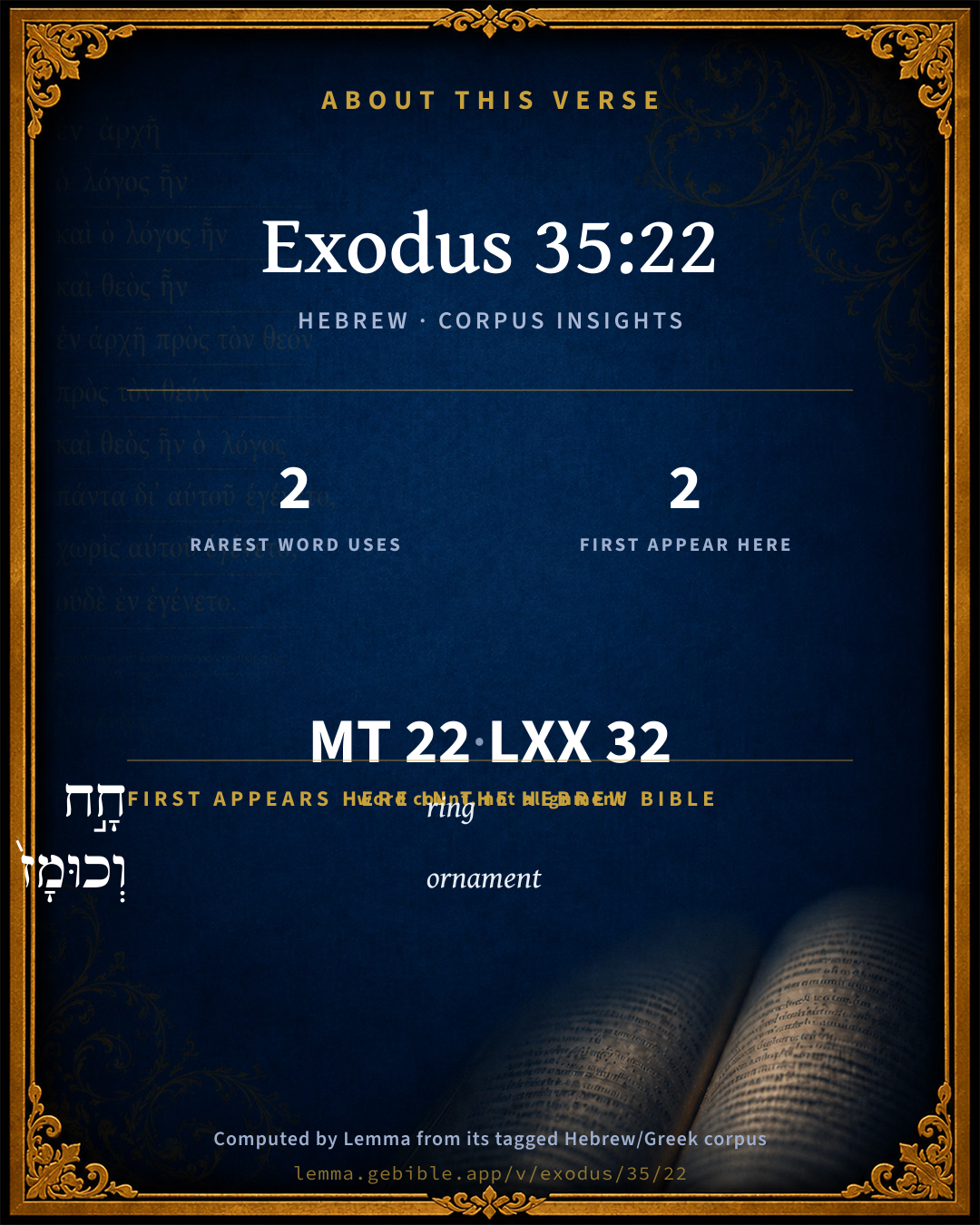
  • 2 first appearances in the Hebrew Bible
Full analysis ↓
Download a study sheet

One document with this verse’s original text, its word-by-word gloss line, the meaning frame, cross-references with their text, attributed commentary, and full source and license credits — printable, and it pastes into notes with its structure intact.

This verse Autodidact and up

Study sheet (.html) Plain text (.txt)

A passage Seminary Student

Up to 50 verses in one chapter. A passage sheet keeps up to 6 commentary sources and 12 cross-references per verse, in the order this page ranks them, and says so on the sheet whenever that leaves anything out. Ask for a single verse and you get the Autodidact verse sheet above.

Everything on this page stays free to read, with no account — the sheet is a download of what is already on screen, not access to it.

Want to remove ads? Support Godless Engineer
Compare translations 3

The same verse in 3 English versions, stacked beneath the original-language interlinear above. Click any original word for its lexicon entry.

Each is an independent rendering of the whole verse — the interlinear is not word-aligned to these translations.

Highlighted words mark where these versions differ — a whole-verse word diff, not a word-by-word alignment.

  • World English Bible Public Domain
    They came, both men and women, as many as were willing-hearted, and brought brooches, ear-rings, signet-rings, and armlets, all jewels of gold; even every man who offered an offering of gold to Yahweh.
  • King James Version Public Domain
    And they came, both men and women, as many as were willing hearted, and brought bracelets, and earrings, and rings, and tablets, all jewels of gold: and every man that offered, offered an offering of gold unto the LORD.
  • unfoldingWord Literal Text CC BY-SA 4.0
    And men along with women came, all impelled of heart. They brought brooches and earrings and rings and ornaments, all of the things of gold. And every man that raised as a raised offering of gold to Yahweh.

unfoldingWord Literal Text — © unfoldingWord, licensed CC BY-SA 4.0. Word-aligned USFM3 via Door43 (git.door43.org/unfoldingWord/en_ult).

Versions to compare (up to 4)

3 of 4 selected

Show all 18 translations

Every available English version of this verse, each an independent rendering of the whole verse.

  • World English Bible Public Domain
    They came, both men and women, as many as were willing-hearted, and brought brooches, ear-rings, signet-rings, and armlets, all jewels of gold; even every man who offered an offering of gold to Yahweh.
  • Berean Standard Bible Public Domain
    So all who had willing hearts, both men and women, came and brought brooches and earrings, rings and necklaces, and all kinds of gold jewelry. And they all presented their gold as a wave offering to the LORD.
  • Majority Standard Bible Public Domain
    So all who had willing hearts, both men and women, came and brought brooches and earrings, rings and necklaces, and all kinds of gold jewelry. And they all presented their gold as a wave offering to the LORD.
  • King James Version Public Domain
    And they came, both men and women, as many as were willing hearted, and brought bracelets, and earrings, and rings, and tablets, all jewels of gold: and every man that offered, offered an offering of gold unto the LORD.
  • American Standard Version (1901) Public Domain
    And they came, both men and women, as many as were willing-hearted, `and' brought brooches, and ear-rings, and signet-rings, and armlets, all jewels of gold; even every man that offered an offering of gold unto Jehovah.
  • Revised Version (1885) Public Domain
    And they came, both men and women, as many as were willing hearted, and brought brooches, and earrings, and signet-rings, and armlets, all jewels of gold; even every man that offered an offering of gold unto the LORD.
  • Geneva Bible (1599) Public Domain
    Both men and women, as many as were free hearted, came and brought taches and earings, and rings, and bracelets, all were iewels of golde: and euery one that offered an offring of gold vnto the Lord:
  • Douay-Rheims (1899) Public Domain
    Both men and women gave bracelets and earrings, rings and tablets: every vessel of gold was set aside to be offered to the Lord.
  • Young's Literal Translation Public Domain
    And they come in -- the men with the women -- every willing-hearted one -- they have brought in nose-ring, and ear-ring, and seal-ring, and necklace, all golden goods, even every one who hath waved a wave-offering of gold to Jehovah.
  • Literal Standard Version CC BY-SA 4.0
    And they come in—the men with the women—every willing-hearted one—they have brought in nose-ring, and earring, and seal-ring, and necklace, all golden goods, even everyone who has waved a wave-offering of gold to YHWH.
  • Unlocked Literal Bible CC BY-SA 4.0
    They came, both men and women, all who had a willing heart. They brought brooches, earrings, rings, and ornaments, all kinds of gold jewelry. They all presented offerings of gold as a wave offering to Yahweh.
  • unfoldingWord Literal Text CC BY-SA 4.0
    And men along with women came, all impelled of heart. They brought brooches and earrings and rings and ornaments, all of the things of gold. And every man that raised as a raised offering of gold to Yahweh.
  • Darby Bible Public Domain
    And they came, both men and women; every one who was of willing heart brought nose-rings, and earrings, and rings, and bracelets, all kinds of utensils of gold: every man that waved a wave-offering of gold to Jehovah.
  • World Messianic Bible Public Domain
    They came, both men and women, as many as were willing-hearted, and brought brooches, earrings, signet rings, and armlets, all jewels of gold; even every man who offered an offering of gold to the LORD.
  • Webster's Bible Public Domain
    And they came, both men and women, as many as were willing-hearted, and brought bracelets, and ear-rings, and rings, and tablets, all jewels of gold; and every man that offered, offered an offering of gold to the LORD.
  • Free Bible Version CC BY-SA 4.0
    So everyone who was willing, both men and women, came and presented their gold as a thanks offering to the Lord, including brooches, earrings, rings, and necklaces—all kinds of gold jewelry.
  • Bible in Basic English Public Domain
    They came, men and women, all who were ready to give, and gave pins and nose-rings and finger-rings and neck-ornaments, all of gold; everyone gave an offering of gold to the Lord.
  • JPS Tanakh (1917) Public Domain
    And they came, both men and women, as many as were willing-hearted, and brought nose-rings, and ear-rings, and signet-rings, and girdles, all jewels of gold; even every man that brought an offering of gold unto the LORD.

Literal Standard Version (2020), Covenant Press — licensed CC BY-SA 4.0. Text via the HelloAO Bible API (eBible.org). Unlocked Literal Bible (unfoldingWord) — licensed CC BY-SA 4.0. Text via the HelloAO Bible API (eBible.org). unfoldingWord Literal Text — © unfoldingWord, licensed CC BY-SA 4.0. Word-aligned USFM3 via Door43 (git.door43.org/unfoldingWord/en_ult). Free Bible Version, Dr. Jonathan Gallagher — licensed CC BY-SA 4.0. Text via the HelloAO Bible API (eBible.org).

Word by word

More ways to search: Search by grammar → Find every occurrence → Compare this word →

Practice this passage: Drill this verse → Learn its vocabulary →

וְכוּמָז֙
kûwmâz
H3558
“and · ornament”
Conjunction + Noun, Common, Masculine, Singular, Absolute
Part of Speech
Conjunction + Noun
Type
Common
Gender
Masculine
Number
Singular
State
Absolute
Full BDB Definition

Origin: from an unused root meaning to store away

TWOT: 990a

ornaments, golden ornament - maybe - armlets of gold - (TWOT) tablets
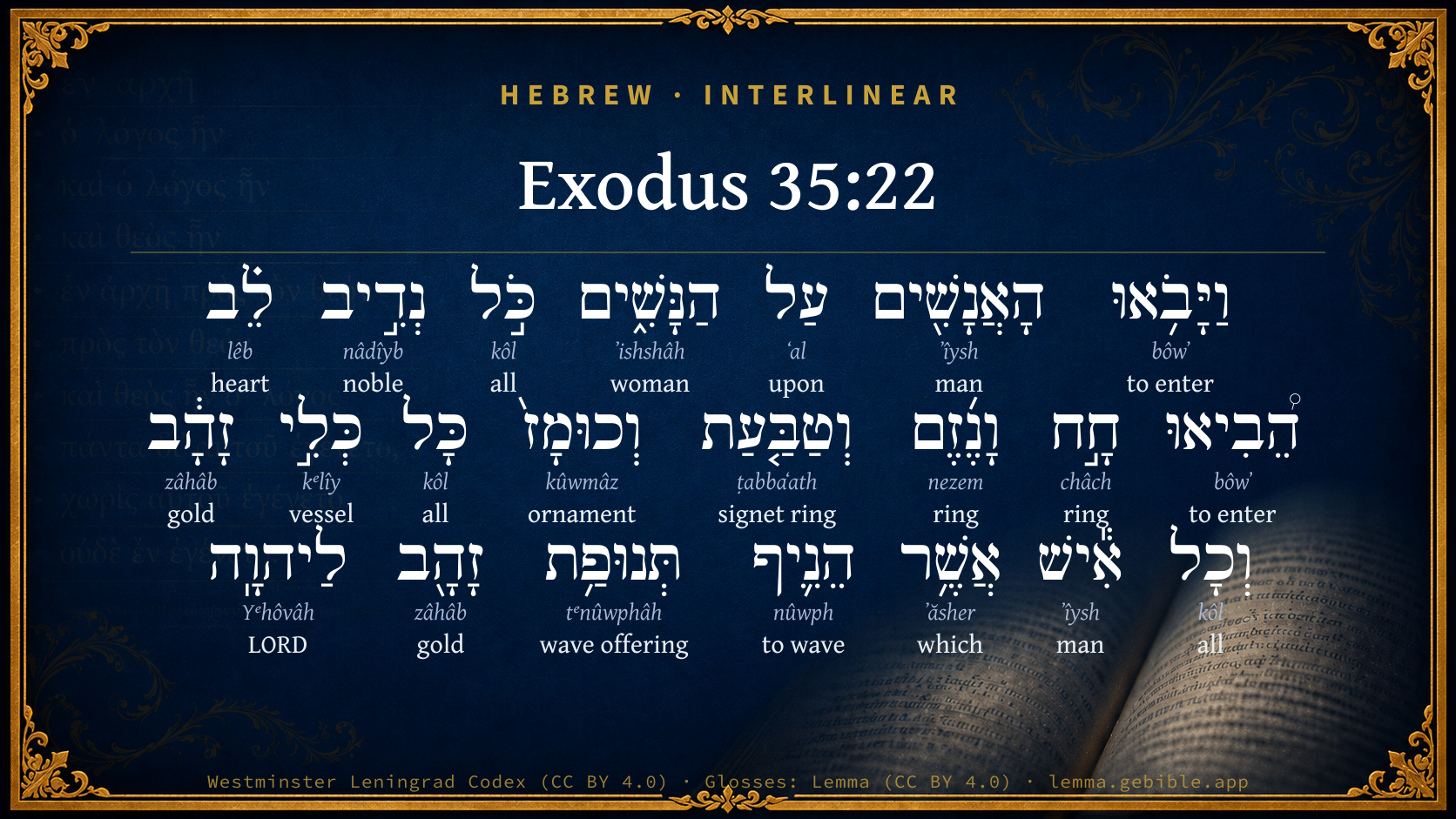
  1. וַיָּבֹ֥אוּ bôwʼ H935 “and · to enter” Conjunction + Verb, Qal, Sequential Imperfect, 3rd Person, Masculine, Plural
  2. הָאֲנָשִׁ֖ים ʼîysh H376 “the · men” Particle, Definite Article + Noun, Common, Masculine, Plural, Absolute
  3. עַל ʻal H5921 “upon” Preposition
  4. הַנָּשִׁ֑ים ʼishshâh H802 “the · women” Particle, Definite Article + Noun, Common, Feminine, Plural, Absolute
  5. כֹּ֣ל kôl H3605 “all” Noun, Common, Masculine, Singular, Absolute
  6. נְדִ֣יב nâdîyb H5081 “noble of” Adjective, Adjective, Masculine, Singular, Construct
  7. לֵ֗ב lêb H3820 “heart” Noun, Common, Masculine, Singular, Absolute
  8. הֵ֠בִיאוּ bôwʼ H935 “to enter” Verb, Hiphil, Perfect, 3rd Person, Common, Plural
  9. חָ֣ח châch H2397 “ring” Noun, Common, Masculine, Singular, Absolute
  10. וָנֶ֜זֶם nezem H5141 “and · ring” Conjunction + Noun, Common, Masculine, Singular, Absolute
  11. וְטַבַּ֤עַת ṭabbaʻath H2885 “and · signet ring” Conjunction + Noun, Common, Feminine, Singular, Absolute
  12. כָּל kôl H3605 “all of” Noun, Common, Masculine, Singular, Construct
  13. כְּלִ֣י kᵉlîy H3627 “vessel of” Noun, Common, Masculine, Singular, Construct
  14. זָהָ֔ב zâhâb H2091 “gold” Noun, Common, Masculine, Singular, Absolute
  15. וְכָל kôl H3605 “and · all of” Conjunction + Noun, Common, Masculine, Singular, Construct
  16. אִ֕ישׁ ʼîysh H376 “man” Noun, Common, Masculine, Singular, Absolute
  17. אֲשֶׁ֥ר ʼăsher H834 “which” Particle, Relative
  18. הֵנִ֛יף nûwph H5130 “to wave” Verb, Hiphil, Perfect, 3rd Person, Masculine, Singular
  19. תְּנוּפַ֥ת tᵉnûwphâh H8573 “wave offering of” Noun, Common, Feminine, Singular, Construct
  20. זָהָ֖ב zâhâb H2091 “gold” Noun, Common, Masculine, Singular, Absolute
  21. לַיהוָֽה Yᵉhôvâh H3068 “to/for · LORD” Preposition + Noun, Proper

About this verse

These counts appear in no published source. They are computed here, from the morphology-tagged text and Lemma’s own curated glosses. What Lemma adds →

22
words
17
distinct lemmas
Pentateuch
section

Notable vocabulary

The rarest word here is וְכוּמָז֙ ornament H3558 — appearing just 2 times in the whole Hebrew Bible.

First appearance in Scripture

These words make their first canonical appearance in the Hebrew Bible here:

  • חָ֣ח ring H2397
  • וְכוּמָז֙ ornament H3558

Shared distinctive vocabulary

וְכוּמָז֙ ornament H3558 occurs in 2 verses of the Hebrew Bible. Also found in:

Grammatical profile

  • 3 verbs
  • 16 nouns
  • 1 adjective
  • 1 preposition
  • 1 particle

Verb forms

  • וַיָּבֹ֥אוּ Qal · Sequential Imperfect
  • הֵ֠בִיאוּ Hiphil · Perfect
  • הֵנִ֛יף Hiphil · Perfect

Repetition

Words recur within this verse — often emphatic in Hebrew:

  • כֹּ֣ל all H3605 ×3
  • וַיָּבֹ֥אוּ to enter H935 ×2
  • הָאֲנָשִׁ֖ים man H376 ×2
  • זָהָ֔ב gold H2091 ×2

Hebrew & Septuagint length

In English translation the verse runs 33 words from the Hebrew and 33 from the Septuagint (LXX English) — the same length.

A rough comparison of the two English renderings, which tokenize alike — not a word-level alignment.

Word counts can differ between the Hebrew and the Greek without any difference in meaning — e.g. the Hebrew direct-object marker אֵת has no separate Greek word, and Greek often adds the article ὁ.

In the original languages it is 22 Hebrew tokens and 32 Greek tokens — but the two are counted differently (Hebrew bundles its prefixes and suffixes into one token; the Greek is in lemma form), so that isn’t a like-for-like length.

Cross-references

12

Topical passages linked to Exodus 35:22 in the Treasury of Scripture Knowledge — connected by theme and wording, ordered by reader-vote popularity; previews shown in the World English Bible.

  • Ezra 2:68–69 Some of the heads of fathers' [houses], when they came to the house of Yahweh which is in Jerusalem, offered willingly for the house of God to set it up in its place:
  • Nehemiah 7:70–72 Some from among the heads of fathers' [houses] gave to the work. The governor gave to the treasury one thousand darics of gold, fifty basins, and five hundred thirty priests' garments.
  • Matthew 2:11 They came into the house and saw the young child with Mary, his mother, and they fell down and worshiped him. Opening their treasures, they offered to him gifts: gold, frankincense, and myrrh.
  • Exodus 32:3 All the people took off the golden rings which were in their ears, and brought them to Aaron.
  • Numbers 31:50 We have brought Yahweh's offering, what every man has gotten, of jewels of gold, ankle-chains, and bracelets, signet-rings, ear-rings, and armlets, to make atonement for our souls before Yahweh.
  • 1 Chronicles 29:6–7 Then the princes of the fathers' [houses], and the princes of the tribes of Israel, and the captains of thousands and of hundreds, with the rulers over the king's work, offered willingly;
  • 2 Chronicles 24:9–14 They made a proclamation through Judah and Jerusalem, to bring in for Yahweh the tax that Moses the servant of God laid on Israel in the wilderness.
  • Isaiah 3:19 the earrings, the bracelets, the veils,
  • Isaiah 60:9 Surely the isles shall wait for me, and the ships of Tarshish first, to bring your sons from far, their silver and their gold with them, for the name of Yahweh your God, and for the Holy One of Israel, because he has glorified you.
  • Isaiah 60:13 The glory of Lebanon shall come to you, the fir tree, the pine, and the box tree together, to beautify the place of my sanctuary; and I will make the place of my feet glorious.
  • Ezekiel 16:11 I decked you with ornaments, and I put bracelets on your hands, and a chain on your neck.
  • Mark 12:41–44 Jesus sat down opposite the treasury, and saw how the multitude cast money into the treasury. Many who were rich cast in much.

Cross-references courtesy of OpenBible.info (CC BY 4.0).

Hebrew and Greek witnesses Masoretic Hebrew ↔ Greek Septuagint

The same verse in the two great witnesses to the Old Testament, shown verse-for-verse.

These are two independent witnesses, not word-aligned to each other, and the Septuagint is shown in lemma (dictionary) form.

Hebrew Exodus 35:22 Masoretic · Westminster Leningrad Codex

וַיָּבֹ֥אוּ הָאֲנָשִׁ֖ים עַל הַנָּשִׁ֑ים כֹּ֣ל נְדִ֣יב לֵ֗ב הֵ֠בִיאוּ חָ֣ח וָנֶ֜זֶם וְטַבַּ֤עַת וְכוּמָז֙ כָּל כְּלִ֣י זָהָ֔ב וְכָל אִ֕ישׁ אֲשֶׁ֥ר הֵנִ֛יף תְּנוּפַ֥ת זָהָ֖ב לַיהוָֽה

They came, both men and women, as many as were willing-hearted, and brought brooches, ear-rings, signet-rings, and armlets, all jewels of gold; even every man who offered an offering of gold to Yahweh.

World English Bible · Public Domain

Greek LXX Exodus 35:22 Septuagint · lemma form

καί φέρω ὁ ἀνήρ παρά ὁ γυνή πᾶς ὅς δοκέω ὁ διάνοια φέρω σφραγίς καί ἐνώτιον καί δακτύλιος καί ἐμπλόκιον καί περιδέξιον πᾶς σκεῦος χρυσοῦς καί πᾶς ὅσος φέρω ἀφαίρεμα χρυσίον κύριος

And the men, even every one to whom it seemed good in his heart, brought from the women, even brought seals and ear-rings, and finger-rings, and necklaces, and bracelets, every article of gold.

LXX2012 (modern English Septuagint) · Public Domain

On this verse, Ellicott's Commentary for English Readers discusses the Septuagint’s reading. Read the note in Commentary ↓

Hebrew: Westminster Leningrad Codex (CC BY 4.0). Greek: Septuagint (public domain); English from LXX2012 (modern English Septuagint) (Public Domain). How the Septuagint differs from the Hebrew →

Targum (Aramaic paraphrase)

2

The Targum is the ancient Jewish Aramaic paraphrase of the Hebrew Scriptures — an interpretive translation, not the Hebrew text itself. Onkelos (literal) and Pseudo-Jonathan (expansive) render the Torah, and Jonathan the Prophets. Coverage is partial: where no permissively-licensed English translation exists for a verse, only the Aramaic is shown. This is verse-level text, not a word-by-word alignment to the Hebrew.

  1. Targum Onkelos Torah (Genesis–Deuteronomy)
    וּמַיְתַן גֻבְרַיָא עַל נְשַׁיָא כֹּל דְאִתְרְעֵי לִבֵּהּ אַיְתִיאוּ שֵׁירִין וְשִׁבְכִין וְעִזְקַן וּמָחוּךְ כָּל מָן דִדְהַב וְכָל גְּבַר דִי אֲרֵים אֲרָמוּת דַהֲבָא קֳדָם יְיָ:

    (no public-domain English translation for this verse)

    Targum Onkelos — Aramaic: “Onkelos Genesis” (public domain); “Onkelos Exodus” (public domain); “Onkelos Leviticus” (public domain); “Onkelos Numbers” (public domain); “Onkelos Deuteronomy” (public domain). English: “Sefaria Community Translation” (CC0 1.0 (public-domain dedication)); “J.W. Etheridge. The Targums of Onkelos and Jonathan Ben Uzziel on the Pentateuch. London: Longmans, Green, 1862” (public domain). Text via Sefaria.

  2. Targum Pseudo-Jonathan Torah (Genesis–Deuteronomy)
    וְאָתוּ גוּבְרַיָא עִם נְשַׁיָא כָּל מַאן דְּאִתְרְעֵי לִבֵּיהּ הַיְתִיוּ שִׁירִין וְשִׁיוְוִין עִזְקַן וּמְחוֹכִין וְכָל תַּכְשִׁיט דִּדְהַב וְכָל גְבַר דְּאֲרִים אֲרָמוּת דַּהֲבָא קֳדָם יְיָ

    And with the men came the women, every one whose heart was moved, and brought chains, and necklaces, rings, bracelets, and every ornament of gold; every one offering up the offering of gold before the Lord.

    Targum Pseudo-Jonathan — Aramaic: “Targum Jonathan on Genesis” (public domain); “Targum Jonathan on Exodus” (public domain); “Targum Jonathan on Leviticus” (public domain); “Targum Jonathan on Numbers” (public domain); “Targum Jonathan on Deuteronomy” (public domain). English: “The Targum of Jonathan ben Uzziel, trans. J. W. Etheridge, London, 1862” (public domain). Text via Sefaria.

Commentary

Notes on Exodus 35:22 from classic Christian and Jewish commentators (each source and its license shown beneath its notes). The classic Christian expositions comment on the surrounding passage and are grouped to its opening verse, so a note may address several verses; the Jewish commentaries on the Tanakh (Rashi and others) are per-verse, so they appear only where the commentator wrote on this verse.

Lemma curates 59 commentaries, every one of them public domain or Creative Commons licensed, each selected and text-cleaned for this edition rather than reprinted as found. About our sources →

Trapp's Complete Commentary

John Trapp

Exo 35:22 And they came, both men and women, as many as were willing hearted, [and] brought bracelets, and earrings, and rings, and tablets, all jewels of gold: and every man that offered [offered] an offering of gold unto the LORD.

Ver. 22. And brought bracelets.] Glad they had anything of price to dedicate to God and to seal up their thankfulness for this readmittance into his love and favour. {See Trapp on "Mat 9:10"} Nazianzen put this price upon his Athenian learning, wherein he was very famous, that he had something of value to part with for Christ. These in the text, in token of their true repentance, brought their bracelets and other ornaments, as freely for the service of the tabernacle, as erst they had done to the making of the golden calf.

John Trapp, A Commentary or Exposition upon All the Books of the Old and New Testament (1647–1656) — public domain. Text from a community e-Sword module.

Geneva Bible (1599)

Geneva Bible translators

Or, hooks.

Geneva Bible (1599) marginal notes — public domain. Text via Bolls.life.

Jamieson, Fausset & Brown

Robert Jamieson, A. R. Fausset & David Brown

they came, both men and women, &c.--literally, "the men over and above the women"; a phraseology which implies that the women acted a prominent part, presented their offerings first, and then were followed by as many of their male companions as were similarly disposed.

brought bracelets, &c.--There was in that early age no money in the form of coins or bullion. What money passed current with the merchant consisted of rings which were weighed, and principally of ornaments for personal decoration. Astonishment at the abundance of their ornaments is at an end when we learn that costly and elegant ornaments abounded in proportion as clothing was simple and scarce among the Egyptians, and some, entirely divested of clothing, yet wore rich necklaces [HENGSTENBERG]. Among people with Oriental sentiments and tastes, scarcely any stronger proof could have been given of the power of religion than their willingness not only to lay aside, but to devote those much-valued trinkets to the house of God; and thus all, like the Eastern sages, laid the best they had at the service of God.

Jamieson, Fausset & Brown — Commentary Critical and Explanatory on the Whole Bible (1871) — public domain (CC PDM 1.0). Text via the HelloAO Bible API.

Adam Clarke's Commentary

Verse 22. As many as were willing-hearted] For no one was forced to lend his help in this sacred work; all was a free-will offering to the Lord.

Bracelets] חח chach, whatever hooks together; ornaments for the wrists, arms, legs, or neck.

Ear-rings] נזם nezem, see this explained Ge 24:22.

Rings] טבעת tabbaath, from טבי taba, to penetrate, enter into; probably rings for the fingers.

Tablets] כומז cumaz, a word only used here and in Nu 31:50, supposed to be a girdle to support the breasts.

Adam Clarke's Commentary on the Bible (1810–1826) — public domain. Text from a community e-Sword/MySword module.

Ellicott's Commentary for English Readers

(22) Both men and women . . . brought bracelets . . . —It is not quite certain what the personal ornaments here mentioned are. The LXX. render σφραγῖδας καὶ ἐνώτια καὶ δακτυλίους καὶ ἐμπλόκια καὶ περιδέξια, “signets, and earrings, and rings, and chains, and armlets,” substituting five terms for four. Rosenmüller thinks the khâkh was a “nose ring;” others make it a “brooch” or “buckle.” The last word of the four, kumâz, cannot possibly mean “tablets.” It comes from a root signifying “rounded,” and designates probably a bead necklace, such as was often worn by the Egyptians. On the use of personal ornaments by the Hebrew men, as well as women, see Note on Exo_32:2.

Jewels of gold.—Literally, articles of gold.

And every man that offered, offered an offering of gold.—By repeating the word “offered,” our translators have spoiled the sense. Moses is enumerating those who came. There came those who offered bracelets, earrings, rings, &c.; there came also those who offered any (other) offering of gold to the Lord.

A Bible Commentary for English Readers, edited by Charles John Ellicott (1878–1897) — public domain. Text from a community e-Sword module.

The Cambridge Bible for Schools and Colleges

gen. ed. J. J. S. Perowne

22. The offering of men and women alike; viz. gold (v. 6; Exo_25:3), in various forms.

brooches] Heb. ḥâḥ,—elsewhere a ‘hook’ for the jaw (Eze_29:4), or nose (2Ki_19:28).

earrings] or nose-rings. See on Exo_32:2.

armlets] marg., necklaces: the precise meaning is uncertain. Heb. kûmâz, only besides Num_31:50.

all jewels of gold] more clearly, ‘(even) every jewel of gold.’

and every man that waved a wave-offering of gold unto Jehovah (brought it)] cf. vv. 23 end, 24 end. The rend, ‘even’ is impossible, besides yielding a wrong sense: the reference in this clause is not to those who brought brooches, and earrings, &c., but to such as brought gold in any form,—probably, in particular, ingots. ‘Wave’ and ‘wave-offering’ are used here, not in their proper sense (see on Exo_29:24) of a ceremony implying that the object ‘waved’ is given ultimately to the priests, but in a weakened and later sense of present, presentation: so Exo_38:24; Exo_38:29, Num_18:11.

The Cambridge Bible for Schools and Colleges (gen. ed. J. J. S. Perowne; Cambridge University Press, 1878–1918) — public domain. Text from a community e-Sword module.

John Gill's Exposition

And every man with whom was found blue, and purple, and scarlet,.... Wool or yarn of either of the colours; unless it can be supposed there might be with some of them the ingredients with which colours were made, brought with them out of Egypt:

and fine linen; they had brought out of Egypt, and for which that country was famous:

and goats' hair; which in those countries was so long as to be shorn like the wool of sheep:

and red skins of the rams; died red, for it does not mean any that were naturally so, of which none are known:

and badgers' skins; see Exo 25:5 of each of these, such who had them in their possession, and their hearts were willing to part with them:

brought them; to Moses, to the tabernacle or tent where he was.

John Gill's Exposition of the Whole Bible (1746–1763) — public domain (CC PDM 1.0). Text via the HelloAO Bible API.

Albert Barnes' Notes on the Bible

Bracelets - Rather, brooches.

Earrings - The Hebrew word signifies a ring, either for the nose (see Gen 24:22) or for the ear Exo 32:2; Gen 35:4. That ear-rings, not nose-rings, are here meant is confirmed by what we know of early Hebrew and Egyptian customs.

Rings - Signet rings.

Tablets - More probably, armlets. It is most likely that all the articles mentioned in this verse were of gold. The indulgence of private luxury was thus given up for the honor of the Lord. Compare Exo 30:18 note.

Albert Barnes' Notes on the Bible (1834–1885) — public domain. Text from a community e-Sword/MySword module.

Haydock's Catholic Bible Commentary

And women, by the hands of their husbands, as the Hebrew and Septuagint intimate. --- Tablets, (dextralia) ornaments worn on the right hand or arm.

George Leo Haydock (1774–1849), Haydock's Catholic Family Bible and Commentary, 1859 edition — public domain. Excludes Psalms (Douay-Rheims chapter numbering differs from Protestant) and Deuterocanonical books (Catholic canon only).

Matthew Poole's English Annotations

Earrings.

Object. Aaron had got these from them for the making of the calf, Exo 32.

Answ. Though the generality of the people did then part with their earrings, yet there was a considerable number who did not, as being unsatisfied with that idolatrous design; and it may seem that the women would not part with theirs, being more fond of their ornaments than of their idols. See Poole "Exo 32:3".

Matthew Poole's English Annotations on the Holy Bible (1683–1685) — public domain. Text from a community e-Sword/MySword module.

Whedon's Commentary on the Bible

Daniel D. Whedon

22. Both men and women — As if anticipating the New Testament idea, that in the life and fellowship of God there is neither male nor female.

Gal_3:28. But in the making of this sanctuary, as in building the Christian Church, there is work both for men and women. As there are some kinds of work suitable only for men and not for women, so there are other kinds suitable only for women and not for men. So, too, it may be in the Christian Church.

Bracelets — The exact meaning of the word (חח) thus translated is not certain. It has been rendered by brooches, hooks, chains, clasps, nose-jewel.

Earrings — See on Exo_32:2.

Rings — Probably signet rings. See note on Gen_41:42.

Tablets — Occurs only here and Num_31:50, and is of uncertain meaning. It has been variously explained, as armlets, necklaces, beads, lockets.

Daniel D. Whedon (gen. ed.), Commentary on the Old and New Testaments (1874–1909) — public domain. Text from a community e-Sword module.

The Pulpit Commentary

They came, both men and women. That among the Hebrews gold ornaments were worn by men, as well as by women, is indicated by Exo_3:22, and Exo_32:2. The Egyptian men at the time of the Exodus wore armlets, bracelets, and sometimes anklets, but not often earrings Earrings, however, had been worn by the household of Jacob. (Gen_35:2) Bracelets. Rather, "buckles" or "brooches." Kalisch says, "nose-rings," and so Gesenins and Rosenmuller. Tablets. Rather, "armlets" (Furst, Cook), or perhaps "necklaces "(Gesenius Kalisch, Knobel). Every man that offered, offered an offering of gold. It is not meant that every man who offered anything gave with it an offering of gold, but simply that, besides those who brought the articles named there were others who brought gold offerings of some different kind.

The Pulpit Commentary (1880–1919), ed. H.D.M. Spence-Jones & Joseph S. Exell — public domain. Text from a community e-Sword module.

John Wesley's Explanatory Notes

Tablets or Lockets.

John Wesley, Explanatory Notes Upon the Whole Bible (1754–1765) — public domain. Text via the GEBible commentary corpus.

Rashi

Rabbi Shlomo Yitzchaki (Rashi)

על הנשים means with the women and closely following them.

חח is a circular golden ornament placed upon the arm; it is the צמיד which is often mentioned in Scripture (cf. e. g., Numbers 31:50).

כומז was a golden ornament worn by the women upon their private parts, Our Rabbis explain the name כּוּמָז as [an acrostic]: כַּאן מְקוֹם זִמָּה, [meaning] here is the place of licentiousness. (cf. Shabbat 64a).

Rashi on the Tanakh — English translations: “The Judaica Press complete Tanach with Rashi, translated by A. J. Rosenberg” (CC BY 4.0); “Pentateuch with Rashi's commentary by M. Rosenbaum and A.M. Silbermann, 1929-1934” (public domain); “The Metsudah Tanach series, Lakewood, N.J” (CC BY 4.0); and “The Book of Joshua, Metsudah Publications, 1997” (CC BY 4.0). Text via Sefaria.

Ramban (Nachmanides)

Rabbi Moshe ben Nachman (Ramban / Nachmanides)

AND THE MEN CAME ‘AL HANASHIM’ (WITH THE WOMEN). The meaning of this expression is that because donations of ornaments were more common amongst women, and they all had these jewels [cited in the verse: nose-rings, and ear-rings, and signet-rings, and golden beads, all jewels of gold], therefore they immediately pulled off their ear-rings and signet-rings and were the first to come to Moses, and [afterwards] they brought with them those men with whom they found ornaments. For the phrase al hanashim indicates that they were there first, while the men joined them later. Similar usage of the word al is found in these verses: Aram is confederate ‘al’ Ephraim, for that war [against Judah] was mainly led by Ephraim [i.e., the kingdom of Israel]; and he did not put them ‘al’ (unto) Laban’s flock; ‘v’alav’ (and next unto him) shall be the tribe of Manasseh. There are other similar instances. Thus Scripture is stating that all — men and women — came with nose-rings, and ear-rings, and signet-rings, and golden beads, and with all jewels of gold, such as bracelets and ear-rings, as all of the people found some jewelry to bring. It further states that some of them brought an offering of gold, in some broken form or as coin.

And every man, with whom was found blue-purple and red-purple. The reason for this expression is that these items were found only amongst a few of the people. Then Scripture states again, and every man, with whom was found acacia-wood, because the people who had this kind of wood were still fewer in number. It states, Every one that did set apart an offering of silver and brass, because most people had silver and brass in coins or vessels. Scripture, however, did not mention this above together with all jewels of gold, because it mentioned there the women, and they did not have silver and brass ornaments but gold ones, just as Aaron said, Pull off the golden rings, which are in the ears of your wives.

And every man that ‘heinif tenufath’ (brought an offering of) gold. This is so phrased because the number of these people was not as great as those who brought silver and brass. Thus the amount of gold brought was not as much as that of silver and brass. It is for this reason that the gold donation is called tenufah (waving), whilst that of silver and brass is called terumah (offering), … for one who brings gold waves it with his hand to show the importance of the donation, or it may be that those who take it from him wave the gold to show up the donor in a praiseworthy light for having brought such a donation. However, in the section of Eileh Pekudei Scripture calls the donations of both gold and brass tenufah, … And in Verse 29: And the brass of ‘hatenufah’… because there it does not mention at all terumah (free-will offering,) but only the silver of them that were numbered., Verse 25. And since everyone had to give the half-shekel in order to be counted, it is not called terumah which indicates a free-will offering. See Ramban above at beginning of Seder Ki Thisa. It is possible that brass also was called tenufah because it was more important to them than silver, since they did not have much of it. Or it may have been very important on its own merit, similar to that which is said, and two vessels of fine bright brass, precious as gold.

Ramban (Nachmanides) on the Tanakh — English translation: “Commentary on the Torah by Ramban (Nachmanides). Translated and annotated by Charles B. Chavel. New York, Shilo Pub. House, 1971-1976” (CC BY 4.0). Text via Sefaria.

Sforno

Rabbi Ovadia Sforno

Both men and women. The men came with their wives because it is forbidden to accept a major donation from a married woman unless one knows that she has her husband’s consent.

Sforno on the Tanakh — English translation: “Yalkut, Sifsei Chachomim Chumash, Metsudah Publications, 2009” (CC BY 4.0). Text via Sefaria.

Lesson kit

Teaching starters — assembled from the data on this page, not authored interpretation. Every prompt links to the verse data it draws on. Edit before teaching.

Exodus, in the Pentateuch, opens this verse with 22 words (17 distinct Hebrew lemmas). Its most distinctive word is kûwmâz (“ornament”). A historical commentator’s framing appears above. Read the whole chapter for the surrounding context.

Discussion questions

  1. How does “ornament” (kûwmâz) shape what this verse is saying?
  2. 2 words here appear for the first time in Scripture. What is being introduced at this debut?
  3. Numbers 31:50 shares the word «ornament» with this verse. How do the two illuminate each other?
  4. “all” occurs 3× in this one verse. What is the effect of the repetition?
  5. The translations on this page render this verse differently — a whole-verse word diff, not a word-by-word alignment. What might account for the different wordings?
  6. The verb «וַיָּבֹ֥אוּ» is Qal Sequential Imperfect. How does its form color the action?
  7. Reading how Trapp's Complete Commentary and Geneva Bible (1599) read this verse, where do the two commentators agree and where do they part?

Things to notice

Reading settings

Reading text

Shown beneath each verse's original-language words.

Old Testament
Old Testament edition

Read the OT as the Masoretic Hebrew (MT) or the Greek Septuagint (LXX).

English shown for the Greek Septuagint (in the Hebrew ↔ Greek comparison).

Comparing translations? Open the Compare panel on any verse page to stack up to four side by side.