1 Samuel 10:22

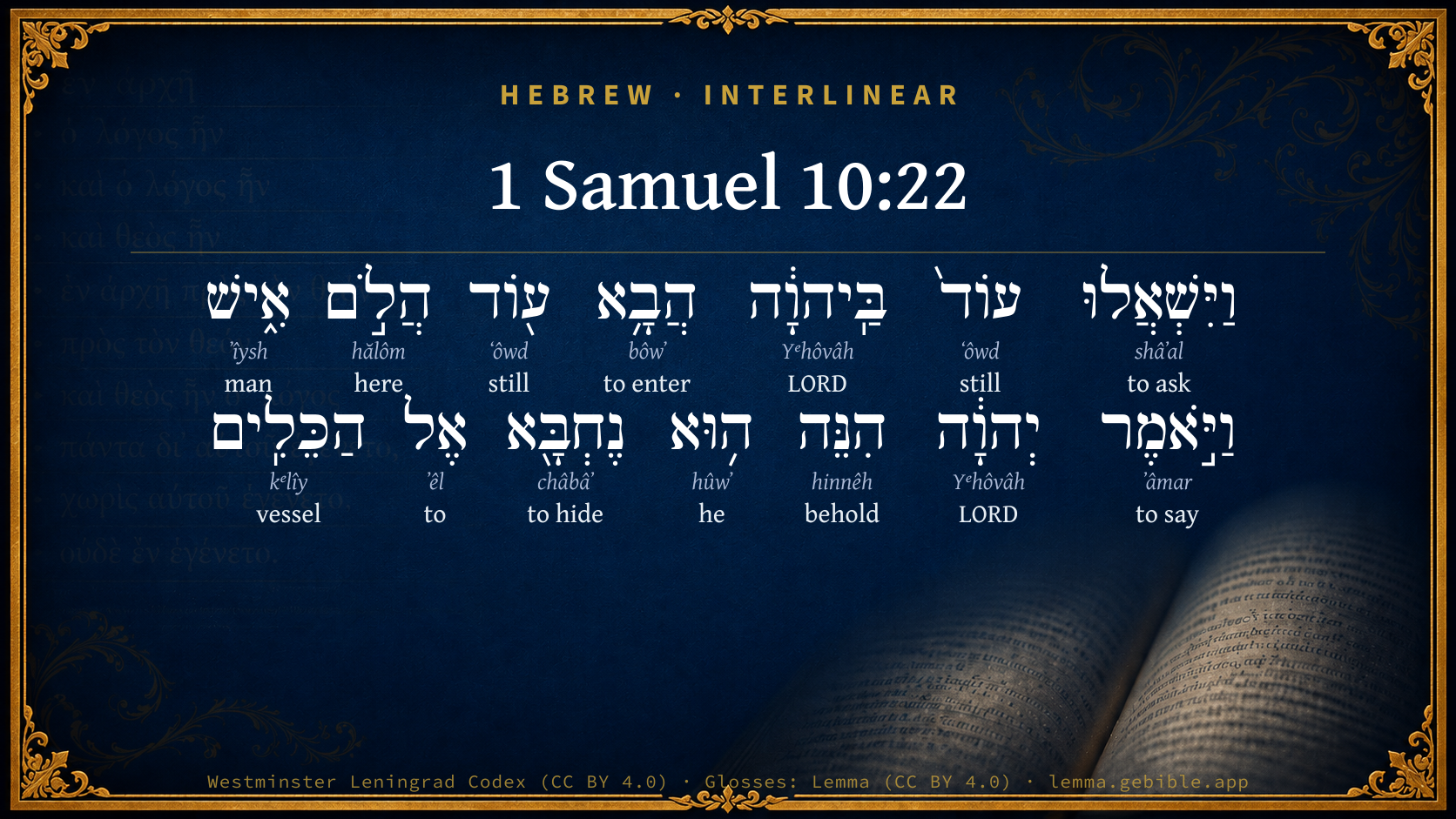
Hebrew (Westminster Leningrad Codex) 1 Samuel 10:22 appears in the Hebrew Old Testament. The text above is from the Westminster Leningrad Codex. Each word links to its Strong’s number, a concise gloss, and parsing drawn from the Open Scriptures Hebrew Bible morphology. Click any word for its full Brown-Driver-Briggs (BDB) entry.
Download image
Cite this verse

1 Samuel 10:22 (World English Bible). Public Domain. Lemma interlinear Bible study tool, https://lemma.gebible.app/v/1-samuel/10/22.

Show BibTeX & RIS
BibTeX
RIS
English Translation
Therefore they asked of Yahweh further, Is there yet a man to come here? Yahweh answered, Behold, he has hid himself among the baggage.
World English Bible · Public Domain
Download a study sheet

One document with this verse’s original text, its word-by-word gloss line, the meaning frame, cross-references with their text, attributed commentary, and full source and license credits — printable, and it pastes into notes with its structure intact.

This verse Autodidact and up

Study sheet (.html) Plain text (.txt)

A passage Seminary Student

Up to 50 verses in one chapter. A passage sheet keeps up to 6 commentary sources and 12 cross-references per verse, in the order this page ranks them, and says so on the sheet whenever that leaves anything out. Ask for a single verse and you get the Autodidact verse sheet above.

Everything on this page stays free to read, with no account — the sheet is a download of what is already on screen, not access to it.

Want to remove ads? Support Godless Engineer
Compare translations 3

The same verse in 3 English versions, stacked beneath the original-language interlinear above. Click any original word for its lexicon entry.

Each is an independent rendering of the whole verse — the interlinear is not word-aligned to these translations.

Highlighted words mark where these versions differ — a whole-verse word diff, not a word-by-word alignment.

  • World English Bible Public Domain
    Therefore they asked of Yahweh further, Is there yet a man to come here? Yahweh answered, Behold, he has hid himself among the baggage.
  • King James Version Public Domain
    Therefore they inquired of the LORD further, if the man should yet come thither. And the LORD answered, Behold he hath hid himself among the stuff.
  • unfoldingWord Literal Text CC BY-SA 4.0
    So they asked of Yahweh again, “Has the man come here yet?” And Yahweh said, “Behold, he has hidden himself among the bags.”

unfoldingWord Literal Text — © unfoldingWord, licensed CC BY-SA 4.0. Word-aligned USFM3 via Door43 (git.door43.org/unfoldingWord/en_ult).

Versions to compare (up to 4)

3 of 4 selected

Show all 18 translations

Every available English version of this verse, each an independent rendering of the whole verse.

  • World English Bible Public Domain
    Therefore they asked of Yahweh further, Is there yet a man to come here? Yahweh answered, Behold, he has hid himself among the baggage.
  • Berean Standard Bible Public Domain
    So again they inquired of the LORD, “Has the man come here yet?” And the LORD replied, “Behold, he has hidden himself among the baggage.”
  • Majority Standard Bible Public Domain
    So again they inquired of the LORD, “Has the man come here yet?” And the LORD replied, “Behold, he has hidden himself among the baggage.”
  • King James Version Public Domain
    Therefore they inquired of the LORD further, if the man should yet come thither. And the LORD answered, Behold he hath hid himself among the stuff.
  • American Standard Version (1901) Public Domain
    Therefore they asked of Jehovah further, Is there yet a man to come hither? And Jehovah answered, Behold, he hath hid himself among the baggage.
  • Revised Version (1885) Public Domain
    Therefore they asked of the LORD further, Is there yet a man to come hither? And the LORD answered, Behold, he hath hid himself among the stuff.
  • Geneva Bible (1599) Public Domain
    Therefore they asked the Lord againe, if that man should yet come thither. And the Lord answered, Beholde, he hath hid himselfe among the stuffe.
  • Douay-Rheims (1899) Public Domain
    And after this they consulted the Lord whether he would come thither. And the Lord answered: Behold he is hidden at home.
  • Young's Literal Translation Public Domain
    And they ask again at Jehovah, `Hath the man yet come hither?' and Jehovah saith, `Lo, he hath been hidden near the vessels.'
  • Literal Standard Version CC BY-SA 4.0
    And they ask again of YHWH, “Has the man come here yet?” And YHWH says, “Behold, he has been hidden near the vessels.”
  • Unlocked Literal Bible CC BY-SA 4.0
    Then the people wanted to ask God more questions, “Is there still another man to come?” Yahweh answered, “He has hidden himself among the baggage.”
  • unfoldingWord Literal Text CC BY-SA 4.0
    So they asked of Yahweh again, “Has the man come here yet?” And Yahweh said, “Behold, he has hidden himself among the bags.”
  • Darby Bible Public Domain
    Therefore they inquired of Jehovah further, Will the man yet come hither? And Jehovah answered, Behold, he hath hid himself among the baggage.
  • World Messianic Bible Public Domain
    Therefore they asked of the LORD further, “Is there yet a man to come here?” The LORD answered, “Behold, he has hidden himself among the baggage.”
  • Webster's Bible Public Domain
    Therefore they inquired of the LORD further, if the man would yet come thither. And the LORD answered, Behold, he hath hid himself among the stuff.
  • Free Bible Version CC BY-SA 4.0
    So they asked the Lord, “Has he arrived here yet?” The Lord replied, “Go and look—he's hiding among the baggage.”
  • Bible in Basic English Public Domain
    So they put another question to the Lord, Is the man present here? And the answer of the Lord was, He is keeping himself from view among the goods.
  • JPS Tanakh (1917) Public Domain
    Therefore they asked of the LORD further: 'Is there yet a man come hither?' And the LORD answered: 'Behold, he hath hid himself among the baggage.'

Literal Standard Version (2020), Covenant Press — licensed CC BY-SA 4.0. Text via the HelloAO Bible API (eBible.org). Unlocked Literal Bible (unfoldingWord) — licensed CC BY-SA 4.0. Text via the HelloAO Bible API (eBible.org). unfoldingWord Literal Text — © unfoldingWord, licensed CC BY-SA 4.0. Word-aligned USFM3 via Door43 (git.door43.org/unfoldingWord/en_ult). Free Bible Version, Dr. Jonathan Gallagher — licensed CC BY-SA 4.0. Text via the HelloAO Bible API (eBible.org).

Word by word

More ways to search: Search by grammar → Find every occurrence → Compare this word →

Practice this passage: Drill this verse → Learn its vocabulary →

הֲלֹ֣ם
hălôm
H1988
“here”
Adverb
Part of Speech
Adverb
Full BDB Definition

Origin: from the article [see H1973 ]

TWOT: 503

here, hither
  1. וַיִּשְׁאֲלוּ shâʼal H7592 “and · to ask” Conjunction + Verb, Qal, Sequential Imperfect, 3rd Person, Masculine, Plural
  2. עוֹד֙ ʻôwd H5750 “still” Adverb
  3. בַּֽיהוָ֔ה Yᵉhôvâh H3068 “in/at · LORD” Preposition + Noun, Proper
  4. הֲבָ֥א bôwʼ H935 “to enter” Particle, Interrogative + Verb, Qal, Perfect, 3rd Person, Masculine, Singular
  5. ע֖וֹד ʻôwd H5750 “still” Adverb
  6. אִ֑ישׁ ʼîysh H376 “man” Noun, Common, Masculine, Singular, Absolute
  7. וַיֹּ֣אמֶר ʼâmar H559 “and · to say” Conjunction + Verb, Qal, Sequential Imperfect, 3rd Person, Masculine, Singular
  8. יְהוָ֔ה Yᵉhôvâh H3068 “LORD” Noun, Proper
  9. הִנֵּה hinnêh H2009 “behold” Particle, Demonstrative
  10. ה֥וּא hûwʼ H1931 “he” Pronoun, Personal, 3rd Person, Masculine, Singular
  11. נֶחְבָּ֖א châbâʼ H2244 “hidden” Verb, Niphal, Participle Passive, Masculine, Singular, Absolute
  12. אֶל ʼêl H413 “to” Preposition
  13. הַכֵּלִֽים kᵉlîy H3627 “the · vessels” Particle, Definite Article + Noun, Common, Masculine, Plural, Absolute

About this verse

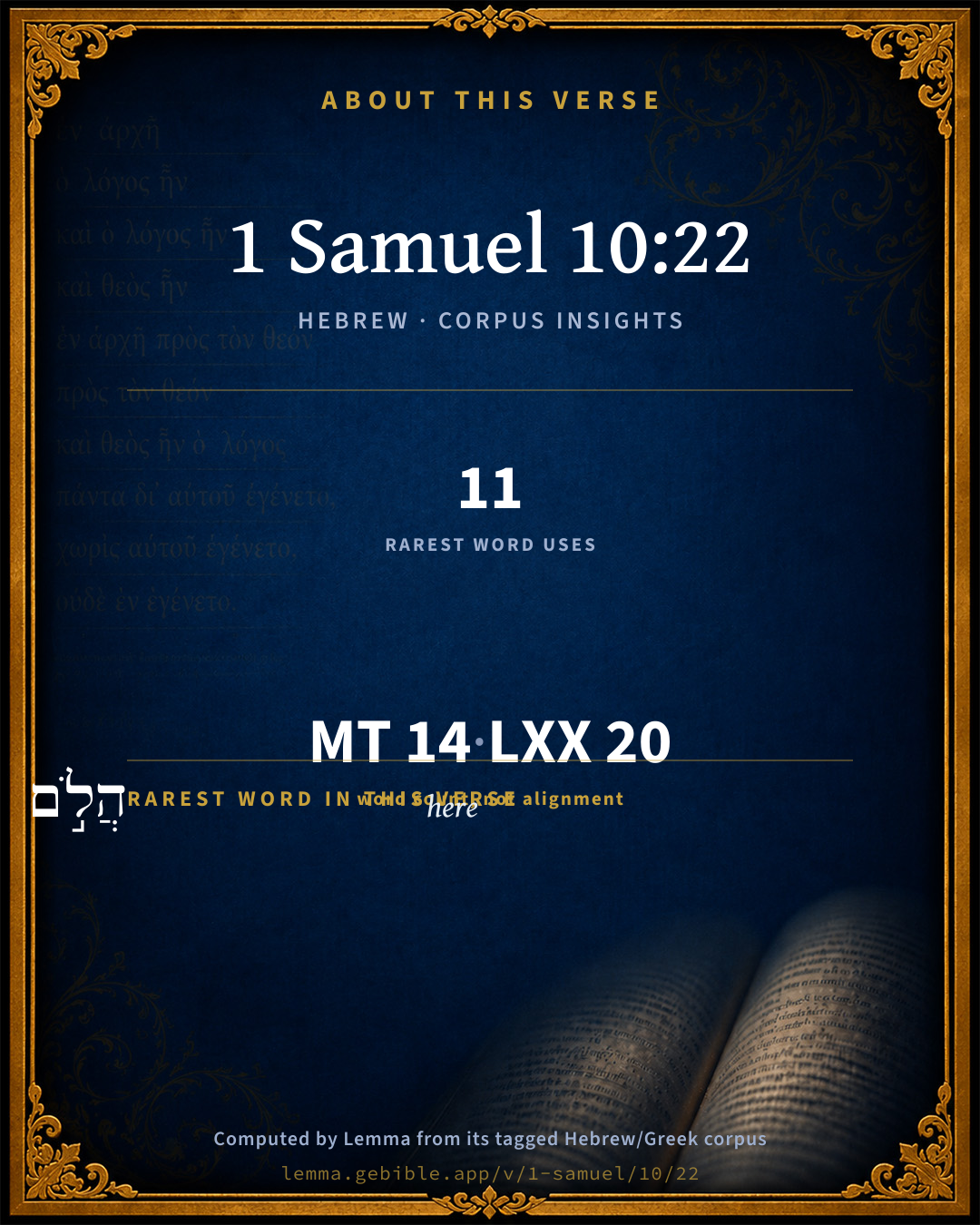
These counts appear in no published source. They are computed here, from the morphology-tagged text and Lemma’s own curated glosses. What Lemma adds →

14
words
12
distinct lemmas
Historical
section

Notable vocabulary

The rarest word here is הֲלֹ֣ם here H1988 — appearing just 11 times in the whole Hebrew Bible.

Shared distinctive vocabulary

הֲלֹ֣ם here H1988 occurs in 11 verses of the Hebrew Bible. Also found in:

Grammatical profile

  • 4 verbs
  • 4 nouns
  • 1 pronoun
  • 1 preposition
  • 3 adverbs
  • 1 particle

Verb forms

  • וַיִּשְׁאֲלוּ Qal · Sequential Imperfect
  • הֲבָ֥א Qal · Perfect
  • וַיֹּ֣אמֶר Qal · Sequential Imperfect
  • נֶחְבָּ֖א Niphal · Participle Passive

Repetition

Words recur within this verse — often emphatic in Hebrew:

  • עוֹד֙ still H5750 ×2
  • בַּֽיהוָ֔ה LORD H3068 ×2

Hebrew & Septuagint length

In English translation the verse runs 24 words from the Hebrew and 24 from the Septuagint (LXX English) — the same length.

A rough comparison of the two English renderings, which tokenize alike — not a word-level alignment.

Word counts can differ between the Hebrew and the Greek without any difference in meaning — e.g. the Hebrew direct-object marker אֵת has no separate Greek word, and Greek often adds the article ὁ.

In the original languages it is 14 Hebrew tokens and 20 Greek tokens — but the two are counted differently (Hebrew bundles its prefixes and suffixes into one token; the Greek is in lemma form), so that isn’t a like-for-like length.

Cross-references

10

Topical passages linked to 1 Samuel 10:22 in the Treasury of Scripture Knowledge — connected by theme and wording, ordered by reader-vote popularity; previews shown in the World English Bible.

  • Numbers 27:21 He shall stand before Eleazar the priest, who shall inquire for him by the judgment of the Urim before Yahweh: at his word shall they go out, and at his word they shall come in, both he, and all the children of Israel with him, even all the congregation.
  • Judges 20:18 The children of Israel arose, and went up to Bethel, and asked counsel of God; and they said, Who shall go up for us first to battle against the children of Benjamin? Yahweh said, Judah [shall go up] first.
  • Judges 1:1 It happened after the death of Joshua, the children of Israel asked of Yahweh, saying, Who shall go up for us first against the Canaanites, to fight against them?
  • Judges 20:23 The children of Israel went up and wept before Yahweh until even; and they asked of Yahweh, saying, Shall I again draw near to battle against the children of Benjamin my brother? Yahweh said, Go up against him.
  • Judges 20:28 and Phinehas, the son of Eleazar, the son of Aaron, stood before it in those days), saying, Shall I yet again go out to battle against the children of Benjamin my brother, or shall I cease? Yahweh said, Go up; for tomorrow I will deliver him into your hand.
  • 1 Samuel 9:21 Saul answered, Am I not a Benjamite, of the smallest of the tribes of Israel? and my family the least of all the families of the tribe of Benjamin? why then speak you to me after this manner?
  • 1 Samuel 15:17 Samuel said, "Though you were little in your own sight, weren't you made the head of the tribes of Israel? Yahweh anointed you king over Israel;
  • 1 Samuel 23:2–4 Therefore David inquired of Yahweh, saying, Shall I go and strike these Philistines? Yahweh said to David, Go, and strike the Philistines, and save Keilah.
  • 1 Samuel 23:11–12 Will the men of Keilah deliver me up into his hand? will Saul come down, as your servant has heard? Yahweh, the God of Israel, I beg you, tell your servant. Yahweh said, He will come down.
  • Luke 14:11 For everyone who exalts himself will be humbled, and whoever humbles himself will be exalted."

Cross-references courtesy of OpenBible.info (CC BY 4.0).

Hebrew and Greek witnesses Masoretic Hebrew ↔ Greek Septuagint

The same verse in the two great witnesses to the Old Testament, shown verse-for-verse.

These are two independent witnesses, not word-aligned to each other, and the Septuagint is shown in lemma (dictionary) form.

Hebrew 1 Samuel 10:22 Masoretic · Westminster Leningrad Codex

וַיִּשְׁאֲלוּ עוֹד֙ בַּֽיהוָ֔ה הֲבָ֥א ע֖וֹד הֲלֹ֣ם אִ֑ישׁ וַיֹּ֣אמֶר יְהוָ֔ה הִנֵּה ה֥וּא נֶחְבָּ֖א אֶל הַכֵּלִֽים

Therefore they asked of Yahweh further, Is there yet a man to come here? Yahweh answered, Behold, he has hid himself among the baggage.

World English Bible · Public Domain

Greek LXX 1 Samuel 10:22 Septuagint · lemma form

καί ἐπιἐρωτάω σαμουηλ ἔτι ἐν κύριος εἰ ἔρχομαι ὁ ἀνήρ ἐνταῦθα καί εἶπον κύριος ἰδού αὐτός κρύπτω ἐν ὁ σκεῦος

And Samuel asked yet again of the Lord, Will the man come here? and the Lord said, Behold, he is hid among the stuff.

LXX2012 (modern English Septuagint) · Public Domain

On this verse, The Pulpit Commentary discusses the Septuagint’s reading. Read the note in Commentary ↓

Hebrew: Westminster Leningrad Codex (CC BY 4.0). Greek: Septuagint (public domain); English from LXX2012 (modern English Septuagint) (Public Domain). How the Septuagint differs from the Hebrew →

Targum (Aramaic paraphrase)

1

The Targum is the ancient Jewish Aramaic paraphrase of the Hebrew Scriptures — an interpretive translation, not the Hebrew text itself. Onkelos (literal) and Pseudo-Jonathan (expansive) render the Torah, and Jonathan the Prophets. Coverage is partial: where no permissively-licensed English translation exists for a verse, only the Aramaic is shown. This is verse-level text, not a word-by-word alignment to the Hebrew.

  1. Targum Jonathan Prophets (Joshua–Malachi)
    וּשְׁאִילוּ עוֹד בְּמֵימְרָא דַייָ הֲאִית עוֹד הָכָא גַבְרָא וַאֲמַר יְיָ הָא הוּא טְמִיר בְּמָנַיָא:

    (no public-domain English translation for this verse)

    Targum Jonathan — Aramaic: “Mikraot Gedolot” (public domain). English: “Sefaria Community Translation” (CC0 1.0 (public-domain dedication)); “London "Chaldee Paraphrase," 1871” (public domain). Text via Sefaria.

Commentary

Notes on 1 Samuel 10:22 from classic Christian and Jewish commentators (each source and its license shown beneath its notes). The classic Christian expositions comment on the surrounding passage and are grouped to its opening verse, so a note may address several verses; the Jewish commentaries on the Tanakh (Rashi and others) are per-verse, so they appear only where the commentator wrote on this verse.

Lemma curates 59 commentaries, every one of them public domain or Creative Commons licensed, each selected and text-cleaned for this edition rather than reprinted as found. About our sources →

Trapp's Complete Commentary

John Trapp

1Sa 10:22 Therefore they enquired of the LORD further, if the man should yet come thither. And the LORD answered, Behold, he hath hid himself among the stuff.

Ver. 22. Behold, he hath hid himself among the stuff.] This he did not out of hypocrisy; - as did Pope Paschalis II, who when he knew aforehand he should be chosen Pope, hid himself; and being drawn into the light, would not be enthroned, till the people of Rome had thrice cried out, Sanctus Petrus Reinerum virum optimum elegit; { a} St Peter hath chosen Reyner, who is a very honest man; - or as that Popish Bishop did, who being asked, as the manner at their instalment is, Visne Episcopare? answered, Nolens volo, et volens nolo; - or else our Richard III, who seemed very unwilling to be made king, but out of humility and prudence: [but] as Augustine would not come at those churches that lacked bishops, lest they should choose him, and at length accepted of little Hippo, when leaden Aurelius got the golden bishopric of Carthage: and as the elector of Saxony, Frederick, seriously and upon mature deliberation, refused the empire of Germany when it was offered him.

{a} Funcc., Chronol.

John Trapp, A Commentary or Exposition upon All the Books of the Old and New Testament (1647–1656) — public domain. Text from a community e-Sword module.

The Biblical Illustrator

Joseph S. Exell

1Sa_10:22

He hath hid himself amongst the stuff.

Responsibility

When Auxentius, the Arian Bishop of Milan, had expired, there was much excitement among the Christians in that City. Both Catholics and Arians had assembled in the principal church for the purpose of electing a new bishop, and each party was eager that some priest who held the same views as itself should be appointed to the vacant see. When the words of the governor had ceased to reverberate through the lofty arches of the church, the clear voice of a little child broke the silence which succeeded, repeating the words Ambrose Bishop--Ambrose Bishop. At once the cry was caught up by that vast assemblage. In vain did Ambrose protest that he was only a Catechumen, that he had not even been baptised; in vain did he urge that the sacred office of a bishop was one utterly foreign to his previous thoughts and studies (for he had been educated as a lawyer); the people would take no denial; and so, at last, he fled from their presence, in order to escape consecration to the Bishopric of Milan. This is no solitary instance. We read in the history of the Christian Church of many similar shrinkings from responsibility on the part of those who were elected to high office in that church; of many who, when called to assume the care of some diocese, or even the sacred office of the priesthood, endeavoured, like Saul the Benjamite, to go and hide themselves among the stuff. Now what was the cause of this strange behaviour: what was the cause of that flight of S. Ambrose, when elected to the Bishopric of Milan? Was it not a sort of nervous fear: was it not what may be called shamefacedness, or as it is better rendered in the revised version of the New Testament shamefastness? We can see countless instances of its disastrous effects in the Christian Church of the present day. But let us not be too ready to condemn our timid brethren. S. Ambrose became a mighty pillar of the Church: Saul, for many years, made an excellent king, and proved himself a courageous warrior after he had been drawn forth from his inglorious retreat. It is a hard thing to lead a holy life in a world given to unrighteousness. Our Lord told His disciples that the world would hate them and persecute them, just as it had hated and persecuted Him. It is the public declaration of our loyalty to Christ which forms the difficulty with most of us. And so this shamefastness leads men to live two lives--one in the Church and one in the family circle: another in the office or in the club. If we investigate the causes of this lack of helpers, what do we find? We find hundreds of young men and women attending our churches: many of them regular communicants--all at least making some outward profession of Christianity--all at least hoping to be saved through faith in the Lord Jesus Christ. You implore them to labour in some one of those many fields which lie fallow for want of a sower, and they respond but too frequently with that parrot cry that charity begins at home. They are asked to join some society, to teach in some Sunday School; the call of God comes to them in a hundred different ways to come forth boldly and testify in His name; but, alas, when they are thus summoned, they flee like Saul the son of Kish, and hide themselves among the stuff and baggage of such excuses as they can drag together to conceal their lack of courage. We read day after day in the public journals, that, as each regiment embarks for service at the seat of war, not a man is found wanting when the muster roll is called--none of the soldiers of our Queen are evading the call of duty--none are hiding themselves among the stuff. And shall we, the soldiers of Christ, suffer such a reproach to be cast at us, shall we suffer it to be said that our Christianity is pure selfishness, that all we care for is to save our souls; and that we care not to come forward and make public avowal, to take up this or that public duty which Christ calls upon us to perform for the love which we profess to bear Him? (Patrick Wilson.)

Among the stuff

For the fulfilment of high offices in Church and State men need the fellowship of those whose experience will impart a new impulse to life as well as a new education.

1. Men hide themselves among feeling arising from a sense of unworthiness. Such a sentiment must be cherished, but not elevated above the call of God. We have a large number of good people who withhold their persons and their influence from the Church of Christ, because they are unfit. Poor stuff! Come to your own coronation, God is calling. Your first fitness is obedience to the call. Be ruled by a sense of the greatness of the Saviour.

2. Men hide themselves among their good intentions. Intentions are good when they are followed by actions, but they are bad when they are mere substitutes. Some lives are made up of intentions, and, like castles in the air, they are blown down by the rough winds of circumstances. Many would be rich without work, wise without learning, and famous without a passport. Very many people sincerely hope to become serious and religious some day.

3. Men hide themselves among their doubts and unbeliefs. Those who set themselves up as harmonisers of the Divine method and fail are not a few. No vessel anchors in fogs on the Banks of Newfoundland, but every one drives through. To live in doubt is to anchor in a fog. Every one knows something of the perplexities of belief. The unrest of the soul calls for the rest of faith; but, he who rests in the unrest of doubt is condemned already.

4. Men hide themselves among worldly cares and anxieties. The motto of many is, Business must be attended to. Certainly, and religion must be attended to likewise.

5. Men hide themselves among the pleasures of life. The pleasure seeker is everywhere, and is catered for most extensively, but it is poor stuff. (T. Davies.)

We should not shrink from the path of duty

Joan of Arc is a striking example of strong resolve and lofty purpose conquering a naturally timid disposition. When convinced that she was called of God to deliver France from English rule, the timid village maiden became a leader in battlefields and sieges, and unawed by the presence of the highest personages in the land. The conviction of her mission made her strong.

The Biblical Illustrator, edited by Joseph S. Exell (c. 1880s–1900s) — public domain. Text from a community e-Sword module.

Joseph Benson's Commentary

1Sa 10:22. They inquired of the Lord — Either by Urim and Thummim, which was the usual way of inquiry; or by Samuel, who by his prayer procured an answer. He hath hid himself among the stuff — Among the carriages or baggage of the people there assembled. This he probably did from a sense of his own unworthiness.

Joseph Benson's Commentary on the Old and New Testaments (1811–1818) — public domain. Text from a community e-Sword module.

Geneva Bible (1599)

Geneva Bible translators

As though he were unworthy and unwilling.

Geneva Bible (1599) marginal notes — public domain. Text via Bolls.life.

Adam Clarke's Commentary

Verse 22. The Lord answered] What a continual access to God! and what condescension in his attention to all their requests!

The stuff among which he had secreted himself may mean the carts, baggage, &c., brought by the people to Mizpeh.

Adam Clarke's Commentary on the Bible (1810–1826) — public domain. Text from a community e-Sword/MySword module.

Ellicott's Commentary for English Readers

(22) Therefore they enquired of the Lord further, if the man should yet come thither.—Saul and Samuel alone, of all the host gathered that day at Mizpeh, knew on whom the lot would fall. So certain was Saul, after the strange signs had sealed the truth of the prophet’s revelation, that he would be designated by the sacred lot, that he shrank from waiting to hear the result, and concealed himself among the baggage and store-tents and waggons of the vast assembly. A second Divine announcement was needed to discover his hiding-place, and draw him forth before the people.

(23–24) He was higher than any of the people.—“How shall this man save us?” was the impatient and angry murmur soon raised by some discontented spirits in Israel, not improbably princes of the leading houses of the great tribes of Judah and Ephraim, who were disgusted at the choice falling on an unknown man of the small and comparatively powerless tribe of Benjamin. But Samuel—whose place in the nation the unknown Benjamite was really to take—with rare nobility and singleness of purpose, had already singled out and called conspicuous attention to the one gift Saul undoubtedly, in an extraordinary degree, possessed—the one gift by which, in that primitive time, a man seemed to be worthy of rule. He was “goodly”: “there was not among the children of Israel a goodlier person than he;” from his shoulders and upward he towered above all the people. When he stood among the people, Samuel could say of him, “See ye him? Look at him whom the Lord hath chosen, that there is none like him among all the people.” It is in the days of the Judges, as in the Homeric days of Greece; Agamemnon, like Saul, is head and shoulders taller than the people. Like Saul, too, he has that peculiar air and dignity expressed by the Hebrew word which we translate “good,” or “goodly.” This is the ground of the epithet which became fixed as part of his name, “Saul the chosen,” “the chosen of the Lord.” In the Mussulman traditions this is the only trait of Saul which is preserved. His name has there been almost lost; he is known only as Thalût, “the tall one.” In the Hebrew songs of his own time he was known by a more endearing, but not less expressive, indication of the same grace. His stately towering form, standing under the pomegranate-tree above the precipice of Migron, or on the pointed crags of Michmash, or the rocks of Engedi, claimed for him the title of “wild roe,” “the gazelle,” perched aloft, the pride and glory of Israel. Against the giant Philistines a giant king was needed. The time for the little stripling of the house of Jesse was close at hand, but was not yet come. Saul and Jonathan, swifter than eagles and stronger than lions, still seemed the fittest champions of Israel. When Saul saw any strong man or any valiant man, he took him unto him. He, in his gigantic panoply, that would fit none but himself, with the spear that he had in his hand, of the same form and fashion as the spear of Goliath, was a host in himself.—Dean Stanley: Lectures on the Jewish Church, 21

A Bible Commentary for English Readers, edited by Charles John Ellicott (1878–1897) — public domain. Text from a community e-Sword module.

The Cambridge Bible for Schools and Colleges

gen. ed. J. J. S. Perowne

22. they inquired of the Lord further] The technical phrase for ascertaining God’s will by means of the Urim and Thummim in the breastplate upon the High-priest’s Ephod (Exo_28:30; Num_27:21). See on 1Sa_28:6, and cp. ch. 1Sa_14:3, 1Sa_22:10, 1Sa_23:9, 1Sa_30:7.

the stuff] The baggage of the people who had come to Mizpah from a distance. Compare

“Therefore away to get our stuff aboard.”

Shakespeare, Com. of Errors, IV. 4.

The Cambridge Bible for Schools and Colleges (gen. ed. J. J. S. Perowne; Cambridge University Press, 1878–1918) — public domain. Text from a community e-Sword module.

John Gill's Exposition

And they ran and fetched him thence,.... Being in haste to see their king elect, and proclaim him:

and when he stood among the people; being brought among them, and presented to them:

he was higher than any of the people, from the shoulders, and upwards; which made him look very graceful and majestic; height of stature, and a comely form, as Kimchi observes, recommend to royal dignity; and make the people stand more in awe of a prince, and have always been reckoned among all other nations to make a prince venerable; see Gill on Sa1 9:2.

John Gill's Exposition of the Whole Bible (1746–1763) — public domain (CC PDM 1.0). Text via the HelloAO Bible API.

Albert Barnes' Notes on the Bible

Among the stuff - Rather, “the baggage.” The assembly was like a camp, and the baggage (impedimenta) of the whole congregation was probably collected in one place, where the wagons were arranged for protection.

Albert Barnes' Notes on the Bible (1834–1885) — public domain. Text from a community e-Sword/MySword module.

Haydock's Catholic Bible Commentary

Home. Hebrew, "he hath hidden himself among the stuff," (Haydock) instruments, or baggage, at Masphath. He acted thus out of modesty, judging himself unfit for the exalted dignity, (Calmet) and shewed that he did not seek for it. (Menochius)

George Leo Haydock (1774–1849), Haydock's Catholic Family Bible and Commentary, 1859 edition — public domain. Excludes Psalms (Douay-Rheims chapter numbering differs from Protestant) and Deuterocanonical books (Catholic canon only).

Matthew Poole's English Annotations

They inquired of the Lord; either by Urim or Thummim, which was the usual way of inquiry, Num 27:21; 1Sa 23:9; 28:6; or by Samuel, who by his prayer procured an answer.

Among the stuff; among the carriages or baggage of the people there assembled. This he might do, because he either had, or at least would be thought to have, a modest sense of his own unworthiness, which was a likely way to commend him to the people.

Matthew Poole's English Annotations on the Holy Bible (1683–1685) — public domain. Text from a community e-Sword/MySword module.

Whedon's Commentary on the Bible

Daniel D. Whedon

22. They inquired of the Lord farther — Either by urim or by the prophet, for in both these ways Jehovah was wont to be inquired of. Compare 1Sa_28:6. Very probably on this occasion Samuel himself was the medium, for the seer who could give information concerning the strayed asses might very naturally be expected to tell where Saul was.

Among the stuff — הכלים, utensils, vessels; that is, the travelling baggage of the assembled people.

Daniel D. Whedon (gen. ed.), Commentary on the Old and New Testaments (1874–1909) — public domain. Text from a community e-Sword module.

The Pulpit Commentary

They inquired of Jehovah further, if the man should yet come thither. More correctly, "Is any one as yet come hither?" The Septuagint and Vulgate translate as if there were an article before "any one" (Hebrew, a man), and give, "Is the man coming hither?" But the Hebrew text is the more satisfactory. For the object of the inquiry, made by the Urim and Thummim, was to find Saul, wherever he might be; and the enigmatical way of putting the question, Is any one as yet come? was regarded as more reverential than asking directly, Is Saul come? Among the stuff. Ie. the baggage, as in 1Sa_17:22, where it is translated "carriage." The people, collected from all Israel, would come with wagons and provisions, and such arms as they could procure; for very probably the Philistines would interrupt such a meeting, as they had that convened formerly by Samuel. (1Sa_7:7) Naturally, therefore, they would follow the regulations of an army, and so arrange their baggage as to form a place of defence in case of attack. See on 1Sa_17:20.

The Pulpit Commentary (1880–1919), ed. H.D.M. Spence-Jones & Joseph S. Exell — public domain. Text from a community e-Sword module.

John Wesley's Explanatory Notes

Inquired - Either by Urim or Thummim, which was the usual way of enquiry. Or, by Samuel, who by his prayer procured an answer. Stuff - Among the carriages or baggage of the people there assembled. This he probably did, from a sense of his own unworthiness.

John Wesley, Explanatory Notes Upon the Whole Bible (1754–1765) — public domain. Text via the GEBible commentary corpus.

unfoldingWord translationNotes

Door43 World Missions Community

he was taller than any of the people from his shoulders upward

The other tall people in Israel did not even come up to his shoulders. See how you translated this in 1 Samuel 9:2.

translationWords

Yahweh

unfoldingWord translationNotes — © Distant Shores Media and the Door43 World Missions Community, licensed CC BY-SA 4.0. Source: git.door43.org/Door43/en_tn.

Rashi

Rabbi Shlomo Yitzchaki (Rashi)

Is hidden by the baggage. In the room where newcomers had placed their baggage; [he hid] because he was running away from the high position. But the Midrash Aggadah of R. Tanchuma explains that 'אֶל הַכֵּלִים' refers to the Urim and Tumim. He said [to himself], 'perhaps I am not worthy of this high position. [I will not assume it]. until they inquire of the Urim and Tumim. Thereupon they asked, and he accepted it.

Rashi on the Tanakh — English translations: “The Judaica Press complete Tanach with Rashi, translated by A. J. Rosenberg” (CC BY 4.0); “Pentateuch with Rashi's commentary by M. Rosenbaum and A.M. Silbermann, 1929-1934” (public domain); “The Metsudah Tanach series, Lakewood, N.J” (CC BY 4.0); and “The Book of Joshua, Metsudah Publications, 1997” (CC BY 4.0). Text via Sefaria.

Lesson kit

Teaching starters — assembled from the data on this page, not authored interpretation. Every prompt links to the verse data it draws on. Edit before teaching.

1 Samuel, in the Historical, opens this verse with 14 words (12 distinct Hebrew lemmas). Its most distinctive word is hălôm (“here”). A historical commentator’s framing appears above. Read the whole chapter for the surrounding context.

Discussion questions

  1. What does “here” (hălôm) contribute to the verse as a whole?
  2. How does Genesis 16:13, which shares the word «here», read alongside this verse?
  3. What does the repetition of “still” (2× in this one verse) do in this verse?
  4. The translations on this page render this verse differently — a whole-verse word diff, not a word-by-word alignment. What might account for the different wordings?
  5. «וַיִּשְׁאֲלוּ» is a Qal Sequential Imperfect verb. How does that grammatical form shape the action described?
  6. Compare how Trapp's Complete Commentary and The Biblical Illustrator read this verse. Where do they agree or differ?

Things to notice

Reading settings

Reading text

Shown beneath each verse's original-language words.

Old Testament
Old Testament edition

Read the OT as the Masoretic Hebrew (MT) or the Greek Septuagint (LXX).

English shown for the Greek Septuagint (in the Hebrew ↔ Greek comparison).

Comparing translations? Open the Compare panel on any verse page to stack up to four side by side.