Ezekiel 15:3

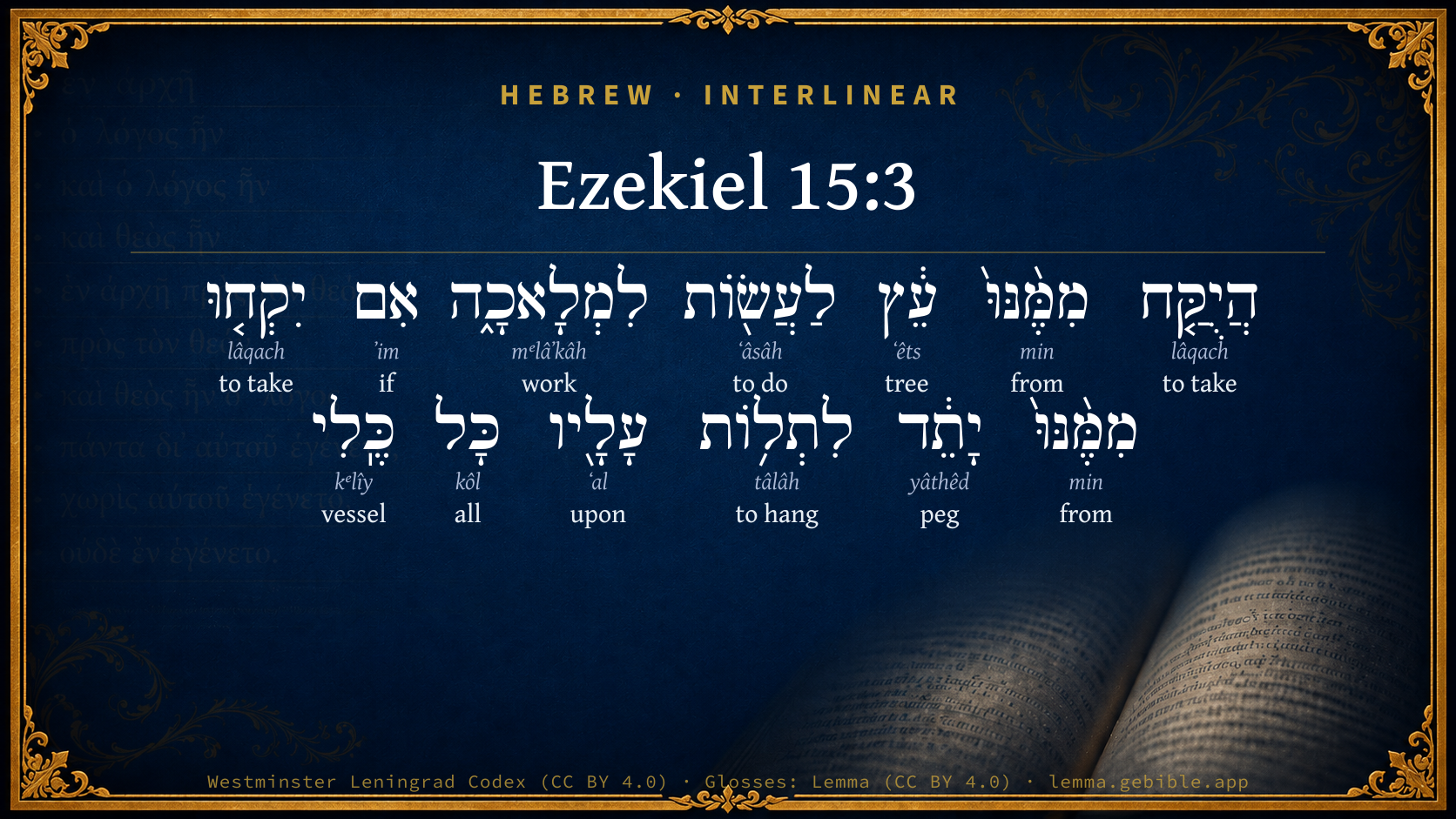
Hebrew (Westminster Leningrad Codex) Ezekiel 15:3 appears in the Hebrew Old Testament. The text above is from the Westminster Leningrad Codex. Each word links to its Strong’s number, a concise gloss, and parsing drawn from the Open Scriptures Hebrew Bible morphology. Click any word for its full Brown-Driver-Briggs (BDB) entry.
Download image
Cite this verse

Ezekiel 15:3 (World English Bible). Public Domain. Lemma interlinear Bible study tool, https://lemma.gebible.app/v/ezekiel/15/3.

Show BibTeX & RIS
BibTeX
RIS
English Translation
Shall wood be taken of it to make any work? or will men take a pin of it to hang any vessel thereon?
World English Bible · Public Domain
Download a study sheet

One document with this verse’s original text, its word-by-word gloss line, the meaning frame, cross-references with their text, attributed commentary, and full source and license credits — printable, and it pastes into notes with its structure intact.

This verse Autodidact and up

Study sheet (.html) Plain text (.txt)

A passage Seminary Student

Up to 50 verses in one chapter. A passage sheet keeps up to 6 commentary sources and 12 cross-references per verse, in the order this page ranks them, and says so on the sheet whenever that leaves anything out. Ask for a single verse and you get the Autodidact verse sheet above.

Everything on this page stays free to read, with no account — the sheet is a download of what is already on screen, not access to it.

Want to remove ads? Support Godless Engineer
Compare translations 3

The same verse in 3 English versions, stacked beneath the original-language interlinear above. Click any original word for its lexicon entry.

Each is an independent rendering of the whole verse — the interlinear is not word-aligned to these translations.

Highlighted words mark where these versions differ — a whole-verse word diff, not a word-by-word alignment.

  • World English Bible Public Domain
    Shall wood be taken of it to make any work? or will men take a pin of it to hang any vessel thereon?
  • King James Version Public Domain
    Shall wood be taken thereof to do any work? or will men take a pin of it to hang any vessel thereon?
  • unfoldingWord Literal Text CC BY-SA 4.0
    Do people take wood from a vine to make anything? Or do they make a peg from it to hang anything on it?

unfoldingWord Literal Text — © unfoldingWord, licensed CC BY-SA 4.0. Word-aligned USFM3 via Door43 (git.door43.org/unfoldingWord/en_ult).

Versions to compare (up to 4)

3 of 4 selected

Show all 18 translations

Every available English version of this verse, each an independent rendering of the whole verse.

  • World English Bible Public Domain
    Shall wood be taken of it to make any work? or will men take a pin of it to hang any vessel thereon?
  • Berean Standard Bible Public Domain
    Can wood be taken from it to make something useful? Or can one make from it a peg on which to hang utensils?
  • Majority Standard Bible Public Domain
    Can wood be taken from it to make something useful? Or can one make from it a peg on which to hang utensils?
  • King James Version Public Domain
    Shall wood be taken thereof to do any work? or will men take a pin of it to hang any vessel thereon?
  • American Standard Version (1901) Public Domain
    Shall wood be taken thereof to make any work? or will men take a pin of it to hang any vessel thereon?
  • Revised Version (1885) Public Domain
    Shall wood be taken thereof to make any work? or will men take a pin of it to hang any vessel thereon?
  • Geneva Bible (1599) Public Domain
    Shall wood bee taken thereof to doe any worke? or wil men take a pin of it to hang any vessel thereon?
  • Douay-Rheims (1899) Public Domain
    Shall wood be taken of if, to do any work, or shall a pin be made of it for any vessel to hang thereon?
  • Young's Literal Translation Public Domain
    Is wood taken from it to use for work? Do they take of it a pin to hang any vessel on it?
  • Literal Standard Version CC BY-SA 4.0
    Is wood taken from it to use for work? Do they take a pin of it to hang any vessel on it?
  • Unlocked Literal Bible CC BY-SA 4.0
    Do people take wood from a vine to make anything? Or do they make a peg from it to hang anything on it?
  • unfoldingWord Literal Text CC BY-SA 4.0
    Do people take wood from a vine to make anything? Or do they make a peg from it to hang anything on it?
  • Darby Bible Public Domain
    Shall wood be taken thereof to do any work? or will [men] take a pin of it to hang any vessel thereon?
  • World Messianic Bible Public Domain
    Will wood be taken of it to make anything? Will men take a pin of it to hang any vessel on it?
  • Webster's Bible Public Domain
    Shall wood be taken of it to do any work? or will men take a pin of it to hang any vessel upon it?
  • Free Bible Version CC BY-SA 4.0
    Can you make anything useful from vine wood? Can you use it to make even just a peg to hang up pots and pans?
  • Bible in Basic English Public Domain
    Will its wood be used for any work? do men make of it a pin for hanging any vessel on?
  • JPS Tanakh (1917) Public Domain
    Shall wood be taken thereof to make any work? or will men take a pin of it to hang any vessel thereon?

Literal Standard Version (2020), Covenant Press — licensed CC BY-SA 4.0. Text via the HelloAO Bible API (eBible.org). Unlocked Literal Bible (unfoldingWord) — licensed CC BY-SA 4.0. Text via the HelloAO Bible API (eBible.org). unfoldingWord Literal Text — © unfoldingWord, licensed CC BY-SA 4.0. Word-aligned USFM3 via Door43 (git.door43.org/unfoldingWord/en_ult). Free Bible Version, Dr. Jonathan Gallagher — licensed CC BY-SA 4.0. Text via the HelloAO Bible API (eBible.org).

Word by word

More ways to search: Search by grammar → Find every occurrence → Compare this word →

Practice this passage: Drill this verse → Learn its vocabulary →

יָתֵ֔ד
yâthêd
H3489
“peg”
Noun, Common, Feminine, Singular, Absolute
Part of Speech
Noun
Type
Common
Gender
Feminine
Number
Singular
State
Absolute
Full BDB Definition

Origin: from an unused root meaning to pin through or fast

TWOT: 932a

pin, stake, peg, nail - pin, peg, tent pin, tent stake - nail, pin (figuratively) - pin (used in weaving)
  1. הֲיֻקַּ֤ח lâqach H3947 “to take” Particle, Interrogative + Verb, Qal Passive, Imperfect, 3rd Person, Masculine, Singular
  2. מִמֶּ֨נּוּ֙ min H4480 “from · us” Preposition + Suffix, Personal, 1st Person, Common, Plural
  3. עֵ֔ץ ʻêts H6086 “tree” Noun, Common, Masculine, Singular, Absolute
  4. לַעֲשׂ֖וֹת ʻâsâh H6213 “to do” Preposition + Verb, Qal, Infinitive Construct
  5. לִמְלָאכָ֑ה mᵉlâʼkâh H4399 “to/for · work” Preposition + Noun, Common, Feminine, Singular, Absolute
  6. אִם ʼim H518 “if” Conjunction
  7. יִקְח֤וּ lâqach H3947 “to take” Verb, Qal, Imperfect, 3rd Person, Masculine, Plural
  8. מִמֶּ֨נּוּ֙ min H4480 “from · us” Preposition + Suffix, Personal, 1st Person, Common, Plural
  9. לִתְל֥וֹת tâlâh H8518 “to hang” Preposition + Verb, Qal, Infinitive Construct
  10. עָלָ֖יו ʻal H5921 “upon · him” Preposition + Suffix, Personal, 3rd Person, Masculine, Singular
  11. כָּל kôl H3605 “all of” Noun, Common, Masculine, Singular, Construct
  12. כֶּֽלִי kᵉlîy H3627 “vessel” Noun, Common, Masculine, Singular, Absolute

About this verse

These counts appear in no published source. They are computed here, from the morphology-tagged text and Lemma’s own curated glosses. What Lemma adds →

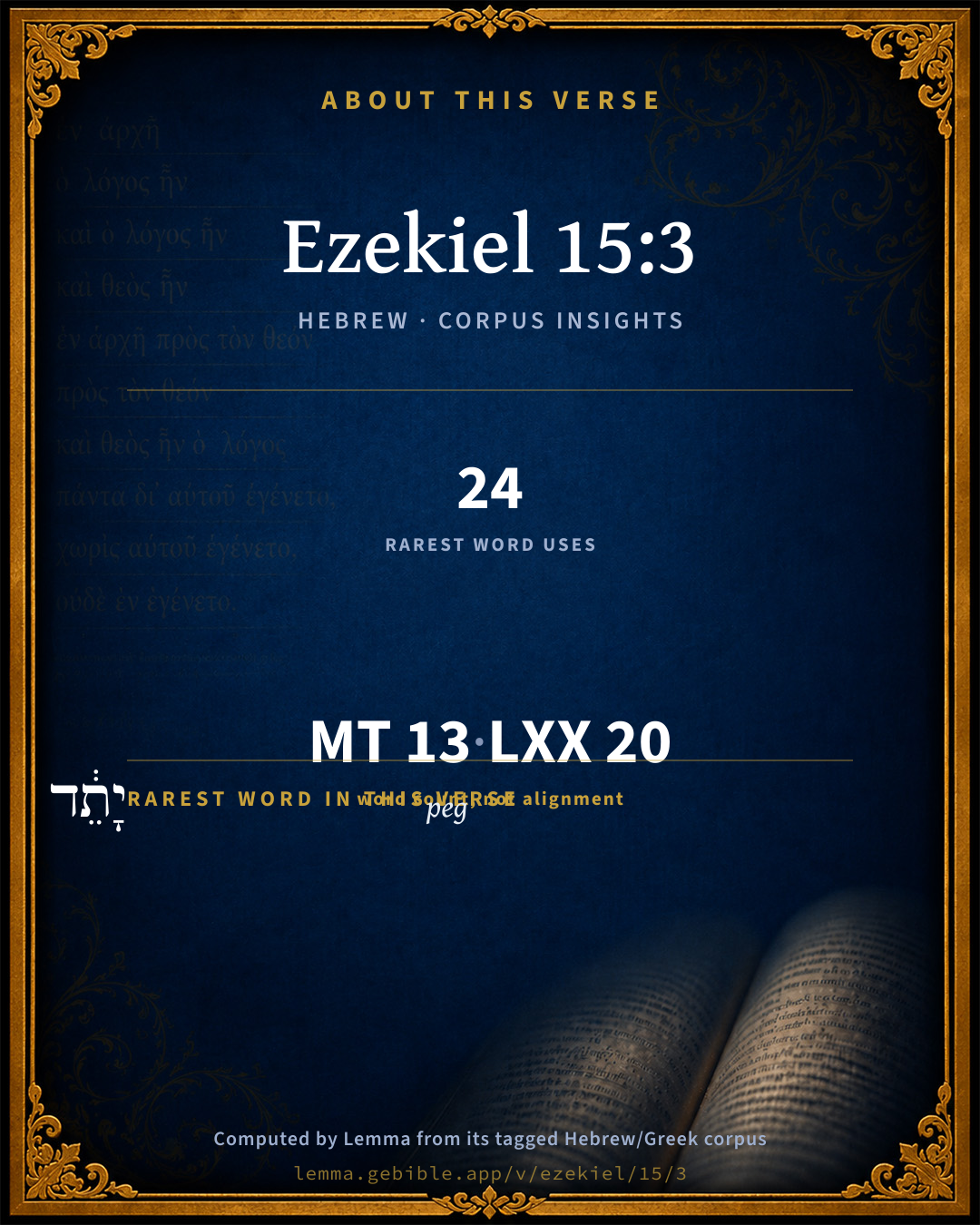
13
words
11
distinct lemmas
Prophets
section

Notable vocabulary

The rarest word here is יָתֵ֔ד peg H3489 — appearing just 24 times in the whole Hebrew Bible.

Shared distinctive vocabulary

יָתֵ֔ד peg H3489 occurs in 19 verses of the Hebrew Bible. Also found in:

Grammatical profile

  • 4 verbs
  • 5 nouns
  • 3 prepositions
  • 1 conjunction

Verb forms

  • הֲיֻקַּ֤ח Qal Passive · Imperfect
  • לַעֲשׂ֖וֹת Qal · Infinitive Construct
  • יִקְח֤וּ Qal · Imperfect
  • לִתְל֥וֹת Qal · Infinitive Construct

Repetition

Words recur within this verse — often emphatic in Hebrew:

  • הֲיֻקַּ֤ח to take H3947 ×2
  • מִמֶּ֨נּוּ֙ from H4480 ×2

Hebrew & Septuagint length

In English translation the verse runs 23 words from the Hebrew and 25 from the Septuagint (LXX English) — closely comparable.

A rough comparison of the two English renderings, which tokenize alike — not a word-level alignment.

Word counts can differ between the Hebrew and the Greek without any difference in meaning — e.g. the Hebrew direct-object marker אֵת has no separate Greek word, and Greek often adds the article ὁ.

In the original languages it is 13 Hebrew tokens and 20 Greek tokens — but the two are counted differently (Hebrew bundles its prefixes and suffixes into one token; the Greek is in lemma form), so that isn’t a like-for-like length.

Cross-references

4

Topical passages linked to Ezekiel 15:3 in the Treasury of Scripture Knowledge — connected by theme and wording, ordered by reader-vote popularity; previews shown in the World English Bible.

  • Luke 14:34–35 Salt is good, but if the salt becomes flat and tasteless, with what do you season it?
  • Jeremiah 24:8 As the bad figs, which can't be eaten, they are so bad, surely thus says Yahweh, So will I give up Zedekiah the king of Judah, and his princes, and the residue of Jerusalem, who remain in this land, and those who dwell in the land of Egypt,
  • Matthew 5:13 "You are the salt of the earth, but if the salt has lost its flavor, with what will it be salted? It is then good for nothing, but to be cast out and trodden under the feet of men.
  • Mark 9:50 Salt is good, but if the salt has lost its saltiness, with what will you season it? Have salt in yourselves, and be at peace with one another."

Cross-references courtesy of OpenBible.info (CC BY 4.0).

Hebrew and Greek witnesses Masoretic Hebrew ↔ Greek Septuagint

The same verse in the two great witnesses to the Old Testament, shown verse-for-verse.

These are two independent witnesses, not word-aligned to each other, and the Septuagint is shown in lemma (dictionary) form.

Hebrew Ezekiel 15:3 Masoretic · Westminster Leningrad Codex

הֲיֻקַּ֤ח מִמֶּ֨נּוּ֙ עֵ֔ץ לַעֲשׂ֖וֹת לִמְלָאכָ֑ה אִם יִקְח֤וּ מִמֶּ֨נּוּ֙ יָתֵ֔ד לִתְל֥וֹת עָלָ֖יו כָּל כֶּֽלִי

Shall wood be taken of it to make any work? or will men take a pin of it to hang any vessel thereon?

World English Bible · Public Domain

Greek LXX Ezekiel 15:3 Septuagint · lemma form

εἰ λαμβάνω ἐκ αὐτός ξύλον ὁ ποιέω εἰς ἐργασία εἰ λαμβάνω ἐκ αὐτός πάσσαλος ὁ κρεμάζω ἐπί αὐτός πᾶς σκεῦος

Will they take wood of it to make it fit for work? will they take of it a peg to hang any vessel upon it?

LXX2012 (modern English Septuagint) · Public Domain

Hebrew: Westminster Leningrad Codex (CC BY 4.0). Greek: Septuagint (public domain); English from LXX2012 (modern English Septuagint) (Public Domain). How the Septuagint differs from the Hebrew →

Targum (Aramaic paraphrase)

1

The Targum is the ancient Jewish Aramaic paraphrase of the Hebrew Scriptures — an interpretive translation, not the Hebrew text itself. Onkelos (literal) and Pseudo-Jonathan (expansive) render the Torah, and Jonathan the Prophets. Coverage is partial: where no permissively-licensed English translation exists for a verse, only the Aramaic is shown. This is verse-level text, not a word-by-word alignment to the Hebrew.

  1. Targum Jonathan Prophets (Joshua–Malachi)
    הֲיִסְבוּן מִנֵיהּ אָעָא לְמֶעְבַּד עֲבִידָא אִם יִסְבוּן מִנֵיהּ סִיכָתָא לְמִתְלֵי בָּהּ כָּל מָאן:

    (no public-domain English translation for this verse)

    Targum Jonathan — Aramaic: “Mikraot Gedolot” (public domain). English: “Sefaria Community Translation” (CC0 1.0 (public-domain dedication)); “London "Chaldee Paraphrase," 1871” (public domain). Text via Sefaria.

Commentary

Notes on Ezekiel 15:3 from classic Christian and Jewish commentators (each source and its license shown beneath its notes). The classic Christian expositions comment on the surrounding passage and are grouped to its opening verse, so a note may address several verses; the Jewish commentaries on the Tanakh (Rashi and others) are per-verse, so they appear only where the commentator wrote on this verse.

Lemma curates 59 commentaries, every one of them public domain or Creative Commons licensed, each selected and text-cleaned for this edition rather than reprinted as found. About our sources →

Trapp's Complete Commentary

John Trapp

Eze 15:3 Shall wood be taken thereof to do any work? or will [men] take a pin of it to hang any vessel thereon?

Ver. 3. Shall wood be taken thereof to do any work?] No, hardly. It is good for nothing; no, not so much as to make a pin or a peg of to hang a hat or bridle on, because it is a sappy and brittle wood. Think the same of that empty vine, the profligate professor, being abominable, disobedient, and unto every good work reprobate. {Tit 1:16}

John Trapp, A Commentary or Exposition upon All the Books of the Old and New Testament (1647–1656) — public domain. Text from a community e-Sword module.

The Cambridge Bible for Schools and Colleges

gen. ed. J. J. S. Perowne

3. Uselessness of the wood of the vine.

to do any work] i.e. use for any work or purpose. The words may mean, to make it into any work or article of workmanship. It has too little firmness even to be made into a pin to hang any article upon.

The Cambridge Bible for Schools and Colleges (gen. ed. J. J. S. Perowne; Cambridge University Press, 1878–1918) — public domain. Text from a community e-Sword module.

John Gill's Exposition

Behold, it is cast into the fire for fuel, That is; a vine tree when cut down, or a branch when cut off, it is good for nothing else; and that is the use it is generally put to; see Joh 15:6; and this, it is suggested, would be the end of the Jewish nation; who were become by their sins like a wild vine, and were fit fuel for the fire of divine wrath:

the fire devoureth both the ends of it; the branch cast into it, and so is quickly consumed. Kimchi explains this by Isa 9:12; "the Syrians before, and the Philistines behind, and they devour Israel with open mouth"; and Abendana of the ten tribes; but it seems only to design how soon the fire takes it; and how inevitable the consumption is when it is fired at both ends:

and the midst of it is burnt: presently; it being dried, and reduced to a brand by the heat of the fire at both ends: this Kimchi interprets of the city of Jerusalem, which was in the midst of the land:

is it meet for any work? no; for if it was not fit for any work when cut down, or cut off, much less when burnt in the fire.

John Gill's Exposition of the Whole Bible (1746–1763) — public domain (CC PDM 1.0). Text via the HelloAO Bible API.

Haydock's Catholic Bible Commentary

Thereon. Isaias xxii. 23. (Calmet) --- The Turkish lords have no furniture in their rooms, but hang their arms, saddles, &c., upon such pins, or on strings. (Roger. ii.)

George Leo Haydock (1774–1849), Haydock's Catholic Family Bible and Commentary, 1859 edition — public domain. Excludes Psalms (Douay-Rheims chapter numbering differs from Protestant) and Deuterocanonical books (Catholic canon only).

Matthew Poole's English Annotations

Is there one good piece of timber in the whole vine fit for building a house, or ship, as there is in the oak, elm, or other wild forest trees? Will it furnish the husbandman or soldier, or seaman with fit materials for their use, in peace, war, or sea? Will it afford a pin to drive into a wall or post, on which you may safely fasten any weight? It is so weak that it is useless as to this.

Matthew Poole's English Annotations on the Holy Bible (1683–1685) — public domain. Text from a community e-Sword/MySword module.

The Pulpit Commentary

Shall wood be taken thereof, etc.? As a timber tree, then, the vine was confessedly valueless. No carpenter would use it, even for the peg upon which men hang their cups, and which had become, as in Isa_22:23, the symbol of political stability. (comp. also Zec_10:4) For the unfruitful vine branch these remained the doom of being cast into the. (Joh_15:6) What was its worth when it was half burned at either end and in the middle? What would Israel be fit for when it had been laid low by the "fire" of God"s judgment? Probably the vivid picture of the charred branch points to the successive judgments which had fallen first on the ten tribes, then on Judah, and lastly on Jerusalem itself. The word "trespass" may refer either to the general guilt of the people, or to the last crowning crime of Zedekiah"s rebellion. I rather incline to the latter, the noun being in the singular.

The Pulpit Commentary (1880–1919), ed. H.D.M. Spence-Jones & Joseph S. Exell — public domain. Text from a community e-Sword module.

John Wesley's Explanatory Notes

A pin - Will it afford even a pin to drive into a wall or post, on which you may safely fasten any weight.

John Wesley, Explanatory Notes Upon the Whole Bible (1754–1765) — public domain. Text via the GEBible commentary corpus.

Rashi

Rabbi Shlomo Yitzchaki (Rashi)

Will...be taken from it, etc. It is not for that.

any utensil Heb. כל כלי.

Rashi on the Tanakh — English translations: “The Judaica Press complete Tanach with Rashi, translated by A. J. Rosenberg” (CC BY 4.0); “Pentateuch with Rashi's commentary by M. Rosenbaum and A.M. Silbermann, 1929-1934” (public domain); “The Metsudah Tanach series, Lakewood, N.J” (CC BY 4.0); and “The Book of Joshua, Metsudah Publications, 1997” (CC BY 4.0). Text via Sefaria.

Lesson kit

Teaching starters — assembled from the data on this page, not authored interpretation. Every prompt links to the verse data it draws on. Edit before teaching.

Ezekiel, in the Prophets, opens this verse with 13 words (11 distinct Hebrew lemmas). Its most distinctive word is yâthêd (“peg”). A historical commentator’s framing appears above. Read the whole chapter for the surrounding context.

Discussion questions

  1. The word yâthêd carries the sense “peg.” How does it shape the verse?
  2. Exodus 27:19 shares the word «peg» with this verse. How do the two illuminate each other?
  3. “to take” occurs 2× in this one verse. What is the effect of the repetition?
  4. These translations render this verse differently; the difference is in the English rendering, not the original. What questions does that raise?
  5. The verb «הֲיֻקַּ֤ח» is Qal Passive Imperfect. How does its form color the action?
  6. Reading how Trapp's Complete Commentary and The Cambridge Bible for Schools and Colleges read this verse, where do the two commentators agree and where do they part?

Things to notice

Reading settings

Reading text

Shown beneath each verse's original-language words.

Old Testament
Old Testament edition

Read the OT as the Masoretic Hebrew (MT) or the Greek Septuagint (LXX).

English shown for the Greek Septuagint (in the Hebrew ↔ Greek comparison).

Comparing translations? Open the Compare panel on any verse page to stack up to four side by side.