1 Chronicles 23:5

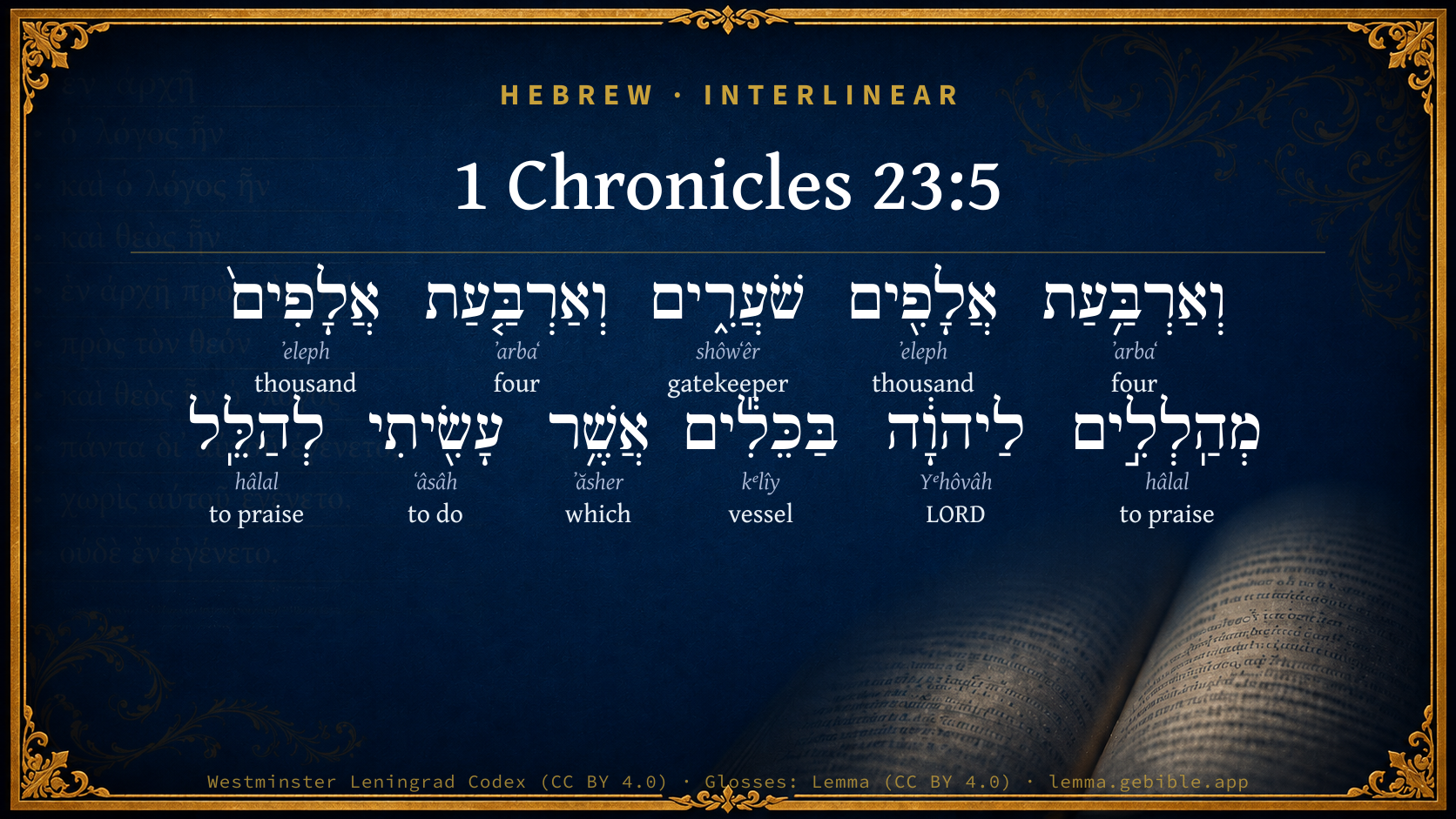
Hebrew (Westminster Leningrad Codex) 1 Chronicles 23:5 appears in the Hebrew Old Testament. The text above is from the Westminster Leningrad Codex. Each word links to its Strong’s number, a concise gloss, and parsing drawn from the Open Scriptures Hebrew Bible morphology. Click any word for its full Brown-Driver-Briggs (BDB) entry.
Download image
Cite this verse

1 Chronicles 23:5 (World English Bible). Public Domain. Lemma interlinear Bible study tool, https://lemma.gebible.app/v/1-chronicles/23/5.

Show BibTeX & RIS
BibTeX
RIS
English Translation
and four thousand were doorkeepers; and four thousand praised Yahweh with the instruments which I made, [said David], for giving praise.
World English Bible · Public Domain
Download a study sheet

One document with this verse’s original text, its word-by-word gloss line, the meaning frame, cross-references with their text, attributed commentary, and full source and license credits — printable, and it pastes into notes with its structure intact.

This verse Autodidact and up

Study sheet (.html) Plain text (.txt)

A passage Seminary Student

Up to 50 verses in one chapter. A passage sheet keeps up to 6 commentary sources and 12 cross-references per verse, in the order this page ranks them, and says so on the sheet whenever that leaves anything out. Ask for a single verse and you get the Autodidact verse sheet above.

Everything on this page stays free to read, with no account — the sheet is a download of what is already on screen, not access to it.

Want to remove ads? Support Godless Engineer
Compare translations 3

The same verse in 3 English versions, stacked beneath the original-language interlinear above. Click any original word for its lexicon entry.

Each is an independent rendering of the whole verse — the interlinear is not word-aligned to these translations.

Highlighted words mark where these versions differ — a whole-verse word diff, not a word-by-word alignment.

  • World English Bible Public Domain
    and four thousand were doorkeepers; and four thousand praised Yahweh with the instruments which I made, [said David], for giving praise.
  • King James Version Public Domain
    Moreover four thousand were porters; and four thousand praised the LORD with the instruments which I made, said David, to praise therewith.
  • unfoldingWord Literal Text CC BY-SA 4.0
    and 4,000 gatekeepers and 4,000 praisers of Yahweh with the instruments that I made for praising.”

unfoldingWord Literal Text — © unfoldingWord, licensed CC BY-SA 4.0. Word-aligned USFM3 via Door43 (git.door43.org/unfoldingWord/en_ult).

Versions to compare (up to 4)

3 of 4 selected

Show all 18 translations

Every available English version of this verse, each an independent rendering of the whole verse.

  • World English Bible Public Domain
    and four thousand were doorkeepers; and four thousand praised Yahweh with the instruments which I made, [said David], for giving praise.
  • Berean Standard Bible Public Domain
    4,000 are to be gatekeepers, and 4,000 are to praise the LORD with the instruments I have made for giving praise.”
  • Majority Standard Bible Public Domain
    4,000 are to be gatekeepers, and 4,000 are to praise the LORD with the instruments I have made for giving praise.”
  • King James Version Public Domain
    Moreover four thousand were porters; and four thousand praised the LORD with the instruments which I made, said David, to praise therewith.
  • American Standard Version (1901) Public Domain
    and four thousand were doorkeepers; and four thousand praised Jehovah with the instruments which I made, `said David', to praise therewith.
  • Revised Version (1885) Public Domain
    and four thousand were doorkeepers; and four thousand praised the LORD with the instruments which I made, said David, to praise therewith.
  • Geneva Bible (1599) Public Domain
    And foure thousand were porters, and foure thousande praised the Lord with instruments which he made to praise the Lord.
  • Douay-Rheims (1899) Public Domain
    Moreover four thousand were porters: and as many singers singing to the Lord with the instruments, which he had made to sing with.
  • Young's Literal Translation Public Domain
    and four thousand gatekeepers, and four thousand giving praise to Jehovah, `with instruments that I made for praising,' `saith David.'
  • Literal Standard Version CC BY-SA 4.0
    and four thousand gatekeepers, and four thousand giving praise to YHWH, “with instruments that I made for praising,” [says David.]
  • Unlocked Literal Bible CC BY-SA 4.0
    Four thousand were gatekeepers, and four thousand were to praise Yahweh with the instruments that I made to give praise,” David said.
  • unfoldingWord Literal Text CC BY-SA 4.0
    and 4,000 gatekeepers and 4,000 praisers of Yahweh with the instruments that I made for praising.”
  • Darby Bible Public Domain
    and four thousand were doorkeepers; and four thousand praised Jehovah with the instruments which I made, [said David,] to praise [therewith].
  • World Messianic Bible Public Domain
    four thousand were doorkeepers, and four thousand praised the LORD with the instruments which I made for giving praise.”
  • Webster's Bible Public Domain
    Moreover, four thousand were porters; and four thousand praised the LORD with the instruments which I made, said David, to praise with them.
  • Free Bible Version CC BY-SA 4.0
    “And 4,000 will be gatekeepers, while 4,000 will praise the Lord using the musical instruments I have provided for praise worship.”
  • Bible in Basic English Public Domain
    Four thousand were door-keepers; and four thousand gave praise to the Lord with the instruments which I made, said David, for giving praise.
  • JPS Tanakh (1917) Public Domain
    and four thousand were doorkeepers; and four thousand praised the LORD 'with the instruments which I made to praise therewith.'

Literal Standard Version (2020), Covenant Press — licensed CC BY-SA 4.0. Text via the HelloAO Bible API (eBible.org). Unlocked Literal Bible (unfoldingWord) — licensed CC BY-SA 4.0. Text via the HelloAO Bible API (eBible.org). unfoldingWord Literal Text — © unfoldingWord, licensed CC BY-SA 4.0. Word-aligned USFM3 via Door43 (git.door43.org/unfoldingWord/en_ult). Free Bible Version, Dr. Jonathan Gallagher — licensed CC BY-SA 4.0. Text via the HelloAO Bible API (eBible.org).

Word by word

More ways to search: Search by grammar → Find every occurrence → Compare this word →

Practice this passage: Drill this verse → Learn its vocabulary →

שֹׁעֲרִ֑ים
shôwʻêr
H7778
“gatekeepers”
Noun, Common, Masculine, Plural, Absolute
Part of Speech
Noun
Type
Common
Gender
Masculine
Number
Plural
State
Absolute
Full BDB Definition

Origin: from H8179

TWOT: 2437b

gatekeeper, porter
  1. וְאַרְבַּ֥עַת ʼarbaʻ H702 “and · four” Conjunction + Adjective, Cardinal number, Masculine, Singular, Construct
  2. אֲלָפִ֖ים ʼeleph H505 “thousand” Adjective, Cardinal number, Both, Plural, Absolute
  3. וְאַרְבַּ֤עַת ʼarbaʻ H702 “and · four” Conjunction + Adjective, Cardinal number, Masculine, Singular, Construct
  4. אֲלָפִים֙ ʼeleph H505 “thousand” Adjective, Cardinal number, Both, Plural, Absolute
  5. מְהַֽלְלִ֣ים hâlal H1984 “praising” Verb, Piel, Participle Active, Masculine, Plural, Absolute
  6. לַיהוָ֔ה Yᵉhôvâh H3068 “to/for · LORD” Preposition + Noun, Proper
  7. בַּכֵּלִ֕ים kᵉlîy H3627 “in/at the · vessels” Preposition, Determined + Noun, Common, Masculine, Plural, Absolute
  8. אֲשֶׁ֥ר ʼăsher H834 “which” Particle, Relative
  9. עָשִׂ֖יתִי ʻâsâh H6213 “to do” Verb, Qal, Perfect, 1st Person, Common, Singular
  10. לְהַלֵּֽל hâlal H1984 “to praise” Preposition + Verb, Piel, Infinitive Construct

About this verse

These counts appear in no published source. They are computed here, from the morphology-tagged text and Lemma’s own curated glosses. What Lemma adds →

11
words
8
distinct lemmas
Historical
section

Shared distinctive vocabulary

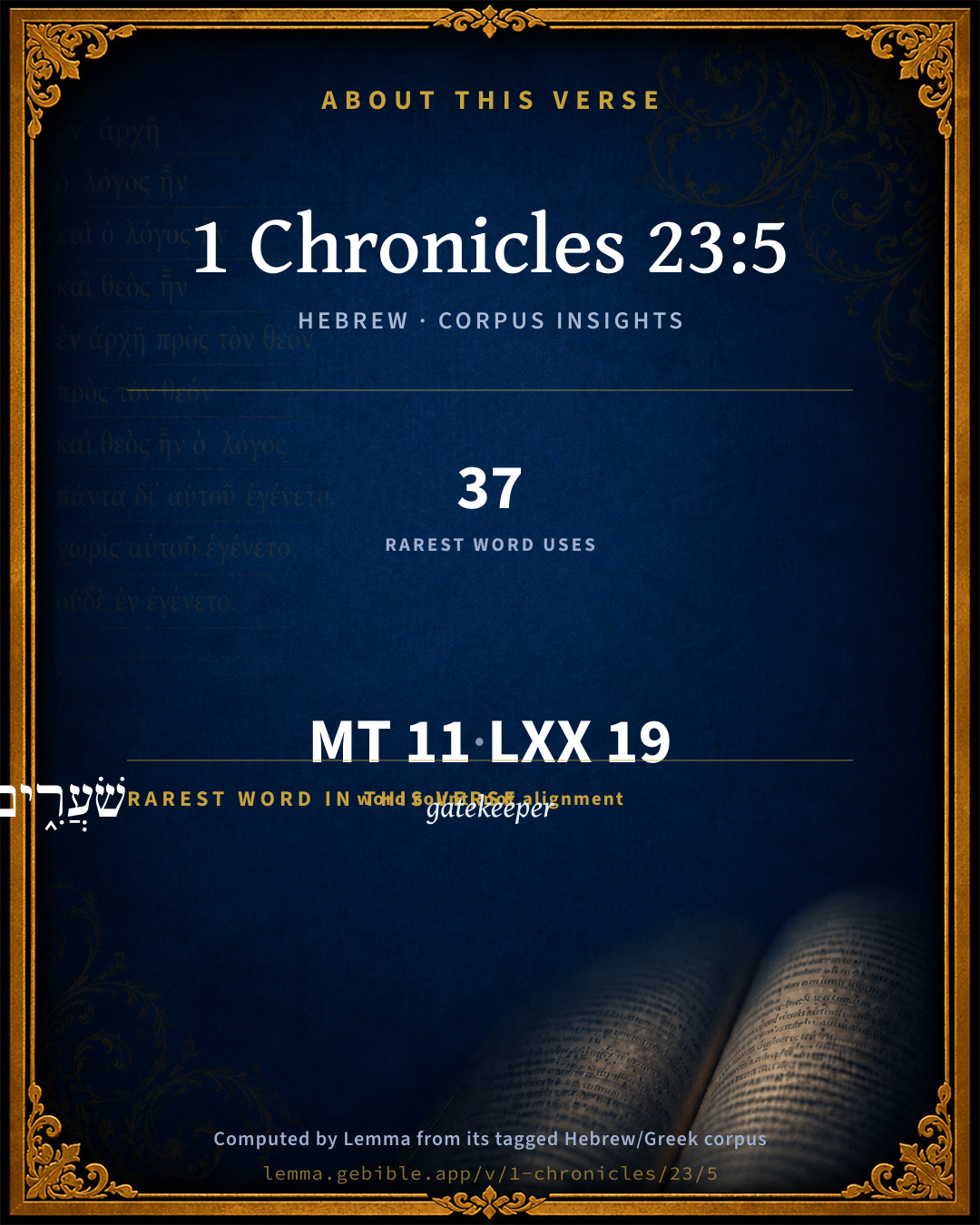
שֹׁעֲרִ֑ים gatekeeper H7778 occurs in 37 verses of the Hebrew Bible. Also found in:

Grammatical profile

  • 3 verbs
  • 3 nouns
  • 4 adjectives
  • 1 particle

Verb forms

  • מְהַֽלְלִ֣ים Piel · Participle Active
  • עָשִׂ֖יתִי Qal · Perfect
  • לְהַלֵּֽל Piel · Infinitive Construct

Repetition

Words recur within this verse — often emphatic in Hebrew:

  • וְאַרְבַּ֥עַת four H702 ×2
  • אֲלָפִ֖ים thousand H505 ×2
  • מְהַֽלְלִ֣ים to praise H1984 ×2

Hebrew & Septuagint length

In English translation the verse runs 21 words from the Hebrew and 20 from the Septuagint (LXX English) — closely comparable.

A rough comparison of the two English renderings, which tokenize alike — not a word-level alignment.

Word counts can differ between the Hebrew and the Greek without any difference in meaning — e.g. the Hebrew direct-object marker אֵת has no separate Greek word, and Greek often adds the article ὁ.

In the original languages it is 11 Hebrew tokens and 19 Greek tokens — but the two are counted differently (Hebrew bundles its prefixes and suffixes into one token; the Greek is in lemma form), so that isn’t a like-for-like length.

Cross-references

17

Topical passages linked to 1 Chronicles 23:5 in the Treasury of Scripture Knowledge — connected by theme and wording, ordered by reader-vote popularity; previews shown in the World English Bible.

  • 2 Chronicles 8:14 He appointed, according to the ordinance of David his father, the divisions of the priests to their service, and the Levites to their offices, to praise, and to minister before the priests, as the duty of every day required; the doorkeepers also by their divisions at every gate: for so had David the man of God commanded.
  • 2 Chronicles 29:25–26 He set the Levites in the house of Yahweh with cymbals, with psalteries, and with harps, according to the commandment of David, and of Gad the king's seer, and Nathan the prophet; for the commandment was of Yahweh by his prophets.
  • Psalms 87:7 Those who sing as well as those who dance say, "All my springs are in you."
  • Amos 6:5 Who strum on the strings of a harp; Who invent for themselves instruments of music, like David;
  • 1 Kings 10:12 The king made of the almug trees pillars for the house of Yahweh, and for the king's house, harps also and psalteries for the singers: there came no such almug trees, nor were seen, to this day.
  • 1 Chronicles 6:31–48 These are they whom David set over the service of song in the house of Yahweh, after that the ark had rest.
  • 1 Chronicles 9:17–27 The porters: Shallum, and Akkub, and Talmon, and Ahiman, and their brothers (Shallum was the chief),
  • 1 Chronicles 9:33 These are the singers, heads of fathers' [houses] of the Levites, [who lived] in the chambers [and were] free [from other service]; for they were employed in their work day and night.
  • 1 Chronicles 15:16–24 David spoke to the chief of the Levites to appoint their brothers the singers, with instruments of music, psalteries and harps and cymbals, sounding aloud and lifting up the voice with joy.
  • 1 Chronicles 16:38 and Obed-edom with their brothers, sixty-eight; Obed-edom also the son of Jeduthun and Hosah to be doorkeepers;
  • 1 Chronicles 16:41–42 and with them Heman and Jeduthun, and the rest who were chosen, who were mentioned by name, to give thanks to Yahweh, because his loving kindness endures forever;
  • 1 Chronicles 25:1–7 Moreover, David and the captains of the host set apart for the service certain of the sons of Asaph, and of Heman, and of Jeduthun, who should prophesy with harps, with psalteries, and with cymbals: and the number of those who did the work according to their service was:
  • 1 Chronicles 26:1–12 For the divisions of the doorkeepers: of the Korahites, Meshelemiah the son of Kore, of the sons of Asaph.
  • 2 Chronicles 20:19–21 The Levites, of the children of the Kohathites and of the children of the Korahites, stood up to praise Yahweh, the God of Israel, with an exceeding loud voice.
  • 2 Chronicles 35:15 The singers the sons of Asaph were in their place, according to the commandment of David, and Asaph, and Heman, and Jeduthun the king's seer; and the porters were at every gate: they didn't need to depart from their service; for their brothers the Levites prepared for them.
  • Ezra 7:7 There went up some of the children of Israel, and of the priests, and the Levites, and the singers, and the porters, and the Nethinim, to Jerusalem, in the seventh year of Artaxerxes the king.
  • Nehemiah 7:73 So the priests, and the Levites, and the porters, and the singers, and some of the people, and the Nethinim, and all Israel, lived in their cities. When the seventh month was come, the children of Israel were in their cities.

Cross-references courtesy of OpenBible.info (CC BY 4.0).

Hebrew and Greek witnesses Masoretic Hebrew ↔ Greek Septuagint

The same verse in the two great witnesses to the Old Testament, shown verse-for-verse.

These are two independent witnesses, not word-aligned to each other, and the Septuagint is shown in lemma (dictionary) form.

Hebrew 1 Chronicles 23:5 Masoretic · Westminster Leningrad Codex

וְאַרְבַּ֥עַת אֲלָפִ֖ים שֹׁעֲרִ֑ים וְאַרְבַּ֤עַת אֲלָפִים֙ מְהַֽלְלִ֣ים לַיהוָ֔ה בַּכֵּלִ֕ים אֲשֶׁ֥ר עָשִׂ֖יתִי לְהַלֵּֽל

and four thousand were doorkeepers; and four thousand praised Yahweh with the instruments which I made, [said David], for giving praise.

World English Bible · Public Domain

Greek LXX 1 Chronicles 23:5 Septuagint · lemma form

καί τέσσαρες χιλιάς πυλωρός καί τέσσαρες χιλιάς αἰνέω ὁ κύριος ἐν ὁ ὄργανον ὅς ποιέω ὁ αἰνέω ὁ κύριος

and four thousand doorkeepers, and four thousand to praise the Lord with instruments which he made to praise the Lord.

LXX2012 (modern English Septuagint) · Public Domain

On this verse, Haydock's Catholic Bible Commentary discusses the Septuagint’s reading. Read the note in Commentary ↓

Hebrew: Westminster Leningrad Codex (CC BY 4.0). Greek: Septuagint (public domain); English from LXX2012 (modern English Septuagint) (Public Domain). How the Septuagint differs from the Hebrew →

Commentary

Notes on 1 Chronicles 23:5 from classic Christian and Jewish commentators (each source and its license shown beneath its notes). The classic Christian expositions comment on the surrounding passage and are grouped to its opening verse, so a note may address several verses; the Jewish commentaries on the Tanakh (Rashi and others) are per-verse, so they appear only where the commentator wrote on this verse.

Lemma curates 59 commentaries, every one of them public domain or Creative Commons licensed, each selected and text-cleaned for this edition rather than reprinted as found. About our sources →

Ellicott's Commentary for English Readers

(5) Moreover four thousand were porters.—Literally, and four thousand (are to be) warders. (Comp. 1Ch_9:21-27.) Reuss thinks 4,000 warders too many; but the different clans went on duty in turn.

And four thousand praised the Lord . . .—Rather, and four thousand (are to be) praising the Lord with the instruments that I have made for praising. (On “praising,” see 1Ch_16:4.) We have here an interesting reference to the fact that David was not only a minstrel and inspired psalmist, but also an inventor of stringed instruments. So the prophet Amos (1Ch_6:5) speaks of the effeminate nobles of Israel, “who prattle on the mouth of the nebel, that invent themselves instruments of music, like David.” The reference is repeated in Neh_12:36.

Which I have made.—This expression proves that 1Ch_23:4-5 should be within inverted commas, as representing a spoken decree of David. Ewald thinks that the narrative is interrupted in 1Ch_23:5 by a fragmentary quotation from an ancient poet who speaks in the name of Jehovah, characterising the musicians as “those whom I have formed to sing my praise.” (But see 2Ch_7:6.)

A Bible Commentary for English Readers, edited by Charles John Ellicott (1878–1897) — public domain. Text from a community e-Sword module.

Trapp's Complete Commentary

John Trapp

1Ch 23:5 Moreover four thousand [were] porters; and four thousand praised the LORD with the instruments which I made, [said David], to praise [therewith].

Ver. 5. Moreover four thousand were porters.] Quos barbare vocant Sacristas.

And four thousand praised the Lord.] Whereof some were teachers, {1Ch 25:7} and some scholars.

Which I made,] i.e., Invented, {Amo 6:6} and appointed to be used in the temple by God’s commandment. {1Ch 29:1-30 1Ch 25:1-31}

John Trapp, A Commentary or Exposition upon All the Books of the Old and New Testament (1647–1656) — public domain. Text from a community e-Sword module.

The Biblical Illustrator

Joseph S. Exell

1Ch_23:5

And four thousand praised the Lord with the instruments which I made.

Music and religion

I. The object of music. To praise therewith well expresses the attitude of the Bible towards music. Plutarch says: The chiefest and sublimest end of music is the graceful return of our thanks to the gods. In these words the wisdom of the Bible representation is vindicated. A worthy conception of God is the only thing which can give the true inspiration of music, and keep it pure and noble through all its strains. Thus music and religion ought never to be divorced.

II. Some of the features of the revelation of God which the Bible gives, and see how they agree with the best features of musical life and growth.

1. The Bible reveals God to man, and man to himself; it opens up depths of meaning which ordinary life cannot sound; it calls man the son of God; it bases itself upon the love of God, which passeth knowledge; it speaks of things which eye hath not seen, nor ear heard, nor hath it entered into the heart of man to conceive. If we allow music any rights of its own, they must be based upon its claim to give expression which is beyond the power of words, and to utter conceptions which thought cannot formulate. It has the power to take them out of the surroundings even of the deepest thoughts, to lift their aspirations where nothing else can go, to carry them into the presence of a power of harmony and order more fundamental than the skill of the hand or the logic of the mind can represent.

2. Then there is the universality of religion. It is meant for all men: there are all grades and kinds of reception of it. The gospel of Christ is for all men; it has truths for the simple, and doctrines for the wise; it meets all nations of men, each according to its nature and its needs. So music in one way or another affects the simplest and the most cultured, appeals to the joyful and to the sorrowing, defies lines of nationality and of language, and is appropriated by all according to the needs of each.

3. The object of religion is harmony--harmony between heaven and earth, between man and man, harmony in the life of the individual, with its varying experiences. The power of man to appreciate harmony finds a response in the growing resources of the musical art; and the yearnings of man for a better existence, where life shall not clash with death, joy with sorrow, and love with hate, finds an answer in a revelation which destroys death, comforts sorrow, and makes love seen everywhere. There could be no better expression for heaven, aa the place where such a revelation finds its completion, than as the place of music. (Arthur Brooks, D. D.)

The Biblical Illustrator, edited by Joseph S. Exell (c. 1880s–1900s) — public domain. Text from a community e-Sword module.

Joseph Benson's Commentary

1Ch 23:5. Four thousand were porters — Whose office it was to take the charge of all the gates of the temple, and its courts, that no forbidden or unclean person might enter there, and of the courts themselves, and of the several chambers and buildings belonging to the temple and the service thereof. These also were to do their work by turns. Praised the Lord with instruments — Whereof two hundred and eighty-eight persons were of greater skill than their brethren, and instructed them, and had some authority over them.

Joseph Benson's Commentary on the Old and New Testaments (1811–1818) — public domain. Text from a community e-Sword module.

Geneva Bible (1599)

Geneva Bible translators

Hebrew, I made, meaning David.

Geneva Bible (1599) marginal notes — public domain. Text via Bolls.life.

Jamieson, Fausset & Brown

Robert Jamieson, A. R. Fausset & David Brown

praised the Lord with the instruments which I made--David seems to have been an inventor of many of the musical instruments used in the temple (Amo 6:5).

Jamieson, Fausset & Brown — Commentary Critical and Explanatory on the Whole Bible (1871) — public domain (CC PDM 1.0). Text via the HelloAO Bible API.

Adam Clarke's Commentary

Verse 5. Four thousand praised the Lord] David made this distribution according to his own judgment, and from the dictates of his piety; but it does not appear that he had any positive Divine authority for such arrangements. As to the instruments of music which he made they are condemned elsewhere; see Am 6:5, to which this verse is allowed to be the parallel.

Adam Clarke's Commentary on the Bible (1810–1826) — public domain. Text from a community e-Sword/MySword module.

The Cambridge Bible for Schools and Colleges

gen. ed. J. J. S. Perowne

5. porters] R.V. doorkeepers. The courses and duties of these are given in 1Ch_26:1-19.

four thousand praised the Lord] Cp. 1Ch_25:1-31, from which it appears that there was also a picked choir consisting of 288 persons, divided into twenty-four courses, whose special duty was psalmody.

the instruments which I made] Cp. 2Ch_29:26.

The Cambridge Bible for Schools and Colleges (gen. ed. J. J. S. Perowne; Cambridge University Press, 1878–1918) — public domain. Text from a community e-Sword module.

John Gill's Exposition

Moreover four thousand were porters,.... At the east, north, and south gates of the temple, in their turns:

and four thousand praised the Lord with the instruments; were singers in the temple, which in all made up 38,000:

which I made, said David, to praise therewith; which instruments he devised and ordered to be made to praise the Lord with; see Ch2 29:26.

John Gill's Exposition of the Whole Bible (1746–1763) — public domain (CC PDM 1.0). Text via the HelloAO Bible API.

Haydock's Catholic Bible Commentary

David. Literally, "he." Septuagint, "they." Protestants, "which I made (said David) to praise therewith." (Haydock)

George Leo Haydock (1774–1849), Haydock's Catholic Family Bible and Commentary, 1859 edition — public domain. Excludes Psalms (Douay-Rheims chapter numbering differs from Protestant) and Deuterocanonical books (Catholic canon only).

Matthew Poole's English Annotations

Porters; whose office was to take the charge of all the gates of the temple and its courts, that no forbidden or unclean person might enter there, and of the courts them selves, and of several chambers or buildings belonging to the temple and the service thereof: these also were to do their work by turns.

Four thousand praised the Lord with instruments; whereof two hundred and eighty-eight were persons of greater skill than their brethren, and did instruct them, and had some authority over them.

Matthew Poole's English Annotations on the Holy Bible (1683–1685) — public domain. Text from a community e-Sword/MySword module.

The Pulpit Commentary

Porters (Hebrew doorkeepers. The word is so translated in 1Ch_15:23, 1Ch_15:24. It was the duty of these to keep the entrances of the sanctuary, by day and night, in their courses. (see also 2Ki_7:10, 2Ki_7:11) The Chaldaic equivalent of this word is rT Ezr_7:24; Dan_2:49) There is no connection between either the word or idea we have here, and those of Psa_84:11, where the Hithp. conjugation of pps; is used, and the sense of residence probably intended to be conveyed. The instruments which I made to praise. Possibly the quotation of a short sentence often on David"s lips. Men given to music may have been very conscious of it, in ancient days, as well as in modern. The language, however, does not necessarily assert that David claimed the inventing or in any similar sense the making of these musical instruments, but that he appointed them for the service of praise. What some of them were may be seen in 2Ch_5:12 psalteries, harps, trumpets" (see also 2Ch_29:25-27; Neh_12:35, Neh_12:36; Amo_6:5)

The Pulpit Commentary (1880–1919), ed. H.D.M. Spence-Jones & Joseph S. Exell — public domain. Text from a community e-Sword module.

Keil & Delitzsch

C. F. Keil & F. Delitzsch

Moreover four thousand were porters,.... At the east, north, and south gates of the temple, in their turns:

and four thousand praised the Lord with the instruments; were singers in the temple, which in all made up 38,000:

which I made, said David, to praise therewith; which instruments he devised and ordered to be made to praise the Lord with; see Ch2 29:26.

Keil & Delitzsch — Biblical Commentary on the Old Testament (1861–1891) — public domain (CC PDM 1.0). Text via the HelloAO Bible API. (Old Testament only.)

Lesson kit

Teaching starters — assembled from the data on this page, not authored interpretation. Every prompt links to the verse data it draws on. Edit before teaching.

1 Chronicles, in the Historical, opens this verse with 11 words (8 distinct Hebrew lemmas). Its most distinctive word is shôwʻêr (“gatekeeper”). A historical commentator’s framing appears above. Read the whole chapter for the surrounding context.

Discussion questions

  1. What does “gatekeeper” (shôwʻêr) contribute to the verse as a whole?
  2. How does 2 Samuel 18:26, which shares the word «gatekeeper», read alongside this verse?
  3. What does the repetition of “four” (2× in this one verse) do in this verse?
  4. These translations render this verse differently. What is at stake in choosing one wording over another?
  5. «מְהַֽלְלִ֣ים» is a Piel Participle Active verb. How does that grammatical form shape the action described?
  6. Compare how Ellicott's Commentary for English Readers and Trapp's Complete Commentary read this verse. Where do they agree or differ?

Things to notice

Reading settings

Reading text

Shown beneath each verse's original-language words.

Old Testament
Old Testament edition

Read the OT as the Masoretic Hebrew (MT) or the Greek Septuagint (LXX).

English shown for the Greek Septuagint (in the Hebrew ↔ Greek comparison).

Comparing translations? Open the Compare panel on any verse page to stack up to four side by side.