
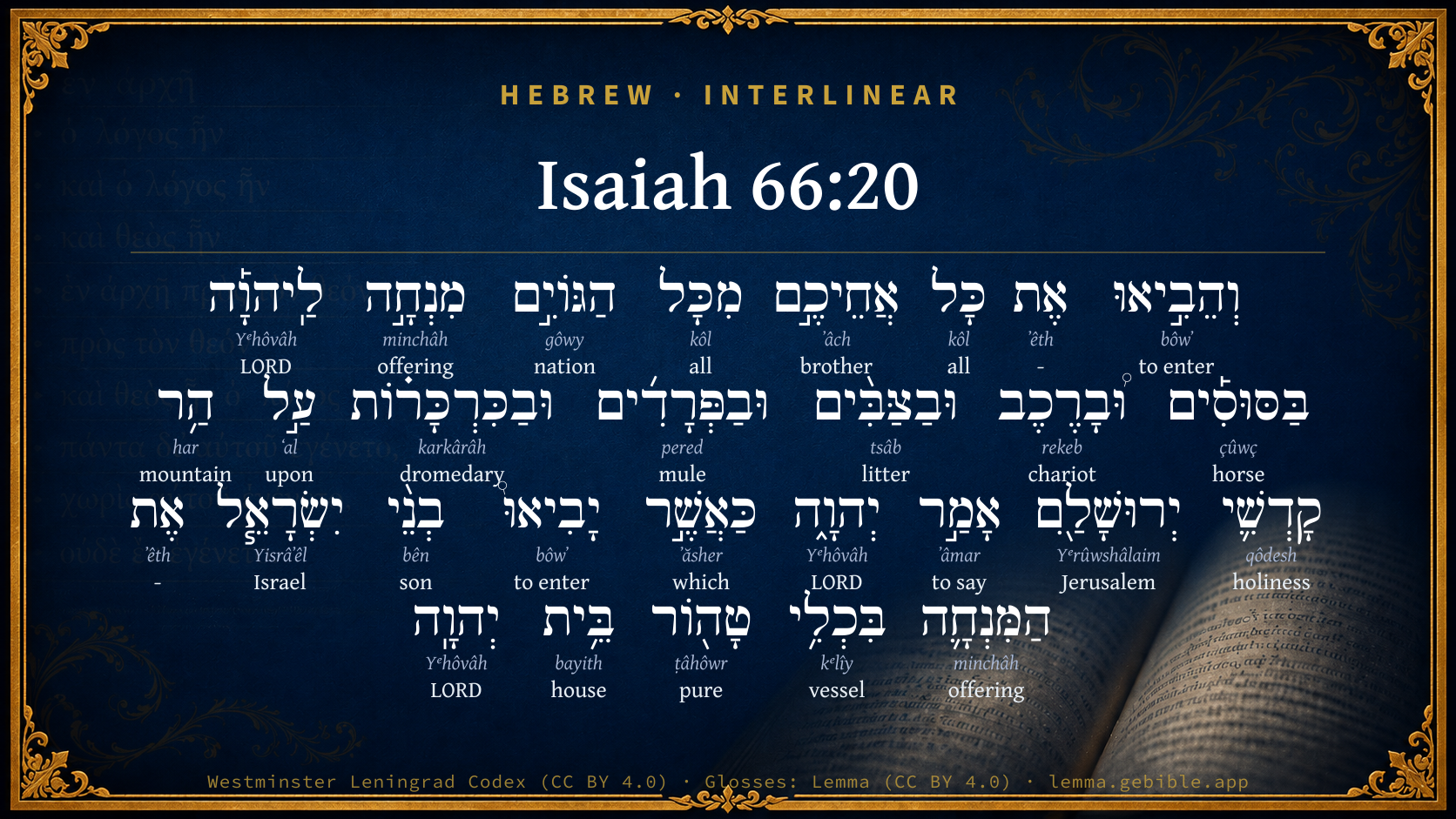
Isaiah 66:20

Hebrew (Westminster Leningrad Codex) Isaiah 66:20 appears in the Hebrew Old Testament. The text above is from the Westminster Leningrad Codex. Each word links to its Strong’s number, a concise gloss, and parsing drawn from the Open Scriptures Hebrew Bible morphology. Click any word for its full Brown-Driver-Briggs (BDB) entry.
Download image
Cite this verse

Isaiah 66:20 (World English Bible). Public Domain. Lemma interlinear Bible study tool, https://lemma.gebible.app/v/isaiah/66/20.

Show BibTeX & RIS
BibTeX
RIS
English Translation
They shall bring all your brothers out of all the nations for an offering to Yahweh, on horses, and in chariots, and in litters, and on mules, and on dromedaries, to my holy mountain Jerusalem, says Yahweh, as the children of Israel bring their offering in a clean vessel into the house of Yahweh.
World English Bible · Public Domain
Highlights
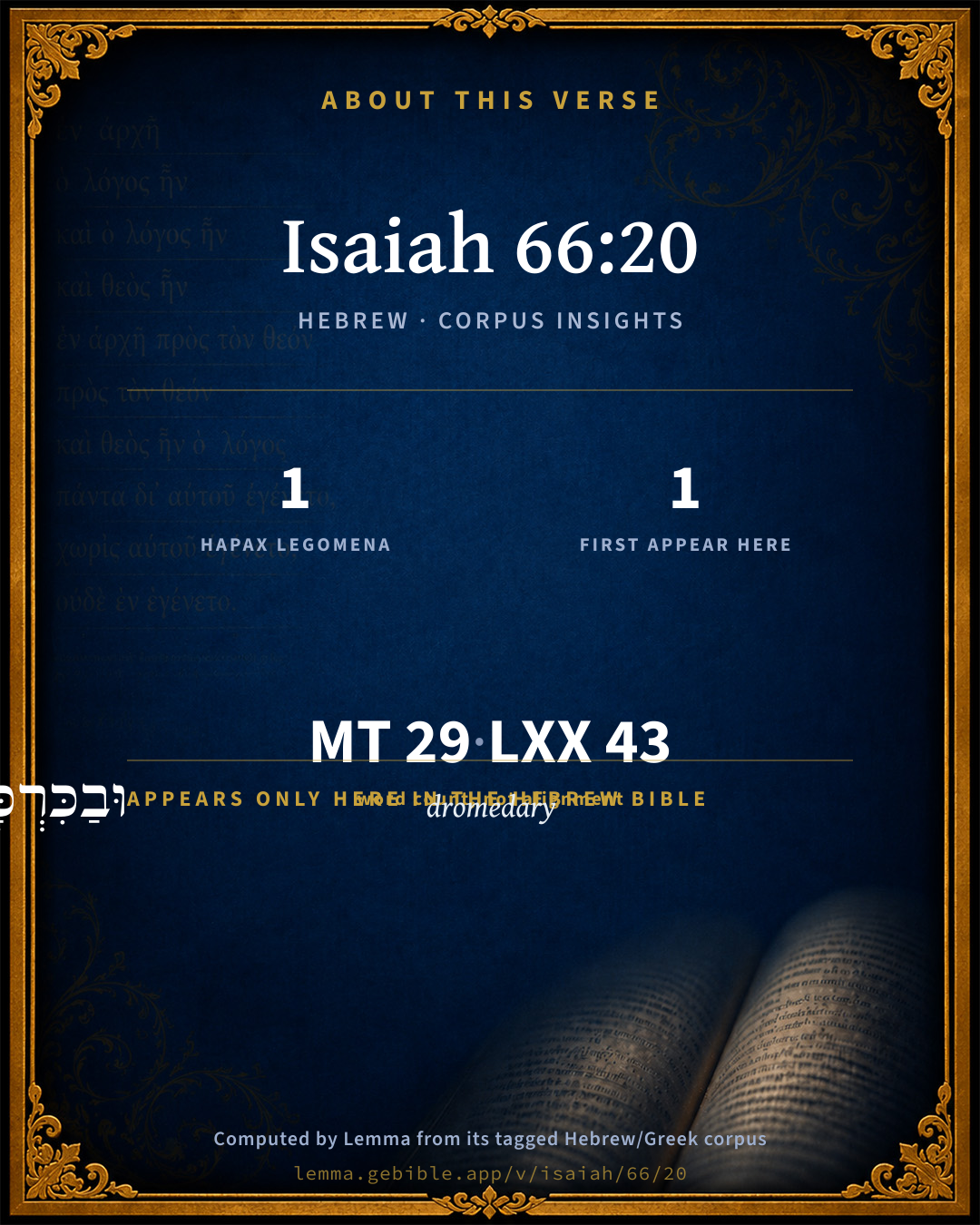
  • 1 hapax legomenon — only here in the Hebrew Bible
  • 1 first appearance in the Hebrew Bible
Full analysis ↓
Download a study sheet

One document with this verse’s original text, its word-by-word gloss line, the meaning frame, cross-references with their text, attributed commentary, and full source and license credits — printable, and it pastes into notes with its structure intact.

This verse Autodidact and up

Study sheet (.html) Plain text (.txt)

A passage Seminary Student

Up to 50 verses in one chapter. A passage sheet keeps up to 6 commentary sources and 12 cross-references per verse, in the order this page ranks them, and says so on the sheet whenever that leaves anything out. Ask for a single verse and you get the Autodidact verse sheet above.

Everything on this page stays free to read, with no account — the sheet is a download of what is already on screen, not access to it.

Want to remove ads? Support Godless Engineer
Compare translations 3

The same verse in 3 English versions, stacked beneath the original-language interlinear above. Click any original word for its lexicon entry.

Each is an independent rendering of the whole verse — the interlinear is not word-aligned to these translations.

Highlighted words mark where these versions differ — a whole-verse word diff, not a word-by-word alignment.

  • World English Bible Public Domain
    They shall bring all your brothers out of all the nations for an offering to Yahweh, on horses, and in chariots, and in litters, and on mules, and on dromedaries, to my holy mountain Jerusalem, says Yahweh, as the children of Israel bring their offering in a clean vessel into the house of Yahweh.
  • King James Version Public Domain
    And they shall bring all your brethren for an offering unto the LORD out of all nations upon horses, and in chariots, and in litters, and upon mules, and upon swift beasts, to my holy mountain Jerusalem, saith the LORD, as the children of Israel bring an offering in a clean vessel into the house of the LORD.
  • unfoldingWord Literal Text CC BY-SA 4.0
    And they will bring all of your brothers from all of the nations an offering to Yahweh, on horses and in chariots and in wagons and on mules and on camels, to the mountain of my holiness, Jerusalem,” says Yahweh, “just as the sons of Israel bring the grain offering in a clean vessel the house of Yahweh.

unfoldingWord Literal Text — © unfoldingWord, licensed CC BY-SA 4.0. Word-aligned USFM3 via Door43 (git.door43.org/unfoldingWord/en_ult).

Versions to compare (up to 4)

3 of 4 selected

Show all 18 translations

Every available English version of this verse, each an independent rendering of the whole verse.

  • World English Bible Public Domain
    They shall bring all your brothers out of all the nations for an offering to Yahweh, on horses, and in chariots, and in litters, and on mules, and on dromedaries, to my holy mountain Jerusalem, says Yahweh, as the children of Israel bring their offering in a clean vessel into the house of Yahweh.
  • Berean Standard Bible Public Domain
    And they will bring all your brothers from all the nations as a gift to the LORD on horses and chariots and wagons, on mules and camels, to My holy mountain Jerusalem,” says the LORD, “just as the Israelites bring an offering in a clean vessel to the house of the LORD.”
  • Majority Standard Bible Public Domain
    And they will bring all your brothers from all the nations as a gift to the LORD on horses and chariots and wagons, on mules and camels, to My holy mountain Jerusalem,” says the LORD, “just as the Israelites bring an offering in a clean vessel to the house of the LORD.”
  • King James Version Public Domain
    And they shall bring all your brethren for an offering unto the LORD out of all nations upon horses, and in chariots, and in litters, and upon mules, and upon swift beasts, to my holy mountain Jerusalem, saith the LORD, as the children of Israel bring an offering in a clean vessel into the house of the LORD.
  • American Standard Version (1901) Public Domain
    And they shall bring all your brethren out of all the nations for an oblation unto Jehovah, upon horses, and in chariots, and in litters, and upon mules, and upon dromedaries, to my holy mountain Jerusalem, saith Jehovah, as the children of Israel bring their oblation in a clean vessel into the house of Jehovah.
  • Revised Version (1885) Public Domain
    And they shall bring all your brethren out of all the nations for an offering unto the LORD, upon horses, and in chariots, and in litters, and upon mules, and upon swift beasts, to my holy mountain Jerusalem, saith the LORD, as the children of Israel bring their offering in a clean vessel into the house of the LORD.
  • Geneva Bible (1599) Public Domain
    And they shall bring all your brethren for an offering vnto the Lord out of all nations, vpon horses, and in charets, and in horse litters, and vpon mules, and swift beastes, to Ierusalem mine holy Mountaine, saith the Lord, as the children of Israel, offer in a cleane vessell in the House of the Lord.
  • Douay-Rheims (1899) Public Domain
    And they shall bring all your brethren out of all nations for a gift to the Lord, upon horses, and in chariots, and in litters, and on mules, and in coaches, to my holy mountain Jerusalem, saith the Lord, as if the children of Israel should bring an offering in a clean vessel into the house of the Lord.
  • Young's Literal Translation Public Domain
    And they have brought all your brethren out of all the nations, A present to Jehovah, On horses, and on chariot, and on litters, And on mules, and on dromedaries, Unto My holy mountain Jerusalem, said Jehovah, As the sons of Israel bring the present in a clean vessel, Into the house of Jehovah.
  • Literal Standard Version CC BY-SA 4.0
    And they have brought all your brothers out of all the nations, || A present to YHWH, || On horses, and on chariot, and on litters, || And on mules, and on dromedaries, || To My holy mountain Jerusalem,” said YHWH, “As the sons of Israel bring the present in a clean vessel, || Into the house of YHWH.
  • Unlocked Literal Bible CC BY-SA 4.0
    They will bring back all your brothers out of all the nations, as an offering to Yahweh. They will come on horses, and in chariots, in wagons, on mules, and on camels, to my holy mountain Jerusalem—says Yahweh. For the people of Israel will bring a grain offering in a clean vessel into the house of Yahweh.
  • unfoldingWord Literal Text CC BY-SA 4.0
    And they will bring all of your brothers from all of the nations an offering to Yahweh, on horses and in chariots and in wagons and on mules and on camels, to the mountain of my holiness, Jerusalem,” says Yahweh, “just as the sons of Israel bring the grain offering in a clean vessel the house of Yahweh.
  • Darby Bible Public Domain
    And they shall bring all your brethren out of all the nations as an oblation unto Jehovah, upon horses, and in chariots, and in covered waggons, and upon mules, and upon dromedaries, to my holy mountain, to Jerusalem, saith Jehovah, as the children of Israel bring an oblation in a clean vessel into the house of Jehovah.
  • World Messianic Bible Public Domain
    They shall bring all your brothers out of all the nations for an offering to the LORD, on horses, in chariots, in litters, on mules, and on camels, to my holy mountain Jerusalem, says the LORD, as the children of Israel bring their offering in a clean vessel into the LORD’s house.
  • Webster's Bible Public Domain
    And they shall bring all your brethren for an offering to the LORD out of all nations upon horses, and in chariots, and in litters, and upon mules, and upon swift beasts, to my holy mountain Jerusalem, saith the LORD, as the children of Israel bring an offering in a clean vessel into the house of the LORD.
  • Free Bible Version CC BY-SA 4.0
    They will bring back all your people from every nation to my holy mountain in Jerusalem as an offering to the Lord. They will come on horses, in chariots and wagons, and on mules and camels, says the Lord. They will bring them in the same way the Israelites bring their grain offerings to the Lord's Temple using vessels that are ceremonially clean.
  • Bible in Basic English Public Domain
    And they will take your countrymen out of all the nations for an offering to the Lord, on horses, and in carriages, and in carts, and on asses, and on camels, to my holy mountain Jerusalem, says the Lord, as the children of Israel take their offering in a clean vessel into the house of the Lord.
  • JPS Tanakh (1917) Public Domain
    And they shall bring all your brethren out of all the nations for an offering unto the LORD, upon horses, and in chariots, and in fitters, and upon mules, and upon swift beasts, to My holy mountain Jerusalem, saith the LORD, as the children of Israel bring their offering in a clean vessel into the house of the LORD.

Literal Standard Version (2020), Covenant Press — licensed CC BY-SA 4.0. Text via the HelloAO Bible API (eBible.org). Unlocked Literal Bible (unfoldingWord) — licensed CC BY-SA 4.0. Text via the HelloAO Bible API (eBible.org). unfoldingWord Literal Text — © unfoldingWord, licensed CC BY-SA 4.0. Word-aligned USFM3 via Door43 (git.door43.org/unfoldingWord/en_ult). Free Bible Version, Dr. Jonathan Gallagher — licensed CC BY-SA 4.0. Text via the HelloAO Bible API (eBible.org).

Word by word

More ways to search: Search by grammar → Find every occurrence → Compare this word →

Practice this passage: Drill this verse → Learn its vocabulary →

וּבַכִּרְכָּר֗וֹת
karkârâh
H3753
“and · in/at the · dromedaries”
Conjunction + Preposition, Determined + Noun, Common, Feminine, Plural, Absolute
Part of Speech
Conjunction + Preposition + Noun
Type
Common
Gender
Feminine
Number
Plural
State
Absolute
Full BDB Definition

Origin: from H3769

TWOT: 1046b

dromedary, dromedary camel, beasts
  1. וְהֵבִ֣יאוּ bôwʼ H935 “and · to enter” Conjunction + Verb, Hiphil, Sequential Perfect, 3rd Person, Common, Plural
  2. אֶת ʼêth H853 “-” Particle, Direct Object
  3. כָּל kôl H3605 “all of” Noun, Common, Masculine, Singular, Construct
  4. אֲחֵיכֶ֣ם ʼâch H251 “brothers · your” Noun, Common, Masculine, Plural, Construct + Suffix, Personal, 2nd Person, Masculine, Plural
  5. מִכָּל kôl H3605 “from · all of” Preposition + Noun, Common, Masculine, Singular, Construct
  6. הַגּוֹיִ֣ם gôwy H1471 “the · nations” Particle, Definite Article + Noun, Common, Masculine, Plural, Absolute
  7. מִנְחָ֣ה minchâh H4503 “offering” Noun, Common, Feminine, Singular, Absolute
  8. לַֽיהוָ֡ה Yᵉhôvâh H3068 “to/for · LORD” Preposition + Noun, Proper
  9. בַּסּוּסִ֡ים çûwç H5483 “in/at the · horses” Preposition, Determined + Noun, Common, Masculine, Plural, Absolute
  10. וּ֠בָרֶכֶב rekeb H7393 “and · in/at the · chariot” Conjunction + Preposition, Determined + Noun, Common, Masculine, Singular, Absolute
  11. וּבַצַּבִּ֨ים tsâb H6632 “and · in/at the · litters” Conjunction + Preposition, Determined + Noun, Common, Masculine, Plural, Absolute
  12. וּבַפְּרָדִ֜ים pered H6505 “and · in/at the · mules” Conjunction + Preposition, Determined + Noun, Common, Masculine, Plural, Absolute
  13. עַ֣ל ʻal H5921 “upon” Preposition
  14. הַ֥ר har H2022 “mountain of” Noun, Common, Masculine, Singular, Construct
  15. קָדְשִׁ֛י qôdesh H6944 “holiness · my” Noun, Common, Masculine, Singular, Construct + Suffix, Personal, 1st Person, Common, Singular
  16. יְרוּשָׁלִַ֖ם Yᵉrûwshâlaim H3389 “Jerusalem” Noun, Proper
  17. אָמַ֣ר ʼâmar H559 “to say” Verb, Qal, Perfect, 3rd Person, Masculine, Singular
  18. יְהוָ֑ה Yᵉhôvâh H3068 “LORD” Noun, Proper
  19. כַּאֲשֶׁ֣ר ʼăsher H834 “like/as · which” Preposition + Particle, Relative
  20. יָבִיאוּ֩ bôwʼ H935 “to enter” Verb, Hiphil, Imperfect, 3rd Person, Masculine, Plural
  21. בְנֵ֨י bên H1121 “sons of” Noun, Common, Masculine, Plural, Construct
  22. יִשְׂרָאֵ֧ל Yisrâʼêl H3478 “Israel” Noun, Proper
  23. אֶת ʼêth H853 “-” Particle, Direct Object
  24. הַמִּנְחָ֛ה minchâh H4503 “the · offering” Particle, Definite Article + Noun, Common, Feminine, Singular, Absolute
  25. בִּכְלִ֥י kᵉlîy H3627 “in/at · vessel” Preposition + Noun, Common, Masculine, Singular, Absolute
  26. טָה֖וֹר ṭâhôwr H2889 “pure” Adjective, Adjective, Masculine, Singular, Absolute
  27. בֵּ֥ית bayith H1004 “house of” Noun, Common, Masculine, Singular, Construct
  28. יְהוָֽה Yᵉhôvâh H3068 “LORD” Noun, Proper

About this verse

These counts appear in no published source. They are computed here, from the morphology-tagged text and Lemma’s own curated glosses. What Lemma adds →

29
words
23
distinct lemmas
Prophets
section

Notable vocabulary

1 hapax legomenon — a word that appears only here in the entire Hebrew Bible:

  • וּבַכִּרְכָּר֗וֹת dromedary H3753

First appearance in Scripture

This word makes its first canonical appearance in the Hebrew Bible here:

  • וּבַכִּרְכָּר֗וֹת dromedary H3753

Shared distinctive vocabulary

וּבַצַּבִּ֨ים litter H6632 occurs in 3 verses of the Hebrew Bible. Also found in:

Grammatical profile

  • 3 verbs
  • 21 nouns
  • 1 adjective
  • 1 preposition
  • 3 particles

Verb forms

  • וְהֵבִ֣יאוּ Hiphil · Sequential Perfect
  • אָמַ֣ר Qal · Perfect
  • יָבִיאוּ֩ Hiphil · Imperfect

Repetition

Words recur within this verse — often emphatic in Hebrew:

  • לַֽיהוָ֡ה LORD H3068 ×3
  • וְהֵבִ֣יאוּ to enter H935 ×2
  • כָּל all H3605 ×2
  • מִנְחָ֣ה offering H4503 ×2

Hebrew & Septuagint length

In English translation the verse runs 54 words from the Hebrew and 55 from the Septuagint (LXX English) — closely comparable.

A rough comparison of the two English renderings, which tokenize alike — not a word-level alignment.

Word counts can differ between the Hebrew and the Greek without any difference in meaning — e.g. the Hebrew direct-object marker אֵת has no separate Greek word, and Greek often adds the article ὁ.

In the original languages it is 29 Hebrew tokens and 43 Greek tokens — but the two are counted differently (Hebrew bundles its prefixes and suffixes into one token; the Greek is in lemma form), so that isn’t a like-for-like length.

Cross-references

13

Topical passages linked to Isaiah 66:20 in the Treasury of Scripture Knowledge — connected by theme and wording, ordered by reader-vote popularity; previews shown in the World English Bible.

  • Isaiah 60:3–14 Nations shall come to your light, and kings to the brightness of your rising.
  • Isaiah 11:9 They shall not hurt nor destroy in all my holy mountain; for the earth shall be full of the knowledge of Yahweh, as the waters cover the sea.
  • Isaiah 43:6 I will tell the north, Give up; and to the south, Don't keep back; bring my sons from far, and my daughters from the end of the earth;
  • Isaiah 56:7 even them will I bring to my holy mountain, and make them joyful in my house of prayer: their burnt offerings and their sacrifices shall be accepted on my altar; for my house shall be called a house of prayer for all peoples.
  • Isaiah 65:11 But you who forsake Yahweh, who forget my holy mountain, who prepare a table for Fortune, and who fill up mixed wine to Destiny;
  • Isaiah 65:25 The wolf and the lamb shall feed together, and the lion shall eat straw like the ox; and dust shall be the serpent's food. They shall not hurt nor destroy in all my holy mountain, says Yahweh.
  • Romans 15:16 that I should be a servant of Christ Jesus to the Gentiles, ministering as a priest the Gospel of God, that the offering up of the Gentiles might be made acceptable, sanctified by the Holy Spirit.
  • Isaiah 49:12–26 Behold, these shall come from far; and, behold, these from the north and from the west; and these from the land of Sinim.
  • Isaiah 52:11 Depart you, depart you, go you out from there, touch no unclean thing; go you out of the midst of her; cleanse yourselves, you who bear the vessels of Yahweh.
  • Isaiah 54:3 For you shall spread aboard on the right hand and on the left; and your seed shall possess the nations, and make the desolate cities to be inhabited.
  • Romans 12:1–2 Therefore I urge you, brothers, by the mercies of God, to present your bodies a living sacrifice, holy, acceptable to God, which is your spiritual service.
  • Philippians 2:17 Yes, and if I am poured out on the sacrifice and service of your faith, I rejoice, and rejoice with you all.
  • 1 Peter 2:5 You also, as living stones, are built up as a spiritual house, to be a holy priesthood, to offer up spiritual sacrifices, acceptable to God through Jesus Christ.

Cross-references courtesy of OpenBible.info (CC BY 4.0).

Hebrew and Greek witnesses Masoretic Hebrew ↔ Greek Septuagint

The same verse in the two great witnesses to the Old Testament, shown verse-for-verse.

These are two independent witnesses, not word-aligned to each other, and the Septuagint is shown in lemma (dictionary) form.

Hebrew Isaiah 66:20 Masoretic · Westminster Leningrad Codex

וְהֵבִ֣יאוּ אֶת כָּל אֲחֵיכֶ֣ם מִכָּל הַגּוֹיִ֣ם מִנְחָ֣ה לַֽיהוָ֡ה בַּסּוּסִ֡ים וּ֠בָרֶכֶב וּבַצַּבִּ֨ים וּבַפְּרָדִ֜ים וּבַכִּרְכָּר֗וֹת עַ֣ל הַ֥ר קָדְשִׁ֛י יְרוּשָׁלִַ֖ם אָמַ֣ר יְהוָ֑ה כַּאֲשֶׁ֣ר יָבִיאוּ֩ בְנֵ֨י יִשְׂרָאֵ֧ל אֶת הַמִּנְחָ֛ה בִּכְלִ֥י טָה֖וֹר בֵּ֥ית יְהוָֽה

They shall bring all your brothers out of all the nations for an offering to Yahweh, on horses, and in chariots, and in litters, and on mules, and on dromedaries, to my holy mountain Jerusalem, says Yahweh, as the children of Israel bring their offering in a clean vessel into the house of Yahweh.

World English Bible · Public Domain

Greek LXX Isaiah 66:20 Septuagint · lemma form

καί ἄγω ὁ ἀδελφός σύ ἐκ πᾶς ὁ ἔθνος δῶρον κύριος μετά ἵππος καί ἅρμα ἐν λαμπήνη ἡμίονος μετά σκιάδιον εἰς ὁ ἅγιος πόλις ἰερουσαλήμ εἶπον κύριος ὡς ἄν φέρω ὁ υἱός ἰσραήλ ἐγώ ὁ θυσία αὐτός μετά ψαλμός εἰς ὁ οἶκος κύριος

And they shall bring your brethren out of all nations for a gift to the Lord with horses, and chariots, in litters drawn by mules with awnings, to the holy city Jerusalem, said the Lord, as though the children of Israel should bring their sacrifices to me with psalms into the house of the Lord.

LXX2012 (modern English Septuagint) · Public Domain

On this verse, John Gill's Exposition discusses the Septuagint’s reading. Read the note in Commentary ↓

Hebrew: Westminster Leningrad Codex (CC BY 4.0). Greek: Septuagint (public domain); English from LXX2012 (modern English Septuagint) (Public Domain). How the Septuagint differs from the Hebrew →

Targum (Aramaic paraphrase)

1

The Targum is the ancient Jewish Aramaic paraphrase of the Hebrew Scriptures — an interpretive translation, not the Hebrew text itself. Onkelos (literal) and Pseudo-Jonathan (expansive) render the Torah, and Jonathan the Prophets. Coverage is partial: where no permissively-licensed English translation exists for a verse, only the Aramaic is shown. This is verse-level text, not a word-by-word alignment to the Hebrew.

  1. Targum Jonathan Prophets (Joshua–Malachi)
    וְיֵיתוּן יַת כָּל אֲחֵיכוֹן מִכָּל עַמְמַיָא קוּרְבָּנָא קֳדָם יְיָ בְסוּסְוָן וּבִרְתִיכִין וּבִרְחֵילִין וּבְכִדְנְוָן וּבְכִרְכְּרָן וּבְתוּשְׁבְּחָן עַל טוּרָא דְקוּדְשָׁא אֲמַר יְיָ כְּמָא דְיֵיתוּן בְּנֵי יִשְׂרָאֵל יַת קוּרְבָּנָא בְּמָנָא דְכֵי לְבֵית מַקְדְשָׁא דַיָי:

    And they shall bring all your brethren out of all nations an offering before the Lord upon horses, and in chariots, and litters, and upon mules, yea, with songs unto my holy mountain in Jerusalem, saith the Lord, as the children of Israel bring an offering in a clean vessel into the house of the sanctuary of the Lord.

    Targum Jonathan — Aramaic: “Mikraot Gedolot” (public domain). English: “Sefaria Community Translation” (CC0 1.0 (public-domain dedication)); “London "Chaldee Paraphrase," 1871” (public domain). Text via Sefaria.

Commentary

Notes on Isaiah 66:20 from classic Christian and Jewish commentators (each source and its license shown beneath its notes). The classic Christian expositions comment on the surrounding passage and are grouped to its opening verse, so a note may address several verses; the Jewish commentaries on the Tanakh (Rashi and others) are per-verse, so they appear only where the commentator wrote on this verse.

Lemma curates 59 commentaries, every one of them public domain or Creative Commons licensed, each selected and text-cleaned for this edition rather than reprinted as found. About our sources →

Trapp's Complete Commentary

John Trapp

Isa 66:20 And they shall bring all your brethren [for] an offering unto the LORD out of all nations upon horses, and in chariots, and in litters, and upon mules, and upon swift beasts, to my holy mountain Jerusalem, saith the LORD, as the children of Israel bring an offering in a clean vessel into the house of the LORD.

Ver. 20. And they shall bring all your brethren.] Now become all your brethren in Christ: Sanctior est copula cordis quam corporis, Religion is the strongest tie.

Upon horses, and in chariots, and in litters,] i.e., With much swiftness and sweetness; though sick, weakly, and unfit for travel, yet rather in litters than not at all. The apostles "became all things to all men, that they might gain them to Christ."

John Trapp, A Commentary or Exposition upon All the Books of the Old and New Testament (1647–1656) — public domain. Text from a community e-Sword module.

Geneva Bible (1599)

Geneva Bible translators

That is, the Gentiles, which by faith shall be made the children of Abraham as you are.

Whereby he meaneth that no necessary means shall want, when God shall call the Gentiles to the knowledge of the Gospel.

Geneva Bible (1599) marginal notes — public domain. Text via Bolls.life.

Jamieson, Fausset & Brown

Robert Jamieson, A. R. Fausset & David Brown

they--the Gentiles (Isa 66:19).

bring . . . your brethren--the Jews, back to the Holy Land (Isa 49:22). It cannot mean the mere entrance of the Jews into the Christian Church; for such an entrance would be by faith, not upon "horses, litters, and mules" [HOUBIGANT]. "Offering" is metaphorical, as in Rom 15:16.

horses--not much used by the Jews. The Gentiles are here represented as using their modes of conveyance to "bring" the Jews to Jerusalem.

chariots--as these are not found in Oriental caravans, translate, "vehicles," namely, borne, not drawn on wheels.

litters--covered sedans for the rich.

upon swift beasts--dromedaries: from Hebrew root, "to dance," from their bounding motion, often accelerated by music [BOCHART]. Panniers were thrown across the dromedaries' back for poorer women [HORSLEY].

Jamieson, Fausset & Brown — Commentary Critical and Explanatory on the Whole Bible (1871) — public domain (CC PDM 1.0). Text via the HelloAO Bible API.

Adam Clarke's Commentary

Verse 20. And in chariots - "And in counes"] There is a sort of vehicle much used in the east, consisting of a pair of hampers or cradles, thrown across a camel's back, one on each side; in each of which a person is carried. They have a covering to defend them from the rain and the sun. Thevenot calls them counes, i. p. 356. Maillet describes them as covered cages hanging on both sides of a camel. "At Aleppo," says Dr. Russell, "women of inferior condition in longer journeys are commonly stowed, one on each side of a mule, in a sort of covered cradles." Nat. Hist. of Aleppo, p. 89. These seem to be what the prophet means by the word צבים tsabbim. Harmer's Observations, i. p. 445.

Adam Clarke's Commentary on the Bible (1810–1826) — public domain. Text from a community e-Sword/MySword module.

Ellicott's Commentary for English Readers

(20) They shall bring all your brethren . . .—The offering is the minchah, the bloodless meatoffering of the Levitical law (Lev_2:1-2). The underlying thought is that the returning exiles would be the most acceptable offering that could be brought to Jehovah. The same idea appears in Zep_3:10, and a similar one, transferred, however, to the Gentile converts, in Rom_15:16.

Upon horses, and in chariots . . .—The list of the modes of transport, as in Zec_14:15, points to the various habits of the many nations who are to be sharers in the work.

As the children of Israel . . .—The “clean offering” is, as before, the minchah. The heathen, or, perhaps, even the chariots and litters on which they brought the exiles, are as the “clean vessels” in which the minchah was brought to the Temple.

A Bible Commentary for English Readers, edited by Charles John Ellicott (1878–1897) — public domain. Text from a community e-Sword module.

The Cambridge Bible for Schools and Colleges

gen. ed. J. J. S. Perowne

20. The subject of the sentence is the nations. Cf. ch. Isa_49:22, Isa_60:9, Isa_14:2.

litters] Elsewhere only in Num_7:3 (in the phrase “covered wagons”).

swift beasts] dromedaries (R.V. marg.).

The Cambridge Bible for Schools and Colleges (gen. ed. J. J. S. Perowne; Cambridge University Press, 1878–1918) — public domain. Text from a community e-Sword module.

John Gill's Exposition

And they shall bring all your brethren, for an offering unto the Lord, out of all nations,.... This is not said of the Jews, either with respect to the first times of the Gospel; not of the devout men of all nations that heard the apostles on the day of Pentecost; nor of those the Gospel met with in the Gentile world, by the ministry of the apostles, to whom Peter and James write their epistles; or, in the latter day, such who remain in the several nations after the general conversion of that people; but this is to be understood of the Gentiles, and of the bringing in the fulness of them, by means of those who shall escape the calamities of those times, the destruction of the eastern and western antichrist; some of which will become preachers of the word, and be the instruments of doing this work: here the Gentiles are called the brethren of the converted Jews, as all the Lord's people are brethren one of another, be they of what nation they will; they are all in a spiritual sense the seed and children of Abraham, who is the father of all that believe; and so all believers are brethren, Jews and Gentiles; yea, they are all the children of God, who is the one God and Father of all, in the covenant of grace, which is common to them all; and by adoption, and through regeneration, the evidence of it. Christ stands in the relation of an elder brother to them all; and the church universal, the Jerusalem above, is the mother of them all; they are mother's children, and so brethren; they are partakers of the same blessings and privileges, and heirs of the same promises, grace, and glory: now all those that are predestinated to the adoption of sons, that are the children of God scattered abroad, and whom God has promised to call by his grace, shall be brought in; not one shall be left behind; such is the will of God, which cannot be resisted; such their election of grace, which stands firm on the sovereign will of God, and, always obtains; such the suretyship of Christ, and the purchase of his blood, which make the bringing of them absolutely necessary; and the Lord knows where they are, and will send his Gospel and ministers to them, to fetch them in, let them be in ever such distant and obscure places: and these shall be brought,

for an offering to the Lord; which shall be offered to him, either by the persons that bring them, the ministers of the Gospel, who are the priests of the Lord, Isa 66:21 and who offer, not slain beasts, as under the law, but living persons, men and women, converted under their ministry; whom they bring to the Lord, and to his house, as trophies of his victorious grace, to serve and glorify him. The Apostle Paul seems to allude to this passage, and to give the sense of it, Rom 15:16 or else by themselves that are brought; who shall present their souls and bodies a living, holy, and acceptable sacrifice unto God, as their reasonable service; not to atone for their sins, but in gratitude to the Lord, as being his, and not their own, Rom 12:1 the means by which they shall be brought follows:

upon horses, and in chariots, and in litters, and upon mules, and upon swift beasts; which Kimchi and Aben Ezra interpret of camels, the better sort of them; but the Targum renders it, with praises; and so Jarchi understands it of the songs of those that skip and dance for joy; see Sa1 6:16, which carriages are not to be understood literally, but figuratively, expressive of the Gospel ministry, which is the vehicle of salvation, and in which souls are brought to Christ, and to his church; and various sorts being mentioned, may signify the multitudes that shall be gathered in, and the different accommodations made, according to different circumstances; some that are strong and eager, and impatient of church communion, are brought on more speedily, on horses, and swift beasts; and others more weakly, and can move but slowly, in chariots and litters; and all denote the safe and honourable way and manner in which they are conducted, as well as the welcome they may expect to have in the churches of Christ; since all manner of help is afforded to them. The horse is an emblem of the Gospel ministry, and so is the chariot, Rev 6:2 the place they will be brought unto is,

to my holy mountain Jerusalem, saith the Lord; not Jerusalem literally taken, though it is highly probable it will be at this time a place of great resort of all Christians; but the church, often called by this name in this prophecy, and in this chapter; a "mountain", for height, visibility, and especially for firmness and immovableness; a "holy" one, where holy things, words, and ordinances are ministered, holy persons meet, and none else should be members of it; hither converted persons are brought, to partake of those holy things, and have communion with holy persons, by means of the ministers of the Gospel, who invite, exhort, encourage, and persuade, and use the most forcible arguments they can, but after all are but instruments, God is the cause; it is he that brings souls to Zion, Jer 3:14 the manner follows:

as the children of Israel bring an offering in a clean vessel into the house of the Lord; just as the "minchah", or meat offering, was brought in a pure and clean vessel into the sanctuary of the Lord, and there presented before him; as all the vessels there were Holy Ones, Ezr 8:28 denoting who those should be that should be brought and offered; persons whose hearts were purified by faith in the blood of Christ; called with a holy calling; sanctified by the Holy Ghost; and appearing in the beauties of holiness of heart and life. The Septuagint version renders it, "with psalms"; and the Arabic version, "with a jubilee"; suggesting they should be brought with joy and gladness; see Psa 45:15. The ancient Jews (p) interpret all this of the gifts brought to the King Messiah in his days.

(p) Midrash Tillim apud Yalkut in Psal. Ixxxvii. 4.

John Gill's Exposition of the Whole Bible (1746–1763) — public domain (CC PDM 1.0). Text via the HelloAO Bible API.

Albert Barnes' Notes on the Bible

And they shall bring all your brethren - That is, as great success shall attend them as if they should bring back all who had gone there when scattered abroad, and should present them as an offering to Yahweh. The image here is taken from the scene which would be presented, should the distant nations be seen bringing the scattered exiles in all lands on horses, and on palanquins, and on dromedaries, again to Jerusalem, and presenting them before Yahweh in the city where they formerly dwelt. It is the image of a vast caravan, conducted by the pagan world when they had become tributary to the people of God, and when they united to return them to their own land. The spiritual signification is, that all they who should be appropriately called, brethren,’ all who should be the true friends of God, should be brought and offered to Yahweh; that is, there should be a great accession to the people of God from the pagan world.

For an offering unto the Lord. - Hebrew, מנחה minchāh - not a bloody offering or sacrifice: but an offering such as was made by flour, oil, etc. (see the notes at Isa 1:13.)

Out of all nations - The truth shall be proclaimed in all lands, and a vast accession shall be made from all parts of the world to the true church of God. To understand this description, we must form an idea of immense caravans proceeding from distant parts of the world to Jerusalem, bearing along the converts to the true religion to be dedicated to the service of Yahweh.

Upon horses - Horses were little used by the Hebrews (see the notes at Isa 2:7), but they are much used by the Arabs, and form an important part of the caravan that goes to distant places.

And in chariots - (Compare the notes at Isa 66:15). It is, however, by no means certain that the word used here refers to a wheeled vehicle, Such vehicles were not used in caravans. The editor of the Ruins of Palmyra tells us that the caravan they formed to go to that place, consisted of about two hundred persons, and about the same number of beasts of carriage, which were an odd mixture of horses, camels, mules, and asses; but there is no account of any vehicle drawn on wheels in that expedition, nor do we find an account of such things in other eastern journeys (Harmer). Coaches, Dr. Russel assures us, are not in use in Aleppo, nor are they commonly used in any of the countries of the East. The Hebrew word used here (רכב rekeb), means properly riding - riders, cavalry (see it explained in the notes at Isa 21:7); then any vehicle for riding - whether a wagon, chariot, or litter. Lowth renders it, ‘In litters.’ Pitts, in his account of the return from Mecca, describes a species of litter which was borne by two camels, one before and another behind, which was all covered over with searcloth, and that again with green broadcloth, and which was elegantly adorned. It is not improbable that some such vehicle is intended here, as it is certain that such things as wagons or chariots are not found in oriental caravans.

And in litters - Margin, ‘Coaches.’ But the word litters more properly expresses the idea. Lowth renders it, ‘Counes.’ Thevenot tells us that counes are hampers, or cradles, carried upon the backs of camels, one on each side, having a back, head, and sides, like great chairs. A covering is commonly laid over them to protect the rider from wind and rain. This is a common mode of traveling in the East. The coune, or hamper, is thrown across the back of the camel, somewhat in the manner of saddle-bags with us. Sometimes a person sits on each side, and they thus balance each other, and sometimes the end in which the person is placed is balanced by provisions, or articles of furniture in the other. ‘At Aleppo,’ says Dr. Russel, ‘women of inferior condition in long journeys are commonly stowed, one on each side of a mule, in a sort of covered cradles.’ The Hebrew word used here (צב tsab), means properly a litter, a sedan coach - what can be lightly or gently borne.

The Septuagint renders it, Ἐν λαμπήναις ἡμιόνων μετὰ σκιαδίων En lampēnais hēmionōn meta skiadiōn - ‘In litters of mules, with shades or umbrellas.’ Perhaps the following description of a scene in the khan at Acre, will afford an apt illustration of this passage. ‘The bustle was increased this morning by the departure of the wives of the governor of Jaffa. They set off in two coaches of a curious description, common in this country. The body of the coach was raised on two parallel poles, somewhat similar to those used for sedan chairs only that in these the poles were attached to the lower par; of the coach - throwing consequently the center of gravity much higher, and apparently exposing the vehicle, with its veiled tenant, to an easy overthrow, or at least to a very active jolt. Between the poles strong mules were harnessed, one before and one behind; who, if they should prove capricious, or have very uneven or mountainous ground to pass, would render the situation of the ladies still more critical.’ (Jowett’s Christian Researches in Syria, pp. 115, 116, Amos Ed.)

And upon swift beasts - Dromedaries. So Lowth and Noyes render it; and so the word used here - כרכרות kirekârôt - properly denotes. The word is derived from כיר kārar, to dance; and the name is given to them for their bounding or dancing motion, their speed being also sometimes accelerated by musical instruments (Bochart, Hieroz. i. 2, 4). For a description of the dromedary, see the notes at Isa 60:6.

As the children of Israel - As the Jews bear an offering to Yahweh in a vessel that is pure, The utmost attention was paid to the cleanliness of their vessels in their public worship.

Albert Barnes' Notes on the Bible (1834–1885) — public domain. Text from a community e-Sword/MySword module.

Haydock's Catholic Bible Commentary

Brethren, as the converts may justly be styled. (Calmet) --- Coaches, (carrucis.) Hebrew circaroth, (Haydock) "dromedaries," (Bochart) "with songs of praise." (Chaldean, &c.) The precise import is unknown. Truth shall shew its sweet force. --- Offering; the first-fruits, brought by all with great solemnity, Deuteronomy xxvi. 4., and 2 Thessalonians ii. 12. (Calmet)

George Leo Haydock (1774–1849), Haydock's Catholic Family Bible and Commentary, 1859 edition — public domain. Excludes Psalms (Douay-Rheims chapter numbering differs from Protestant) and Deuterocanonical books (Catholic canon only).

Matthew Poole's English Annotations

Those who are the children of Abraham (not considered as the father of the Jewish nation only, but considered as the father of many nations, and as the father of the faithful, or who are the children of God, being believers, and receiving Christ, and so are your brethren, how contemptible soever you judge them) shall be brought out of all nations for an

offering to the Lord. God will have no more offerings of bullocks, and rams, or lambs, but of men and women, reasonable services, Rom 12:1; he will have an offering up of the Gentiles, Rom 15:16. And because the Gentiles are many of them far off from Jerusalem, and as yet farther off from God, Eph 2:17, God will find out fit means for this end, as horses, and litters, and mules, and swift beasts are, to bring men and women long journeys. And they shall be brought into the church, which began at Jerusalem; and lifts you may be assured of, for the Lord hath said it, who cannot lie nor repent. And they shall come with as much joy and gladness, with as much sincerity and holiness, as the godly Jews use and exercise when they bring their offerings in clean vessels.

Matthew Poole's English Annotations on the Holy Bible (1683–1685) — public domain. Text from a community e-Sword/MySword module.

Whedon's Commentary on the Bible

Daniel D. Whedon

20. They shall bring all your brethren for an offering — The order of the Hebrew text is, “They shall bring all your brethren” out of all nations “for an offering.” The writer is speaking still to, and in the verbal costume of, his own times. “They,” or men, shall bring an offering, or an oblation, to Jehovah at his holy mountain or Church at Jerusalem; the oblation being from far-off sections of the world as indicated by the modes of conveyance in early Jewish times. It is a sensible thought that “the spirit of this prophecy authorizes us to substitute for horses and chariots, railcars and steamships, and to assume that the transportation will be outward rather than inward; missionaries going forth into all the world, and not the nations themselves coming in to some great central Jerusalem.” — Cowles, in loco.

Daniel D. Whedon (gen. ed.), Commentary on the Old and New Testaments (1874–1909) — public domain. Text from a community e-Sword module.

The Pulpit Commentary

They shall bring all your brethren for an offering unto the Lord. When the distant Gentiles have been converted, they shall bring to Christ the Jews of the dispersion, who dwell with them in the remote parts of the earth. (comp. Zep_3:10) Upon horses. The "new Jerusalem" being localized, the converts from the distant regions are represented as journeying from their own lands to the "holy mountain," and bringing the Jewish exiles with them by various methods of conveyance upon horses, mules, and dromedaries, in chariots, and finally in palanquins or litters. "Litters" were used by the great men among the Egyptians from a very early date (see Rosellini, "Monumenti Civili," pl. 93, fig. 2; Wilkinson, "Ancient Egyptians," vol. 2. p. 208). They were also employed by the Persians (Herod., 3:146) and by the later Romans. As the children of Israel bring an offering; rather, bring the meat offering. The existence of the temple, and the continuance of the Levitical rites at the time of the delivery of this prophecy, are clearly implied.

The Pulpit Commentary (1880–1919), ed. H.D.M. Spence-Jones & Joseph S. Exell — public domain. Text from a community e-Sword module.

John Wesley's Explanatory Notes

Your brethren -- those who are the children of Abraham, not considered as the father of the Jewish nation only, but considered as the father of many nations, and as the father of the faithful, and so are your brethren, shall be brought out of all nations for an offering to the Lord. Holy mountain - And they shall be brought into the church, which began at Jerusalem. As - And they shall come with as much joy and gladness, with as much sincerity and holiness, as the Godly Jews do when they bring their offerings in clean vessels.

John Wesley, Explanatory Notes Upon the Whole Bible (1754–1765) — public domain. Text via the GEBible commentary corpus.

J. A. Alexander on Isaiah

Joseph Addison Alexander

“And they shall bring all your brethren from all nations an oblation to Jehovah, with horses, and with chariot, and with litters, and with mules, and with dromedaries, on my holy mountain Jerusalem, saith Jehovah, as the children of Israel bring the oblation in a clean vessel to the house of Jehovah.” The verb at the beginning may be construed either with the messengers of v. 19, or indefinitely as denoting ‘men shall bring your brethren,’ equivalent in Hebrew usage to ‘your brethren shall be brought.’ Although this last construction is in perfect agreement with analogy, the other is not only unobjectionable but entitled to the preference as much more graphic and expressive. The survivors sent forth to the nations are then described as bringing back the converts to the true religion as an offering to Jehovah. Their return for this purpose is described as easy, swift, and even splendid, all the choicest methods of conveyance used in ancient times being here combined to express that idea. As to the sense of the particular expressions there is no longer any dispute or doubt. The minchah was the stated vegetable offering of the Mosaic ritual. It was commonly composed of flour with oil and incense; but the name, in its widest sense, may be considered as including fruits and grain in a crude as well as a prepared state. This oblation seems to be selected here as free from the concomitant ideas of cruelty and grossness which were inseparable from bloody sacrifices. The only general exegetical question in relation to this verse is whether your brethren means the scattered Jews or the converted Gentiles. Here again, all depends upon a foregone conclusion. How inextricably this one case is implicated in the general question as to the subject and design of the prophecy, appears from the fact that those who apply this expression to the Jews content themselves with citing all the other places in Isaiah where precisely the same doubt exists as in the case before us. In favor of the other explanation may be cited Paul’s description of the Gentiles as an oblation which he as an officiating priest offered up to God (Rom 15:16). Although it might be doubted whether Paul there formally explains or even quotes this prophecy, his obvious allusion to its images and terms shows at least that he considered them as bearing such an application, and in the absence of any other gives it undoubtedly a clear advantage. Another suggestion not unworthy of attention, is that there may here be special reference to the early converts from the heathen world considered as the first-fruits of the spiritual harvest; which agrees well with the wide use of the technical term minchah, as already stated, and with the frequent application of the figure of first fruits to the same subject in the books of the New Testament.

Joseph Addison Alexander, The Prophecies of Isaiah (1846–1847; New York: Scribner, 1870–1878) — public domain. Text from a community e-Sword module.

unfoldingWord translationNotes

Door43 World Missions Community

They will bring

Here "they" refers to the foreigners who survived and witnessed to the nations. They will return to Jerusalem with exiled Israelites.

holy mountain

See how you translated this in Isaiah 11:9.

translationWords

brother

nation

sacrifice

Yahweh

horse

chariot

donkey

camel

holy

Jerusalem

Israel

grain offering

clean

house of God

priest

Levi

unfoldingWord translationNotes — © Distant Shores Media and the Door43 World Missions Community, licensed CC BY-SA 4.0. Source: git.door43.org/Door43/en_tn.

Rashi

Rabbi Shlomo Yitzchaki (Rashi)

and with covered wagons Heb. וּבַצַּבִּים. These are wagons equipped with partitions and a tent. Comp. (Num. 7:3) “Six covered wagons (עֶגְלוֹתצָב).”

and with joyous songs Heb. וּבַכִּרְכָּרוֹת. With a song of players and dancers. Comp. (II Sam. 6:14) “And David danced (מְכַרְכֵּר),” treper in O.F. [Menahem (p. 109) explains it as an expression meaning a lamb. Comp. (supra 16:1) “Send lambs (כַּר) of the ruler of the land.”]

as...bring an offering in a pure vessel for acceptance, so will they bring your brethren as an acceptable offering.

Rashi on the Tanakh — English translations: “The Judaica Press complete Tanach with Rashi, translated by A. J. Rosenberg” (CC BY 4.0); “Pentateuch with Rashi's commentary by M. Rosenbaum and A.M. Silbermann, 1929-1934” (public domain); “The Metsudah Tanach series, Lakewood, N.J” (CC BY 4.0); and “The Book of Joshua, Metsudah Publications, 1997” (CC BY 4.0). Text via Sefaria.

Ibn Ezra

Rabbi Abraham ibn Ezra

To the Lord. To the glory of the Lord, whom they will fear.

ברכב In chariots of iron.

בצבים In waggons. Comp. עגלת צב covered waggons (Num. 7:3).

ובכרכרות And upon dromedaries. Comp. כר dromedary (16:1). A noble species of camel. כרכרות is a reduplication of כר.

As the children of Israel, etc. As the Israelites used to bring the oblation in a clean vessel, that it should not be defiled.

Ibn Ezra on the Tanakh — English translations: “Sefaria Community Translation” (CC0 1.0 (public-domain dedication)); “Yalkut, Sifsei Chachomim Chumash, Metsudah Publications, 2009” (CC BY 4.0); and “Commentary of Ibn Ezra on Isaiah - trans. by M. Friedlander, 1873” (public domain). Text via Sefaria.

Lesson kit

Teaching starters — assembled from the data on this page, not authored interpretation. Every prompt links to the verse data it draws on. Edit before teaching.

Isaiah, in the Prophets, opens this verse with 29 words (23 distinct Hebrew lemmas). Its most distinctive word is karkârâh (“dromedary”). A historical commentator’s framing appears above. Read the whole chapter for the surrounding context.

Discussion questions

  1. What does “dromedary” (karkârâh) contribute to the verse as a whole?
  2. 1 word here appears nowhere else in the Hebrew Bible. Why might the author reach for such rare wording?
  3. This is the first place “dromedary” appears in Scripture (first appears here). What does its debut here establish?
  4. How does Leviticus 11:29, which shares the word «litter», read alongside this verse?
  5. What does the repetition of “LORD” (3× in this one verse) do in this verse?
  6. The translations on this page render this verse differently — a whole-verse word diff, not a word-by-word alignment. What might account for the different wordings?
  7. «וְהֵבִ֣יאוּ» is a Hiphil Sequential Perfect verb. How does that grammatical form shape the action described?
  8. Compare how Trapp's Complete Commentary and Geneva Bible (1599) read this verse. Where do they agree or differ?

Things to notice

  • 1 word in this verse appears nowhere else in the Hebrew Bible.
  • 1 word makes its first canonical appearance in Scripture here.
  • This verse counts 29 Hebrew ↔ 43 Greek words.
  • These translations choose different wording for 22 words in this verse.
  • “LORD” occurs 3× in this single verse.

Reading settings

Reading text

Shown beneath each verse's original-language words.

Old Testament
Old Testament edition

Read the OT as the Masoretic Hebrew (MT) or the Greek Septuagint (LXX).

English shown for the Greek Septuagint (in the Hebrew ↔ Greek comparison).

Comparing translations? Open the Compare panel on any verse page to stack up to four side by side.