
1 Samuel 8:12

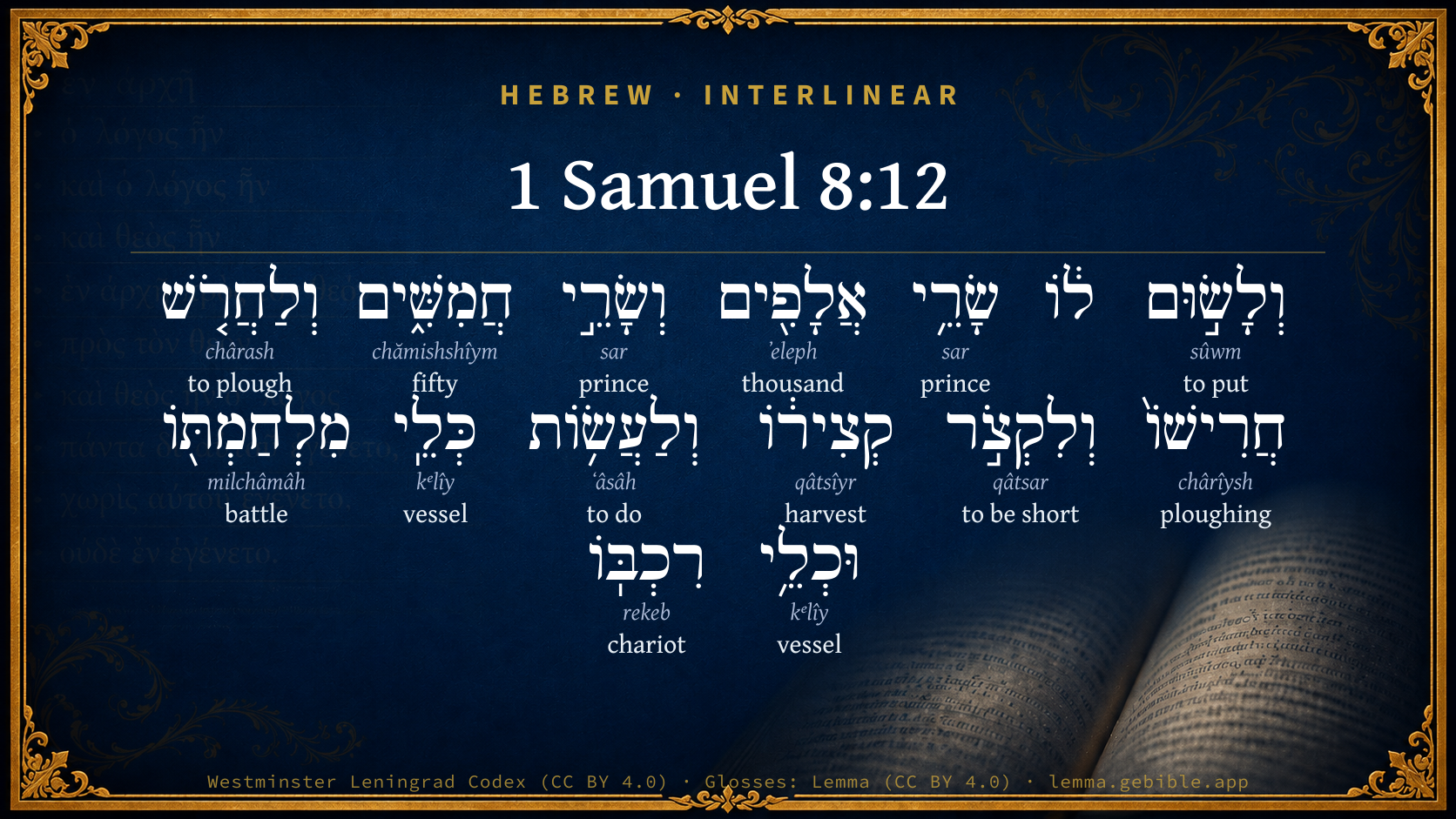
Hebrew (Westminster Leningrad Codex) 1 Samuel 8:12 appears in the Hebrew Old Testament. The text above is from the Westminster Leningrad Codex. Each word links to its Strong’s number, a concise gloss, and parsing drawn from the Open Scriptures Hebrew Bible morphology. Click any word for its full Brown-Driver-Briggs (BDB) entry.
Download image
Cite this verse

1 Samuel 8:12 (World English Bible). Public Domain. Lemma interlinear Bible study tool, https://lemma.gebible.app/v/1-samuel/8/12.

Show BibTeX & RIS
BibTeX
RIS
English Translation
and he will appoint them to him for captains of thousands, and captains of fifties; and [he will set some] to plow his ground, and to reap his harvest, and to make his instruments of war, and the instruments of his chariots.
World English Bible · Public Domain
Download a study sheet

One document with this verse’s original text, its word-by-word gloss line, the meaning frame, cross-references with their text, attributed commentary, and full source and license credits — printable, and it pastes into notes with its structure intact.

This verse Autodidact and up

Study sheet (.html) Plain text (.txt)

A passage Seminary Student

Up to 50 verses in one chapter. A passage sheet keeps up to 6 commentary sources and 12 cross-references per verse, in the order this page ranks them, and says so on the sheet whenever that leaves anything out. Ask for a single verse and you get the Autodidact verse sheet above.

Everything on this page stays free to read, with no account — the sheet is a download of what is already on screen, not access to it.

Want to remove ads? Support Godless Engineer
Compare translations 3

The same verse in 3 English versions, stacked beneath the original-language interlinear above. Click any original word for its lexicon entry.

Each is an independent rendering of the whole verse — the interlinear is not word-aligned to these translations.

Highlighted words mark where these versions differ — a whole-verse word diff, not a word-by-word alignment.

  • World English Bible Public Domain
    and he will appoint them to him for captains of thousands, and captains of fifties; and [he will set some] to plow his ground, and to reap his harvest, and to make his instruments of war, and the instruments of his chariots.
  • King James Version Public Domain
    And he will appoint him captains over thousands, and captains over fifties; and will set them to ear his ground, and to reap his harvest, and to make his instruments of war, and instruments of his chariots.
  • unfoldingWord Literal Text CC BY-SA 4.0
    And appoint for himself commanders of thousands and commanders of fifties, and to plow his plowing, and to harvest his harvest, and to make the implements of his war and the implements of his chariot.

unfoldingWord Literal Text — © unfoldingWord, licensed CC BY-SA 4.0. Word-aligned USFM3 via Door43 (git.door43.org/unfoldingWord/en_ult).

Versions to compare (up to 4)

3 of 4 selected

Show all 18 translations

Every available English version of this verse, each an independent rendering of the whole verse.

  • World English Bible Public Domain
    and he will appoint them to him for captains of thousands, and captains of fifties; and [he will set some] to plow his ground, and to reap his harvest, and to make his instruments of war, and the instruments of his chariots.
  • Berean Standard Bible Public Domain
    He will appoint some for himself as commanders of thousands and of fifties, and others to plow his ground, to reap his harvest, to make his weapons of war, and to equip his chariots.
  • Majority Standard Bible Public Domain
    He will appoint some for himself as commanders of thousands and of fifties, and others to plow his ground, to reap his harvest, and to make his weapons of war and equipment for his chariots.
  • King James Version Public Domain
    And he will appoint him captains over thousands, and captains over fifties; and will set them to ear his ground, and to reap his harvest, and to make his instruments of war, and instruments of his chariots.
  • American Standard Version (1901) Public Domain
    and he will appoint them unto him for captains of thousands, and captains of fifties; and `he will set some' to plow his ground, and to reap his harvest, and to make his instruments of war, and the instruments of his chariots.
  • Revised Version (1885) Public Domain
    and he will appoint them unto him for captains of thousands and captains of fifties; and he will set some to plow his ground, and to reap his harvest, and to make his instruments of war, and the instruments of his chariots.
  • Geneva Bible (1599) Public Domain
    Also he will make them his captaines ouer thousands, and captaines ouer fifties, and to eare his ground, and to reape his haruest, and to make instruments of warre, and the thinges that serue for his charets.
  • Douay-Rheims (1899) Public Domain
    And he will appoint of them to be his tribunes, and centurions, and to plough his fields, and to reap his corn, and to make him arms and chariots.
  • Young's Literal Translation Public Domain
    also to appoint for himself heads of thousands, and heads of fifties; also to plow his plowing, and to reap his reaping; and to make instruments of his war, and instruments of his charioteer.
  • Literal Standard Version CC BY-SA 4.0
    also to appoint for himself heads of thousands, and heads of fifties; also to plow his plowing, and to reap his reaping; and to make instruments of his war, and instruments of his charioteer.
  • Unlocked Literal Bible CC BY-SA 4.0
    He will appoint for himself captains of thousands and captains of fifties. He will make some plow his ground, some reap his harvest, and some make his weapons of war and the equipment for his chariots.
  • unfoldingWord Literal Text CC BY-SA 4.0
    And appoint for himself commanders of thousands and commanders of fifties, and to plow his plowing, and to harvest his harvest, and to make the implements of his war and the implements of his chariot.
  • Darby Bible Public Domain
    and [he will take them] that he may appoint for himself captains over thousands, and captains over fifties, and that they may plough his ground, and reap his harvest, and make his instruments of war and instruments of his chariots.
  • World Messianic Bible Public Domain
    He will appoint them to him for captains of thousands and captains of fifties; and he will assign some to plow his ground and to reap his harvest; and to make his instruments of war and the instruments of his chariots.
  • Webster's Bible Public Domain
    And he will appoint him captains over thousands, and captains over fifties; and will set them to till his ground, and to reap his harvest, and to make his instruments of war, and instruments of his chariots.
  • Free Bible Version CC BY-SA 4.0
    Some of them he will make commanders of thousands and commanders of fifties, and some will have to plow his fields and reap his harvest. Some will be assigned to making weapons of war and chariot equipment.
  • Bible in Basic English Public Domain
    And he will make them captains of thousands and of fifties; some he will put to work ploughing and cutting his grain and making his instruments of war and building his war-carriages.
  • JPS Tanakh (1917) Public Domain
    And he will appoint them unto him for captains of thousands, and captains of fifties; and to plow his ground, and to reap his harvest, and to make his instruments of war, and the instruments of his chariots.

Literal Standard Version (2020), Covenant Press — licensed CC BY-SA 4.0. Text via the HelloAO Bible API (eBible.org). Unlocked Literal Bible (unfoldingWord) — licensed CC BY-SA 4.0. Text via the HelloAO Bible API (eBible.org). unfoldingWord Literal Text — © unfoldingWord, licensed CC BY-SA 4.0. Word-aligned USFM3 via Door43 (git.door43.org/unfoldingWord/en_ult). Free Bible Version, Dr. Jonathan Gallagher — licensed CC BY-SA 4.0. Text via the HelloAO Bible API (eBible.org).

Word by word

More ways to search: Search by grammar → Find every occurrence → Compare this word →

Practice this passage: Drill this verse → Learn its vocabulary →

חֲרִישׁוֹ֙
chârîysh
H2758
“ploughing · his”
Noun, Common, Masculine, Singular, Construct + Suffix, Personal, 3rd Person, Masculine, Singular
Part of Speech
Noun
Type
Common
Gender
Masculine
Number
Singular
State
Construct
Full BDB Definition

Origin: from H2790

TWOT: 760c

ploughing, ploughing time
  1. וְלָשׂ֣וּם sûwm H7760 “and · to put” Conjunction + Preposition + Verb, Qal, Infinitive Construct
  2. שָׂרֵ֥י sar H8269 “princes of” Noun, Common, Masculine, Plural, Construct
  3. אֲלָפִ֖ים ʼeleph H505 “thousand” Adjective, Cardinal number, Both, Plural, Absolute
  4. וְשָׂרֵ֣י sar H8269 “and · princes of” Conjunction + Noun, Common, Masculine, Plural, Construct
  5. חֲמִשִּׁ֑ים chămishshîym H2572 “fifty” Adjective, Cardinal number, Both, Plural, Absolute
  6. וְלַחֲרֹ֤שׁ chârash H2790 “and · to plough” Conjunction + Preposition + Verb, Qal, Infinitive Construct
  7. וְלִקְצֹ֣ר qâtsar H7114 “and · to be short” Conjunction + Preposition + Verb, Qal, Infinitive Construct
  8. קְצִיר֔וֹ qâtsîyr H7105 “harvest · his” Noun, Common, Masculine, Singular, Construct + Suffix, Personal, 3rd Person, Masculine, Singular
  9. וְלַעֲשׂ֥וֹת ʻâsâh H6213 “and · to do” Conjunction + Preposition + Verb, Qal, Infinitive Construct
  10. כְּלֵֽי kᵉlîy H3627 “vessels of” Noun, Common, Masculine, Plural, Construct
  11. מִלְחַמְתּ֖וֹ milchâmâh H4421 “battle · his” Noun, Common, Feminine, Singular, Construct + Suffix, Personal, 3rd Person, Masculine, Singular
  12. וּכְלֵ֥י kᵉlîy H3627 “and · vessels of” Conjunction + Noun, Common, Masculine, Plural, Construct
  13. רִכְבּֽוֹ rekeb H7393 “chariot · his” Noun, Common, Masculine, Singular, Construct + Suffix, Personal, 3rd Person, Masculine, Singular

About this verse

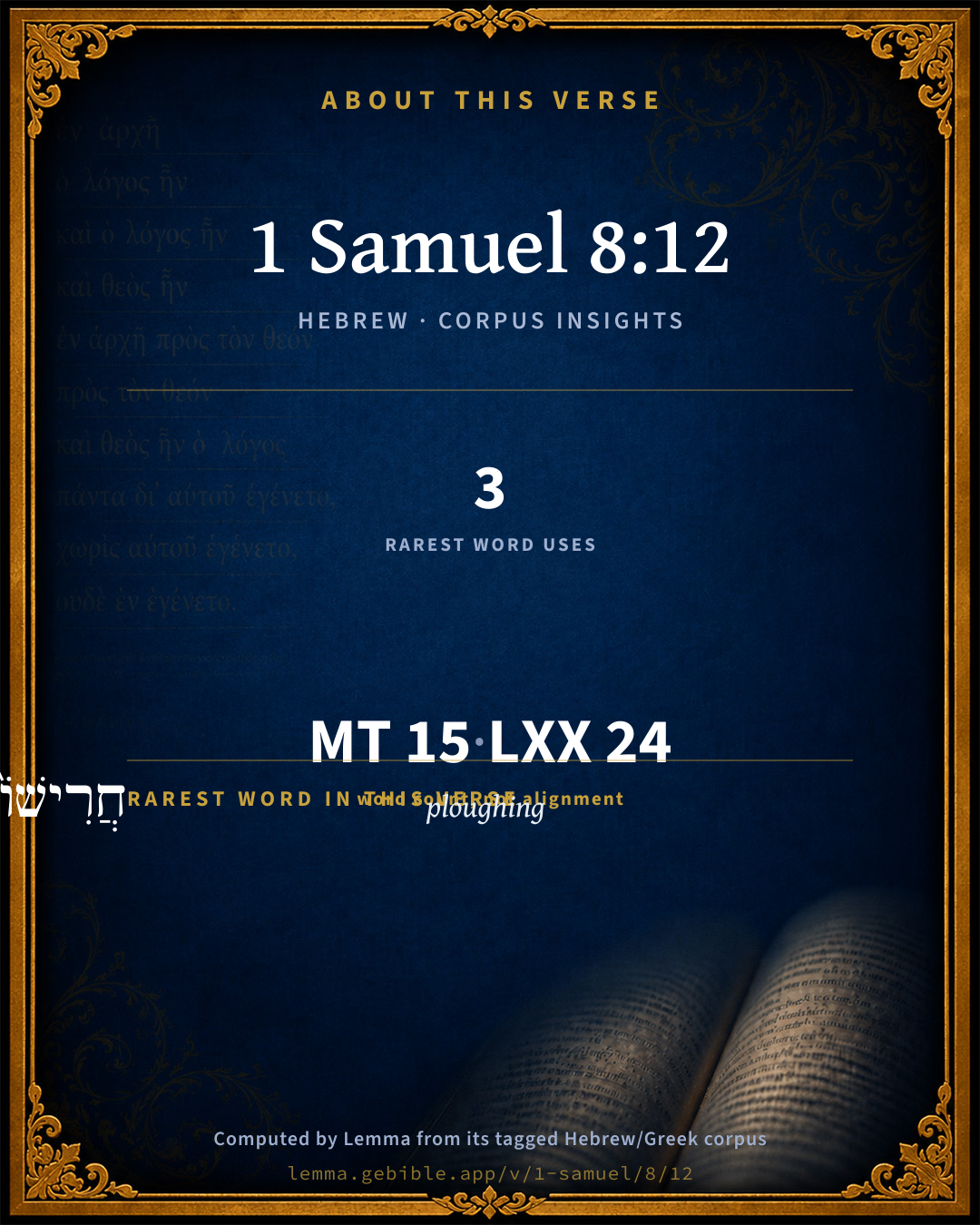
These counts appear in no published source. They are computed here, from the morphology-tagged text and Lemma’s own curated glosses. What Lemma adds →

15
words
12
distinct lemmas
Historical
section

Notable vocabulary

The rarest word here is חֲרִישׁוֹ֙ ploughing H2758 — appearing just 3 times in the whole Hebrew Bible.

Shared distinctive vocabulary

חֲרִישׁוֹ֙ ploughing H2758 occurs in 3 verses of the Hebrew Bible. Also found in:

Grammatical profile

  • 4 verbs
  • 8 nouns
  • 2 adjectives
  • 1 preposition

Verb forms

  • וְלָשׂ֣וּם Qal · Infinitive Construct
  • וְלַחֲרֹ֤שׁ Qal · Infinitive Construct
  • וְלִקְצֹ֣ר Qal · Infinitive Construct
  • וְלַעֲשׂ֥וֹת Qal · Infinitive Construct

Repetition

Words recur within this verse — often emphatic in Hebrew:

  • שָׂרֵ֥י prince H8269 ×2
  • כְּלֵֽי vessel H3627 ×2

Hebrew & Septuagint length

In English translation the verse runs 42 words from the Hebrew and 38 from the Septuagint (LXX English) — closely comparable.

A rough comparison of the two English renderings, which tokenize alike — not a word-level alignment.

Word counts can differ between the Hebrew and the Greek without any difference in meaning — e.g. the Hebrew direct-object marker אֵת has no separate Greek word, and Greek often adds the article ὁ.

In the original languages it is 15 Hebrew tokens and 24 Greek tokens — but the two are counted differently (Hebrew bundles its prefixes and suffixes into one token; the Greek is in lemma form), so that isn’t a like-for-like length.

Cross-references

6

Topical passages linked to 1 Samuel 8:12 in the Treasury of Scripture Knowledge — connected by theme and wording, ordered by reader-vote popularity; previews shown in the World English Bible.

  • 1 Samuel 22:7 Saul said to his servants who stood about him, Hear now, you Benjamites; will the son of Jesse give everyone of you fields and vineyards, will he make you all captains of thousands and captains of hundreds,
  • 1 Kings 4:7 Solomon had twelve officers over all Israel, who provided food for the king and his household: each man had to make provision for a month in the year.
  • 1 Kings 4:22–23 Solomon's provision for one day was thirty measures of fine flour, and sixty measures of meal,
  • 1 Kings 4:27–28 Those officers provided food for king Solomon, and for all who came to king Solomon's table, every man in his month; they let nothing be lacking.
  • 1 Chronicles 27:1–22 Now the children of Israel after their number, the heads of fathers' [houses] and the captains of thousands and of hundreds, and their officers who served the king, in any matter of the divisions which came in and went out month by month throughout all the months of the year--of every division were twenty-four thousand.
  • 2 Chronicles 32:28–29 store-houses also for the increase of grain and new wine and oil; and stalls for all manner of animals, and flocks in folds.

Cross-references courtesy of OpenBible.info (CC BY 4.0).

Hebrew and Greek witnesses Masoretic Hebrew ↔ Greek Septuagint

The same verse in the two great witnesses to the Old Testament, shown verse-for-verse.

These are two independent witnesses, not word-aligned to each other, and the Septuagint is shown in lemma (dictionary) form.

Hebrew 1 Samuel 8:12 Masoretic · Westminster Leningrad Codex

וְלָשׂ֣וּם ל֔וֹ שָׂרֵ֥י אֲלָפִ֖ים וְשָׂרֵ֣י חֲמִשִּׁ֑ים וְלַחֲרֹ֤שׁ חֲרִישׁוֹ֙ וְלִקְצֹ֣ר קְצִיר֔וֹ וְלַעֲשׂ֥וֹת כְּלֵֽי מִלְחַמְתּ֖וֹ וּכְלֵ֥י רִכְבּֽוֹ

and he will appoint them to him for captains of thousands, and captains of fifties; and [he will set some] to plow his ground, and to reap his harvest, and to make his instruments of war, and the instruments of his chariots.

World English Bible · Public Domain

Greek LXX 1 Samuel 8:12 Septuagint · lemma form

καί τίθημι αὐτός ἑαυτοῦ χιλίαρχος καί ἑκατόνταρχος καί θερίζω θερισμός αὐτός καί τρυγάω τρύγητος αὐτός καί ποιέω σκεῦος πολεμικός αὐτός καί σκεῦος ἅρμα αὐτός

and his manner shall be to make them to himself captains of hundreds and captains of thousands; and to reap his harvest, and gather his vintage, and prepare his instruments of war, and the implements of his chariots.

LXX2012 (modern English Septuagint) · Public Domain

Hebrew: Westminster Leningrad Codex (CC BY 4.0). Greek: Septuagint (public domain); English from LXX2012 (modern English Septuagint) (Public Domain). How the Septuagint differs from the Hebrew →

Targum (Aramaic paraphrase)

1

The Targum is the ancient Jewish Aramaic paraphrase of the Hebrew Scriptures — an interpretive translation, not the Hebrew text itself. Onkelos (literal) and Pseudo-Jonathan (expansive) render the Torah, and Jonathan the Prophets. Coverage is partial: where no permissively-licensed English translation exists for a verse, only the Aramaic is shown. This is verse-level text, not a word-by-word alignment to the Hebrew.

  1. Targum Jonathan Prophets (Joshua–Malachi)
    וּלְמַנָאָה לֵיהּ רַבָּנֵי אַלְפִין וְרַבָּנֵי חַמְשִׁין וְאִכָּרַיָא לְמִיגַר נִירֵיהּ וּלְמֶחְצַד חַצְדֵיהּ וְאוּמְנַיָא לְמֶעְבַּד מָאנֵי קְרָבֵיהּ וּמָאנֵי רְתִיכוֹהִי:

    (no public-domain English translation for this verse)

    Targum Jonathan — Aramaic: “Mikraot Gedolot” (public domain). English: “Sefaria Community Translation” (CC0 1.0 (public-domain dedication)); “London "Chaldee Paraphrase," 1871” (public domain). Text via Sefaria.

Commentary

Notes on 1 Samuel 8:12 from classic Christian and Jewish commentators (each source and its license shown beneath its notes). The classic Christian expositions comment on the surrounding passage and are grouped to its opening verse, so a note may address several verses; the Jewish commentaries on the Tanakh (Rashi and others) are per-verse, so they appear only where the commentator wrote on this verse.

Lemma curates 59 commentaries, every one of them public domain or Creative Commons licensed, each selected and text-cleaned for this edition rather than reprinted as found. About our sources →

Trapp's Complete Commentary

John Trapp

1Sa 8:12 And he will appoint him captains over thousands, and captains over fifties; and [will set them] to ear his ground, and to reap his harvest, and to make his instruments of war, and instruments of his chariots.

Ver. 12. And he will appoint him captains over thousands, &c.] Who shall use the common soldiers as the Turkish commanders do their asapi, only to blunt the swords of the enemy, and to fill up ditches with their dead bodies, &c. {a}

{a} Turk. Hist., 317.

John Trapp, A Commentary or Exposition upon All the Books of the Old and New Testament (1647–1656) — public domain. Text from a community e-Sword module.

Joseph Benson's Commentary

1Sa 8:12. He will appoint him — Hebrew, To or for himself; for his own fancy, or glory, and not only when the necessities of the kingdom require it. Captains over thousands, and captains over fifties — Will dispose of them to military offices, higher or lower as he pleases, (1Sa 14:52,) to be perfectly subject to him, and placed or displaced as he thinks fit. And though this might seem to be no disadvantage, but an honour to the persons so advanced; yet even in them that honour was accompanied with great dangers, and pernicious snares of many kinds, for which those faint shadows of glory could not recompense them; and as to the public, their pomp and power proved very burdensome to the people, whose lands and fruits were taken from them, and bestowed upon these, for the support of their state. And will set them to ear his ground, &c. — Will make them his husbandmen, to plough his ground and reap his corn, at his own pleasure, and on his own terms, when, perhaps, their labour is necessary about their own fields. To make his instruments of war, &c. — Others he will make artificers: which was not very agreeable to that nation, who were inclined, from their first rise, rather to employ themselves in attending to the breeding of cattle, and in looking after their flocks and herds.

Joseph Benson's Commentary on the Old and New Testaments (1811–1818) — public domain. Text from a community e-Sword module.

Tyndale Open Study Notes

Tyndale Open Resources

8:12-17 The king would take people as well as possessions.

Tyndale Open Study Notes — © Tyndale Open Resources, licensed CC BY-SA 4.0. Text via the HelloAO Bible API.

Jamieson, Fausset & Brown

Robert Jamieson, A. R. Fausset & David Brown

he will appoint him captains--In the East, a person must accept any office to which he may be nominated by the king, however irksome it may be to his taste or ruinous to his interests.

Jamieson, Fausset & Brown — Commentary Critical and Explanatory on the Whole Bible (1871) — public domain (CC PDM 1.0). Text via the HelloAO Bible API.

Ellicott's Commentary for English Readers

(12) To ear his ground.—To ear, that is, to plough. The word is an old word (Anglo-Saxon earian), and connected with the Latin arare.

A Bible Commentary for English Readers, edited by Charles John Ellicott (1878–1897) — public domain. Text from a community e-Sword module.

The Cambridge Bible for Schools and Colleges

gen. ed. J. J. S. Perowne

12. captains over thousands and captains over fifties] The Sept. reads “captains of hundreds and captains of thousands,” which are the usual military divisions (ch. 1Sa_22:7; Num_31:14): but the Heb. text is to be preferred as mentioning the highest and the lowest offices. Cp. 2Ki_1:9 ff. For the fact cp. ch. 1Sa_14:52.

to ear his ground] “To ear” = “to plough,” from Lat. arare through A.-S. erian. The verb occurs again in Deu_21:4 and Isa_30:24; the subst. earing in Gen_45:6; Exo_34:21. Shakespeare uses the word:

“And let them go

To ear the land that hath some hope to grow.”

Richard II. A. iii. Sc. 2.

The Cambridge Bible for Schools and Colleges (gen. ed. J. J. S. Perowne; Cambridge University Press, 1878–1918) — public domain. Text from a community e-Sword module.

John Gill's Exposition

And he will appoint him captains over thousands, and captains over fifties,.... Which though posts of honour, yet when they are not matter of choice, and especially being precarious, and depending on the arbitrary will of a prince, are not eligible, and less so to persons that choose another sort of life:

and will set them to ear his ground; to plough it; not the same persons made captains of thousands and fifties, but others, whom he will employ in tilling and manuring his fields, and oblige them to it:

and to reap his harvest; when it is ripe, and gather it in, and bring it home into his barns and garners:

and to make his instruments of war: as swords, spears, bows and arrows, most commonly used in those times:

and instruments of chariots; which seem to design chariots of war, and the iron spikes and scythes which were joined to them, to cut down the foot soldiers, when driven among them in battle, which are commonly called chariots of iron; see Jos 17:16.

John Gill's Exposition of the Whole Bible (1746–1763) — public domain (CC PDM 1.0). Text via the HelloAO Bible API.

Albert Barnes' Notes on the Bible

This organization was as old as the time of Moses Num 31:14; Deu 1:15, and prevailed among the Philistines also 1Sa 29:2. The civil and military divisions were identical, and the civil officers were the same as the captains of thousands, hundreds, fifties, and tens, in time of war.

To ear his ground - literally, “to plow his plowing.” “To ear” is an old English word, now obsolete, for to plow.

Albert Barnes' Notes on the Bible (1834–1885) — public domain. Text from a community e-Sword/MySword module.

Haydock's Catholic Bible Commentary

Centurions, or body-guards. (Menochius) --- These offices might be honourable, but at the same time disagreeable, when people were forced to accept of them, and to neglect their more pleasing agricultural employment. The multitude of officers increases the expenses of the prince, and falls heavy upon the people. (Calmet)

George Leo Haydock (1774–1849), Haydock's Catholic Family Bible and Commentary, 1859 edition — public domain. Excludes Psalms (Douay-Rheims chapter numbering differs from Protestant) and Deuterocanonical books (Catholic canon only).

Matthew Poole's English Annotations

He will appoint him, Heb. to or for himself emphatically, i.e. for his own fancy, or glory, or conveniency, or evil design, and not only when the necessities of the kingdom or commonwealth require it, as the judges did. And though this might seem to be no encumbrance, as it is here represented, but an honour and advantage to the persons so advanced, yet even in them that honour was accompanied with great dangers, and pernicious snares of many kinds, which those faint shadows of glory could not recompense; and as to the public, their pomp and power proved very burdensome and oppressive to the people, whose lands and fruits were taken from them, and bestowed upon these, for the support of their state, as it follows below, 1Sa 8:14,15.

And to reap his harvest, at his own pleasure, and without their consent, when possibly their own fields required all their time and pains.

To make his instruments of war, and

instruments of his chariots; he will press them for all sorts of his work, and that upon his own terms.

Matthew Poole's English Annotations on the Holy Bible (1683–1685) — public domain. Text from a community e-Sword/MySword module.

The Pulpit Commentary

Captains over thousands, and captains over fifties. The largest and smallest divisions respectively of an Israelite, army. However objectionable the king"s personal state might be, this would fall in with the people"s wishes, for it would give them the promise of a well organised army. Not so the next clause, to ear i.e. to ploughhis ground. Forced labour was one of the most unjust, oppressive, and wasteful exactions of absolute governments, and was the chief cause of the revolt of the ten tribes from Rehoboam. (comp. 1Ki_5:13-16 1Ki_12:4) And yet it was the universal rule in ancient times, and in some countries it has continued even to the present day to be the law that the peasants must at certain seasons give their labour unpaid either to the proprietors or to the state.

Naturally, for a nation of agriculturists to have to leave their own fields just when their presence at home was most needed to plough the king"s ground and reap his harvest would be a bitter annoyance, because to the loss would be added a sense of wrong. How determinately a high-spirited nation like the Jews did resist this injustice we gather not merely from the indignation felt against Solomon"s levies, but also from the reproach cast in Jehoiakim"s teeth by Jeremiah, that "he used his neighbour"s service without wages, and gave him not for his work". (Jer_22:13) To make his instruments of war. Such work must be done; but in well organised states it is paid for by means of taxes, i.e. by a money compensation in place of personal service. In semi-barbarous states forced labour is used, and the national arsenals furnished at the greatest possible expense and vexation to those compelled to labour, and loss to the national resources.

The Pulpit Commentary (1880–1919), ed. H.D.M. Spence-Jones & Joseph S. Exell — public domain. Text from a community e-Sword module.

John Wesley's Explanatory Notes

Will appoint - Hebrew. To, or for himself; for his own fancy, or glory, and not only when the necessities of the kingdom require it. And though this might seem to be no incumbrance, but an honour to the persons so advanced, yet even in them that honour was accompanied with great dangers, and pernicious snares of many kinds, which those faint shadows of glory could not recompense; and as to the public, their pomp and power proved very burdensome to the people, whose lands and fruits were taken from them, and bestowed upon these, for the support of their state. Will set them - At his own pleasure, when possibly their own fields required all their time and pains. He will press them for all sorts of his work, and that upon his own terms.

John Wesley, Explanatory Notes Upon the Whole Bible (1754–1765) — public domain. Text via the GEBible commentary corpus.

Rashi

Rabbi Shlomo Yitzchaki (Rashi)

And to produce his implements of war. To train them as craftsmen, blacksmiths, and carpenters.

Rashi on the Tanakh — English translations: “The Judaica Press complete Tanach with Rashi, translated by A. J. Rosenberg” (CC BY 4.0); “Pentateuch with Rashi's commentary by M. Rosenbaum and A.M. Silbermann, 1929-1934” (public domain); “The Metsudah Tanach series, Lakewood, N.J” (CC BY 4.0); and “The Book of Joshua, Metsudah Publications, 1997” (CC BY 4.0). Text via Sefaria.

Lesson kit

Teaching starters — assembled from the data on this page, not authored interpretation. Every prompt links to the verse data it draws on. Edit before teaching.

1 Samuel, in the Historical, opens this verse with 15 words (12 distinct Hebrew lemmas). Its most distinctive word is chârîysh (“ploughing”). A historical commentator’s framing appears above. Read the whole chapter for the surrounding context.

Discussion questions

  1. What does “ploughing” (chârîysh) contribute to the verse as a whole?
  2. How does Genesis 45:6, which shares the word «ploughing», read alongside this verse?
  3. What does the repetition of “prince” (2× in this one verse) do in this verse?
  4. The translations on this page render this verse differently — a whole-verse word diff, not a word-by-word alignment. What might account for the different wordings?
  5. «וְלָשׂ֣וּם» is a Qal Infinitive Construct verb. How does that grammatical form shape the action described?
  6. Compare how Trapp's Complete Commentary and Joseph Benson's Commentary read this verse. Where do they agree or differ?

Things to notice

Reading settings

Reading text

Shown beneath each verse's original-language words.

Old Testament
Old Testament edition

Read the OT as the Masoretic Hebrew (MT) or the Greek Septuagint (LXX).

English shown for the Greek Septuagint (in the Hebrew ↔ Greek comparison).

Comparing translations? Open the Compare panel on any verse page to stack up to four side by side.