Leviticus 15:12

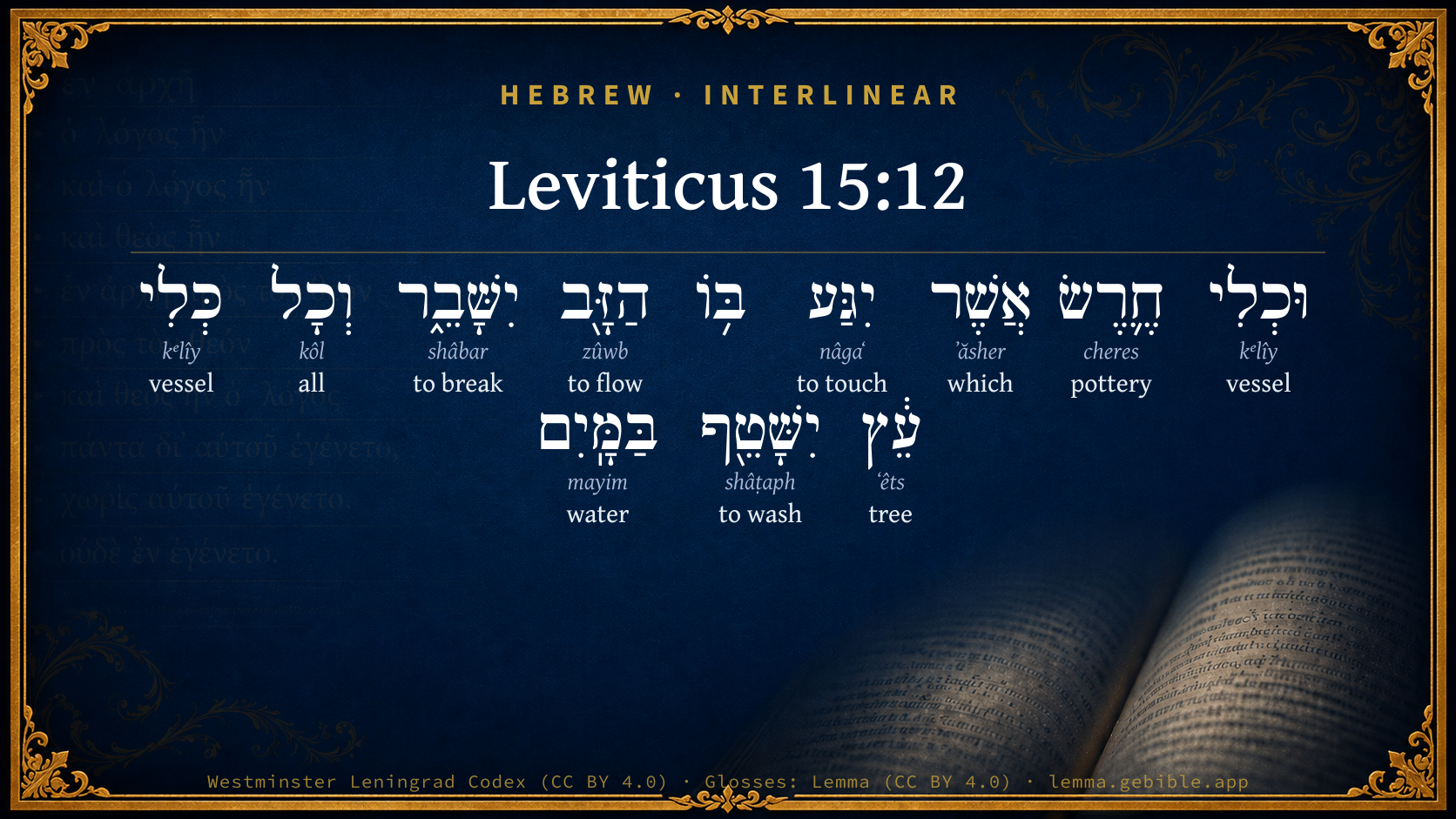
Hebrew (Westminster Leningrad Codex) Leviticus 15:12 appears in the Hebrew Old Testament. The text above is from the Westminster Leningrad Codex. Each word links to its Strong’s number, a concise gloss, and parsing drawn from the Open Scriptures Hebrew Bible morphology. Click any word for its full Brown-Driver-Briggs (BDB) entry.
Download image
Cite this verse

Leviticus 15:12 (World English Bible). Public Domain. Lemma interlinear Bible study tool, https://lemma.gebible.app/v/leviticus/15/12.

Show BibTeX & RIS
BibTeX
RIS
English Translation
"'The earthen vessel, which he who has the discharge touches, shall be broken; and every vessel of wood shall be rinsed in water.
World English Bible · Public Domain
Download a study sheet

One document with this verse’s original text, its word-by-word gloss line, the meaning frame, cross-references with their text, attributed commentary, and full source and license credits — printable, and it pastes into notes with its structure intact.

This verse Autodidact and up

Study sheet (.html) Plain text (.txt)

A passage Seminary Student

Up to 50 verses in one chapter. A passage sheet keeps up to 6 commentary sources and 12 cross-references per verse, in the order this page ranks them, and says so on the sheet whenever that leaves anything out. Ask for a single verse and you get the Autodidact verse sheet above.

Everything on this page stays free to read, with no account — the sheet is a download of what is already on screen, not access to it.

Want to remove ads? Support Godless Engineer
Compare translations 3

The same verse in 3 English versions, stacked beneath the original-language interlinear above. Click any original word for its lexicon entry.

Each is an independent rendering of the whole verse — the interlinear is not word-aligned to these translations.

Highlighted words mark where these versions differ — a whole-verse word diff, not a word-by-word alignment.

  • World English Bible Public Domain
    "'The earthen vessel, which he who has the discharge touches, shall be broken; and every vessel of wood shall be rinsed in water.
  • King James Version Public Domain
    And the vessel of earth, that he toucheth which hath the issue, shall be broken: and every vessel of wood shall be rinsed in water.
  • unfoldingWord Literal Text CC BY-SA 4.0
    And a vessel of clay that the flowing touches shall be broken, and every vessel of wood shall be rinsed with water.

unfoldingWord Literal Text — © unfoldingWord, licensed CC BY-SA 4.0. Word-aligned USFM3 via Door43 (git.door43.org/unfoldingWord/en_ult).

Versions to compare (up to 4)

3 of 4 selected

Show all 18 translations

Every available English version of this verse, each an independent rendering of the whole verse.

  • World English Bible Public Domain
    "'The earthen vessel, which he who has the discharge touches, shall be broken; and every vessel of wood shall be rinsed in water.
  • Berean Standard Bible Public Domain
    Any clay pot that the man with the discharge touches must be broken, and any wooden utensil must be rinsed with water.
  • Majority Standard Bible Public Domain
    Any clay pot that the man with the discharge touches must be broken, and any wooden utensil must be rinsed with water.
  • King James Version Public Domain
    And the vessel of earth, that he toucheth which hath the issue, shall be broken: and every vessel of wood shall be rinsed in water.
  • American Standard Version (1901) Public Domain
    And the earthen vessel, which he that hath the issue toucheth, shall be broken; and every vessel of wood shall be rinsed in water.
  • Revised Version (1885) Public Domain
    And the earthen vessel, which he that hath the issue toucheth, shall be broken: and every vessel of wood shall be rinsed in water.
  • Geneva Bible (1599) Public Domain
    And the vessel of earth that he toucheth, which hath the issue, shalbe broken: and euery vessel of wood shalbe rinsed in water.
  • Douay-Rheims (1899) Public Domain
    If he touch a vessel of earth, it shall be broken: but if a vessel of wood, if shall be washed with water.
  • Young's Literal Translation Public Domain
    `And the earthen vessel which he who hath the issue cometh against is broken; and every wooden vessel is rinsed with water.
  • Literal Standard Version CC BY-SA 4.0
    And the earthen vessel which he who has the discharging comes against is broken; and every wooden vessel is rinsed with water.
  • Unlocked Literal Bible CC BY-SA 4.0
    Any clay pot that the one with such a flow of fluid touches must be broken, and every container of wood must be rinsed in water.
  • unfoldingWord Literal Text CC BY-SA 4.0
    And a vessel of clay that the flowing touches shall be broken, and every vessel of wood shall be rinsed with water.
  • Darby Bible Public Domain
    And the vessel of earth that he toucheth who hath the flux shall be broken; and every vessel of wood shall be rinsed in water.
  • World Messianic Bible Public Domain
    “‘The earthen vessel, which he who has the discharge touches, shall be broken; and every vessel of wood shall be rinsed in water.
  • Webster's Bible Public Domain
    And the vessel of earth that he toucheth who hath the issue, shall be broken: and every vessel of wood shall be rinsed in water.
  • Free Bible Version CC BY-SA 4.0
    Any clay item touched by the man must be broken, and any wooden item must be washed with water.
  • Bible in Basic English Public Domain
    And any vessel of earth which has been touched by the unclean man will have to be broken and any vessel of wood washed.
  • JPS Tanakh (1917) Public Domain
    And the earthen vessel, which he that hath the issue toucheth, shall be broken; and every vessel of wood shall be rinsed in water.

Literal Standard Version (2020), Covenant Press — licensed CC BY-SA 4.0. Text via the HelloAO Bible API (eBible.org). Unlocked Literal Bible (unfoldingWord) — licensed CC BY-SA 4.0. Text via the HelloAO Bible API (eBible.org). unfoldingWord Literal Text — © unfoldingWord, licensed CC BY-SA 4.0. Word-aligned USFM3 via Door43 (git.door43.org/unfoldingWord/en_ult). Free Bible Version, Dr. Jonathan Gallagher — licensed CC BY-SA 4.0. Text via the HelloAO Bible API (eBible.org).

Word by word

More ways to search: Search by grammar → Find every occurrence → Compare this word →

Practice this passage: Drill this verse → Learn its vocabulary →

חֶ֛רֶשׂ
cheres
H2789
“pottery”
Noun, Common, Masculine, Singular, Absolute
Part of Speech
Noun
Type
Common
Gender
Masculine
Number
Singular
State
Absolute
Full BDB Definition

Origin: a collateral form mediating between H2775 and H2791

TWOT: 759a

earthenware, clay pottery, shard, potsherd, earthen vessel
  1. וּכְלִי kᵉlîy H3627 “and · vessel of” Conjunction + Noun, Common, Masculine, Singular, Construct
  2. אֲשֶׁר ʼăsher H834 “which” Particle, Relative
  3. יִגַּע nâgaʻ H5060 “to touch” Verb, Qal, Imperfect, 3rd Person, Masculine, Singular
  4. הַזָּ֖ב zûwb H2100 “the · flowing” Particle, Definite Article + Verb, Qal, Participle Active, Masculine, Singular, Absolute
  5. יִשָּׁבֵ֑ר shâbar H7665 “to break” Verb, Niphal, Imperfect, 3rd Person, Masculine, Singular
  6. וְכָל kôl H3605 “and · all of” Conjunction + Noun, Common, Masculine, Singular, Construct
  7. כְּלִי kᵉlîy H3627 “vessel of” Noun, Common, Masculine, Singular, Construct
  8. עֵ֔ץ ʻêts H6086 “tree” Noun, Common, Masculine, Singular, Absolute
  9. יִשָּׁטֵ֖ף shâṭaph H7857 “to wash” Verb, Niphal, Imperfect, 3rd Person, Masculine, Singular
  10. בַּמָּֽיִם mayim H4325 “in/at the · water(s)” Preposition, Determined + Noun, Common, Masculine, Plural, Absolute

About this verse

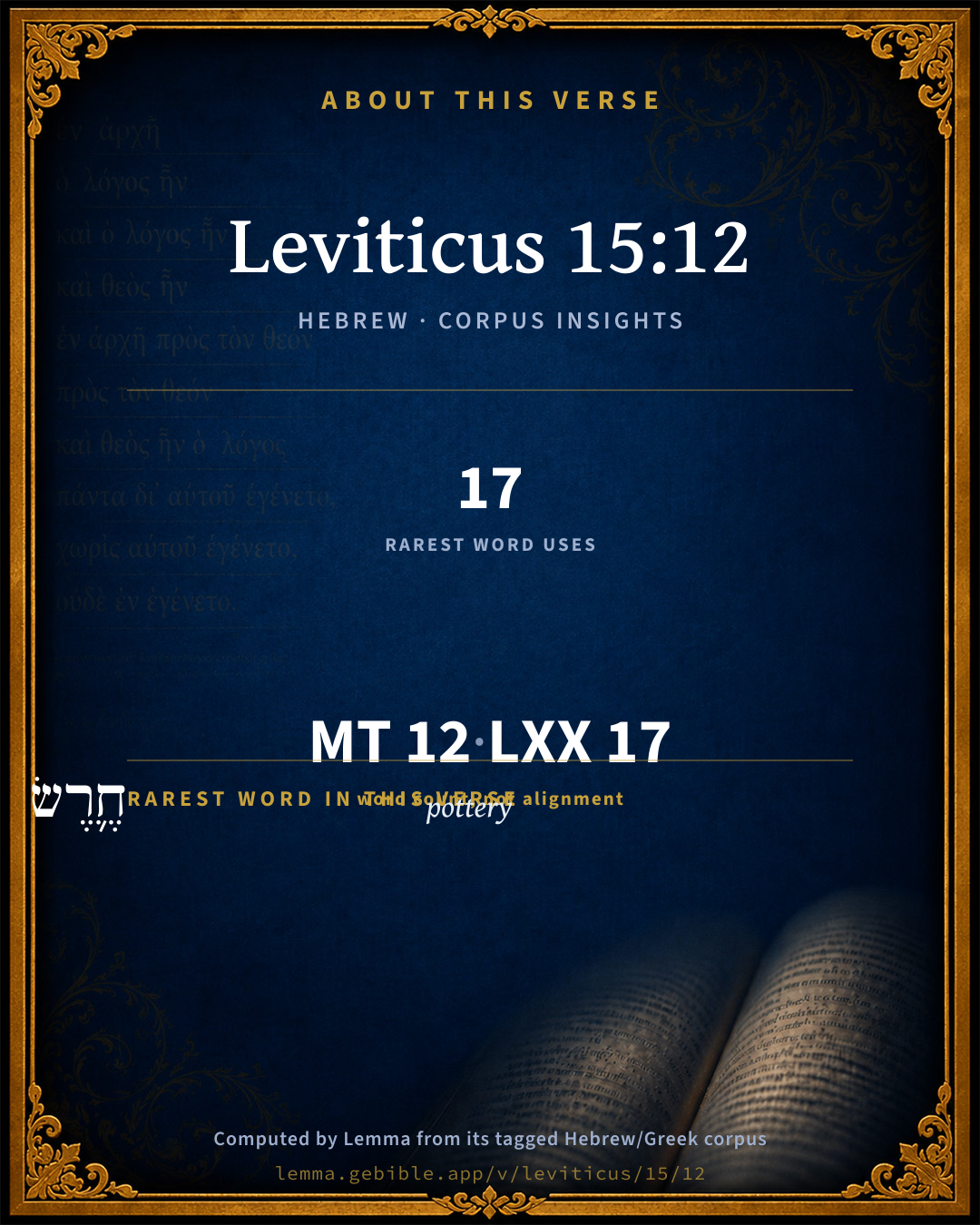
These counts appear in no published source. They are computed here, from the morphology-tagged text and Lemma’s own curated glosses. What Lemma adds →

12
words
10
distinct lemmas
Pentateuch
section

Notable vocabulary

The rarest word here is חֶ֛רֶשׂ pottery H2789 — appearing just 17 times in the whole Hebrew Bible.

Shared distinctive vocabulary

חֶ֛רֶשׂ pottery H2789 occurs in 16 verses of the Hebrew Bible. Also found in:

Grammatical profile

  • 4 verbs
  • 6 nouns
  • 1 preposition
  • 1 particle

Verb forms

  • יִגַּע Qal · Imperfect
  • הַזָּ֖ב Qal · Participle Active
  • יִשָּׁבֵ֑ר Niphal · Imperfect
  • יִשָּׁטֵ֖ף Niphal · Imperfect

Repetition

A word recurs within this verse — often emphatic in Hebrew:

  • וּכְלִי vessel H3627 ×2

Hebrew & Septuagint length

In English translation the verse runs 23 words from the Hebrew and 30 from the Septuagint (LXX English) — closely comparable.

A rough comparison of the two English renderings, which tokenize alike — not a word-level alignment.

Word counts can differ between the Hebrew and the Greek without any difference in meaning — e.g. the Hebrew direct-object marker אֵת has no separate Greek word, and Greek often adds the article ὁ.

In the original languages it is 12 Hebrew tokens and 17 Greek tokens — but the two are counted differently (Hebrew bundles its prefixes and suffixes into one token; the Greek is in lemma form), so that isn’t a like-for-like length.

Cross-references

8

Topical passages linked to Leviticus 15:12 in the Treasury of Scripture Knowledge — connected by theme and wording, ordered by reader-vote popularity; previews shown in the World English Bible.

  • Leviticus 6:28 But the earthen vessel in which it is boiled shall be broken; and if it is boiled in a brazen vessel, it shall be scoured, and rinsed in water.
  • Leviticus 11:32–33 On whatever any of them falls when they are dead, it shall be unclean; whether it is any vessel of wood, or clothing, or skin, or sack, whatever vessel it is, with which any work is done, it must be put into water, and it shall be unclean until the evening; then it will be clean.
  • Psalms 2:9 You shall break them with a rod of iron. You shall dash them in pieces like a potter's vessel."
  • Proverbs 1:21 She calls at the head of noisy places. At the entrance of the city gates, she utters her words:
  • Proverbs 1:23 Turn at my reproof. Behold, I will pour out my spirit on you. I will make known my words to you.
  • Proverbs 3:21 My son, let them not depart from your eyes. Keep sound wisdom and discretion:
  • 2 Corinthians 5:1 For we know that if the earthly house of our tent is dissolved, we have a building from God, a house not made with hands, eternal, in the heavens.
  • Philippians 3:21 who will change the body of our humiliation to be conformed to the body of his glory, according to the working by which he is able even to subject all things to himself.

Cross-references courtesy of OpenBible.info (CC BY 4.0).

Hebrew and Greek witnesses Masoretic Hebrew ↔ Greek Septuagint

The same verse in the two great witnesses to the Old Testament, shown verse-for-verse.

These are two independent witnesses, not word-aligned to each other, and the Septuagint is shown in lemma (dictionary) form.

Hebrew Leviticus 15:12 Masoretic · Westminster Leningrad Codex

וּכְלִי חֶ֛רֶשׂ אֲשֶׁר יִגַּע בּ֥וֹ הַזָּ֖ב יִשָּׁבֵ֑ר וְכָל כְּלִי עֵ֔ץ יִשָּׁטֵ֖ף בַּמָּֽיִם

"'The earthen vessel, which he who has the discharge touches, shall be broken; and every vessel of wood shall be rinsed in water.

World English Bible · Public Domain

Greek LXX Leviticus 15:12 Septuagint · lemma form

καί σκεῦος ὀστράκινος ὅς ἄν ἅπτομαι ὁ γονορρυής συντρίβω καί σκεῦος ξύλινος νίπτω ὕδωρ καί καθαρός εἰμί

And the earthen vessel which he that has the issue shall happen to touch, shall be broken; and a wooden vessel shall be washed with water, and shall be clean.

LXX2012 (modern English Septuagint) · Public Domain

Hebrew: Westminster Leningrad Codex (CC BY 4.0). Greek: Septuagint (public domain); English from LXX2012 (modern English Septuagint) (Public Domain). How the Septuagint differs from the Hebrew →

Targum (Aramaic paraphrase)

2

The Targum is the ancient Jewish Aramaic paraphrase of the Hebrew Scriptures — an interpretive translation, not the Hebrew text itself. Onkelos (literal) and Pseudo-Jonathan (expansive) render the Torah, and Jonathan the Prophets. Coverage is partial: where no permissively-licensed English translation exists for a verse, only the Aramaic is shown. This is verse-level text, not a word-by-word alignment to the Hebrew.

  1. Targum Onkelos Torah (Genesis–Deuteronomy)
    וּמָאן דַחֲסַף דִי יִקְרַב בֵּהּ דוֹבָנָא יִתָּבָר וְכָל מָאן דְאָע יִשְׁתַּטַּף בְּמַיָא

    (no public-domain English translation for this verse)

    Targum Onkelos — Aramaic: “Onkelos Genesis” (public domain); “Onkelos Exodus” (public domain); “Onkelos Leviticus” (public domain); “Onkelos Numbers” (public domain); “Onkelos Deuteronomy” (public domain). English: “Sefaria Community Translation” (CC0 1.0 (public-domain dedication)); “J.W. Etheridge. The Targums of Onkelos and Jonathan Ben Uzziel on the Pentateuch. London: Longmans, Green, 1862” (public domain). Text via Sefaria.

  2. Targum Pseudo-Jonathan Torah (Genesis–Deuteronomy)
    וּמָאן דְפָחַר דְיִקְרַב בְּגַוֵיהּ דוֹבָנָא יִתְבַּר וְכָל מָאן דְקֵיסָא יִשְׁתְּטֵיף בְּמַיָא

    And any vessel of earthenware whose inside may have been touched by him who hath the issue shall be broken; and any vessel of wood shall be washed in water.

    Targum Pseudo-Jonathan — Aramaic: “Targum Jonathan on Genesis” (public domain); “Targum Jonathan on Exodus” (public domain); “Targum Jonathan on Leviticus” (public domain); “Targum Jonathan on Numbers” (public domain); “Targum Jonathan on Deuteronomy” (public domain). English: “The Targum of Jonathan ben Uzziel, trans. J. W. Etheridge, London, 1862” (public domain). Text via Sefaria.

Commentary

Notes on Leviticus 15:12 from classic Christian and Jewish commentators (each source and its license shown beneath its notes). The classic Christian expositions comment on the surrounding passage and are grouped to its opening verse, so a note may address several verses; the Jewish commentaries on the Tanakh (Rashi and others) are per-verse, so they appear only where the commentator wrote on this verse.

Lemma curates 59 commentaries, every one of them public domain or Creative Commons licensed, each selected and text-cleaned for this edition rather than reprinted as found. About our sources →

Jamieson, Fausset & Brown

Robert Jamieson, A. R. Fausset & David Brown

the vessel of earth, that he toucheth which hath the issue, shall be broken--It is thought that the pottery of the Israelites, like the earthenware jars in which the Egyptians kept their water, was unglazed and consequently porous, and that it was its porousness which, rendering it extremely liable to imbibe small particles of impure matter, was the reason why the vessel touched by an unclean person was ordered to be broken.

Jamieson, Fausset & Brown — Commentary Critical and Explanatory on the Whole Bible (1871) — public domain (CC PDM 1.0). Text via the HelloAO Bible API.

Ellicott's Commentary for English Readers

(12) And the vessel of earth . . . shall be broken.—For the reason why vessels of a porous clay must be destroyed when contaminated by defilement, see Lev_6:28; Lev_11:33. This, however, is the only instance where an earthen vessel touched on the outside was defiled, thus again showing the intense loathing with which the guilt of this kind of infirmity was regarded.

Every vessel of wood shall be rinsed in water.—As these kinds of vessels were both more expensive and more difficult to restore, the Law, which so frequently takes into consideration the circumstances of the people, mercifully spares the more costly utensils. These are to undergo the same baptism as human beings. The administrators of the law during the second Temple took the expression “wood” in a more generic sense, as denoting more enduring material than clay; hence they included vessels made of copper, brass, silver, &c. With regard to the manner in which the vessels thus polluted are to be immersed, they ordained that if the utensil is dipped with its mouth downward, or if the vessel, at the time of its immersion, contains any liquor except water, the baptism is illegal. They, moreover, ordained that all new vessels which are purchased, or otherwise acquired, must likewise be immersed, for fear lest the maker, or some of those who have handled them prior to the purchase, might have been in a state of defilement. Hence the orthodox Jews to this day literally baptize cups, plates, knives, forks, or any new utensil which they buy. It is to this law that Christ refers when He says, “And many other things there be, which they have received to hold, as the washing [literally, the baptism] of cups, and pots, brazen vessels, and of tables,” or, as the Margin has it more correctly, “beds,” or couches (Mar_7:4).

A Bible Commentary for English Readers, edited by Charles John Ellicott (1878–1897) — public domain. Text from a community e-Sword module.

The Cambridge Bible for Schools and Colleges

gen. ed. J. J. S. Perowne

12. The difference between the earthen and wooden vessel is the same as that in Lev_6:28, Lev_11:32 f. The rabbis inferred from this verse that metal vessels should be washed. The Jew who purchased a brasen pot was bound to wash it, for it might have been handled by one who was ritually unclean. These ‘washings of cups, and pots, and brasen vessels,’ are referred to in Mar_7:4.

The Cambridge Bible for Schools and Colleges (gen. ed. J. J. S. Perowne; Cambridge University Press, 1878–1918) — public domain. Text from a community e-Sword module.

John Gill's Exposition

And the vessel of earth that he toucheth which hath an issue shall be broken,.... That it might not be made use of afterwards; which was ordered, that they might be careful what they touched who were in such circumstances: according to Gersom an earthen vessel received no uncleanness but from the middle, though he owns the law does not distinguish between the middle and the outside; wherefore Jarchi is of opinion, that if the back or outside of it was touched, it was unclean, and to be broken:

and every vessel of wood shall be rinsed in water; and after that be used: what should be the reason why an earthen vessel defiled by touching should be broken, and a wooden vessel defiled in the same way should not, but be rinsed and cleansed, when an earthen vessel might as well be rinsed and fit for use as that, is not easy to say; it depended upon the will of the lawgiver: according to Ainsworth, the one may signify the destruction of reprobate persons, the other the cleansing of penitent sinners.

John Gill's Exposition of the Whole Bible (1746–1763) — public domain (CC PDM 1.0). Text via the HelloAO Bible API.

Haydock's Catholic Bible Commentary

Broken, after he is perfectly healed. (Calmet)

George Leo Haydock (1774–1849), Haydock's Catholic Family Bible and Commentary, 1859 edition — public domain. Excludes Psalms (Douay-Rheims chapter numbering differs from Protestant) and Deuterocanonical books (Catholic canon only).

Whedon's Commentary on the Bible

Daniel D. Whedon

12. The vessel of earth… shall be broken — The reason for this command will be found in the fact that the earthen vessels in use among the Hebrews were unglazed, and from their porous nature, capable of defilement beyond the possibility of cleansing by washing. See Lev_11:33, note.

Daniel D. Whedon (gen. ed.), Commentary on the Old and New Testaments (1874–1909) — public domain. Text from a community e-Sword module.

Keil & Delitzsch

C. F. Keil & F. Delitzsch

Vessels that he had touched were to be broken to pieces if they were of earthenware, and rinsed with water if they were of wood, for the reasons explained in Lev 11:33 and Lev 6:21.

Keil & Delitzsch — Biblical Commentary on the Old Testament (1861–1891) — public domain (CC PDM 1.0). Text via the HelloAO Bible API. (Old Testament only.)

Rashi

Rabbi Shlomo Yitzchaki (Rashi)

וכלי חרס אשר יגע בו הזב AND THE VESSEL OF EARTH THAT HE WHO HATH THE ISSUE TOUCHETH [SHALL BE BROKEN] — One might think that the law applies also if he touched it from outside (its exterior) etc., as it is stated in Torath Cohanim (Sifra, Metzora Parashat Zavim, Section 3 1).

Rashi on the Tanakh — English translations: “The Judaica Press complete Tanach with Rashi, translated by A. J. Rosenberg” (CC BY 4.0); “Pentateuch with Rashi's commentary by M. Rosenbaum and A.M. Silbermann, 1929-1934” (public domain); “The Metsudah Tanach series, Lakewood, N.J” (CC BY 4.0); and “The Book of Joshua, Metsudah Publications, 1997” (CC BY 4.0). Text via Sefaria.

Lesson kit

Teaching starters — assembled from the data on this page, not authored interpretation. Every prompt links to the verse data it draws on. Edit before teaching.

Leviticus, in the Pentateuch, opens this verse with 12 words (10 distinct Hebrew lemmas). Its most distinctive word is cheres (“pottery”). A historical commentator’s framing appears above. Read the whole chapter for the surrounding context.

Discussion questions

  1. What does “pottery” (cheres) contribute to the verse as a whole?
  2. How does Leviticus 6:28, which shares the word «pottery», read alongside this verse?
  3. What does the repetition of “vessel” (2× in this one verse) do in this verse?
  4. The translations on this page render this verse differently — a whole-verse word diff, not a word-by-word alignment. What might account for the different wordings?
  5. «יִגַּע» is a Qal Imperfect verb. How does that grammatical form shape the action described?
  6. Compare how Jamieson, Fausset & Brown and Ellicott's Commentary for English Readers read this verse. Where do they agree or differ?

Things to notice

Reading settings

Reading text

Shown beneath each verse's original-language words.

Old Testament
Old Testament edition

Read the OT as the Masoretic Hebrew (MT) or the Greek Septuagint (LXX).

English shown for the Greek Septuagint (in the Hebrew ↔ Greek comparison).

Comparing translations? Open the Compare panel on any verse page to stack up to four side by side.