1 Chronicles 9:28

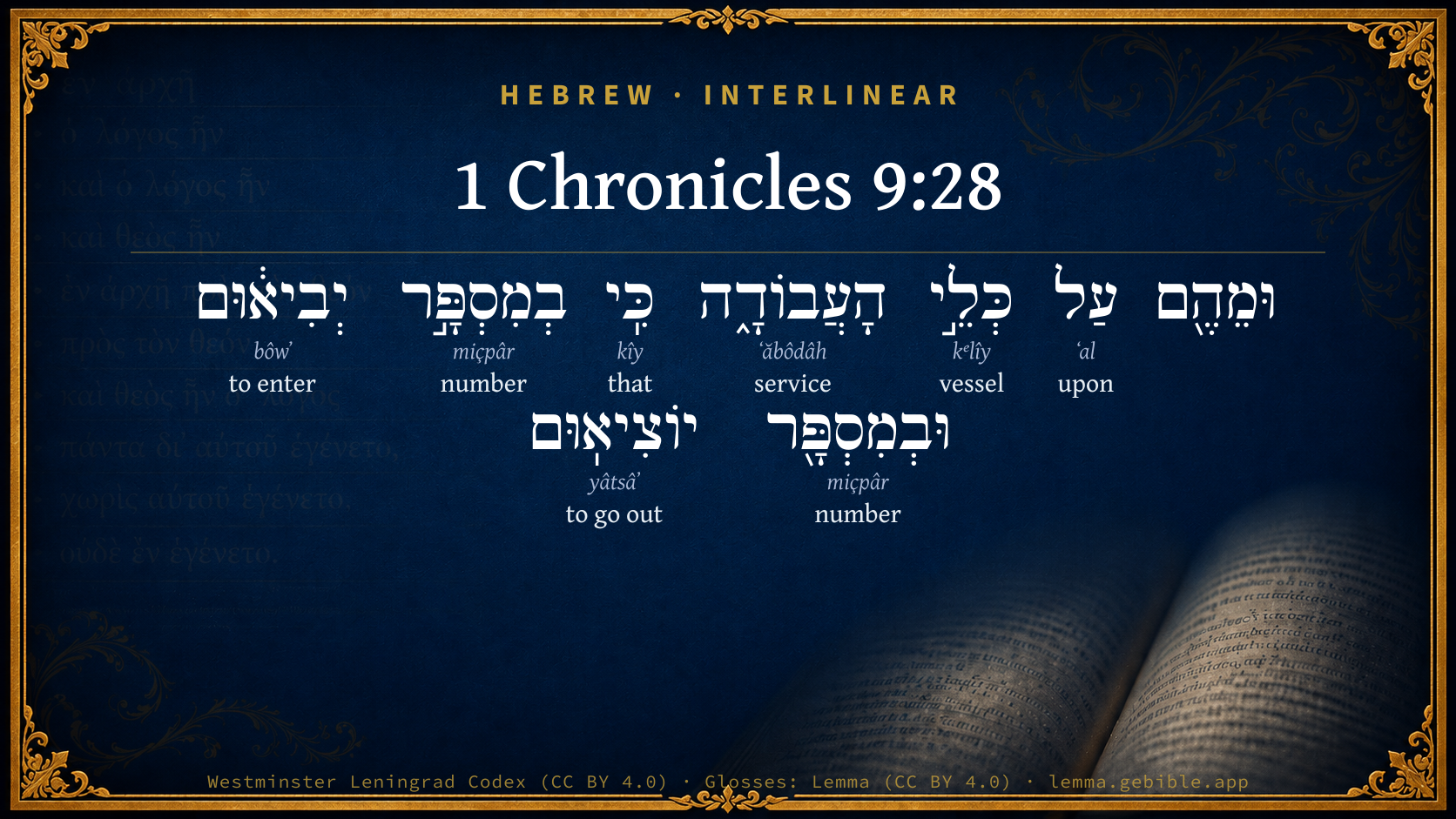
Hebrew (Westminster Leningrad Codex) 1 Chronicles 9:28 appears in the Hebrew Old Testament. The text above is from the Westminster Leningrad Codex. Each word links to its Strong’s number, a concise gloss, and parsing drawn from the Open Scriptures Hebrew Bible morphology. Click any word for its full Brown-Driver-Briggs (BDB) entry.
Download image
Cite this verse

1 Chronicles 9:28 (World English Bible). Public Domain. Lemma interlinear Bible study tool, https://lemma.gebible.app/v/1-chronicles/9/28.

Show BibTeX & RIS
BibTeX
RIS
English Translation
Certain of them had charge of the vessels of service; for by count were these brought in and by count were these taken out.
World English Bible · Public Domain
Download a study sheet

One document with this verse’s original text, its word-by-word gloss line, the meaning frame, cross-references with their text, attributed commentary, and full source and license credits — printable, and it pastes into notes with its structure intact.

This verse Autodidact and up

Study sheet (.html) Plain text (.txt)

A passage Seminary Student

Up to 50 verses in one chapter. A passage sheet keeps up to 6 commentary sources and 12 cross-references per verse, in the order this page ranks them, and says so on the sheet whenever that leaves anything out. Ask for a single verse and you get the Autodidact verse sheet above.

Everything on this page stays free to read, with no account — the sheet is a download of what is already on screen, not access to it.

Want to remove ads? Support Godless Engineer
Compare translations 3

The same verse in 3 English versions, stacked beneath the original-language interlinear above. Click any original word for its lexicon entry.

Each is an independent rendering of the whole verse — the interlinear is not word-aligned to these translations.

Highlighted words mark where these versions differ — a whole-verse word diff, not a word-by-word alignment.

  • World English Bible Public Domain
    Certain of them had charge of the vessels of service; for by count were these brought in and by count were these taken out.
  • King James Version Public Domain
    And certain of them had the charge of the ministering vessels, that they should bring them in and out by tale.
  • unfoldingWord Literal Text CC BY-SA 4.0
    And from them over the utensils of the service, for by number they brought them in, and by number they brought them out.

unfoldingWord Literal Text — © unfoldingWord, licensed CC BY-SA 4.0. Word-aligned USFM3 via Door43 (git.door43.org/unfoldingWord/en_ult).

Versions to compare (up to 4)

3 of 4 selected

Show all 18 translations

Every available English version of this verse, each an independent rendering of the whole verse.

  • World English Bible Public Domain
    Certain of them had charge of the vessels of service; for by count were these brought in and by count were these taken out.
  • Berean Standard Bible Public Domain
    Some of them were in charge of the articles used in worship, to count them whenever they were brought in or taken out.
  • Majority Standard Bible Public Domain
    Some of them were in charge of the articles used in worship, to count them whenever they were brought in or taken out.
  • King James Version Public Domain
    And certain of them had the charge of the ministering vessels, that they should bring them in and out by tale.
  • American Standard Version (1901) Public Domain
    And certain of them had charge of the vessels of service; for by count were these brought in and by count were these taken out.
  • Revised Version (1885) Public Domain
    And certain of them had charge of the vessels of service; for by tale were they brought in and by tale were they taken out.
  • Geneva Bible (1599) Public Domain
    And certaine of them had the rule of the ministring vessels: for they brought them in by tale, and brought them out by tale.
  • Douay-Rheims (1899) Public Domain
    And some of their stock had the charge of the vessels for the ministry: for the vessels were both brought in and carried out by number.
  • Young's Literal Translation Public Domain
    And `some' of them `are' over the vessels of service, for by number they bring them in, and by number they take them out.
  • Literal Standard Version CC BY-SA 4.0
    And [some] of them [are] over the vessels of service, for they bring them in by number, and by number they take them out.
  • Unlocked Literal Bible CC BY-SA 4.0
    Some of them were in charge of the temple's equipment; they counted the articles when they were brought in and when they were taken out.
  • unfoldingWord Literal Text CC BY-SA 4.0
    And from them over the utensils of the service, for by number they brought them in, and by number they brought them out.
  • Darby Bible Public Domain
    And [part] of them had the charge of the instruments of service, for by number they brought them in and by number they brought them out.
  • World Messianic Bible Public Domain
    Certain of them were in charge of the vessels of service, for these were brought in by count, and these were taken out by count.
  • Webster's Bible Public Domain
    And certain of them had the charge of the ministering vessels, that they should bring them in and out by number.
  • Free Bible Version CC BY-SA 4.0
    Some of the gatekeepers were responsible for the articles that were used in worship services. They counted what was brought in and what was taken out.
  • Bible in Basic English Public Domain
    Certain of them had the care of the vessels used in worship, to keep an account of them when they came in and when they were taken out again.
  • JPS Tanakh (1917) Public Domain
    And certain of them had charge of the vessels of service; for by tale were they brought in and by tale were they taken out.

Literal Standard Version (2020), Covenant Press — licensed CC BY-SA 4.0. Text via the HelloAO Bible API (eBible.org). Unlocked Literal Bible (unfoldingWord) — licensed CC BY-SA 4.0. Text via the HelloAO Bible API (eBible.org). unfoldingWord Literal Text — © unfoldingWord, licensed CC BY-SA 4.0. Word-aligned USFM3 via Door43 (git.door43.org/unfoldingWord/en_ult). Free Bible Version, Dr. Jonathan Gallagher — licensed CC BY-SA 4.0. Text via the HelloAO Bible API (eBible.org).

Word by word

More ways to search: Search by grammar → Find every occurrence → Compare this word →

Practice this passage: Drill this verse → Learn its vocabulary →

בְמִסְפָּ֣ר
miçpâr
H4557
“in/at · number”
Preposition + Noun, Common, Masculine, Singular, Absolute
Part of Speech
Preposition + Noun
Type
Common
Gender
Masculine
Number
Singular
State
Absolute
Full BDB Definition

Origin: from H5608

TWOT: 1540e

number, tale - number - number - innumerable (with negative) - few, numerable (alone) - by count, in number, according to number (with preposition) - recounting, relation
  1. עַל ʻal H5921 “upon” Preposition
  2. כְּלֵ֣י kᵉlîy H3627 “vessels of” Noun, Common, Masculine, Plural, Construct
  3. הָעֲבוֹדָ֑ה ʻăbôdâh H5656 “the · service” Particle, Definite Article + Noun, Common, Feminine, Singular, Absolute
  4. כִּֽי kîy H3588 “that” Conjunction
  5. יְבִיא֔וּם bôwʼ H935 “to enter · them” Verb, Hiphil, Imperfect, 3rd Person, Masculine, Plural + Suffix, Personal, 3rd Person, Masculine, Plural
  6. וּבְמִסְפָּ֖ר miçpâr H4557 “and · in/at · number” Conjunction + Preposition + Noun, Common, Masculine, Singular, Absolute
  7. יוֹצִיאֽוּם yâtsâʼ H3318 “to go out · them” Verb, Hiphil, Imperfect, 3rd Person, Masculine, Plural + Suffix, Personal, 3rd Person, Masculine, Plural

About this verse

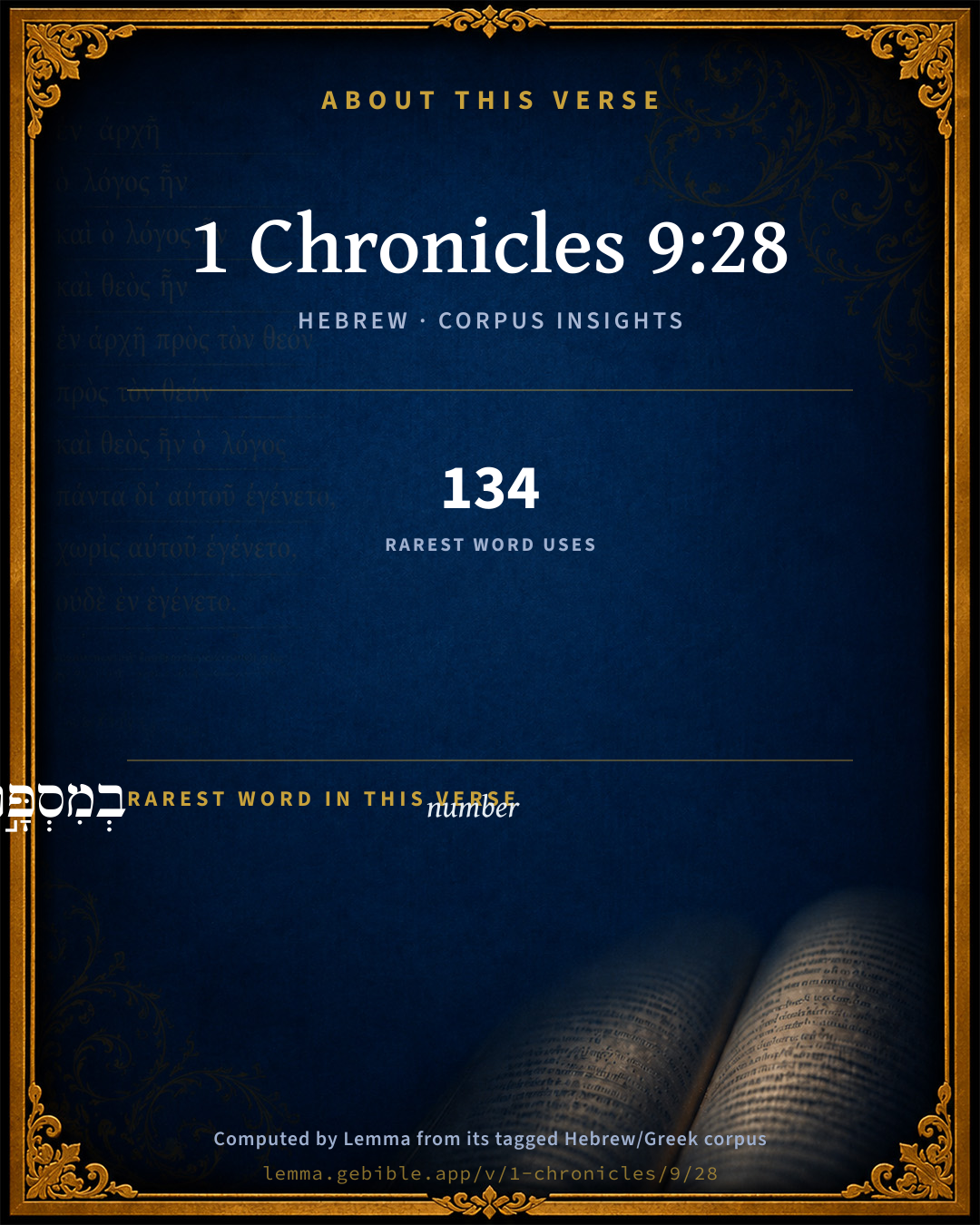
These counts appear in no published source. They are computed here, from the morphology-tagged text and Lemma’s own curated glosses. What Lemma adds →

9
words
7
distinct lemmas
Historical
section

Grammatical profile

  • 2 verbs
  • 4 nouns
  • 2 prepositions
  • 1 conjunction

Verb forms

  • יְבִיא֔וּם Hiphil · Imperfect
  • יוֹצִיאֽוּם Hiphil · Imperfect

Repetition

A word recurs within this verse — often emphatic in Hebrew:

  • בְמִסְפָּ֣ר number H4557 ×2

Hebrew & Septuagint length

In English translation the verse runs 24 words from the Hebrew and 25 from the Septuagint (LXX English) — closely comparable.

A rough comparison of the two English renderings, which tokenize alike — not a word-level alignment.

Word counts can differ between the Hebrew and the Greek without any difference in meaning — e.g. the Hebrew direct-object marker אֵת has no separate Greek word, and Greek often adds the article ὁ.

Cross-references

5

Topical passages linked to 1 Chronicles 9:28 in the Treasury of Scripture Knowledge — connected by theme and wording, ordered by reader-vote popularity; previews shown in the World English Bible.

  • Nehemiah 12:44 On that day were men appointed over the chambers for the treasures, for the heave-offerings, for the first fruits, and for the tithes, to gather into them, according to the fields of the cities, the portions appointed by the law for the priests and Levites: for Judah rejoiced for the priests and for the Levites who waited.
  • Nehemiah 13:4–5 Now before this, Eliashib the priest, who was appointed over the chambers of the house of our God, being allied to Tobiah,
  • Numbers 23:25–27 Balak said to Balaam, Neither curse them at all, nor bless them at all.
  • 1 Chronicles 26:22–26 The sons of Jehieli: Zetham, and Joel his brother, over the treasures of the house of Yahweh.
  • Ezra 8:25–30 and weighed to them the silver, and the gold, and the vessels, even the offering for the house of our God, which the king, and his counselors, and his princes, and all Israel there present, had offered:

Cross-references courtesy of OpenBible.info (CC BY 4.0).

Hebrew and Greek witnesses Masoretic Hebrew ↔ Greek Septuagint

The same verse in the two great witnesses to the Old Testament, shown verse-for-verse.

These are two independent witnesses, not word-aligned to each other, and the Septuagint is shown in lemma (dictionary) form.

Hebrew 1 Chronicles 9:28 Masoretic · Westminster Leningrad Codex

וּמֵהֶ֖ם עַל כְּלֵ֣י הָעֲבוֹדָ֑ה כִּֽי בְמִסְפָּ֣ר יְבִיא֔וּם וּבְמִסְפָּ֖ר יוֹצִיאֽוּם

Certain of them had charge of the vessels of service; for by count were these brought in and by count were these taken out.

World English Bible · Public Domain

Greek LXX 1 Chronicles 9:28 Septuagint · lemma form

καί ἐκ αὐτός ἐπί ὁ σκεῦος ὁ λειτουργία ὅτι ἐν ἀριθμός εἰςφέρω αὐτός καί ἐν ἀριθμός ἐκφέρω αὐτός

And some of them were appointed over the vessels of service, that they should carry them in by number, and carry them out by number.

LXX2012 (modern English Septuagint) · Public Domain

Hebrew: Westminster Leningrad Codex (CC BY 4.0). Greek: Septuagint (public domain); English from LXX2012 (modern English Septuagint) (Public Domain). How the Septuagint differs from the Hebrew →

Commentary

Notes on 1 Chronicles 9:28 from classic Christian and Jewish commentators (each source and its license shown beneath its notes). The classic Christian expositions comment on the surrounding passage and are grouped to its opening verse, so a note may address several verses; the Jewish commentaries on the Tanakh (Rashi and others) are per-verse, so they appear only where the commentator wrote on this verse.

Lemma curates 59 commentaries, every one of them public domain or Creative Commons licensed, each selected and text-cleaned for this edition rather than reprinted as found. About our sources →

The Cambridge Bible for Schools and Colleges

gen. ed. J. J. S. Perowne

28, 29. Duties of the Levites

28. And certain of them] The reference is to the Levites. The contents of 1Ch_9:28-29 clearly refer to Levitical duties (cp. 1Ch_23:29), and the transition from porters to Levites is made easier by the fact that the four porters last mentioned (1Ch_9:26-27) are Levites.

the ministering vessels] R.V. the vessels of service.

that they should bring them in and out by tale] R.V. for by tale were they brought in and by tale were they taken out.

The Cambridge Bible for Schools and Colleges (gen. ed. J. J. S. Perowne; Cambridge University Press, 1878–1918) — public domain. Text from a community e-Sword module.

Tyndale Open Study Notes

Tyndale Open Resources

9:28-32 various articles used in worship: See Exod 25:8–30:38.

Tyndale Open Study Notes — © Tyndale Open Resources, licensed CC BY-SA 4.0. Text via the HelloAO Bible API.

Ellicott's Commentary for English Readers

(28) The care of the sacred vessels of gold and silver. These were counted when brought out of the store rooms, and when replaced, to make sure that none was purloined. (Comp. Ezr_8:20 et seq.)

Tale.—“Reckoning,” “number.:”—

“ And every shepherd tells his tale

Under the hawthorn in the dale.”

Literally, for by number they used to bring them in (to the sanctuary), and by number they used to take them out.

A Bible Commentary for English Readers, edited by Charles John Ellicott (1878–1897) — public domain. Text from a community e-Sword module.

John Gill's Exposition

And other of their brethren, of the sons of the Kohathites, were over the shewbread, to prepare it every sabbath,.... Twelve loaves of which were set every week before the ark upon the shewbread table, and the old ones taken away: now the work of these Levites was to make this shewbread, and get it ready every week to be set upon the table, and which was done not by them, but by priests; under the second temple, the family of Garmu was set over this work (a).

(a) Misn. Shekalim, ut supra. (c. 5. sect. 1.)

John Gill's Exposition of the Whole Bible (1746–1763) — public domain (CC PDM 1.0). Text via the HelloAO Bible API.

Albert Barnes' Notes on the Bible

By tale - literally, “by number.” The vessels for service taken out of the treasury were counted, that the same number should be returned to the treasury after the service was over,

Albert Barnes' Notes on the Bible (1834–1885) — public domain. Text from a community e-Sword/MySword module.

Whedon's Commentary on the Bible

Daniel D. Whedon

28. The ministering vessels — As these seem to be distinguished from the ordinary vessels of the sanctuary mentioned in the next verse, they are understood by Bertheau and Keil to be the peculiarly costly vessels; for example, “the golden cups for the libations, etc., which were brought from the treasure chamber only for a short time for use in the service.”

By tale — Or, by number. They were carefully numbered, both when brought in and taken out, lest any one of them should become lost or missing.

Daniel D. Whedon (gen. ed.), Commentary on the Old and New Testaments (1874–1909) — public domain. Text from a community e-Sword module.

The Pulpit Commentary

That they should bring them in by tale and by tale carry them out. That is, that they should scrupulously number them.

Vers. 28-32.

Every man to his own office.

The distribution of gifts is constantly recognized, and on this we have much apostolic teaching. But the answering distribution of offices requires to be more fully apprehended. The power and the place are divinely fitted together; and in the economy of the Divine administration we may be sure there are no more powers given than there are places in which the powers may find exercise. It follows upon this that each man is bound to realize his power, discover his place, fit into it faithfully, and interfere with no other mans work. The way in which one man"s gifts and work may fit into another man"s is often an insoluble puzzle to us, but is quite plain in the plan of Divine forethought, and will be discovered when we can read final issues. Each man stands right before God when he clearly sees his work and says, "This one thing I do." The following points have been, in part, presented in previous outlines; they should be dealt with now in the light of the above topic, "Every man to his own office:

I GOD HAS BOTH GIFTS AND SPHERES FOR THEIR EXERCISE. That be has gifts we know, but we too readily assume that the spheres are human arrangements.

II GOD"S PROVIDENCES TEND TOWARDS SECURING THE PROPER RELATION OF GIFTS AND SPHERES. A north-country proverb tersely expresses this, "The tools will come to the hands that can use them." Every man, sooner or later, gains his providential opportunity, when he may do what he can do.

III MAN"S WILFULNESS SERIOUSLY MINGLES THE GIFTS AND THE SPHERES. By some men"s failing to recognize their gifts; by others prostrating their Divine gifts to base and selfish uses; by some, when they know their gifts, refusing to occupy their spheres; and by the forcing of too many into certain particular spheres for which an undue preference is shown. What we need in Christ"s Church and work is a wise subdivision of labour and more earnest endeavour to do faithfully and well our little piece. And in just this our Lord and Master set us his own holy example.

R.T.

The Pulpit Commentary (1880–1919), ed. H.D.M. Spence-Jones & Joseph S. Exell — public domain. Text from a community e-Sword module.

Keil & Delitzsch

C. F. Keil & F. Delitzsch

And other of their brethren, of the sons of the Kohathites, were over the shewbread, to prepare it every sabbath,.... Twelve loaves of which were set every week before the ark upon the shewbread table, and the old ones taken away: now the work of these Levites was to make this shewbread, and get it ready every week to be set upon the table, and which was done not by them, but by priests; under the second temple, the family of Garmu was set over this work (a).

(a) Misn. Shekalim, ut supra. (c. 5. sect. 1.)

Keil & Delitzsch — Biblical Commentary on the Old Testament (1861–1891) — public domain (CC PDM 1.0). Text via the HelloAO Bible API. (Old Testament only.)

unfoldingWord translationNotes

Door43 World Missions Community

Some of them

"Some of the guards"

they counted the articles when they were brought in and when they were taken out

This can be translated in active form. AT: "they counted the articles that people took out to use, and they counted the articles when people brought them back" (See: Active or Passive)

Some of them also were assigned to take care of

It is not clear who assigned these men, so if you have to translate in active form, use your language's most general way of doing so. AT: "The leaders also assigned some of them to take care of" or "Some of them also took care of" (See: Active or Passive)

translationWords

temple

holy

wine

oil

frankincense

unfoldingWord translationNotes — © Distant Shores Media and the Door43 World Missions Community, licensed CC BY-SA 4.0. Source: git.door43.org/Door43/en_tn.

Rashi

Rabbi Shlomo Yitzchaki (Rashi)

And some of them were in charge of the service vessels כְּלֵי הָעֲבוֹדָה, the service vessels - they would take them out by number and bring them by number.

Rashi on the Tanakh — English translations: “The Judaica Press complete Tanach with Rashi, translated by A. J. Rosenberg” (CC BY 4.0); “Pentateuch with Rashi's commentary by M. Rosenbaum and A.M. Silbermann, 1929-1934” (public domain); “The Metsudah Tanach series, Lakewood, N.J” (CC BY 4.0); and “The Book of Joshua, Metsudah Publications, 1997” (CC BY 4.0). Text via Sefaria.

Lesson kit

Teaching starters — assembled from the data on this page, not authored interpretation. Every prompt links to the verse data it draws on. Edit before teaching.

1 Chronicles, in the Historical, opens this verse with 9 words (7 distinct Hebrew lemmas). Its most distinctive word is miçpâr (“number”). A historical commentator’s framing appears above. Read the whole chapter for the surrounding context.

Discussion questions

  1. How does “number” (miçpâr) shape what this verse is saying?
  2. Nehemiah 12:44 shares this passage’s theme. How do the two illuminate each other?
  3. “number” occurs 2× in this one verse. What is the effect of the repetition?
  4. These translations render this verse differently. What is at stake in choosing one wording over another?
  5. The verb «יְבִיא֔וּם» is Hiphil Imperfect. How does its form color the action?
  6. Reading how The Cambridge Bible for Schools and Colleges and Tyndale Open Study Notes read this verse, where do the two commentators agree and where do they part?

Things to notice

Reading settings

Reading text

Shown beneath each verse's original-language words.

Old Testament
Old Testament edition

Read the OT as the Masoretic Hebrew (MT) or the Greek Septuagint (LXX).

English shown for the Greek Septuagint (in the Hebrew ↔ Greek comparison).

Comparing translations? Open the Compare panel on any verse page to stack up to four side by side.