Judges 18:11

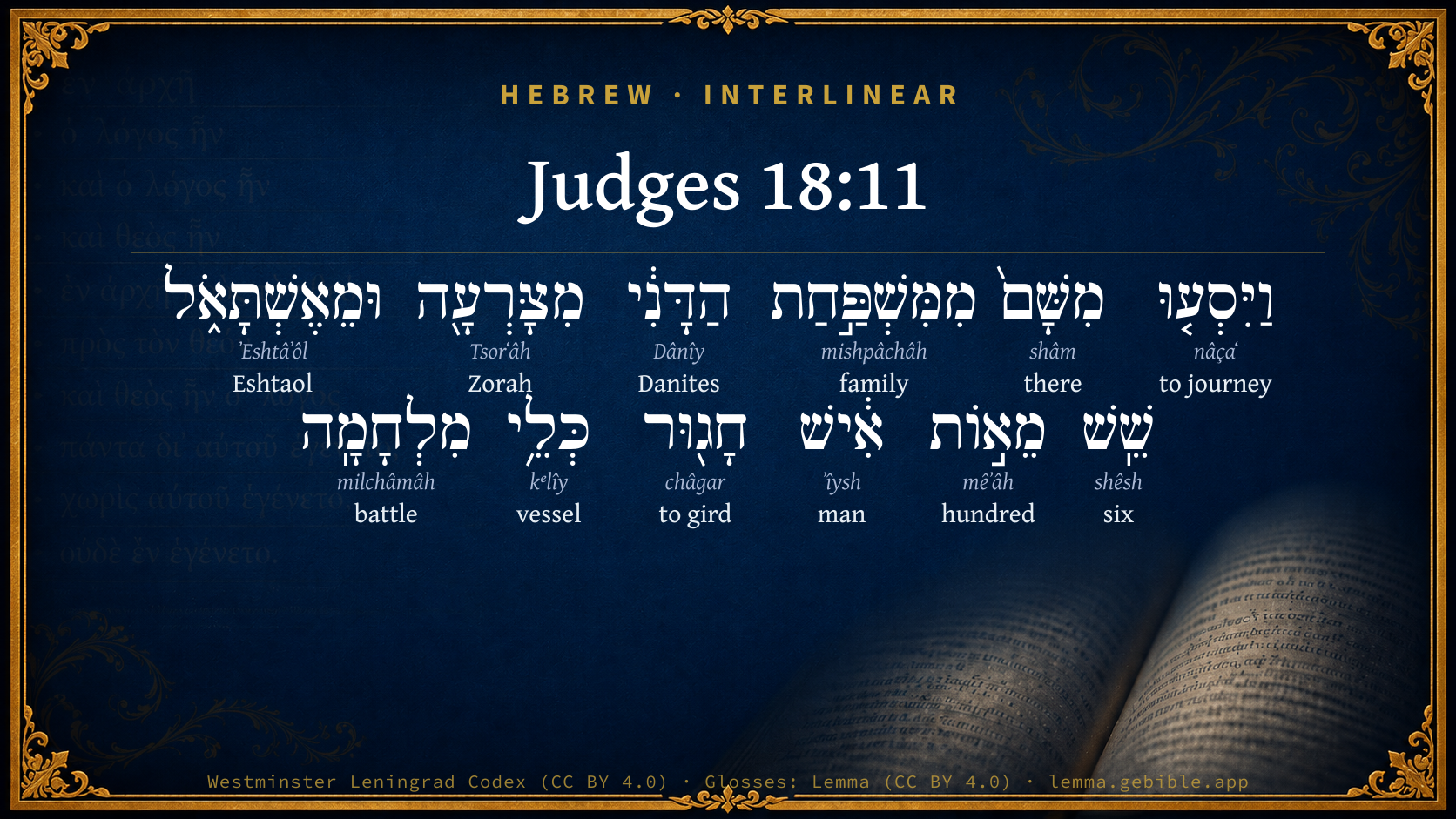
Hebrew (Westminster Leningrad Codex) Judges 18:11 appears in the Hebrew Old Testament. The text above is from the Westminster Leningrad Codex. Each word links to its Strong’s number, a concise gloss, and parsing drawn from the Open Scriptures Hebrew Bible morphology. Click any word for its full Brown-Driver-Briggs (BDB) entry.
Download image
Cite this verse

Judges 18:11 (World English Bible). Public Domain. Lemma interlinear Bible study tool, https://lemma.gebible.app/v/judges/18/11.

Show BibTeX & RIS
BibTeX
RIS
English Translation
There set forth from there of the family of the Danites, out of Zorah and out of Eshtaol, six hundred men girt with weapons of war.
World English Bible · Public Domain
Download a study sheet

One document with this verse’s original text, its word-by-word gloss line, the meaning frame, cross-references with their text, attributed commentary, and full source and license credits — printable, and it pastes into notes with its structure intact.

This verse Autodidact and up

Study sheet (.html) Plain text (.txt)

A passage Seminary Student

Up to 50 verses in one chapter. A passage sheet keeps up to 6 commentary sources and 12 cross-references per verse, in the order this page ranks them, and says so on the sheet whenever that leaves anything out. Ask for a single verse and you get the Autodidact verse sheet above.

Everything on this page stays free to read, with no account — the sheet is a download of what is already on screen, not access to it.

Want to remove ads? Support Godless Engineer
Compare translations 3

The same verse in 3 English versions, stacked beneath the original-language interlinear above. Click any original word for its lexicon entry.

Each is an independent rendering of the whole verse — the interlinear is not word-aligned to these translations.

Highlighted words mark where these versions differ — a whole-verse word diff, not a word-by-word alignment.

  • World English Bible Public Domain
    There set forth from there of the family of the Danites, out of Zorah and out of Eshtaol, six hundred men girt with weapons of war.
  • King James Version Public Domain
    And there went from thence of the family of the Danites, out of Zorah and out of Eshtaol, six hundred men appointed with weapons of war.
  • unfoldingWord Literal Text CC BY-SA 4.0
    So they journeyed from there, from the clan of the Danite, from Zorah and Eshtaol, 600 men girded weapons of war.

unfoldingWord Literal Text — © unfoldingWord, licensed CC BY-SA 4.0. Word-aligned USFM3 via Door43 (git.door43.org/unfoldingWord/en_ult).

Versions to compare (up to 4)

3 of 4 selected

Show all 18 translations

Every available English version of this verse, each an independent rendering of the whole verse.

  • World English Bible Public Domain
    There set forth from there of the family of the Danites, out of Zorah and out of Eshtaol, six hundred men girt with weapons of war.
  • Berean Standard Bible Public Domain
    So six hundred Danites departed from Zorah and Eshtaol, armed with weapons of war.
  • Majority Standard Bible Public Domain
    So six hundred Danites departed from Zorah and Eshtaol, armed with weapons of war.
  • King James Version Public Domain
    And there went from thence of the family of the Danites, out of Zorah and out of Eshtaol, six hundred men appointed with weapons of war.
  • American Standard Version (1901) Public Domain
    And there set forth from thence of the family of the Danites, out of Zorah and out of Eshtaol, six hundred men girt with weapons of war.
  • Revised Version (1885) Public Domain
    And there set forth from thence of the family of the Danites, out of Zorah and out of Eshtaol, six hundred men girt with weapons of war.
  • Geneva Bible (1599) Public Domain
    Then there departed thence of the familie of the Danites, from Zorah and from Eshtaol, sixe hundreth men appointed with instruments of warre.
  • Douay-Rheims (1899) Public Domain
    There went therefore of the kindred of Dan, to wit, from Saraa and Esthaol, six hundred men, furnished with arms for war,
  • Young's Literal Translation Public Domain
    And there journey thence, of the family of the Danite, from Zorah, and from Eshtaol, six hundred men girded with weapons of war.
  • Literal Standard Version CC BY-SA 4.0
    And there journey there, of the family of the Danite, from Zorah, and from Eshtaol, six hundred men girded with weapons of war.
  • Unlocked Literal Bible CC BY-SA 4.0
    Six hundred men of the tribe of Dan, armed with weapons of war, set out from Zorah and Eshtaol.
  • unfoldingWord Literal Text CC BY-SA 4.0
    So they journeyed from there, from the clan of the Danite, from Zorah and Eshtaol, 600 men girded weapons of war.
  • Darby Bible Public Domain
    And six hundred men of the tribe of Dan, armed with weapons of war, set forth from Zorah and Esh'ta-ol,
  • World Messianic Bible Public Domain
    The family of the Danites set out from Zorah and Eshtaol with six hundred men armed with weapons of war.
  • Webster's Bible Public Domain
    And there went from thence of the family of the Danites, out of Zorah and out of Eshtaol, six hundred men appointed with weapons of war.
  • Free Bible Version CC BY-SA 4.0
    So six hundred Danite armed men left Zorah and Eshtaol, ready to attack.
  • Bible in Basic English Public Domain
    So six hundred men of the Danites from Zorah and Eshtaol went out armed with instruments of war.
  • JPS Tanakh (1917) Public Domain
    And there set forth from thence of the family of the Danites, out of Zorah and out of Eshtaol, six hundred men girt with weapons of war.

Literal Standard Version (2020), Covenant Press — licensed CC BY-SA 4.0. Text via the HelloAO Bible API (eBible.org). Unlocked Literal Bible (unfoldingWord) — licensed CC BY-SA 4.0. Text via the HelloAO Bible API (eBible.org). unfoldingWord Literal Text — © unfoldingWord, licensed CC BY-SA 4.0. Word-aligned USFM3 via Door43 (git.door43.org/unfoldingWord/en_ult). Free Bible Version, Dr. Jonathan Gallagher — licensed CC BY-SA 4.0. Text via the HelloAO Bible API (eBible.org).

Word by word

More ways to search: Search by grammar → Find every occurrence → Compare this word →

Practice this passage: Drill this verse → Learn its vocabulary →

הַדָּנִ֔י
Dânîy
H1839
“the · Danites”
Particle, Definite Article + Noun, Gentilic, Masculine, Singular, Absolute
Part of Speech
Particle + Noun
Type
Gentilic
Gender
Masculine
Number
Singular
State
Absolute
Full BDB Definition

Origin: patronymically from H1835

TWOT: None

Danites = "judge" - descendants of Dan, son of Jacob - inhabitants of the territory of Dan
  1. וַיִּסְע֤וּ nâçaʻ H5265 “and · to journey” Conjunction + Verb, Qal, Sequential Imperfect, 3rd Person, Masculine, Plural
  2. מִשָּׁם֙ shâm H8033 “from · there” Preposition + Adverb
  3. מִמִּשְׁפַּ֣חַת mishpâchâh H4940 “from · family of” Preposition + Noun, Common, Feminine, Singular, Construct
  4. מִצָּרְעָ֖ה Tsorʻâh H6881 “from · Zorah” Preposition + Noun, Proper
  5. וּמֵאֶשְׁתָּאֹ֑ל ʼEshtâʼôl H847 “and · from · Eshtaol” Conjunction + Preposition + Noun, Proper
  6. שֵֽׁשׁ shêsh H8337 “six” Adjective, Cardinal number, Feminine, Singular, Absolute
  7. מֵא֣וֹת mêʼâh H3967 “hundred” Adjective, Cardinal number, Both, Plural, Absolute
  8. אִ֔ישׁ ʼîysh H376 “man” Noun, Common, Masculine, Singular, Absolute
  9. חָג֖וּר châgar H2296 “girded” Verb, Qal, Participle Passive, Masculine, Singular, Absolute
  10. כְּלֵ֥י kᵉlîy H3627 “vessels of” Noun, Common, Masculine, Plural, Construct
  11. מִלְחָמָֽה milchâmâh H4421 “battle” Noun, Common, Feminine, Singular, Absolute

About this verse

These counts appear in no published source. They are computed here, from the morphology-tagged text and Lemma’s own curated glosses. What Lemma adds →

12
words
12
distinct lemmas
Historical
section

Notable vocabulary

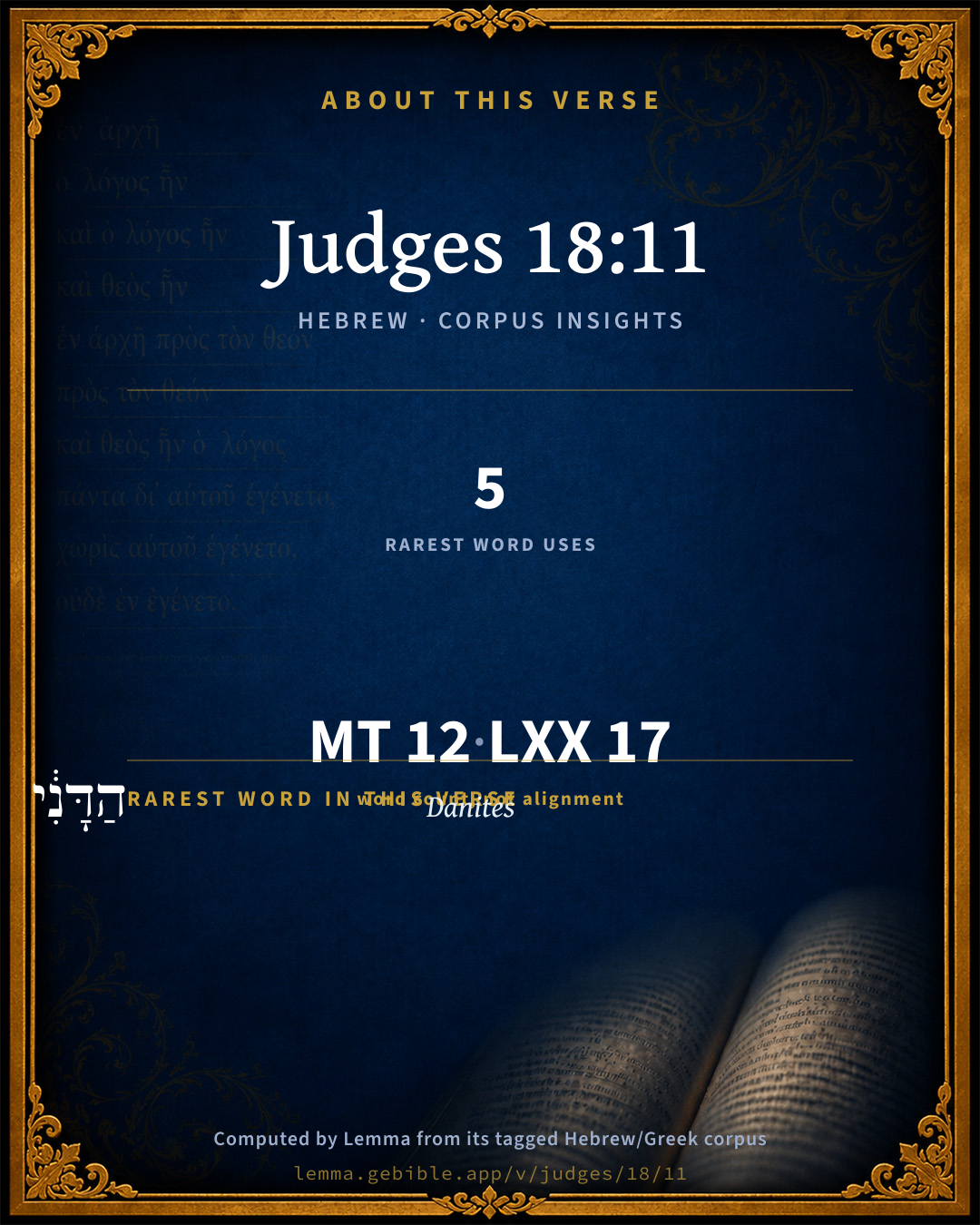
The rarest word here is הַדָּנִ֔י Danites H1839 — appearing just 5 times in the whole Hebrew Bible.

Shared distinctive vocabulary

הַדָּנִ֔י Danites H1839 occurs in 5 verses of the Hebrew Bible. Also found in:

Grammatical profile

  • 2 verbs
  • 7 nouns
  • 2 adjectives
  • 1 adverb

Verb forms

  • וַיִּסְע֤וּ Qal · Sequential Imperfect
  • חָג֖וּר Qal · Participle Passive

Hebrew & Septuagint length

In English translation the verse runs 26 words from the Hebrew and 22 from the Septuagint (LXX English) — closely comparable.

A rough comparison of the two English renderings, which tokenize alike — not a word-level alignment.

Word counts can differ between the Hebrew and the Greek without any difference in meaning — e.g. the Hebrew direct-object marker אֵת has no separate Greek word, and Greek often adds the article ὁ.

In the original languages it is 12 Hebrew tokens and 17 Greek tokens — but the two are counted differently (Hebrew bundles its prefixes and suffixes into one token; the Greek is in lemma form), so that isn’t a like-for-like length.

Cross-references

1

Topical passages linked to Judges 18:11 in the Treasury of Scripture Knowledge — connected by theme and wording, ordered by reader-vote popularity; previews shown in the World English Bible.

  • Judges 18:16 The six hundred men girt with their weapons of war, who were of the children of Dan, stood by the entrance of the gate.

Cross-references courtesy of OpenBible.info (CC BY 4.0).

Hebrew and Greek witnesses Masoretic Hebrew ↔ Greek Septuagint

The same verse in the two great witnesses to the Old Testament, shown verse-for-verse.

These are two independent witnesses, not word-aligned to each other, and the Septuagint is shown in lemma (dictionary) form.

Hebrew Judges 18:11 Masoretic · Westminster Leningrad Codex

וַיִּסְע֤וּ מִשָּׁם֙ מִמִּשְׁפַּ֣חַת הַדָּנִ֔י מִצָּרְעָ֖ה וּמֵאֶשְׁתָּאֹ֑ל שֵֽׁשׁ מֵא֣וֹת אִ֔ישׁ חָג֖וּר כְּלֵ֥י מִלְחָמָֽה

There set forth from there of the family of the Danites, out of Zorah and out of Eshtaol, six hundred men girt with weapons of war.

World English Bible · Public Domain

Greek LXX Judges 18:11 Septuagint · lemma form

καί ἀποαἴρω ἐκεῖθεν ἀπό δῆμος ὁ δαν ἀπό σαραα καί ἀπό εσθαολ ἑξακόσιοι ἀνήρ ζώννυμι σκεῦος παράταξις

And there departed thence of the families of Dan, from Saraa and from Esthaol, six hundred men, girded with weapons of war.

LXX2012 (modern English Septuagint) · Public Domain

Hebrew: Westminster Leningrad Codex (CC BY 4.0). Greek: Septuagint (public domain); English from LXX2012 (modern English Septuagint) (Public Domain). How the Septuagint differs from the Hebrew →

Targum (Aramaic paraphrase)

1

The Targum is the ancient Jewish Aramaic paraphrase of the Hebrew Scriptures — an interpretive translation, not the Hebrew text itself. Onkelos (literal) and Pseudo-Jonathan (expansive) render the Torah, and Jonathan the Prophets. Coverage is partial: where no permissively-licensed English translation exists for a verse, only the Aramaic is shown. This is verse-level text, not a word-by-word alignment to the Hebrew.

  1. Targum Jonathan Prophets (Joshua–Malachi)
    וּנְטָלוּ מִתַּמָן מִזַרְעִית דָן מִצָרְעָה וּמֵאֶשְׁתָּאֹל שִׁית מְאָה גַבְרִין מְזָרְזִין בְמָנֵי קְרָבָא:

    (no public-domain English translation for this verse)

    Targum Jonathan — Aramaic: “Mikraot Gedolot” (public domain). English: “Sefaria Community Translation” (CC0 1.0 (public-domain dedication)); “London "Chaldee Paraphrase," 1871” (public domain). Text via Sefaria.

Commentary

Notes on Judges 18:11 from classic Christian and Jewish commentators (each source and its license shown beneath its notes). The classic Christian expositions comment on the surrounding passage and are grouped to its opening verse, so a note may address several verses; the Jewish commentaries on the Tanakh (Rashi and others) are per-verse, so they appear only where the commentator wrote on this verse.

Lemma curates 59 commentaries, every one of them public domain or Creative Commons licensed, each selected and text-cleaned for this edition rather than reprinted as found. About our sources →

Trapp's Complete Commentary

John Trapp

Jdg 18:11 And there went from thence of the family of the Danites, out of Zorah and out of Eshtaol, six hundred men appointed with weapons of war.

Ver. 11. Six hundred men.] Picked out for the purpose, and very well appointed: they and their families, a whole colony of them, set forward for Laish, by the persuasion of the spies. Oh that we could as easily prevail with people to take God’s kingdom by force, to storm heaven, and to lay hold upon eternal life! Plutarch {a} telleth of the Gauls, that after they had once tasted of the grapes that grew in Italy, they never rested till they had possessed themselves of that country. Oh that we would do so for heaven!

{a} In Camillo.

John Trapp, A Commentary or Exposition upon All the Books of the Old and New Testament (1647–1656) — public domain. Text from a community e-Sword module.

Keil & Delitzsch

C. F. Keil & F. Delitzsch

Removal of Six Hundred Danites to Laish - Robbery of Micah's Images - Conquest of Laish, and Settlement There. - Jdg 18:11, Jdg 18:12. In consequence of the favourable account of the spies who returned, certain Danites departed from Zorea and Eshtaol, to the number of 600 men, accoutred with weapons of war, with their families and their possessions in cattle and goods (see Jdg 18:21), and encamped by the way at Kirjath-jearim (i.e., Kuriyet Enab; see Jos 9:17), in the tribe territory of Judah, at a place which received the permanent name of Mahaneh Dan (camp of Dan) from that circumstance, and was situated behind, i.e., to the west of, Kirjath-jearim (see at Jdg 13:25). The fact that this locality received a standing name from the circumstance described, compels us to assume that the Danites had encamped there for a considerable time, for reasons which we cannot determine from our want of other information. The emigrants may possibly have first of all assembled here, and prepared and equipped themselves for their further march.

Keil & Delitzsch — Biblical Commentary on the Old Testament (1861–1891) — public domain (CC PDM 1.0). Text via the HelloAO Bible API. (Old Testament only.)

Jamieson, Fausset & Brown

Robert Jamieson, A. R. Fausset & David Brown

there went from thence of the family of the Danites . . . six hundred men--This was the collective number of the men who were equipped with arms to carry out this expeditionary enterprise, without including the families and furniture of the emigrants (Jdg 18:21). Their journey led them through the territory of Judah, and their first halting place was "behind," that is, on the west of Kirjath-jearim, on a spot called afterwards "the camp of Dan." Prosecuting the northern route, they skirted the base of the Ephraimite hills. On approaching the neighborhood of Micah's residence, the spies having given information that a private sanctuary was kept there, the priest of which had rendered them important service when on their exploring expedition, it was unanimously agreed that both he and the furniture of the establishment would be a valuable acquisition to their proposed settlement. A plan of spoliation was immediately formed. While the armed men stood sentinels at the gates, the five spies broke into the chapel, pillaged the images and vestments, and succeeded in bribing the priest also by a tempting offer to transfer his services to their new colony. Taking charge of the ephod, the teraphim, and the graven image, he "went in the midst of the people"--a central position assigned him in the march, perhaps for his personal security; but more probably in imitation of the place appointed for the priests and the ark, in the middle of the congregated tribes, on the marches through the wilderness. This theft presents a curious medley of low morality and strong religious feeling. The Danites exemplified a deep-seated principle of our nature--that men have religious affections, which must have an object on which these may be exercised, while they are often not very discriminating in the choice of the objects. In proportion to the slender influence religion wields over the heart, the greater is the importance attached to external rites; and in the exact observance of these, the conscience is fully satisfied, and seldom or never molested by reflections on the breach of minor morals.

Jamieson, Fausset & Brown — Commentary Critical and Explanatory on the Whole Bible (1871) — public domain (CC PDM 1.0). Text via the HelloAO Bible API.

Adam Clarke's Commentary

Verse 11. Six hundred men] These were not the whole, for we find they had children, c., Jdg 18:21 but these appear to have been six hundred armed men.

Adam Clarke's Commentary on the Bible (1810–1826) — public domain. Text from a community e-Sword/MySword module.

Ellicott's Commentary for English Readers

(11) Appointed.—Literally, girded. This was not a mere raid of warriors, but the migration of a section from the tribe, accompanied by their wives and children, and carrying their possessions with them (Jdg_18:21). The numbers of the whole tribe at the last census had been 64,400 (Num_26:43).

A Bible Commentary for English Readers, edited by Charles John Ellicott (1878–1897) — public domain. Text from a community e-Sword module.

The Cambridge Bible for Schools and Colleges

gen. ed. J. J. S. Perowne

11. six hundred men] Not the whole clan, but only the more enterprising members of it; the rest remained behind in the south. The armed men took their women and children with them (Jdg_18:21); altogether the numbers must have reached a thousand.

The Cambridge Bible for Schools and Colleges (gen. ed. J. J. S. Perowne; Cambridge University Press, 1878–1918) — public domain. Text from a community e-Sword module.

John Gill's Exposition

And there went from thence of the family of the Danites,.... Or families, the singular being put for the plural; for it can hardly be thought that such a number of men, as after mentioned, went out of one family:

out of Zorah, and out of Eshtaol; the two places the spies were sent from, and now had returned unto: and upon their report, and at their instigation, and by the encouragement they gave, there were

six hundred men appointed with weapons of war; that set out armed from the above places, on the expedition to take Laish.

John Gill's Exposition of the Whole Bible (1746–1763) — public domain (CC PDM 1.0). Text via the HelloAO Bible API.

Haydock's Catholic Bible Commentary

War, besides their wives, &c., ver. 21.

George Leo Haydock (1774–1849), Haydock's Catholic Family Bible and Commentary, 1859 edition — public domain. Excludes Psalms (Douay-Rheims chapter numbering differs from Protestant) and Deuterocanonical books (Catholic canon only).

Matthew Poole's English Annotations

Of the family; by which it again appears, that the tribe, Jdg 18:1, is put for family.

Matthew Poole's English Annotations on the Holy Bible (1683–1685) — public domain. Text from a community e-Sword/MySword module.

Whedon's Commentary on the Bible

Daniel D. Whedon

11. Six hundred men — So confident were they of victory that they took along with them, as appears from Jdg_18:21, their little ones, and their cattle and precious things. This entire expedition was a fulfilling of Jacob’s prophetic words: “Dan shall be a serpent by the way, an adder in the path, that biteth the horse’s heels, so that his rider shall fall backward.” Gen_49:17. So, too, Moses likens Dan to a young lion of Bashan that leaps forth suddenly from his ambush upon the prey. Deu_33:22.

Daniel D. Whedon (gen. ed.), Commentary on the Old and New Testaments (1874–1909) — public domain. Text from a community e-Sword module.

The Pulpit Commentary

The family meaning the tribe. (see Jud_1:13:2, note, and cf. Jos_7:17) Possibly a reason for the use of the word family here and in ver. 2, as applied to Dan, may be that there was only one family in the tribe of Dan, that of the Shuhamites. (Num_26:42) Six hundred men. With their wives and sisters and children (see ver. 21), the whole company, must have amounted to two or three thousand souls.

The Pulpit Commentary (1880–1919), ed. H.D.M. Spence-Jones & Joseph S. Exell — public domain. Text from a community e-Sword module.

unfoldingWord translationNotes

Door43 World Missions Community

Six hundred men

"600 men" (See: Numbers)

Kiriath Jearim

This is the name of a town. (See: How to Translate Names)

Mahaneh Dan

Translate the name of this place the same as you did in Judges 13:25.

to this day

This means that something remains the same. It refers to the "present" time. AT: "and that is still its name" (See: Idiom)

translationWords

tribe

Dan

Judah

unfoldingWord translationNotes — © Distant Shores Media and the Door43 World Missions Community, licensed CC BY-SA 4.0. Source: git.door43.org/Door43/en_tn.

Lesson kit

Teaching starters — assembled from the data on this page, not authored interpretation. Every prompt links to the verse data it draws on. Edit before teaching.

Judges, in the Historical, opens this verse with 12 words (12 distinct Hebrew lemmas). Its most distinctive word is Dânîy (“Danites”). A historical commentator’s framing appears above. Read the whole chapter for the surrounding context.

Discussion questions

  1. What does “Danites” (Dânîy) contribute to the verse as a whole?
  2. How does Judges 13:2, which shares the word «Danites», read alongside this verse?
  3. The translations on this page render this verse differently — a whole-verse word diff, not a word-by-word alignment. What might account for the different wordings?
  4. «וַיִּסְע֤וּ» is a Qal Sequential Imperfect verb. How does that grammatical form shape the action described?
  5. Compare how Trapp's Complete Commentary and Keil & Delitzsch read this verse. Where do they agree or differ?

Things to notice

Reading settings

Reading text

Shown beneath each verse's original-language words.

Old Testament
Old Testament edition

Read the OT as the Masoretic Hebrew (MT) or the Greek Septuagint (LXX).

English shown for the Greek Septuagint (in the Hebrew ↔ Greek comparison).

Comparing translations? Open the Compare panel on any verse page to stack up to four side by side.