
2 Kings 20:13

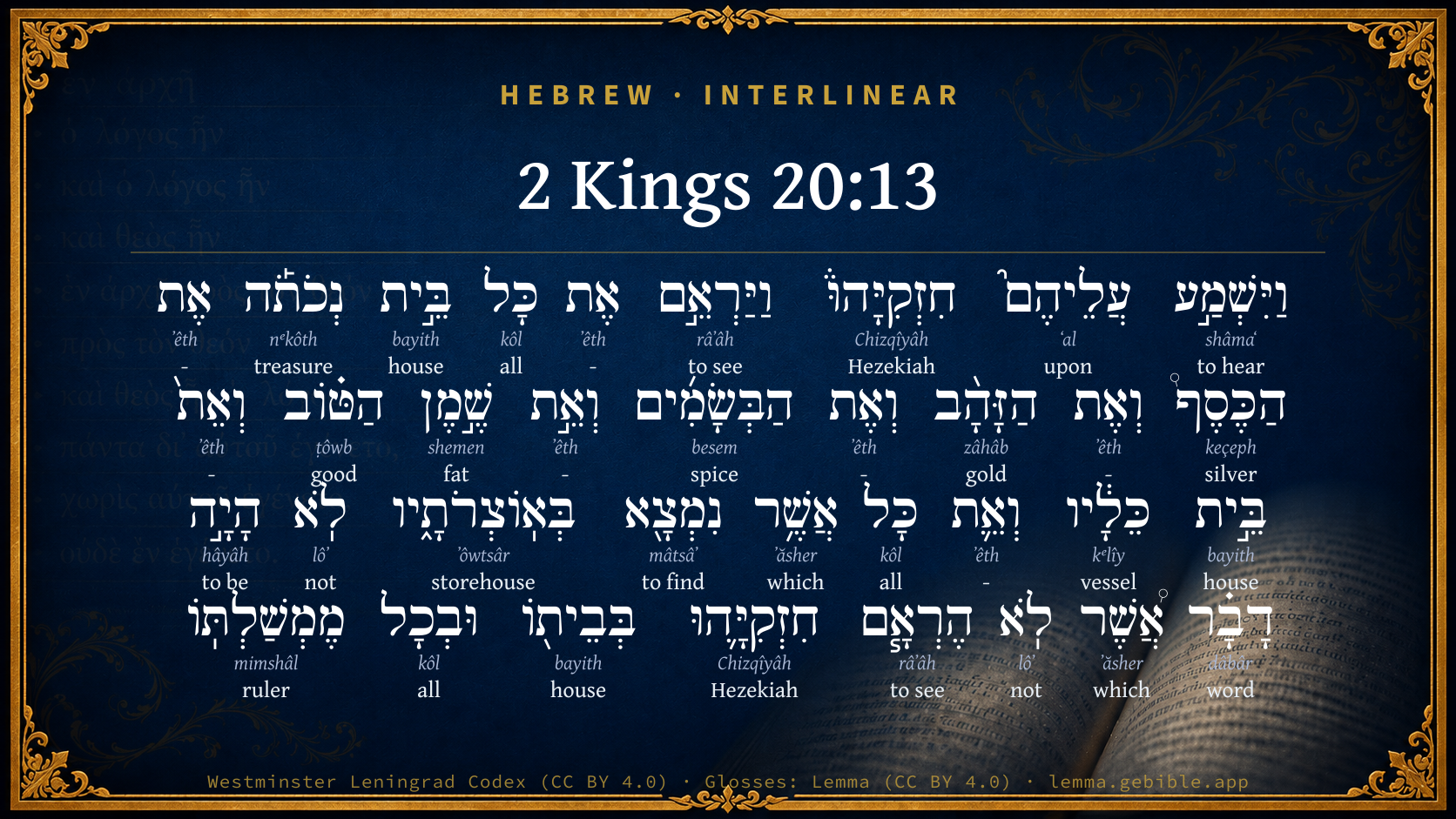
Hebrew (Westminster Leningrad Codex) 2 Kings 20:13 appears in the Hebrew Old Testament. The text above is from the Westminster Leningrad Codex. Each word links to its Strong’s number, a concise gloss, and parsing drawn from the Open Scriptures Hebrew Bible morphology. Click any word for its full Brown-Driver-Briggs (BDB) entry.
Download image
Cite this verse

2 Kings 20:13 (World English Bible). Public Domain. Lemma interlinear Bible study tool, https://lemma.gebible.app/v/2-kings/20/13.

Show BibTeX & RIS
BibTeX
RIS
English Translation
Hezekiah listened to them, and shown them all the house of his precious things, the silver, and the gold, and the spices, and the precious oil, and the house of his armor, and all that was found in his treasures: there was nothing in his house, nor in all his dominion, that Hezekiah didn't show them.
World English Bible · Public Domain
Highlights
  • 2 first appearances in the Hebrew Bible
Full analysis ↓
Download a study sheet

One document with this verse’s original text, its word-by-word gloss line, the meaning frame, cross-references with their text, attributed commentary, and full source and license credits — printable, and it pastes into notes with its structure intact.

This verse Autodidact and up

Study sheet (.html) Plain text (.txt)

A passage Seminary Student

Up to 50 verses in one chapter. A passage sheet keeps up to 6 commentary sources and 12 cross-references per verse, in the order this page ranks them, and says so on the sheet whenever that leaves anything out. Ask for a single verse and you get the Autodidact verse sheet above.

Everything on this page stays free to read, with no account — the sheet is a download of what is already on screen, not access to it.

Want to remove ads? Support Godless Engineer
Compare translations 3

The same verse in 3 English versions, stacked beneath the original-language interlinear above. Click any original word for its lexicon entry.

Each is an independent rendering of the whole verse — the interlinear is not word-aligned to these translations.

Highlighted words mark where these versions differ — a whole-verse word diff, not a word-by-word alignment.

  • World English Bible Public Domain
    Hezekiah listened to them, and shown them all the house of his precious things, the silver, and the gold, and the spices, and the precious oil, and the house of his armor, and all that was found in his treasures: there was nothing in his house, nor in all his dominion, that Hezekiah didn't show them.
  • King James Version Public Domain
    And Hezekiah hearkened unto them, and showed them all the house of his precious things, the silver, and the gold, and the spices, and the precious ointment, and all the house of his armor, and all that was found in his treasures: there was nothing in his house, nor in all his dominion, that Hezekiah showed them not.
  • unfoldingWord Literal Text CC BY-SA 4.0
    And Hezekiah listened to them, and he showed them the whole house of his treasure, the silver and the gold and the spices and the fine oil and the house of his armor and everything that was found in his treasuries. There was not a thing that Hezekiah did not show them in his house or in all of his realm.

unfoldingWord Literal Text — © unfoldingWord, licensed CC BY-SA 4.0. Word-aligned USFM3 via Door43 (git.door43.org/unfoldingWord/en_ult).

Versions to compare (up to 4)

3 of 4 selected

Show all 18 translations

Every available English version of this verse, each an independent rendering of the whole verse.

  • World English Bible Public Domain
    Hezekiah listened to them, and shown them all the house of his precious things, the silver, and the gold, and the spices, and the precious oil, and the house of his armor, and all that was found in his treasures: there was nothing in his house, nor in all his dominion, that Hezekiah didn't show them.
  • Berean Standard Bible Public Domain
    And Hezekiah received the envoys and showed them all that was in his treasure house—the silver, the gold, the spices, and the precious oil, as well as his armory—all that was found in his storehouses. There was nothing in his palace or in all his dominion that Hezekiah did not show them.
  • Majority Standard Bible Public Domain
    And Hezekiah received the envoys and showed them all that was in his treasure house—the silver, the gold, the spices, and the precious oil, as well as his armory—all that was found in his storehouses. There was nothing in his palace or in all his dominion that Hezekiah did not show them.
  • King James Version Public Domain
    And Hezekiah hearkened unto them, and showed them all the house of his precious things, the silver, and the gold, and the spices, and the precious ointment, and all the house of his armor, and all that was found in his treasures: there was nothing in his house, nor in all his dominion, that Hezekiah showed them not.
  • American Standard Version (1901) Public Domain
    And Hezekiah hearkened unto them, and showed them all the house of his precious things, the silver, and the gold, and the spices, and the precious oil, and the house of his armor, and all that was found in his treasures: there was nothing in his house, nor in all his dominion, that Hezekiah showed them not.
  • Revised Version (1885) Public Domain
    And Hezekiah hearkened unto them, and shewed them all the house of his precious things, the silver, and the gold, and the spices, and the precious oil, and the house of his armour, and all that was found in his treasures: there was nothing in his house, nor in all his dominion that Hezekiah shewed them not.
  • Geneva Bible (1599) Public Domain
    And Hezekiah heard them, and shewed them all his treasure house, to wit, the siluer, and the golde, and the spices, and the precious oyntment, and all the house of his armour, and al that was founde in his treasures: there was nothing in his house, and in all his realme, that Hezekiah shewed them not.
  • Douay-Rheims (1899) Public Domain
    And Ezechias rejoiced at their coming, and he showed them the house of his aromatical spices, and the gold and the silver, and divers precious odours, and ointments, and the house of his vessels, and all that he had in his treasures. There was nothing in his house, nor in all his dominions that Ezechias shewed them not.
  • Young's Literal Translation Public Domain
    and Hezekiah hearkeneth unto them, and sheweth them all the house of his treasury, the silver, and the gold, and the spices, and the good ointment, and all the house of his vessels, and all that hath been found in his treasuries; there hath not been a thing that Hezekiah hath not shewed them, in his house, and in all his dominion.
  • Literal Standard Version CC BY-SA 4.0
    and Hezekiah listens to them, and shows them all the house of his treasury, the silver, and the gold, and the spices, and the good ointment, and all the house of his vessels, and all that has been found in his treasuries; there has not been a thing that Hezekiah has not showed them in his house and in all his dominion.
  • Unlocked Literal Bible CC BY-SA 4.0
    Hezekiah listened to those letters, and then showed the messengers all the palace and his valuable things, the silver, the gold, the spices and precious oil, and the storehouse of his weapons, and all that was found in his storehouses. There was nothing in his house, nor in all his kingdom, that Hezekiah did not show them.
  • unfoldingWord Literal Text CC BY-SA 4.0
    And Hezekiah listened to them, and he showed them the whole house of his treasure, the silver and the gold and the spices and the fine oil and the house of his armor and everything that was found in his treasuries. There was not a thing that Hezekiah did not show them in his house or in all of his realm.
  • Darby Bible Public Domain
    And Hezekiah hearkened to them, and shewed them all his treasure-house, the silver and the gold, and the spices and the fine oil, and all the house of his armour, and all that was found among his treasures: there was nothing in his house, nor in all his dominion, that Hezekiah did not shew them.
  • World Messianic Bible Public Domain
    Hezekiah listened to them, and showed them all the storehouse of his precious things—the silver, the gold, the spices, and the precious oil, and the house of his armor, and all that was found in his treasures. There was nothing in his house, or in all his dominion, that Hezekiah didn’t show them.
  • Webster's Bible Public Domain
    And Hezekiah hearkened to them, and showed them all the house of his precious things, the silver, and the gold, and the spices, and the precious ointment, and all the house of his armor, and all that was found in his treasures: there was nothing in his house, nor in all his dominion, that Hezekiah showed them not.
  • Free Bible Version CC BY-SA 4.0
    Hezekiah welcomed the visitors and showed them everything in his treasury—all the silver, the gold, the spices, and the expensive oils. He also showed them his armory and all that he had in his storehouses. In fact there wasn't anything in his palace or in the whole of his kingdom that Hezekiah didn't show them.
  • Bible in Basic English Public Domain
    And Hezekiah was glad at their coming and let them see all his store of wealth, the silver and the gold and the spices and the oil of great price, and the house of his arms, and everything there was in his stores; there was nothing in all his house or his kingdom which Hezekiah did not let them see.
  • JPS Tanakh (1917) Public Domain
    And Hezekiah hearkened unto them, and showed them all his treasure-house, the silver, and the gold, and the spices, and the precious oil, and the house of his armour, and all that was found in his treasures; there was nothing in his house, nor in all his dominion, that Hezekiah showed them not.

Literal Standard Version (2020), Covenant Press — licensed CC BY-SA 4.0. Text via the HelloAO Bible API (eBible.org). Unlocked Literal Bible (unfoldingWord) — licensed CC BY-SA 4.0. Text via the HelloAO Bible API (eBible.org). unfoldingWord Literal Text — © unfoldingWord, licensed CC BY-SA 4.0. Word-aligned USFM3 via Door43 (git.door43.org/unfoldingWord/en_ult). Free Bible Version, Dr. Jonathan Gallagher — licensed CC BY-SA 4.0. Text via the HelloAO Bible API (eBible.org).

Word by word

More ways to search: Search by grammar → Find every occurrence → Compare this word →

Practice this passage: Drill this verse → Learn its vocabulary →

נְכֹתֹ֡ה
nᵉkôth
H5238
“treasure · his”
Noun, Common, Feminine, Singular, Construct + Suffix, Personal, 3rd Person, Masculine, Singular
Part of Speech
Noun
Type
Common
Gender
Feminine
Number
Singular
State
Construct
Full BDB Definition

Origin: probably for H5219

TWOT: 1369

treasure
  1. וַיִּשְׁמַ֣ע shâmaʻ H8085 “and · to hear” Conjunction + Verb, Qal, Sequential Imperfect, 3rd Person, Masculine, Singular
  2. עֲלֵיהֶם֮ ʻal H5921 “upon · them” Preposition + Suffix, Personal, 3rd Person, Masculine, Plural
  3. חִזְקִיָּהוּ֒ Chizqîyâh H2396 “Hezekiah” Noun, Proper
  4. וַיַּרְאֵ֣ם râʼâh H7200 “and · to see · them” Conjunction + Verb, Hiphil, Sequential Imperfect, 3rd Person, Masculine, Singular + Suffix, Personal, 3rd Person, Masculine, Plural
  5. אֶת ʼêth H853 “-” Particle, Direct Object
  6. כָּל kôl H3605 “all of” Noun, Common, Masculine, Singular, Construct
  7. בֵּ֣ית bayith H1004 “house of” Noun, Common, Masculine, Singular, Construct
  8. אֶת ʼêth H853 “-” Particle, Direct Object
  9. הַכֶּסֶף֩ keçeph H3701 “the · silver” Particle, Definite Article + Noun, Common, Masculine, Singular, Absolute
  10. וְאֶת ʼêth H853 “and · -” Conjunction + Particle, Direct Object
  11. הַזָּהָ֨ב zâhâb H2091 “the · gold” Particle, Definite Article + Noun, Common, Masculine, Singular, Absolute
  12. וְאֶת ʼêth H853 “and · -” Conjunction + Particle, Direct Object
  13. הַבְּשָׂמִ֜ים besem H1314 “the · spices” Particle, Definite Article + Noun, Common, Masculine, Plural, Absolute
  14. וְאֵ֣ת ʼêth H853 “and · -” Conjunction + Particle, Direct Object
  15. שֶׁ֣מֶן shemen H8081 “fat of” Noun, Common, Masculine, Singular, Construct
  16. הַטּ֗וֹב ṭôwb H2896 “the · good” Particle, Definite Article + Adjective, Adjective, Masculine, Singular, Absolute
  17. וְאֵת֙ ʼêth H853 “and · -” Conjunction + Particle, Direct Object
  18. בֵּ֣ית bayith H1004 “house of” Noun, Common, Masculine, Singular, Construct
  19. כֵּלָ֔יו kᵉlîy H3627 “vessels · his” Noun, Common, Masculine, Plural, Construct + Suffix, Personal, 3rd Person, Masculine, Singular
  20. וְאֵ֛ת ʼêth H853 “and · -” Conjunction + Particle, Direct Object
  21. כָּל kôl H3605 “all of” Noun, Common, Masculine, Singular, Construct
  22. אֲשֶׁ֥ר ʼăsher H834 “which” Particle, Relative
  23. נִמְצָ֖א mâtsâʼ H4672 “to find” Verb, Niphal, Perfect, 3rd Person, Masculine, Singular
  24. בְּאֽוֹצְרֹתָ֑יו ʼôwtsâr H214 “in/at · storehouses · his” Preposition + Noun, Common, Masculine, Plural, Construct + Suffix, Personal, 3rd Person, Masculine, Singular
  25. לֹֽא lôʼ H3808 “not” Particle, Negative
  26. הָיָ֣ה hâyâh H1961 “to be” Verb, Qal, Perfect, 3rd Person, Masculine, Singular
  27. דָבָ֗ר dâbâr H1697 “word” Noun, Common, Masculine, Singular, Absolute
  28. אֲ֠שֶׁר ʼăsher H834 “which” Particle, Relative
  29. לֹֽא lôʼ H3808 “not” Particle, Negative
  30. הֶרְאָ֧ם râʼâh H7200 “to see · them” Verb, Hiphil, Perfect, 3rd Person, Masculine, Singular + Suffix, Personal, 3rd Person, Masculine, Plural
  31. חִזְקִיָּ֛הוּ Chizqîyâh H2396 “Hezekiah” Noun, Proper
  32. בְּבֵית֖וֹ bayith H1004 “in/at · house · his” Preposition + Noun, Common, Masculine, Singular, Construct + Suffix, Personal, 3rd Person, Masculine, Singular
  33. וּבְכָל kôl H3605 “and · in/at · all of” Conjunction + Preposition + Noun, Common, Masculine, Singular, Construct
  34. מֶמְשַׁלְתּֽוֹ mimshâl H4474 “ruler · his” Noun, Common, Both, Singular, Construct + Suffix, Personal, 3rd Person, Masculine, Singular

About this verse

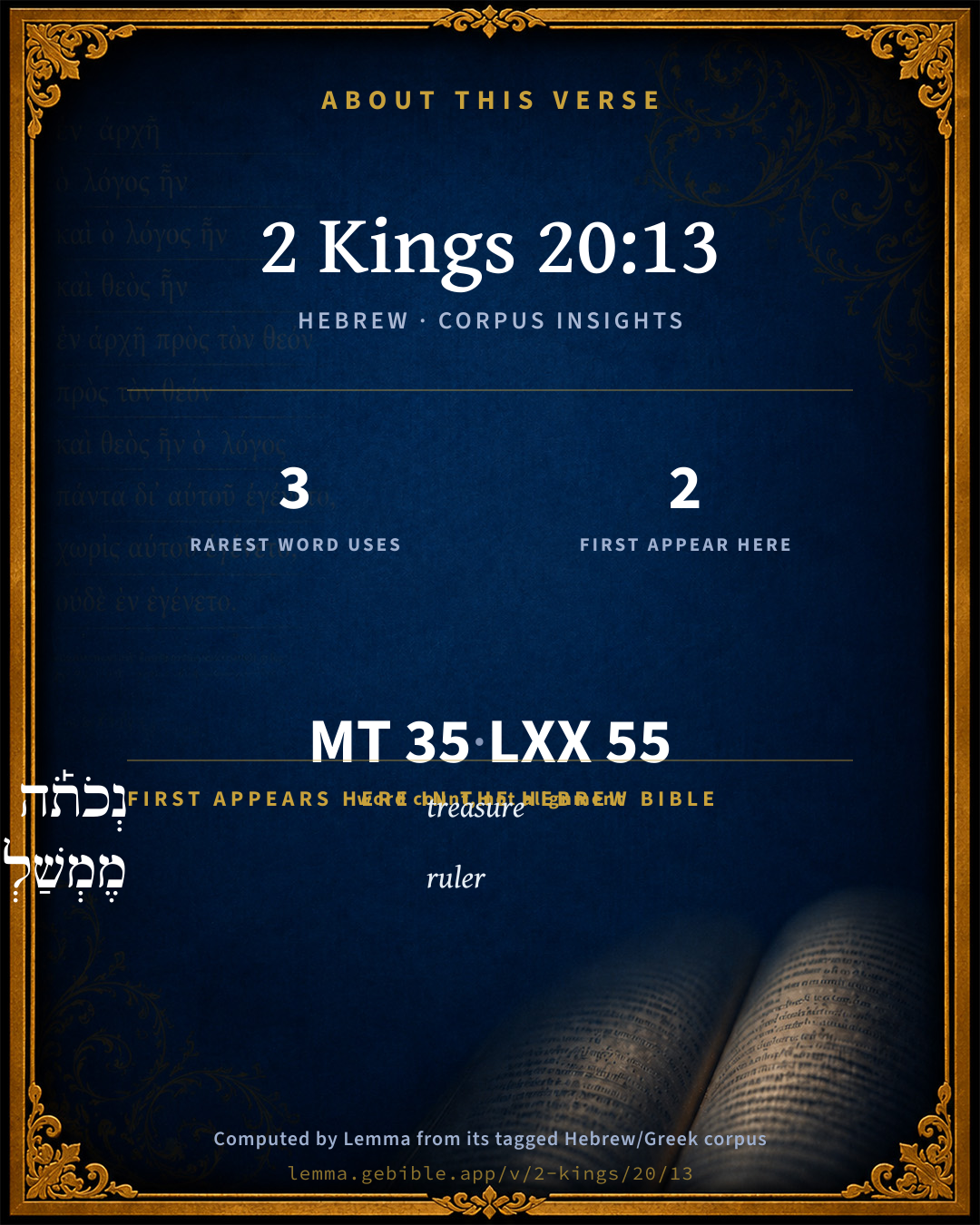
These counts appear in no published source. They are computed here, from the morphology-tagged text and Lemma’s own curated glosses. What Lemma adds →

35
words
21
distinct lemmas
Historical
section

Notable vocabulary

The rarest word here is נְכֹתֹ֡ה treasure H5238 — appearing just 3 times in the whole Hebrew Bible.

First appearance in Scripture

These words make their first canonical appearance in the Hebrew Bible here:

  • נְכֹתֹ֡ה treasure H5238
  • מֶמְשַׁלְתּֽוֹ ruler H4474

Shared distinctive vocabulary

נְכֹתֹ֡ה treasure H5238 occurs in 2 verses of the Hebrew Bible. Also found in:

Grammatical profile

  • 5 verbs
  • 17 nouns
  • 1 adjective
  • 1 preposition
  • 11 particles

Verb forms

  • וַיִּשְׁמַ֣ע Qal · Sequential Imperfect
  • וַיַּרְאֵ֣ם Hiphil · Sequential Imperfect
  • נִמְצָ֖א Niphal · Perfect
  • הָיָ֣ה Qal · Perfect
  • הֶרְאָ֧ם Hiphil · Perfect

Repetition

Words recur within this verse — often emphatic in Hebrew:

  • כָּל all H3605 ×3
  • בֵּ֣ית house H1004 ×3
  • חִזְקִיָּהוּ֒ Hezekiah H2396 ×2
  • וַיַּרְאֵ֣ם to see H7200 ×2
  • אֲשֶׁ֥ר which H834 ×2
  • לֹֽא not H3808 ×2

Hebrew & Septuagint length

In English translation the verse runs 56 words from the Hebrew and 52 from the Septuagint (LXX English) — closely comparable.

A rough comparison of the two English renderings, which tokenize alike — not a word-level alignment.

Word counts can differ between the Hebrew and the Greek without any difference in meaning — e.g. the Hebrew direct-object marker אֵת has no separate Greek word, and Greek often adds the article ὁ.

In the original languages it is 35 Hebrew tokens and 55 Greek tokens — but the two are counted differently (Hebrew bundles its prefixes and suffixes into one token; the Greek is in lemma form), so that isn’t a like-for-like length.

Cross-references

8

Topical passages linked to 2 Kings 20:13 in the Treasury of Scripture Knowledge — connected by theme and wording, ordered by reader-vote popularity; previews shown in the World English Bible.

  • 1 Kings 10:2 She came to Jerusalem with a very great train, with camels that bore spices, and very much gold, and precious stones; and when she was come to Solomon, she talked with him of all that was in her heart.
  • 1 Kings 10:10 She gave the king one hundred twenty talents of gold, and of spices very great store, and precious stones: there came no more such abundance of spices as these which the queen of Sheba gave to king Solomon.
  • 1 Kings 10:15 besides [that which] the traders [brought], and the traffic of the merchants, and of all the kings of the mixed people, and of the governors of the country.
  • 1 Kings 10:25 They brought every man his tribute, vessels of silver, and vessels of gold, and clothing, and armor, and spices, horses, and mules, a rate year by year.
  • 2 Chronicles 32:25–27 But Hezekiah didn't render again according to the benefit done to him; for his heart was lifted up: therefore there was wrath on him, and on Judah and Jerusalem.
  • Proverbs 23:5 Why do you set your eyes on that which is not? For it certainly sprouts wings like an eagle and flies in the sky.
  • Ecclesiastes 7:20 Surely there is not a righteous man on earth, who does good and doesn't sin.
  • Isaiah 39:2 Hezekiah was glad of them, and shown them the house of his precious things, the silver, and the gold, and the spices, and the precious oil, and all the house of his armor, and all that was found in his treasures: there was nothing in his house, nor in all his dominion, that Hezekiah didn't show them.

Cross-references courtesy of OpenBible.info (CC BY 4.0).

Hebrew and Greek witnesses Masoretic Hebrew ↔ Greek Septuagint

The same verse in the two great witnesses to the Old Testament, shown verse-for-verse.

These are two independent witnesses, not word-aligned to each other, and the Septuagint is shown in lemma (dictionary) form.

Hebrew 2 Kings 20:13 Masoretic · Westminster Leningrad Codex

וַיִּשְׁמַ֣ע עֲלֵיהֶם֮ חִזְקִיָּהוּ֒ וַיַּרְאֵ֣ם אֶת כָּל בֵּ֣ית נְכֹתֹ֡ה אֶת הַכֶּסֶף֩ וְאֶת הַזָּהָ֨ב וְאֶת הַבְּשָׂמִ֜ים וְאֵ֣ת שֶׁ֣מֶן הַטּ֗וֹב וְאֵת֙ בֵּ֣ית כֵּלָ֔יו וְאֵ֛ת כָּל אֲשֶׁ֥ר נִמְצָ֖א בְּאֽוֹצְרֹתָ֑יו לֹֽא הָיָ֣ה דָבָ֗ר אֲ֠שֶׁר לֹֽא הֶרְאָ֧ם חִזְקִיָּ֛הוּ בְּבֵית֖וֹ וּבְכָל מֶמְשַׁלְתּֽוֹ

Hezekiah listened to them, and shown them all the house of his precious things, the silver, and the gold, and the spices, and the precious oil, and the house of his armor, and all that was found in his treasures: there was nothing in his house, nor in all his dominion, that Hezekiah didn't show them.

World English Bible · Public Domain

Greek LXX 2 Kings 20:13 Septuagint · lemma form

καί χαίρω ἐπί αὐτός εζεκιας καί δεικνύω αὐτός ὅλος ὁ οἶκος ὁ νεχωθα ὁ ἀργύριον καί ὁ χρυσίον ὁ ἄρωμα καί ὁ ἔλαιον ὁ ἀγαθός καί ὁ οἶκος ὁ σκεῦος καί ὅσος εὑρίσκω ἐν ὁ θησαυρός αὐτός οὐ εἰμί λόγος ὅς οὐ δεικνύω αὐτός εζεκιας ἐν ὁ οἶκος αὐτός καί ἐν πᾶς ὁ ἐξουσία αὐτός

And Ezekias rejoiced at them, and showed all the house of his spices, the silver and the gold, the spices, and the fine oil, and the armory, and all that was found in his treasures: there was nothing which Ezekias did not show them in his house, and in all his dominion.

LXX2012 (modern English Septuagint) · Public Domain

On this verse, Adam Clarke's Commentary discusses the Septuagint’s reading. Read the note in Commentary ↓

Hebrew: Westminster Leningrad Codex (CC BY 4.0). Greek: Septuagint (public domain); English from LXX2012 (modern English Septuagint) (Public Domain). How the Septuagint differs from the Hebrew →

Targum (Aramaic paraphrase)

1

The Targum is the ancient Jewish Aramaic paraphrase of the Hebrew Scriptures — an interpretive translation, not the Hebrew text itself. Onkelos (literal) and Pseudo-Jonathan (expansive) render the Torah, and Jonathan the Prophets. Coverage is partial: where no permissively-licensed English translation exists for a verse, only the Aramaic is shown. This is verse-level text, not a word-by-word alignment to the Hebrew.

  1. Targum Jonathan Prophets (Joshua–Malachi)
    וְקַבֵּל מִנְהוֹן חִזְקִיָה וְאַחֲזִינוּן יַת כָּל בֵּית גִנְזוֹהִי יַת כַּסְפָּא וְיַת דַהֲבָא וְיַת בּוּסְמָנַיָא וְיַת מִשְׁחָא טָבָא וְיַת בֵּית מָנוֹהִי וְיַת כָּל דְאִשְׁתְּכַח בְּגִנְזוֹהִי לָא הֲוָה מִדַעַם דְלָא אַחְזִינוּן חִזְקִיָה בְּבֵיתֵיהּ וּבְכָל שׁוּלְטָנֵיהּ:

    (no public-domain English translation for this verse)

    Targum Jonathan — Aramaic: “Mikraot Gedolot” (public domain). English: “Sefaria Community Translation” (CC0 1.0 (public-domain dedication)); “London "Chaldee Paraphrase," 1871” (public domain). Text via Sefaria.

Commentary

Notes on 2 Kings 20:13 from classic Christian and Jewish commentators (each source and its license shown beneath its notes). The classic Christian expositions comment on the surrounding passage and are grouped to its opening verse, so a note may address several verses; the Jewish commentaries on the Tanakh (Rashi and others) are per-verse, so they appear only where the commentator wrote on this verse.

Lemma curates 59 commentaries, every one of them public domain or Creative Commons licensed, each selected and text-cleaned for this edition rather than reprinted as found. About our sources →

Trapp's Complete Commentary

John Trapp

2Ki 20:13 And Hezekiah hearkened unto them, and shewed them all the house of his precious things, the silver, and the gold, and the spices, and the precious ointment, and [all] the house of his armour, and all that was found in his treasures: there was nothing in his house, nor in all his dominion, that Hezekiah shewed them not.

Ver. 13. And Hezekiah hearkened unto them.] Ad quos intentus, Ezechiah? He was taken and tickled with their company and courtship, gratifying them in that they came about, and proud of the honour they had done him. {2Ch 32:25; 2Ch 32:31} As there be white teeth in the blackest blackamoor, so there is a black bill in the whitest swan - a rotten kernel or two in the fairest pomegranate, &c.

And showed them the house of his precious things.] Superbe simul et stulte. This was proudly and foolishly done; for now gold thirsty Babylon knew where to have her draught, where to fetch a fat and fit booty. By the imperial law {a} of the Romans, the exporting of wine, oil, and other delicious liquors was flatly forbidden, and this reason given, Ne Barbare gustu illecti promptius invaderent fines Romanorum, Lest the barbarians tasting thereof, should be the rather drawn thereby to invade the Roman empire, as the Gauls did when once they had tasted of the grapes that grew in Italy. {b} Of the Chinese it is reported that they suffer not any foreigner to come into the heart of their kingdom, but only to trade with them on the seacoasts. It was doubtless impoliticly done at best by Hezekiah, to show these strangers his wealth and treasure: yea, it was sinfully done of him - had his storehouse been as rich as the earth - to be lifted up with those heavy metals. {c}

The silver and the gold.] Which he had partly by the spoil of Sennacherib’s camp, and partly by the many gifts brought by all nations unto him, as the world’s wonder for the sun’s going backward for his sake.

And the spices.] Galen {d} writeth that in his time cinnamon was very rare and hard to be found, except in the storehouses of great princes.

{a} Leg. l.

{b} Plutarch, in Camillo.

{c} Boter., in Catalog. Imper.

{d} Lib. i. Antidot.

John Trapp, A Commentary or Exposition upon All the Books of the Old and New Testament (1647–1656) — public domain. Text from a community e-Sword module.

Joseph Benson's Commentary

2Ki 20:13. Hezekiah hearkened unto them, &c. — He was so pleased, or rather, transported with joy, at the honour the king of Babylon had done him, that he not only gave his ambassadors a gracious audience, and granted them a league and amity, but ordered his officers to show them all the rarities and precious things which he had in his treasures, with his spices, costly ointments, and the house of his armour — For though his country had been lamentably harassed and plundered by the king of Assyria, and he had endeavoured to appease him with large sums of money and other gifts; yet he had reserved much gold and silver, and many curiosities and valuable things, which he and his fathers had gathered in Jerusalem. Besides, no doubt, he had got considerable spoils out of the Assyrian camp. Also many presents had been sent him since the stroke from heaven on Sennacherib’s army, and his own miraculous recovery from sickness, and the astonishing sign which God had previously given him of it. There was nothing in his house, nor in all his dominion, which Hezekiah showed them not — In this he was influenced by pride of heart and vain ostentation, (2Ch 32:25-26,) being lifted up, it seems, by the great honour God had done him, in working such glorious miracles for his sake, and by the great respect rendered to him by divers princes, and now by this great Babylonian monarch. So hard a matter it is even for a good man to be high and humble. Although no particular mention is made of Hezekiah’s showing these strangers the temple, yet, as it was by far the most sumptuous and splendid building in Jerusalem, and the greatest curiosity in his dominions, there can be no doubt but it was shown them, as far as it was permitted to heathen, who were not proselytes to the Jewish religion, to see it; but whether he took any pains to make them acquainted with the great Being who was worshipped there, and who, by his almighty power, had wrought the miracles which had excited their attention, or with his laws, and the ordinances of his service, may well be doubted. Although, certainly, he had a very fair opportunity of doing this, and of demonstrating to them the unreasonableness and folly of idolatry in all its branches, and especially of their worship of the sun, which the late miracle had shown to be no more than the creature and servant of the God of Israel.

Joseph Benson's Commentary on the Old and New Testaments (1811–1818) — public domain. Text from a community e-Sword module.

Geneva Bible (1599)

Geneva Bible translators

Being moved with ambition and vain glory, and also because he seemed to rejoice in the friendship of him that was God’s enemy and an infidel.

Geneva Bible (1599) marginal notes — public domain. Text via Bolls.life.

Jamieson, Fausset & Brown

Robert Jamieson, A. R. Fausset & David Brown

the silver, and the gold--He paid so much tribute to Sennacherib as exhausted his treasury (compare Kg2 18:16). But, after the destruction of Sennacherib, presents were brought him from various quarters, out of respect to a king who, by his faith and prayer, saved his country; and besides, it is by no means improbable that from the corpses in the Assyrian camp, all the gold and silver he had paid might be recovered. The vain display, however, was offensive to his divine liege lord, who sent Isaiah to reprove him. The answer he gave the prophet (Kg2 22:14) shows how he was elated by the compliment of their visit; but it was wrong, as presenting a bait for the cupidity of these rapacious foreigners, who, at no distant period, would return and pillage his country, and transfer all the possessions he ostentatiously displayed to Babylon, as well as his posterity to be court attendants in that country--(see on Ch2 32:31).

Jamieson, Fausset & Brown — Commentary Critical and Explanatory on the Whole Bible (1871) — public domain (CC PDM 1.0). Text via the HelloAO Bible API.

Adam Clarke's Commentary

Verse 13. Hezekiah hearkened unto them] Instead of וישמע vaiyishma, he hearkened, וישמח vaiyismach, he rejoiced or was glad, is the reading of twelve of Kennicott's and De Rossi's MSS., the parallel place, Isa 39:2, the Septuagint, Syriac, Vulgate, Arabic, some copies of the Targum, and the Babylonian Talmud.

All the house of his precious things] Interpreters are not well agreed about the meaning of the original נכתה nechothoh, which we here translate precious things, and in the margin spicery or jewels. I suppose the last to be meant.

There was nothing in his house] He showed them through a spirit of folly and exultation, all his treasures, and no doubt those in the house of the Lord. And it is said, 2Ch 32:31, that in this business God left him to try him, that he might know all that was in his heart; and this trial proved that in his heart there was little else than pride and folly.

Adam Clarke's Commentary on the Bible (1810–1826) — public domain. Text from a community e-Sword/MySword module.

Ellicott's Commentary for English Readers

(13) Hearkened unto.—A scribe’s error for “was glad of them” (Isaiah, and many MSS. and the versions here).

The silver, and the gold.—This, as well as the phrase in 2Ki_20:17, “that which thy fathers have laid up,” appears to contradict 2Ki_18:15-16. Schrader regards this as an indication that Hezekiah’s illness and the embassy of Merodach-baladan belong to the time preceding Sennacherib’s invasion. Thenius, however, supposes that Hezekiah simply gave all the money in his treasury to Sennacherib’s envoys, and stripped off the gold plating of the Temple before them that they might suppose his resources exhausted, when, in fact, he had not touched his real treasures, which were concealed in subterranean chambers. Thenius also refers to the “credible” statement of the chronicler, that presents were made to Hezekiah from all quarters after the retreat of Sennacherib (2Ch_32:23). Professor Robertson Smith agrees with Schrader in referring the embassy of Merodach-baladan to the years 704-703 B.C.

The precious ointment.—The fine oil (Cheyne). Perfumed oil used for anointing.

All that was found in his treasures.—See 2Ch_32:27-28. Storehouses beyond the precincts of the palace, and beyond Jerusalem. (Comp. the phrase “in all his dominion,” which alludes to the resources of Hezekiah in the country, statistics of which he might show to the envoys.)

A Bible Commentary for English Readers, edited by Charles John Ellicott (1878–1897) — public domain. Text from a community e-Sword module.

The Cambridge Bible for Schools and Colleges

gen. ed. J. J. S. Perowne

13. And Hezekiah hearkened unto them] In Isaiah we read he ‘was glad of them’, and there is no doubt that is the correct reading. The LXX. gives ἐχάρη, he rejoiced, in this passage. The difference in the Hebrew words is very slight. Here we have ישמצ, in Isaiah ישמח.

and shewed them all the house of his precious things] On the margin both A.V. and R.V. give ‘spicery’ instead of ‘precious things’; and the word (with a very slight difference of form) is used in that sense in Gen_37:25; Gen_43:11. But here as the house seems to have contained the various things which follow after, silver and gold as well as spices, perhaps the more general rendering is to be preferred. The storehouse which at first had its name from the aromatic treasures bestowed there, came in time to be used, without change of name, for the keeping of other things that were valuable.

precious ointment] R.V. oil. This is the more usual rendering. The stores would be of pure oil more likely than of manufactured ointment.

and all the house of his armour] R.V. omits ‘all’, which is not in the Hebrew text here, though it is in Isaiah. Hence the Massoretes have put it as a various reading on the margin of this verse.

The house of armour was no doubt ‘the house of the forest of Lebanon’, which Solomon built as an armoury, see notes on 1Ki_7:2; 1Ki_10:17.

nothing … that Hezekiah shewed them not] He was clearly desirous to produce an impression of his wealth and consequent power. This proud spirit the Chronicler (2Ch_32:25) describes thus, ‘Hezekiah rendered not again according to the benefit done unto him: for his heart was lifted up: therefore there was wrath upon him and upon Judah and Jerusalem’.

The Cambridge Bible for Schools and Colleges (gen. ed. J. J. S. Perowne; Cambridge University Press, 1878–1918) — public domain. Text from a community e-Sword module.

Albert Barnes' Notes on the Bible

Hezekiah hearkened unto them, and shewed them - The Jewish king lent a favorable ear to the proposals of the ambassadors, and exhibited to them the resources which he possessed, in order to induce them to report well of him to their master.

All the house of his precious things - literally, the “spice-house;” the phrase had acquired the more generic sense of “treasure-house” from the fact that the gold, the silver, and the spices were all stored together.

Albert Barnes' Notes on the Bible (1834–1885) — public domain. Text from a community e-Sword/MySword module.

Haydock's Catholic Bible Commentary

Rejoiced, at being honoured by so great a prince, (Menochius) who afterwards defeated Asarhaddon. (Tirinus) --- Hebrew, "hearkened unto them." But the sense of the Vulgate is preferable, and the construction of the original seems to require it, as it is also understood by the Septuagint and Syriac, and by Isaias xxxix. 2. --- Spices. Hebrew, "precious things," (Montanus) "treasures," (Chaldean; Syriac) "cabinet" of jewels, &c. (Vatable) --- Vessels, or armour, and all this fine furniture. St. Jerome says, that Ezechias also displayed before them the treasures of the temple, which chiefly drew upon him God’s displeasure. (Calmet) --- He might be guilty only of a venial sin of vanity and of ingratitude: (Menochius) and God took occasion, from this offence to admonish the king of the impending ruin. (Du Hamel)

George Leo Haydock (1774–1849), Haydock's Catholic Family Bible and Commentary, 1859 edition — public domain. Excludes Psalms (Douay-Rheims chapter numbering differs from Protestant) and Deuterocanonical books (Catholic canon only).

Matthew Poole's English Annotations

Hearkened unto them, i.e. granted their desires of a league and amity with them.

The silver and the gold, & c.; for though his country had lately been harassed by the Assyrians, yet he had reserved all his treasures and precious things which he and his fathers had gathered in Jerusalem. Besides, he had considerable spoils out of the Assyrian camp. Also he had many presents sent to him, 2Ch 32:23, which doubtless were things of considerable worth.

Nothing in his house, nor in all his dominion, that Hezekiah showed them not; which he did through vain ostentation and pride of heart, 2Ch 32:25,26, being lifted up by the great honour which God had done him, in working such glorious miracles for his sake, and by the great respects and presents rendered to him from divers princes and people, and now by this great Babylonian monarch. So hard a matter is it even for a good man to be high and humble.

Matthew Poole's English Annotations on the Holy Bible (1683–1685) — public domain. Text from a community e-Sword/MySword module.

Whedon's Commentary on the Bible

Daniel D. Whedon

13. Hezekiah hearkened unto them — Many manuscripts and versions here read, was glad of them, or rejoiced over them, (ישׂמח עליהם,) as in Isa_39:2; but this is no sufficient proof that our text is corrupt. שׁמעis, indeed, seldom construed with על, but examples are to be found in chapter 2Ki_22:13, and Gen_41:15. The king hearkened unto the proposal to form an alliance with Merodach-baladan; and to convince them that he was not so feeble and destitute of resources as the king of Assyria might pretend, he showed them his treasures.

House of his precious things — Better, as the margin, house of spicery, or spice house. So the word is rendered at Gen_37:25. Spices were regarded as very precious things.

The spices — Rather, the aromatics, or perfumes; all sorts of fragrant plants or spices which create a pleasant smell.

The precious ointment — “Not fine olive-oil,” says Keil, “but, according to the rabbies and Movers, the valuable balsam oil which was obtained in the royal gardens; for olive oil, which was obtained in all Judea, was not stored in the treasure-chambers along with the gold, silver, and perfumes, but in special storehouses.” 1Ch_27:28.

House of his armour — The armory, or arsenal.

In all his dominion — He made known to them the whole extent of his resources, whether of wealth, luxuries, or power.

Those expositors who understand this embassy to have visited Hezekiah after the Assyrian invasion, and after Sennacherib had taken away all the silver of the temple and the palace, (2Ki_18:15,) are put to it to account for all those treasures of gold and silver and precious things yet in possession of the Jewish king. They argue that Sennacherib took only silver and gold, not spices or arms, and that Hezekiah preferred to strip the doors and pillars of the temple for gold and silver, rather than give up that which was concealed in his treasuries. They also suppose that the treasury of Jerusalem had been replenished by the gifts mentioned in 2Ch_32:23. But if, as we have assumed, (2Ki_20:12, note,) this embassy came before Hezekiah had given all his silver and gold to Sennacherib, this accumulation of treasure is the more easily accounted for.

Daniel D. Whedon (gen. ed.), Commentary on the Old and New Testaments (1874–1909) — public domain. Text from a community e-Sword module.

The Pulpit Commentary

And Hezekiah hearkened unto them. Hezekiah was dazzled by the prospect that opened upon him. It was a grand thing that his fame should have reached so far as Babylon, a still grander thing to be offered such an alliance. It must be remembered that he and his counselors were inclined from the first to meet Assyrian menace by calling in foreign aid (2Ki_18:21-24; Isa_20:6 Isa_30:2-7 Isa_36:6) He had not yet accepted the view of Isaiah, that human aid was vain, and that the only reasonable ground of hope or confidence was, in Jehovah. And showed them all the house of his precious things; i.e. his treasury. Hezekiah did not do this in mere ostentation, though he may have had a certain pride in exhibiting his wealth. His main wish, no doubt, was to make known his resources, and show that he was a valuable ally. So Oroetes acted towards Polycrates (Herod., 3:123), and Hannibal towards the Gortynians (Com. Nep., "Vit. Hannib.," It is to be borne in mind that Hezekiah"s treasures were, in B.C. 712, still intact, and included all that ample store which he sacrificed to save Jerusalem at the time of the first expedition of Sennacherib see 2Ki_18:14-16, and comp. "Eponym Canon," p. 135, where we find enumerated among the treasures given up, besides gold and silver, "precious carbuncles, couches of ivory, elevated thrones of ivory, skins of buffaloes, horns of buffaloes, and weapons"). The silver, and the gold, and the spices. Compare the description of the wealth of Solomon. (1Ki_10:25) "Spices" always form an important portion of the treasure of Oriental kings (comp. Herod., 2. 97, sub fin.). And the precious ointment; rather, the precious oil mc, not jqro (compare the Septuagint, to elaion ton). It is thought (Keil, Bahr) that the valuable balsam oil, which was obtained from the royal gardens, is intended. And all the house of his armor; or, of his vessels; but arms and armor are probably intended. It would be almost as important to show that he had abundant arms in store, as that he had abundant riches. And all that was found in his treasures a clause implying that there was much more which had not been specified, as precious stones, ivory, ebony, and the likethere was nothing in his house, nor in all his dominion, that Hezekiah showed them not. This is a manifest hyperbole; but it can scarcely mean less than that he gave orders for them to be shown the collections of arms and stores which existed in his other strongholds besides Jerusalem. Hezekiah, no doubt, had many store cities," as Solomon (2Ch_8:6) and Rehoboam (2Ch_11:5-12) had.

The Pulpit Commentary (1880–1919), ed. H.D.M. Spence-Jones & Joseph S. Exell — public domain. Text from a community e-Sword module.

John Wesley's Explanatory Notes

His treasures - For though his country had lately been harassed by the Assyrians, yet he had reserved all his treasures and precious things, which he and his fathers had gathered in Jerusalem. Besides, he had considerable spoils out of the Assyrian camp. Also he had many presents sent to him, 2 Chron. xxxii, 23. Shewed - Which he did through pride of heart, 2 Chron. xxxii, 25, 26, being lifted up by the great honour which God had done him, in working such glorious miracles for his sake, and by the great respects rendered to him from divers princes, and now by this great Babylonian monarch. So hard a matter is it even for a good man to be high and humble.

John Wesley, Explanatory Notes Upon the Whole Bible (1754–1765) — public domain. Text via the GEBible commentary corpus.

Rashi

Rabbi Shlomo Yitzchaki (Rashi)

His treasure house. The storehouse of his spices, as in, “spices [=נכאת], balm, and lotus.”

The fine oil. Some interpret this as the anointment oil, and others interpret it as balsam oil, which is found in Eretz Yisroel, as it is said, ”Yehudah and [Eretz] Yisroel, they were your merchants, with wheat of מנית and פנג,” and I saw in the book of Yosephun, that פנג is balsam, and it grows in Yericho, and because of its aroma [=ריח], it is called Yericho [=יריחו].

There was nothing. [He even showed them] the Ark, the Luchos, and the Torah Scroll.

Rashi on the Tanakh — English translations: “The Judaica Press complete Tanach with Rashi, translated by A. J. Rosenberg” (CC BY 4.0); “Pentateuch with Rashi's commentary by M. Rosenbaum and A.M. Silbermann, 1929-1934” (public domain); “The Metsudah Tanach series, Lakewood, N.J” (CC BY 4.0); and “The Book of Joshua, Metsudah Publications, 1997” (CC BY 4.0). Text via Sefaria.

Lesson kit

Teaching starters — assembled from the data on this page, not authored interpretation. Every prompt links to the verse data it draws on. Edit before teaching.

2 Kings, in the Historical, opens this verse with 35 words (21 distinct Hebrew lemmas). Its most distinctive word is nᵉkôth (“treasure”). A historical commentator’s framing appears above. Read the whole chapter for the surrounding context.

Discussion questions

  1. How does “treasure” (nᵉkôth) shape what this verse is saying?
  2. 2 words here appear for the first time in Scripture. What is being introduced at this debut?
  3. Isaiah 39:2 shares the word «treasure» with this verse. How do the two illuminate each other?
  4. “all” occurs 3× in this one verse. What is the effect of the repetition?
  5. The translations on this page render this verse differently — a whole-verse word diff, not a word-by-word alignment. What might account for the different wordings?
  6. The verb «וַיִּשְׁמַ֣ע» is Qal Sequential Imperfect. How does its form color the action?
  7. Reading how Trapp's Complete Commentary and Joseph Benson's Commentary read this verse, where do the two commentators agree and where do they part?

Things to notice

Reading settings

Reading text

Shown beneath each verse's original-language words.

Old Testament
Old Testament edition

Read the OT as the Masoretic Hebrew (MT) or the Greek Septuagint (LXX).

English shown for the Greek Septuagint (in the Hebrew ↔ Greek comparison).

Comparing translations? Open the Compare panel on any verse page to stack up to four side by side.