
2 Chronicles 36:18

Hebrew (Westminster Leningrad Codex) 2 Chronicles 36:18 appears in the Hebrew Old Testament. The text above is from the Westminster Leningrad Codex. Each word links to its Strong’s number, a concise gloss, and parsing drawn from the Open Scriptures Hebrew Bible morphology. Click any word for its full Brown-Driver-Briggs (BDB) entry.
Download image
Cite this verse

2 Chronicles 36:18 (World English Bible). Public Domain. Lemma interlinear Bible study tool, https://lemma.gebible.app/v/2-chronicles/36/18.

Show BibTeX & RIS
BibTeX
RIS
English Translation
All the vessels of the house of God, great and small, and the treasures of the house of Yahweh, and the treasures of the king, and of his princes, all these he brought to Babylon.
World English Bible · Public Domain
Download a study sheet

One document with this verse’s original text, its word-by-word gloss line, the meaning frame, cross-references with their text, attributed commentary, and full source and license credits — printable, and it pastes into notes with its structure intact.

This verse Autodidact and up

Study sheet (.html) Plain text (.txt)

A passage Seminary Student

Up to 50 verses in one chapter. A passage sheet keeps up to 6 commentary sources and 12 cross-references per verse, in the order this page ranks them, and says so on the sheet whenever that leaves anything out. Ask for a single verse and you get the Autodidact verse sheet above.

Everything on this page stays free to read, with no account — the sheet is a download of what is already on screen, not access to it.

Want to remove ads? Support Godless Engineer
Compare translations 3

The same verse in 3 English versions, stacked beneath the original-language interlinear above. Click any original word for its lexicon entry.

Each is an independent rendering of the whole verse — the interlinear is not word-aligned to these translations.

Highlighted words mark where these versions differ — a whole-verse word diff, not a word-by-word alignment.

  • World English Bible Public Domain
    All the vessels of the house of God, great and small, and the treasures of the house of Yahweh, and the treasures of the king, and of his princes, all these he brought to Babylon.
  • King James Version Public Domain
    And all the vessels of the house of God, great and small, and the treasures of the house of the LORD, and the treasures of the king, and of his princes; all these he brought to Babylon.
  • unfoldingWord Literal Text CC BY-SA 4.0
    All the items of the house of God, great things and small things, and the treasures of the house of Yahweh, and the treasures of the king and his chiefs—the entirety he brought to Babylon.

unfoldingWord Literal Text — © unfoldingWord, licensed CC BY-SA 4.0. Word-aligned USFM3 via Door43 (git.door43.org/unfoldingWord/en_ult).

Versions to compare (up to 4)

3 of 4 selected

Show all 18 translations

Every available English version of this verse, each an independent rendering of the whole verse.

  • World English Bible Public Domain
    All the vessels of the house of God, great and small, and the treasures of the house of Yahweh, and the treasures of the king, and of his princes, all these he brought to Babylon.
  • Berean Standard Bible Public Domain
    who carried off everything to Babylon—all the articles of the house of God, both large and small, and the treasures of the house of the LORD and of the king and his officials.
  • Majority Standard Bible Public Domain
    who carried off everything to Babylon—all the articles of the house of God, both large and small, and the treasures of the house of the LORD and of the king and his officials.
  • King James Version Public Domain
    And all the vessels of the house of God, great and small, and the treasures of the house of the LORD, and the treasures of the king, and of his princes; all these he brought to Babylon.
  • American Standard Version (1901) Public Domain
    And all the vessels of the house of God, great and small, and the treasures of the house of Jehovah, and the treasures of the king, and of his princes, all these he brought to Babylon.
  • Revised Version (1885) Public Domain
    And all the vessels of the house of God, great and small, and the treasures of the house of the LORD, and the treasures of the king, and of his princes; all these he brought to Babylon.
  • Geneva Bible (1599) Public Domain
    And all the vessels of the house of God great and small, and the treasures of the house of the Lord, and the treasures of the King, and of his princes: all these caryed he to Babel.
  • Douay-Rheims (1899) Public Domain
    And all the vessels of the house of the Lord, great and small, and the treasures of the temple and of the king, and of the princes he carried away to Babylon.
  • Young's Literal Translation Public Domain
    And all the vessels of the house of God, the great and the small, and the treasures of the house of Jehovah, and the treasures of the king and of his princes -- the whole he hath brought in to Babylon.
  • Literal Standard Version CC BY-SA 4.0
    And all the vessels of the house of God, the great and the small, and the treasures of the house of YHWH, and the treasures of the king and of his princes—he has brought the whole to Babylon.
  • Unlocked Literal Bible CC BY-SA 4.0
    All the furnishings of the house of God, great and small, the treasures of the house of Yahweh, and the treasures of the king and his officials—all these he took to Babylon.
  • unfoldingWord Literal Text CC BY-SA 4.0
    All the items of the house of God, great things and small things, and the treasures of the house of Yahweh, and the treasures of the king and his chiefs—the entirety he brought to Babylon.
  • Darby Bible Public Domain
    And all the vessels of the house of God, great and small, and the treasures of the house of Jehovah, and the treasures of the king and of his princes, he brought all to Babylon.
  • World Messianic Bible Public Domain
    All the vessels of God’s house, great and small, and the treasures of the LORD’s house, and the treasures of the king and of his princes, all these he brought to Babylon.
  • Webster's Bible Public Domain
    And all the vessels of the house of God, great and small, and the treasures of the house of the LORD, and the treasures of the king, and of his princes; all these he brought to Babylon.
  • Free Bible Version CC BY-SA 4.0
    He took back to Babylon all the articles, large and small, from God's Temple, and from the Temple treasury, and from the king and from his officials.
  • Bible in Basic English Public Domain
    And all the vessels of the house of God, great and small, and the stored wealth of the Lord's house and the wealth of the king and his chiefs, he took away to Babylon.
  • JPS Tanakh (1917) Public Domain
    And all the vessels of the house of God, great and small, and the treasures of the house of the LORD, and the treasures of the king, and of his princes; all these he brought to Babylon.

Literal Standard Version (2020), Covenant Press — licensed CC BY-SA 4.0. Text via the HelloAO Bible API (eBible.org). Unlocked Literal Bible (unfoldingWord) — licensed CC BY-SA 4.0. Text via the HelloAO Bible API (eBible.org). unfoldingWord Literal Text — © unfoldingWord, licensed CC BY-SA 4.0. Word-aligned USFM3 via Door43 (git.door43.org/unfoldingWord/en_ult). Free Bible Version, Dr. Jonathan Gallagher — licensed CC BY-SA 4.0. Text via the HelloAO Bible API (eBible.org).

Word by word

More ways to search: Search by grammar → Find every occurrence → Compare this word →

Practice this passage: Drill this verse → Learn its vocabulary →

וְאֹֽצְרוֹת֙
ʼôwtsâr
H214
“and · storehouses of”
Conjunction + Noun, Common, Masculine, Plural, Construct
Part of Speech
Conjunction + Noun
Type
Common
Gender
Masculine
Number
Plural
State
Construct
Full BDB Definition

Origin: from H686

TWOT: 154a

treasure, storehouse - treasure (gold, silver, etc) - store, supplies of food or drink - treasure-house, treasury - treasure-house - storehouse, magazine - treasury - magazine of weapons (figuratively of God's armoury) - storehouses (of God for rain, snow, hail, wind, sea)
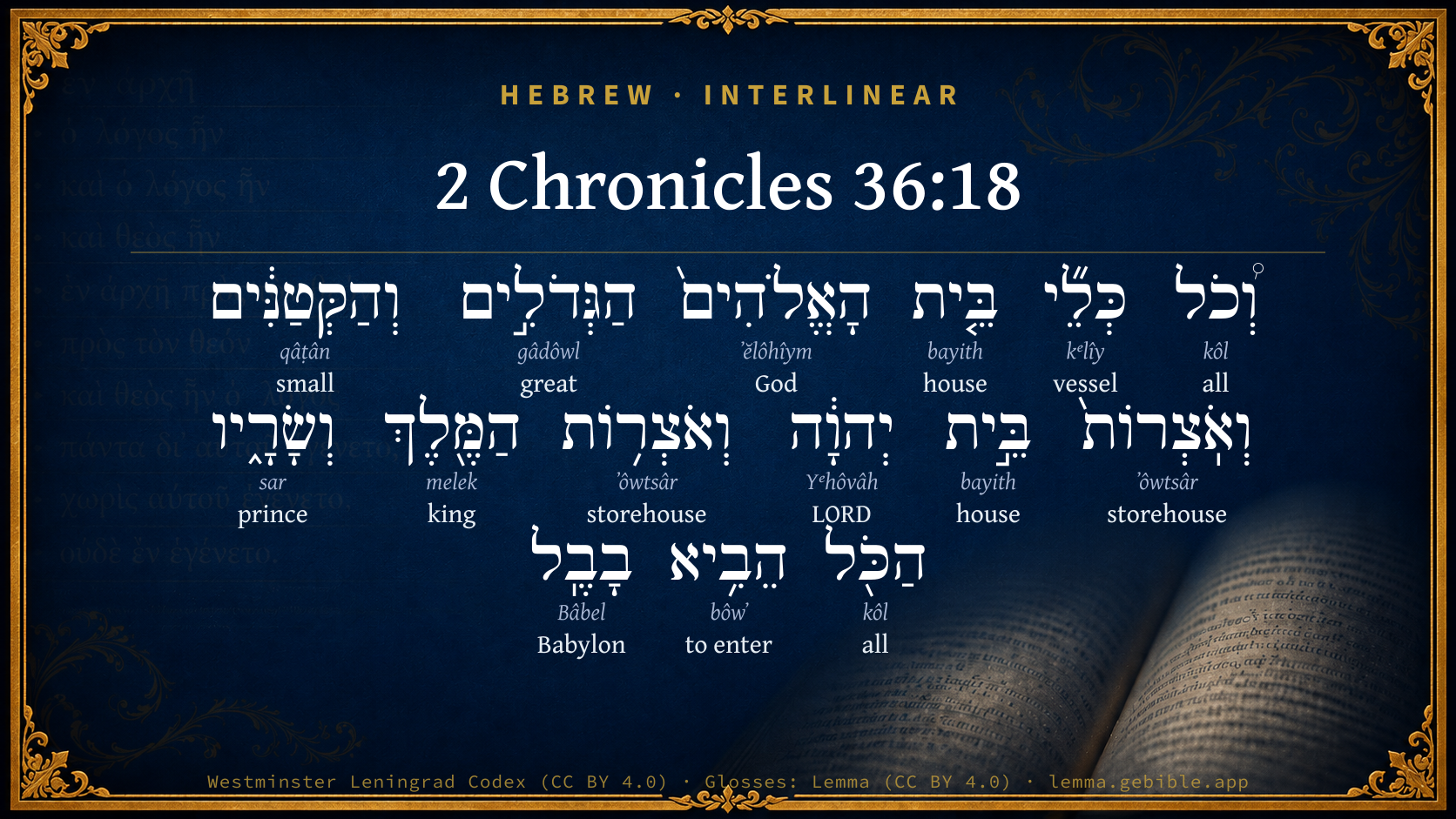
  1. וְ֠כֹל kôl H3605 “and · all of” Conjunction + Noun, Common, Masculine, Singular, Construct
  2. כְּלֵ֞י kᵉlîy H3627 “vessels of” Noun, Common, Masculine, Plural, Construct
  3. בֵּ֤ית bayith H1004 “house of” Noun, Common, Masculine, Singular, Construct
  4. הָאֱלֹהִים֙ ʼĕlôhîym H430 “the · God(s)” Particle, Definite Article + Noun, Common, Masculine, Plural, Absolute
  5. הַגְּדֹלִ֣ים gâdôwl H1419 “the · great” Particle, Definite Article + Adjective, Adjective, Masculine, Plural, Absolute
  6. וְהַקְּטַנִּ֔ים qâṭân H6996 “and · the · small” Conjunction + Particle, Definite Article + Adjective, Adjective, Masculine, Plural, Absolute
  7. בֵּ֣ית bayith H1004 “house of” Noun, Common, Masculine, Singular, Construct
  8. יְהוָ֔ה Yᵉhôvâh H3068 “LORD” Noun, Proper
  9. וְאֹצְר֥וֹת ʼôwtsâr H214 “and · storehouses of” Conjunction + Noun, Common, Masculine, Plural, Construct
  10. הַמֶּ֖לֶךְ melek H4428 “the · king” Particle, Definite Article + Noun, Common, Masculine, Singular, Absolute
  11. וְשָׂרָ֑יו sar H8269 “and · princes · his” Conjunction + Noun, Common, Masculine, Plural, Construct + Suffix, Personal, 3rd Person, Masculine, Singular
  12. הַכֹּ֖ל kôl H3605 “the · all” Particle, Definite Article + Noun, Common, Masculine, Singular, Absolute
  13. הֵבִ֥יא bôwʼ H935 “to enter” Verb, Hiphil, Perfect, 3rd Person, Masculine, Singular
  14. בָבֶֽל Bâbel H894 “Babylon” Noun, Proper

About this verse

These counts appear in no published source. They are computed here, from the morphology-tagged text and Lemma’s own curated glosses. What Lemma adds →

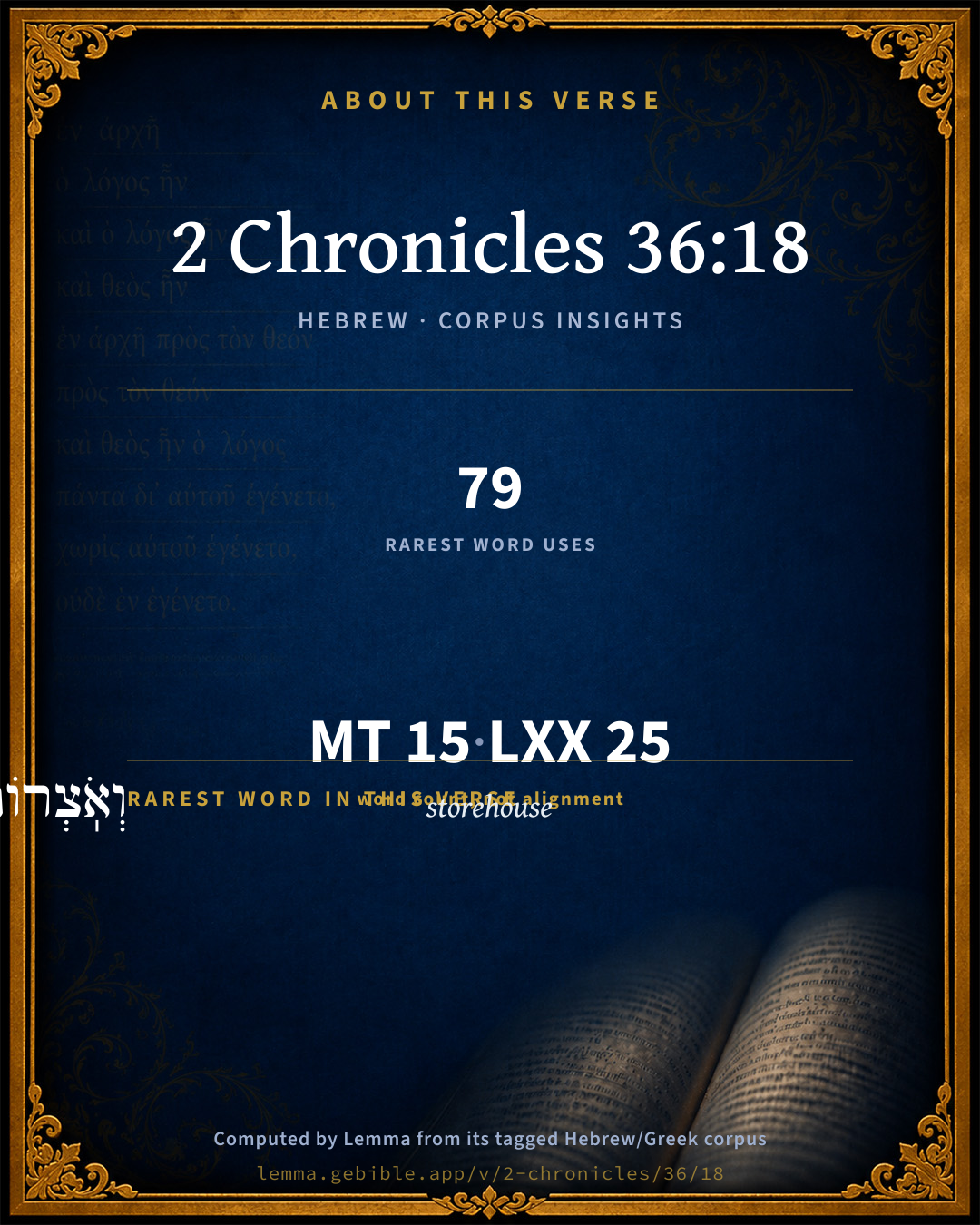
15
words
12
distinct lemmas
Historical
section

Grammatical profile

  • 1 verb
  • 12 nouns
  • 2 adjectives

Verb forms

  • הֵבִ֥יא Hiphil · Perfect

Repetition

Words recur within this verse — often emphatic in Hebrew:

  • וְ֠כֹל all H3605 ×2
  • בֵּ֤ית house H1004 ×2
  • וְאֹֽצְרוֹת֙ storehouse H214 ×2

Hebrew & Septuagint length

In English translation the verse runs 35 words from the Hebrew and 39 from the Septuagint (LXX English) — closely comparable.

A rough comparison of the two English renderings, which tokenize alike — not a word-level alignment.

Word counts can differ between the Hebrew and the Greek without any difference in meaning — e.g. the Hebrew direct-object marker אֵת has no separate Greek word, and Greek often adds the article ὁ.

In the original languages it is 15 Hebrew tokens and 25 Greek tokens — but the two are counted differently (Hebrew bundles its prefixes and suffixes into one token; the Greek is in lemma form), so that isn’t a like-for-like length.

Cross-references

9

Topical passages linked to 2 Chronicles 36:18 in the Treasury of Scripture Knowledge — connected by theme and wording, ordered by reader-vote popularity; previews shown in the World English Bible.

  • 2 Chronicles 36:7 Nebuchadnezzar also carried of the vessels of the house of Yahweh to Babylon, and put them in his temple at Babylon.
  • 2 Chronicles 36:10 At the return of the year king Nebuchadnezzar sent, and brought him to Babylon, with the goodly vessels of the house of Yahweh, and made Zedekiah his brother king over Judah and Jerusalem.
  • 2 Kings 20:13–17 Hezekiah listened to them, and shown them all the house of his precious things, the silver, and the gold, and the spices, and the precious oil, and the house of his armor, and all that was found in his treasures: there was nothing in his house, nor in all his dominion, that Hezekiah didn't show them.
  • 2 Kings 25:13–17 The pillars of brass that were in the house of Yahweh, and the bases and the brazen sea that were in the house of Yahweh, did the Chaldeans break in pieces, and carried the brass of them to Babylon.
  • Isaiah 39:6 Behold, the days are coming, when all that is in your house, and that which your fathers have laid up in store until this day, shall be carried to Babylon: nothing shall be left, says Yahweh.
  • Jeremiah 27:18–22 But if they be prophets, and if the word of Yahweh be with them, let them now make intercession to Yahweh of Hosts, that the vessels which are left in the house of Yahweh, and in the house of the king of Judah, and at Jerusalem, don't go to Babylon.
  • Jeremiah 52:17–23 The pillars of brass that were in the house of Yahweh, and the bases and the brazen sea that were in the house of Yahweh, did the Chaldeans break in pieces, and carried all the brass of them to Babylon.
  • Daniel 5:3 Then they brought the golden vessels that were taken out of the temple of the house of God which was at Jerusalem; and the king and his lords, his wives and his concubines, drank from them.
  • Zechariah 1:6 But my words and my decrees, which I commanded my servants the prophets, didn't they overtake your fathers? "Then they repented and said, 'Just as Yahweh of Hosts determined to do to us, according to our ways, and according to our practices, so he has dealt with us.'"

Cross-references courtesy of OpenBible.info (CC BY 4.0).

Hebrew and Greek witnesses Masoretic Hebrew ↔ Greek Septuagint

The same verse in the two great witnesses to the Old Testament, shown verse-for-verse.

These are two independent witnesses, not word-aligned to each other, and the Septuagint is shown in lemma (dictionary) form.

Hebrew 2 Chronicles 36:18 Masoretic · Westminster Leningrad Codex

וְ֠כֹל כְּלֵ֞י בֵּ֤ית הָאֱלֹהִים֙ הַגְּדֹלִ֣ים וְהַקְּטַנִּ֔ים וְאֹֽצְרוֹת֙ בֵּ֣ית יְהוָ֔ה וְאֹצְר֥וֹת הַמֶּ֖לֶךְ וְשָׂרָ֑יו הַכֹּ֖ל הֵבִ֥יא בָבֶֽל

All the vessels of the house of God, great and small, and the treasures of the house of Yahweh, and the treasures of the king, and of his princes, all these he brought to Babylon.

World English Bible · Public Domain

Greek LXX 2 Chronicles 36:18 Septuagint · lemma form

καί πᾶς ὁ σκεῦος οἶκος θεός ὁ μέγας καί ὁ μικρός καί ὁ θησαυρός καί πᾶς ὁ θησαυρός βασιλεύς καί μεγιστάν πᾶς εἰςφέρω εἰς βαβυλών

And all the vessels of the house of God, the great and the small, and the treasures of the house of the Lord, and all the treasures of the king and the great men; he brought all to Babylon.

LXX2012 (modern English Septuagint) · Public Domain

Hebrew: Westminster Leningrad Codex (CC BY 4.0). Greek: Septuagint (public domain); English from LXX2012 (modern English Septuagint) (Public Domain). How the Septuagint differs from the Hebrew →

Commentary

Notes on 2 Chronicles 36:18 from classic Christian and Jewish commentators (each source and its license shown beneath its notes). The classic Christian expositions comment on the surrounding passage and are grouped to its opening verse, so a note may address several verses; the Jewish commentaries on the Tanakh (Rashi and others) are per-verse, so they appear only where the commentator wrote on this verse.

Lemma curates 59 commentaries, every one of them public domain or Creative Commons licensed, each selected and text-cleaned for this edition rather than reprinted as found. About our sources →

Trapp's Complete Commentary

John Trapp

2Ch 36:18 And all the vessels of the house of God, great and small, and the treasures of the house of the LORD, and the treasures of the king, and of his princes; all [these] he brought to Babylon.

Ver. 18. And all the vessels of the house of God.] See 2Ki 24:13-15.

John Trapp, A Commentary or Exposition upon All the Books of the Old and New Testament (1647–1656) — public domain. Text from a community e-Sword module.

Joseph Benson's Commentary

2Ch 36:18. And the treasures of the king, and of his princes — The treasures of the temple, by a special providence of God, were preserved, and restored, in the reign of Cyrus, to the house of the Lord: but the other, it is likely, were looked upon as spoil, and spent by the king and his great men.

Joseph Benson's Commentary on the Old and New Testaments (1811–1818) — public domain. Text from a community e-Sword module.

Ellicott's Commentary for English Readers

(18) All the vessels . . . (the) great and (the) small.—See 2Ki_25:13-17, for an inventory of the articles; also Jer_27:19 seq.

A Bible Commentary for English Readers, edited by Charles John Ellicott (1878–1897) — public domain. Text from a community e-Sword module.

The Cambridge Bible for Schools and Colleges

gen. ed. J. J. S. Perowne

18. all the vessels] i.e. all the vessels which remained after the previous spoliation (2Ch_36:10). They were perhaps chiefly of brass; cp. 2Ki_25:13-15.

The Cambridge Bible for Schools and Colleges (gen. ed. J. J. S. Perowne; Cambridge University Press, 1878–1918) — public domain. Text from a community e-Sword module.

John Gill's Exposition

And they burnt the house of the Lord,.... The temple; of which, and what follows in this verse; see Gill on Jer 52:13; see Gill on Jer 52:14.

.

2 Chronicles 36:20

ch2 36:20

ch2 36:20

ch2 36:20And them that had escaped from the sword carried he away captive,.... The king of Babylon, or his general by his orders, excepting some poor persons left to till the land, see Jer 52:15,

where they were servants to him and his sons; his son Evilmerodach, and his grandson Belshazzar; see Gill on Jer 27:7,

until the reign of the kingdom of Persia; until that monarchy began, as it did upon the taking of Babylon by Cyrus king of Persia. This is the first place we meet with this name of Persia in Scripture. The Arabic writers differ about the origin of it; some derive it from Pars the son of Arsham (Arphaxad), the son of Shem; others from Pars the son of Amur, the son of Japheth; and others say Pars was the son of Elam, the son of Shem, the son of Noah (a); but Bochart (b), seems to be most correct in the derivation of the word, who observes, from Xenophon (c), horses were very rare in this country; and very few could ride them before the times of Cyrus, who taught his foot soldiers to ride horses; and hence it became common, so that none of the best men of the land cared to be seen on foot; yea, he made a law, that it should be reckoned infamous if any of those he had taught the art of riding were seen to go on foot, though ever so little a way; from this sudden change made in his time the people were called Persians, and the country Persia; in the Arabic language, "pharas" signifying a horse, and "pharis" a horseman; and the same writer observes, that hence it is that no mention is made of this country, in the name of Persia, by Isaiah and Jeremiah; but by Ezekiel and Daniel, who were contemporary with Cyrus; and in this book and the following historical ones, which were wrote after the Babylonish captivity, as their history shows; and that this book was, is clear from the preceding clause, as well as from the three last verses.

(a) Hyde, Hist. Relig. Vet. Pers. c. 35. p. 418, 419. (b) Phaleg. l. 4. c. 10. col. 224. (c) Cyropaedia, l. 1. c. 11. & l. 4. c. 17, 18.

John Gill's Exposition of the Whole Bible (1746–1763) — public domain (CC PDM 1.0). Text via the HelloAO Bible API.

Haydock's Catholic Bible Commentary

Vessels. Only a few remained, to be restored by Cyrus, v. 19. C.

George Leo Haydock (1774–1849), Haydock's Catholic Family Bible and Commentary, 1859 edition — public domain. Excludes Psalms (Douay-Rheims chapter numbering differs from Protestant) and Deuterocanonical books (Catholic canon only).

The Pulpit Commentary

Compare the parallel in its vers. 13-17; 2Ki 25 Jer_52:15-23.

Vers. 18, 19.

Desecration and destruction.

We look at

I A SAD HISTORICAL FACT. Perhaps a Jew would say, the saddest of all the facts of history. This is the very climax of disasters the, great temple of Jehovah in Jerusalem burnt down, and all its precious treasures and all its sacred vessels carried away into a heathen land, to be there profaned by irreverent and wanton hands! Could anything happen more painful to the feelings, more shocking to the imagination, of the devout than that? All the work to which David consecrated his energies with such rare affection and devotion, to which Solomon brought all his wisdom and for which he obtained the most advanced culture of his time, brought to desolation by the ruthless hand of the heathen! That glorious, that sacred, that beloved building, meeting-place of God and man, where the people of God realized their highest privileges, and recognized their relation to their Redeemer and to one another, burned and desolated, the foot of the idolater intruding into its holiest sanctuary, and the hand of the spoiler taking away its most sacred treasure!

II ITS SADDEST HISTORICAL ANALOGUE. Once there lived upon the earth a Son of man who could say of himself without presumption, "In this place is One greater than the temple"; (Mat_12:6) and he once spake of "the temple of his body". (Joh_2:21) And well, indeed, might the Son of God speak thus of himself; for was he not the manifestation of the Divine to the children of men, and did he not reveal the truth of God to mankind, and in his presence men drew near to God as they did not even in "the holy of holies"? We know how that living temple of God suffered from the rude violence of men, and at last "with wicked hands was slain." No such desecration took place when the temple was burnt and spoiled as was witnessed when Jesus Christ was crowned with thorns in the soldiers" hall, and was crucified at Calvary.

III ITS LAMENTABLE ILLUSTRATION NOW. Where shall we find the visible, approachable, appreciable manifestation of God now? Where, but in the life and the character of good men? We are the temple of God when we are what our Divine Father created us to be; such are we then, that, as men draw nigh to us and observe us and learn of us, they know God and learn of him. But how may this temple be desecrated and destroyed?

1. By the profanation of our powers and our affections. When our powersare expended on the furtherance of that which is evil and on the production of that which is baneful; when our affections are wasted on those who are unworthy of our love; when we prize and when we pursue that which is below our true aspiration, and which leads us downward and backward; then the temple of God is despoiled and desecrated.

2. By the guilty forfeiture of our life. What a destruction of the temple ofGod is a guilty suicide! And they are many who take their own lives. It is not only those who shoot or hang themselves that commit suicide; it is they who deliberately and repeatedly do those things which they must know are destroying their vitality and taking away their life; these are men who put a brand to the temple which God as well as man has built.

IV ITS EXCELLENT OPPOSITE. This is found in the reverence we pay to the human body as the temple of God; the habit of regarding our bodily frame and how much more our human spirit! as a sacred thing, because it is (because we are) the very dwelling-place of God (see 1Co_2:9, 1Co_2:16, 17 6:19; 2Co_6:16; Eph_2:20, 21 1Pe_2:5) It is this elevated and ennobling thought which, more than any other, stirs and strengthen us to "purify ourselves even as Christ the Lord is pure;" to seek, by earnest effort and frequent prayer, for the utmost attainable sanctity of spirit and of life. C.

The Pulpit Commentary (1880–1919), ed. H.D.M. Spence-Jones & Joseph S. Exell — public domain. Text from a community e-Sword module.

Keil & Delitzsch

C. F. Keil & F. Delitzsch

All the vessels of the house of God, the treasures of the temple, and of the palace of the king and of the princes, all he brought to Babylon.

Keil & Delitzsch — Biblical Commentary on the Old Testament (1861–1891) — public domain (CC PDM 1.0). Text via the HelloAO Bible API. (Old Testament only.)

unfoldingWord translationNotes

Door43 World Missions Community

the house of God ... the house of Yahweh

The word "house" represents the temple. AT: "the temple of God ... the temple of Yahweh" (See: Metonymy)

They burned down

"They" refers to the Babylonian soldiers.

translationWords

house of God

Babylon

Jerusalem

palace

unfoldingWord translationNotes — © Distant Shores Media and the Door43 World Missions Community, licensed CC BY-SA 4.0. Source: git.door43.org/Door43/en_tn.

Rashi

Rabbi Shlomo Yitzchaki (Rashi)

And all the vessels of the House of God, both large and small which were left over from the exiles of Jehoiakim and Jeconiah.

Rashi on the Tanakh — English translations: “The Judaica Press complete Tanach with Rashi, translated by A. J. Rosenberg” (CC BY 4.0); “Pentateuch with Rashi's commentary by M. Rosenbaum and A.M. Silbermann, 1929-1934” (public domain); “The Metsudah Tanach series, Lakewood, N.J” (CC BY 4.0); and “The Book of Joshua, Metsudah Publications, 1997” (CC BY 4.0). Text via Sefaria.

Lesson kit

Teaching starters — assembled from the data on this page, not authored interpretation. Every prompt links to the verse data it draws on. Edit before teaching.

2 Chronicles, in the Historical, opens this verse with 15 words (12 distinct Hebrew lemmas). Its most distinctive word is ʼôwtsâr (“storehouse”). A historical commentator’s framing appears above. Read the whole chapter for the surrounding context.

Discussion questions

  1. How does “storehouse” (ʼôwtsâr) shape what this verse is saying?
  2. 2 Chronicles 36:7 shares this passage’s theme. How do the two illuminate each other?
  3. “all” occurs 2× in this one verse. What is the effect of the repetition?
  4. These translations render this verse differently. What is at stake in choosing one wording over another?
  5. The verb «הֵבִ֥יא» is Hiphil Perfect. How does its form color the action?
  6. Reading how Trapp's Complete Commentary and Joseph Benson's Commentary read this verse, where do the two commentators agree and where do they part?

Things to notice

Reading settings

Reading text

Shown beneath each verse's original-language words.

Old Testament
Old Testament edition

Read the OT as the Masoretic Hebrew (MT) or the Greek Septuagint (LXX).

English shown for the Greek Septuagint (in the Hebrew ↔ Greek comparison).

Comparing translations? Open the Compare panel on any verse page to stack up to four side by side.