Exodus 27:3

Hebrew (Westminster Leningrad Codex) Exodus 27:3 appears in the Hebrew Old Testament. The text above is from the Westminster Leningrad Codex. Each word links to its Strong’s number, a concise gloss, and parsing drawn from the Open Scriptures Hebrew Bible morphology. Click any word for its full Brown-Driver-Briggs (BDB) entry.
Download image
Cite this verse

Exodus 27:3 (World English Bible). Public Domain. Lemma interlinear Bible study tool, https://lemma.gebible.app/v/exodus/27/3.

Show BibTeX & RIS
BibTeX
RIS
English Translation
You shall make its pots to take away its ashes, its shovels, its basins, its flesh hooks, and its fire pans: all its vessels you shall make of brass.
World English Bible · Public Domain
Highlights
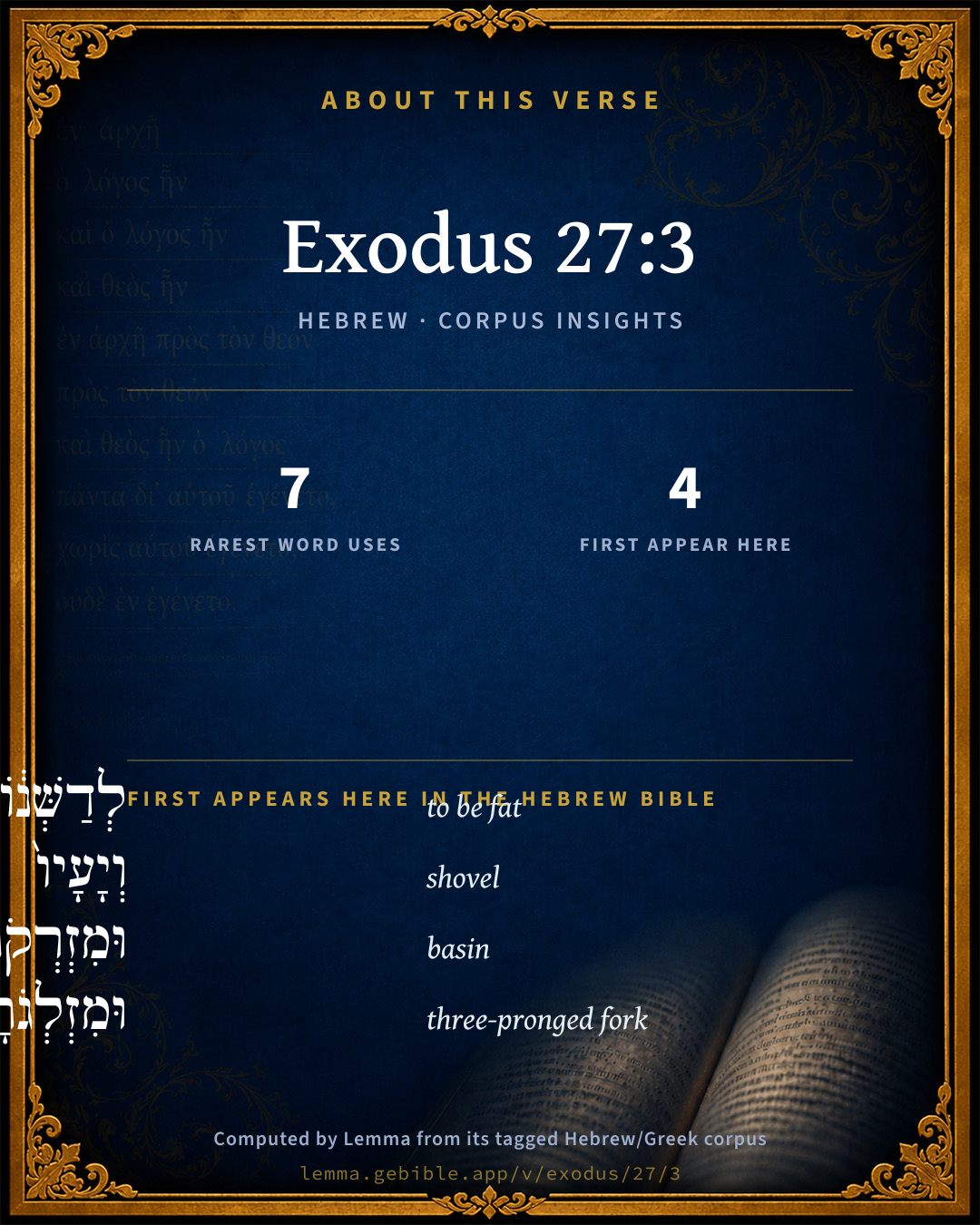
  • 4 first appearances in the Hebrew Bible
Full analysis ↓
Download a study sheet

One document with this verse’s original text, its word-by-word gloss line, the meaning frame, cross-references with their text, attributed commentary, and full source and license credits — printable, and it pastes into notes with its structure intact.

This verse Autodidact and up

Study sheet (.html) Plain text (.txt)

A passage Seminary Student

Up to 50 verses in one chapter. A passage sheet keeps up to 6 commentary sources and 12 cross-references per verse, in the order this page ranks them, and says so on the sheet whenever that leaves anything out. Ask for a single verse and you get the Autodidact verse sheet above.

Everything on this page stays free to read, with no account — the sheet is a download of what is already on screen, not access to it.

Want to remove ads? Support Godless Engineer
Compare translations 3

The same verse in 3 English versions, stacked beneath the original-language interlinear above. Click any original word for its lexicon entry.

Each is an independent rendering of the whole verse — the interlinear is not word-aligned to these translations.

Highlighted words mark where these versions differ — a whole-verse word diff, not a word-by-word alignment.

  • World English Bible Public Domain
    You shall make its pots to take away its ashes, its shovels, its basins, its flesh hooks, and its fire pans: all its vessels you shall make of brass.
  • King James Version Public Domain
    And thou shalt make his pans to receive his ashes, and his shovels, and his basins, and his fleshhooks, and his firepans: all the vessels thereof thou shalt make of brass.
  • unfoldingWord Literal Text CC BY-SA 4.0
    And you shall make its pots for fatty ashes and its shovels and its basins and its meat forks and its trays. You shall make all its utensils with bronze.

unfoldingWord Literal Text — © unfoldingWord, licensed CC BY-SA 4.0. Word-aligned USFM3 via Door43 (git.door43.org/unfoldingWord/en_ult).

Versions to compare (up to 4)

3 of 4 selected

Show all 18 translations

Every available English version of this verse, each an independent rendering of the whole verse.

  • World English Bible Public Domain
    You shall make its pots to take away its ashes, its shovels, its basins, its flesh hooks, and its fire pans: all its vessels you shall make of brass.
  • Berean Standard Bible Public Domain
    Make all its utensils of bronze—its pots for removing ashes, its shovels, its sprinkling bowls, its meat forks, and its firepans.
  • Majority Standard Bible Public Domain
    Make all its utensils of bronze—its pots for removing ashes, its shovels, its sprinkling bowls, its meat forks, and its firepans.
  • King James Version Public Domain
    And thou shalt make his pans to receive his ashes, and his shovels, and his basins, and his fleshhooks, and his firepans: all the vessels thereof thou shalt make of brass.
  • American Standard Version (1901) Public Domain
    And thou shalt make its pots to take away its ashes, and its shovels, and its basins, and its flesh-hooks, and its firepans: all the vessels thereof thou shalt make of brass.
  • Revised Version (1885) Public Domain
    And thou shalt make its pots to take away its ashes, and its shovels, and its basons, and its fleshhooks, and its firepans: all the vessels thereof thou shalt make of brass.
  • Geneva Bible (1599) Public Domain
    Also thou shalt make his ashpannes for his ashes and his besoms, and his basens, and his flesh-hookes, and his censers: thou shalt make all the instruments thereof of brasse.
  • Douay-Rheims (1899) Public Domain
    And thou shalt make for the uses thereof pans to receive the ashes, and tongs and fleshhooks, and firepans: all its vessels thou shalt make of brass.
  • Young's Literal Translation Public Domain
    And thou hast made its pots to remove its ashes, and its shovels, and its bowls, and its forks, and its fire-pans, even all its vessels thou dost make of brass.
  • Literal Standard Version CC BY-SA 4.0
    And you have made its pots to remove its ashes, and its shovels, and its bowls, and its forks, and its fire-pans, even all its vessels you make of bronze.
  • Unlocked Literal Bible CC BY-SA 4.0
    You must make equipment for the altar: pots for ashes, and also shovels, basins, meat forks, and firepans. You must make all these utensils with bronze.
  • unfoldingWord Literal Text CC BY-SA 4.0
    And you shall make its pots for fatty ashes and its shovels and its basins and its meat forks and its trays. You shall make all its utensils with bronze.
  • Darby Bible Public Domain
    And thou shalt make its pots to cleanse it of the fat, its shovels, and its bowls, and its forks, and its firepans; for all the utensils thereof thou shalt employ copper.
  • World Messianic Bible Public Domain
    You shall make its pots to take away its ashes; and its shovels, its basins, its meat hooks, and its fire pans. You shall make all its vessels of bronze.
  • Webster's Bible Public Domain
    And thou shalt make its pans to receive its ashes, and its shovels, and its basins, and its flesh-hooks, and its fire-pans: all its vessels thou shalt make of brass.
  • Free Bible Version CC BY-SA 4.0
    Make all its utensils of bronze: buckets for removing ashes, shovels, sprinkling bowls, meat forks, and firepans.
  • Bible in Basic English Public Domain
    And make all its vessels, the baskets for taking away the dust of the fire, the spades and basins and meat-hooks and fire-trays, of brass.
  • JPS Tanakh (1917) Public Domain
    And thou shalt make its pots to take away its ashes, and its shovels, and its basins, and its flesh-hooks, and its fire-pans; all the vessels thereof thou shalt make of brass.

Literal Standard Version (2020), Covenant Press — licensed CC BY-SA 4.0. Text via the HelloAO Bible API (eBible.org). Unlocked Literal Bible (unfoldingWord) — licensed CC BY-SA 4.0. Text via the HelloAO Bible API (eBible.org). unfoldingWord Literal Text — © unfoldingWord, licensed CC BY-SA 4.0. Word-aligned USFM3 via Door43 (git.door43.org/unfoldingWord/en_ult). Free Bible Version, Dr. Jonathan Gallagher — licensed CC BY-SA 4.0. Text via the HelloAO Bible API (eBible.org).

Word by word

More ways to search: Search by grammar → Find every occurrence → Compare this word →

Practice this passage: Drill this verse → Learn its vocabulary →

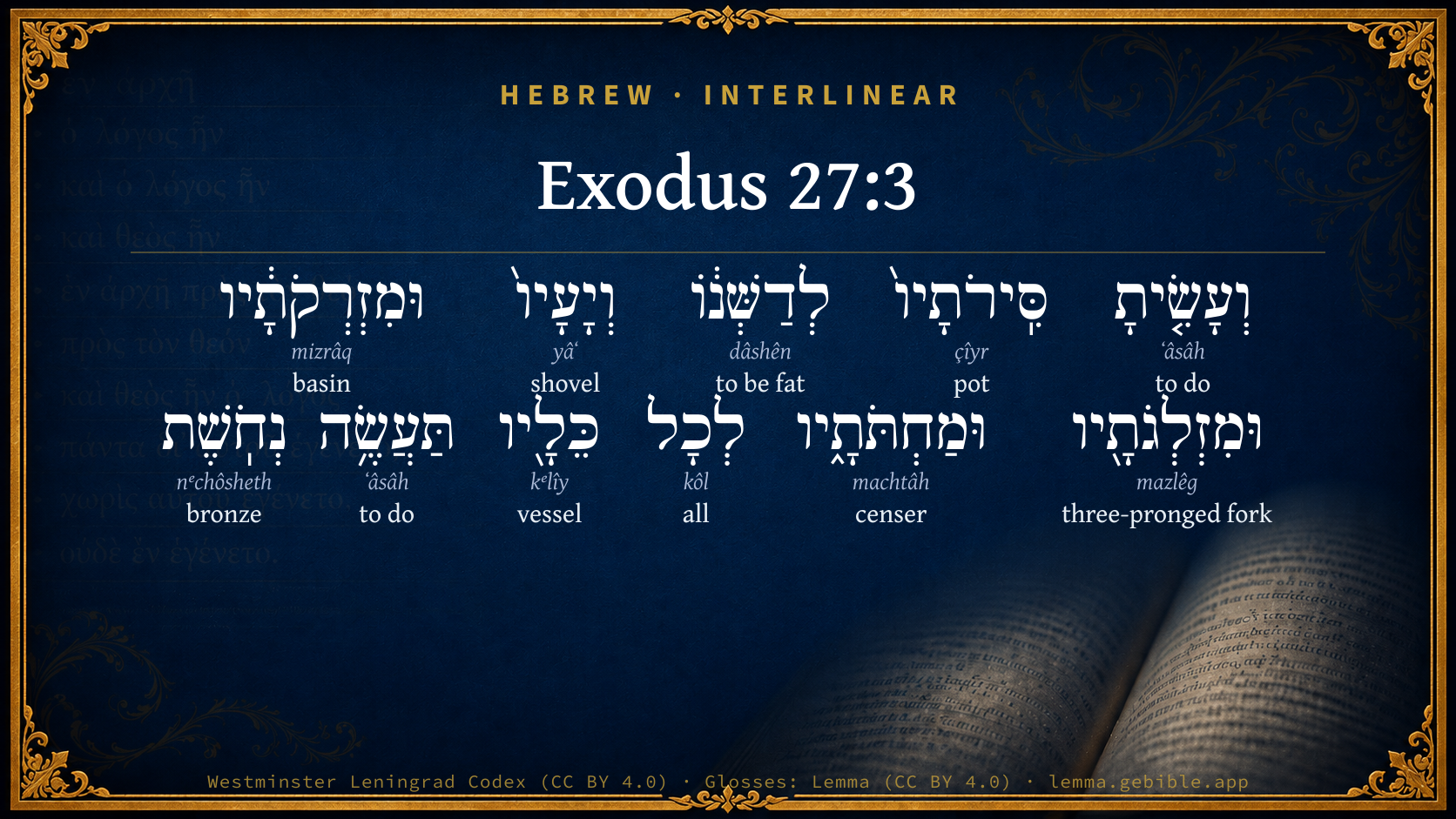
וּמִזְלְגֹתָ֖יו
mazlêg
H4207
“and · three-pronged forks · his”
Conjunction + Noun, Common, Feminine, Plural, Construct + Suffix, Personal, 3rd Person, Masculine, Singular
Part of Speech
Conjunction + Noun
Type
Common
Gender
Feminine
Number
Plural
State
Construct
Full BDB Definition

Origin: from an unused root meaning to draw up

TWOT: 552a

three-pronged fork - a sacrificial implement
  1. וְעָשִׂ֤יתָ ʻâsâh H6213 “and · to do” Conjunction + Verb, Qal, Sequential Perfect, 2nd Person, Masculine, Singular
  2. סִּֽירֹתָיו֙ çîyr H5518 “pots · his” Noun, Common, Both, Plural, Construct + Suffix, Personal, 3rd Person, Masculine, Singular
  3. לְדַשְּׁנ֔וֹ dâshên H1878 “to be fat · him” Preposition + Verb, Piel, Infinitive Construct + Suffix, Personal, 3rd Person, Masculine, Singular
  4. וְיָעָיו֙ yâʻ H3257 “and · shovels · his” Conjunction + Noun, Common, Masculine, Plural, Construct + Suffix, Personal, 3rd Person, Masculine, Singular
  5. וּמִזְרְקֹתָ֔יו mizrâq H4219 “and · basins · his” Conjunction + Noun, Common, Masculine, Plural, Construct + Suffix, Personal, 3rd Person, Masculine, Singular
  6. וּמַחְתֹּתָ֑יו machtâh H4289 “and · censers · his” Conjunction + Noun, Common, Feminine, Plural, Construct + Suffix, Personal, 3rd Person, Masculine, Singular
  7. לְכָל kôl H3605 “to/for · all of” Preposition + Noun, Common, Masculine, Singular, Construct
  8. כֵּלָ֖יו kᵉlîy H3627 “vessels · his” Noun, Common, Masculine, Plural, Construct + Suffix, Personal, 3rd Person, Masculine, Singular
  9. תַּעֲשֶׂ֥ה ʻâsâh H6213 “to do” Verb, Qal, Imperfect, 2nd Person, Masculine, Singular
  10. נְחֹֽשֶׁת nᵉchôsheth H5178 “bronze” Noun, Common, Feminine, Singular, Absolute

About this verse

These counts appear in no published source. They are computed here, from the morphology-tagged text and Lemma’s own curated glosses. What Lemma adds →

11
words
10
distinct lemmas
Pentateuch
section

Notable vocabulary

The rarest word here is וּמִזְלְגֹתָ֖יו three-pronged fork H4207 — appearing just 7 times in the whole Hebrew Bible.

First appearance in Scripture

These words make their first canonical appearance in the Hebrew Bible here:

  • לְדַשְּׁנ֔וֹ to be fat H1878
  • וְיָעָיו֙ shovel H3257
  • וּמִזְרְקֹתָ֔יו basin H4219
  • וּמִזְלְגֹתָ֖יו three-pronged fork H4207

Shared distinctive vocabulary

וּמִזְלְגֹתָ֖יו three-pronged fork H4207 occurs in 7 verses of the Hebrew Bible. Also found in:

Grammatical profile

  • 3 verbs
  • 8 nouns

Verb forms

  • וְעָשִׂ֤יתָ Qal · Sequential Perfect
  • לְדַשְּׁנ֔וֹ Piel · Infinitive Construct
  • תַּעֲשֶׂ֥ה Qal · Imperfect

Repetition

A word recurs within this verse — often emphatic in Hebrew:

  • וְעָשִׂ֤יתָ to do H6213 ×2

Hebrew & Septuagint length

In English translation the verse runs 29 words from the Hebrew and 31 from the Septuagint (LXX English) — closely comparable.

A rough comparison of the two English renderings, which tokenize alike — not a word-level alignment.

Word counts can differ between the Hebrew and the Greek without any difference in meaning — e.g. the Hebrew direct-object marker אֵת has no separate Greek word, and Greek often adds the article ὁ.

Cross-references

12

Topical passages linked to Exodus 27:3 in the Treasury of Scripture Knowledge — connected by theme and wording, ordered by reader-vote popularity; previews shown in the World English Bible.

  • 1 Kings 7:45 and the pots, and the shovels, and the basins: even all these vessels, which Hiram made for king Solomon, in the house of Yahweh, were of burnished brass.
  • Exodus 24:6 Moses took half of the blood and put it in basins, and half of the blood he sprinkled on the altar.
  • Exodus 38:3 He made all the vessels of the altar, the pots, the shovels, the basins, the flesh-hooks, and the fire pans. He made all its vessels of brass.
  • Leviticus 16:12 He shall take a censer full of coals of fire from off the altar before Yahweh, and two handfuls of sweet incense beaten small, and bring it within the veil:
  • Numbers 4:14 They shall put on it all its vessels, with which they minister about it, the fire pans, the flesh hooks, the shovels, and the basins; all the vessels of the altar; and they shall spread on it a covering of sealskin, and put in its poles.
  • 1 Samuel 2:13–14 The custom of the priests with the people was that when any man offered sacrifice, the priest's servant came, while the flesh was boiling, with a flesh-hook of three teeth in his hand;
  • 1 Kings 7:40 Hiram made the basins, and the shovels, and the basins. So Hiram made an end of doing all the work that he worked for king Solomon in the house of Yahweh:
  • 2 Kings 25:15 The fire pans, and the basins, that which was of gold, in gold, and that which was of silver, in silver, the captain of the guard took away.
  • 1 Chronicles 28:17 and the flesh-hooks, and the basins, and the cups, of pure gold; and for the golden bowls by weight for every bowl; and for the silver bowls by weight for every bowl;
  • 2 Chronicles 4:11 Huram made the pots, and the shovels, and the basins. So Huram made an end of doing the work that he did for king Solomon in the house of God:
  • 2 Chronicles 4:16 The pots also, and the shovels, and the flesh-hooks, and all the vessels of it, did Huram his father make for king Solomon for the house of Yahweh of bright brass.
  • Jeremiah 52:18–20 The pots also, and the shovels, and the snuffers, and the basins, and the spoons, and all the vessels of brass with which they ministered, took they away.

Cross-references courtesy of OpenBible.info (CC BY 4.0).

Hebrew and Greek witnesses Masoretic Hebrew ↔ Greek Septuagint

The same verse in the two great witnesses to the Old Testament, shown verse-for-verse.

These are two independent witnesses, not word-aligned to each other, and the Septuagint is shown in lemma (dictionary) form.

Hebrew Exodus 27:3 Masoretic · Westminster Leningrad Codex

וְעָשִׂ֤יתָ סִּֽירֹתָיו֙ לְדַשְּׁנ֔וֹ וְיָעָיו֙ וּמִזְרְקֹתָ֔יו וּמִזְלְגֹתָ֖יו וּמַחְתֹּתָ֑יו לְכָל כֵּלָ֖יו תַּעֲשֶׂ֥ה נְחֹֽשֶׁת

You shall make its pots to take away its ashes, its shovels, its basins, its flesh hooks, and its fire pans: all its vessels you shall make of brass.

World English Bible · Public Domain

Greek LXX Exodus 27:3 Septuagint · lemma form

καί ποιέω στεφάνη ὁ θυσιαστήριον καί ὁ καλυπτήρ αὐτός καί ὁ φιάλη αὐτός καί ὁ κρεάγρα αὐτός καί ὁ πυρεῖον αὐτός καί πᾶς ὁ σκεῦος αὐτός ποιέω χαλκοῦς

And you shall make a rim for the altar; and its covering and its cups, and its flesh hooks, and its fire-pan, and all its vessels shall you make of brass.

LXX2012 (modern English Septuagint) · Public Domain

On this verse, Haydock's Catholic Bible Commentary discusses the Septuagint’s reading. Read the note in Commentary ↓

Hebrew: Westminster Leningrad Codex (CC BY 4.0). Greek: Septuagint (public domain); English from LXX2012 (modern English Septuagint) (Public Domain). How the Septuagint differs from the Hebrew →

Targum (Aramaic paraphrase)

2

The Targum is the ancient Jewish Aramaic paraphrase of the Hebrew Scriptures — an interpretive translation, not the Hebrew text itself. Onkelos (literal) and Pseudo-Jonathan (expansive) render the Torah, and Jonathan the Prophets. Coverage is partial: where no permissively-licensed English translation exists for a verse, only the Aramaic is shown. This is verse-level text, not a word-by-word alignment to the Hebrew.

  1. Targum Onkelos Torah (Genesis–Deuteronomy)
    וְתַעְבֵּד פְּסַכְתְּרָוָתֵהּ לְמִסְפֵי קִטְּמֵיהּ וּמַגְרוֹפְיָתֵהּ וּמִזְרְקָתֵהּ וְצִנוּרְיָתֵהּ וּמַחְתְּיָתֵהּ לְכָל מָנוֹהִי תַּעְבֵּד נְחָשָׁא:

    (no public-domain English translation for this verse)

    Targum Onkelos — Aramaic: “Onkelos Genesis” (public domain); “Onkelos Exodus” (public domain); “Onkelos Leviticus” (public domain); “Onkelos Numbers” (public domain); “Onkelos Deuteronomy” (public domain). English: “Sefaria Community Translation” (CC0 1.0 (public-domain dedication)); “J.W. Etheridge. The Targums of Onkelos and Jonathan Ben Uzziel on the Pentateuch. London: Longmans, Green, 1862” (public domain). Text via Sefaria.

  2. Targum Pseudo-Jonathan Torah (Genesis–Deuteronomy)
    וְתַעֲבֵיד דּוּדְוָתֵיהּ לְמֵירְדָדָא יָתֵיהּ וּמִגְרִפַתֵּיהּ וּמִזִירִקוֹי וּמְשִׁילְיָיתֵיהּ וּמַחְתְּיָיתֵיהּ כָּל מָנוֹי תַּעֲבֵיד נְחָשָׁא

    And thou shalt make its pots to carry away its ashes and its shovels, and its basins, and its thuribles; all its vessels thou shalt make of brass.

    Targum Pseudo-Jonathan — Aramaic: “Targum Jonathan on Genesis” (public domain); “Targum Jonathan on Exodus” (public domain); “Targum Jonathan on Leviticus” (public domain); “Targum Jonathan on Numbers” (public domain); “Targum Jonathan on Deuteronomy” (public domain). English: “The Targum of Jonathan ben Uzziel, trans. J. W. Etheridge, London, 1862” (public domain). Text via Sefaria.

Commentary

Notes on Exodus 27:3 from classic Christian and Jewish commentators (each source and its license shown beneath its notes). The classic Christian expositions comment on the surrounding passage and are grouped to its opening verse, so a note may address several verses; the Jewish commentaries on the Tanakh (Rashi and others) are per-verse, so they appear only where the commentator wrote on this verse.

Lemma curates 59 commentaries, every one of them public domain or Creative Commons licensed, each selected and text-cleaned for this edition rather than reprinted as found. About our sources →

Trapp's Complete Commentary

John Trapp

Exo 27:3 And thou shalt make his pans to receive his ashes, and his shovels, and his basons, and his fleshhooks, and his firepans: all the vessels thereof thou shalt make [of] brass.

Ver. 3. His shovels, and his basons.] These several instruments figured the ministry of the word, say some; the sundry callings that Christ hath in his Church, say others, for her edification.

John Trapp, A Commentary or Exposition upon All the Books of the Old and New Testament (1647–1656) — public domain. Text from a community e-Sword module.

Geneva Bible (1599)

Geneva Bible translators

Or, fire pans.

Geneva Bible (1599) marginal notes — public domain. Text via Bolls.life.

Jamieson, Fausset & Brown

Robert Jamieson, A. R. Fausset & David Brown

shovels--fire shovels for scraping together any of the scattered ashes.

basons--for receiving the blood of the sacrifice to be sprinkled on the people.

fleshhooks--curved, three-pronged forks (Sa1 2:13-14).

fire-pans--A large sort of vessel, wherein the sacred fire which came down from heaven (Lev 9:24) was kept burning, while they cleaned the altar and the grate from the coals and ashes, and while the altar was carried from one place to another in the wilderness [PATRICK, SPENCER, LE CLERC].

Jamieson, Fausset & Brown — Commentary Critical and Explanatory on the Whole Bible (1871) — public domain (CC PDM 1.0). Text via the HelloAO Bible API.

Adam Clarke's Commentary

Verse 3. Thou shalt make his pans] סירתיו sirothaiv, a sort or large brazen dishes, which stood under the altar to receive the ashes that fell through the grating.

His shovels] יעיו yaaiv. Some render this besoms; but as these were brazen instruments, it is more natural to suppose that some kind of fire-shovels are intended, or scuttles, which were used to carry off the ashes that fell through the grating into the large pan or siroth.

His basins] מזרקתיו mizrekothaiv, from זרק zarak, to sprinkle or disperse; bowls or basins to receive the blood of the sacrifices, in order that it might be sprinkled on the people before the altar, c.

His flesh-hooks] מזלגתיו mizlegothaiu. That this word is rightly translated flesh-hooks is fully evident from 1Sa 2:13, where the same word is used in such a connection as demonstrates its meaning: And the priest's custom with the people was, that when any man offered sacrifice, the priest's servant came, while the flesh was in the seething, with a FLESH-HOOK (מזלג mazleg) of three teeth (prongs) in his hand, and he struck it into the pan, c. all that the FLESH-HOOK (מזלג mazleg) brought up, the priest took for himself. It was probably a kind of trident, or fork with three prongs, and these bent to a right angle at the middle, as the ideal meaning of the Hebrew seems to imply crookedness or curvature in general.

His fire-pans] מחתתיו machtothaiu. Bishop Patrick and others suppose that "this was a larger sort of vessel, wherein, probably, the sacred fire which came down from heaven (Le 9:24) was kept burning, whilst they cleansed the altar and the grate from the coals and the ashes and while the altar was carried from one place to another, as it often was in the wilderness.

Adam Clarke's Commentary on the Bible (1810–1826) — public domain. Text from a community e-Sword/MySword module.

Ellicott's Commentary for English Readers

(3) His pans to receive his ashes.—Scuttles, in which the ashes were placed for removal from the sanctuary, are intended. The word translated “to receive his ashes” is a rare one, and implies a mixture with the ashes of unburnt fat.

His shovels.—A right rendering. The “shovels” would be used in clearing away the ashes from off the altar.

His basons.—Basins were needed to receive the blood of the victims (Exo_24:6), which was cast from basins upon the foot of the altar.

His fleshhooks.—Implements with three prongs, used for arranging the pieces of the victim upon the altar. The priests’ servants sometimes applied them to a different purpose (1Sa_2:13).

His firepans.—The word here used is elsewhere translated either “snuffdishes,” or “censers.” Probably vessels employed in carrying embers from the brazen altar to the altar of incense (Lev_16:12) are intended.

A Bible Commentary for English Readers, edited by Charles John Ellicott (1878–1897) — public domain. Text from a community e-Sword module.

The Cambridge Bible for Schools and Colleges

gen. ed. J. J. S. Perowne

3. The vessels of the altar, for use in connexion with the sacrifices.

its pots … and its shovels] cf., in the Temple, 1Ki_7:45, 2Ki_25:14.

its ashes] lit. its fat, i.e. the fat, which, when a sacrifice was burnt, ran down and mixed with the ashes: cf. Num_4:13, Lev_1:16; Lev_4:12; Lev_6:10 f. Not used of ordinary ashes. The shovels would be for collecting and sweeping away (cf. the same root, Isa_28:17) the ashes.

basons] lit. tossing-vessels,—large bowls, used for tossing the blood in a volume against the sides of the altar: see on Exo_24:6, and Exo_29:16. Cf. Zec_9:15; Zec_14:20 (‘bowls’).

fleshhooks] Exo_38:3, Num_4:14, 1Ch_28:17, 2Ch_4:16†.

firepans] 1Ki_7:50. Cf. the note on ‘snuffdishes,’ Exo_25:38.

The Cambridge Bible for Schools and Colleges (gen. ed. J. J. S. Perowne; Cambridge University Press, 1878–1918) — public domain. Text from a community e-Sword module.

John Gill's Exposition

And thou shall make his pans to receive his ashes,.... Not to receive them in as they fell, but to gather them up in, and carry them away; and this was done every morning about cockcrowing, not much sooner nor later (c):

and his shovels; to throw up the ashes together to be put into the pans; Jarchi describes this vessel to be like the cover of a brass pot, with a handle to it; the same we call a fire shovel:

and his basins: to receive the blood of the sacrifice, and out of which it was sprinkled, as the word signifies, and may be rendered sprinkling basins:

and his flesh hooks; not such as were used to take flesh out of the pot, Sa1 2:13 for there could be no use for such at the altar of burnt offering; but were, as Jarchi says, like hooks recurved, with which they struck into the flesh, and turned it upon the coals to hasten the burning of it; and with which very probably they kept the fire and the parts of the sacrifices in good order, until they were consumed:

and his fire pans; which were a kind of censers in which coals of fire were taken off from the altar of burnt offering, and carried to the altar of incense, as Jarchi and Ben Gersom observe, see Lev 16:12 but as censers did not belong to the altar of burnt offering, but to the altar of incense, Fortunatus Scacchus (d) is of opinion, that these were a larger sort of vessels, wherein the fire which came down from heaven was kept burning while the altar and grate were cleansed from the coals and ashes, and when the altar was had from place to place:

all the vessels thereof thou shalt make of brass; as being fittest for the use of this altar.

(c) Misn. Yoma, c. 1. sect. 8. & Maimon, in ib. (d) Sacr. Elaeochrism. Myrothec. l. 2. c. 73. p. 676, 677.

John Gill's Exposition of the Whole Bible (1746–1763) — public domain (CC PDM 1.0). Text via the HelloAO Bible API.

Haydock's Catholic Bible Commentary

Pans, &c. The Septuagint have, "a crown or border, for the altar, and its covering, and its cups, and flesh-hooks, and fire-place, or pan." Hebrew also has five terms; which Calmet renders: 1. a small kettle to receive the ashes under the grate; 2. fire-shovels; 3. bowls to receive blood (mozrokoth, which term the Vulgate does not perhaps notice); 4. flesh-hooks; 5. chafing-dishes. The Protestant version has also the basins or broad cups, phialas, of the Septuagint (Haydock)

George Leo Haydock (1774–1849), Haydock's Catholic Family Bible and Commentary, 1859 edition — public domain. Excludes Psalms (Douay-Rheims chapter numbering differs from Protestant) and Deuterocanonical books (Catholic canon only).

Matthew Poole's English Annotations

Basons, to receive the blood of the sacrifices, which they were to sprinkle.

Flesh-hooks, wherewith they took flesh out of the pot in which it was seethed, as 1Sa 2:14. But this seems not proper here, because the flesh was never boiled upon the altar, but in other places appointed for that use. And the Hebrew word is general, and may signify either tongs or fire-forks.

Firepans, in which they carried live coals from this altar to that of incense, as occasion required.

Matthew Poole's English Annotations on the Holy Bible (1683–1685) — public domain. Text from a community e-Sword/MySword module.

Whedon's Commentary on the Bible

Daniel D. Whedon

3. Pans… shovels… basins… fleshhooks… firepans — These several vessels were all requisite in the service of the altar, for taking up and removing ashes, receiving the blood of victims, adjusting the pieces of flesh, and carrying coals of fire.

Daniel D. Whedon (gen. ed.), Commentary on the Old and New Testaments (1874–1909) — public domain. Text from a community e-Sword module.

The Pulpit Commentary

His pans to receive his ashes. Literally, "to cleanse it from fati.e. , to receive what remained after burning the victims, which would be ashes mixed with a good deal of fat. His shovels. Those would be used in removing the ashes from the altar, and depositing them in the pans. His basins. Vessels for receiving the blood of the victims and from which it was poured on the altar. Compare Exo_24:6. His flesh hooks. So the Septuagint, and our translators again in 1Sa_2:13. They would seem by the latter passage to have been three-pronged forks, the proper use of which was, no doubt, to arrange the various pieces, into which the victim was cut, upon the altar. His fire-pans. The word used is generally translated "censers" (Lev_10:1; Lev_16:12; Num_4:14; Num_16:6, Num_16:17, etc.) but sometimes "snuff-dishes". (Exo_25:38 Exo_37:23) It here perhaps designates the vessels used for carrying burning embers from the altar of burnt-offering, to the altar of incense on certain occasions. (Lev_16:12) Etymologically, it means simply "a receptacle." All the vessels thereof thou shalt make of brass. Rather, "of bronze." Bronze was the usual material of utensils and implements in Egypt (Birch, Guide to British Museum, pp. 13-21; 28, 29; 35-41; etc.). Copper was scarcely used without the alloy of tin which converts it into bronze; and brass was wholly unknown. A trace of iron is sometimes found in Egyptian bronze

The Pulpit Commentary (1880–1919), ed. H.D.M. Spence-Jones & Joseph S. Exell — public domain. Text from a community e-Sword module.

unfoldingWord translationNotes

Door43 World Missions Community

General Information:

Yahweh continues to tell Moses what the people must do.

basins

bowls

firepans

These were pans that held hot coals from the altar.

utensils

These were any instrument, vessel, or tool that served a useful purpose.

You must make a grate for the altar, a network of bronze

"You must make a bronze grate for the altar"

grate

a frame of crossed bars for holding wood when burning

translationWords

altar

bronze

unfoldingWord translationNotes — © Distant Shores Media and the Door43 World Missions Community, licensed CC BY-SA 4.0. Source: git.door43.org/Door43/en_tn.

Rashi

Rabbi Shlomo Yitzchaki (Rashi)

סירתיו — a kind of pot.

לדשנו means TO REMOVE ITS ASHES in them. That is exactly as Onkelos translated it: למספי קטמה, to remove the ashes into them. For although in its primary sense דַּשֵּׁן would mean to cover with ashes, it has also the meaning of removing the ashes, for there are in the Hebrew language certain expressions with the peculiarity that the same word changes in meaning so as to be used to denote both “construction” and “destruction,” (having a positive and a negative meaning). Examples are: (Psalms 80:10) “and didst cause it to take deep root (ותשרש)”; (Job 5:3) “I have seen the foolish taking root (משריש),” whilst we have its opposite (negative) meaning in, (Job 31:12) “and thou wouldst root out (תשרש) all my increase.” Similar to it is, (Isaiah 17:6) “in the utmost fruitful branches (בסעיפיה),” and its opposite, (Isaiah 10:33) “The Lord of hosts shall מסעף”, i. e. shall lop off the branches thereof. Similar to it is also (Jeremiah 50:17) “And this last person עִצְּמוֹ” — “has broken his bones” although the primary meaning of עצם is to be strongboned. Similar to it is, (1 Kings 21:13) “and stoned him with stones (ויסקלהו)” i. e. heaped up stones above him, and its opposite is, (Isaiah 62:10) “סקלו the stones” — i. e. remove its stones; and so, too, (Isaiah 5:2) “And he fenced it and gathered out the stones thereof (ויסקלהו).” Thus here, also, לדשנו means to remove its ashes. In 0. F. à discendrer.

ויעיו AND ITS SHOVELS — as the Targum renders it, מגרפות, shovels by which the ashes were removed. They had the form of the lid of a pot, of thin metal, but having a handle. In old French vedil.

ומזרקתיו AND ITS BOWLS, in which to receive the blood of the sacrifices.

ומזלגתיו AND ITS FLESHHOOKS — These had the form of bent hooks; they stuck them forcibly into the flesh so that they penetrated it, and with them they turned the flesh over upon the coals of the fire-place in order that it might become the more quickly consumed. In old French these are called crochets and in the language of our Sages צנוריות (Yoma 12a).

ומחתתיו AND ITS FIRE-PANS — These had a cavity to hold things so that the coals might be taken in them from the altar in order to carry them on to the inner altar for the incense. And because of their use for raking the coals into them (חתיה) they were called מחתות. This word is of the same root and meaning as the verb in, (Isaiah 30:14) “לחתות fire from the fire-place,” which has the meaning of drawing fire from its place. Similar is, (Proverbs 6:27) “Can a man rake (היחתה) fire into his bosom?”

לכל כליו means ALL THE VESSELS THEREOF [THOU SHALT MAKE OF COPPER] (i. e. it does not mean: “thou shalt make things of copper, for (i. e. to serve as) all its vessels” but the ל is redundant; cf. Rashi on Exodus 14:28).

Rashi on the Tanakh — English translations: “The Judaica Press complete Tanach with Rashi, translated by A. J. Rosenberg” (CC BY 4.0); “Pentateuch with Rashi's commentary by M. Rosenbaum and A.M. Silbermann, 1929-1934” (public domain); “The Metsudah Tanach series, Lakewood, N.J” (CC BY 4.0); and “The Book of Joshua, Metsudah Publications, 1997” (CC BY 4.0). Text via Sefaria.

Lesson kit

Teaching starters — assembled from the data on this page, not authored interpretation. Every prompt links to the verse data it draws on. Edit before teaching.

Exodus, in the Pentateuch, opens this verse with 11 words (10 distinct Hebrew lemmas). Its most distinctive word is mazlêg (“three-pronged fork”). A historical commentator’s framing appears above. Read the whole chapter for the surrounding context.

Discussion questions

  1. The word mazlêg carries the sense “three-pronged fork.” How does it shape the verse?
  2. 4 words here appear for the first time in Scripture. What is being introduced at this debut?
  3. Exodus 38:3 shares the word «three-pronged fork» with this verse. How do the two illuminate each other?
  4. “to do” occurs 2× in this one verse. What is the effect of the repetition?
  5. These translations render this verse differently; the difference is in the English rendering, not the original. What questions does that raise?
  6. The verb «וְעָשִׂ֤יתָ» is Qal Sequential Perfect. How does its form color the action?
  7. Reading how Trapp's Complete Commentary and Geneva Bible (1599) read this verse, where do the two commentators agree and where do they part?

Things to notice

  • 4 words make their first canonical appearance in Scripture here.
  • These translations choose different wording for 21 words in this verse.
  • “to do” occurs 2× in this single verse.
  • 10 distinct Hebrew lemmas span 11 words in this verse.

Reading settings

Reading text

Shown beneath each verse's original-language words.

Old Testament
Old Testament edition

Read the OT as the Masoretic Hebrew (MT) or the Greek Septuagint (LXX).

English shown for the Greek Septuagint (in the Hebrew ↔ Greek comparison).

Comparing translations? Open the Compare panel on any verse page to stack up to four side by side.