1 Samuel 31:10

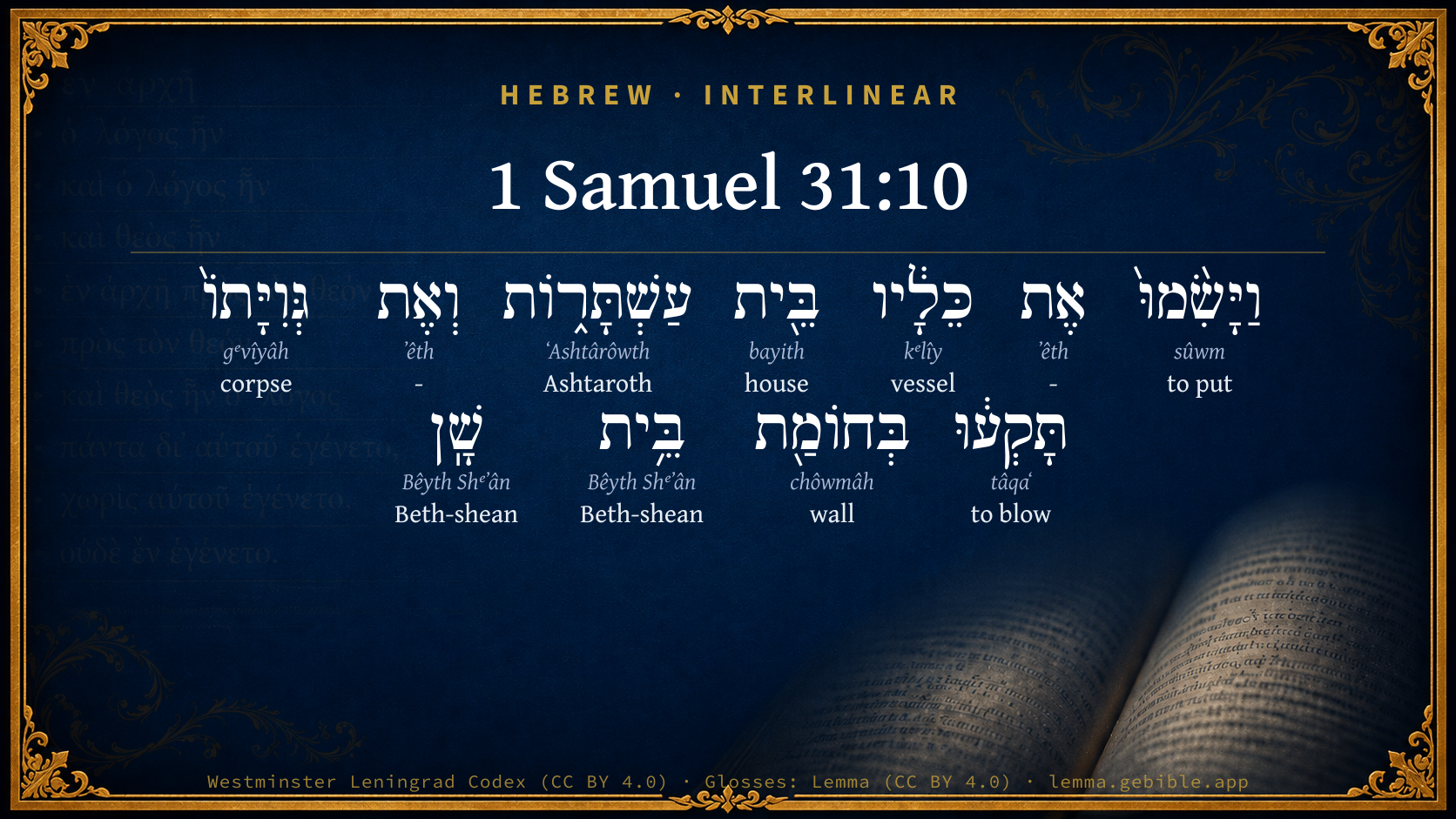
Hebrew (Westminster Leningrad Codex) 1 Samuel 31:10 appears in the Hebrew Old Testament. The text above is from the Westminster Leningrad Codex. Each word links to its Strong’s number, a concise gloss, and parsing drawn from the Open Scriptures Hebrew Bible morphology. Click any word for its full Brown-Driver-Briggs (BDB) entry.
Download image
Cite this verse

1 Samuel 31:10 (World English Bible). Public Domain. Lemma interlinear Bible study tool, https://lemma.gebible.app/v/1-samuel/31/10.

Show BibTeX & RIS
BibTeX
RIS
English Translation
They put his armor in the house of the Ashtaroth; and they fastened his body to the wall of Beth-shan.
World English Bible · Public Domain
Download a study sheet

One document with this verse’s original text, its word-by-word gloss line, the meaning frame, cross-references with their text, attributed commentary, and full source and license credits — printable, and it pastes into notes with its structure intact.

This verse Autodidact and up

Study sheet (.html) Plain text (.txt)

A passage Seminary Student

Up to 50 verses in one chapter. A passage sheet keeps up to 6 commentary sources and 12 cross-references per verse, in the order this page ranks them, and says so on the sheet whenever that leaves anything out. Ask for a single verse and you get the Autodidact verse sheet above.

Everything on this page stays free to read, with no account — the sheet is a download of what is already on screen, not access to it.

Want to remove ads? Support Godless Engineer
Compare translations 3

The same verse in 3 English versions, stacked beneath the original-language interlinear above. Click any original word for its lexicon entry.

Each is an independent rendering of the whole verse — the interlinear is not word-aligned to these translations.

Highlighted words mark where these versions differ — a whole-verse word diff, not a word-by-word alignment.

  • World English Bible Public Domain
    They put his armor in the house of the Ashtaroth; and they fastened his body to the wall of Beth-shan.
  • King James Version Public Domain
    And they put his armor in the house of Ashtaroth: and they fastened his body to the wall of Bethshan.
  • unfoldingWord Literal Text CC BY-SA 4.0
    And they put his equipment in the house of the Ashtoreths, and they fastened his corpse on the wall of Beth Shan.

unfoldingWord Literal Text — © unfoldingWord, licensed CC BY-SA 4.0. Word-aligned USFM3 via Door43 (git.door43.org/unfoldingWord/en_ult).

Versions to compare (up to 4)

3 of 4 selected

Show all 18 translations

Every available English version of this verse, each an independent rendering of the whole verse.

  • World English Bible Public Domain
    They put his armor in the house of the Ashtaroth; and they fastened his body to the wall of Beth-shan.
  • Berean Standard Bible Public Domain
    They put his armor in the temple of the Ashtoreths and hung his body on the wall of Beth-shan.
  • Majority Standard Bible Public Domain
    They put his armor in the temple of the Ashtoreths and hung his body on the wall of Beth-shan.
  • King James Version Public Domain
    And they put his armor in the house of Ashtaroth: and they fastened his body to the wall of Bethshan.
  • American Standard Version (1901) Public Domain
    And they put his armor in the house of the Ashtaroth; and they fastened his body to the wall of Beth-shan.
  • Revised Version (1885) Public Domain
    And they put his armour in the house of the Ashtaroth: and they fastened his body to the wall of Beth-shan.
  • Geneva Bible (1599) Public Domain
    And they layed vp his armour in the house of Ashtaroth, but they hanged vp his body on the wall of Beth-shan.
  • Douay-Rheims (1899) Public Domain
    And they put his armour in the temple of Astaroth, but his body they hung on the wall of Bethsan.
  • Young's Literal Translation Public Domain
    and they place his weapons `in' the house of Ashtaroth, and his body they have fixed on the wall of Beth-Shan.
  • Literal Standard Version CC BY-SA 4.0
    and they place his weapons [in] the house of Ashtaroth, and they have fixed his body on the wall of Beth-Shan.
  • Unlocked Literal Bible CC BY-SA 4.0
    They put his armor in the temple of the Ashtoreths, and they fastened his body to the city wall of Beth Shan.
  • unfoldingWord Literal Text CC BY-SA 4.0
    And they put his equipment in the house of the Ashtoreths, and they fastened his corpse on the wall of Beth Shan.
  • Darby Bible Public Domain
    And they put his armour in the house of Ashtaroth; and they fastened his body to the wall of Beth-shan.
  • World Messianic Bible Public Domain
    They put his armor in the house of the Ashtaroth, and they fastened his body to the wall of Beth Shan.
  • Webster's Bible Public Domain
    And they put his armor in the house of Ashtaroth: and they fastened his body to the wall of Beth-shan.
  • Free Bible Version CC BY-SA 4.0
    They placed his armor in the temple of the Ashtoreths, and nailed his body to the town wall of Beth-shan.
  • Bible in Basic English Public Domain
    His war-dress they put in the house of Astarte; and his body was fixed on the wall of Beth-shan.
  • JPS Tanakh (1917) Public Domain
    And they put his armour in the house of the Ashtaroth; and they fastened his body to the wall of Beth-shan.

Literal Standard Version (2020), Covenant Press — licensed CC BY-SA 4.0. Text via the HelloAO Bible API (eBible.org). Unlocked Literal Bible (unfoldingWord) — licensed CC BY-SA 4.0. Text via the HelloAO Bible API (eBible.org). unfoldingWord Literal Text — © unfoldingWord, licensed CC BY-SA 4.0. Word-aligned USFM3 via Door43 (git.door43.org/unfoldingWord/en_ult). Free Bible Version, Dr. Jonathan Gallagher — licensed CC BY-SA 4.0. Text via the HelloAO Bible API (eBible.org).

Word by word

More ways to search: Search by grammar → Find every occurrence → Compare this word →

Practice this passage: Drill this verse → Learn its vocabulary →

עַשְׁתָּר֑וֹת
ʻAshtârôwth
H6252
“Ashtaroth”
Noun, Proper
Part of Speech
Noun
Type
Proper
Full BDB Definition

Origin: pl. of H6251

TWOT: 1718b

Ashtaroth or Astaroth = "star" - false goddesses in the Canaanite religion, usually related to fertility cult (noun proper feminine deity) - a city in Bashan east of the Jordan given to Manasseh (noun proper locative)
  1. וַיָּשִׂ֨מוּ֙ sûwm H7760 “and · to put” Conjunction + Verb, Qal, Sequential Imperfect, 3rd Person, Masculine, Plural
  2. אֶת ʼêth H853 “-” Particle, Direct Object
  3. כֵּלָ֔יו kᵉlîy H3627 “vessels · his” Noun, Common, Masculine, Plural, Construct + Suffix, Personal, 3rd Person, Masculine, Singular
  4. בֵּ֖ית bayith H1004 “house of” Noun, Common, Masculine, Singular, Construct
  5. וְאֶת ʼêth H853 “and · -” Conjunction + Particle, Direct Object
  6. גְּוִיָּתוֹ֙ gᵉvîyâh H1472 “corpse · his” Noun, Common, Feminine, Singular, Construct + Suffix, Personal, 3rd Person, Masculine, Singular
  7. תָּקְע֔וּ tâqaʻ H8628 “to blow” Verb, Qal, Perfect, 3rd Person, Common, Plural
  8. בְּחוֹמַ֖ת chôwmâh H2346 “in/at · wall of” Preposition + Noun, Common, Feminine, Singular, Construct
  9. בֵּ֥ית Bêyth Shᵉʼân H1052 “Beth-shean” Noun, Proper
  10. שָֽׁן Bêyth Shᵉʼân H1052 “Beth-shean” Noun, Proper

About this verse

These counts appear in no published source. They are computed here, from the morphology-tagged text and Lemma’s own curated glosses. What Lemma adds →

11
words
9
distinct lemmas
Historical
section

Notable vocabulary

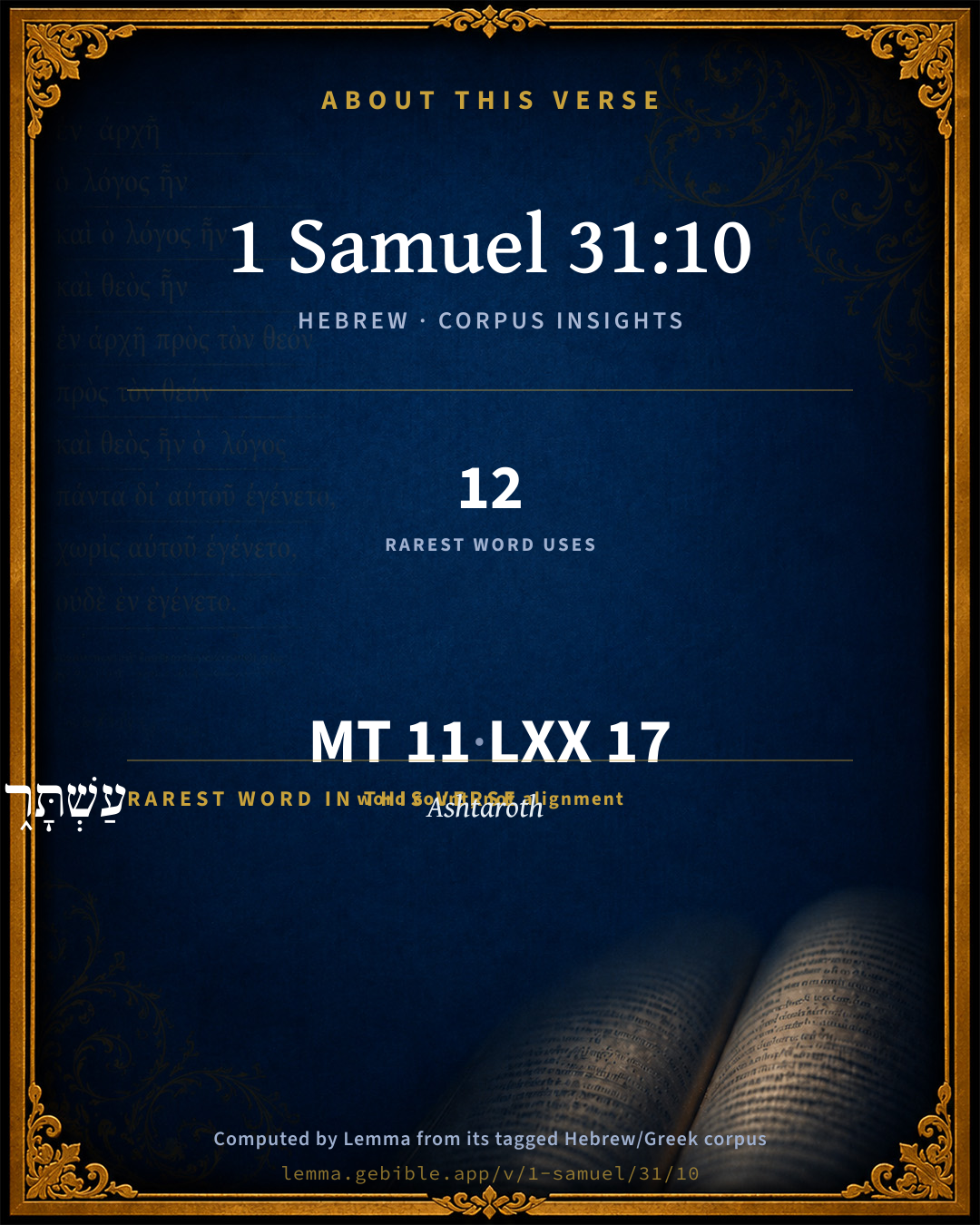
The rarest word here is עַשְׁתָּר֑וֹת Ashtaroth H6252 — appearing just 12 times in the whole Hebrew Bible.

Shared distinctive vocabulary

עַשְׁתָּר֑וֹת Ashtaroth H6252 occurs in 12 verses of the Hebrew Bible. Also found in:

Grammatical profile

  • 2 verbs
  • 7 nouns
  • 2 particles

Verb forms

  • וַיָּשִׂ֨מוּ֙ Qal · Sequential Imperfect
  • תָּקְע֔וּ Qal · Perfect

Repetition

A word recurs within this verse — often emphatic in Hebrew:

  • בֵּ֥ית Beth-shean H1052 ×2

Hebrew & Septuagint length

In English translation the verse runs 20 words from the Hebrew and 21 from the Septuagint (LXX English) — closely comparable.

A rough comparison of the two English renderings, which tokenize alike — not a word-level alignment.

Word counts can differ between the Hebrew and the Greek without any difference in meaning — e.g. the Hebrew direct-object marker אֵת has no separate Greek word, and Greek often adds the article ὁ.

In the original languages it is 11 Hebrew tokens and 17 Greek tokens — but the two are counted differently (Hebrew bundles its prefixes and suffixes into one token; the Greek is in lemma form), so that isn’t a like-for-like length.

Cross-references

6

Topical passages linked to 1 Samuel 31:10 in the Treasury of Scripture Knowledge — connected by theme and wording, ordered by reader-vote popularity; previews shown in the World English Bible.

  • Joshua 17:11 Manasseh had in Issachar and in Asher Beth-shean and its towns, and Ibleam and its towns, and the inhabitants of Dor and its towns, and the inhabitants of En-dor and its towns, and the inhabitants of Taanach and its towns, and the inhabitants of Megiddo and its towns, even the three heights.
  • Judges 2:13 They forsook Yahweh, and served Baal and the Ashtaroth.
  • 1 Samuel 21:9 The priest said, The sword of Goliath the Philistine, whom you killed in the valley of Elah, behold, it is here wrapped in a cloth behind the ephod: if you will take that, take it; for there is no other except that here. David said, There is none like that; give it me.
  • Judges 1:27 Manasseh did not drive out [the inhabitants of] Beth-shean and its towns, nor [of] Taanach and its towns, nor the inhabitants of Dor and its towns, nor the inhabitants of Ibleam and its towns, nor the inhabitants of Megiddo and its towns; but the Canaanites would dwell in that land.
  • 1 Samuel 7:3 Samuel spoke to all the house of Israel, saying, If you do return to Yahweh with all your heart, then put away the foreign gods and the Ashtaroth from among you, and direct your hearts to Yahweh, and serve him only; and he will deliver you out of the hand of the Philistines.
  • 2 Samuel 21:12–14 David went and took the bones of Saul and the bones of Jonathan his son from the men of Jabesh Gilead, who had stolen them from the street of Beth-shan, where the Philistines had hanged them, in the day that the Philistines killed Saul in Gilboa;

Cross-references courtesy of OpenBible.info (CC BY 4.0).

Hebrew and Greek witnesses Masoretic Hebrew ↔ Greek Septuagint

The same verse in the two great witnesses to the Old Testament, shown verse-for-verse.

These are two independent witnesses, not word-aligned to each other, and the Septuagint is shown in lemma (dictionary) form.

Hebrew 1 Samuel 31:10 Masoretic · Westminster Leningrad Codex

וַיָּשִׂ֨מוּ֙ אֶת כֵּלָ֔יו בֵּ֖ית עַשְׁתָּר֑וֹת וְאֶת גְּוִיָּתוֹ֙ תָּקְע֔וּ בְּחוֹמַ֖ת בֵּ֥ית שָֽׁן

They put his armor in the house of the Ashtaroth; and they fastened his body to the wall of Beth-shan.

World English Bible · Public Domain

Greek LXX 1 Samuel 31:10 Septuagint · lemma form

καί ἀνατίθημι ὁ σκεῦος αὐτός εἰς ὁ ἀσταρτεῖον καί ὁ σῶμα αὐτός καταπήγνυμι ἐν ὁ τεῖχος βαιθσαν

And they set up his armor at the temple of Astarte, and they fastened his body on the wall of Baethsam.

LXX2012 (modern English Septuagint) · Public Domain

Hebrew: Westminster Leningrad Codex (CC BY 4.0). Greek: Septuagint (public domain); English from LXX2012 (modern English Septuagint) (Public Domain). How the Septuagint differs from the Hebrew →

Targum (Aramaic paraphrase)

1

The Targum is the ancient Jewish Aramaic paraphrase of the Hebrew Scriptures — an interpretive translation, not the Hebrew text itself. Onkelos (literal) and Pseudo-Jonathan (expansive) render the Torah, and Jonathan the Prophets. Coverage is partial: where no permissively-licensed English translation exists for a verse, only the Aramaic is shown. This is verse-level text, not a word-by-word alignment to the Hebrew.

  1. Targum Jonathan Prophets (Joshua–Malachi)
    וְשַׁוִיאוּ יַת זְיָנֵיהּ בֵּית עַשְׁתְּרָתָא וְיַת גוּפֵיהּ צְלָבוּ בְּשׁוּרָא דְבֵית שָׁן:

    (no public-domain English translation for this verse)

    Targum Jonathan — Aramaic: “Mikraot Gedolot” (public domain). English: “Sefaria Community Translation” (CC0 1.0 (public-domain dedication)); “London "Chaldee Paraphrase," 1871” (public domain). Text via Sefaria.

Commentary

Notes on 1 Samuel 31:10 from classic Christian and Jewish commentators (each source and its license shown beneath its notes). The classic Christian expositions comment on the surrounding passage and are grouped to its opening verse, so a note may address several verses; the Jewish commentaries on the Tanakh (Rashi and others) are per-verse, so they appear only where the commentator wrote on this verse.

Lemma curates 59 commentaries, every one of them public domain or Creative Commons licensed, each selected and text-cleaned for this edition rather than reprinted as found. About our sources →

Trapp's Complete Commentary

John Trapp

1Sa 31:10 And they put his armour in the house of Ashtaroth: and they fastened his body to the wall of Bethshan.

Ver. 10. And they put his armour in the house of Ashtaroth.] That is, Of Venus, or, as some think, Juno. See Mr Selden, "De diis Syris," - opus illud accuratissimum, eruditionisqne reconditioris cum primis faetum, saith learned Mr Gataker. {a}

{a} Dissert. de Tetragram.

John Trapp, A Commentary or Exposition upon All the Books of the Old and New Testament (1647–1656) — public domain. Text from a community e-Sword module.

Tyndale Open Study Notes

Tyndale Open Resources

31:10 the Ashtoreths: See 7:3. • fastened his body: This practice further degraded the executed person by depriving him of proper burial. It also served as a deterrent to other potential enemies (see also Gen 40:19; Deut 21:21-22; Josh 10:26; Esth 9:6-14). • Beth-shan was a short distance east of Mount Gilboa.

Tyndale Open Study Notes — © Tyndale Open Resources, licensed CC BY-SA 4.0. Text via the HelloAO Bible API.

Jamieson, Fausset & Brown

Robert Jamieson, A. R. Fausset & David Brown

to the wall-- (Sa2 21:12) --"the street" of Beth-shan. The street was called from the temple which stood in it. And they had to go along it to the wall of the city (see Jos 17:11).

Jamieson, Fausset & Brown — Commentary Critical and Explanatory on the Whole Bible (1871) — public domain (CC PDM 1.0). Text via the HelloAO Bible API.

Adam Clarke's Commentary

Verse 10. They put his armour in the house of Ashtaroth] As David had done in placing the sword of Goliath in the tabernacle. We have already seen that it was common for the conquerors to consecrate armour and spoils taken in war, to those who were the objects of religious worship.

They fastened his body to the wall] Probably by means of iron hooks; but it is said, 2Sa 21:12, that these bodies were fastened in the STREET of Beth-shan. This may mean that the place where they were fastened to the wall was the main street or entrance into the city.

Adam Clarke's Commentary on the Bible (1810–1826) — public domain. Text from a community e-Sword/MySword module.

Ellicott's Commentary for English Readers

(10) The house of Ashtaroth.—Literally, of “the Ashtaroth.” The expression may signify that the pieces of armour belonging to the four men were divided between the different shrines of Astarte in the land, or placed together in the famous Astarte Temple, at Askelon, which Herodotus (i. 105) describes as the most ancient of the temples dedicated to the worship of the Syrian Venus. The latter supposition seems the more probable, as Askelon is specially mentioned by David in the funeral hymn of Saul and Jonathan (2Sa_1:20).

The wall of Beth-shan.—Beth-shan was in the tribe of Manasseh, some four miles west of the Jordan, and twelve miles south of the sea of Galilee. We are told in Jdg_1:27, that the Canaanites, the original inhabitants of the city, were permitted by the conqueror to dwell still in the city. This Canaanitish element in the population was perhaps the reason why Beth-shan was chosen for the barbarous exhibition. The Canaanites would probably have welcomed the miserable spectacle which seemed to degrade their ancient enemies. The writer of the chronicle adds one more ghastly detail to this account: “They fastened the head (skull) of Saul in the Temple of Dagon.”

A Bible Commentary for English Readers, edited by Charles John Ellicott (1878–1897) — public domain. Text from a community e-Sword module.

The Cambridge Bible for Schools and Colleges

gen. ed. J. J. S. Perowne

10. the house of Ashtaroth] See on 1Sa_7:3. “This was doubtless the famous temple of Venus in Askelon mentioned by Herodotus (I. 105) as the most ancient of all her temples. Hence the special mention of Askelon in 2Sa_1:20.” Speaker’s Comm.

they fastened his body to the wall] Together with the bodies of his sons (1Sa_31:12). They were hung on the wall in the “open place” (2Sa_21:12, E. V. street) by the gate, that all the passers by might join in exulting over the defeat and disgrace of Israel.

Beth-shan] Now Beisân, situated in the Wady Jâlûd four miles west of the Jordan, “on the brow just where the plain of Jezreel drops down by a rather steep descent some three hundred feet to the level of the Ghôr,” or Jordan valley. After the Return from the Captivity it was known as Scythopolis (2Ma_12:29; cp. the Sept. of Jdg_1:27).

In 1Ch_10:10 this statement about Saul’s body is omitted, and in its place we read that “they fastened his head in the temple of Dagon.”

The Cambridge Bible for Schools and Colleges (gen. ed. J. J. S. Perowne; Cambridge University Press, 1878–1918) — public domain. Text from a community e-Sword module.

John Gill's Exposition

And they put his armour in the house of Ashtaroth,.... A temple dedicated to their deities, called by this name; of which See Gill on Jdg 2:13; Nothing was more common with the Gentiles than to place in their temples the arms they took from their enemies, as is strongly expressed by Homer (i) and Virgil (k); and indeed the Jews did the same, as appears by the sword of Goliath being laid up in the tabernacle, Sa1 21:9. Here also the Heathens (l) hung up their own arms when the war was ended:

and they fastened his body to the wall of Bethshan; which Josephus (m) says is the same which in his time was called Scythopolis, from the Scythians that possessed it, before called Nysa, according to Pliny (n): it was given to the tribe of Manasseh, but they could not drive out the inhabitants of it, so that it was always in the possession of others, Jos 17:11; where it is called Bethshean; to the wall of the city they fastened the body of Saul with nails, as it is commonly understood; but it is more likely they hung it on a gibbet without, and near the walls of the city; so the Targum, they hung his body; or, as Josephus (o), they crucified it there; and so they did also the bodies of his sons, as appears from Sa1 31:12.

(i) , Iliad. 7. ver. 83. (k) "Multaque praeterea sacris in postibus arma", &c. Aeneid. 7. ver. 183. So Persius, Satyr. 6. ver. 45. (l) Messal. Corvin. de August. Progen. (m) Ut supra, (Antiqu. l. 6. c. 14.) l. 8. (n) Nat. Hist. l. 5. c. 18. Vid. Solin. Polyhistor. c. 49. (o) Ut supra. (Antiqu. l. 6. c. 14. l. 8.)

John Gill's Exposition of the Whole Bible (1746–1763) — public domain (CC PDM 1.0). Text via the HelloAO Bible API.

Albert Barnes' Notes on the Bible

In the house of Ashtaroth - This was doubtless the famous temple of Venus in Askelon mentioned by Herodotus as the most ancient of all her temples. Hence, the special mention of Askelon 2Sa 1:20. The placing Saul’s armour as a trophy in the temple of Ashtaroth was a counterpart to the placing Goliath’s sword in the tabernacle 1Sa 21:9. In 1Ch 10:10 it is added that they “fastened Saul’s head in the temple of Dagon,” probably either in Gaza Jdg 16:21, or in Ashdod 1Sa 5:1-3. This was, perhaps, in retaliation for the similar treatment of Goliath’s head 1Sa 17:54. The variations seem to imply that both this narrative and that in 1Ch 10:1-14 are compiled from a common and a fuller document.

Albert Barnes' Notes on the Bible (1834–1885) — public domain. Text from a community e-Sword/MySword module.

Haydock's Catholic Bible Commentary

Astaroth. The like custom was observed by the Hebrew, (chap. xxi. 9,) and by the Greeks and Romans, (Calmet) to acknowledge that victory was granted by God. The Philistines insulted Saul’s body, and blasphemed the true God, as much as if they had taken the king alive. He only avoided the mortification of hearing them while he was forced to attend to the furies below. --- Body, with those of his three sons, ver. 12. (Haydock) --- Saul’s head was hung up in the temple of Dagon, at Azotus; (1 Paralipomenon x. 10,) his body was suspended on the wall or street of Bethsan; (2 Kings xxi. 12,) or in the most public place, near the gate of the city.

George Leo Haydock (1774–1849), Haydock's Catholic Family Bible and Commentary, 1859 edition — public domain. Excludes Psalms (Douay-Rheims chapter numbering differs from Protestant) and Deuterocanonical books (Catholic canon only).

Whedon's Commentary on the Bible

Daniel D. Whedon

10. Ashtaroth — See on Jdg_2:13.

Beth-shan — The modern Beisan, between the mountains of Gilboa and the river Jordan. See on Jos_17:11. The wall of Beth-shan, to which the bodies were fastened, appears to have faced some main street of the city. 2Sa_21:12.

Daniel D. Whedon (gen. ed.), Commentary on the Old and New Testaments (1874–1909) — public domain. Text from a community e-Sword module.

Lesson kit

Teaching starters — assembled from the data on this page, not authored interpretation. Every prompt links to the verse data it draws on. Edit before teaching.

1 Samuel, in the Historical, opens this verse with 11 words (9 distinct Hebrew lemmas). Its most distinctive word is ʻAshtârôwth (“Ashtaroth”). A historical commentator’s framing appears above. Read the whole chapter for the surrounding context.

Discussion questions

  1. What does “Ashtaroth” (ʻAshtârôwth) contribute to the verse as a whole?
  2. How does Deuteronomy 1:4, which shares the word «Ashtaroth», read alongside this verse?
  3. What does the repetition of “Beth-shean” (2× in this one verse) do in this verse?
  4. The translations on this page render this verse differently — a whole-verse word diff, not a word-by-word alignment. What might account for the different wordings?
  5. «וַיָּשִׂ֨מוּ֙» is a Qal Sequential Imperfect verb. How does that grammatical form shape the action described?
  6. Compare how Trapp's Complete Commentary and Tyndale Open Study Notes read this verse. Where do they agree or differ?

Things to notice

Reading settings

Reading text

Shown beneath each verse's original-language words.

Old Testament
Old Testament edition

Read the OT as the Masoretic Hebrew (MT) or the Greek Septuagint (LXX).

English shown for the Greek Septuagint (in the Hebrew ↔ Greek comparison).

Comparing translations? Open the Compare panel on any verse page to stack up to four side by side.