2 Chronicles 36:7

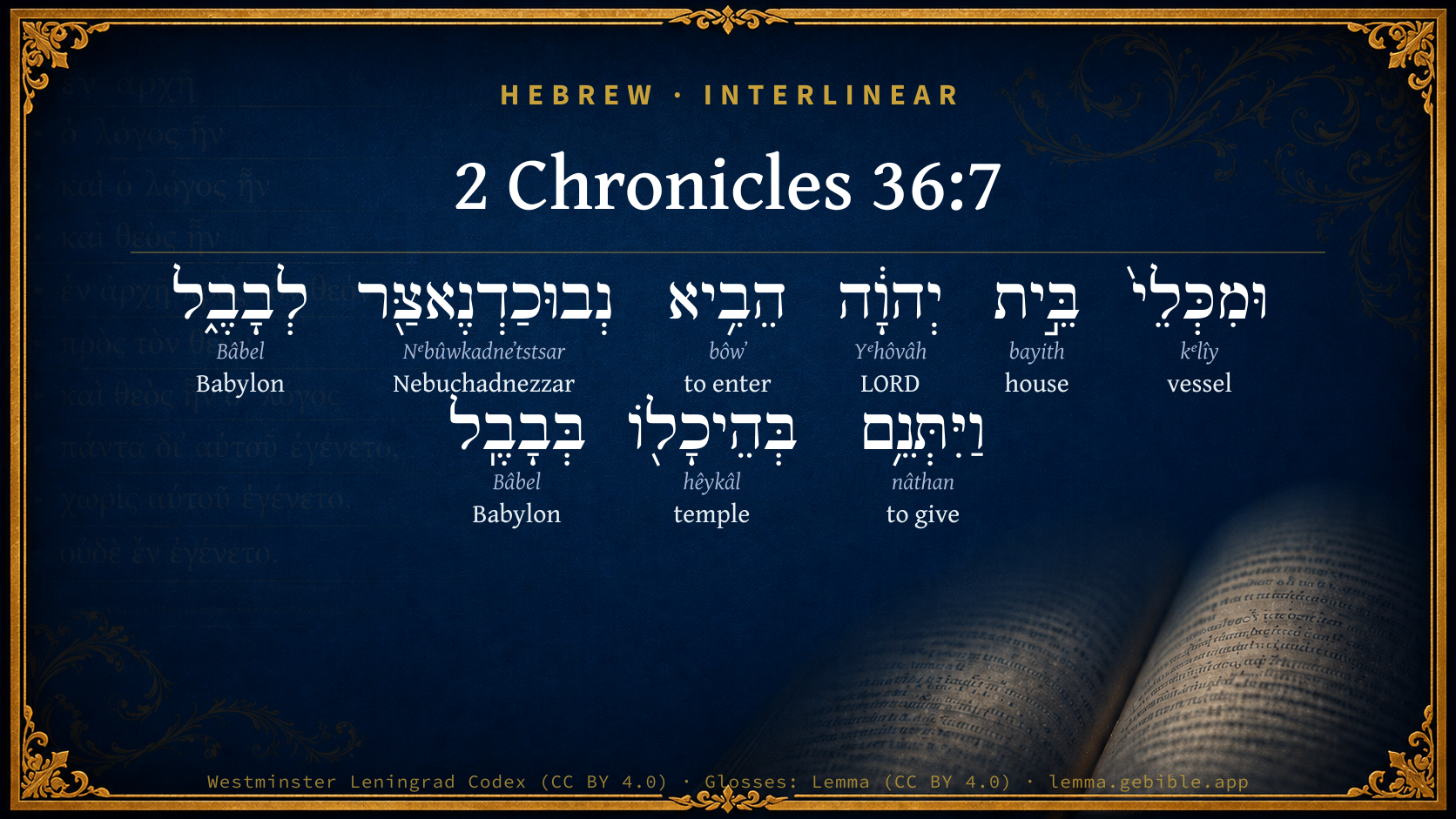
Hebrew (Westminster Leningrad Codex) 2 Chronicles 36:7 appears in the Hebrew Old Testament. The text above is from the Westminster Leningrad Codex. Each word links to its Strong’s number, a concise gloss, and parsing drawn from the Open Scriptures Hebrew Bible morphology. Click any word for its full Brown-Driver-Briggs (BDB) entry.
Download image
Cite this verse

2 Chronicles 36:7 (World English Bible). Public Domain. Lemma interlinear Bible study tool, https://lemma.gebible.app/v/2-chronicles/36/7.

Show BibTeX & RIS
BibTeX
RIS
English Translation
Nebuchadnezzar also carried of the vessels of the house of Yahweh to Babylon, and put them in his temple at Babylon.
World English Bible · Public Domain
Download a study sheet

One document with this verse’s original text, its word-by-word gloss line, the meaning frame, cross-references with their text, attributed commentary, and full source and license credits — printable, and it pastes into notes with its structure intact.

This verse Autodidact and up

Study sheet (.html) Plain text (.txt)

A passage Seminary Student

Up to 50 verses in one chapter. A passage sheet keeps up to 6 commentary sources and 12 cross-references per verse, in the order this page ranks them, and says so on the sheet whenever that leaves anything out. Ask for a single verse and you get the Autodidact verse sheet above.

Everything on this page stays free to read, with no account — the sheet is a download of what is already on screen, not access to it.

Want to remove ads? Support Godless Engineer
Compare translations 3

The same verse in 3 English versions, stacked beneath the original-language interlinear above. Click any original word for its lexicon entry.

Each is an independent rendering of the whole verse — the interlinear is not word-aligned to these translations.

Highlighted words mark where these versions differ — a whole-verse word diff, not a word-by-word alignment.

  • World English Bible Public Domain
    Nebuchadnezzar also carried of the vessels of the house of Yahweh to Babylon, and put them in his temple at Babylon.
  • King James Version Public Domain
    Nebuchadnezzar also carried of the vessels of the house of the LORD to Babylon, and put them in his temple at Babylon.
  • unfoldingWord Literal Text CC BY-SA 4.0
    And some of the items of the house of Yahweh Nebuchadnezzar brought to Babylon, and he placed them in his temple at Babylon.

unfoldingWord Literal Text — © unfoldingWord, licensed CC BY-SA 4.0. Word-aligned USFM3 via Door43 (git.door43.org/unfoldingWord/en_ult).

Versions to compare (up to 4)

3 of 4 selected

Show all 18 translations

Every available English version of this verse, each an independent rendering of the whole verse.

  • World English Bible Public Domain
    Nebuchadnezzar also carried of the vessels of the house of Yahweh to Babylon, and put them in his temple at Babylon.
  • Berean Standard Bible Public Domain
    Nebuchadnezzar also took to Babylon some of the articles from the house of the LORD, and he put them in his temple in Babylon.
  • Majority Standard Bible Public Domain
    Nebuchadnezzar also took to Babylon some of the articles from the house of the LORD, and he put them in his temple in Babylon.
  • King James Version Public Domain
    Nebuchadnezzar also carried of the vessels of the house of the LORD to Babylon, and put them in his temple at Babylon.
  • American Standard Version (1901) Public Domain
    Nebuchadnezzar also carried of the vessels of the house of Jehovah to Babylon, and put them in his temple at Babylon.
  • Revised Version (1885) Public Domain
    Nebuchadnezzar also carried of the vessels of the house of the LORD to Babylon, and put them in his temple at Babylon.
  • Geneva Bible (1599) Public Domain
    Nebuchadnezzar also caryed of the vessels of the house of the Lord to Babel, and put them in his temple at Babel.
  • Douay-Rheims (1899) Public Domain
    And he carried also thither the vessels of the Lord, and put them in his temple.
  • Young's Literal Translation Public Domain
    And of the vessels of the house of Jehovah hath Nebuchadnezzar brought in to Babylon, and putteth them in his temple in Babylon.
  • Literal Standard Version CC BY-SA 4.0
    And Nebuchadnezzar has brought from the vessels of the house of YHWH to Babylon, and puts them in his temple in Babylon.
  • Unlocked Literal Bible CC BY-SA 4.0
    Nebuchadnezzar also carried some of the objects in the house of Yahweh to Babylon, and put them in his palace at Babylon.
  • unfoldingWord Literal Text CC BY-SA 4.0
    And some of the items of the house of Yahweh Nebuchadnezzar brought to Babylon, and he placed them in his temple at Babylon.
  • Darby Bible Public Domain
    And Nebuchadnezzar carried [part] of the vessels of the house of Jehovah to Babylon, and put them in his temple at Babylon.
  • World Messianic Bible Public Domain
    Nebuchadnezzar also carried some of the vessels of the LORD’s house to Babylon, and put them in his temple at Babylon.
  • Webster's Bible Public Domain
    Nebuchadnezzar also carried of the vessels of the house of the LORD to Babylon, and put them in his temple at Babylon.
  • Free Bible Version CC BY-SA 4.0
    Nebuchadnezzar also took some items from the Lord's Temple, and he put them in his temple in Babylon.
  • Bible in Basic English Public Domain
    And Nebuchadnezzar took away some of the vessels of the Lord's house, and put them in the house of his god in Babylon.
  • JPS Tanakh (1917) Public Domain
    Nebuchadnezzar also carried of the vessels of the house of the LORD to Babylon, and put them in his temple at Babylon.

Literal Standard Version (2020), Covenant Press — licensed CC BY-SA 4.0. Text via the HelloAO Bible API (eBible.org). Unlocked Literal Bible (unfoldingWord) — licensed CC BY-SA 4.0. Text via the HelloAO Bible API (eBible.org). unfoldingWord Literal Text — © unfoldingWord, licensed CC BY-SA 4.0. Word-aligned USFM3 via Door43 (git.door43.org/unfoldingWord/en_ult). Free Bible Version, Dr. Jonathan Gallagher — licensed CC BY-SA 4.0. Text via the HelloAO Bible API (eBible.org).

Word by word

More ways to search: Search by grammar → Find every occurrence → Compare this word →

Practice this passage: Drill this verse → Learn its vocabulary →

נְבוּכַדְנֶאצַּ֖ר
Nᵉbûwkadneʼtstsar
H5019
“Nebuchadnezzar”
Noun, Proper
Part of Speech
Noun
Type
Proper
Full BDB Definition

Origin: of foreign derivation

TWOT: None

Nebuchadnezzar or Nebuchadrezzar = "may Nebo protect the crown" - the great king of Babylon who captured Jerusalem and carried Judah captive
  1. וּמִכְּלֵי֙ kᵉlîy H3627 “and · from · vessels of” Conjunction + Preposition + Noun, Common, Masculine, Plural, Construct
  2. בֵּ֣ית bayith H1004 “house of” Noun, Common, Masculine, Singular, Construct
  3. יְהוָ֔ה Yᵉhôvâh H3068 “LORD” Noun, Proper
  4. הֵבִ֥יא bôwʼ H935 “to enter” Verb, Hiphil, Perfect, 3rd Person, Masculine, Singular
  5. לְבָבֶ֑ל Bâbel H894 “to/for · Babylon” Preposition + Noun, Proper
  6. וַיִּתְּנֵ֥ם nâthan H5414 “and · to give · them” Conjunction + Verb, Qal, Sequential Imperfect, 3rd Person, Masculine, Singular + Suffix, Personal, 3rd Person, Masculine, Plural
  7. בְּהֵיכָל֖וֹ hêykâl H1964 “in/at · temple · his” Preposition + Noun, Common, Masculine, Singular, Construct + Suffix, Personal, 3rd Person, Masculine, Singular
  8. בְּבָבֶֽל Bâbel H894 “in/at · Babylon” Preposition + Noun, Proper

About this verse

These counts appear in no published source. They are computed here, from the morphology-tagged text and Lemma’s own curated glosses. What Lemma adds →

9
words
8
distinct lemmas
Historical
section

Shared distinctive vocabulary

נְבוּכַדְנֶאצַּ֖ר Nebuchadnezzar H5019 occurs in 58 verses of the Hebrew Bible. Also found in:

Grammatical profile

  • 2 verbs
  • 7 nouns

Verb forms

  • הֵבִ֥יא Hiphil · Perfect
  • וַיִּתְּנֵ֥ם Qal · Sequential Imperfect

Repetition

A word recurs within this verse — often emphatic in Hebrew:

  • לְבָבֶ֑ל Babylon H894 ×2

Hebrew & Septuagint length

In English translation the verse runs 21 words from the Hebrew and 25 from the Septuagint (LXX English) — closely comparable.

A rough comparison of the two English renderings, which tokenize alike — not a word-level alignment.

Word counts can differ between the Hebrew and the Greek without any difference in meaning — e.g. the Hebrew direct-object marker אֵת has no separate Greek word, and Greek often adds the article ὁ.

Cross-references

6

Topical passages linked to 2 Chronicles 36:7 in the Treasury of Scripture Knowledge — connected by theme and wording, ordered by reader-vote popularity; previews shown in the World English Bible.

  • 2 Kings 24:13 He carried out there all the treasures of the house of Yahweh, and the treasures of the king's house, and cut in pieces all the vessels of gold, which Solomon king of Israel had made in the temple of Yahweh, as Yahweh had said.
  • Ezra 1:7–11 Also Cyrus the king brought forth the vessels of the house of Yahweh, which Nebuchadnezzar had brought forth out of Jerusalem, and had put in the house of his gods;
  • Jeremiah 27:16–18 Also I spoke to the priests and to all this people, saying, Thus says Yahweh: Don't listen to the words of your prophets who prophesy to you, saying, Behold, the vessels of Yahweh's house shall now shortly be brought again from Babylon; for they prophesy a lie to you.
  • Jeremiah 28:3 Within two full years will I bring again into this place all the vessels of Yahweh's house, that Nebuchadnezzar king of Babylon took away from this place, and carried to Babylon:
  • Daniel 1:2 The Lord gave Jehoiakim king of Judah into his hand, with part of the vessels of the house of God; and he carried them into the land of Shinar to the house of his god: and he brought the vessels into the treasure-house of his god.
  • Daniel 5:2–4 Belshazzar, while he tasted the wine, commanded to bring the golden and silver vessels which Nebuchadnezzar his father had taken out of the temple which was in Jerusalem; that the king and his lords, his wives and his concubines, might drink from it.

Cross-references courtesy of OpenBible.info (CC BY 4.0).

Hebrew and Greek witnesses Masoretic Hebrew ↔ Greek Septuagint

The same verse in the two great witnesses to the Old Testament, shown verse-for-verse.

These are two independent witnesses, not word-aligned to each other, and the Septuagint is shown in lemma (dictionary) form.

Hebrew 2 Chronicles 36:7 Masoretic · Westminster Leningrad Codex

וּמִכְּלֵי֙ בֵּ֣ית יְהוָ֔ה הֵבִ֥יא נְבוּכַדְנֶאצַּ֖ר לְבָבֶ֑ל וַיִּתְּנֵ֥ם בְּהֵיכָל֖וֹ בְּבָבֶֽל

Nebuchadnezzar also carried of the vessels of the house of Yahweh to Babylon, and put them in his temple at Babylon.

World English Bible · Public Domain

Greek LXX 2 Chronicles 36:7 Septuagint · lemma form

καί μέρος ὁ σκεῦος οἶκος κύριος ἀποφέρω εἰς βαβυλών καί τίθημι αὐτός ἐν ὁ ναός αὐτός ἐν βαβυλών

And he carried away a part of the vessels of the house of the Lord to Babylon, and put them in his temple in Babylon.

LXX2012 (modern English Septuagint) · Public Domain

On this verse, The Cambridge Bible for Schools and Colleges discusses the Septuagint’s reading. Read the note in Commentary ↓

Hebrew: Westminster Leningrad Codex (CC BY 4.0). Greek: Septuagint (public domain); English from LXX2012 (modern English Septuagint) (Public Domain). How the Septuagint differs from the Hebrew →

Commentary

Notes on 2 Chronicles 36:7 from classic Christian and Jewish commentators (each source and its license shown beneath its notes). The classic Christian expositions comment on the surrounding passage and are grouped to its opening verse, so a note may address several verses; the Jewish commentaries on the Tanakh (Rashi and others) are per-verse, so they appear only where the commentator wrote on this verse.

Lemma curates 59 commentaries, every one of them public domain or Creative Commons licensed, each selected and text-cleaned for this edition rather than reprinted as found. About our sources →

Trapp's Complete Commentary

John Trapp

2Ch 36:7 Nebuchadnezzar also carried of the vessels of the house of the LORD to Babylon, and put them in his temple at Babylon.

Ver. 7. Nebuchadnezzar also carried off the vessels,] viz., Some of them, for some were carried to Babylon at other times. {2Ki 24:13 Jer 52:19}

John Trapp, A Commentary or Exposition upon All the Books of the Old and New Testament (1647–1656) — public domain. Text from a community e-Sword module.

Ellicott's Commentary for English Readers

(7) Nebuchadnezzar also carried.—And of the vessels of the house . . . did Nebuchadnezzar bring. Not mentioned in Kings, but confirmed by Dan_1:2.

In his temple.—The temple of “Mercdach, my Lord” (Bilu, i.e., Bel), whom his inscriptions so frequently mention. The great temple of Belus (Bel Merodach), which Nebuchadnezzar built, was one of the wonders of the world to Herodotus (Herod, i. 181 seq.)

A Bible Commentary for English Readers, edited by Charles John Ellicott (1878–1897) — public domain. Text from a community e-Sword module.

The Cambridge Bible for Schools and Colleges

gen. ed. J. J. S. Perowne

7. of the vessels] There is no mention in 2 Kin. of the removal of sacred vessels during Jehoiakim’s reign. Some were carried off under Jehoiachin, the rest under Zedekiah; 2Ki_24:13; 2Ki_25:13-17. Cp. last note.

in his temple] So LXX.; 1Es_1:39 [41]; Dan_1:2. R.V. mg., “in his palace.” The Heb. word (heykâl) is a loan-word; the original (ikallu) is the ordinary word in Assyrio-Babylonian for “palace.”

The Cambridge Bible for Schools and Colleges (gen. ed. J. J. S. Perowne; Cambridge University Press, 1878–1918) — public domain. Text from a community e-Sword module.

Albert Barnes' Notes on the Bible

In his temple - Compare “the house of his god” Dan 1:2. Nebuchadnezzars inscriptions show him to have been the special votary of Merodach, the Babylonian Mars. His temple, which the Greeks called the temple of Behus, was one of the most magnificent buildings in Babylon. Its ruins still remain in the vast mound, called Babil, which is the loftiest and most imposing of the “heaps” that mark the site of the ancient city.

Albert Barnes' Notes on the Bible (1834–1885) — public domain. Text from a community e-Sword/MySword module.

Haydock's Catholic Bible Commentary

The vessels. Heb. and Sept. "a part of the vessels;" probably the most precious, (v. 10) breaking the rest in pieces, as he left none behind, v. 18. --- Temple of his God, Daniel i. 2.

George Leo Haydock (1774–1849), Haydock's Catholic Family Bible and Commentary, 1859 edition — public domain. Excludes Psalms (Douay-Rheims chapter numbering differs from Protestant) and Deuterocanonical books (Catholic canon only).

The Pulpit Commentary

(Comp. Dan_2:2) The temple here called his temple was, no doubt, the temple of Belus, or in the vernacular "Merodach," the Babylonian god of war. This rifling of the sacred vessels of Jerusalem"s temple for Babylon"s temple was the significant beginning of the end for Judah now at last, after many a warning.

The Pulpit Commentary (1880–1919), ed. H.D.M. Spence-Jones & Joseph S. Exell — public domain. Text from a community e-Sword module.

Rashi

Rabbi Shlomo Yitzchaki (Rashi)

And some of the vessels of the House of the Lord And some of the vessels of the House of the Lord, and concerning this, Jeremiah prophesied (27:21): “For so said the Lord of Hosts, the God of Israel, concerning the vessels remaining, etc.” Seder Olam questions (Dan. 1:1): “In the third year of the reign of Jehoiakim, king of Judah, etc. and the Lord delivered...into his hand.” Here, however, it is apparent that it was in the eleventh year of his reign. Now what is the meaning of “in the third year”? Counting from his rebellion, for it is stated (II Kings 24:1): “and Jehoiakim was his vassal for three years, then he turned and rebelled against him” for three years, and in the third year of his rebellion, he advanced against him, and that is the eighth year of Nebuchadnezzar, for the master taught: In the first year [of his reign] he conquered Nineveh; in the second year he vanquished Jehoiakim, who served him for three years and rebelled against him for three years, and he did not reign until the fourth year of Jehoiakim, for it is stated (Jer. 25:1): “in the fourth year of Jehoiakim, the son of Josiah, king of Judah - that was the first year of Nebuchadnezzar.”

Rashi on the Tanakh — English translations: “The Judaica Press complete Tanach with Rashi, translated by A. J. Rosenberg” (CC BY 4.0); “Pentateuch with Rashi's commentary by M. Rosenbaum and A.M. Silbermann, 1929-1934” (public domain); “The Metsudah Tanach series, Lakewood, N.J” (CC BY 4.0); and “The Book of Joshua, Metsudah Publications, 1997” (CC BY 4.0). Text via Sefaria.

Lesson kit

Teaching starters — assembled from the data on this page, not authored interpretation. Every prompt links to the verse data it draws on. Edit before teaching.

2 Chronicles, in the Historical, opens this verse with 9 words (8 distinct Hebrew lemmas). Its most distinctive word is Nᵉbûwkadneʼtstsar (“Nebuchadnezzar”). A historical commentator’s framing appears above. Read the whole chapter for the surrounding context.

Discussion questions

  1. The word Nᵉbûwkadneʼtstsar carries the sense “Nebuchadnezzar.” How does it shape the verse?
  2. 2 Kings 24:1 shares the word «Nebuchadnezzar» with this verse. How do the two illuminate each other?
  3. “Babylon” occurs 2× in this one verse. What is the effect of the repetition?
  4. These translations render this verse differently. What is at stake in choosing one wording over another?
  5. The verb «הֵבִ֥יא» is Hiphil Perfect. How does its form color the action?
  6. Reading how Trapp's Complete Commentary and Ellicott's Commentary for English Readers read this verse, where do the two commentators agree and where do they part?

Things to notice

Reading settings

Reading text

Shown beneath each verse's original-language words.

Old Testament
Old Testament edition

Read the OT as the Masoretic Hebrew (MT) or the Greek Septuagint (LXX).

English shown for the Greek Septuagint (in the Hebrew ↔ Greek comparison).

Comparing translations? Open the Compare panel on any verse page to stack up to four side by side.