
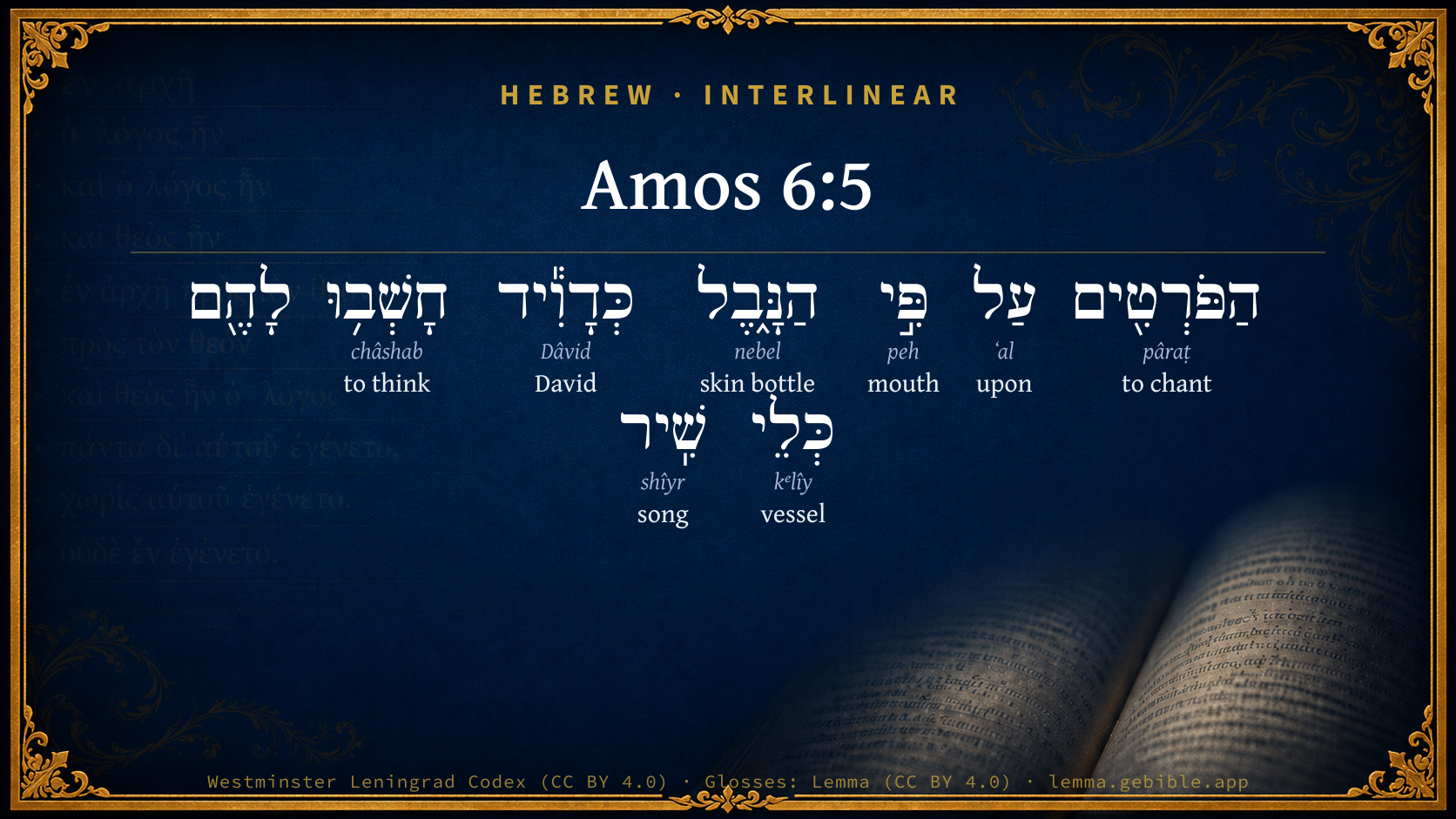
Amos 6:5

Hebrew (Westminster Leningrad Codex) Amos 6:5 appears in the Hebrew Old Testament. The text above is from the Westminster Leningrad Codex. Each word links to its Strong’s number, a concise gloss, and parsing drawn from the Open Scriptures Hebrew Bible morphology. Click any word for its full Brown-Driver-Briggs (BDB) entry.
Download image
Cite this verse

Amos 6:5 (World English Bible). Public Domain. Lemma interlinear Bible study tool, https://lemma.gebible.app/v/amos/6/5.

Show BibTeX & RIS
BibTeX
RIS
English Translation
Who strum on the strings of a harp; Who invent for themselves instruments of music, like David;
World English Bible · Public Domain
Highlights
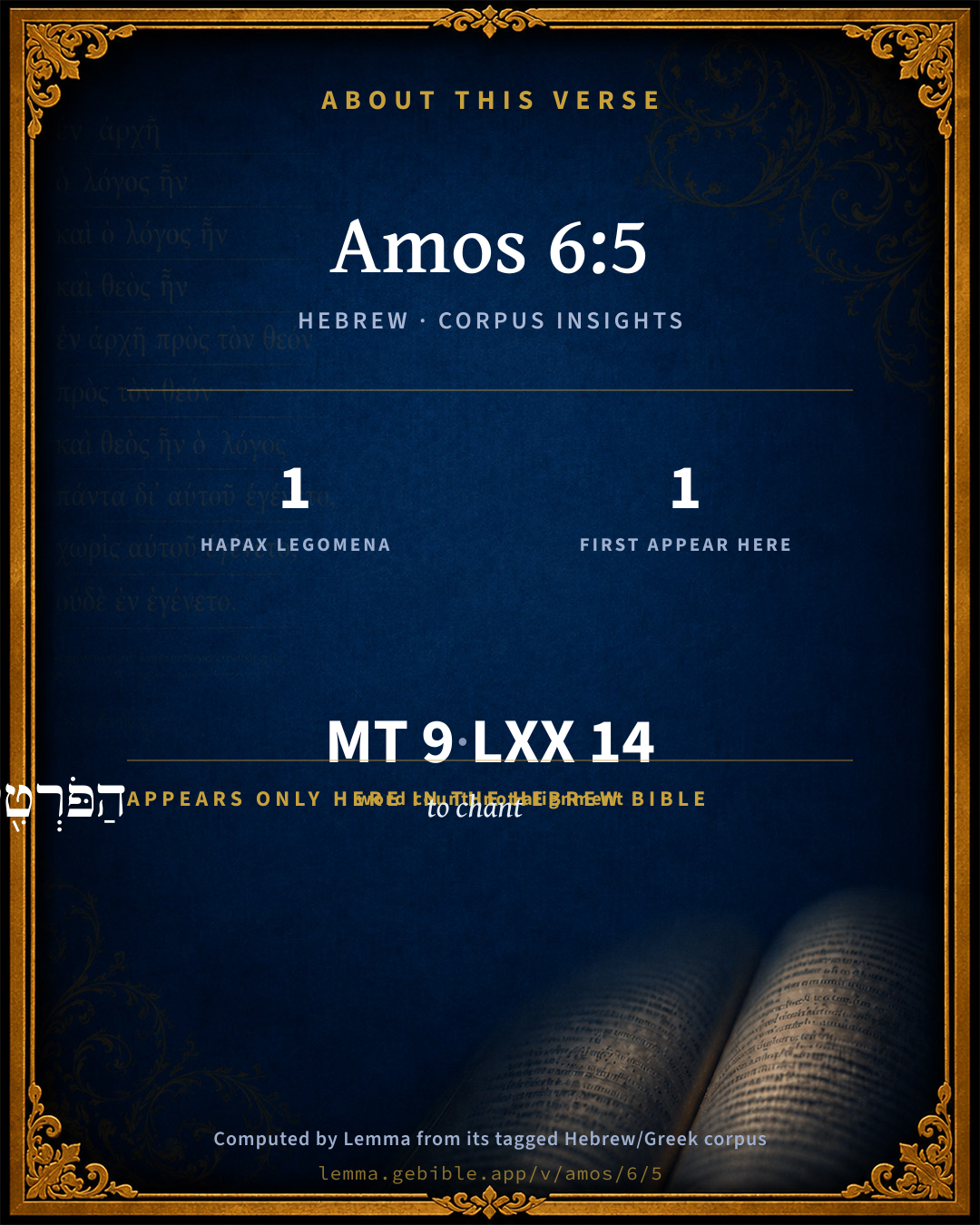
  • 1 hapax legomenon — only here in the Hebrew Bible
  • 1 first appearance in the Hebrew Bible
Full analysis ↓
Download a study sheet

One document with this verse’s original text, its word-by-word gloss line, the meaning frame, cross-references with their text, attributed commentary, and full source and license credits — printable, and it pastes into notes with its structure intact.

This verse Autodidact and up

Study sheet (.html) Plain text (.txt)

A passage Seminary Student

Up to 50 verses in one chapter. A passage sheet keeps up to 6 commentary sources and 12 cross-references per verse, in the order this page ranks them, and says so on the sheet whenever that leaves anything out. Ask for a single verse and you get the Autodidact verse sheet above.

Everything on this page stays free to read, with no account — the sheet is a download of what is already on screen, not access to it.

Want to remove ads? Support Godless Engineer
Compare translations 3

The same verse in 3 English versions, stacked beneath the original-language interlinear above. Click any original word for its lexicon entry.

Each is an independent rendering of the whole verse — the interlinear is not word-aligned to these translations.

Highlighted words mark where these versions differ — a whole-verse word diff, not a word-by-word alignment.

  • World English Bible Public Domain
    Who strum on the strings of a harp; Who invent for themselves instruments of music, like David;
  • King James Version Public Domain
    That chant to the sound of the viol, and invent to themselves instruments of musick, like David;
  • unfoldingWord Literal Text CC BY-SA 4.0
    They sing foolish songs to the music of the harp; they improvise on musical instruments as David did.

unfoldingWord Literal Text — © unfoldingWord, licensed CC BY-SA 4.0. Word-aligned USFM3 via Door43 (git.door43.org/unfoldingWord/en_ult).

Versions to compare (up to 4)

3 of 4 selected

Show all 18 translations

Every available English version of this verse, each an independent rendering of the whole verse.

  • World English Bible Public Domain
    Who strum on the strings of a harp; Who invent for themselves instruments of music, like David;
  • Berean Standard Bible Public Domain
    You improvise songs on the harp like David and invent your own musical instruments.
  • Majority Standard Bible Public Domain
    You improvise songs on the harp like David and invent your own musical instruments.
  • King James Version Public Domain
    That chant to the sound of the viol, and invent to themselves instruments of musick, like David;
  • American Standard Version (1901) Public Domain
    that sing idle songs to the sound of the viol; that invent for themselves instruments of music, like David;
  • Revised Version (1885) Public Domain
    that sing idle songs to the sound of the viol; that devise for themselves instruments of music, like David;
  • Geneva Bible (1599) Public Domain
    They sing to the sounde of the viole: they inuent to themselues instruments of musike like Dauid.
  • Douay-Rheims (1899) Public Domain
    You that sing to the sound of the psaltery: they have thought themselves to have instruments of music like David;
  • Young's Literal Translation Public Domain
    Who are taking part according to the psaltery, Like David they invented for themselves instruments of music;
  • Literal Standard Version CC BY-SA 4.0
    Who are taking part according to the stringed instrument, || Like David they invented for themselves instruments of music;
  • Unlocked Literal Bible CC BY-SA 4.0
    They sing foolish songs to the music of the harp; they improvise on instruments as David did.
  • unfoldingWord Literal Text CC BY-SA 4.0
    They sing foolish songs to the music of the harp; they improvise on musical instruments as David did.
  • Darby Bible Public Domain
    that chant to the sound of the lute, [and] invent them instruments of music, like David;
  • World Messianic Bible Public Domain
    who strum on the strings of a harp, who invent for themselves instruments of music, like David;
  • Webster's Bible Public Domain
    That chant to the sound of the viol, and invent to themselves instruments of music, like David;
  • Free Bible Version CC BY-SA 4.0
    You make up songs accompanied by the harp, thinking you're great composers like David.
  • Bible in Basic English Public Domain
    Making foolish songs to the sound of corded instruments, and designing for themselves instruments of music, like David;
  • JPS Tanakh (1917) Public Domain
    That thrum on the psaltery, that devise for themselves instruments of music, like David;

Literal Standard Version (2020), Covenant Press — licensed CC BY-SA 4.0. Text via the HelloAO Bible API (eBible.org). Unlocked Literal Bible (unfoldingWord) — licensed CC BY-SA 4.0. Text via the HelloAO Bible API (eBible.org). unfoldingWord Literal Text — © unfoldingWord, licensed CC BY-SA 4.0. Word-aligned USFM3 via Door43 (git.door43.org/unfoldingWord/en_ult). Free Bible Version, Dr. Jonathan Gallagher — licensed CC BY-SA 4.0. Text via the HelloAO Bible API (eBible.org).

Word by word

More ways to search: Search by grammar → Find every occurrence → Compare this word →

Practice this passage: Drill this verse → Learn its vocabulary →

About this verse

These counts appear in no published source. They are computed here, from the morphology-tagged text and Lemma’s own curated glosses. What Lemma adds →

9
words
8
distinct lemmas
Prophets
section

Notable vocabulary

1 hapax legomenon — a word that appears only here in the entire Hebrew Bible:

  • הַפֹּרְטִ֖ים to chant H6527

First appearance in Scripture

This word makes its first canonical appearance in the Hebrew Bible here:

  • הַפֹּרְטִ֖ים to chant H6527

Shared distinctive vocabulary

הַנָּ֑בֶל skin bottle H5035 occurs in 37 verses of the Hebrew Bible. Also found in:

Grammatical profile

  • 2 verbs
  • 5 nouns
  • 2 prepositions

Verb forms

  • הַפֹּרְטִ֖ים Qal · Participle Active
  • חָשְׁב֥וּ Qal · Perfect

Hebrew & Septuagint length

In English translation the verse runs 17 words from the Hebrew and 18 from the Septuagint (LXX English) — closely comparable.

A rough comparison of the two English renderings, which tokenize alike — not a word-level alignment.

Word counts can differ between the Hebrew and the Greek without any difference in meaning — e.g. the Hebrew direct-object marker אֵת has no separate Greek word, and Greek often adds the article ὁ.

In the original languages it is 9 Hebrew tokens and 14 Greek tokens — but the two are counted differently (Hebrew bundles its prefixes and suffixes into one token; the Greek is in lemma form), so that isn’t a like-for-like length.

Cross-references

10

Topical passages linked to Amos 6:5 in the Treasury of Scripture Knowledge — connected by theme and wording, ordered by reader-vote popularity; previews shown in the World English Bible.

  • Isaiah 5:12 The harp, lyre, tambourine, and flute, with wine, are at their feasts; But they don't regard the work of Yahweh, Neither have they considered the operation of his hands.
  • Amos 5:23 Take away from me the noise of your songs! I will not listen to the music of your harps.
  • Amos 8:3 The songs of the temple will be wailings in that day," says the Lord Yahweh. "The dead bodies will be many. In every place they will throw them out with silence.
  • Genesis 31:27 Why did you flee secretly, and deceive me, and didn't tell me, that I might have sent you away with mirth and with songs, with tambourine and with harp;
  • 1 Chronicles 15:16 David spoke to the chief of the Levites to appoint their brothers the singers, with instruments of music, psalteries and harps and cymbals, sounding aloud and lifting up the voice with joy.
  • 1 Chronicles 23:5 and four thousand were doorkeepers; and four thousand praised Yahweh with the instruments which I made, [said David], for giving praise.
  • Job 21:11–12 They send forth their little ones like a flock. Their children dance.
  • Ecclesiastes 2:8 I also gathered silver and gold for myself, and the treasure of kings and of the provinces. I got myself men-singers and women-singers, and the delights of the sons of men--musical instruments, and that of all sorts.
  • 1 Peter 4:3 For we have spent enough of our past time doing the desire of the Gentiles, and having walked in lewdness, lusts, drunken binges, orgies, carousings, and abominable idolatries.
  • Revelation 18:22 The voice of harpists, minstrels, flute players, and trumpeters will be heard no more at all in you. No craftsman, of whatever craft, will be found any more at all in you. The sound of a mill will be heard no more at all in you.

Cross-references courtesy of OpenBible.info (CC BY 4.0).

Hebrew and Greek witnesses Masoretic Hebrew ↔ Greek Septuagint

The same verse in the two great witnesses to the Old Testament, shown verse-for-verse.

These are two independent witnesses, not word-aligned to each other, and the Septuagint is shown in lemma (dictionary) form.

Hebrew Amos 6:5 Masoretic · Westminster Leningrad Codex

הַפֹּרְטִ֖ים עַל פִּ֣י הַנָּ֑בֶל כְּדָוִ֕יד חָשְׁב֥וּ לָהֶ֖ם כְּלֵי שִֽׁיר

Who strum on the strings of a harp; Who invent for themselves instruments of music, like David;

World English Bible · Public Domain

Greek LXX Amos 6:5 Septuagint · lemma form

ὁ ἐπικροτέω πρός ὁ φωνή ὁ ὄργανον ὡς ἵστημι λογίζομαι καί οὐ ὡς φεύγω

who excel in the sound of musical instruments; they have regarded them as dwelling, not as fleeting pleasures;

LXX2012 (modern English Septuagint) · Public Domain

On this verse, Haydock's Catholic Bible Commentary discusses the Septuagint’s reading. Read the note in Commentary ↓

Hebrew: Westminster Leningrad Codex (CC BY 4.0). Greek: Septuagint (public domain); English from LXX2012 (modern English Septuagint) (Public Domain). How the Septuagint differs from the Hebrew →

Targum (Aramaic paraphrase)

1

The Targum is the ancient Jewish Aramaic paraphrase of the Hebrew Scriptures — an interpretive translation, not the Hebrew text itself. Onkelos (literal) and Pseudo-Jonathan (expansive) render the Torah, and Jonathan the Prophets. Coverage is partial: where no permissively-licensed English translation exists for a verse, only the Aramaic is shown. This is verse-level text, not a word-by-word alignment to the Hebrew.

  1. Targum Jonathan Prophets (Joshua–Malachi)
    דִמְנַגָן עַל פּוּם נְבָלָא כְּדָוִיד אַתְקִינוּ לְהוֹן מָנֵי זְמָרָא:

    (no public-domain English translation for this verse)

    Targum Jonathan — Aramaic: “Mikraot Gedolot” (public domain). English: “Sefaria Community Translation” (CC0 1.0 (public-domain dedication)); “London "Chaldee Paraphrase," 1871” (public domain). Text via Sefaria.

Commentary

Notes on Amos 6:5 from classic Christian and Jewish commentators (each source and its license shown beneath its notes). The classic Christian expositions comment on the surrounding passage and are grouped to its opening verse, so a note may address several verses; the Jewish commentaries on the Tanakh (Rashi and others) are per-verse, so they appear only where the commentator wrote on this verse.

Lemma curates 59 commentaries, every one of them public domain or Creative Commons licensed, each selected and text-cleaned for this edition rather than reprinted as found. About our sources →

The Cambridge Bible for Schools and Colleges

gen. ed. J. J. S. Perowne

5. chant] improvise idly. The word (pâraṭ) occurs only here; and its meaning is uncertain: but (if the text be correct) this on the whole is the most probable rendering: see the Additional Note, p. 236. In illustration of the custom of having music at banquets, see Isa_5:12; Isa_24:9.

the viol] the harp (comp. Amo_5:23, and see p. 234 ff.).

devise for themselves instruments of musick, like David] or, perhaps, like David’s. The skill of David as a player on the kinnôr (p. 234) is of course, well known (1Sa_16:18; 1Sa_16:23, &c.): this passage speaks of him as famed further either for the musical instruments which he invented, or for those which he owned, and which will naturally have been performed upon either by himself or by others at his direction. The comparison rather suggests that the music for which David at this time was chiefly remembered was of a secular kind (cf., of Solomon, 1Ki_10:12 where ‘singers’ is not the term used technically in later writings of the Temple-singers), but it is obviously not inconsistent with the tradition embodied in the Chronicles that he cultivated sacred music as well. Comp. W. R. Smith, O.T.J.C[176][177] p. 223 f.

[176] .T.J.C. … W. Robertson Smith, The Old Testament in the Jewish Church, ed. 2, 1892.

[177] … W. Robertson Smith, The Old Testament in the Jewish Church, ed. 2, 1892.

Additional Note on Chap. Amo_6:5 (pâraṭ)

The root in Arabic which corresponds to the Hebrew pâraṭ means properly to precede, anticipate, hence faraṭa minhu kalâm, “speech proceeded from him prematurely, without reflexion,” and faraṭa ‘alaihi (Qor. 20:47), “he hasted (acted hastily and unjustly) against him”; conj. ii. to send before, hence to send before so as to leave, to relinquish, to fail, be remiss, neglectful in anything (Qor. 6:31, 12:80, 39:57); conj. iii. takallama firâṭan, he spoke hastily, without premeditation; conj. iv. to send before (Qor. xvi. 64 “They shall be sent first into the fire of hell”), to hasten, and (very frequently) to exceed due bounds, act extravagantly in a thing, ’afraṭa fi ’lqauli, to be immoderate in talk. It is thus just possible that, as Abul-walid supposed, it might be used of those who extemporized poetry over-rapidly, without premeditation, in a hurried flow of unmeaning, unconsidered words: hence R.V. sing idle songs. The mediaeval Jewish authorities, Rashi, Ibn Ezra, and David Kimchi, connecting the word with pereṭ (Lev_19:10), the fallen or separated berries in a vineyard, supposed it to denote the way in which a singer divides his words into parts (מְחַתֵּךְ אֶת־הַדּבּוּר בִּפְרוּסְרוּם) to suit the notes of the accompaniment; hence, no doubt, A. V. chant (marg. quaver). (In Dr Pusey’s note, “measured out defilements” should be “divided the melody”: a word was inaccurately transcribed in the Thesaurus of Gesenius; see Roediger’s note in the Appendix, p. 107, or Neubauer’s ed. of Abul-walid’s Lexicon, col. 586.)

An ancient Egyptian lyre (from Sir J. Gardner Wilkinson’s Ancient Egyptians, 1878, ii. 476).

An ancient Egyptian guitar[229] (from Sir J. Gardner Wilkinson’s Ancient Egyptians, 1878, ii. 481).

[229] The lute differs substantially from the guitar only in having a shorter neck.

The Cambridge Bible for Schools and Colleges (gen. ed. J. J. S. Perowne; Cambridge University Press, 1878–1918) — public domain. Text from a community e-Sword module.

Trapp's Complete Commentary

John Trapp

Amo 6:5 That chant to the sound of the viol, [and] invent to themselves instruments of musick, like David;

Ver. 5. That chant (or quaver) to the sound of the viol] That sing division with much variation of their voices, and many distinctions of diverse tones, modulations fractions. Particularizant, they sing their parts in concert. The Hebrew root word signifieth the single grains of grapes that remain after the vintage; or the particular berries, Lev 19:10. Our word parting, answereth to the Hebrew peret. It is their wanton and unseasonable music (emasculating, dissolving, and drawing out their spirits) that they are here threatened for. This abuse of music (given to men for better purposes) is elsewhere condemned, Amo 5:23 Isa 5:12 Exo 32:18 Ecc 2:8. God made not man more avium minurire, to be chirping of birds to sport on earth as leviathan doth in the sea; to spend his whole time (as the people of Tombutum, in Africa, are said to do) in singing and dancing; and, when he is cast out of one paradise, to make himself another. It is charged as a foul fault upon those sensualists in St James, that they had "lived in pleasure on the earth, and been wanton," Jas 5:5.

And invent to themselves instruments of music, like David] Whose example likely they pleaded to patronize their fiddlings and chanting of menial songs. But his music and theirs agreed like harp and harrow, as the proverb is. Two may do the same thing and yet it not be the same; because not from the same principles and for the same purposes: as we see in Cain and Abel, the Pharisee and the publican, David and these singsters, who did nothing less than help forward their devotion by music, as did David; and as did our late holy Esty, who, when he sat and heard a sweet concert of music, seemed upon this occasion carried up for the time beforehand to the place of his rest, saying very passionately, What music may we think there is in heaven? (Dr Hall’s Art of Div. Medit.)

John Trapp, A Commentary or Exposition upon All the Books of the Old and New Testament (1647–1656) — public domain. Text from a community e-Sword module.

Tyndale Open Study Notes

Tyndale Open Resources

6:5-6 These verses provide a picture of drunken revelry.

Tyndale Open Study Notes — © Tyndale Open Resources, licensed CC BY-SA 4.0. Text via the HelloAO Bible API.

Geneva Bible (1599)

Geneva Bible translators

As he caused divers kinds of instruments to be made to serve God’s glory, so these did contend to invent as many to serve their wanton affections and lusts.

Geneva Bible (1599) marginal notes — public domain. Text via Bolls.life.

Jamieson, Fausset & Brown

Robert Jamieson, A. R. Fausset & David Brown

chant--literally, "mark distinct sounds and tones."

viol--the lyre, or lute.

invent . . . instruments . . . like David--They fancy they equal David in musical skill (Ch1 23:5; Neh 12:36). They defend their luxurious passion for music by his example: forgetting that he pursued this study when at peace and free from danger, and that for the praise of God; but they pursue for their own self-gratification, and that when God is angry and ruin is imminent.

Jamieson, Fausset & Brown — Commentary Critical and Explanatory on the Whole Bible (1871) — public domain (CC PDM 1.0). Text via the HelloAO Bible API.

Adam Clarke's Commentary

Verse 5. And invent to themselves instruments of music, like David] 2Ch 23:5; and see especially Clarke's note on "2Ch 29:25". I believe that David was not authorized by the Lord to introduce that multitude of musical instruments into the Divine worship of which we read, and I am satisfied that his conduct in this respect is most solemnly reprehended by this prophet; and I farther believe that the use of such instruments of music, in the Christian Church, is without the sanction and against the will of God; that they are subversive of the spirit of true devotion, and that they are sinful. If there was a wo to them who invented instruments of music, as did David under the law, is there no wo, no curse to them who invent them, and introduce them into the worship of God in the Christian Church? I am an old man, and an old minister; and I here declare that I never knew them productive of any good in the worship of God; and have had reason to believe that they were productive of much evil. Music, as a science, I esteem and admire: but instruments of music in the house of God I abominate and abhor. This is the abuse of music; and here I register my protest against all such corruptions in the worship of the Author of Christianity. The late venerable and most eminent divine, the Rev. John Wesley, who was a lover of music, and an elegant poet, when asked his opinion of instruments of music being introduced into the chapels of the Methodists said, in his terse and powerful manner, "I have no objection to instruments of music in our chapels, provided they are neither HEARD nor SEEN." I say the same, though I think the expense of purchase had better be spared.

The word הפרטים happoretim, which we render chant, and the margin quaver, signifies to dance, to skip, &c. In the sight of such a text, fiddlers, drummers, waltzers, &c., may well tremble, who perform to excite detestable passions.

Adam Clarke's Commentary on the Bible (1810–1826) — public domain. Text from a community e-Sword/MySword module.

John Calvin's Commentaries

The word פרט, pereth, means to divide; so some explain it, and derive it from the clusters which remain after the vintage, because there are not then thick grapes, but a cluster here and there, and a great distance between: hence they think that the participle הפורטים, epurethim, is to be taken here metaphorically as meaning to divide by marks, as music has its various notes; for except there be a distinct variety in singing, the sound would be confused, and would produce no pleasing effect. Who sing then with the harps and have invented for themselves, after the example of David, musical instruments.

The Prophet still continues his discourse, and shows that these men lived sumptuously; as though they did not belong to the common class, they delighted themselves, against God’s will, not only in the common mode of living, but even sought new pleasures, as if they were continually at marriage feasts, or celebrating birthdays. As then they had no season for mourning, they pursued their own indulgences; and this is what the Prophet now reprehends. If then any one thinks that music is in these words condemned, he is much deceived, as it appears from the context. Indeed, the Prophet never dealt so rigidly with that people, but he ever kept to this point — that they were extremely torpid, nay, destitute of common sense, who perceived not that God showed himself angry with them, in order that they might flee immediately to the standard of repentance and humbly deprecate, with mourning, the wrath of God, as they ought to have done. It was therefore meet ever to set before them Gods wrath, which ought to have humbled the Jews and the Israelites, inasmuch as they ever obstinately set up against God their own indifference.

In saying that after the example of David they invented for themselves musical instruments, he no doubt greatly aggravated their sin by this comparison: for it is not likely that they had abused this pretext, as hypocrites do, who are wont to boast of the examples of the saints, when they seek to disguise their own vices, — “What!” some will say, “Did not David use musical instruments?” Others will say, “Had not Solomon very splendid palaces?” And some will add, “Had not Abraham a company of servants in his house?” So every one lays hold on what may avail for an excuse: and thus the examples of the saints are absurdly referred to by many. But it seems not probable that this was done by those whom Amos now addresses: but, on the contrary, he appears sharply to reprove them for provoking God’s wrath by self indulgence, and for manifesting their perverseness, while David employed musical instruments in the exercises of religion, to raise up his mind to God. No doubt, David, when in a peaceful state, after having been delivered from all dangers, could also amuse himself: but he applied musical instruments to another purpose — to sound forth the praises of God in the temple, that thereby he and other godly persons might together elevate their thoughts to a religious devotion. While David then, even in a state of peace and prosperity, did not allow his mind to become sunk in vain self-indulgences, these men, when God appeared angry, when he spread terror by so many tokens of his vengeance, yet dared contumaciously to follow their own ways, so that they left off nothing of their usual pomp and of their accustomed pleasures.

We now see the design of the comparison which the Prophet makes: He aggravates, I have no doubt, their sin, because they regarded not the example of David, but transferred musical instruments to serve the purpose of gross and beastly indulgences, and thus they did when God was opposed to them, when he had begun to terrify them by his vengeance. Let us proceed —

John Calvin's Commentaries (1540-1563) — public domain. Text from the Calvin Translation Society English edition (1840s-50s) via the Christian Classics Ethereal Library (ccel.org). Calvin's coverage is partial (roughly two-thirds of the Bible); uncommented books and verses are honest gaps, never fabricated. The 19th-century editor's footnotes and remarks are omitted so the notes are faithfully Calvin's own voice.

Ellicott's Commentary for English Readers

(5) Chant.—The original Hebrew only occurs in this passage, and is best rendered prattle, or jabber. The comparison with David is ironical He made these instruments to please the Lord, these princes to please themselves.

A Bible Commentary for English Readers, edited by Charles John Ellicott (1878–1897) — public domain. Text from a community e-Sword module.

John Gill's Exposition

That chant to the sound of the viol,.... Or psaltery; an instrument of twelve cords, and that gave twelve sounds, as Josephus (x) says, being stricken with the fingers; and to these sounds these men chanted or quivered, made like sounds with their voice, which they raised higher or lower, according to the sound of the instrument: they "particularized", as the word signifies (y); or observed the divisions and distinctions of notes and sounds, by the modulation of their voice:

and invent to themselves instruments of music, like David: not content with old ones, such as were used in former times, they invented new instruments and new tunes, and new songs to sing to them; as David made songs and invented several instruments of music to sing them upon and to, in religious worship, and for the praise and glory of God; so these men invented new ones to indulge their carnal mirth and jollity, in which they thought themselves to be justified by the example of David.

(x) Antiqu. l. 7. c. 19. sect. 3. (y) "particularizantes", Montanus; "qui particularia habent cantica", Pagninus; "qui particulatim canunt", Vatablus, Mercerus; "variis modulationibus concinunt", Tigurine version.

John Gill's Exposition of the Whole Bible (1746–1763) — public domain (CC PDM 1.0). Text via the HelloAO Bible API.

Albert Barnes' Notes on the Bible

That chant to the voice of the lyre - Accompanying “the voice of the lyre” with the human voice; giving vocal expression and utterance to what the instrumental music spoke without words. The word, which Amos alone uses in this one place, describes probably a hurried flow of unmeaning, unconsidered words, in which the rhythm of words and music was everything, the sense, nothing; much like most glees.

The English margin “quaver” has also some foundation in the root, but does not suit the idiom so well, which expresses that the act was something done “to the voice of the lyre,” accompanying the music, not altering the music itself. In fact, they would go together. An artificial, effeminate music which should relax the soul, frittering the melody, and displacing the power and majesty of divine harmony by tricks of art, and giddy, thoughtless, heartless, soulless versifying would be meet company. Debased music is a mark of a nation’s decay, and promotes it. The Hebrew music seems to have been very simple; and singing appears to have been reserved almost exclusively for solemn occasions, the temple-service, or the greeting of victory 1Sa 18:7. “Singing men and singing women” were part of the state of David and Solomon 2Sa 19:35; Ecc 2:8. Else the music at the feasts of the rich appears rather to be mentioned with blame Isa 5:12; Isa 24:9. Songs they had Pro 25:20; but the songs, for which the Hebrew exiles were celebrated, and which their Babylonian masters required them to sing, “the songs of Zion” Psa 137:3-4, were the hymns of the temple, “the Lord’s song.”

And invent to themselves instruments of music - The same pains, which David employed on music to the honor of God, they employed on their light, enervating unmeaningful music, and, if they were in earnest enough, justified their inventions by the example of David. Much as people have justified our degraded, sensualizing, immodest dancing, by the religious dancing of Holy Scripture! The word can mean no other than devised. David then did “devise” and “invent” instruments of music for the service of God. He introduced into the temple-service the use of the stringed instruments, the “kinnor,” (the “lyre”) and the “nebel” (the “harp”) in addition to the cymbals. Whence these, in contrast with the trumpets, are called “the instruments of David” (2Ch 29:26, compare 2Ch 29:25, and 1Ch 15:16, 1Ch 15:19-21, 1Ch 15:24). Probably, in adapting them to the temple-service, he, in some way, improved the existing instrument; having been, in early youth, remarkable for his skill upon the harp 1Sa 16:16, 1Sa 16:18, 1Sa 16:23. As he elevated the character and powers of the, perhaps rude, instrument which he found, and suited it to the service of God, so these people refined it doubtless, as they thought, and suited it for the service of luxury and sensuality. But what harm, they thought, in amending the music of their day, since so did David?

Albert Barnes' Notes on the Bible (1834–1885) — public domain. Text from a community e-Sword/MySword module.

Haydock's Catholic Bible Commentary

David. They think they excel him in music; but he consecrated his talent to a better purpose. (Calmet) --- Septuagint, "they deemed them stable, and not fugitive things." (Haydock) --- They have placed their chief good in such pleasures. (Theodoret) (Calmet)

George Leo Haydock (1774–1849), Haydock's Catholic Family Bible and Commentary, 1859 edition — public domain. Excludes Psalms (Douay-Rheims chapter numbering differs from Protestant) and Deuterocanonical books (Catholic canon only).

Matthew Poole's English Annotations

Woe to them that, in a time of deepest morning, do entertain themselves with songs, and with greatest skill sing to their musical instruments, as if they had no greater thing to mind!

Viol; or lute, or gittern, one kind put for every one used in their feastings at this time of Amos.

Invent to themselves instruments of music; not content with known, old-fashioned music, they find out new instruments, new songs and tunes.

Like David; in imitation of David, as they profanely pretend, or else emulating his skill, and preferring their own feast songs and music before his temple music and songs. We may imagine what songs such ungodly, cruel, voluptuous men would sing, and what tunes they would set too, on such occasions, viz. loose, profane, and impure enough.

Matthew Poole's English Annotations on the Holy Bible (1683–1685) — public domain. Text from a community e-Sword/MySword module.

The Pulpit Commentary

That chant. The word parat (apax legomenon) means rather "to prattle," "to sing idle songs," as the Revised Version translates it. The reading of the Septuagint varies between ejpikratountev. "excelling," and ejpikrotountev, the latter of which words might mean "applauding." Viol. (see note on Amo_5:23) Invent to themselves instruments of music, like David. As David devised stringed instruments and modes of singing to do honour to God and for the service of his sanctuary. (see 1Ch_15:16, etc.; 1Ch_23:5; 2Ch_29:26, 2Ch_29:27; and the supernumerary psalm at the end of the Psalter in the Septuagint) so these debauchees invented new singing and playing to grace their luxurious feasts. The Septuagint rendering, which Jerome calls "sensus pulcherrimus," is not to be explained by the present Hebrew text, however true to fact it may be considered, JWv eJsthkota ejlogisanto kaigonta. "Regarded them as abiding and not as fleeting things."

The Pulpit Commentary (1880–1919), ed. H.D.M. Spence-Jones & Joseph S. Exell — public domain. Text from a community e-Sword module.

John Wesley's Explanatory Notes

That chant - That in a time of deep mourning entertain themselves with songs, and musical instruments.

John Wesley, Explanatory Notes Upon the Whole Bible (1754–1765) — public domain. Text via the GEBible commentary corpus.

unfoldingWord translationNotes

Door43 World Missions Community

they improvise on instruments

Possible meanings: 1) they invent new songs and ways of playing the instruments or 2) they invent new instruments.

drink wine from bowls

This implies that they drink a lot of wine because they drink it from a large bowl rather than a regular wine cup. (See: Assumed Knowledge and Implicit Information)

they do not grieve over the ruin of Joseph

Here "Joseph" represents his descendants. AT: "they do not grieve about the descendants of Joseph whom enemies will soon destroy" (See: Metonymy)

translationWords

fool

harp

David

wine

anoint

oil

ruin

Joseph (OT)

unfoldingWord translationNotes — © Distant Shores Media and the Door43 World Missions Community, licensed CC BY-SA 4.0. Source: git.door43.org/Door43/en_tn.

Rashi

Rabbi Shlomo Yitzchaki (Rashi)

Who sing according to the tone of the lute—Menahem (Machbereth Menahem p. 145) classifies it with (Lev. 19:10) “And the single grapes (וּפֶרֶט) of your vineyard,” and I approve of his view, for the one who sings with a musical instrument separates the speech individually, everything according to the tone of the instrument, whether to raise [the note] or to lower [it].

they thought their musical instruments were like [those of] David—They thought their musical instruments were like the musical instruments of your servant David, which were meant for the sake of Heaven, but these were for enjoyment.

Rashi on the Tanakh — English translations: “The Judaica Press complete Tanach with Rashi, translated by A. J. Rosenberg” (CC BY 4.0); “Pentateuch with Rashi's commentary by M. Rosenbaum and A.M. Silbermann, 1929-1934” (public domain); “The Metsudah Tanach series, Lakewood, N.J” (CC BY 4.0); and “The Book of Joshua, Metsudah Publications, 1997” (CC BY 4.0). Text via Sefaria.

Lesson kit

Teaching starters — assembled from the data on this page, not authored interpretation. Every prompt links to the verse data it draws on. Edit before teaching.

Amos, in the Prophets, opens this verse with 9 words (8 distinct Hebrew lemmas). Its most distinctive word is pâraṭ (“to chant”). A historical commentator’s framing appears above. Read the whole chapter for the surrounding context.

Discussion questions

  1. What does “to chant” (pâraṭ) contribute to the verse as a whole?
  2. 1 word here appears nowhere else in the Hebrew Bible. Why might the author reach for such rare wording?
  3. This is the first place “to chant” appears in Scripture (first appears here). What does its debut here establish?
  4. How does 1 Samuel 1:24, which shares the word «skin bottle», read alongside this verse?
  5. These translations render this verse differently. What is at stake in choosing one wording over another?
  6. «הַפֹּרְטִ֖ים» is a Qal Participle Active verb. How does that grammatical form shape the action described?
  7. Compare how The Cambridge Bible for Schools and Colleges and Trapp's Complete Commentary read this verse. Where do they agree or differ?

Things to notice

Reading settings

Reading text

Shown beneath each verse's original-language words.

Old Testament
Old Testament edition

Read the OT as the Masoretic Hebrew (MT) or the Greek Septuagint (LXX).

English shown for the Greek Septuagint (in the Hebrew ↔ Greek comparison).

Comparing translations? Open the Compare panel on any verse page to stack up to four side by side.