
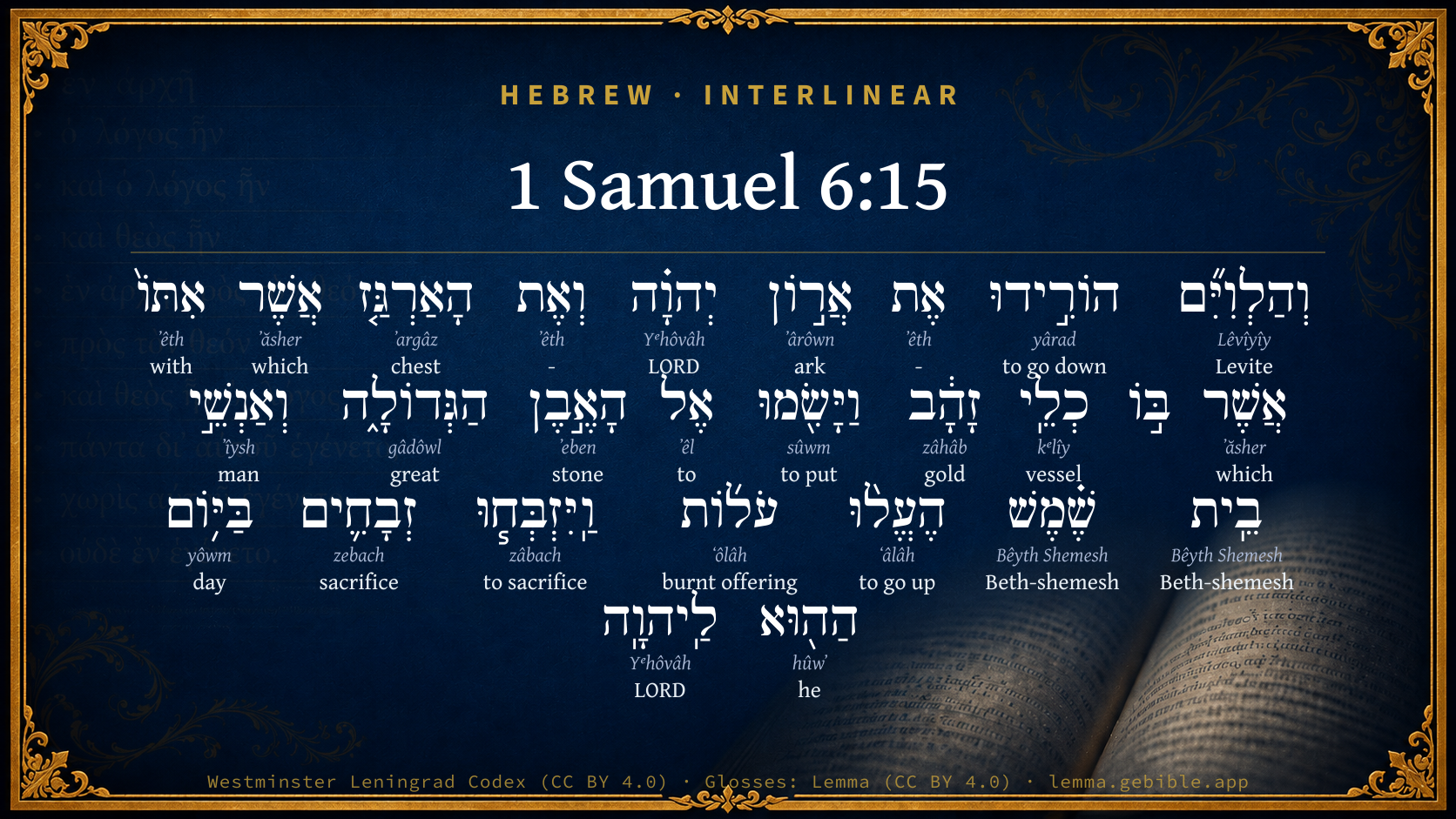
1 Samuel 6:15

Hebrew (Westminster Leningrad Codex) 1 Samuel 6:15 appears in the Hebrew Old Testament. The text above is from the Westminster Leningrad Codex. Each word links to its Strong’s number, a concise gloss, and parsing drawn from the Open Scriptures Hebrew Bible morphology. Click any word for its full Brown-Driver-Briggs (BDB) entry.
Download image
Cite this verse

1 Samuel 6:15 (World English Bible). Public Domain. Lemma interlinear Bible study tool, https://lemma.gebible.app/v/1-samuel/6/15.

Show BibTeX & RIS
BibTeX
RIS
English Translation
The Levites took down the ark of Yahweh, and the coffer that was with it, in which the jewels of gold were, and put them on the great stone: and the men of Beth-shemesh offered burnt offerings and sacrificed sacrifices the same day to Yahweh.
World English Bible · Public Domain
Download a study sheet

One document with this verse’s original text, its word-by-word gloss line, the meaning frame, cross-references with their text, attributed commentary, and full source and license credits — printable, and it pastes into notes with its structure intact.

This verse Autodidact and up

Study sheet (.html) Plain text (.txt)

A passage Seminary Student

Up to 50 verses in one chapter. A passage sheet keeps up to 6 commentary sources and 12 cross-references per verse, in the order this page ranks them, and says so on the sheet whenever that leaves anything out. Ask for a single verse and you get the Autodidact verse sheet above.

Everything on this page stays free to read, with no account — the sheet is a download of what is already on screen, not access to it.

Want to remove ads? Support Godless Engineer
Compare translations 3

The same verse in 3 English versions, stacked beneath the original-language interlinear above. Click any original word for its lexicon entry.

Each is an independent rendering of the whole verse — the interlinear is not word-aligned to these translations.

Highlighted words mark where these versions differ — a whole-verse word diff, not a word-by-word alignment.

  • World English Bible Public Domain
    The Levites took down the ark of Yahweh, and the coffer that was with it, in which the jewels of gold were, and put them on the great stone: and the men of Beth-shemesh offered burnt offerings and sacrificed sacrifices the same day to Yahweh.
  • King James Version Public Domain
    And the Levites took down the ark of the LORD, and the coffer that was with it, wherein the jewels of gold were, and put them on the great stone: and the men of Bethshemesh offered burnt offerings and sacrificed sacrifices the same day unto the LORD.
  • unfoldingWord Literal Text CC BY-SA 4.0
    Now the Levites had taken down the Box of Yahweh and the box that with it, in which were the objects of gold, and they had set on the great stone. And the men of Beth Shemesh offered burnt offerings and sacrificed sacrifices on that day to Yahweh.

unfoldingWord Literal Text — © unfoldingWord, licensed CC BY-SA 4.0. Word-aligned USFM3 via Door43 (git.door43.org/unfoldingWord/en_ult).

Versions to compare (up to 4)

3 of 4 selected

Show all 18 translations

Every available English version of this verse, each an independent rendering of the whole verse.

  • World English Bible Public Domain
    The Levites took down the ark of Yahweh, and the coffer that was with it, in which the jewels of gold were, and put them on the great stone: and the men of Beth-shemesh offered burnt offerings and sacrificed sacrifices the same day to Yahweh.
  • Berean Standard Bible Public Domain
    And the Levites took down the ark of the LORD and the chest containing the gold objects, and they placed them on the large rock. That day the men of Beth-shemesh offered burnt offerings and made sacrifices to the LORD.
  • Majority Standard Bible Public Domain
    And the Levites took down the ark of the LORD and the chest containing the gold objects, and they placed them on the large rock. That day the men of Beth-shemesh offered burnt offerings and made sacrifices to the LORD.
  • King James Version Public Domain
    And the Levites took down the ark of the LORD, and the coffer that was with it, wherein the jewels of gold were, and put them on the great stone: and the men of Bethshemesh offered burnt offerings and sacrificed sacrifices the same day unto the LORD.
  • American Standard Version (1901) Public Domain
    And the Levites took down the ark of Jehovah, and the coffer that was with it, wherein the jewels of gold were, and put them on the great stone: and the men of Beth-shemesh offered burnt-offerings and sacrificed sacrifices the same day unto Jehovah.
  • Revised Version (1885) Public Domain
    And the Levites took down the ark of the LORD, and the coffer that was with it, wherein the jewels of gold were, and put them on the great stone: and the men of Beth-shemesh offered burnt offerings and sacrificed sacrifices the same day unto the LORD.
  • Geneva Bible (1599) Public Domain
    And the Leuites tooke downe the Arke of the Lord, and the coffer that was with it, wherein the iewels of golde were, and put them on the great stone, and the men of Beth-shemesh offred burnt offring, and sacrificed sacrifices that same day vnto the Lord.
  • Douay-Rheims (1899) Public Domain
    And the Levites took down the ark of God, and the little box that was at the side of it, wherein were the vessels of gold, and they put them upon the great stone. The men also of Bethsames offered holocausts and sacrificed victims that day to the Lord.
  • Young's Literal Translation Public Domain
    And the Levites have taken down the ark of Jehovah, and the coffer which `is' with it, in which `are' the vessels of gold, and place `them' on the great stone; and the men of Beth-Shemesh have caused to ascend burnt-offerings and sacrifice sacrifices in that day to Jehovah;
  • Literal Standard Version CC BY-SA 4.0
    And the Levites have taken down the Ark of YHWH, and the coffer which [is] with it, in which [are] the vessels of gold, and place [them] on the great stone; and the men of Beth-Shemesh have caused burnt-offerings to ascend and sacrifice sacrifices in that day to YHWH;
  • Unlocked Literal Bible CC BY-SA 4.0
    The Levites took down the ark of Yahweh and the box that was with it, where the golden figures were, and put them on the great stone. The men of Beth Shemesh offered burnt offerings and made sacrifices the same day to Yahweh.
  • unfoldingWord Literal Text CC BY-SA 4.0
    Now the Levites had taken down the Box of Yahweh and the box that with it, in which were the objects of gold, and they had set on the great stone. And the men of Beth Shemesh offered burnt offerings and sacrificed sacrifices on that day to Yahweh.
  • Darby Bible Public Domain
    And the Levites took down the ark of Jehovah, and the coffer that was with it, in which were the golden jewels, and put them on the great stone; and the men of Beth-shemesh offered up burnt-offerings and sacrificed sacrifices the same day to Jehovah.
  • World Messianic Bible Public Domain
    The Levites took down the LORD’s ark and the box that was with it, in which the jewels of gold were, and put them on the great stone; and the men of Beth Shemesh offered burnt offerings and sacrificed sacrifices the same day to the LORD.
  • Webster's Bible Public Domain
    And the Levites took down the ark of the LORD, and the coffer that was with it, in which were the jewels of gold, and put them on the great stone: and the men of Beth-shemesh offered burnt-offerings and sacrificed sacrifices the same day to the LORD.
  • Free Bible Version CC BY-SA 4.0
    The Levites took down the Ark of the Lord and the chest containing the gold objects, and put them on the large rock. The people of Beth-shemesh presented burnt offerings and made sacrifices to the Lord that day.
  • Bible in Basic English Public Domain
    Then the Levites took down the ark of the Lord and the chest in which were the gold images, and put them on the great stone: and the men of Beth-shemesh made burned offerings and gave worship that day before the Lord.
  • JPS Tanakh (1917) Public Domain
    And the Levites took down the ark of the LORD, and the coffer that was with it, wherein the jewels of gold were, and put them on the great stone; and the men of Beth-shemesh offered burnt-offerings and sacrificed sacrifices the same day unto the LORD.

Literal Standard Version (2020), Covenant Press — licensed CC BY-SA 4.0. Text via the HelloAO Bible API (eBible.org). Unlocked Literal Bible (unfoldingWord) — licensed CC BY-SA 4.0. Text via the HelloAO Bible API (eBible.org). unfoldingWord Literal Text — © unfoldingWord, licensed CC BY-SA 4.0. Word-aligned USFM3 via Door43 (git.door43.org/unfoldingWord/en_ult). Free Bible Version, Dr. Jonathan Gallagher — licensed CC BY-SA 4.0. Text via the HelloAO Bible API (eBible.org).

Word by word

More ways to search: Search by grammar → Find every occurrence → Compare this word →

Practice this passage: Drill this verse → Learn its vocabulary →

הָאַרְגַּ֤ז
ʼargâz
H712
“the · chest”
Particle, Definite Article + Noun, Common, Masculine, Singular, Absolute
Part of Speech
Particle + Noun
Type
Common
Gender
Masculine
Number
Singular
State
Absolute
Full BDB Definition

Origin: perhaps from H7264 (in the sense of being suspended)

TWOT: 2112d

box, chest, coffer
  1. וְהַלְוִיִּ֞ם Lêvîyîy H3881 “and · the · Levites” Conjunction + Particle, Definite Article + Noun, Gentilic, Masculine, Plural, Absolute
  2. הוֹרִ֣ידוּ yârad H3381 “to go down” Verb, Hiphil, Perfect, 3rd Person, Common, Plural
  3. אֶת ʼêth H853 “-” Particle, Direct Object
  4. אֲר֣וֹן ʼârôwn H727 “ark of” Noun, Common, Both, Singular, Construct
  5. יְהוָ֗ה Yᵉhôvâh H3068 “LORD” Noun, Proper
  6. וְאֶת ʼêth H853 “and · -” Conjunction + Particle, Direct Object
  7. אֲשֶׁר ʼăsher H834 “which” Particle, Relative
  8. אִתּוֹ֙ ʼêth H854 “with · him” Preposition + Suffix, Personal, 3rd Person, Masculine, Singular
  9. אֲשֶׁר ʼăsher H834 “which” Particle, Relative
  10. כְלֵֽי kᵉlîy H3627 “vessels of” Noun, Common, Masculine, Plural, Construct
  11. זָהָ֔ב zâhâb H2091 “gold” Noun, Common, Masculine, Singular, Absolute
  12. וַיָּשִׂ֖מוּ sûwm H7760 “and · to put” Conjunction + Verb, Qal, Sequential Imperfect, 3rd Person, Masculine, Plural
  13. אֶל ʼêl H413 “to” Preposition
  14. הָאֶ֣בֶן ʼeben H68 “the · stone” Particle, Definite Article + Noun, Common, Feminine, Singular, Absolute
  15. הַגְּדוֹלָ֑ה gâdôwl H1419 “the · great” Particle, Definite Article + Adjective, Adjective, Feminine, Singular, Absolute
  16. וְאַנְשֵׁ֣י ʼîysh H376 “and · men of” Conjunction + Noun, Common, Masculine, Plural, Construct
  17. בֵֽית Bêyth Shemesh H1053 “Beth-shemesh” Noun, Proper
  18. שֶׁ֗מֶשׁ Bêyth Shemesh H1053 “Beth-shemesh” Noun, Proper
  19. הֶעֱל֨וּ ʻâlâh H5927 “to go up” Verb, Hiphil, Perfect, 3rd Person, Common, Plural
  20. עֹל֜וֹת ʻôlâh H5930 “burnt offerings” Noun, Common, Feminine, Plural, Absolute
  21. וַֽיִּזְבְּח֧וּ zâbach H2076 “and · to sacrifice” Conjunction + Verb, Qal, Sequential Imperfect, 3rd Person, Masculine, Plural
  22. זְבָחִ֛ים zebach H2077 “sacrifices” Noun, Common, Masculine, Plural, Absolute
  23. בַּיּ֥וֹם yôwm H3117 “in/at the · day” Preposition, Determined + Noun, Common, Masculine, Singular, Absolute
  24. הַה֖וּא hûwʼ H1931 “the · he” Particle, Definite Article + Pronoun, Personal, 3rd Person, Masculine, Singular
  25. לַֽיהוָֽה Yᵉhôvâh H3068 “to/for · LORD” Preposition + Noun, Proper

About this verse

These counts appear in no published source. They are computed here, from the morphology-tagged text and Lemma’s own curated glosses. What Lemma adds →

27
words
22
distinct lemmas
Historical
section

Notable vocabulary

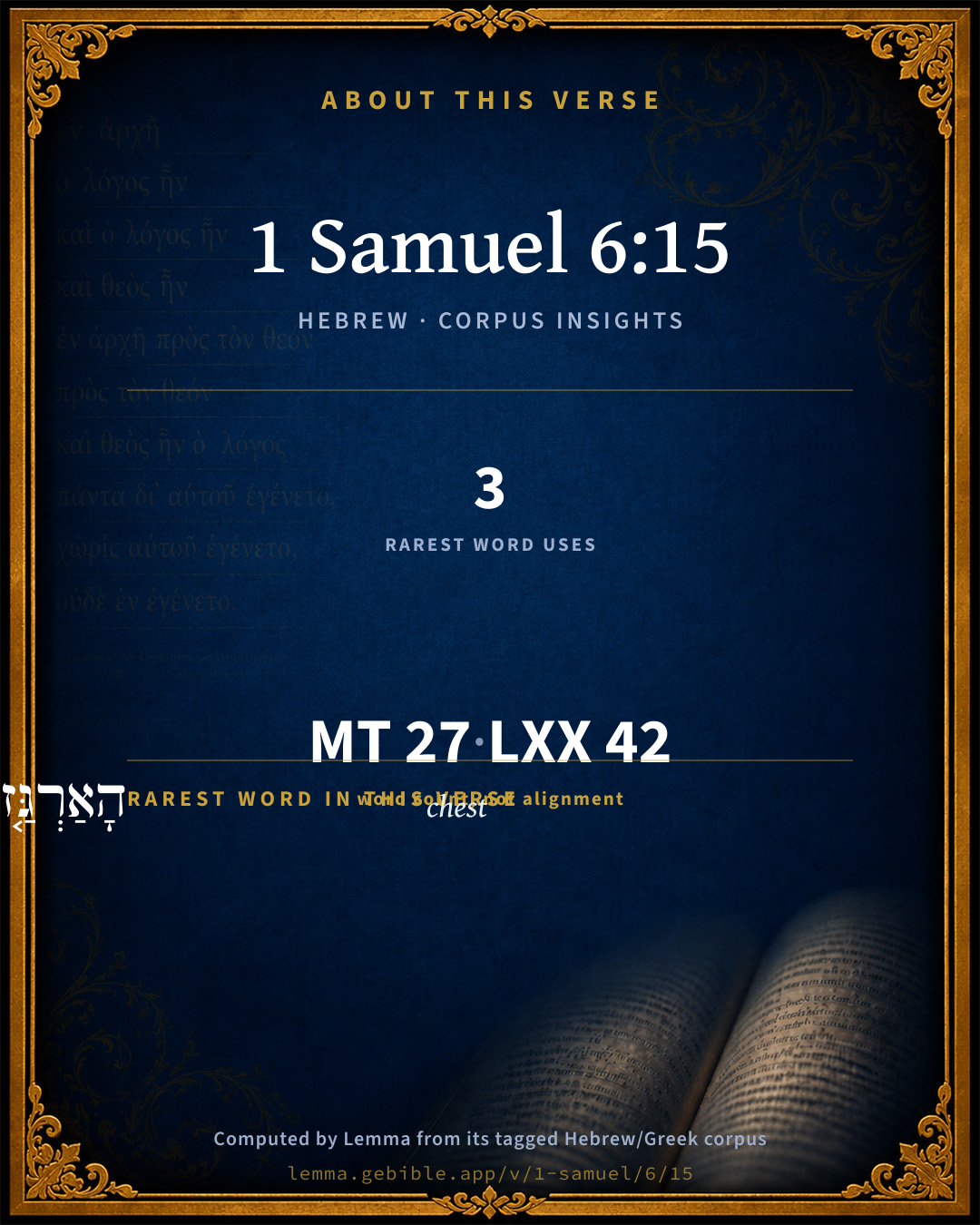
The rarest word here is הָאַרְגַּ֤ז chest H712 — appearing just 3 times in the whole Hebrew Bible.

Shared distinctive vocabulary

הָאַרְגַּ֤ז chest H712 occurs in 3 verses of the Hebrew Bible. Also found in:

Grammatical profile

  • 4 verbs
  • 14 nouns
  • 1 adjective
  • 1 pronoun
  • 3 prepositions
  • 4 particles

Verb forms

  • הוֹרִ֣ידוּ Hiphil · Perfect
  • וַיָּשִׂ֖מוּ Qal · Sequential Imperfect
  • הֶעֱל֨וּ Hiphil · Perfect
  • וַֽיִּזְבְּח֧וּ Qal · Sequential Imperfect

Repetition

Words recur within this verse — often emphatic in Hebrew:

  • יְהוָ֗ה LORD H3068 ×2
  • בֵֽית Beth-shemesh H1053 ×2
  • אֲשֶׁר which H834 ×2

Hebrew & Septuagint length

In English translation the verse runs 45 words from the Hebrew and 46 from the Septuagint (LXX English) — closely comparable.

A rough comparison of the two English renderings, which tokenize alike — not a word-level alignment.

Word counts can differ between the Hebrew and the Greek without any difference in meaning — e.g. the Hebrew direct-object marker אֵת has no separate Greek word, and Greek often adds the article ὁ.

In the original languages it is 27 Hebrew tokens and 42 Greek tokens — but the two are counted differently (Hebrew bundles its prefixes and suffixes into one token; the Greek is in lemma form), so that isn’t a like-for-like length.

Cross-references

1

Topical passages linked to 1 Samuel 6:15 in the Treasury of Scripture Knowledge — connected by theme and wording, ordered by reader-vote popularity; previews shown in the World English Bible.

  • Joshua 3:3 and they commanded the people, saying, When you see the ark of the covenant of Yahweh your God, and the priests the Levites bearing it, then you shall remove from your place, and go after it.

Cross-references courtesy of OpenBible.info (CC BY 4.0).

Hebrew and Greek witnesses Masoretic Hebrew ↔ Greek Septuagint

The same verse in the two great witnesses to the Old Testament, shown verse-for-verse.

These are two independent witnesses, not word-aligned to each other, and the Septuagint is shown in lemma (dictionary) form.

Hebrew 1 Samuel 6:15 Masoretic · Westminster Leningrad Codex

וְהַלְוִיִּ֞ם הוֹרִ֣ידוּ אֶת אֲר֣וֹן יְהוָ֗ה וְאֶת הָאַרְגַּ֤ז אֲשֶׁר אִתּוֹ֙ אֲשֶׁר בּ֣וֹ כְלֵֽי זָהָ֔ב וַיָּשִׂ֖מוּ אֶל הָאֶ֣בֶן הַגְּדוֹלָ֑ה וְאַנְשֵׁ֣י בֵֽית שֶׁ֗מֶשׁ הֶעֱל֨וּ עֹל֜וֹת וַֽיִּזְבְּח֧וּ זְבָחִ֛ים בַּיּ֥וֹם הַה֖וּא לַֽיהוָֽה

The Levites took down the ark of Yahweh, and the coffer that was with it, in which the jewels of gold were, and put them on the great stone: and the men of Beth-shemesh offered burnt offerings and sacrificed sacrifices the same day to Yahweh.

World English Bible · Public Domain

Greek LXX 1 Samuel 6:15 Septuagint · lemma form

καί ὁ λευίτης ἀναφέρω ὁ κιβωτός ὁ κύριος καί ὁ θέμα εργαβ μετά αὐτός καί ὁ ἐπί αὐτός σκεῦος ὁ χρυσοῦς καί τίθημι ἐπί ὁ λίθος ὁ μέγας καί ὁ ἀνήρ βαιθσαμυς ἀναφέρω ὁλοκαύτωσις καί θυσία ἐν ὁ ἡμέρα ἐκεῖνος ὁ κύριος

And the Levites brought up the ark of the Lord, and the coffer with it, and the golden articles upon it, and placed them on the great stone, and the men of Baethsamys offered whole burnt offerings and meat offerings on that day to the Lord.

LXX2012 (modern English Septuagint) · Public Domain

On this verse, Keil & Delitzsch discusses the Septuagint’s reading. Read the note in Commentary ↓

Hebrew: Westminster Leningrad Codex (CC BY 4.0). Greek: Septuagint (public domain); English from LXX2012 (modern English Septuagint) (Public Domain). How the Septuagint differs from the Hebrew →

Targum (Aramaic paraphrase)

1

The Targum is the ancient Jewish Aramaic paraphrase of the Hebrew Scriptures — an interpretive translation, not the Hebrew text itself. Onkelos (literal) and Pseudo-Jonathan (expansive) render the Torah, and Jonathan the Prophets. Coverage is partial: where no permissively-licensed English translation exists for a verse, only the Aramaic is shown. This is verse-level text, not a word-by-word alignment to the Hebrew.

  1. Targum Jonathan Prophets (Joshua–Malachi)
    וְלֵוָאֵי אָחִיתוּ יַת אָרוֹנָא דַייָ וְיַת תֵּיבוּתָא דִי עִמֵיהּ דִי בֵיהּ מָנֵי דַהֲבָא וְשַׁוִיאוּ עַל אַבְנָא רַבְּתָא וְגַבְרֵי בֵית שֶׁמֶשׁ אַסִיקוּ עֲלַוָן וּנְכִיסוּ נִכְסַת קוּדְשִׁין בְּיוֹמָא הַהוּא קֳדָם יְיָ:

    (no public-domain English translation for this verse)

    Targum Jonathan — Aramaic: “Mikraot Gedolot” (public domain). English: “Sefaria Community Translation” (CC0 1.0 (public-domain dedication)); “London "Chaldee Paraphrase," 1871” (public domain). Text via Sefaria.

Commentary

Notes on 1 Samuel 6:15 from classic Christian and Jewish commentators (each source and its license shown beneath its notes). The classic Christian expositions comment on the surrounding passage and are grouped to its opening verse, so a note may address several verses; the Jewish commentaries on the Tanakh (Rashi and others) are per-verse, so they appear only where the commentator wrote on this verse.

Lemma curates 59 commentaries, every one of them public domain or Creative Commons licensed, each selected and text-cleaned for this edition rather than reprinted as found. About our sources →

Trapp's Complete Commentary

John Trapp

1Sa 6:15 And the Levites took down the ark of the LORD, and the coffer that [was] with it, wherein the jewels of gold [were], and put [them] on the great stone: and the men of Bethshemesh offered burnt offerings and sacrificed sacrifices the same day unto the LORD.

Ver. 15. And put them on the great stone.] Or, Beside it, rather, as Comestor hath it, for upon the stone they offered their sacrifices: which they might the better do in that place, because they had the ark with them, which was the visible sign of God’s presence.

John Trapp, A Commentary or Exposition upon All the Books of the Old and New Testament (1647–1656) — public domain. Text from a community e-Sword module.

Keil & Delitzsch

C. F. Keil & F. Delitzsch

Sa1 6:15 contains a supplementary remark, therefore הורידוּ is to be translated as a pluperfect. After sacrificing the cart, with the cows, as a burnt-offering to the Lord, the inhabitants of Bethshemesh gave a further practical expression to their joy at the return of the ark, by offering burnt-offerings and slain-offerings in praise of God. In the burnt-offerings they consecrated themselves afresh, with all their members, to the service of the Lord; and in the slain-offerings, which culminated in the sacrificial meals, they sealed anew their living fellowship with the Lord. The offering of these sacrifices at Bethshemesh was no offence against the commandment, to sacrifice to the Lord at the place of His sanctuary alone. The ark of the covenant was the throne of the gracious presence of God, before which the sacrifices were really offered at the tabernacle. The Lord had sanctified the ark afresh as the throne of His presence, by the miracle which He had wrought in bringing it back again. - In Sa1 6:17 and Sa1 6:18 the different atoning presents, which the Philistines sent to Jehovah as compensation, are enumerated once more: viz., five golden boils, one for each of their five principal towns (see at Jos 13:3), and "golden mice, according to the number of all the Philistian towns of the five princes, from the fortified city to the village of the inhabitants of the level land" (perazi; see at Deu 3:5). The priests had only proposed that five golden mice should be sent as compensation, as well as five boils (Sa1 6:4). But the Philistines offered as many images of mice as there were towns and villages in their five states, no doubt because the plague of mice had spread over the whole land, whereas the plague of boils had only fallen upon the inhabitants of those towns to which the ark of the covenant had come. In this way the apparent discrepancy between Sa1 6:4 and Sa1 6:18 is very simply removed. The words which follow, viz., וגו עליה הגּיחוּ עשׁר, "upon which they had set down the ark," show unmistakeably, when compared with Sa1 6:14 and Sa1 6:15, that we are to understand by הגּדולה אבל the great stone upon which the ark was placed when it was taken off the cart. The conjecture of Kimchi, that this stone was called Abel (luctus), on account of the mourning which took place there (see Sa1 6:19), is extremely unnatural. Consequently there is no other course left than to regard אבל as an error in writing for אבן, according to the reading, or at all events the rendering, adopted by the lxx and Targum. But ועד (even unto) is quite unsuitable here, as no further local definition is required after the foregoing הפּרי כּפר ועד, and it is impossible to suppose that the Philistines offered a golden mouse as a trespass-offering for the great stone upon which the ark was placed. We must therefore alter ועד into ועד: "And the great stone is witness (for ועד in this sense, see Gen 31:52) to this day in the field of Joshua the Bethshemeshite," sc., of the fact just described.

Keil & Delitzsch — Biblical Commentary on the Old Testament (1861–1891) — public domain (CC PDM 1.0). Text via the HelloAO Bible API. (Old Testament only.)

Tyndale Open Study Notes

Tyndale Open Resources

6:15 Providentially, the Ark had arrived in Beth-shemesh (6:13), which was a Levite city (Josh 21:13-16). The men of the tribe of Levi who lived there could safely move the Ark (see Num 4:15).

Tyndale Open Study Notes — © Tyndale Open Resources, licensed CC BY-SA 4.0. Text via the HelloAO Bible API.

Adam Clarke's Commentary

Verse 15. The Levites took down] It appears there were some of the tribe of Levi among the people of Beth-shemesh: to them appertained the service of the tabernacle.

Adam Clarke's Commentary on the Bible (1810–1826) — public domain. Text from a community e-Sword/MySword module.

The Cambridge Bible for Schools and Colleges

gen. ed. J. J. S. Perowne

15. And the Levites took down] Rather, in accordance with 1Sa_6:14, Now the Levites had taken down. As Beth-shemesh was a priestly city, “Levites” appears to be used here in a general sense to mean “members of the tribe of Levi,” not in its technical sense of “Levites” as distinguished from “priests.” Cp. Exo_4:14; Jos_3:3.

the men of Beth-shemesh, &c.] In addition to the offering of the kine mentioned in the previous verse, the inhabitants of the town brought offerings of their own. The burst-offerings symbolized renewed consecration of the worshippers to the service of Jehovah: the sacrifices were thank-offerings to Jehovah for His goodness in restoring the Ark.

The Cambridge Bible for Schools and Colleges (gen. ed. J. J. S. Perowne; Cambridge University Press, 1878–1918) — public domain. Text from a community e-Sword module.

John Gill's Exposition

And the Levites took down the ark of the Lord,.... Or, "had took it down" (x); for this, though here related, was done as soon as the ark came into the field, or quickly after, and before the burnt offering could be made, which was burnt with the wood of the cart; and though the persons that took it down are called Levites, they were priests, who were of the tribe of Levi; for it was the work of the priests to take it down, though the Levites then might carry it; and it is remarkable that Bethshemesh was given to the Kohathite Levites, whose business it was to carry the ark on their shoulders; see Jos 21:10.

and the coffer that was with it, wherein the jewels of gold were; the purse or bag in which were the five golden mice, and the five golden emerods:

and put them on the great stone; both the ark and the coffer, by which the cart stood, and on which the sacrifice of burnt offering was probably offered:

and the men of Bethshemesh offered burnt offerings, and sacrificed sacrifices, the same day unto the Lord; besides the burnt offering of the two cows, they offered others to testify their thankfulness for the return of the ark; and also peace offerings, on which they feasted with one another, to express their greater joy.

(x) "deposuerant", Meudoza; so Pool.

John Gill's Exposition of the Whole Bible (1746–1763) — public domain (CC PDM 1.0). Text via the HelloAO Bible API.

Albert Barnes' Notes on the Bible

The word “Levites” here probably means priests Exo 4:14, sons of Levi, since Bethshemesh was one of the cities of the priests Jos 21:13-16. The burnt offering of the kine was not in any sense the offering of the men of Bethshemesh, but rather of the Philistine lords to whom the cart and the kine belonged. But the Bethshemites themselves, in token of their gratitude for such a signal mercy, now offered both burnt offerings and sacrifices, probably peace offerings, and doubtless feasted together with great joy and gladness (see 1Ki 8:62-66; Ezr 6:16-17). There is nothing whatever in the text to indicate that these sacrifices were offered otherwise than in the appointed way by the priests.

Albert Barnes' Notes on the Bible (1834–1885) — public domain. Text from a community e-Sword/MySword module.

Haydock's Catholic Bible Commentary

Vessels. Protestants less properly, "jewels of gold." (Haydock)

George Leo Haydock (1774–1849), Haydock's Catholic Family Bible and Commentary, 1859 edition — public domain. Excludes Psalms (Douay-Rheims chapter numbering differs from Protestant) and Deuterocanonical books (Catholic canon only).

Matthew Poole's English Annotations

And the Levites took down, or, for the Levites had taken down; for this, though mentioned after, was done before the sacrifices were offered.

Matthew Poole's English Annotations on the Holy Bible (1683–1685) — public domain. Text from a community e-Sword/MySword module.

Whedon's Commentary on the Bible

Daniel D. Whedon

15. The Levites took down — We have already noticed that Beth-shemesh was a city of the Levites, (see on 1Sa_6:9.) There was fitness in the kine stopping and standing still, when they had brought the sacred treasure to those whose duty it was to look after it.

Daniel D. Whedon (gen. ed.), Commentary on the Old and New Testaments (1874–1909) — public domain. Text from a community e-Sword module.

The Pulpit Commentary

The Levites took down the ark. Naturally, in a city of which priests formed the ruling caste, the people would be acquainted with the general nature of the regulations of the law. Apparently it was only after the sacrificial feast that they forgot the reverence due to the symbol of Jehovah"s presence among them.

The Pulpit Commentary (1880–1919), ed. H.D.M. Spence-Jones & Joseph S. Exell — public domain. Text from a community e-Sword module.

Lesson kit

Teaching starters — assembled from the data on this page, not authored interpretation. Every prompt links to the verse data it draws on. Edit before teaching.

1 Samuel, in the Historical, opens this verse with 27 words (22 distinct Hebrew lemmas). Its most distinctive word is ʼargâz (“chest”). A historical commentator’s framing appears above. Read the whole chapter for the surrounding context.

Discussion questions

  1. What does “chest” (ʼargâz) contribute to the verse as a whole?
  2. 1 Samuel 6:8 shares the word «chest» with this verse. How do the two illuminate each other?
  3. “LORD” occurs 2× in this one verse. What is the effect of the repetition?
  4. These translations render this verse differently. What is at stake in choosing one wording over another?
  5. The verb «הוֹרִ֣ידוּ» is Hiphil Perfect. How does its form color the action?
  6. Reading how Trapp's Complete Commentary and Keil & Delitzsch read this verse, where do the two commentators agree and where do they part?

Things to notice

Reading settings

Reading text

Shown beneath each verse's original-language words.

Old Testament
Old Testament edition

Read the OT as the Masoretic Hebrew (MT) or the Greek Septuagint (LXX).

English shown for the Greek Septuagint (in the Hebrew ↔ Greek comparison).

Comparing translations? Open the Compare panel on any verse page to stack up to four side by side.