
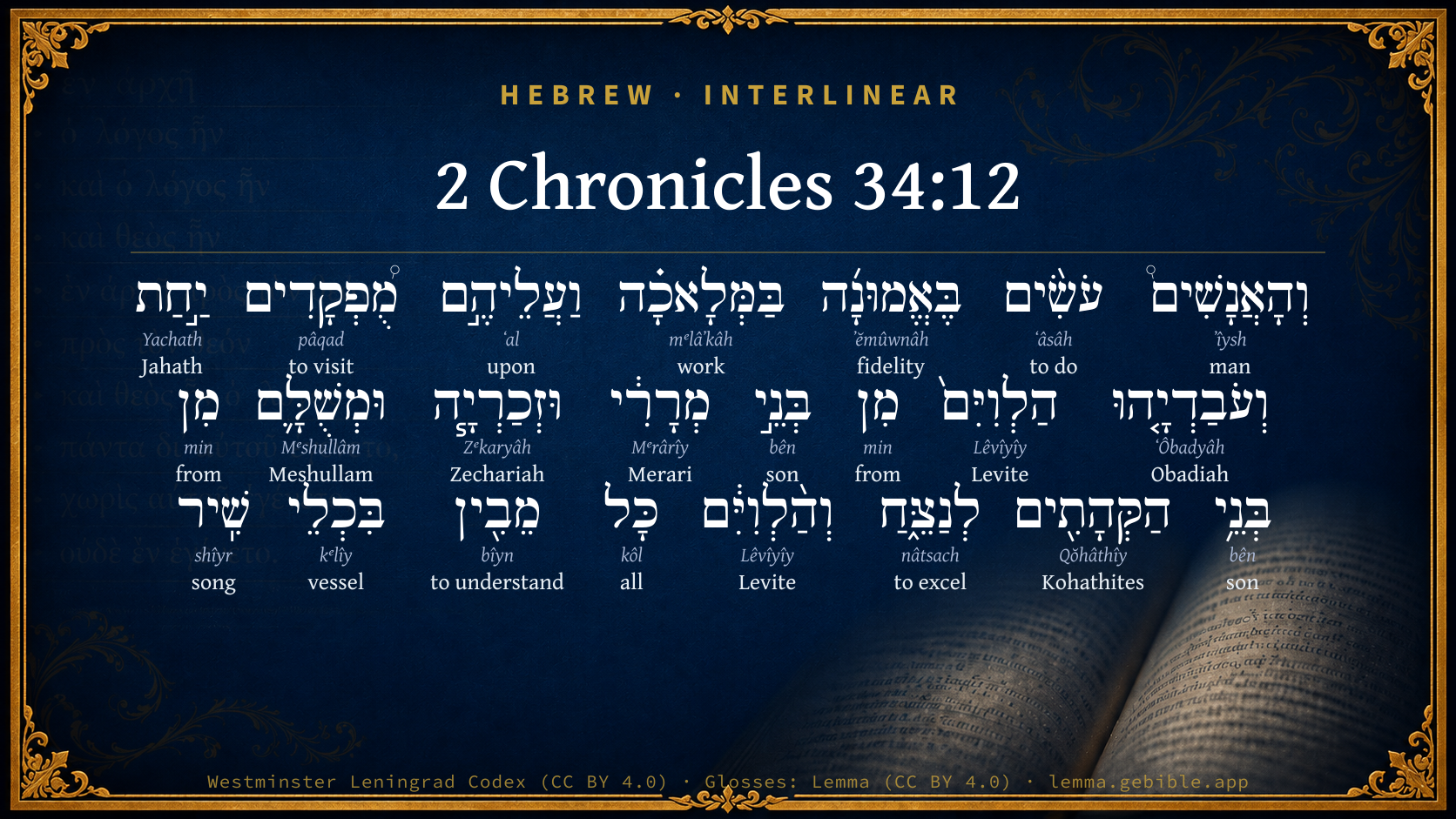
2 Chronicles 34:12

Hebrew (Westminster Leningrad Codex) 2 Chronicles 34:12 appears in the Hebrew Old Testament. The text above is from the Westminster Leningrad Codex. Each word links to its Strong’s number, a concise gloss, and parsing drawn from the Open Scriptures Hebrew Bible morphology. Click any word for its full Brown-Driver-Briggs (BDB) entry.
Download image
Cite this verse

2 Chronicles 34:12 (World English Bible). Public Domain. Lemma interlinear Bible study tool, https://lemma.gebible.app/v/2-chronicles/34/12.

Show BibTeX & RIS
BibTeX
RIS
English Translation
The men did the work faithfully: and the overseers of them were Jahath and Obadiah, the Levites, of the sons of Merari; and Zechariah and Meshullam, of the sons of the Kohathites, to set it forward; and [others of] the Levites, all who were skillful with instruments of music.
World English Bible · Public Domain
Download a study sheet

One document with this verse’s original text, its word-by-word gloss line, the meaning frame, cross-references with their text, attributed commentary, and full source and license credits — printable, and it pastes into notes with its structure intact.

This verse Autodidact and up

Study sheet (.html) Plain text (.txt)

A passage Seminary Student

Up to 50 verses in one chapter. A passage sheet keeps up to 6 commentary sources and 12 cross-references per verse, in the order this page ranks them, and says so on the sheet whenever that leaves anything out. Ask for a single verse and you get the Autodidact verse sheet above.

Everything on this page stays free to read, with no account — the sheet is a download of what is already on screen, not access to it.

Want to remove ads? Support Godless Engineer
Compare translations 3

The same verse in 3 English versions, stacked beneath the original-language interlinear above. Click any original word for its lexicon entry.

Each is an independent rendering of the whole verse — the interlinear is not word-aligned to these translations.

Highlighted words mark where these versions differ — a whole-verse word diff, not a word-by-word alignment.

  • World English Bible Public Domain
    The men did the work faithfully: and the overseers of them were Jahath and Obadiah, the Levites, of the sons of Merari; and Zechariah and Meshullam, of the sons of the Kohathites, to set it forward; and [others of] the Levites, all who were skillful with instruments of music.
  • King James Version Public Domain
    And the men did the work faithfully: and the overseers of them were Jahath and Obadiah, the Levites, of the sons of Merari; and Zechariah and Meshullam, of the sons of the Kohathites, to set it forward; and other of the Levites, all that could skill of instruments of music.
  • unfoldingWord Literal Text CC BY-SA 4.0
    And the men were working with faithfulness in the work. And over them were appointed Jahath, and Obadiah, the Levites from the sons of Merari, and Zechariah, and Meshullam, from the sons of the Kohathites, to direct, and the Levites, all who understand about the instruments of song.

unfoldingWord Literal Text — © unfoldingWord, licensed CC BY-SA 4.0. Word-aligned USFM3 via Door43 (git.door43.org/unfoldingWord/en_ult).

Versions to compare (up to 4)

3 of 4 selected

Show all 18 translations

Every available English version of this verse, each an independent rendering of the whole verse.

  • World English Bible Public Domain
    The men did the work faithfully: and the overseers of them were Jahath and Obadiah, the Levites, of the sons of Merari; and Zechariah and Meshullam, of the sons of the Kohathites, to set it forward; and [others of] the Levites, all who were skillful with instruments of music.
  • Berean Standard Bible Public Domain
    And the men did the work faithfully. The Levites overseeing them were Jahath and Obadiah, descendants of Merari, and Zechariah and Meshullam, descendants of Kohath. Other Levites, all skilled with musical instruments,
  • Majority Standard Bible Public Domain
    And the men did the work faithfully. The Levites overseeing them were Jahath and Obadiah, descendants of Merari, and Zechariah and Meshullam, descendants of Kohath. Other Levites, all skilled with musical instruments,
  • King James Version Public Domain
    And the men did the work faithfully: and the overseers of them were Jahath and Obadiah, the Levites, of the sons of Merari; and Zechariah and Meshullam, of the sons of the Kohathites, to set it forward; and other of the Levites, all that could skill of instruments of music.
  • American Standard Version (1901) Public Domain
    And the men did the work faithfully: and the overseers of them were Jahath and Obadiah, the Levites, of the sons of Merari; and Zechariah and Meshullam, of the sons of the Kohathites, to set it forward; and `others of' the Levites, all that were skilful with instruments of music.
  • Revised Version (1885) Public Domain
    And the men did the work faithfully: and the overseers of them were Jahath and Obadiah, the Levites, of the sons of Merari; and Zechariah and Meshullam, of the sons of the Kohathites, to set it forward: and other of the Levites, all that could skill of instruments of music.
  • Geneva Bible (1599) Public Domain
    And the men did the worke faithfully, and the ouerseers of them were Iahath and Obadiah the Leuites, of the children of Merari, and Zechariah, and Meshullam, of the children of the Kohathites to set it forward: and of the Leuites all that could skill of instruments of musike.
  • Douay-Rheims (1899) Public Domain
    And they did all faithfully. Now the overseers of the workmen were Jahath and Abdias of the sons of Merari, Zacharias and Mosollam of the sons of Caath, who hastened the work: all Levites skilful to play on instruments.
  • Young's Literal Translation Public Domain
    And the men are working faithfully in the business, and over them are appointed Jahath and Obadiah, the Levites, of the sons of Merari, and Zechariah and Meshullam, of the sons of the Kohathite, to overlook; and of the Levites, every one understanding about instruments of song,
  • Literal Standard Version CC BY-SA 4.0
    And the men are working faithfully in the business, and over them are appointed Jahath and Obadiah, the Levites, of the sons of Merari, and Zechariah and Meshullam, of the sons of the Kohathite, to overlook; and of the Levites, everyone understanding about instruments of song,
  • Unlocked Literal Bible CC BY-SA 4.0
    The men did the work faithfully. Their supervisors Jahath and Obadiah, the Levites, of the sons of Merari; and Zechariah and Meshullam, from the sons of the Kohathites. Other Levites, all of whom were very good musicians, closely directed the workmen.
  • unfoldingWord Literal Text CC BY-SA 4.0
    And the men were working with faithfulness in the work. And over them were appointed Jahath, and Obadiah, the Levites from the sons of Merari, and Zechariah, and Meshullam, from the sons of the Kohathites, to direct, and the Levites, all who understand about the instruments of song.
  • Darby Bible Public Domain
    And the men did the work faithfully. And over them were appointed Jahath and Obadiah, Levites, of the children of Merari, and Zechariah and Meshullam, of the children of the Kohathites, for the oversight; and all these Levites were skilled in instruments of music.
  • World Messianic Bible Public Domain
    The men did the work faithfully. Their overseers were Jahath and Obadiah the Levites, of the sons of Merari; and Zechariah and Meshullam, of the sons of the Kohathites, to give direction; and others of the Levites, who were all skillful with musical instruments.
  • Webster's Bible Public Domain
    And the men did the work faithfully: and the overseers of them were Jahath and Obadiah, the Levites, of the sons of Merari; and Zechariah and Meshullam, of the sons of the Kohathites, to superintend it; and others of the Levites, all that had skill in instruments of music.
  • Free Bible Version CC BY-SA 4.0
    The men did good, honest work. In charge of them were Jahath and Obadiah, Levites from the sons of Merari; and Zechariah and Meshullam, Levites from the sons of the Kohathites. The Levites, all skilled musicians,
  • Bible in Basic English Public Domain
    And the men did the work well; and those who had authority over them were Jahath and Obadiah, Levites of the sons of Merari, and Zechariah and Meshullam, of the sons of the Kohathites, who were to be responsible for seeing that the work was done; and others of the Levites, who were expert with instruments of music,
  • JPS Tanakh (1917) Public Domain
    And the men did the work faithfully; and the overseers of them were Jahath and Obadiah, the Levites, of the sons of Merari; and Zechariah and Meshullam, of the sons of the Kohathites, to preside over it; and other of the Levites, all that had skill with instruments of music.

Literal Standard Version (2020), Covenant Press — licensed CC BY-SA 4.0. Text via the HelloAO Bible API (eBible.org). Unlocked Literal Bible (unfoldingWord) — licensed CC BY-SA 4.0. Text via the HelloAO Bible API (eBible.org). unfoldingWord Literal Text — © unfoldingWord, licensed CC BY-SA 4.0. Word-aligned USFM3 via Door43 (git.door43.org/unfoldingWord/en_ult). Free Bible Version, Dr. Jonathan Gallagher — licensed CC BY-SA 4.0. Text via the HelloAO Bible API (eBible.org).

Word by word

More ways to search: Search by grammar → Find every occurrence → Compare this word →

Practice this passage: Drill this verse → Learn its vocabulary →

יַ֣חַת
Yachath
H3189
“Jahath”
Noun, Proper
Part of Speech
Noun
Type
Proper
Full BDB Definition

Origin: from H3161

TWOT: None

Jahath = "He will snatch up" - son of Reaiah and grandson of Shobal of the tribe of Judah - a son of Libni and grandson of Gershom and great grandson of Levi - a Gershonite Levite; the eldest son of Shimei and the grandson of Laadan; founder of the house of Jahath - a Levite and son of Shelomoth - a Merarite Levite in the reign of Josiah
  1. וְהָאֲנָשִׁים֩ ʼîysh H376 “and · the · men” Conjunction + Particle, Definite Article + Noun, Common, Masculine, Plural, Absolute
  2. עֹשִׂ֨ים ʻâsâh H6213 “doing” Verb, Qal, Participle Active, Masculine, Plural, Absolute
  3. בֶּאֱמוּנָ֜ה ʼĕmûwnâh H530 “in/at · fidelity” Preposition + Noun, Common, Feminine, Singular, Absolute
  4. בַּמְּלָאכָ֗ה mᵉlâʼkâh H4399 “in/at the · work” Preposition, Determined + Noun, Common, Feminine, Singular, Absolute
  5. וַעֲלֵיהֶ֣ם ʻal H5921 “and · upon · them” Conjunction + Preposition + Suffix, Personal, 3rd Person, Masculine, Plural
  6. מֻ֠פְקָדִים pâqad H6485 “visited” Verb, Hophal, Participle Passive, Masculine, Plural, Absolute
  7. וְעֹבַדְיָ֤הוּ ʻÔbadyâh H5662 “and · Obadiah” Conjunction + Noun, Proper
  8. הַלְוִיִּם֙ Lêvîyîy H3881 “the · Levites” Particle, Definite Article + Noun, Gentilic, Masculine, Plural, Absolute
  9. מִן min H4480 “from” Preposition
  10. בְּנֵ֣י bên H1121 “sons of” Noun, Common, Masculine, Plural, Construct
  11. מְרָרִ֔י Mᵉrârîy H4847 “Merari” Noun, Proper
  12. וּזְכַרְיָ֧ה Zᵉkaryâh H2148 “and · Zechariah” Conjunction + Noun, Proper
  13. וּמְשֻׁלָּ֛ם Mᵉshullâm H4918 “and · Meshullam” Conjunction + Noun, Proper
  14. מִן min H4480 “from” Preposition
  15. בְּנֵ֥י bên H1121 “sons of” Noun, Common, Masculine, Plural, Construct
  16. הַקְּהָתִ֖ים Qŏhâthîy H6956 “the · Kohathites” Particle, Definite Article + Noun, Gentilic, Masculine, Plural, Absolute
  17. לְנַצֵּ֑חַ nâtsach H5329 “to excel” Preposition + Verb, Piel, Infinitive Construct
  18. וְהַ֨לְוִיִּ֔ם Lêvîyîy H3881 “and · the · Levites” Conjunction + Particle, Definite Article + Noun, Gentilic, Masculine, Plural, Absolute
  19. כָּל kôl H3605 “all of” Noun, Common, Masculine, Singular, Construct
  20. מֵבִ֖ין bîyn H995 “understanding” Verb, Hiphil, Participle Active, Masculine, Singular, Absolute
  21. בִּכְלֵי kᵉlîy H3627 “in/at · vessels of” Preposition + Noun, Common, Masculine, Plural, Construct
  22. שִֽׁיר shîyr H7892 “song” Noun, Common, Both, Singular, Absolute

About this verse

These counts appear in no published source. They are computed here, from the morphology-tagged text and Lemma’s own curated glosses. What Lemma adds →

23
words
20
distinct lemmas
Historical
section

Notable vocabulary

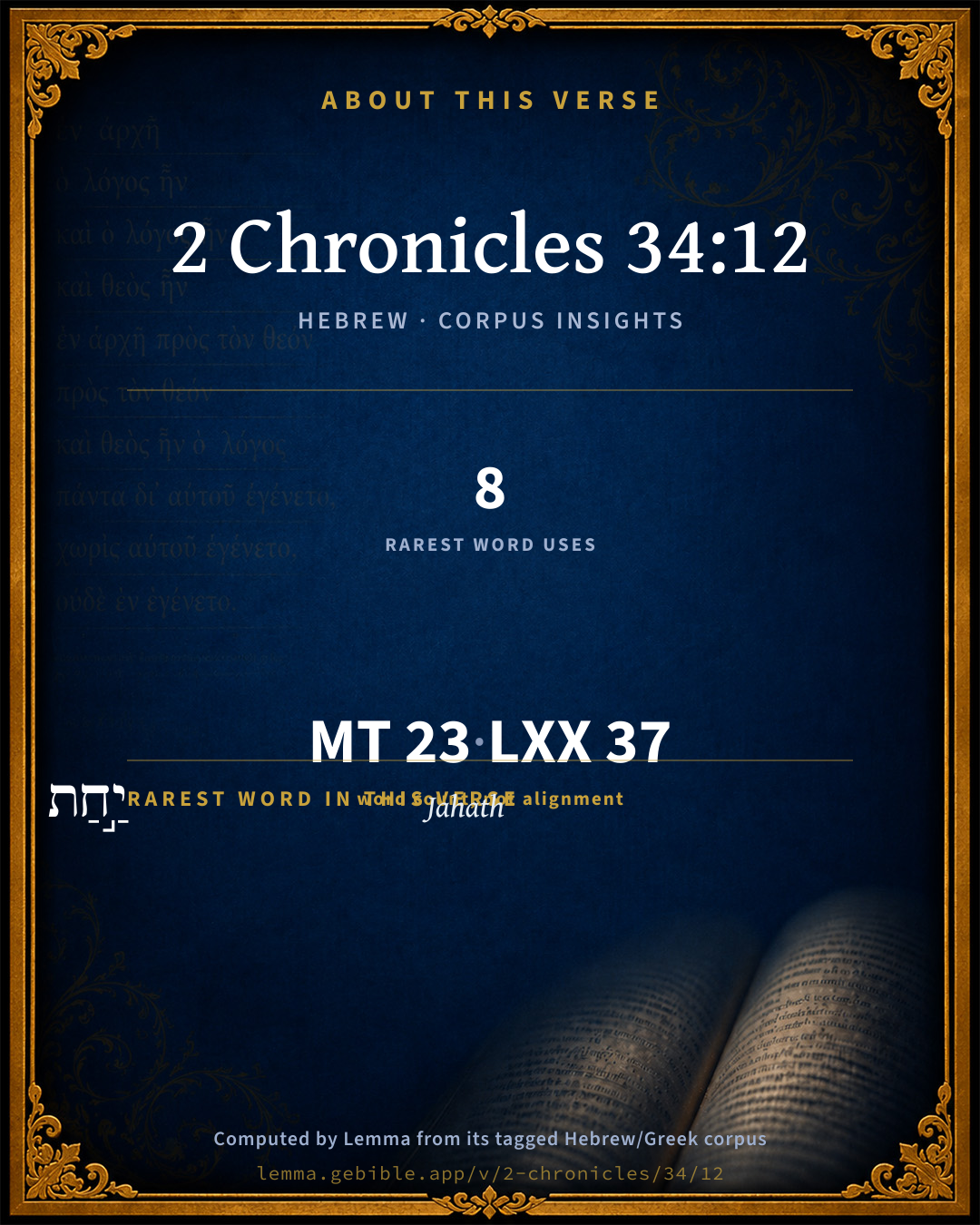
The rarest word here is יַ֣חַת Jahath H3189 — appearing just 8 times in the whole Hebrew Bible.

Shared distinctive vocabulary

יַ֣חַת Jahath H3189 occurs in 7 verses of the Hebrew Bible. Also found in:

Grammatical profile

  • 4 verbs
  • 16 nouns
  • 3 prepositions

Verb forms

  • עֹשִׂ֨ים Qal · Participle Active
  • מֻ֠פְקָדִים Hophal · Participle Passive
  • לְנַצֵּ֑חַ Piel · Infinitive Construct
  • מֵבִ֖ין Hiphil · Participle Active

Repetition

Words recur within this verse — often emphatic in Hebrew:

  • הַלְוִיִּם֙ Levite H3881 ×2
  • בְּנֵ֣י son H1121 ×2
  • מִן from H4480 ×2

Hebrew & Septuagint length

In English translation the verse runs 49 words from the Hebrew and 49 from the Septuagint (LXX English) — the same length.

A rough comparison of the two English renderings, which tokenize alike — not a word-level alignment.

Word counts can differ between the Hebrew and the Greek without any difference in meaning — e.g. the Hebrew direct-object marker אֵת has no separate Greek word, and Greek often adds the article ὁ.

In the original languages it is 23 Hebrew tokens and 37 Greek tokens — but the two are counted differently (Hebrew bundles its prefixes and suffixes into one token; the Greek is in lemma form), so that isn’t a like-for-like length.

Cross-references

12

Topical passages linked to 2 Chronicles 34:12 in the Treasury of Scripture Knowledge — connected by theme and wording, ordered by reader-vote popularity; previews shown in the World English Bible.

  • 2 Kings 12:15 Moreover they didn't demand an accounting from the men into whose hand they delivered the money to give to those who did the work; for they dealt faithfully.
  • 1 Chronicles 23:5 and four thousand were doorkeepers; and four thousand praised Yahweh with the instruments which I made, [said David], for giving praise.
  • 2 Kings 22:7 However there was no reckoning made with them of the money that was delivered into their hand; for they dealt faithfully.
  • 1 Chronicles 6:31–48 These are they whom David set over the service of song in the house of Yahweh, after that the ark had rest.
  • 1 Chronicles 15:16–22 David spoke to the chief of the Levites to appoint their brothers the singers, with instruments of music, psalteries and harps and cymbals, sounding aloud and lifting up the voice with joy.
  • 1 Chronicles 16:4–5 He appointed certain of the Levites to minister before the ark of Yahweh, and to celebrate and to thank and praise Yahweh, the God of Israel:
  • 1 Chronicles 16:41 and with them Heman and Jeduthun, and the rest who were chosen, who were mentioned by name, to give thanks to Yahweh, because his loving kindness endures forever;
  • 1 Chronicles 25:1–31 Moreover, David and the captains of the host set apart for the service certain of the sons of Asaph, and of Heman, and of Jeduthun, who should prophesy with harps, with psalteries, and with cymbals: and the number of those who did the work according to their service was:
  • 2 Chronicles 31:12 They brought in the offerings and the tithes and the dedicated things faithfully: and over them Conaniah the Levite was ruler, and Shimei his brother was second.
  • Nehemiah 7:2 that I gave my brother Hanani, and Hananiah the governor of the castle, charge over Jerusalem; for he was a faithful man, and feared God above many.
  • Proverbs 28:20 A faithful man is rich with blessings; But one who is eager to be rich will not go unpunished.
  • 1 Corinthians 4:2 Here, moreover, it is required of stewards, that they be found faithful.

Cross-references courtesy of OpenBible.info (CC BY 4.0).

Hebrew and Greek witnesses Masoretic Hebrew ↔ Greek Septuagint

The same verse in the two great witnesses to the Old Testament, shown verse-for-verse.

These are two independent witnesses, not word-aligned to each other, and the Septuagint is shown in lemma (dictionary) form.

Hebrew 2 Chronicles 34:12 Masoretic · Westminster Leningrad Codex

וְהָאֲנָשִׁים֩ עֹשִׂ֨ים בֶּאֱמוּנָ֜ה בַּמְּלָאכָ֗ה וַעֲלֵיהֶ֣ם מֻ֠פְקָדִים יַ֣חַת וְעֹבַדְיָ֤הוּ הַלְוִיִּם֙ מִן בְּנֵ֣י מְרָרִ֔י וּזְכַרְיָ֧ה וּמְשֻׁלָּ֛ם מִן בְּנֵ֥י הַקְּהָתִ֖ים לְנַצֵּ֑חַ וְהַ֨לְוִיִּ֔ם כָּל מֵבִ֖ין בִּכְלֵי שִֽׁיר

The men did the work faithfully: and the overseers of them were Jahath and Obadiah, the Levites, of the sons of Merari; and Zechariah and Meshullam, of the sons of the Kohathites, to set it forward; and [others of] the Levites, all who were skillful with instruments of music.

World English Bible · Public Domain

Greek LXX 2 Chronicles 34:12 Septuagint · lemma form

καί ὁ ἀνήρ ἐν πίστις ἐπί ὁ ἔργον καί ἐπί αὐτός ἐπισκοπός ιεθ καί αβδιας ὁ λευείτης ἐκ υἱός μεραρι καί ζαχαριας καί μοσολλαμ ἐκ ὁ υἱός κααθ ἐπισκοπέω καί πᾶς λευείτης πᾶς συνἵημι ἐν ὄργανον ᾠδή

And the men were faithfully engaged in the works: and over them were superintendents, Jeth and Abdias, Levites of the sons of Merari, and Zacharias and Mosollam, of the sons of Caath, appointed to oversee; and every Levite, and every one that understood how to play on musical instruments.

LXX2012 (modern English Septuagint) · Public Domain

Hebrew: Westminster Leningrad Codex (CC BY 4.0). Greek: Septuagint (public domain); English from LXX2012 (modern English Septuagint) (Public Domain). How the Septuagint differs from the Hebrew →

Commentary

Notes on 2 Chronicles 34:12 from classic Christian and Jewish commentators (each source and its license shown beneath its notes). The classic Christian expositions comment on the surrounding passage and are grouped to its opening verse, so a note may address several verses; the Jewish commentaries on the Tanakh (Rashi and others) are per-verse, so they appear only where the commentator wrote on this verse.

Lemma curates 59 commentaries, every one of them public domain or Creative Commons licensed, each selected and text-cleaned for this edition rather than reprinted as found. About our sources →

Trapp's Complete Commentary

John Trapp

2Ch 34:12 And the men did the work faithfully: and the overseers of them [were] Jahath and Obadiah, the Levites, of the sons of Merari; and Zechariah and Meshullam, of the sons of the Kohathites, to set [it] forward; and [other of] the Levites, all that could skill of instruments of musick.

Ver. 12. The men did the work faithfully.] As in the presence of God: to whom if men would but do eye-service, it were well: but a faithful servant is a rare bird.

All that could skill of instruments of music.] This was then a great praise; and haply they used their skill in the hearing of the workmen, to cheer them up: as Amphion did those that built the walls of Thebes; the poets feign, that by his sweet music he drew together the stones of those walls. Alexander Aphrodisaeus gives this reason, why porters go singing under their burdens: because their minds being delighted with the sweetness of their music, the body may feel the less weight under the burden. {a}

{a} Probl. 1, Num 78.

John Trapp, A Commentary or Exposition upon All the Books of the Old and New Testament (1647–1656) — public domain. Text from a community e-Sword module.

Joseph Benson's Commentary

2Ch 34:12. All that could skill of instruments of music — All these, here named, were skilful in instruments of music — Which may be here mentioned, to intimate, that as they were skilful, so they were exercised in both employments, and did successively oversee the work, and praise God with their voices and instruments.

Joseph Benson's Commentary on the Old and New Testaments (1811–1818) — public domain. Text from a community e-Sword module.

Tyndale Open Study Notes

Tyndale Open Resources

34:12-13 That musicians supervised the construction shows how important it was for Levites to be in charge of this work. Other ancient texts note that music was a common element of construction projects.

Tyndale Open Study Notes — © Tyndale Open Resources, licensed CC BY-SA 4.0. Text via the HelloAO Bible API.

Geneva Bible (1599)

Geneva Bible translators

Meaning, that they were in such credit for their fidelity, that they made none accounts of that which they received, 2 Kings 22:7, 9.

Geneva Bible (1599) marginal notes — public domain. Text via Bolls.life.

Adam Clarke's Commentary

Verse 12. All that could skill of instruments of music] Did the musicians play on their several instruments to encourage and enliven the workmen? Is not this a probable case from their mention here? If this were really the case, instrumental music was never better applied in any thing that refers to the worship of God. It is fabled of Orpheus, a most celebrated musician, that such was the enchanting harmony of his lyre, that he built the city of Thebes by it: the stones and timbers danced to his melody; and by the power of his harmony rose up, and took their respective places in the different parts of the wall that was to defend the city! This is fable; but as all fable is a representation of truth, where is the truth and fact to which this refers? How long has this question lain unanswered! But have we not the answer now? It is known in general, that the cities of Herculaneum and Pompeii were overwhelmed by an eruption of Mount Vesuvius, about the seventy-ninth year of the Christian era. It is also known that, in sinking for wells, the workmen of the king of Naples lighted on houses, c., of those overwhelmed cities that excavations have been carried on, and are now in the act of being carried on, which are bringing daily to view various utensils, pictures, and books, which have escaped the influence of the burning lava; and that some of those parchment volumes have been unrolled, and facsimiles of them engraved and published; and that our late Prince Regent, afterwards George IV., king of Great Britain, expended considerable sums of money annually in searching for, unrolling, and deciphering those rolls. This I record to his great credit as the lover of science and literature. Now, among the books that have been unrolled and published, is a Greek Treatise on Music, by Philodemus; and here we have the truth represented which lay hidden under the fables of Orpheus and Amphion. This latter was a skilful harper, who was frequently employed by the Theban workmen to play to them while engaged in their labour, and for which they rewarded him out of the proceeds of that labor. So powerful and pleasing was his music, that they went lightly and comfortably through their work; and time and labour passed on without tedium or fatigue; and the walls and towers were speedily raised. This, by a metaphor, was attributed to the dulcet sounds of his harp; and poetry seized on and embellished it, and mythology incorporated it with her fabulous system. Orpheus is the same. By his skill in music he drew stones and trees after him, i.e., he presided over and encouraged the workmen by his skill in music. Yet how simple and natural is the representation given by this ancient Greek writer of such matters! See Philodemus, Col. viii. and ix. Orpheus, and Amphion, by their music, moved the workmen to diligence and activity, and lessened and alleviated their toil. May we not suppose, then, that skilful musicians among the Levites did exercise their art among the workmen who were employed in the repairs of the house of the Lord? May I be allowed a gentle transition? Is it not the power and harmony of the grace of Jesus Christ in the Gospel, that convert, change, and purify the souls of men, and prepare them for and place them in that part of the house of God, the New Jerusalem? A most beautiful and chaste allusion to this fact and fable is made by an eminent poet, while praying for his own success as a Christian minister, who uses all his skill as a poet and musician for the glory of God: -

Thy own musician, Lord, inspire,

And may my consecrated lyre

Repeat the psalmist's part!

His Son and thine reveal in me,

And fill with sacred melody

The fibres of my heart.

So shall I charm the listening throng,

And draw the LIVING STONES along

By Jesus' tuneful name.

The living stones shall dance, shall rise,

And FORM a CITY in the skies,

The New Jerusalem.

CHARLES WESLEY.

Adam Clarke's Commentary on the Bible (1810–1826) — public domain. Text from a community e-Sword/MySword module.

Ellicott's Commentary for English Readers

(12) And the men did the work faithfully.—Literally, And the men were working (or dealing) in good faith in the work. In 2Ki_22:7 Josiah bids the High Priest not to require any account of the money delivered to the master-workmen, “because they work in good faith.”

And the overseers of them were.—And over them were set. The names of the overseers, and the details added in next verse, are peculiar to and characteristic of the chronicler.

To set it forward.—To lead, conduct, preside; usually a musical term. (Comp. 1Ch_23:4.)

And other . . . music.—Literally, and the Levites, to wit, every one skilled in the instruments of song. (Comp. 1Ch_15:16; 1Ch_25:7.)

A Bible Commentary for English Readers, edited by Charles John Ellicott (1878–1897) — public domain. Text from a community e-Sword module.

The Cambridge Bible for Schools and Colleges

gen. ed. J. J. S. Perowne

12. the overseers] There is no parallel in 2 Kin. for the rest of this verse and for 2Ch_34:13.

to set it forward] The same Heb. word is used in 1Ch_23:4.

could skill] “Skill” is used as a verb also in 2Ch_2:7-8. skill of instruments = “play skilfully upon instruments.”

The Cambridge Bible for Schools and Colleges (gen. ed. J. J. S. Perowne; Cambridge University Press, 1878–1918) — public domain. Text from a community e-Sword module.

John Gill's Exposition

Also they were over the bearers of burdens,.... Who carried the timber and stones to the workmen, to look after them, that they were not dilatory, and that the workmen might not stand still for want of materials being brought to them to work with:

and were overseers over all that wrought in any manner of service; whether in the way of masonry, or in that of carpenters, or of such that served them, or in whatsoever way:

and of the Levites there were scribes, and officers, and porters; some to take the account of the money carried in and paid, who were the

scribes, according to Jarchi; and others who looked after the men, and kept them to work, who were the

officers; and others that let them in and out, called

porters.

John Gill's Exposition of the Whole Bible (1746–1763) — public domain (CC PDM 1.0). Text via the HelloAO Bible API.

Haydock's Catholic Bible Commentary

Of music is expressed in Heb. and Sept. H. --- These Levites were chosen, because they were not so constantly employed in the temple, (C.) and they were not hired barely to inspect the works, and hence the expense was diminished.

George Leo Haydock (1774–1849), Haydock's Catholic Family Bible and Commentary, 1859 edition — public domain. Excludes Psalms (Douay-Rheims chapter numbering differs from Protestant) and Deuterocanonical books (Catholic canon only).

Matthew Poole's English Annotations

Or, all these here named were skilful in instruments of music; which may be here mentioned, either to their commendation, that they were fit for and careful and diligent in this employment, wherewith they were now intrusted, no less than in their own proper work; or to intimate, that as they were skilful, so they were exercised in both their employments, and did successively oversee the work, and praised God with their voices and instruments for his gracious and powerful help in carrying on the work.

Matthew Poole's English Annotations on the Holy Bible (1683–1685) — public domain. Text from a community e-Sword/MySword module.

Whedon's Commentary on the Bible

Daniel D. Whedon

12. All that could skill of instruments — The word skill in the sense here intended is obsolete; we should render, all that were skilled in instruments of music.

Daniel D. Whedon (gen. ed.), Commentary on the Old and New Testaments (1874–1909) — public domain. Text from a community e-Sword module.

The Pulpit Commentary

Faithfully, Refer back to note, Xnl 2Ch_31:12. To set forward; Hebrew, h the idea, of course, not so much that of expediting, as of guiding and instructing. The mention of those Levites whoso business was music is rather a surprise, and is not found in the parallel.

Faithful work.

the men did the work faithfully." It became a godly King of Judah to do anything and everything that was required for the strength and beauty of the temple. For in that sacred edifice centred the religious life of the nation, and there God manifested himself as nowhere else. With us religious thought and spiritual earnestness are not thus localized; and though, after the manner as well as in the spirit of Josiah, we may concern ourselves much with the erection or the repair of some "house of the Lord," yet Christian zeal now shows itself in a hundred ways; it branches and bears fruit in all directions. There is, however, a sense in which it is all building. We who are at work for our Lord and for our neighbour are building up the kingdom of Christ, and, at the same time, are building up a peaceful, happy, holy community. It is probable that we have all undertaken some specific work of this kind, some ministry; that we have committed ourselves to some office which makes certain demands on our intelligence, our strength, our time. That being so, it is well that we realize the importance of "doing the work faithfully" which we have in hand.

I WHAT CONSTITUTES FAITHFULNESS. TO be faithful is clearly a very different thing from being successful. Some men are successful, as men count success, who are not faithful in the sight of God; others are faithful who are not "successful." To be faithful is to act with rightful, earnest, patient effort in the sphere in which our Lord has placed us.

1. Doing our work honestly, fairly, conscientiously, keeping in view therevealed will of God and the claims of men. (see 2Ti_2:5)

2. Acting with earnestness; not languidly and listlessly, but devotedly andenergetically.

3. With patient, persevering effort; not daunted by the first nor by thefiftieth difficulty that presents itself, not silenced by clamour, not forsaking the path of holy service because prosperity seems long in coming; but calmly, patiently, thoroughly proceeding with and completing our work; holding on and bearing up until we can say, thankfully and reverently, "It is finished.

II WHAT INDUCEMENTS WE HAVE TO BE FAITHFUL IN OUR WORK.

1. Our Lord requires it. "It is required in stewards that a man be found faithful". (1Co_4:2) "Be thou faithful unto death," says the ascended Lord with commanding voice. There were "overseers," our text says, to "set forward" the work in which these artificers were engaged. We have one great Divine Overseer, who is ever looking on and taking account, desiring of us that we "do the work faithfully," and it behoves us to do everything we undertake, both that which does and that which does not directly belong to the affairs of his kingdom, "as ever in the great Taskmaster"s eye.

2. By so doing we take rank with the best of the sons of men. Of Moses we read that "he was faithful in all his house". (Heb_3:2) He did not seem to be remarkably successful; probably in the eyes of his contemporaries he appeared positively unsuccessful. But when he lay down to die on Nebo he could feel that he had done his work faithfully. And thus with Paul. And so with the best and worthiest of our race. To be faithful in our work is to stand with the best of men.

3. Thus only can we secure the approval of our own conscience. But thus we shall; and how great a victory it will be to be able to feel as Paul felt when his course was run, "I have fought a good fight, I have kept the faith"!

4. We shall receive a large reward. If we arc but faithful in a few things here, we shall be rulers over many things hereafter. (Mat_25:21) If faithful unto death, Christ will give us a crown of life". (Rev_2:10) Life in all its glorious fulness, in all its perfect blessedness, will be ours for ever. C.

The Pulpit Commentary (1880–1919), ed. H.D.M. Spence-Jones & Joseph S. Exell — public domain. Text from a community e-Sword module.

John Wesley's Explanatory Notes

Musick - All these here named, were skilful in instruments of musick. Which may be here mentioned, to intimate, that as they were skilful, so they were exercised in both employments, and did successively oversee the work, and praise God with their voices and instruments.

John Wesley, Explanatory Notes Upon the Whole Bible (1754–1765) — public domain. Text via the GEBible commentary corpus.

unfoldingWord translationNotes

Door43 World Missions Community

Jahath ... Meshullam

These are the names of men. (See: How to Translate Names)

Merari

Translate this man's name as you did in 2 Chronicles 29:12. (See: How to Translate Names)

Kohathites

Translate the name of the clan as you did in 2 Chronicles 20:19. (See: How to Translate Names)

Obadiah ... Zechariah

Translate these men's names the same as you did for other men by the same names in 2 Chronicles 17:7. (See: How to Translate Names)

These Levites were in charge of those who carried building material and all other men who worked in any way

This means that they were in charge of all the men who did any type of building work. AT: "These Levites were in charge of all of the men who did any kind of building work" (See: Assumed Knowledge and Implicit Information)

translationWords

faithful

son

unfoldingWord translationNotes — © Distant Shores Media and the Door43 World Missions Community, licensed CC BY-SA 4.0. Source: git.door43.org/Door43/en_tn.

Rashi

Rabbi Shlomo Yitzchaki (Rashi)

to direct - Heb. לְנַצּחַ, lemestriyer, to direct, supervise, and so (Ezra 3:8): “to direct (לְנַצּחַ) the work of the House of the Lord,” and likewise (above 2:17): “and six hundred overseers (מְנַצּחִים).”

and the Levites, all who were expert - Heb. מֵבִין. The term expertise (הֲבָנָה) is universally mentioned regarding song, and so above (I Chron. 25:8), when they cast lots, it is written: “like the small one so the great one, expert (מֵבִין) with pupil.” And likewise, (ibid. verse 7): “trained in song to the Lord: every expert (מֵבִין),” and it is written (ibid. 15:22): “And Chananiah, the leader of the Levites, etc., because he was an expert (מֵבִין),” and he was appointed over them to chastise [them] in raising [the voice], how they should raise [their voice], because he was an expert (מֵבִין).

Rashi on the Tanakh — English translations: “The Judaica Press complete Tanach with Rashi, translated by A. J. Rosenberg” (CC BY 4.0); “Pentateuch with Rashi's commentary by M. Rosenbaum and A.M. Silbermann, 1929-1934” (public domain); “The Metsudah Tanach series, Lakewood, N.J” (CC BY 4.0); and “The Book of Joshua, Metsudah Publications, 1997” (CC BY 4.0). Text via Sefaria.

Lesson kit

Teaching starters — assembled from the data on this page, not authored interpretation. Every prompt links to the verse data it draws on. Edit before teaching.

2 Chronicles, in the Historical, opens this verse with 23 words (20 distinct Hebrew lemmas). Its most distinctive word is Yachath (“Jahath”). A historical commentator’s framing appears above. Read the whole chapter for the surrounding context.

Discussion questions

  1. What does “Jahath” (Yachath) contribute to the verse as a whole?
  2. 1 Chronicles 4:2 shares the word «Jahath» with this verse. How do the two illuminate each other?
  3. “Levite” occurs 2× in this one verse. What is the effect of the repetition?
  4. The translations on this page render this verse differently — a whole-verse word diff, not a word-by-word alignment. What might account for the different wordings?
  5. The verb «עֹשִׂ֨ים» is Qal Participle Active. How does its form color the action?
  6. Reading how Trapp's Complete Commentary and Joseph Benson's Commentary read this verse, where do the two commentators agree and where do they part?

Things to notice

Reading settings

Reading text

Shown beneath each verse's original-language words.

Old Testament
Old Testament edition

Read the OT as the Masoretic Hebrew (MT) or the Greek Septuagint (LXX).

English shown for the Greek Septuagint (in the Hebrew ↔ Greek comparison).

Comparing translations? Open the Compare panel on any verse page to stack up to four side by side.