
Exodus 3:22

Hebrew (Westminster Leningrad Codex) Exodus 3:22 appears in the Hebrew Old Testament. The text above is from the Westminster Leningrad Codex. Each word links to its Strong’s number, a concise gloss, and parsing drawn from the Open Scriptures Hebrew Bible morphology. Click any word for its full Brown-Driver-Briggs (BDB) entry.
Download image
Cite this verse

Exodus 3:22 (World English Bible). Public Domain. Lemma interlinear Bible study tool, https://lemma.gebible.app/v/exodus/3/22.

Show BibTeX & RIS
BibTeX
RIS
English Translation
But every woman shall ask of her neighbor, and of her who visits her house, jewels of silver, jewels of gold, and clothing; and you shall put them on your sons, and on your daughters. You shall despoil the Egyptians.
World English Bible · Public Domain
Highlights
  • 1 first appearance in the Hebrew Bible
Full analysis ↓
Download a study sheet

One document with this verse’s original text, its word-by-word gloss line, the meaning frame, cross-references with their text, attributed commentary, and full source and license credits — printable, and it pastes into notes with its structure intact.

This verse Autodidact and up

Study sheet (.html) Plain text (.txt)

A passage Seminary Student

Up to 50 verses in one chapter. A passage sheet keeps up to 6 commentary sources and 12 cross-references per verse, in the order this page ranks them, and says so on the sheet whenever that leaves anything out. Ask for a single verse and you get the Autodidact verse sheet above.

Everything on this page stays free to read, with no account — the sheet is a download of what is already on screen, not access to it.

Want to remove ads? Support Godless Engineer
Compare translations 3

The same verse in 3 English versions, stacked beneath the original-language interlinear above. Click any original word for its lexicon entry.

Each is an independent rendering of the whole verse — the interlinear is not word-aligned to these translations.

Highlighted words mark where these versions differ — a whole-verse word diff, not a word-by-word alignment.

  • World English Bible Public Domain
    But every woman shall ask of her neighbor, and of her who visits her house, jewels of silver, jewels of gold, and clothing; and you shall put them on your sons, and on your daughters. You shall despoil the Egyptians.
  • King James Version Public Domain
    But every woman shall borrow of her neighbor, and of her that sojourneth in her house, jewels of silver, and jewels of gold, and raiment: and ye shall put them upon your sons, and upon your daughters; and ye shall spoil the Egyptians.
  • unfoldingWord Literal Text CC BY-SA 4.0
    And a woman will ask from her neighbor and from one sojourning in her house for items of silver and items of gold and clothing. And you will put them on your sons and on your daughters, and you will plunder the Egyptians.”

unfoldingWord Literal Text — © unfoldingWord, licensed CC BY-SA 4.0. Word-aligned USFM3 via Door43 (git.door43.org/unfoldingWord/en_ult).

Versions to compare (up to 4)

3 of 4 selected

Show all 18 translations

Every available English version of this verse, each an independent rendering of the whole verse.

  • World English Bible Public Domain
    But every woman shall ask of her neighbor, and of her who visits her house, jewels of silver, jewels of gold, and clothing; and you shall put them on your sons, and on your daughters. You shall despoil the Egyptians.
  • Berean Standard Bible Public Domain
    Every woman shall ask her neighbor and any woman staying in her house for silver and gold jewelry and clothing, and you will put them on your sons and daughters. So you will plunder the Egyptians.”
  • Majority Standard Bible Public Domain
    Every woman shall ask her neighbor and any woman staying in her house for silver and gold jewelry and clothing, and you will put them on your sons and daughters. So you will plunder the Egyptians.”
  • King James Version Public Domain
    But every woman shall borrow of her neighbor, and of her that sojourneth in her house, jewels of silver, and jewels of gold, and raiment: and ye shall put them upon your sons, and upon your daughters; and ye shall spoil the Egyptians.
  • American Standard Version (1901) Public Domain
    But every woman shall ask of her neighbor, and of her that sojourneth in her house, jewels of silver, and jewels of gold, and raiment: and ye shall put them upon your sons, and upon your daughters; and ye shall despoil the Egyptians.
  • Revised Version (1885) Public Domain
    but every woman shall ask of her neighbour, and of her that sojourneth in her house, jewels of silver, and jewels of gold, and raiment: and ye shall put them upon your sons, and upon your daughters; and ye shall spoil the Egyptians.
  • Geneva Bible (1599) Public Domain
    For euery woman shall aske of her neighbour, and of her that soiourneth in her house, iewels of siluer and iewels of gold and raiment, and ye shall put them on your sonnes, and on your daughters, and shall spoyle the Egyptians.
  • Douay-Rheims (1899) Public Domain
    But every woman shall ask of her neighbour, and of her that is in her house, vessels of silver and of gold, and raiment: and you shall put them on your sons and daughters, and shall spoil Egypt.
  • Young's Literal Translation Public Domain
    and `every' woman hath asked from her neighbour, and from her who is sojourning in her house, vessels of silver, and vessels of gold, and garments, and ye have put `them' on your sons and on your daughters, and have spoiled the Egyptians.'
  • Literal Standard Version CC BY-SA 4.0
    and [every] woman has asked from her neighbor, and from her who is sojourning in her house, [for] vessels of silver, and vessels of gold, and garments, and you have put [them] on your sons and on your daughters, and have spoiled the Egyptians.”
  • Unlocked Literal Bible CC BY-SA 4.0
    Every woman will ask for silver and gold jewels and for clothing from her Egyptian neighbors and any women staying in her neighbors' houses. You will put them on your sons and daughters. In this way you will plunder the Egyptians.”
  • unfoldingWord Literal Text CC BY-SA 4.0
    And a woman will ask from her neighbor and from one sojourning in her house for items of silver and items of gold and clothing. And you will put them on your sons and on your daughters, and you will plunder the Egyptians.”
  • Darby Bible Public Domain
    but every woman shall ask of her neighbour, and of her that is the inmate of her house, utensils of silver, and utensils of gold, and clothing; and ye shall put [them] on your sons and on your daughters, and shall spoil the Egyptians.
  • World Messianic Bible Public Domain
    But every woman shall ask of her neighbor, and of her who visits her house, jewels of silver, jewels of gold, and clothing. You shall put them on your sons, and on your daughters. You shall plunder the Egyptians.”
  • Webster's Bible Public Domain
    But every woman shall borrow of her neighbor, and of her that dwelleth in her house, jewels of silver, and jewels of gold, and raiment: and ye shall put them upon your sons, and upon your daughters: and ye shall spoil the Egyptians.
  • Free Bible Version CC BY-SA 4.0
    Every woman will ask her neighbor as well as any woman living in her house for silver and gold jewelry and clothing, and put them on your sons and daughters. In this way you will take the wealth of the Egyptians with you.”
  • Bible in Basic English Public Domain
    For every woman will get from her neighbour and from the woman living in her house, ornaments of silver and gold, and clothing; and you will put them on your sons and your daughters; you will take the best of their goods from the Egyptians.
  • JPS Tanakh (1917) Public Domain
    but every woman shall ask of her neighbour, and of her that sojourneth in her house, jewels of silver, and jewels of gold, and raiment; and ye shall put them upon your sons, and upon your daughters; and ye shall spoil the Egyptians.'

Literal Standard Version (2020), Covenant Press — licensed CC BY-SA 4.0. Text via the HelloAO Bible API (eBible.org). Unlocked Literal Bible (unfoldingWord) — licensed CC BY-SA 4.0. Text via the HelloAO Bible API (eBible.org). unfoldingWord Literal Text — © unfoldingWord, licensed CC BY-SA 4.0. Word-aligned USFM3 via Door43 (git.door43.org/unfoldingWord/en_ult). Free Bible Version, Dr. Jonathan Gallagher — licensed CC BY-SA 4.0. Text via the HelloAO Bible API (eBible.org).

Word by word

More ways to search: Search by grammar → Find every occurrence → Compare this word →

Practice this passage: Drill this verse → Learn its vocabulary →

מִשְּׁכֶנְתָּהּ֙
shâkên
H7934
“from · inhabitant · her”
Preposition + Adjective, Adjective, Feminine, Singular, Construct + Suffix, Personal, 3rd Person, Feminine, Singular
Part of Speech
Preposition + Adjective
Type
Adjective
Gender
Feminine
Number
Singular
State
Construct
Full BDB Definition

Origin: from H7931

TWOT: 2387b

inhabitant, neighbour - inhabitant - neighbour
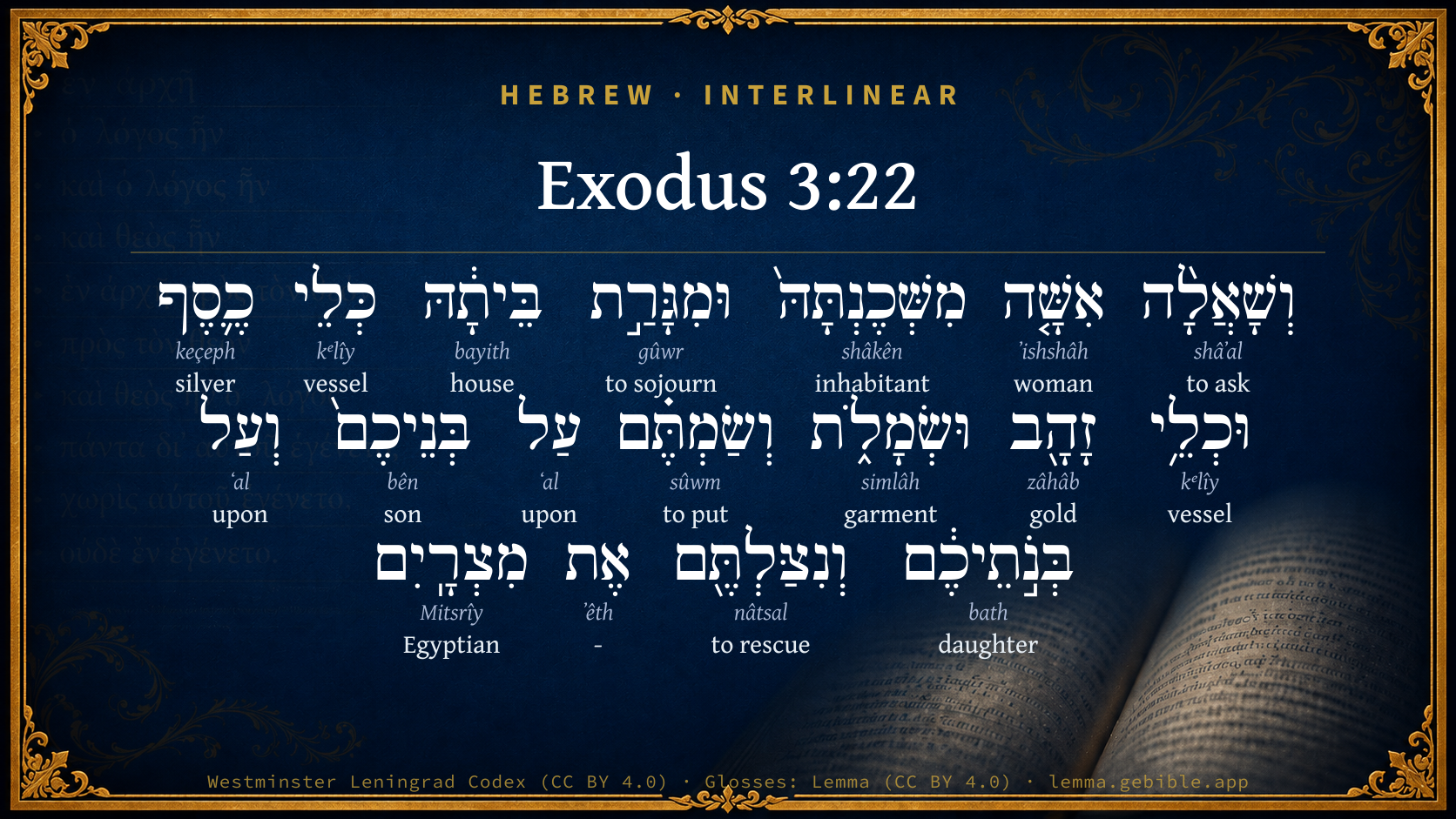
  1. וְשָׁאֲלָ֨ה shâʼal H7592 “and · to ask” Conjunction + Verb, Qal, Sequential Perfect, 3rd Person, Feminine, Singular
  2. אִשָּׁ֤ה ʼishshâh H802 “woman” Noun, Common, Feminine, Singular, Absolute
  3. וּמִגָּרַ֣ת gûwr H1481 “and · from · sojourning” Conjunction + Preposition + Verb, Qal, Participle Active, Feminine, Singular, Construct
  4. בֵּיתָ֔הּ bayith H1004 “house · her” Noun, Common, Masculine, Singular, Construct + Suffix, Personal, 3rd Person, Feminine, Singular
  5. כְּלֵי kᵉlîy H3627 “vessels of” Noun, Common, Masculine, Plural, Construct
  6. כֶ֛סֶף keçeph H3701 “silver” Noun, Common, Masculine, Singular, Absolute
  7. וּכְלֵ֥י kᵉlîy H3627 “and · vessels of” Conjunction + Noun, Common, Masculine, Plural, Construct
  8. זָהָ֖ב zâhâb H2091 “gold” Noun, Common, Masculine, Singular, Absolute
  9. וּשְׂמָלֹ֑ת simlâh H8071 “and · garments” Conjunction + Noun, Common, Feminine, Plural, Absolute
  10. וְשַׂמְתֶּ֗ם sûwm H7760 “and · to put” Conjunction + Verb, Qal, Sequential Perfect, 2nd Person, Masculine, Plural
  11. עַל ʻal H5921 “upon” Preposition
  12. בְּנֵיכֶם֙ bên H1121 “sons · your” Noun, Common, Masculine, Plural, Construct + Suffix, Personal, 2nd Person, Masculine, Plural
  13. וְעַל ʻal H5921 “and · upon” Conjunction + Preposition
  14. בְּנֹ֣תֵיכֶ֔ם bath H1323 “daughters · your” Noun, Common, Feminine, Plural, Construct + Suffix, Personal, 2nd Person, Masculine, Plural
  15. וְנִצַּלְתֶּ֖ם nâtsal H5337 “and · to rescue” Conjunction + Verb, Piel, Sequential Perfect, 2nd Person, Masculine, Plural
  16. אֶת ʼêth H853 “-” Particle, Direct Object
  17. מִצְרָֽיִם Mitsrîy H4713 “Egyptian” Noun, Proper

About this verse

These counts appear in no published source. They are computed here, from the morphology-tagged text and Lemma’s own curated glosses. What Lemma adds →

18
words
16
distinct lemmas
Pentateuch
section

Notable vocabulary

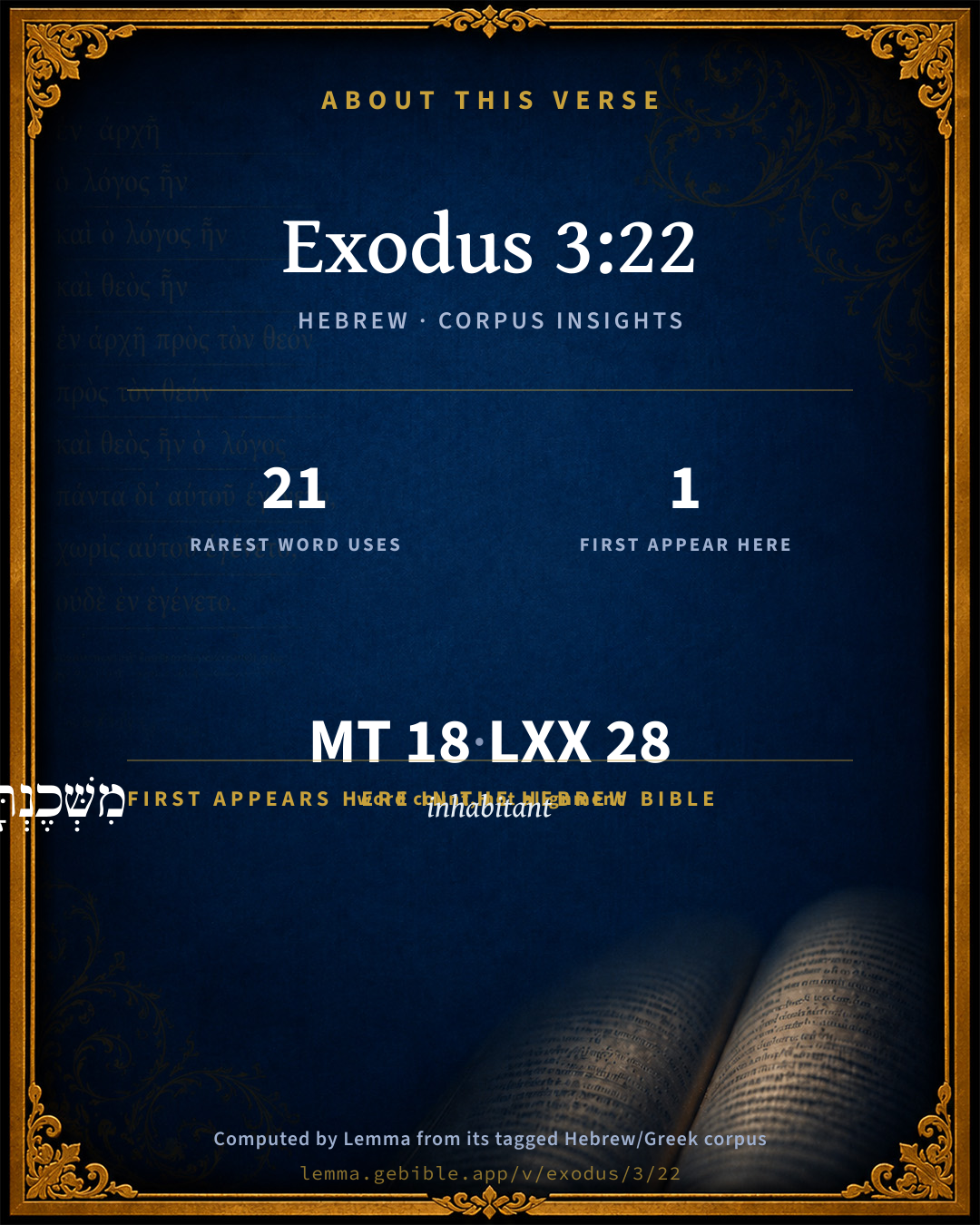
The rarest word here is מִשְּׁכֶנְתָּהּ֙ inhabitant H7934 — appearing just 21 times in the whole Hebrew Bible.

First appearance in Scripture

This word makes its first canonical appearance in the Hebrew Bible here:

  • מִשְּׁכֶנְתָּהּ֙ inhabitant H7934

Shared distinctive vocabulary

מִשְּׁכֶנְתָּהּ֙ inhabitant H7934 occurs in 20 verses of the Hebrew Bible. Also found in:

Grammatical profile

  • 4 verbs
  • 10 nouns
  • 1 adjective
  • 2 prepositions
  • 1 particle

Verb forms

  • וְשָׁאֲלָ֨ה Qal · Sequential Perfect
  • וּמִגָּרַ֣ת Qal · Participle Active
  • וְשַׂמְתֶּ֗ם Qal · Sequential Perfect
  • וְנִצַּלְתֶּ֖ם Piel · Sequential Perfect

Repetition

Words recur within this verse — often emphatic in Hebrew:

  • כְּלֵי vessel H3627 ×2
  • עַל upon H5921 ×2

Hebrew & Septuagint length

In English translation the verse runs 40 words from the Hebrew and 35 from the Septuagint (LXX English) — closely comparable.

A rough comparison of the two English renderings, which tokenize alike — not a word-level alignment.

Word counts can differ between the Hebrew and the Greek without any difference in meaning — e.g. the Hebrew direct-object marker אֵת has no separate Greek word, and Greek often adds the article ὁ.

In the original languages it is 18 Hebrew tokens and 28 Greek tokens — but the two are counted differently (Hebrew bundles its prefixes and suffixes into one token; the Greek is in lemma form), so that isn’t a like-for-like length.

Cross-references

8

Topical passages linked to Exodus 3:22 in the Treasury of Scripture Knowledge — connected by theme and wording, ordered by reader-vote popularity; previews shown in the World English Bible.

  • Exodus 11:2 Speak now in the ears of the people, and let them ask every man of his neighbor, and every woman of her neighbor, jewels of silver, and jewels of gold."
  • Ezekiel 39:10 so that they shall take no wood out of the field, neither cut down any out of the forests; for they shall make fires of the weapons; and they shall plunder those who plundered them, and rob those who robbed them, says the Lord Yahweh.
  • Genesis 15:14 I will also judge that nation, whom they will serve. Afterward they will come out with great substance.
  • Exodus 12:35–36 The children of Israel did according to the word of Moses; and they asked of the Egyptians jewels of silver, and jewels of gold, and clothing.
  • Psalms 105:37 He brought them forth with silver and gold. There was not one feeble person among his tribes.
  • Job 27:16–17 Though he heap up silver as the dust, And prepare clothing as the clay;
  • Proverbs 13:22 A good man leaves an inheritance to his children's children, But the wealth of the sinner is stored for the righteous.
  • Isaiah 33:1 Woe to you who destroy, and you weren't destroyed; and deal treacherously, and they didn't deal treacherously with you! When you have ceased to destroy, you shall be destroyed; and when you have made an end of dealing treacherously, they shall deal treacherously with you.

Cross-references courtesy of OpenBible.info (CC BY 4.0).

Hebrew and Greek witnesses Masoretic Hebrew ↔ Greek Septuagint

The same verse in the two great witnesses to the Old Testament, shown verse-for-verse.

These are two independent witnesses, not word-aligned to each other, and the Septuagint is shown in lemma (dictionary) form.

Hebrew Exodus 3:22 Masoretic · Westminster Leningrad Codex

וְשָׁאֲלָ֨ה אִשָּׁ֤ה מִשְּׁכֶנְתָּהּ֙ וּמִגָּרַ֣ת בֵּיתָ֔הּ כְּלֵי כֶ֛סֶף וּכְלֵ֥י זָהָ֖ב וּשְׂמָלֹ֑ת וְשַׂמְתֶּ֗ם עַל בְּנֵיכֶם֙ וְעַל בְּנֹ֣תֵיכֶ֔ם וְנִצַּלְתֶּ֖ם אֶת מִצְרָֽיִם

But every woman shall ask of her neighbor, and of her who visits her house, jewels of silver, jewels of gold, and clothing; and you shall put them on your sons, and on your daughters. You shall despoil the Egyptians.

World English Bible · Public Domain

Greek LXX Exodus 3:22 Septuagint · lemma form

αἰτέω γυνή παρά γείτων καί σύσκηνος αὐτός σκεῦος ἀργυροῦς καί χρυσοῦς καί ἱματισμός καί ἐπιτίθημι ἐπί ὁ υἱός σύ καί ἐπί ὁ θυγάτηρ σύ καί σκυλεύω ὁ αἰγύπτιος

But every woman shall ask of her neighbor and fellow lodger, articles of gold and silver, and apparel; and you⌃ shall put them upon your sons and upon your daughters, —and spoil you⌃ the Egyptians.

LXX2012 (modern English Septuagint) · Public Domain

On this verse, Adam Clarke's Commentary discusses the Septuagint’s reading. Read the note in Commentary ↓

Hebrew: Westminster Leningrad Codex (CC BY 4.0). Greek: Septuagint (public domain); English from LXX2012 (modern English Septuagint) (Public Domain). How the Septuagint differs from the Hebrew →

Targum (Aramaic paraphrase)

2

The Targum is the ancient Jewish Aramaic paraphrase of the Hebrew Scriptures — an interpretive translation, not the Hebrew text itself. Onkelos (literal) and Pseudo-Jonathan (expansive) render the Torah, and Jonathan the Prophets. Coverage is partial: where no permissively-licensed English translation exists for a verse, only the Aramaic is shown. This is verse-level text, not a word-by-word alignment to the Hebrew.

  1. Targum Onkelos Torah (Genesis–Deuteronomy)
    וְתִשְׁאַל אִתְּתָא מִשְׁבַבְתַּהּ וּמִקְרִיבַת בֵּיתַהּ מָנִין דִכְסַף וּמָנִין דִדְהַב וּלְבוּשִׁין וּתְשַׁווּן עַל בְּנֵיכוֹן וְעַל בְּנָתֵיכוֹן וּתְרוֹקִנוּן יָת מִצְרָיִם:

    (no public-domain English translation for this verse)

    Targum Onkelos — Aramaic: “Onkelos Genesis” (public domain); “Onkelos Exodus” (public domain); “Onkelos Leviticus” (public domain); “Onkelos Numbers” (public domain); “Onkelos Deuteronomy” (public domain). English: “Sefaria Community Translation” (CC0 1.0 (public-domain dedication)); “J.W. Etheridge. The Targums of Onkelos and Jonathan Ben Uzziel on the Pentateuch. London: Longmans, Green, 1862” (public domain). Text via Sefaria.

  2. Targum Pseudo-Jonathan Torah (Genesis–Deuteronomy)
    וְתִשְׁאַל אִתְּתָא מִן שְׁבַבְתָּא וּמִן קְרִיבַת כּוֹתְלֵי בֵיתָהּ מָנִין דִכְסַף וּמָנִין דִדְהַב וּלְבוּשִׁין וּתְעַטְרוּן עַל בָּנֵיכוֹן וְעַל בְּנָתֵיכוֹן וּתְרוֹקִינוּן יַת מִצְרָאֵי

    But a woman shall ask of her neighbour, and from those next to the wall of her house, vessels of silver, and vessels of gold, and vestments; and you shall set them as crowns upon your sons and your daughters, and make the Mizraee empty.

    Targum Pseudo-Jonathan — Aramaic: “Targum Jonathan on Genesis” (public domain); “Targum Jonathan on Exodus” (public domain); “Targum Jonathan on Leviticus” (public domain); “Targum Jonathan on Numbers” (public domain); “Targum Jonathan on Deuteronomy” (public domain). English: “The Targum of Jonathan ben Uzziel, trans. J. W. Etheridge, London, 1862” (public domain). Text via Sefaria.

Commentary

Notes on Exodus 3:22 from classic Christian and Jewish commentators (each source and its license shown beneath its notes). The classic Christian expositions comment on the surrounding passage and are grouped to its opening verse, so a note may address several verses; the Jewish commentaries on the Tanakh (Rashi and others) are per-verse, so they appear only where the commentator wrote on this verse.

Lemma curates 59 commentaries, every one of them public domain or Creative Commons licensed, each selected and text-cleaned for this edition rather than reprinted as found. About our sources →

Trapp's Complete Commentary

John Trapp

Exo 3:22 But every woman shall borrow of her neighbour, and of her that sojourneth in her house, jewels of silver, and jewels of gold, and raiment: and ye shall put [them] upon your sons, and upon your daughters; and ye shall spoil the Egyptians.

Ver. 22. Ye shall spoil the Egyptians.] By a special dispensation, which none could grant but the law maker. So Eze 39:10. These jewels did afterwards become a snare to the Israelites in the matter of the golden calf.

John Trapp, A Commentary or Exposition upon All the Books of the Old and New Testament (1647–1656) — public domain. Text from a community e-Sword module.

Joseph Benson's Commentary

Exo 3:22. Every woman shall ask, שׁאלה, shaalah, (not borrow,) jewels. And I will give this people favour in the sight of the Egyptians — God sometimes makes the enemies of his people not only to be at peace with them, but to be kind to them. And he has many ways of balancing accounts between the injured and the injurious, of righting the oppressed, and compelling those that have done wrong to make restitution.

Joseph Benson's Commentary on the Old and New Testaments (1811–1818) — public domain. Text from a community e-Sword module.

Geneva Bible (1599)

Geneva Bible translators

This example may not be followed generally: though at God’s commandment they did it justly, receiving some recompense of their labors.

Or, in whose house she sojourneth.

Geneva Bible (1599) marginal notes — public domain. Text via Bolls.life.

Adam Clarke's Commentary

Verse 22. Every woman shall borrow] This is certainly not a very correct translation: the original word שאל shaal signifies simply to ask, request, demand, require, inquire, c. but it does not signify to borrow in the proper sense of that word, though in a very few places of Scripture it is thus used. In this and the parallel place, Ex 12:35, the word signifies to ask or demand, and not to borrow, which is a gross mistake into which scarcely any of the versions, ancient or modern, have fallen, except our own. The SEPTUAGINT has αιτησει, she shall ask; the VULGATE, postulabit, she shall demand; the SYRIAC, CHALDEE, SAMARITAN, SAMARITAN Version, COPTIC, and PERSIAN, are the same as the Hebrew. The European versions are generally correct on this point; and our common English version is almost the sole transgressor: I say, the common version, which, copying the Bible published by Becke in 1549, gives us the exceptionable term borrow, for the original שאל shaal, which in the Geneva Bible, and Barker's Bible of 1615, and some others, is rightly translated aske. God commanded the Israelites to ask or demand a certain recompense for their past services, and he inclined the hearts of the Egyptians to give liberally; and this, far from a matter of oppression, wrong, or even charity, was no more than a very partial recompense for the long and painful services which we may say six hundred thousand Israelites had rendered to Egypt, during a considerable number of years. And there can be no doubt that while their heaviest oppression lasted, they were permitted to accumulate no kind of property, as all their gains went to their oppressors.

Our exceptionable translation of the original has given some countenance to the desperate cause of infidelity; its abettors have exultingly said: "Moses represents the just God as ordering the Israelites to borrow the goods of the Egyptians under the pretence of returning them, whereas he intended that they should march off with the booty." Let these men know that there was no borrowing in the case; and that if accounts were fairly balanced, Egypt would be found still in considerable arrears to Israel. Let it also be considered that the Egyptians had never any right to the services of the Hebrews. Egypt owed its policy, its opulence, and even its political existence, to the Israelites. What had Joseph for his important services? NOTHING! He had neither district, nor city, nor lordship in Egypt; nor did he reserve any to his children. All his services were gratuitous; and being animated with a better hope than any earthly possession could inspire, he desired that even his bones should be carried up out of Egypt. Jacob and his family, it is true, were permitted to sojourn in Goshen, but they were not provided for in that place; for they brought their cattle, their goods, and all that they had into Egypt, Ge 46:1; Ge 46:6; so that they had nothing but the bare land to feed on; and had built treasure cities or fortresses, we know not how many; and two whole cities, Pithom and Raamses, besides; and for all these services they had no compensation whatever, but were besides cruelly abused, and obliged to witness, as the sum of their calamities, the daily murder of their male infants. These particulars considered, will infidelity ever dare to produce this case again in support of its worthless pretensions?

Jewels of silver, c.] The word כלי keley we have already seen signifies vessels, instruments, weapons, c., and may be very well translated by our English term, articles or goods. The Israelites got both gold and silver, probably both in coin and in plate of different kinds and such raiment as was necessary for the journey which they were about to undertake.

Ye shall spoil the Egyptians.] The verb נצל natsal signifies, not only to spoil, snatch away, but also to get away, to escape, to deliver, to regain, or recover. SPOIL signifies what is taken by rapine or violence but this cannot be the meaning of the original word here, as the Israelites only asked, and the Egyptians with out fear, terror, or constraint, freely gave. It is worthy of remark that the original word is used, 1Sa 30:22, to signify the recovery of property that had been taken away by violence: "Then answered all the wicked men, and men of Belial, of those that went with David, Because they went not with us we will not give them aught of the SPOIL (מהשלל mehashSHALAL) that we have RECOVERED, אשר הצלנו asher HITSTSALNU. In this sense we should understand the word here. The Israelites recovered a part of their property-their wages, of which they had been most unjustly deprived by the Egyptians.

IN this chapter we have much curious and important information; but what is most interesting is the name by which God was pleased to make himself known to Moses and to the Israelites, a name by which the Supreme Being was afterwards known among the wisest inhabitants of the earth. HE who IS and who WILL BE what he IS. This is a proper characteristic of the Divine Being, who is, properly speaking, the only BEING, because he is independent and eternal; whereas all other beings, in whatsoever forms they may appear, are derived, finite, changeable, and liable to destruction, decay, and even to annihilation. When God, therefore, announced himself to Moses by this name, he proclaimed his own eternity and immateriality; and the very name itself precludes the possibility of idolatry, because it was impossible for the mind, in considering it, to represent the Divine Being in any assignable shape; for who could represent BEING or Existence by any limited form? And who can have any idea of a form that is unlimited? Thus, then, we find that the first discovery which God made of himself was intended to show the people the simplicity and spirituality of his nature; that while they considered him as BEING, and the Cause of all BEING, they might be preserved from all idolatry for ever. The very name itself is a proof of a Divine revelation; for it is not possible that such an idea could have ever entered into the mind of man, unless it had been communicated from above. It could not have been produced by reasoning, for there were no premises on which it could be built, nor any analogies by which it could have been formed. We can as easily comprehend eternity as we can being, simply considered in and of itself, when nothing of assignable forms, colours, or qualities existed, besides its infinite and illimitable self.

To this Divine discovery the ancient Greeks owed the inscription which they placed above the door of the temple of Apollo at Delphi: the whole of the inscription consisted in the simple monosyllable EI, THOU ART, the second person of the Greek substantive verb ειμι, I am. On this inscription Plutarch, one of the most intelligent of all the Gentile philosophers, made an express treatise, περι του ΕΙ εν Δελφοις, having received the true interpretation in his travels in Egypt, whither he had gone for the express purpose of inquiring into their ancient learning, and where he had doubtless seen these words of God to Moses in the Greek version of the Septuagint, which had been current among the Egyptians (for whose sake it was first made) about four hundred years previously to the death of Plutarch. This philosopher observes that "this title is not only proper, but peculiar to God, because HE alone is being; for mortals have no participation of true being, because that which begins and ends, and is continually changing, is never one nor the same, nor in the same state. The deity on whose temple this word was inscribed was called Apollo, Απολλν, from α, negative, and πολυς, many, because God is ONE, his nature simple, his essence uncompounded." Hence he informs us the ancient mode of addressing God was, "EI 'EN, Thou art One, ου γαρ πολλα το θειον εστιν, for many cannot be attributed to the Divine nature: και οὑ προτερον ουδεν εστιν, ουδ' υστερον, ουδε μελλον, ουδε παρωχημενον, ουδε πρεσβυτερον, ουδε νεωτερον, in which there is neither first nor last, future nor past, old nor young; αλλ' εις ων ενι τῳ νυν το αει πεπληρωκε, but as being one, fills up in one NOW an eternal duration." And he concludes with observing that "this word corresponds to certain others on the same temple, viz., ΓΝΩΘΙ ΣΕΑΥΤΟΝ Know thyself; as if, under the name EI. THOU ART, the Deity designed to excite men to venerate HIM as eternally existing, ὡς οντα διαπαντος, and to put them in mind of the frailty and mortality of their own nature."

What beautiful things have the ancient Greek philosophers stolen from the testimonies of God to enrich their own works, without any kind of acknowledgment! And, strange perversity of man! these are the very things which we so highly applaud in the heathen copies, while we neglect or pass them by in the Divine originals!

Adam Clarke's Commentary on the Bible (1810–1826) — public domain. Text from a community e-Sword/MySword module.

Ellicott's Commentary for English Readers

(22) Every woman shall borrow.—Rather, shall ask (αἰτήσει, LXX.; postulabit, Vulg.). That there was really no pretence of “borrowing,” appears from Exo_12:33-36, where we find that the “jewels” were not asked for until the very moment of departure, when the Israelites were being “thrust forth,” and the people were urgent on them to be gone, certainly neither expecting nor wishing to see them again. Asking for presents is a common practice in the East, and persons who were quitting their homes to set out on a long journey through a strange country would have abundant excuse, if any had been needed, for soliciting aid from their rich neighbours.

Of her neighbour.—Egyptians were mingled with the Israelites in Goshen, as we see by Exo_2:3.

Of her that sojourneth in her house.—Rosenmüller supposes that Egyptians who rented houses which belonged to the Hebrews are intended; but the expression used is more suitable to lodgers or visitors, (Comp. Job_19:15.)

Upon your sons.—The Egyptian men of the Rameside period wore gold and silver ornaments almost as freely as the women. Their ornaments included armlets, bracelets, anklets, and collars.

Ye shall spoil, i.e., It shall be as if ye had conquered the Egyptians, and spoiled them. Compare the promise made to Abraham (Genesis 15, 14); and for the fulfilment, see below (Exo_12:35-36).

A Bible Commentary for English Readers, edited by Charles John Ellicott (1878–1897) — public domain. Text from a community e-Sword module.

The Cambridge Bible for Schools and Colleges

gen. ed. J. J. S. Perowne

22. sojourneth] probably, as a slave or hired servant: cf. Job_19:15 (RVm.), and on ch. Exo_12:48.

put them upon] as ornaments; cf. Gen_24:47; Gen_41:42.

This remarkable incident is referred to twice again: in Exo_11:2 f., where the people are directly commanded to make the request, and Exo_12:35 f., where the occurrence itself is narrated. ‘According to the tradition (‘Sage’) as handed down by E, the Israelites at their departure received from their Egyptian acquaintances, who were favourably disposed towards them, and held Moses in honour (see Exo_11:3), all kinds of valuables. For what purpose is not, in the present text, stated: probably as ornaments and festal attire for the feast, such as it was usual to wear on such occasions (Hos_2:13). It is at the same time possible that according to the original intention of the legend, the valuables, which the Israelites used for their sanctuary (Exo_33:6; Exo_35:22 f.), were to be regarded as spoil won from the Egyptians. But as it now stands, the chief stress appears to rest on the consideration that through God’s providence the Israelites were enriched at the expense of their oppressors, and gained as it were a sort of prize of victory as a compensation for their long oppression’ (Dillm.: similarly Ewald, Hist. ii. 65 f.). See further on Exo_12:36.

The Cambridge Bible for Schools and Colleges (gen. ed. J. J. S. Perowne; Cambridge University Press, 1878–1918) — public domain. Text from a community e-Sword module.

John Gill's Exposition

But every woman shall borrow of her neighbour, and of her that sojourneth in her house,.... Or "shall ask" (f), desire them to give or lend, what follows; and by this it appears, that the Israelites by reason of their great increase were spread about, and mixed with the Egyptians; and hence it was that there was such a mixed multitude that went up with them out of Egypt, who either were in connection with them in civil things, or were proselyted by them:

jewels of silver, and jewels of gold; that is, jewels set in silver and in gold; or "vessels of silver, and vessels of gold" (g), plate of both sorts, cups, dishes, &c:

and raiment; rich and goodly apparel, which they might borrow to appear in at their feast and sacrifices in the wilderness, whither they asked leave to go to:

and ye shall put them upon your sons, and upon your daughters; and so deck and ornament them with them at the time of their departure:

and ye shall spoil the Egyptians; and very justly, for the hard service they put them to; for which all this was but their wages due unto them, and which they would stand in need of in their travels to Canaan's land, and for the erection of the tabernacle, and providing things appertaining to it in the wilderness.

(f) Sept. "postulabit", V. L. Pagninus, Montanus, Tigurine version, Drusius; "petet", Junius & Tremellius. (g) "vasa", V. L. Pagninus, Montanus, Piscator, Tigurine version, Drusius.

Next: Exodus Chapter 4

John Gill's Exposition of the Whole Bible (1746–1763) — public domain (CC PDM 1.0). Text via the HelloAO Bible API.

Albert Barnes' Notes on the Bible

Shall borrow - shall ask. The Egyptians had made the people serve “with rigor,” and the Israelites when about to leave the country for ever were to ask or claim the jewels as a just, though very inadequate, remuneration for services which had made “their lives bitter.” The Egyptians would doubtless have refused had not their feelings toward Moses (see Exo 11:3) and the people been changed, under God’s influence, by calamities in which they recognized a divine interposition, which also they rightly attributed to the obstinacy of their own king (see Exo 10:7). The Hebrew women were to make the demand, and were to make it of women, who would of course be especially moved to compliance by the loss of their children, the fear of a recurrence of calamity, perhaps also by a sense of the fitness of the request in connection with a religious festival.

Jewels - Chiefly, trinkets. These ornaments were actually applied to the purpose for which they were probably demanded, being employed in making the vessels of the sanctuary (compare Exo 35:22).

Sojourneth in her house - This indicates a degree of friendly and neighborly contact, in accordance with several indirect notices, and was a natural result of long and peaceable sojourn in the district. The Egyptians did not all necessarily share the feelings of their new king.

Albert Barnes' Notes on the Bible (1834–1885) — public domain. Text from a community e-Sword/MySword module.

Haydock's Catholic Bible Commentary

Shall spoil, &c. That is, you shall strip, and take away the goods of the Egyptians. This was not authorizing theft or injustice: but was a just disposal made by him, who is the great Lord and Master of all things; in order to pay the children of Israel some part of what was due to them from the Egyptians for their labours. (Challoner) --- Wisdom (x. 17) rendered to the just the wages of their labours; and (ver. 19,) the just took the spoils of the wicked, in a just war. It is an ancient tradition of the Jews, that the Egyptians appealed to Alexander the Great for the recovery of these spoils; but when the Jews demanded their wages, they were willing to desist from their claims. (Selden, de Ture vii. 8; Tertullian, contra Marcion ii. 20.) (Calmet) --- God had a mind to punish the extravagance of the Egyptians, while he enabled his people to appear with suitable presents before him. It was on this last plea that the Hebrews borrowed precious garments, gold, &c. (Haydock) See Clement of Alexandria, strom. 1; St. Augustine, q. 23.

George Leo Haydock (1774–1849), Haydock's Catholic Family Bible and Commentary, 1859 edition — public domain. Excludes Psalms (Douay-Rheims chapter numbering differs from Protestant) and Deuterocanonical books (Catholic canon only).

Matthew Poole's English Annotations

Whether this was just or no, see Poole "Exo 12:36".

Matthew Poole's English Annotations on the Holy Bible (1683–1685) — public domain. Text from a community e-Sword/MySword module.

Whedon's Commentary on the Bible

Daniel D. Whedon

22. Every woman shall borrow — Literally, ask, for this is always the meaning of the word שׁאל; and whether the thing asked for is to be returned or not the context must determine. Thus the thirsty Barak asks water, (Jdg_5:25,) and Gideon asks for the golden earrings of the Ishmaelites, (Jdg_8:26,) evidently not intending to return the things asked for; but the prophet’s widow (2Ki_4:3) asks empty oil vessels of her neighbours, possibly intending to return them. All the circumstances here show that the Israelites did not promise, and that the Egyptians did not expect, that these jewels and garments would ever be returned. See on Exo_11:2, etc.

Daniel D. Whedon (gen. ed.), Commentary on the Old and New Testaments (1874–1909) — public domain. Text from a community e-Sword module.

The Pulpit Commentary

Borrow. The Hebrew word means simply "ask" (aijthsei, LXX; postula-bit, Vulg.). Of her neighbours. The intermixture to some extent of the Egyptians with the Hebrews in Goshen is here again implied, as in chs. 1. and 2. And of her that sojourneth in her house. Some of the Israelites, it would seem, took in Egyptian lodgers superior to them in wealth and rank. This implies more friendly feeling between the two nations than we should have expected; but it is quite natural that, after their long stay in Egypt, the Hebrews should have made a certain number of the Egyptians their friends.

The Pulpit Commentary (1880–1919), ed. H.D.M. Spence-Jones & Joseph S. Exell — public domain. Text from a community e-Sword module.

John Wesley's Explanatory Notes

Everywoman shall ask (not borrow!) jewels. And I will give this people favour in the sight of the Egyptians - God sometimes makes the enemies of his people not only to be at peace with them, but to be kind to them. And he has many ways of balancing accounts between the injured and the injurious, of righting the oppressed, and compelling those that have done wrong to make restitution.

John Wesley, Explanatory Notes Upon the Whole Bible (1754–1765) — public domain. Text via the GEBible commentary corpus.

Scofield Reference Notes

C. I. Scofield

borrow The use of little things. Cf. Jdg 3:31; 1Ki 17:12-16; Joh 6:9; 1Co 1:25-31

The Scofield Reference Bible (1917 edition), notes by C. I. Scofield — public domain. Text from a community e-Sword module.

Rashi

Rabbi Shlomo Yitzchaki (Rashi)

ומגרת ביתה means from that woman with whom she sojourneth in one house.

ונצלתם render it as the Targum does: and ye shall empty out Egypt. Similar are: (Exodus 12:36) “And they emptied out (וינצלו) Egypt”; (Exodus 33:6) “And the children of Israel stripped themselves (ויתנצלו) of their ornaments” The נ in it is a root-letter. Menachem ben Seruk placed it (this word ויתנצלו) in section צ (taking the root as צל not as נצל) together with, (Genesis 31:9) “And God took away (ויצל) your father’s cattle”, and with, (Genesis 31:16) “which God hath taken away (הציל) from our father”, but his view cannot be sustained. For if the נ is not a root-letter, then seeing that it (the word ונצלתם) is vowelled with Chirik, it cannot be used in the sense of “and ye shall do something” (the active voice, which is required here since את מצרים can only be the object of the verb), but in the sense of “and ye shall have something done to you” (the passive — “Niphal”), as (Deuteronomy 28:63) “And ye shall be plucked up (וְנִסַּחְתֶּם) from off your land”; (Leviticus 26:25) “and ye shall be given (וְנִתַּתֶּם) into the hand of the enemy”; (Leviticus 17) “And ye shall be smitten (וְנִגַּפְתָּם) before your enemies”; (Ezekiel 22:21) “And ye shall be melted (וְנִתַּכְתָּם) in the midst thereof”; (Jeremiah 7:10) “And ye say, נִצַּלְנוּ” — which expresses the idea “we have had something done to us” (the Niphal: we have been delivered). Then again, every נ which sometimes appears in a word and sometimes is omitted, as e. g. the נ of נוגף and נושא and נותן and נושך, when the word expresses the sense “and ye shall do something” (the Kal), it is pointed with vocal Sheva (חטף a “snatched” sound), as, for instance, (Genesis 45:19) “and ye shall bear (וּנְשָׂאתָם) your father”; (Numbers 32:29) “And ye shall give (וּנְתַתֶּם) them the land of Gilead”; (Genesis 17:11) “And ye shall circumcise (וּנְמַלְתֶּם) the flesh of your foreskin”. Consequently I am of the opinion that this letter נ which is vowelled with a Chirik is one of the root letters, and the grammatical form of the noun of the same root is נִצּוּל which is of the strong (dageshed) forms, just as דִּבּוּר and כִּפּוּר and לִמּוּד. When, in the case of verbs formed from these roots one expresses the idea of “and ye shall do something” (active voice) the נ has the vowel Chirik (i. e. it is the Piel conjugation), as (Numbers 20:8) “And ye shall speak (וְדִבַּרְתֶּם) unto the rock”; (Ezekiel 45:20) “And ye shall atone (וְכִּפַּרְתֶּם) for the house”; (Deuteronomy 11:19) “And ye shall teach (וְלִמַּדְתָּם) them unto your children”.

Rashi on the Tanakh — English translations: “The Judaica Press complete Tanach with Rashi, translated by A. J. Rosenberg” (CC BY 4.0); “Pentateuch with Rashi's commentary by M. Rosenbaum and A.M. Silbermann, 1929-1934” (public domain); “The Metsudah Tanach series, Lakewood, N.J” (CC BY 4.0); and “The Book of Joshua, Metsudah Publications, 1997” (CC BY 4.0). Text via Sefaria.

Lesson kit

Teaching starters — assembled from the data on this page, not authored interpretation. Every prompt links to the verse data it draws on. Edit before teaching.

Exodus, in the Pentateuch, opens this verse with 18 words (16 distinct Hebrew lemmas). Its most distinctive word is shâkên (“inhabitant”). A historical commentator’s framing appears above. Read the whole chapter for the surrounding context.

Discussion questions

  1. How does “inhabitant” (shâkên) shape what this verse is saying?
  2. This is the first place “inhabitant” appears in Scripture (first appears here). What does its debut here establish?
  3. How does Exodus 12:4, which shares the word «inhabitant», read alongside this verse?
  4. What does the repetition of “vessel” (2× in this one verse) do in this verse?
  5. These translations render this verse differently. What is at stake in choosing one wording over another?
  6. «וְשָׁאֲלָ֨ה» is a Qal Sequential Perfect verb. How does that grammatical form shape the action described?
  7. Compare how Trapp's Complete Commentary and Joseph Benson's Commentary read this verse. Where do they agree or differ?

Things to notice

Reading settings

Reading text

Shown beneath each verse's original-language words.

Old Testament
Old Testament edition

Read the OT as the Masoretic Hebrew (MT) or the Greek Septuagint (LXX).

English shown for the Greek Septuagint (in the Hebrew ↔ Greek comparison).

Comparing translations? Open the Compare panel on any verse page to stack up to four side by side.