Ezekiel 27:13

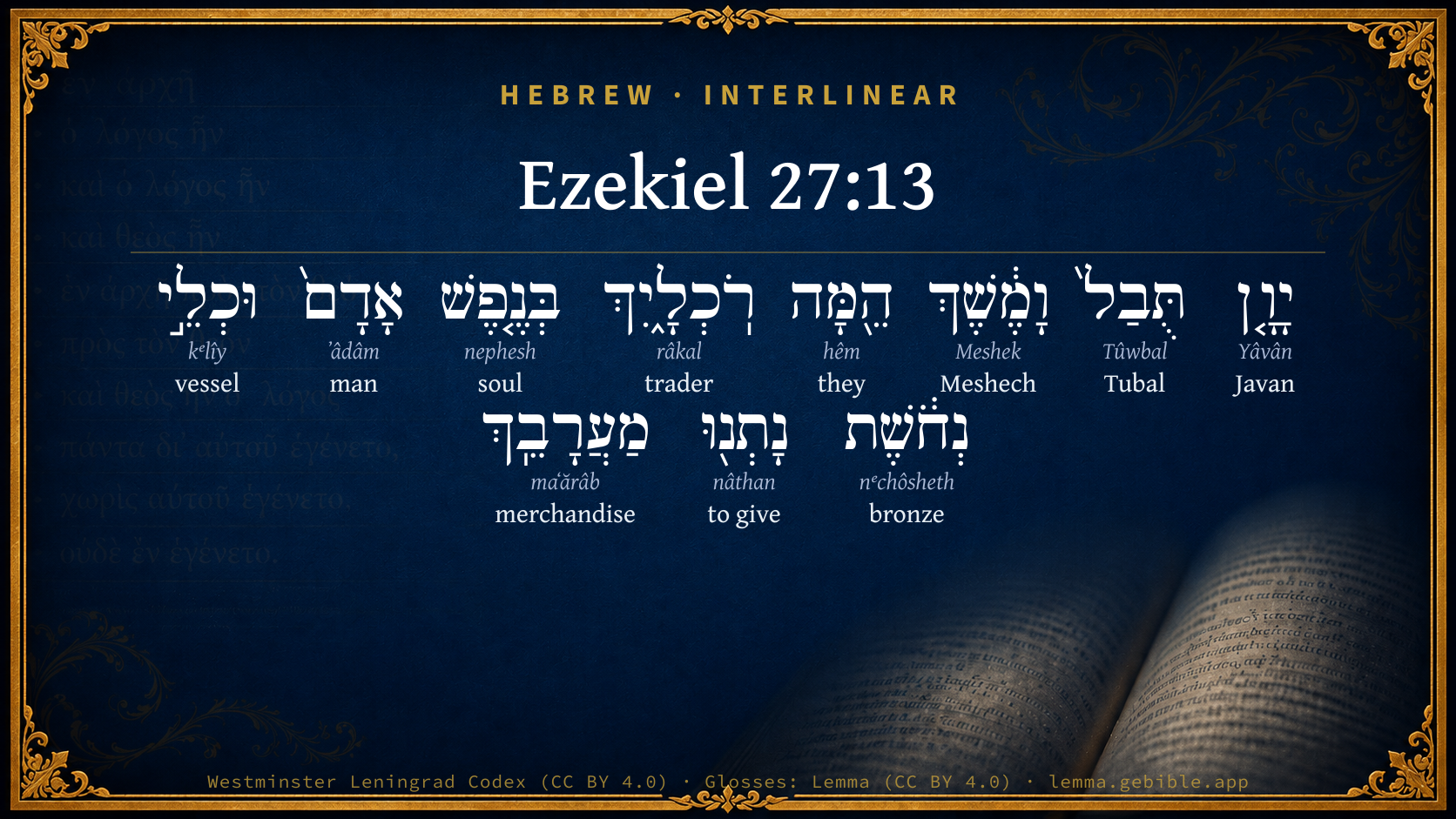
Hebrew (Westminster Leningrad Codex) Ezekiel 27:13 appears in the Hebrew Old Testament. The text above is from the Westminster Leningrad Codex. Each word links to its Strong’s number, a concise gloss, and parsing drawn from the Open Scriptures Hebrew Bible morphology. Click any word for its full Brown-Driver-Briggs (BDB) entry.
Download image
Cite this verse

Ezekiel 27:13 (World English Bible). Public Domain. Lemma interlinear Bible study tool, https://lemma.gebible.app/v/ezekiel/27/13.

Show BibTeX & RIS
BibTeX
RIS
English Translation
Javan, Tubal, and Meshech, they were your traffickers; they traded the persons of men and vessels of brass for your merchandise.
World English Bible · Public Domain
Download a study sheet

One document with this verse’s original text, its word-by-word gloss line, the meaning frame, cross-references with their text, attributed commentary, and full source and license credits — printable, and it pastes into notes with its structure intact.

This verse Autodidact and up

Study sheet (.html) Plain text (.txt)

A passage Seminary Student

Up to 50 verses in one chapter. A passage sheet keeps up to 6 commentary sources and 12 cross-references per verse, in the order this page ranks them, and says so on the sheet whenever that leaves anything out. Ask for a single verse and you get the Autodidact verse sheet above.

Everything on this page stays free to read, with no account — the sheet is a download of what is already on screen, not access to it.

Want to remove ads? Support Godless Engineer
Compare translations 3

The same verse in 3 English versions, stacked beneath the original-language interlinear above. Click any original word for its lexicon entry.

Each is an independent rendering of the whole verse — the interlinear is not word-aligned to these translations.

Highlighted words mark where these versions differ — a whole-verse word diff, not a word-by-word alignment.

  • World English Bible Public Domain
    Javan, Tubal, and Meshech, they were your traffickers; they traded the persons of men and vessels of brass for your merchandise.
  • King James Version Public Domain
    Javan, Tubal, and Meshech, they were thy merchants: they traded the persons of men and vessels of brass in thy market.
  • unfoldingWord Literal Text CC BY-SA 4.0
    Javan, Tubal, and Meshech—they traded slaves and in items made of bronze. They handled your merchandise.

unfoldingWord Literal Text — © unfoldingWord, licensed CC BY-SA 4.0. Word-aligned USFM3 via Door43 (git.door43.org/unfoldingWord/en_ult).

Versions to compare (up to 4)

3 of 4 selected

Show all 18 translations

Every available English version of this verse, each an independent rendering of the whole verse.

  • World English Bible Public Domain
    Javan, Tubal, and Meshech, they were your traffickers; they traded the persons of men and vessels of brass for your merchandise.
  • Berean Standard Bible Public Domain
    Javan, Tubal, and Meshech were your merchants. They exchanged slaves and bronze utensils for your merchandise.
  • Majority Standard Bible Public Domain
    Javan, Tubal, and Meshech were your merchants. They exchanged slaves and bronze utensils for your merchandise.
  • King James Version Public Domain
    Javan, Tubal, and Meshech, they were thy merchants: they traded the persons of men and vessels of brass in thy market.
  • American Standard Version (1901) Public Domain
    Javan, Tubal, and Meshech, they were thy traffickers; they traded the persons of men and vessels of brass for thy merchandise.
  • Revised Version (1885) Public Domain
    Javan, Tubal, and Meshech, they were thy traffickers: they traded the persons of men and vessels of brass for thy merchandise.
  • Geneva Bible (1599) Public Domain
    They of Iauan, Tubal and Meshech were thy marchants, concerning the liues of men, and they brought vessels of brasse for thy marchadise.
  • Douay-Rheims (1899) Public Domain
    Greece, Thubal, and Mosoch, they were thy merchants: they brought to thy people slaves and vessels of brass.
  • Young's Literal Translation Public Domain
    Javan, Tubal, and Meshech -- they `are' thy merchants, For persons of men, and vessels of brass, They have given out thy merchandise.
  • Literal Standard Version CC BY-SA 4.0
    Javan, Tubal, and Meshech—they [are] your merchants, || They have given [the] soul of man, and vessels of bronze, [for] your merchandise.
  • Unlocked Literal Bible CC BY-SA 4.0
    Javan, Tubal, and Meshech—they traded slaves and in items made of bronze. They handled your merchandise.
  • unfoldingWord Literal Text CC BY-SA 4.0
    Javan, Tubal, and Meshech—they traded slaves and in items made of bronze. They handled your merchandise.
  • Darby Bible Public Domain
    Javan, Tubal, and Meshech, they were thy traffickers: they bartered with thee the persons of men, and vessels of bronze.
  • World Messianic Bible Public Domain
    “‘“Javan, Tubal, and Meshech were your traders. They traded the persons of men and vessels of bronze for your merchandise.
  • Webster's Bible Public Domain
    Javan, Tubal, and Meshech, they were thy merchants: they traded in the persons of men and vessels of brass in thy market.
  • Free Bible Version CC BY-SA 4.0
    Greece, Tubal, and Meshech traded with you. They bought your goods, paying with slaves and objects made of bronze.
  • Bible in Basic English Public Domain
    Javan, Tubal, and Meshech were your traders; they gave living men and brass vessels for your goods.
  • JPS Tanakh (1917) Public Domain
    Javan, Tubal, and Meshech, they were thy traffickers; they traded the persons of men and vessels of brass for thy merchandise.

Literal Standard Version (2020), Covenant Press — licensed CC BY-SA 4.0. Text via the HelloAO Bible API (eBible.org). Unlocked Literal Bible (unfoldingWord) — licensed CC BY-SA 4.0. Text via the HelloAO Bible API (eBible.org). unfoldingWord Literal Text — © unfoldingWord, licensed CC BY-SA 4.0. Word-aligned USFM3 via Door43 (git.door43.org/unfoldingWord/en_ult). Free Bible Version, Dr. Jonathan Gallagher — licensed CC BY-SA 4.0. Text via the HelloAO Bible API (eBible.org).

Word by word

More ways to search: Search by grammar → Find every occurrence → Compare this word →

Practice this passage: Drill this verse → Learn its vocabulary →

תֻּבַל֙
Tûwbal
H8422
“Tubal”
Noun, Proper
Part of Speech
Noun
Type
Proper
Full BDB Definition

Origin: probably of foreign derivation

TWOT: None

Tubal = "thou shall be brought" - son of Japheth and grandson of Noah (noun proper masculine) - a region in east Asia Minor (noun proper territory) - perhaps nearly equal to Cappadocia
  1. יָוָ֤ן Yâvân H3120 “Javan” Noun, Proper
  2. וָמֶ֔שֶׁךְ Meshek H4902 “and · Meshech” Conjunction + Noun, Proper
  3. הֵ֖מָּה hêm H1992 “they” Pronoun, Personal, 3rd Person, Masculine, Plural
  4. רֹֽכְלָ֑יִךְ râkal H7402 “trader · you” Verb, Qal, Participle Active, Masculine, Plural, Construct + Suffix, Personal, 2nd Person, Feminine, Singular
  5. בְּנֶ֤פֶשׁ nephesh H5315 “in/at · soul of” Preposition + Noun, Common, Both, Singular, Construct
  6. אָדָם֙ ʼâdâm H120 “man” Noun, Common, Masculine, Singular, Absolute
  7. וּכְלֵ֣י kᵉlîy H3627 “and · vessels of” Conjunction + Noun, Common, Masculine, Plural, Construct
  8. נְחֹ֔שֶׁת nᵉchôsheth H5178 “bronze” Noun, Common, Feminine, Singular, Absolute
  9. נָתְנ֖וּ nâthan H5414 “to give” Verb, Qal, Perfect, 3rd Person, Common, Plural
  10. מַעֲרָבֵֽךְ maʻărâb H4627 “merchandise · your” Noun, Common, Masculine, Singular, Construct + Suffix, Personal, 2nd Person, Feminine, Singular

About this verse

These counts appear in no published source. They are computed here, from the morphology-tagged text and Lemma’s own curated glosses. What Lemma adds →

11
words
11
distinct lemmas
Prophets
section

Notable vocabulary

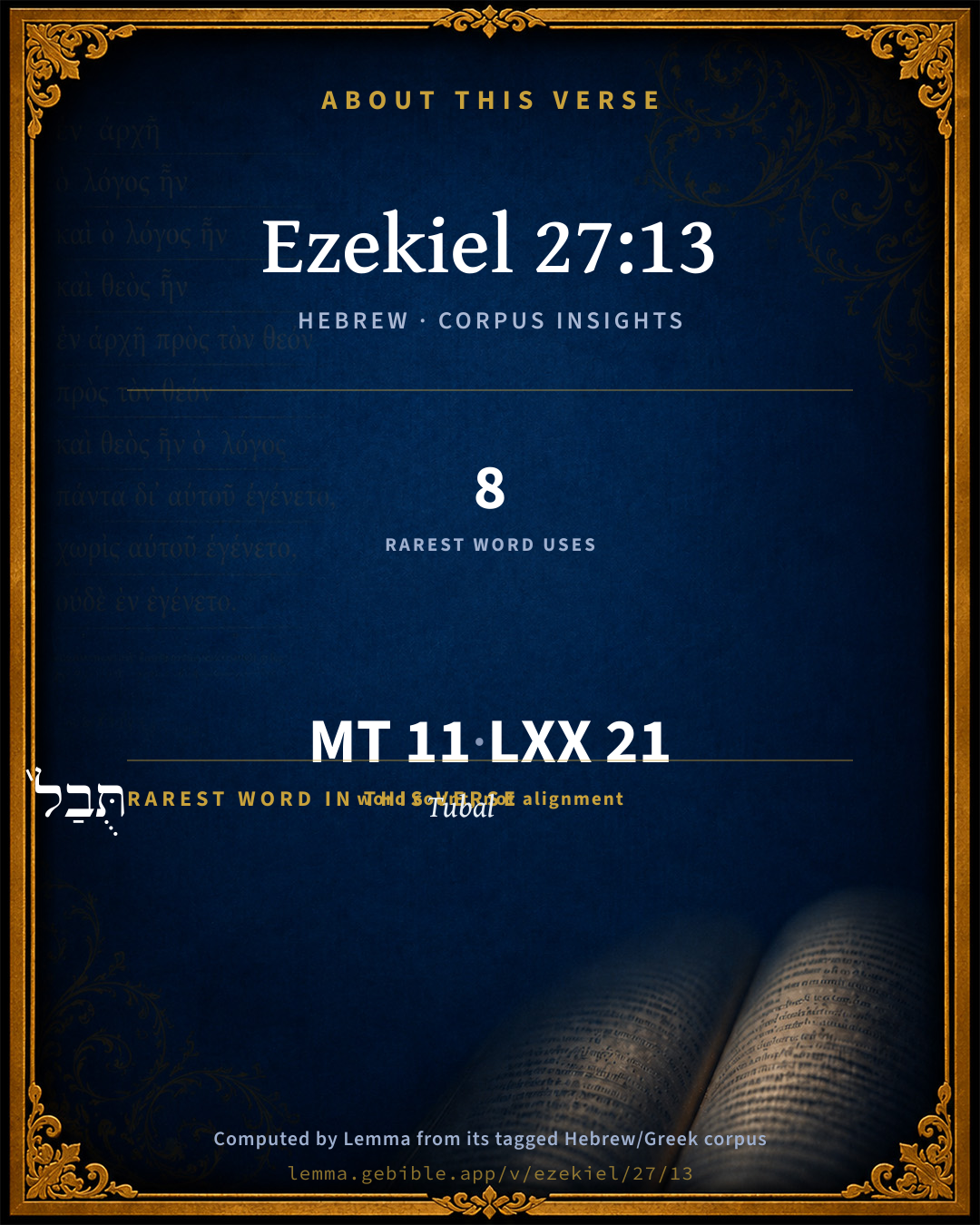
The rarest word here is תֻּבַל֙ Tubal H8422 — appearing just 8 times in the whole Hebrew Bible.

Shared distinctive vocabulary

תֻּבַל֙ Tubal H8422 occurs in 8 verses of the Hebrew Bible. Also found in:

Grammatical profile

  • 2 verbs
  • 8 nouns
  • 1 pronoun

Verb forms

  • רֹֽכְלָ֑יִךְ Qal · Participle Active
  • נָתְנ֖וּ Qal · Perfect

Hebrew & Septuagint length

In English translation the verse runs 21 words from the Hebrew and 27 from the Septuagint (LXX English) — closely comparable.

A rough comparison of the two English renderings, which tokenize alike — not a word-level alignment.

Word counts can differ between the Hebrew and the Greek without any difference in meaning — e.g. the Hebrew direct-object marker אֵת has no separate Greek word, and Greek often adds the article ὁ.

In the original languages it is 11 Hebrew tokens and 21 Greek tokens — but the two are counted differently (Hebrew bundles its prefixes and suffixes into one token; the Greek is in lemma form), so that isn’t a like-for-like length.

Cross-references

14

Topical passages linked to Ezekiel 27:13 in the Treasury of Scripture Knowledge — connected by theme and wording, ordered by reader-vote popularity; previews shown in the World English Bible.

  • Genesis 10:2 The sons of Japheth: Gomer, Magog, Madai, Javan, Tubal, Meshech, and Tiras.
  • Isaiah 66:19 I will set a sign among them, and I will send such as escape of them to the nations, to Tarshish, Pul, and Lud, who draw the bow, to Tubal and Javan, to the isles afar off, who have not heard my fame, neither have seen my glory; and they shall declare my glory among the nations.
  • 1 Chronicles 1:5 The sons of Japheth: Gomer, and Magog, and Madai, and Javan, and Tubal, and Meshech, and Tiras.
  • Ezekiel 39:1 You, son of man, prophesy against Gog, and say, Thus says the Lord Yahweh: Behold, I am against you, Gog, prince of Rosh, Meshech, and Tubal:
  • Revelation 18:13 and cinnamon, incense, perfume, frankincense, wine, olive oil, fine flour, wheat, sheep, horses, chariots, bodies, and people's souls.
  • Ezekiel 32:26 There is Meshech, Tubal, and all their multitude; their graves are round about them; all of them uncircumcised, slain by the sword; for they caused their terror in the land of the living.
  • Joel 3:3 And have cast lots for my people, And have given a boy for a prostitute, And sold a girl for wine, that they may drink.
  • Genesis 10:4 The sons of Javan: Elishah, Tarshish, Kittim, and Dodanim.
  • 1 Chronicles 1:7 The sons of Javan: Elishah, and Tarshish, Kittim, and Rodanim.
  • Ezekiel 27:19 Vedan and Javan traded with yarn for your wares: bright iron, cassia, and calamus, were among your merchandise.
  • Ezekiel 38:2–3 Son of man, set your face toward Gog, of the land of Magog, the prince of Rosh, Meshech, and Tubal, and prophesy against him,
  • Daniel 8:21 The rough male goat is the king of Greece: and the great horn that is between his eyes is the first king.
  • Daniel 10:20 Then he said, "Do you know why I have come to you? Now I will return to fight with the prince of Persia. When I go forth, behold, the prince of Greece shall come.
  • Daniel 11:2 Now will I show you the truth. Behold, there shall stand up yet three kings in Persia; and the fourth shall be far richer than they all: and when he has grown strong through his riches, he shall stir up all against the realm of Greece.

Cross-references courtesy of OpenBible.info (CC BY 4.0).

Hebrew and Greek witnesses Masoretic Hebrew ↔ Greek Septuagint

The same verse in the two great witnesses to the Old Testament, shown verse-for-verse.

These are two independent witnesses, not word-aligned to each other, and the Septuagint is shown in lemma (dictionary) form.

Hebrew Ezekiel 27:13 Masoretic · Westminster Leningrad Codex

יָוָ֤ן תֻּבַל֙ וָמֶ֔שֶׁךְ הֵ֖מָּה רֹֽכְלָ֑יִךְ בְּנֶ֤פֶשׁ אָדָם֙ וּכְלֵ֣י נְחֹ֔שֶׁת נָתְנ֖וּ מַעֲרָבֵֽךְ

Javan, Tubal, and Meshech, they were your traffickers; they traded the persons of men and vessels of brass for your merchandise.

World English Bible · Public Domain

Greek LXX Ezekiel 27:13 Septuagint · lemma form

ὁ ἑλλάς καί ὁ σύμπας καί ὁ παρατείνω οὗτος ἐνπορεύομαι σύ ἐν ψυχή ἄνθρωπος καί σκεῦος χαλκοῦς δίδωμι ὁ ἐμπορία σύ

Greece, both the whole world, and the adjacent coasts, these traded with you in the persons of men, and they gave as your merchandise vessels of brass.

LXX2012 (modern English Septuagint) · Public Domain

Hebrew: Westminster Leningrad Codex (CC BY 4.0). Greek: Septuagint (public domain); English from LXX2012 (modern English Septuagint) (Public Domain). How the Septuagint differs from the Hebrew →

Targum (Aramaic paraphrase)

1

The Targum is the ancient Jewish Aramaic paraphrase of the Hebrew Scriptures — an interpretive translation, not the Hebrew text itself. Onkelos (literal) and Pseudo-Jonathan (expansive) render the Torah, and Jonathan the Prophets. Coverage is partial: where no permissively-licensed English translation exists for a verse, only the Aramaic is shown. This is verse-level text, not a word-by-word alignment to the Hebrew.

  1. Targum Jonathan Prophets (Joshua–Malachi)
    יָוָן תּוּבָל וּמֶשֶׁךְ אִינוּן תַּגָרֵיךְ בְּנַפְשָׁא דֶאֱנָשָׁא וּמַנֵי נְחָשָׁא מַיְתָן סְחוֹרָא לְגַוִיךְ:

    (no public-domain English translation for this verse)

    Targum Jonathan — Aramaic: “Mikraot Gedolot” (public domain). English: “Sefaria Community Translation” (CC0 1.0 (public-domain dedication)); “London "Chaldee Paraphrase," 1871” (public domain). Text via Sefaria.

Commentary

Notes on Ezekiel 27:13 from classic Christian and Jewish commentators (each source and its license shown beneath its notes). The classic Christian expositions comment on the surrounding passage and are grouped to its opening verse, so a note may address several verses; the Jewish commentaries on the Tanakh (Rashi and others) are per-verse, so they appear only where the commentator wrote on this verse.

Lemma curates 59 commentaries, every one of them public domain or Creative Commons licensed, each selected and text-cleaned for this edition rather than reprinted as found. About our sources →

Trapp's Complete Commentary

John Trapp

Eze 27:13 Javan, Tubal, and Meshech, they [were] thy merchants: they traded the persons of men and vessels of brass in thy market.

Ver. 13. Javan, Tubal, and Meshech,] i.e., Grecians, Spaniards, and Muscovites or Cappadocians, who were naturally of a servile disposition: they were anciently called Meschines, saith Josephus, {a} of Meshech, the son of Japhet. {Gen 10:2}

They traded the persons of men,] i.e., They bought and sold slaves, as now they do in Turkey.

{a} Lib. i. cap. 6.

John Trapp, A Commentary or Exposition upon All the Books of the Old and New Testament (1647–1656) — public domain. Text from a community e-Sword module.

Tyndale Open Study Notes

Tyndale Open Resources

27:13-14 Tubal, Meshech, and neighboring Beth-togarmah were regions in Anatolia (modern Turkey).

Tyndale Open Study Notes — © Tyndale Open Resources, licensed CC BY-SA 4.0. Text via the HelloAO Bible API.

Geneva Bible (1599)

Geneva Bible translators

By selling slaves.

Of Greece, Italy and Cappadocia.

Geneva Bible (1599) marginal notes — public domain. Text via Bolls.life.

Jamieson, Fausset & Brown

Robert Jamieson, A. R. Fausset & David Brown

Javan--the Ionians or Greeks: for the Ionians of Asia Minor were the first Greeks with whom the Asiatics came in contact.

Tubal . . . Meshech--the Tibareni and Moschi, in the mountain region between the Black and Caspian Seas.

persons of men--that is, as slaves. So the Turkish harems are supplied with female slaves from Circassia and Georgia.

vessels--all kinds of articles. Superior weapons are still manufactured in the Caucasus region.

Jamieson, Fausset & Brown — Commentary Critical and Explanatory on the Whole Bible (1871) — public domain (CC PDM 1.0). Text via the HelloAO Bible API.

Adam Clarke's Commentary

Verse 13. Javan, Tubal, and Meshech] The Ionians, the Tybarenians, and the Cappadocians, or Muscovites.

They traded the persons of men] That is, they trafficked in slaves. The bodies and souls of men were bought and sold in those days, as in our degenerate age. With these also they traded in brazen vessels.

Adam Clarke's Commentary on the Bible (1810–1826) — public domain. Text from a community e-Sword/MySword module.

Ellicott's Commentary for English Readers

(13) Javan, Tubal, and Meshech.—Javan is strictly Ionia, more generally Greece. Tubal and Meshech are the classic Tibareni and Moschi, between the Black and Caspian Seas. They were famous for dealing in slaves and in brass, or rather copper, of which their mountains still contain abundant supplies.

A Bible Commentary for English Readers, edited by Charles John Ellicott (1878–1897) — public domain. Text from a community e-Sword module.

The Cambridge Bible for Schools and Colleges

gen. ed. J. J. S. Perowne

13. These three countries, Javan, Tubal and Meshech are usually named together, Gen_10:2; Eze_32:26; Eze_38:2; Eze_39:1; Isa_66:19. The first is the Ionians, the Greeks of Asia Minor, and the two last have usually been identified with the Moschi and Tibareni, lying to the S. and S.E. of the Black Sea. Copper and “souls of men” i.e. slaves, form the contribution of these countries. That Javan traded in slaves appears from Joel 4:6; cf. Amo_1:6; Amo_1:9.

they traded … in thy market] they brought as thy wares souls of men, &c. The nations are the servants of Tyre, and what they bring is her wares.

The Cambridge Bible for Schools and Colleges (gen. ed. J. J. S. Perowne; Cambridge University Press, 1878–1918) — public domain. Text from a community e-Sword module.

John Gill's Exposition

They of the house of Togarmah,.... The Targum is,

"they of the province or country of Germany.''

Jerom understands it of Phrygia, near to which was Cappadocia; and perhaps is here meant, since it abounded with what these people are said to trade with Tyre in:

these traded in thy fairs with horses, horsemen, and mules; for the Cappadocians paid for their yearly tribute to the Persians fifteen hundred horses, and two thousand mules, as Bochart (c) from Strabo observes; and as they sold horses and mules to the Tyrians, so likewise horsemen, men that were skilled in riding and taking care of horses; and these were sold along with the horses, as servants for that purpose.

(c) Phaleg. c. 11. col. 178.

John Gill's Exposition of the Whole Bible (1746–1763) — public domain (CC PDM 1.0). Text via the HelloAO Bible API.

Haydock's Catholic Bible Commentary

Slaves. Those from Greece were much esteemed. (Calmet) --- Alas! thirty thousand Tyrians were themselves thus sold by Alexander [the Great]! (Haydock)

George Leo Haydock (1774–1849), Haydock's Catholic Family Bible and Commentary, 1859 edition — public domain. Excludes Psalms (Douay-Rheims chapter numbering differs from Protestant) and Deuterocanonical books (Catholic canon only).

Matthew Poole's English Annotations

Javan; the Grecians, particularly the Ionians. Tubal; the Asiatic Iberians, &c.; the Albanians toward the Caspian Sea.

Meshech; the Cappadocians, with the Moschi, who dwelt about Cholcis, the country now called Mingrelia.

Traded the persons of men; brought men to sell for slaves, so the Greeks did; the (Mancipia Ionica) Ionian slaves were known and valued in the East, especially the handsome girls to wait on great ladies. The too great desire hereof in Atossa, Darius’s queen, is said to be the chief cause of his war on Greece. And as to the other, beside their senile inclinations, they were so barbarous and inhuman, and had opportunities to seize men, women, and children to sell them, that no doubt the market of Tyre was full of them.

Brass; of which metal there was great store, they say, in Cappadocia and Iberia, which they brought with them.

Matthew Poole's English Annotations on the Holy Bible (1683–1685) — public domain. Text from a community e-Sword/MySword module.

Whedon's Commentary on the Bible

Daniel D. Whedon

13. Javan, Tubal, and Meshech — Javan, brother of Tarshish (Gen_10:2), is the well-known name for Ionian or Greek. The Tel-el-Amarna tablets, 1400 B.C., mention a Yivana who had been sent on a mission to Tyre by the Egyptian king. Cyprus was called the “island of the Ionians” by the Assyrians, and Sayce thinks Cyprus is meant when Javan is referred to by Ezekiel (Races, p. 46. For extent and character of the early Greek commerce see Introduction to Daniel, III, 2.) It is possible, however, that at this period the name had a wider application, being perhaps a racial term, which was beginning to be specifically used of the Greeks of the mainland. Tubal and Meshech are generally mentioned together in the Scriptures (Eze_32:26; Eze_38:2; Eze_39:1), and appear in the Assyrian inscriptions as Tabali, Tubla, and Muska. They were famous as archers and were probably located in the interior of Asia Minor on the coast of the Black Sea. Professor Smith says: “Beyond Yavan were the coasts of Elisha, that was perhaps Sicily, and Tarshish, the great Phoenician colony in Spain. To all of these ships traded from Tyre and Sidon and Accho and Joppa. Their outward cargoes were Syrian wheat, oil, balm, with oriental wares, and they brought back cloth, purple and scarlet, silver, iron, tin, lead, and brass. Sometimes they carried west Hebrew slaves (Amo_1:9; Joel 4:6) and outlaws (Jon_1:3), forerunners of the great Dispersion” (Historical Geography, p. 136).

Daniel D. Whedon (gen. ed.), Commentary on the Old and New Testaments (1874–1909) — public domain. Text from a community e-Sword module.

The Pulpit Commentary

Javan father of Elishah, Tarshish, Kittim, and Dodanim, and son of Japheth, (Gen_10:2, Gen_10:4) stands generically for Greece, and probably represents Ionia. Tubal and Meshech are sons of Japheth in Gen_10:2, and are always grouped together, except in Psa_120:5, where Meshech appears alone, and in Isa_66:19, where Tubal is named, but not Meshech. In Eze_32:26 they are associated with Elam and Asshur (Assyria) in Eze_38:2, 3 and Eze_39:1 with Gog. The two names probably represented the tribes on the southeast coast of the Black Sea. Here the chief traffic was in slaves, the Tyrian traders probably buying them in exchange for their manufactured goods, and selling them to the cities of Greece as well as Phoenicia. In Greek history the names appear as Tibaroni and Moschi (Herod., 3:94; Xenophon, "Anab.," 5:5. 2, etal.). In Joe 3 Tyriaus are represented as selling Israelites as slaves in Greek cities (Hebrew "sons of Javan"). Thrace and Scythia were at all times the chief countries from which Greece imported her slaves. Vessels of brass. Here, as throughout the Old Testament, we should read "copper," the mixed metal which we know as "brass" not Being known to ancient metallurgy. Copper-mines were found near the Caucasus, and Euboea was also famous for them. The region was also noted for its iron.

The slave-trade.

Among the wares that the Phoenicians imported into Asia were Greek slaves. "With the persons of men did they trade for thy wares" from Javan and elsewhere. Thus early have we a picture of that hideous traffic in human flesh which is desolating the continent of Africa in our own day.

I THE SLAVE-TRADE IS CARRIED ON TO A TREMENDOUS EXTENT. This is no small evil. Every traveler into the interior of Africa writes of its wide prevalence; Whole provinces, vast regions as big as European kingdoms, are completely wrecked and depopulated. We are here face to face with one of the most gigantic evils of the human race.

II THE SLAVE-TRADE IS DIABOLICALLY CRUEL. There is cruelty in the very seizing of innocent human beings, depriving them of their liberty, tearing them from their families, driving them from their native villages, and exporting them to foreign countries, there to live in perpetual bondage. But, the manner in which this process is carried out aggravates the cruelty of it immensely. No proper provision is made for the transport of great companies of men, women, and children through vast regions of African forest to the coast, and thence by sea to their destination. By far the larger portion of the stolen victims perish on the way, after suffering piteously.

III THE SLAVE-TRADE IS AN OUTRAGE ON HUMANITY. All slaves are our fellow-men. The Greek slaves of antiquity were higher in race than their captors. But we have no reason to believe that they were treated so cruelly as the African slaves are treated by the Arabs. The modern slaves are lower in civilization than their captors they cannot Be lower in morals. But it is the more shameful that a powerful people should oppress these children of nature. They are human, and God "hath made of one blood all nations of men". (Act_17:26) Mankind is insulted in the person of the slaves and degraded to the level of devilry in that of their hunters.

IV THE SLAVE-TRADE IS A WRONG IN THE SIGHT OF HEAVEN. The notion that the Arabs are civilizing Africa, and even preparing for Christianity by leading the native people out of their heathen darkness to the belief in one God and the higher life of Mohammedanism, is not encouraged by the reports of those who have witnessed what is happening on the spot. On the contrary, the enforced conversion of whole tribes who are terrorized by the slave-hunters cannot mean any real advance in religion, while the awful wickedness of the trade carried on by these Mohammedan missionaries is one of the greatest sins in the sight of God.

V THE SLAVE-TRADE MUST BE STOPPED. NO crusade could be more needed or more blessed in its result than one that was wisely directed for the suppression of this curse of Africa. Christianity is the inspiration of philanthropy. Christ infuses an enthusiasm of humanity in his true followers. Christians should not rest till they have done all that in them lies to suppress the vile, cruel slave-trade.

The Pulpit Commentary (1880–1919), ed. H.D.M. Spence-Jones & Joseph S. Exell — public domain. Text from a community e-Sword module.

John Wesley's Explanatory Notes

Javan - The Grecians, particularly the Ionians. Tubal - The Asiatic Iberians, and the Albanians toward the Caspian sea. Meshech - The Cappadocians. They traded - Brought men to sell for slaves.

John Wesley, Explanatory Notes Upon the Whole Bible (1754–1765) — public domain. Text via the GEBible commentary corpus.

Rashi

Rabbi Shlomo Yitzchaki (Rashi)

with living people male and female slaves to sell.

Rashi on the Tanakh — English translations: “The Judaica Press complete Tanach with Rashi, translated by A. J. Rosenberg” (CC BY 4.0); “Pentateuch with Rashi's commentary by M. Rosenbaum and A.M. Silbermann, 1929-1934” (public domain); “The Metsudah Tanach series, Lakewood, N.J” (CC BY 4.0); and “The Book of Joshua, Metsudah Publications, 1997” (CC BY 4.0). Text via Sefaria.

Lesson kit

Teaching starters — assembled from the data on this page, not authored interpretation. Every prompt links to the verse data it draws on. Edit before teaching.

Ezekiel, in the Prophets, opens this verse with 11 words (11 distinct Hebrew lemmas). Its most distinctive word is Tûwbal (“Tubal”). A historical commentator’s framing appears above. Read the whole chapter for the surrounding context.

Discussion questions

  1. The word Tûwbal carries the sense “Tubal.” How does it shape the verse?
  2. Genesis 10:2 shares the word «Tubal» with this verse. How do the two illuminate each other?
  3. The translations on this page render this verse differently — a whole-verse word diff, not a word-by-word alignment. What might account for the different wordings?
  4. The verb «רֹֽכְלָ֑יִךְ» is Qal Participle Active. How does its form color the action?
  5. Reading how Trapp's Complete Commentary and Tyndale Open Study Notes read this verse, where do the two commentators agree and where do they part?

Things to notice

Reading settings

Reading text

Shown beneath each verse's original-language words.

Old Testament
Old Testament edition

Read the OT as the Masoretic Hebrew (MT) or the Greek Septuagint (LXX).

English shown for the Greek Septuagint (in the Hebrew ↔ Greek comparison).

Comparing translations? Open the Compare panel on any verse page to stack up to four side by side.