2 Samuel 17:28

Hebrew (Westminster Leningrad Codex) 2 Samuel 17:28 appears in the Hebrew Old Testament. The text above is from the Westminster Leningrad Codex. Each word links to its Strong’s number, a concise gloss, and parsing drawn from the Open Scriptures Hebrew Bible morphology. Click any word for its full Brown-Driver-Briggs (BDB) entry.
Download image
Cite this verse

2 Samuel 17:28 (World English Bible). Public Domain. Lemma interlinear Bible study tool, https://lemma.gebible.app/v/2-samuel/17/28.

Show BibTeX & RIS
BibTeX
RIS
English Translation
brought beds, and basins, and earthen vessels, and wheat, and barley, and meal, and parched [grain], and beans, and lentils, and parched [pulse],
World English Bible · Public Domain
Highlights
  • 1 first appearance in the Hebrew Bible
Full analysis ↓
Download a study sheet

One document with this verse’s original text, its word-by-word gloss line, the meaning frame, cross-references with their text, attributed commentary, and full source and license credits — printable, and it pastes into notes with its structure intact.

This verse Autodidact and up

Study sheet (.html) Plain text (.txt)

A passage Seminary Student

Up to 50 verses in one chapter. A passage sheet keeps up to 6 commentary sources and 12 cross-references per verse, in the order this page ranks them, and says so on the sheet whenever that leaves anything out. Ask for a single verse and you get the Autodidact verse sheet above.

Everything on this page stays free to read, with no account — the sheet is a download of what is already on screen, not access to it.

Want to remove ads? Support Godless Engineer
Compare translations 3

The same verse in 3 English versions, stacked beneath the original-language interlinear above. Click any original word for its lexicon entry.

Each is an independent rendering of the whole verse — the interlinear is not word-aligned to these translations.

Highlighted words mark where these versions differ — a whole-verse word diff, not a word-by-word alignment.

  • World English Bible Public Domain
    brought beds, and basins, and earthen vessels, and wheat, and barley, and meal, and parched [grain], and beans, and lentils, and parched [pulse],
  • King James Version Public Domain
    Brought beds, and basins, and earthen vessels, and wheat, and barley, and flour, and parched corn, and beans, and lentils, and parched pulse,
  • unfoldingWord Literal Text CC BY-SA 4.0
    beds and basins and vessels of the potter and wheat and barley and flour and roasted grain and beans and lentils and roasted beans

unfoldingWord Literal Text — © unfoldingWord, licensed CC BY-SA 4.0. Word-aligned USFM3 via Door43 (git.door43.org/unfoldingWord/en_ult).

Versions to compare (up to 4)

3 of 4 selected

Show all 18 translations

Every available English version of this verse, each an independent rendering of the whole verse.

  • World English Bible Public Domain
    brought beds, and basins, and earthen vessels, and wheat, and barley, and meal, and parched [grain], and beans, and lentils, and parched [pulse],
  • Berean Standard Bible Public Domain
    They brought beds, basins, and earthen vessels, as well as wheat, barley, flour, roasted grain, beans, lentils,
  • Majority Standard Bible Public Domain
    They brought beds, basins, and earthen vessels, as well as wheat, barley, flour, roasted grain, beans, lentils,
  • King James Version Public Domain
    Brought beds, and basins, and earthen vessels, and wheat, and barley, and flour, and parched corn, and beans, and lentils, and parched pulse,
  • American Standard Version (1901) Public Domain
    brought beds, and basins, and earthen vessels, and wheat, and barley, and meal, and parched `grain', and beans, and lentils, and parched `pulse',
  • Revised Version (1885) Public Domain
    brought beds, and basons, and earthen vessels, and wheat, and barley, and meal, and parched corn, and beans, and lentils, and parched pulse,
  • Geneva Bible (1599) Public Domain
    Brought beds, and basens, and earthen vessels, and wheat, and barley, and floure, and parched corne, and beanes, and lentiles, and parched corne.
  • Douay-Rheims (1899) Public Domain
    Brought him beds, and tapestry, and earthen vessels, and wheat, and barley, and meal, and parched corn, and beans, and lentils, and fried pulse,
  • Young's Literal Translation Public Domain
    couch, and basin, and earthen vessel, and wheat, and barley, and flour, and roasted `corn', and beans, and lentiles, and roasted `pulse',
  • Literal Standard Version CC BY-SA 4.0
    [have brought] bed, and basin, and earthen vessel, and wheat, and barley, and flour, and roasted [grain], and beans, and lentiles, and roasted [pulse],
  • Unlocked Literal Bible CC BY-SA 4.0
    brought sleeping mats and blankets, bowls and pots, and wheat, barley flour, roasted grain, beans, lentils,
  • unfoldingWord Literal Text CC BY-SA 4.0
    beds and basins and vessels of the potter and wheat and barley and flour and roasted grain and beans and lentils and roasted beans
  • Darby Bible Public Domain
    brought beds, and basons, and earthen vessels, and wheat, and barley, and flour, and parched [corn], and beans, and lentils, and parched [pulse],
  • World Messianic Bible Public Domain
    brought beds, basins, earthen vessels, wheat, barley, meal, parched grain, beans, lentils, roasted grain,
  • Webster's Bible Public Domain
    Brought beds, and basins, and earthen vessels, and wheat, and barley, and flour, and parched corn, and beans, and lentils, and parched pulse,
  • Free Bible Version CC BY-SA 4.0
    They brought bedding, bowls, and clay jars, as well as wheat, barley, flour, roasted grain, beans, lentils,
  • Bible in Basic English Public Domain
    Came with beds and basins and pots, and grain and meal, and all sorts of dry foods,
  • JPS Tanakh (1917) Public Domain
    brought beds, and basins, and earthen vessels, and wheat, and barley, and meal, and parched corn, and beans, and lentils, and parched pulse,

Literal Standard Version (2020), Covenant Press — licensed CC BY-SA 4.0. Text via the HelloAO Bible API (eBible.org). Unlocked Literal Bible (unfoldingWord) — licensed CC BY-SA 4.0. Text via the HelloAO Bible API (eBible.org). unfoldingWord Literal Text — © unfoldingWord, licensed CC BY-SA 4.0. Word-aligned USFM3 via Door43 (git.door43.org/unfoldingWord/en_ult). Free Bible Version, Dr. Jonathan Gallagher — licensed CC BY-SA 4.0. Text via the HelloAO Bible API (eBible.org).

Word by word

More ways to search: Search by grammar → Find every occurrence → Compare this word →

Practice this passage: Drill this verse → Learn its vocabulary →

וּפ֥וֹל
pôwl
H6321
“and · beans”
Conjunction + Noun, Common, Masculine, Singular, Absolute
Part of Speech
Conjunction + Noun
Type
Common
Gender
Masculine
Number
Singular
State
Absolute
Full BDB Definition

Origin: from an unused root meaning to be thick

TWOT: 1743

beans
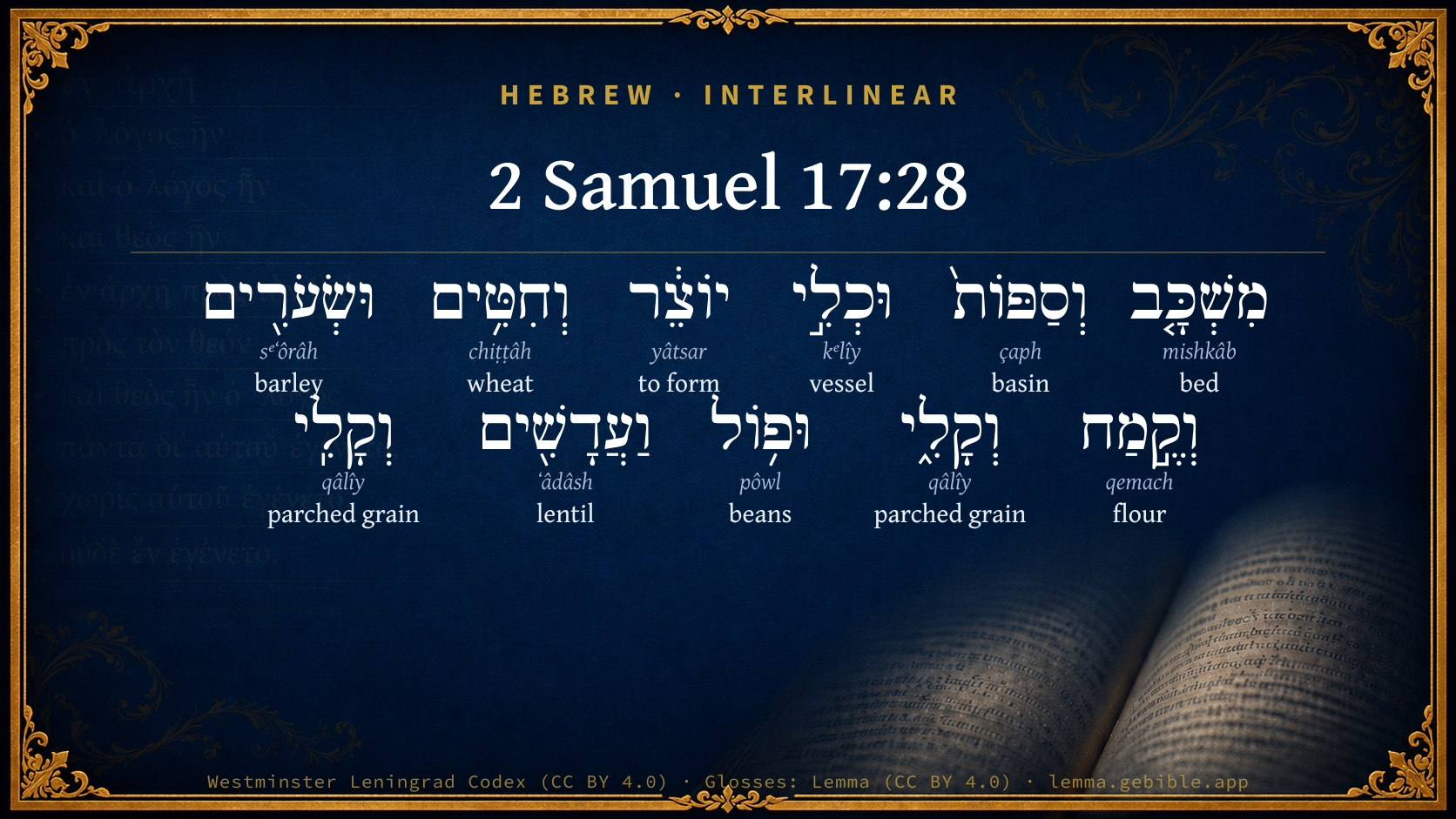
  1. מִשְׁכָּ֤ב mishkâb H4904 “bed” Noun, Common, Masculine, Singular, Absolute
  2. וְסַפּוֹת֙ çaph H5592 “and · basins” Conjunction + Noun, Common, Masculine, Plural, Absolute
  3. וּכְלִ֣י kᵉlîy H3627 “and · vessel of” Conjunction + Noun, Common, Masculine, Singular, Construct
  4. יוֹצֵ֔ר yâtsar H3335 “potter” Noun, Common, Masculine, Singular, Absolute
  5. וְחִטִּ֥ים chiṭṭâh H2406 “and · wheat” Conjunction + Noun, Common, Feminine, Plural, Absolute
  6. וּשְׂעֹרִ֖ים sᵉʻôrâh H8184 “and · barley” Conjunction + Noun, Common, Feminine, Plural, Absolute
  7. וְקֶ֣מַח qemach H7058 “and · flour” Conjunction + Noun, Common, Masculine, Singular, Absolute
  8. וְקָלִ֑י qâlîy H7039 “and · parched grain” Conjunction + Noun, Common, Masculine, Singular, Absolute
  9. וַעֲדָשִׁ֖ים ʻâdâsh H5742 “and · lentils” Conjunction + Noun, Common, Feminine, Plural, Absolute
  10. וְקָלִֽי qâlîy H7039 “and · parched grain” Conjunction + Noun, Common, Masculine, Singular, Absolute

About this verse

These counts appear in no published source. They are computed here, from the morphology-tagged text and Lemma’s own curated glosses. What Lemma adds →

11
words
10
distinct lemmas
Historical
section

Notable vocabulary

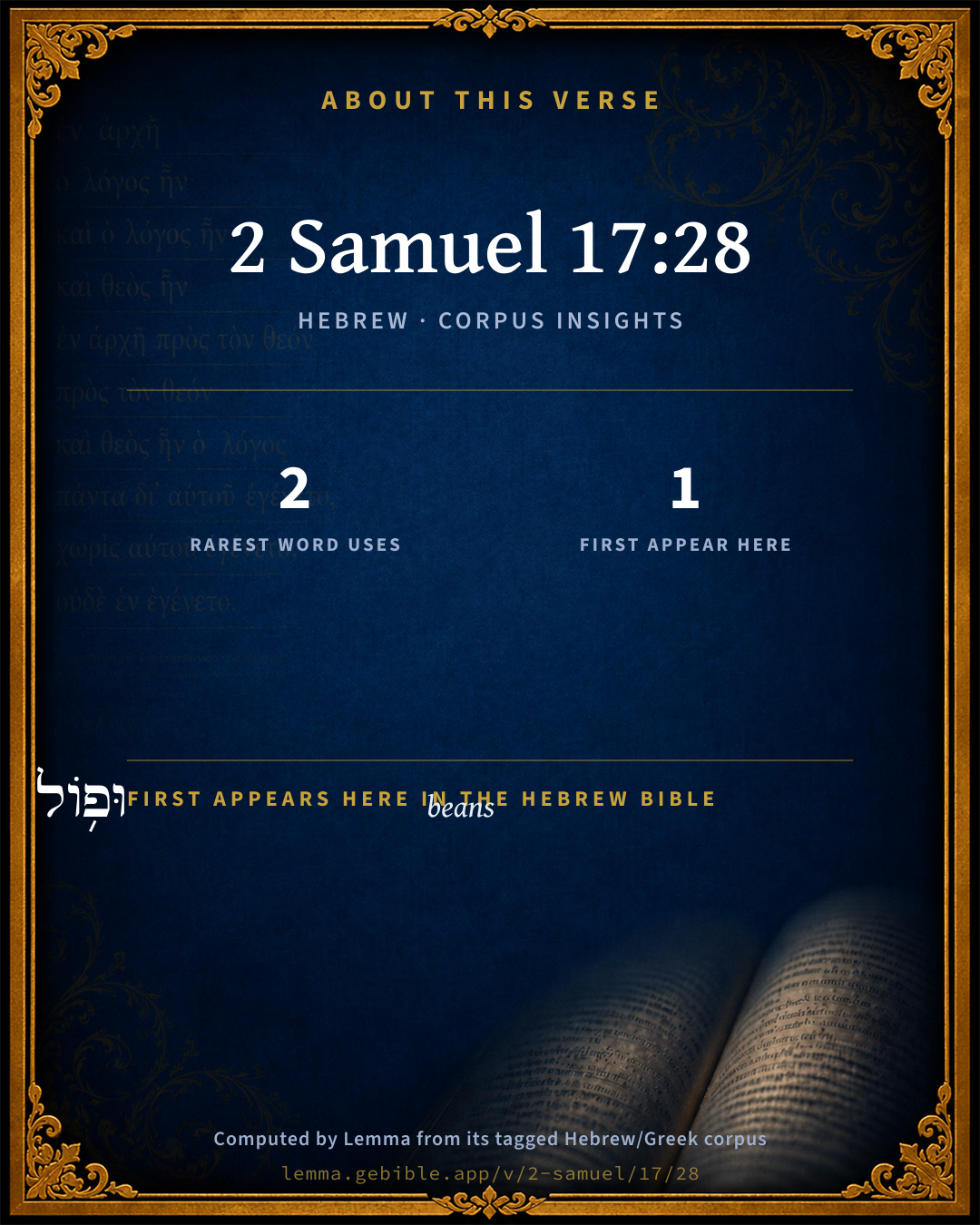
The rarest word here is וּפ֥וֹל beans H6321 — appearing just 2 times in the whole Hebrew Bible.

First appearance in Scripture

This word makes its first canonical appearance in the Hebrew Bible here:

  • וּפ֥וֹל beans H6321

Shared distinctive vocabulary

וּפ֥וֹל beans H6321 occurs in 2 verses of the Hebrew Bible. Also found in:

Grammatical profile

  • 11 nouns

Repetition

A word recurs within this verse — often emphatic in Hebrew:

  • וְקָלִ֑י parched grain H7039 ×2

Hebrew & Septuagint length

In English translation the verse runs 23 words from the Hebrew and 24 from the Septuagint (LXX English) — closely comparable.

A rough comparison of the two English renderings, which tokenize alike — not a word-level alignment.

Word counts can differ between the Hebrew and the Greek without any difference in meaning — e.g. the Hebrew direct-object marker אֵת has no separate Greek word, and Greek often adds the article ὁ.

Cross-references

4

Topical passages linked to 2 Samuel 17:28 in the Treasury of Scripture Knowledge — connected by theme and wording, ordered by reader-vote popularity; previews shown in the World English Bible.

  • 1 Samuel 25:18 Then Abigail made haste, and took two hundred loaves, and two bottles of wine, and five sheep ready dressed, and five measures of parched grain, and one hundred clusters of raisins, and two hundred cakes of figs, and laid them on donkeys.
  • 2 Samuel 16:1–2 When David was a little past the top [of the ascent], behold, Ziba the servant of Mephibosheth met him, with a couple of donkeys saddled, and on them two hundred loaves of bread, and one hundred clusters of raisins, and one hundred summer fruits, and a bottle of wine.
  • Isaiah 32:8 But the noble devises noble things; and in noble things shall he continue.
  • Obadiah 1:3 The pride of your heart has deceived you, you who dwell in the clefts of the rock, whose habitation is high, who says in his heart, 'Who will bring me down to the ground?'

Cross-references courtesy of OpenBible.info (CC BY 4.0).

Hebrew and Greek witnesses Masoretic Hebrew ↔ Greek Septuagint

The same verse in the two great witnesses to the Old Testament, shown verse-for-verse.

These are two independent witnesses, not word-aligned to each other, and the Septuagint is shown in lemma (dictionary) form.

Hebrew 2 Samuel 17:28 Masoretic · Westminster Leningrad Codex

מִשְׁכָּ֤ב וְסַפּוֹת֙ וּכְלִ֣י יוֹצֵ֔ר וְחִטִּ֥ים וּשְׂעֹרִ֖ים וְקֶ֣מַח וְקָלִ֑י וּפ֥וֹל וַעֲדָשִׁ֖ים וְקָלִֽי

brought beds, and basins, and earthen vessels, and wheat, and barley, and meal, and parched [grain], and beans, and lentils, and parched [pulse],

World English Bible · Public Domain

Greek LXX 2 Samuel 17:28 Septuagint · lemma form

φέρω δέκα κοίτη καί ἀμφίταπος καί λέβης δέκα καί σκεῦος κέραμος καί πυρός καί κριθή καί ἄλευρον καί ἄλφιτον καί κύαμος καί φακός

brought ten embroidered beds, (with double coverings,) and ten caldrons, and earthenware, and wheat, and barley, and flour, and meal, and beans, and pulse,

LXX2012 (modern English Septuagint) · Public Domain

On this verse, Haydock's Catholic Bible Commentary discusses the Septuagint’s reading. Read the note in Commentary ↓

Hebrew: Westminster Leningrad Codex (CC BY 4.0). Greek: Septuagint (public domain); English from LXX2012 (modern English Septuagint) (Public Domain). How the Septuagint differs from the Hebrew →

Targum (Aramaic paraphrase)

1

The Targum is the ancient Jewish Aramaic paraphrase of the Hebrew Scriptures — an interpretive translation, not the Hebrew text itself. Onkelos (literal) and Pseudo-Jonathan (expansive) render the Torah, and Jonathan the Prophets. Coverage is partial: where no permissively-licensed English translation exists for a verse, only the Aramaic is shown. This is verse-level text, not a word-by-word alignment to the Hebrew.

  1. Targum Jonathan Prophets (Joshua–Malachi)
    מַכְבִּין וְקוֹלִין וּמָאן דַחֲסַף וְחִטִין וּסְעוֹרִין וְקִמְחָא וְקַלְיָא וּפוּלָא וּטְלוֹפְחִין וְקַלְיָא:

    (no public-domain English translation for this verse)

    Targum Jonathan — Aramaic: “Mikraot Gedolot” (public domain). English: “Sefaria Community Translation” (CC0 1.0 (public-domain dedication)); “London "Chaldee Paraphrase," 1871” (public domain). Text via Sefaria.

Commentary

Notes on 2 Samuel 17:28 from classic Christian and Jewish commentators (each source and its license shown beneath its notes). The classic Christian expositions comment on the surrounding passage and are grouped to its opening verse, so a note may address several verses; the Jewish commentaries on the Tanakh (Rashi and others) are per-verse, so they appear only where the commentator wrote on this verse.

Lemma curates 59 commentaries, every one of them public domain or Creative Commons licensed, each selected and text-cleaned for this edition rather than reprinted as found. About our sources →

Trapp's Complete Commentary

John Trapp

2Sa 17:28 Brought beds, and basons, and earthen vessels, and wheat, and barley, and flour, and parched [corn], and beans, and lentiles, and parched [pulse],

Ver. 28. Brought beds, &c.] Strangers relieve David, whom his own son persecuteth. While the divine bounty serveth us in good meat, though not in our own dishes, we have good reason to be thankful.

John Trapp, A Commentary or Exposition upon All the Books of the Old and New Testament (1647–1656) — public domain. Text from a community e-Sword module.

Joseph Benson's Commentary

2Sa 17:28-29. Brought beds, and basins, and earthen vessels — All manner of household stuff; and wheat, and barley, and flour, and corn — That is, various kinds of provision, which they now wanted. For they said, The people is hungry and weary, &c.,in the wilderness — Having been in the wilderness, where there was a total want or scarcity of provisions and all conveniences, and therefore they needed refreshment when they were come out of it, which moved these persons to bring them these things. Thus God sometimes makes up to his people that comfort from strangers which they are disappointed of in their own families. The circumstances now related were all so many happy beginnings and omens of David’s future success, and pledges of that just and humble confidence which he had placed in the divine favour and protection.

Joseph Benson's Commentary on the Old and New Testaments (1811–1818) — public domain. Text from a community e-Sword module.

Geneva Bible (1599)

Geneva Bible translators

God showeth himself most liberal to his, when they seem to be utterly destitute.

Geneva Bible (1599) marginal notes — public domain. Text via Bolls.life.

Adam Clarke's Commentary

Verse 28. Brought beds] These no doubt consisted in skins of beasts, mats, carpets, and such like things.

Basons] ספות sappoth. Probably wooden bowls, such as the Arabs still use to eat out of, and to knead their bread in.

Earthen vessels] כלי יוצר keley yotser. Probably clay vessels, baked in the sun. These were perhaps used for lifting water, and boiling those articles which required to be cooked.

Wheat, and barley, c.] There is no direct mention of flesh-meat here little was eaten in that country, and it would not keep. Whether the sheep mentioned were brought for their flesh or their milk. I cannot tell.

According to Mr. Jones, "the Moors of west Barbary use the flour of parched barley, which is the chief provision they make for their journeys, and often use it at home; and this they carry in a leathern satchel." These are ordinarily made of goat-skins. One of them now lies before me: it has been drawn off the animal before it was cut up; the places where the fore-legs, the tail, and the anus were, are elegantly closed, and have leathers thongs attached to them, by which it can be slung over the back of man, ass, or camel. The place of the neck is left open, with a running string to draw it up, purse-like, when necessary. The skin itself is tanned; and the upper side is curiously embroidered with red, black, blue, yellow, and flesh-coloured leather, in very curious and elegant forms and devices. Bags of this kind are used for carrying wine, water, milk, butter, grain, flour, clothes, and different articles of merchandise. This is, as I have before stated, the Scripture bottle. Mr. Jones farther says: "Travellers use zumeet, tumeet, and limereece. Zumeet is flour mixed with honey, butter, and spice; tumeet is flour done up with organ oil; and limereece is flour mixed with water for drink. This quenches the thirst much better than water alone; satisfies a hungry appetite; cools and refreshes tired and weary spirits; overcoming those ill effects which a hot sun and fatiguing journey might well occasion."

This flour might be made of grain or pulse of any kind: and probably may be that which we here term parched corn and parched pulse; and in the forms above mentioned was well calculated, according to Mr. Jones's account, for the people hungry, weary, and thirsty, in the wilderness. This was a timely supply for David and his men, and no doubt contributed much to the victory mentioned in the following chapter.

A REMARKABLE account of maternal affection in a she-bear: "In the year 1772, the Seahorse frigate and Carcass bomb, under the command of the Hon. Captain C. J. Phipps, afterwards Lord Mulgrave, were sent on a voyage of discovery to the north seas. In this expedition the late celebrated admiral Lord Nelson served as midshipman. While the Carcass lay locked in the ice, early one morning, the man at the masthead gave notice that three bears were making their way very fast over the frozen sea, and were directing their course towards the ship. They had no doubt been invited by the scent of some blubber of a seahorse that the crew had killed a few days before, which had been set on fire, and was burning on the ice at the time of their approach. They proved to be a she-bear and her two cubs, but the cubs were nearly as large as the dam. They ran eagerly to the fire, and drew out from the flames part of the flesh of the seahorse that remained unconsumed, and ate voraciously. The crew from the ship threw great lumps of flesh of the seahorse, which they had still left upon the ice, which the old bear fetched away singly, laid every lump before her cubs as she brought it, and dividing it, gave each a share, reserving but a small portion to herself. As she was fetching away the last piece, they levelled their muskets at the cubs, and shot them both dead; and in her retreat they wounded the dam, but not mortally. It would have drawn tears of pity from any but unfeeling minds, to have marked the affectionate concern expressed by this poor beast in the dying moments of her expiring young. Though she was sorely wounded, and could but just crawl to the place where they lay, she carried the lump of flesh she had fetched away, as she had done the others before, tore it in pieces and laid it down before them; and when she saw that they refused to eat, she laid her paws first upon one, and then upon the other, and endeavoured to raise them up; all this while it was piteous to hear her moan. When she found she could not move them, she went off; and being at some distance, looked back and moaned. This not availing to entice them away, she returned, and smelling around them, began to lick their wounds. She went off a second time, as before; and having crawled a few paces, looked again behind her, and for some time stood moaning. But still her cubs not rising to follow her, she returned to them again, and with signs of inexpressible fondness went round one, and round the other, pawing them and moaning. Finding at last that they were cold and lifeless, she raised her head towards the ship, and growled a curse upon the murderers, which they returned with a volley of musket balls. She fell between her cubs, and died licking their wounds."

Had this animal got among the destroyers of her young, she would have soon shown what was implied in the chafed mind of a bear robbed of her whelps.

Adam Clarke's Commentary on the Bible (1810–1826) — public domain. Text from a community e-Sword/MySword module.

The Cambridge Bible for Schools and Colleges

gen. ed. J. J. S. Perowne

28. beds, and basons] The Sept. reads “ten beds with coverlets and ten bowls.”

parched corn … parched pulse] If the text is sound, this is the right explanation: but it is strange that the same word should be twice repeated in one sentence to denote different articles. The Sept. omits the second.

The Cambridge Bible for Schools and Colleges (gen. ed. J. J. S. Perowne; Cambridge University Press, 1878–1918) — public domain. Text from a community e-Sword module.

Haydock's Catholic Bible Commentary

Beds, will all the necessary furniture, coverlets, &c. Roman Septuagint, "ten beds, with fur on both sides." --- Tapestry. Some would translate, "bottles," (Chaldean) or "cauldrons;" (Roman Septuagint) but other editions agree with the Vulgate. --- Vessels. These are necessary, as much as things of greater magnificence. Precious metals were then rarely used in the kitchen. --- Pulse, (cicer) or "parched peas." Hebrew kali, is thus twice translated, as it had been rendered parched corn. It signifies any thing "parched." The ancients made great use of such food in journeys, as the Ethiopians and Turks do still. (Atheneus ii. 13.; Busbec. iii.; Bellon. ii. 53.) (Calmet)

George Leo Haydock (1774–1849), Haydock's Catholic Family Bible and Commentary, 1859 edition — public domain. Excludes Psalms (Douay-Rheims chapter numbering differs from Protestant) and Deuterocanonical books (Catholic canon only).

Matthew Poole's English Annotations

Beds and basons, i.e. all sorts of household stuff, as well as other provisions, all which David now wanted.

Matthew Poole's English Annotations on the Holy Bible (1683–1685) — public domain. Text from a community e-Sword/MySword module.

The Pulpit Commentary

Beds. These would be for the women and children, and were scarcely more than rugs and small carpets. Basons; pots of metal for cooking, while the earthenware would be vessels for holding their food. Parched (corn) ... and parched (pulse); Hebrew, kali and kali. The word includes all kinds of parched grain. The Septuagint and Syriac rightly omit it in the second place, as it is probably a mere error of some ancient copyist; but for what word it has been substituted we have no means of ascertaining.

The Pulpit Commentary (1880–1919), ed. H.D.M. Spence-Jones & Joseph S. Exell — public domain. Text from a community e-Sword module.

Rashi

Rabbi Shlomo Yitzchaki (Rashi)

Mats. Mats.

Utensils. They are utensils for practical use. as [we find], "Silver utensils."

Toasted grain. Types of toasted foods Our Rabbis said Barzilai brought two types of porridge to Dovid, one made of wheat and one made of lentils as described here flour and קָלִי, this one was made from wheat. Beans, lentils and קָלִי [this one] was made from types of beans. They used to dry them in ovens [having been put in] while they were [still] moist, they [thus] were permenantly sweet [then] they ground them and made from them a food that was called "porridge."

Rashi on the Tanakh — English translations: “The Judaica Press complete Tanach with Rashi, translated by A. J. Rosenberg” (CC BY 4.0); “Pentateuch with Rashi's commentary by M. Rosenbaum and A.M. Silbermann, 1929-1934” (public domain); “The Metsudah Tanach series, Lakewood, N.J” (CC BY 4.0); and “The Book of Joshua, Metsudah Publications, 1997” (CC BY 4.0). Text via Sefaria.

Lesson kit

Teaching starters — assembled from the data on this page, not authored interpretation. Every prompt links to the verse data it draws on. Edit before teaching.

2 Samuel, in the Historical, opens this verse with 11 words (10 distinct Hebrew lemmas). Its most distinctive word is pôwl (“beans”). A historical commentator’s framing appears above. Read the whole chapter for the surrounding context.

Discussion questions

  1. What does “beans” (pôwl) contribute to the verse as a whole?
  2. This is the first place “beans” appears in Scripture (first appears here). What does its debut here establish?
  3. How does Ezekiel 4:9, which shares the word «beans», read alongside this verse?
  4. What does the repetition of “parched grain” (2× in this one verse) do in this verse?
  5. These translations render this verse differently. What is at stake in choosing one wording over another?
  6. Compare how Trapp's Complete Commentary and Joseph Benson's Commentary read this verse. Where do they agree or differ?

Things to notice

  • 1 word makes its first canonical appearance in Scripture here.
  • These translations choose different wording for 10 words in this verse.
  • “parched grain” occurs 2× in this single verse.
  • 10 distinct Hebrew lemmas span 11 words in this verse.

Reading settings

Reading text

Shown beneath each verse's original-language words.

Old Testament
Old Testament edition

Read the OT as the Masoretic Hebrew (MT) or the Greek Septuagint (LXX).

English shown for the Greek Septuagint (in the Hebrew ↔ Greek comparison).

Comparing translations? Open the Compare panel on any verse page to stack up to four side by side.