Leviticus 15:23

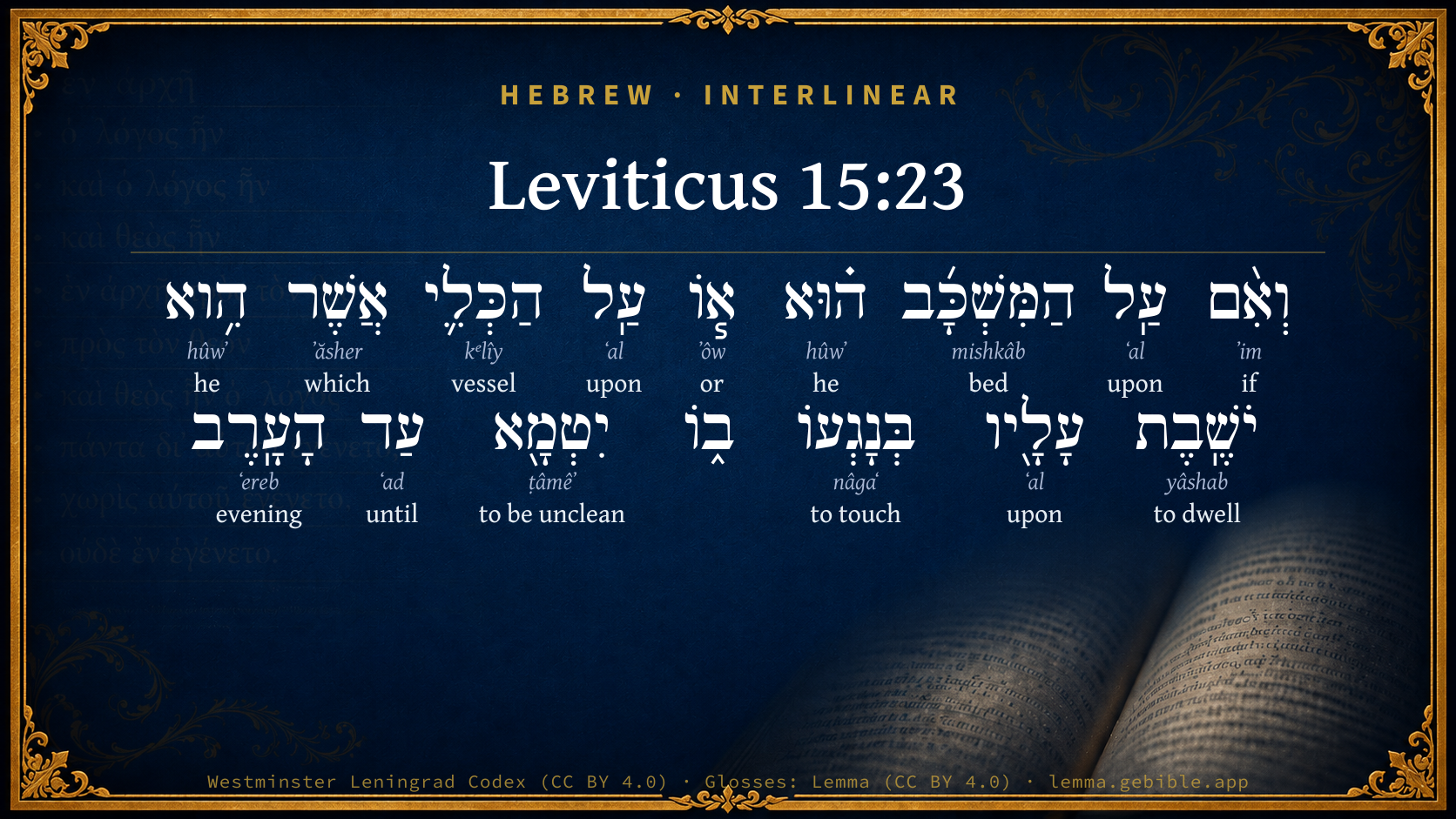
Hebrew (Westminster Leningrad Codex) Leviticus 15:23 appears in the Hebrew Old Testament. The text above is from the Westminster Leningrad Codex. Each word links to its Strong’s number, a concise gloss, and parsing drawn from the Open Scriptures Hebrew Bible morphology. Click any word for its full Brown-Driver-Briggs (BDB) entry.
Download image
Cite this verse

Leviticus 15:23 (World English Bible). Public Domain. Lemma interlinear Bible study tool, https://lemma.gebible.app/v/leviticus/15/23.

Show BibTeX & RIS
BibTeX
RIS
English Translation
If it is on the bed, or on anything whereon she sits, when he touches it, he shall be unclean until the evening.
World English Bible · Public Domain
Download a study sheet

One document with this verse’s original text, its word-by-word gloss line, the meaning frame, cross-references with their text, attributed commentary, and full source and license credits — printable, and it pastes into notes with its structure intact.

This verse Autodidact and up

Study sheet (.html) Plain text (.txt)

A passage Seminary Student

Up to 50 verses in one chapter. A passage sheet keeps up to 6 commentary sources and 12 cross-references per verse, in the order this page ranks them, and says so on the sheet whenever that leaves anything out. Ask for a single verse and you get the Autodidact verse sheet above.

Everything on this page stays free to read, with no account — the sheet is a download of what is already on screen, not access to it.

Want to remove ads? Support Godless Engineer
Compare translations 3

The same verse in 3 English versions, stacked beneath the original-language interlinear above. Click any original word for its lexicon entry.

Each is an independent rendering of the whole verse — the interlinear is not word-aligned to these translations.

Highlighted words mark where these versions differ — a whole-verse word diff, not a word-by-word alignment.

  • World English Bible Public Domain
    If it is on the bed, or on anything whereon she sits, when he touches it, he shall be unclean until the evening.
  • King James Version Public Domain
    And if it be on her bed, or on any thing whereon she sitteth, when he toucheth it, he shall be unclean until the even.
  • unfoldingWord Literal Text CC BY-SA 4.0
    But if it on the bed or on furniture on which she is sitting, when he touches it, he shall be unclean until the evening.

unfoldingWord Literal Text — © unfoldingWord, licensed CC BY-SA 4.0. Word-aligned USFM3 via Door43 (git.door43.org/unfoldingWord/en_ult).

Versions to compare (up to 4)

3 of 4 selected

Show all 18 translations

Every available English version of this verse, each an independent rendering of the whole verse.

  • World English Bible Public Domain
    If it is on the bed, or on anything whereon she sits, when he touches it, he shall be unclean until the evening.
  • Berean Standard Bible Public Domain
    And whether it is a bed or furniture on which she was sitting, whoever touches it will be unclean until evening.
  • Majority Standard Bible Public Domain
    And whether it is a bed or furniture on which she was sitting, whoever touches it will be unclean until evening.
  • King James Version Public Domain
    And if it be on her bed, or on any thing whereon she sitteth, when he toucheth it, he shall be unclean until the even.
  • American Standard Version (1901) Public Domain
    And if it be on the bed, or on anything whereon she sitteth, when he toucheth it, he shall be unclean until the even.
  • Revised Version (1885) Public Domain
    And if it be on the bed, or on any thing whereon she sitteth, when he toucheth it, he shall be unclean until the even.
  • Geneva Bible (1599) Public Domain
    So that whether he touche her bed, or any thing whereon shee hath sit, he shalbe vncleane vnto the euen.
  • Douay-Rheims (1899) Public Domain
    Whosoever shall touch any vessel on which she sitteth, shall wash his clothes: and himself being washed with water, shall be defiled until the evening.
  • Young's Literal Translation Public Domain
    `And if it `is' on the bed, or on the vessel on which she is sitting, in his coming against it, he is unclean till the evening.
  • Literal Standard Version CC BY-SA 4.0
    And if it [is] on the bed, or on the vessel on which she is sitting, in his coming against it, he is unclean until the evening.
  • Unlocked Literal Bible CC BY-SA 4.0
    Whether it is on the bed or on anything on which she sits, if he touches it, that person will be unclean until evening.
  • unfoldingWord Literal Text CC BY-SA 4.0
    But if it on the bed or on furniture on which she is sitting, when he touches it, he shall be unclean until the evening.
  • Darby Bible Public Domain
    And if it be on the bed, or on anything whereon she sitteth, when he toucheth it, he shall be unclean until the even.
  • World Messianic Bible Public Domain
    If it is on the bed, or on anything she sits on, when he touches it, he shall be unclean until the evening.
  • Webster's Bible Public Domain
    And if it be on her bed, or on any thing on which she sitteth, when he toucheth it, he shall be unclean until the evening.
  • Free Bible Version CC BY-SA 4.0
    Whether it's a bed or something she was sitting on, anyone who touches it will be unclean until the evening.
  • Bible in Basic English Public Domain
    Anyone touching anything on the bed or on the thing on which she has been seated, will be unclean till evening.
  • JPS Tanakh (1917) Public Domain
    And if he be on the bed, or on any thing whereon she sitteth, when he toucheth it, he shall be unclean until the even.

Literal Standard Version (2020), Covenant Press — licensed CC BY-SA 4.0. Text via the HelloAO Bible API (eBible.org). Unlocked Literal Bible (unfoldingWord) — licensed CC BY-SA 4.0. Text via the HelloAO Bible API (eBible.org). unfoldingWord Literal Text — © unfoldingWord, licensed CC BY-SA 4.0. Word-aligned USFM3 via Door43 (git.door43.org/unfoldingWord/en_ult). Free Bible Version, Dr. Jonathan Gallagher — licensed CC BY-SA 4.0. Text via the HelloAO Bible API (eBible.org).

Word by word

More ways to search: Search by grammar → Find every occurrence → Compare this word →

Practice this passage: Drill this verse → Learn its vocabulary →

הַמִּשְׁכָּ֜ב
mishkâb
H4904
“the · bed”
Particle, Definite Article + Noun, Common, Masculine, Singular, Absolute
Part of Speech
Particle + Noun
Type
Common
Gender
Masculine
Number
Singular
State
Absolute
Full BDB Definition

Origin: from H7901

TWOT: 2381c

a lying down, couch, bier, act of lying - couch, bed - act of lying, lying down or sleeping room, bedroom - lying down (for sexual contact)
  1. וְאִ֨ם ʼim H518 “and · if” Conjunction + Conjunction
  2. עַֽל ʻal H5921 “upon” Preposition
  3. ה֗וּא hûwʼ H1931 “he” Pronoun, Personal, 3rd Person, Masculine, Singular
  4. א֧וֹ ʼôw H176 “or” Conjunction
  5. עַֽל ʻal H5921 “upon” Preposition
  6. הַכְּלִ֛י kᵉlîy H3627 “the · vessel” Particle, Definite Article + Noun, Common, Masculine, Singular, Absolute
  7. אֲשֶׁר ʼăsher H834 “which” Particle, Relative
  8. הִ֥וא hûwʼ H1931 “he” Pronoun, Personal, 3rd Person, Feminine, Singular
  9. יֹשֶֽׁבֶת yâshab H3427 “dwelling” Verb, Qal, Participle Active, Feminine, Singular, Absolute
  10. עָלָ֖יו ʻal H5921 “upon · him” Preposition + Suffix, Personal, 3rd Person, Masculine, Singular
  11. בְּנָגְעוֹ nâgaʻ H5060 “in/at · to touch · him” Preposition + Verb, Qal, Infinitive Construct + Suffix, Personal, 3rd Person, Masculine, Singular
  12. יִטְמָ֖א ṭâmêʼ H2930 “to be unclean” Verb, Qal, Imperfect, 3rd Person, Masculine, Singular
  13. עַד ʻad H5704 “until” Preposition
  14. הָעָֽרֶב ʻereb H6153 “the · evening” Particle, Definite Article + Noun, Common, Masculine, Singular, Absolute

About this verse

These counts appear in no published source. They are computed here, from the morphology-tagged text and Lemma’s own curated glosses. What Lemma adds →

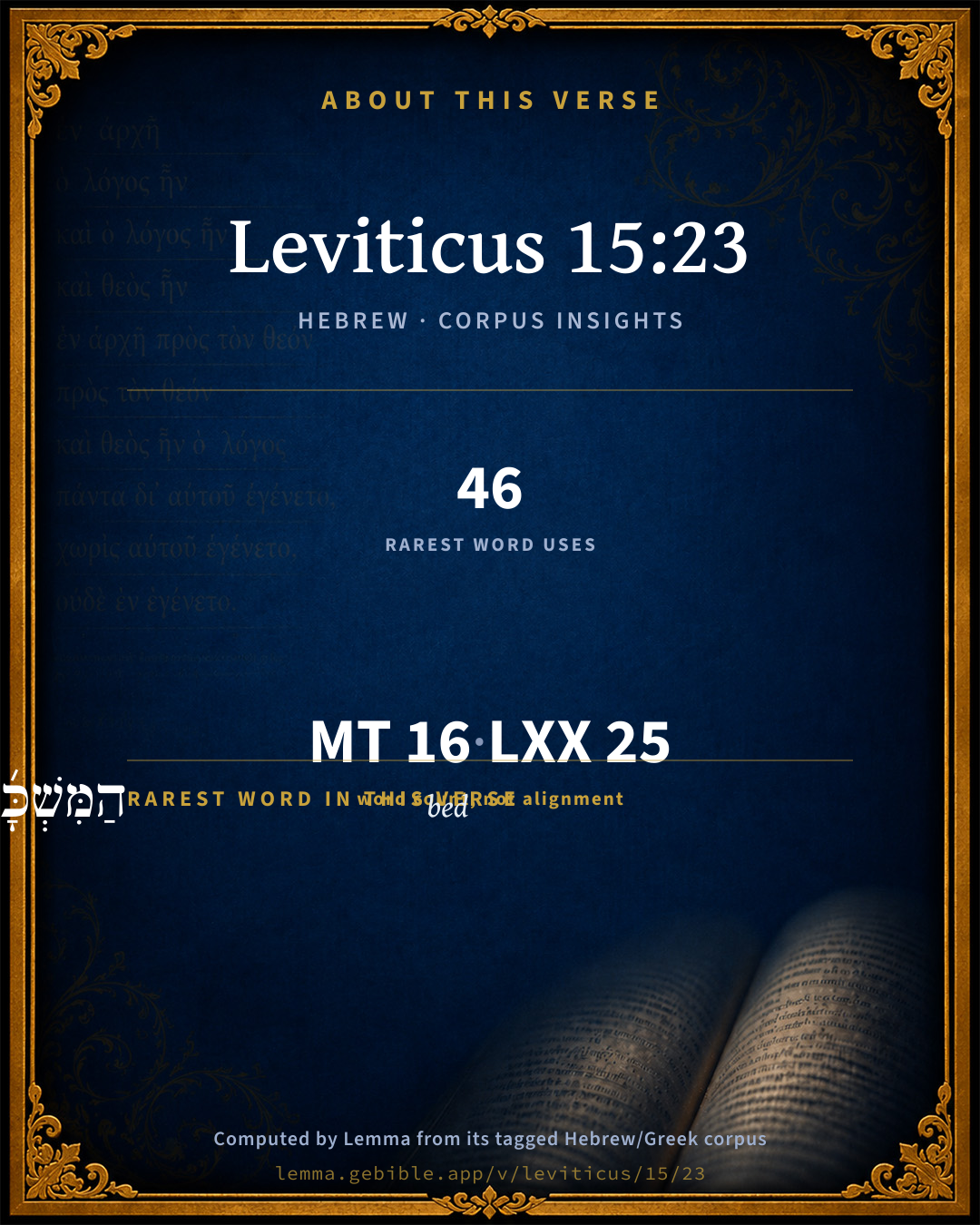
16
words
12
distinct lemmas
Pentateuch
section

Shared distinctive vocabulary

הַמִּשְׁכָּ֜ב bed H4904 occurs in 44 verses of the Hebrew Bible. Also found in:

Grammatical profile

  • 3 verbs
  • 3 nouns
  • 2 pronouns
  • 5 prepositions
  • 2 conjunctions
  • 1 particle

Verb forms

  • יֹשֶֽׁבֶת Qal · Participle Active
  • בְּנָגְעוֹ Qal · Infinitive Construct
  • יִטְמָ֖א Qal · Imperfect

Repetition

Words recur within this verse — often emphatic in Hebrew:

Hebrew & Septuagint length

In English translation the verse runs 23 words from the Hebrew and 31 from the Septuagint (LXX English) — closely comparable.

A rough comparison of the two English renderings, which tokenize alike — not a word-level alignment.

Word counts can differ between the Hebrew and the Greek without any difference in meaning — e.g. the Hebrew direct-object marker אֵת has no separate Greek word, and Greek often adds the article ὁ.

In the original languages it is 16 Hebrew tokens and 25 Greek tokens — but the two are counted differently (Hebrew bundles its prefixes and suffixes into one token; the Greek is in lemma form), so that isn’t a like-for-like length.

Hebrew and Greek witnesses Masoretic Hebrew ↔ Greek Septuagint

The same verse in the two great witnesses to the Old Testament, shown verse-for-verse.

These are two independent witnesses, not word-aligned to each other, and the Septuagint is shown in lemma (dictionary) form.

Hebrew Leviticus 15:23 Masoretic · Westminster Leningrad Codex

וְאִ֨ם עַֽל הַמִּשְׁכָּ֜ב ה֗וּא א֧וֹ עַֽל הַכְּלִ֛י אֲשֶׁר הִ֥וא יֹשֶֽׁבֶת עָלָ֖יו בְּנָגְעוֹ ב֑וֹ יִטְמָ֖א עַד הָעָֽרֶב

If it is on the bed, or on anything whereon she sits, when he touches it, he shall be unclean until the evening.

World English Bible · Public Domain

Greek LXX Leviticus 15:23 Septuagint · lemma form

ἐάν δέ ἐν ὁ κοίτη αὐτός εἰμί ἤ ἐπί ὁ σκεῦος οὗ ἐάν καταἵζω ἐπί αὐτός ἐν ὁ ἅπτομαι αὐτός αὐτός ἀκάθαρτος εἰμί ἕως ἑσπέρα

And whether it be while she is on her bed, or on a seat which she may happen to sit upon when he touches her, he shall be unclean till evening.

LXX2012 (modern English Septuagint) · Public Domain

Hebrew: Westminster Leningrad Codex (CC BY 4.0). Greek: Septuagint (public domain); English from LXX2012 (modern English Septuagint) (Public Domain). How the Septuagint differs from the Hebrew →

Targum (Aramaic paraphrase)

2

The Targum is the ancient Jewish Aramaic paraphrase of the Hebrew Scriptures — an interpretive translation, not the Hebrew text itself. Onkelos (literal) and Pseudo-Jonathan (expansive) render the Torah, and Jonathan the Prophets. Coverage is partial: where no permissively-licensed English translation exists for a verse, only the Aramaic is shown. This is verse-level text, not a word-by-word alignment to the Hebrew.

  1. Targum Onkelos Torah (Genesis–Deuteronomy)
    וְאִם עַל מִשְׁכְּבָא הוּא אוֹ עַל מָנָא דִי הִיא יָתְבָא עֲלוֹהִי בְּמִקְרְבֵהּ בֵּהּ יְהֵי מְסָאָב עַד רַמְשָׁא

    (no public-domain English translation for this verse)

    Targum Onkelos — Aramaic: “Onkelos Genesis” (public domain); “Onkelos Exodus” (public domain); “Onkelos Leviticus” (public domain); “Onkelos Numbers” (public domain); “Onkelos Deuteronomy” (public domain). English: “Sefaria Community Translation” (CC0 1.0 (public-domain dedication)); “J.W. Etheridge. The Targums of Onkelos and Jonathan Ben Uzziel on the Pentateuch. London: Longmans, Green, 1862” (public domain). Text via Sefaria.

  2. Targum Pseudo-Jonathan Torah (Genesis–Deuteronomy)
    וְאִין עַל מִשְׁכָּבָא הוּא כְּדוֹבָא דְגוּפֵיהּ אוֹ עַל מָאנָא דְהִיא יַתְבָא עַל קְצָתֵיהּ בִּזְמַן מִיקְרְבֵיהּ בֵּיהּ יְהֵי מְסָאָב עַד רַמְשָׁא

    And if the effusion of her body be upon her bed, or on a thing upon any part of which she sitteth, what time any one toucheth it, he shall be unclean until evening.

    Targum Pseudo-Jonathan — Aramaic: “Targum Jonathan on Genesis” (public domain); “Targum Jonathan on Exodus” (public domain); “Targum Jonathan on Leviticus” (public domain); “Targum Jonathan on Numbers” (public domain); “Targum Jonathan on Deuteronomy” (public domain). English: “The Targum of Jonathan ben Uzziel, trans. J. W. Etheridge, London, 1862” (public domain). Text via Sefaria.

Commentary

Notes on Leviticus 15:23 from classic Christian and Jewish commentators (each source and its license shown beneath its notes). The classic Christian expositions comment on the surrounding passage and are grouped to its opening verse, so a note may address several verses; the Jewish commentaries on the Tanakh (Rashi and others) are per-verse, so they appear only where the commentator wrote on this verse.

Lemma curates 59 commentaries, every one of them public domain or Creative Commons licensed, each selected and text-cleaned for this edition rather than reprinted as found. About our sources →

Ellicott's Commentary for English Readers

(23) And if it be on her bed.—Better, and if any object be on her bed, that is, if anything happen to lie on her bed.

When he toucheth it.—Rather, if he toucheth it. Whilst the former two verses declare that if any one touches the bed itself, or the thing on which she sat, he contracts such a degree of defilement that he must wash his clothes, bathe his whole body, and remain in a state of pollution till sundown, the verse before us enacts that if he happens to touch any vessel, garment, or any other objects which are lying on the defiling bed or seat in question, he has only to remain unclean till sundown, without having to wash his garments. The defilement in this case is not primary, but secondary. It is no more the bed or seat which defiled by direct contact, but an object which the defiled bed or seat had defiled, the pollution in this case being indirect.

A Bible Commentary for English Readers, edited by Charles John Ellicott (1878–1897) — public domain. Text from a community e-Sword module.

John Gill's Exposition

And if any man lie with her at all,.... Not presumptuously but ignorantly, as Aben Ezra observes; for he was guilty of cutting off, that lay with her wilfully, Lev 20:18,

and her flowers be upon her; or, "her separation" (k), her monthly courses not being ceased:

he shall be unclean seven days; and be excluded from all conversation civil and religious:

and all the bed whereon she lieth shall be unclean; that and every thing upon it; and this uncleanness also lasted seven days, as Aben Ezra notes, and defiled others, though it is not written.

(k) "menstruum ejus", Pagninus, Montanus; "separatio ejus", Drusius.

John Gill's Exposition of the Whole Bible (1746–1763) — public domain (CC PDM 1.0). Text via the HelloAO Bible API.

Rashi

Rabbi Shlomo Yitzchaki (Rashi)

ואם על המשכב הוא AND IF ONE BE ON HER PLACE OF REPOSE [OR ON ANY THING WHEREON SHE SITTETH] — This means, one who sleeps or sits on the place where she has slept or has sat even though he does not directly touch it (e. g. if there are covers upon the couch or the seat; for if he touches it vv. 21 and 22 apply); he also comes under the law of uncleanness that is stated in the above verse — that he requires washing of garments.

על הכלי UPON A VESSEL — This is intended to add to משכב and מושב any article for riding on (Sifra, Metzora Parashat Zavim, Section 4 15).

בנגעו בו WHEN HE TOUCHETH IT — "it" (בו) — this refers only to מרכב which, as has just been stated, is included in the law on account of the words על הכלי.

בנגעו בו יטמא WHEN HE TOUCHETH IT HE SHALL BE UNCLEAN, but does not require washing of the garments, because so far as the מרכב is concerned its being touched does not communicate uncleanness to people so that they in turn should render their garments unclean (cf. Mishnah Kelim 23:3).

Rashi on the Tanakh — English translations: “The Judaica Press complete Tanach with Rashi, translated by A. J. Rosenberg” (CC BY 4.0); “Pentateuch with Rashi's commentary by M. Rosenbaum and A.M. Silbermann, 1929-1934” (public domain); “The Metsudah Tanach series, Lakewood, N.J” (CC BY 4.0); and “The Book of Joshua, Metsudah Publications, 1997” (CC BY 4.0). Text via Sefaria.

Lesson kit

Teaching starters — assembled from the data on this page, not authored interpretation. Every prompt links to the verse data it draws on. Edit before teaching.

Leviticus, in the Pentateuch, opens this verse with 16 words (12 distinct Hebrew lemmas). Its most distinctive word is mishkâb (“bed”). A historical commentator’s framing appears above. Read the whole chapter for the surrounding context.

Discussion questions

  1. What does “bed” (mishkâb) contribute to the verse as a whole?
  2. How does Genesis 49:4, which shares the word «bed», read alongside this verse?
  3. What does the repetition of “upon” (3× in this one verse) do in this verse?
  4. These translations render this verse differently. What is at stake in choosing one wording over another?
  5. «יֹשֶֽׁבֶת» is a Qal Participle Active verb. How does that grammatical form shape the action described?
  6. Compare how Ellicott's Commentary for English Readers and John Gill's Exposition read this verse. Where do they agree or differ?

Things to notice

Reading settings

Reading text

Shown beneath each verse's original-language words.

Old Testament
Old Testament edition

Read the OT as the Masoretic Hebrew (MT) or the Greek Septuagint (LXX).

English shown for the Greek Septuagint (in the Hebrew ↔ Greek comparison).

Comparing translations? Open the Compare panel on any verse page to stack up to four side by side.