
1 Kings 17:10

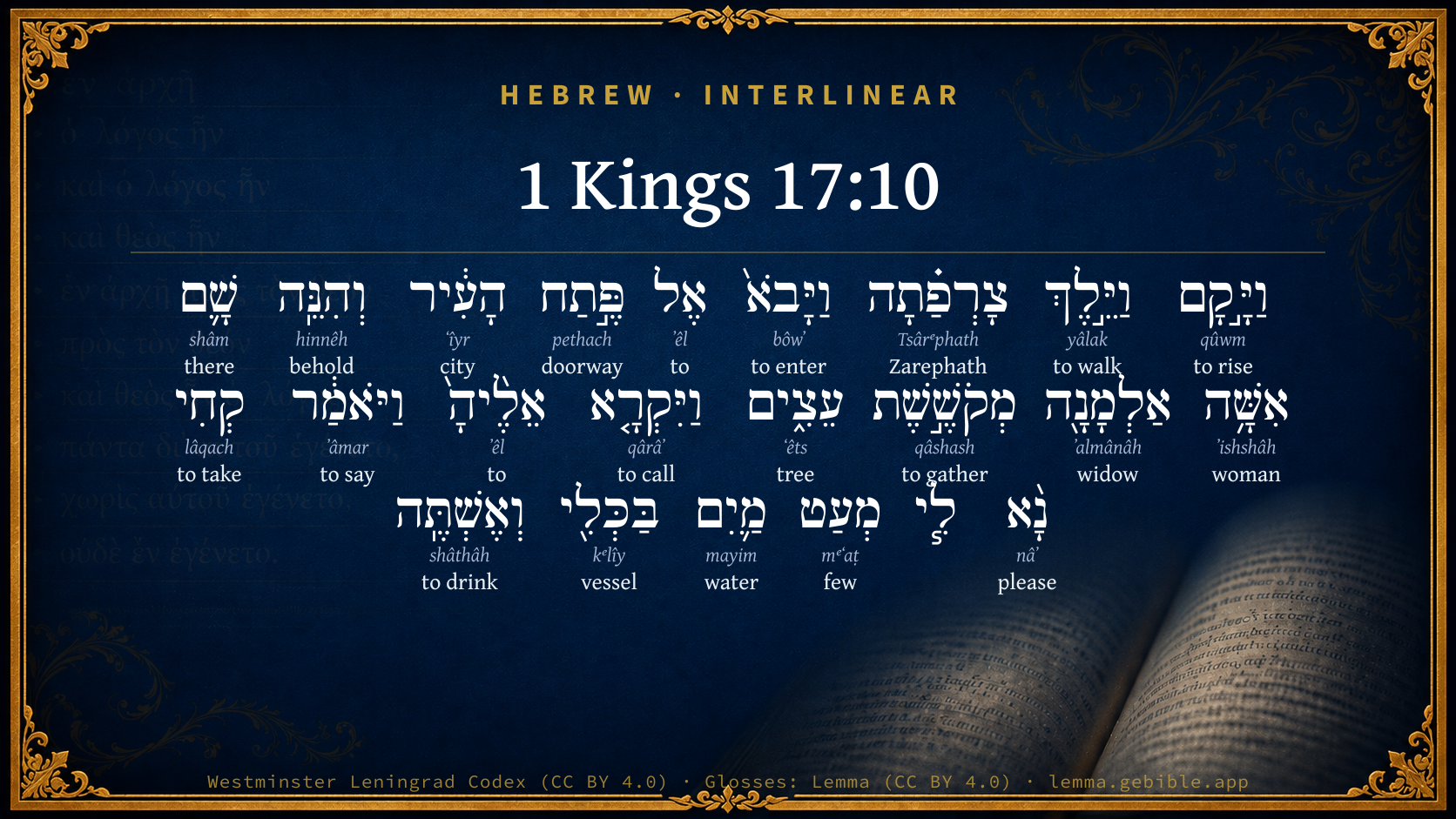
Hebrew (Westminster Leningrad Codex) 1 Kings 17:10 appears in the Hebrew Old Testament. The text above is from the Westminster Leningrad Codex. Each word links to its Strong’s number, a concise gloss, and parsing drawn from the Open Scriptures Hebrew Bible morphology. Click any word for its full Brown-Driver-Briggs (BDB) entry.
Download image
Cite this verse

1 Kings 17:10 (World English Bible). Public Domain. Lemma interlinear Bible study tool, https://lemma.gebible.app/v/1-kings/17/10.

Show BibTeX & RIS
BibTeX
RIS
English Translation
So he arose and went to Zarephath; and when he came to the gate of the city, behold, a widow was there gathering sticks: and he called to her, and said, Please get me a little water in a vessel, that I may drink.
World English Bible · Public Domain
Download a study sheet

One document with this verse’s original text, its word-by-word gloss line, the meaning frame, cross-references with their text, attributed commentary, and full source and license credits — printable, and it pastes into notes with its structure intact.

This verse Autodidact and up

Study sheet (.html) Plain text (.txt)

A passage Seminary Student

Up to 50 verses in one chapter. A passage sheet keeps up to 6 commentary sources and 12 cross-references per verse, in the order this page ranks them, and says so on the sheet whenever that leaves anything out. Ask for a single verse and you get the Autodidact verse sheet above.

Everything on this page stays free to read, with no account — the sheet is a download of what is already on screen, not access to it.

Want to remove ads? Support Godless Engineer
Compare translations 3

The same verse in 3 English versions, stacked beneath the original-language interlinear above. Click any original word for its lexicon entry.

Each is an independent rendering of the whole verse — the interlinear is not word-aligned to these translations.

Highlighted words mark where these versions differ — a whole-verse word diff, not a word-by-word alignment.

  • World English Bible Public Domain
    So he arose and went to Zarephath; and when he came to the gate of the city, behold, a widow was there gathering sticks: and he called to her, and said, Please get me a little water in a vessel, that I may drink.
  • King James Version Public Domain
    So he arose and went to Zarephath. And when he came to the gate of the city, behold, the widow woman was there gathering of sticks: and he called to her, and said, Fetch me, I pray thee, a little water in a vessel, that I may drink.
  • unfoldingWord Literal Text CC BY-SA 4.0
    So he arose and went to Zarephath. And he came to the entrance of the city, and behold, a woman, a widow, there, gathering sticks. And he called to her and said, “Please take to me a little water in a vessel, and I shall drink.”

unfoldingWord Literal Text — © unfoldingWord, licensed CC BY-SA 4.0. Word-aligned USFM3 via Door43 (git.door43.org/unfoldingWord/en_ult).

Versions to compare (up to 4)

3 of 4 selected

Show all 18 translations

Every available English version of this verse, each an independent rendering of the whole verse.

  • World English Bible Public Domain
    So he arose and went to Zarephath; and when he came to the gate of the city, behold, a widow was there gathering sticks: and he called to her, and said, Please get me a little water in a vessel, that I may drink.
  • Berean Standard Bible Public Domain
    So Elijah got up and went to Zarephath. When he arrived at the city gate, there was a widow gathering sticks. Elijah called to her and said, “Please bring me a little water in a cup, so that I may drink.”
  • Majority Standard Bible Public Domain
    So Elijah got up and went to Zarephath. When he arrived at the city gate, there was a widow gathering sticks. Elijah called to her and said, “Please bring me a little water in a cup, so that I may drink.”
  • King James Version Public Domain
    So he arose and went to Zarephath. And when he came to the gate of the city, behold, the widow woman was there gathering of sticks: and he called to her, and said, Fetch me, I pray thee, a little water in a vessel, that I may drink.
  • American Standard Version (1901) Public Domain
    So he arose and went to Zarephath; and when he came to the gate of the city, behold, a widow was there gathering sticks: and he called to her, and said, Fetch me, I pray thee, a little water in a vessel, that I may drink.
  • Revised Version (1885) Public Domain
    So he arose and went to Zarephath; and when he came to the gate of the city, behold, a widow woman was there gathering sticks: and he called to her, and said, Fetch me, I pray thee, a little water in a vessel, that I may drink.
  • Geneva Bible (1599) Public Domain
    So he arose, and went to Zarephath: and when he came to the gate of the citie, beholde, the widowe was there gathering stickes: and he called her, and sayde, Bring me, I pray thee, a litle water in a vessel, that I may drinke.
  • Douay-Rheims (1899) Public Domain
    He arose, and went to Sarephta. And when he was come to the gate of the city, he saw the widow woman gathering sticks, and he called her, and said to her: Give me a little water in a vessel, that I may drink.
  • Young's Literal Translation Public Domain
    And he riseth, and goeth to Zarephath, and cometh in unto the opening of the city, and lo there, a widow woman gathering sticks, and he calleth unto her, and saith, `Bring, I pray thee, to me, a little water in a vessel, and I drink.'
  • Literal Standard Version CC BY-SA 4.0
    And he rises, and goes to Zarephath, and comes to the opening of the city, and behold, there [is] a widow woman gathering sticks, and he calls to her and says, “Please bring a little water to me in a vessel, and I drink.”
  • Unlocked Literal Bible CC BY-SA 4.0
    So he arose and went to Zarephath, and when he came to the gate of the city a widow was there gathering sticks. So he called to her and said, “Please bring me a little water in a jar so that I may drink.”
  • unfoldingWord Literal Text CC BY-SA 4.0
    So he arose and went to Zarephath. And he came to the entrance of the city, and behold, a woman, a widow, there, gathering sticks. And he called to her and said, “Please take to me a little water in a vessel, and I shall drink.”
  • Darby Bible Public Domain
    And he arose and went to Zarephath; and when he came to the entrance of the city, behold, a widow woman was there gathering sticks. And he called to her and said, Fetch me, I pray thee, a little water in a vessel, that I may drink.
  • World Messianic Bible Public Domain
    So he arose and went to Zarephath; and when he came to the gate of the city, behold, a widow was there gathering sticks. He called to her and said, “Please get me a little water in a jar, that I may drink.”
  • Webster's Bible Public Domain
    So he arose and went to Zarephath. And when he came to the gate of the city, behold, the widow woman was there gathering sticks: and he called to her, and said, Bring me, I pray thee, a little water in a vessel, that I may drink.
  • Free Bible Version CC BY-SA 4.0
    So he left for Zarephath. When he arrived at the entrance to the town, he saw a woman, a widow, gathering sticks. He called her over and asked her, “Could you bring me a little water in a cup so I can have a drink?”
  • Bible in Basic English Public Domain
    So he got up and went to Zarephath; and when he came to the door of the town, he saw a widow woman getting sticks together; and crying out to her he said, Will you give me a little water in a vessel for my drink?
  • JPS Tanakh (1917) Public Domain
    So he arose and went to Zarephath; and when he came to the gate of the city, behold, a widow was there gathering sticks; and he called to her, and said: 'Fetch me, I pray thee, a little water in a vessel, that I may drink.'

Literal Standard Version (2020), Covenant Press — licensed CC BY-SA 4.0. Text via the HelloAO Bible API (eBible.org). Unlocked Literal Bible (unfoldingWord) — licensed CC BY-SA 4.0. Text via the HelloAO Bible API (eBible.org). unfoldingWord Literal Text — © unfoldingWord, licensed CC BY-SA 4.0. Word-aligned USFM3 via Door43 (git.door43.org/unfoldingWord/en_ult). Free Bible Version, Dr. Jonathan Gallagher — licensed CC BY-SA 4.0. Text via the HelloAO Bible API (eBible.org).

Word by word

More ways to search: Search by grammar → Find every occurrence → Compare this word →

Practice this passage: Drill this verse → Learn its vocabulary →

צָרְפַ֗תָה
Tsârᵉphath
H6886
“Zarephath · toward”
Noun, Proper + Suffix, Demonstrative
Part of Speech
Noun
Type
Proper
Full BDB Definition

Origin: from H6884

TWOT: None

Zarephath = "refinery" - a city on the coast south of Sidon and the residence of Elijah during the last part of the drought; modern 'Sura-fend'
  1. וַיָּ֣קָם qûwm H6965 “and · to rise” Conjunction + Verb, Qal, Sequential Imperfect, 3rd Person, Masculine, Singular
  2. וַיֵּ֣לֶךְ yâlak H3212 “and · to walk” Conjunction + Verb, Qal, Sequential Imperfect, 3rd Person, Masculine, Singular
  3. וַיָּבֹא֙ bôwʼ H935 “and · to enter” Conjunction + Verb, Qal, Sequential Imperfect, 3rd Person, Masculine, Singular
  4. אֶל ʼêl H413 “to” Preposition
  5. פֶּ֣תַח pethach H6607 “doorway of” Noun, Common, Masculine, Singular, Construct
  6. הָעִ֔יר ʻîyr H5892 “the · city” Particle, Definite Article + Noun, Common, Feminine, Singular, Absolute
  7. וְהִנֵּֽה hinnêh H2009 “and · behold” Conjunction + Particle, Demonstrative
  8. שָׁ֛ם shâm H8033 “there” Adverb
  9. אִשָּׁ֥ה ʼishshâh H802 “woman” Noun, Common, Feminine, Singular, Absolute
  10. אַלְמָנָ֖ה ʼalmânâh H490 “widow” Noun, Common, Feminine, Singular, Absolute
  11. מְקֹשֶׁ֣שֶׁת qâshash H7197 “gathering” Verb, Poel, Participle Active, Feminine, Singular, Construct
  12. עֵצִ֑ים ʻêts H6086 “trees” Noun, Common, Masculine, Plural, Absolute
  13. וַיִּקְרָ֤א qârâʼ H7121 “and · to call” Conjunction + Verb, Qal, Sequential Imperfect, 3rd Person, Masculine, Singular
  14. אֵלֶ֨יהָ֙ ʼêl H413 “to · her” Preposition + Suffix, Personal, 3rd Person, Feminine, Singular
  15. וַיֹּאמַ֔ר ʼâmar H559 “and · to say” Conjunction + Verb, Qal, Sequential Imperfect, 3rd Person, Masculine, Singular
  16. קְחִי lâqach H3947 “take” Verb, Qal, Imperative, 2nd Person, Feminine, Singular
  17. נָ֨א nâʼ H4994 “please” Particle, Exhortation
  18. מְעַט mᵉʻaṭ H4592 “few of” Noun, Common, Masculine, Singular, Construct
  19. מַ֛יִם mayim H4325 “water(s)” Noun, Common, Masculine, Plural, Absolute
  20. בַּכְּלִ֖י kᵉlîy H3627 “in/at the · vessel” Preposition, Determined + Noun, Common, Masculine, Singular, Absolute
  21. וְאֶשְׁתֶּֽה shâthâh H8354 “and · to drink” Conjunction + Verb, Qal, Cohortative, 1st Person, Common, Singular

About this verse

These counts appear in no published source. They are computed here, from the morphology-tagged text and Lemma’s own curated glosses. What Lemma adds →

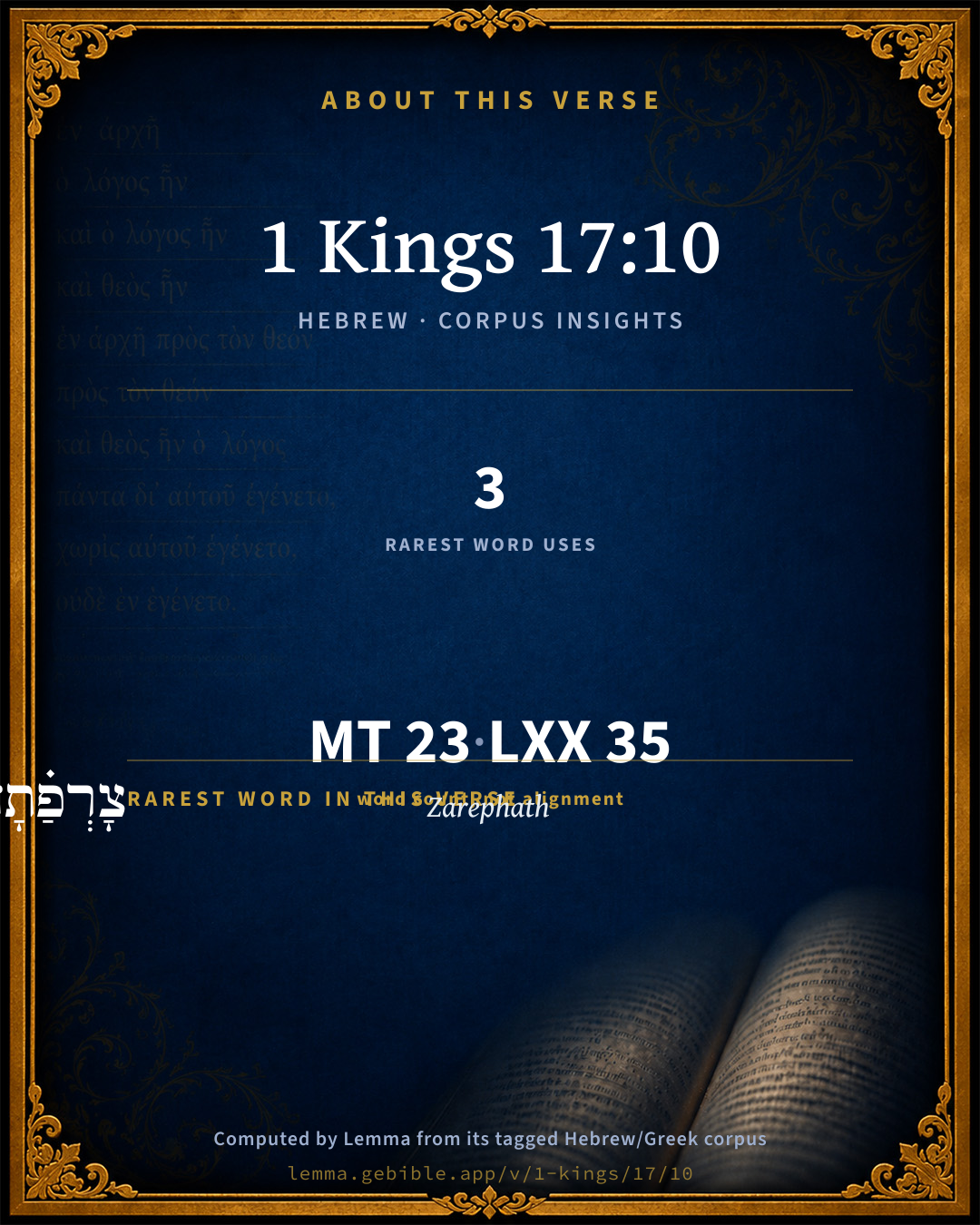
23
words
21
distinct lemmas
Historical
section

Notable vocabulary

The rarest word here is צָרְפַ֗תָה Zarephath H6886 — appearing just 3 times in the whole Hebrew Bible.

Shared distinctive vocabulary

צָרְפַ֗תָה Zarephath H6886 occurs in 3 verses of the Hebrew Bible. Also found in:

Grammatical profile

  • 8 verbs
  • 9 nouns
  • 3 prepositions
  • 1 adverb
  • 2 particles

Verb forms

  • וַיָּ֣קָם Qal · Sequential Imperfect
  • וַיֵּ֣לֶךְ Qal · Sequential Imperfect
  • וַיָּבֹא֙ Qal · Sequential Imperfect
  • מְקֹשֶׁ֣שֶׁת Poel · Participle Active
  • וַיִּקְרָ֤א Qal · Sequential Imperfect
  • וַיֹּאמַ֔ר Qal · Sequential Imperfect
  • קְחִי Qal · Imperative
  • וְאֶשְׁתֶּֽה Qal · Cohortative

Repetition

A word recurs within this verse — often emphatic in Hebrew:

  • אֶל to H413 ×2

Hebrew & Septuagint length

In English translation the verse runs 44 words from the Hebrew and 47 from the Septuagint (LXX English) — closely comparable.

A rough comparison of the two English renderings, which tokenize alike — not a word-level alignment.

Word counts can differ between the Hebrew and the Greek without any difference in meaning — e.g. the Hebrew direct-object marker אֵת has no separate Greek word, and Greek often adds the article ὁ.

In the original languages it is 23 Hebrew tokens and 35 Greek tokens — but the two are counted differently (Hebrew bundles its prefixes and suffixes into one token; the Greek is in lemma form), so that isn’t a like-for-like length.

Cross-references

5

Topical passages linked to 1 Kings 17:10 in the Treasury of Scripture Knowledge — connected by theme and wording, ordered by reader-vote popularity; previews shown in the World English Bible.

  • Genesis 24:17 The servant ran to meet her, and said, "Please give me a drink, a little water from your pitcher."
  • John 4:7 A woman of Samaria came to draw water. Jesus said to her, "Give me a drink."
  • Genesis 21:15 The water in the bottle was spent, and she cast the child under one of the shrubs.
  • 2 Corinthians 11:27 in labor and travail, in watchings often, in hunger and thirst, in fastings often, and in cold and nakedness.
  • Hebrews 11:37 They were stoned. They were sawn apart. They were tempted. They were slain with the sword. They went around in sheep skins and in goat skins; being destitute, afflicted, ill-treated

Cross-references courtesy of OpenBible.info (CC BY 4.0).

Hebrew and Greek witnesses Masoretic Hebrew ↔ Greek Septuagint

The same verse in the two great witnesses to the Old Testament, shown verse-for-verse.

These are two independent witnesses, not word-aligned to each other, and the Septuagint is shown in lemma (dictionary) form.

Hebrew 1 Kings 17:10 Masoretic · Westminster Leningrad Codex

וַיָּ֣קָם וַיֵּ֣לֶךְ צָרְפַ֗תָה וַיָּבֹא֙ אֶל פֶּ֣תַח הָעִ֔יר וְהִנֵּֽה שָׁ֛ם אִשָּׁ֥ה אַלְמָנָ֖ה מְקֹשֶׁ֣שֶׁת עֵצִ֑ים וַיִּקְרָ֤א אֵלֶ֨יהָ֙ וַיֹּאמַ֔ר קְחִי נָ֨א לִ֧י מְעַט מַ֛יִם בַּכְּלִ֖י וְאֶשְׁתֶּֽה

So he arose and went to Zarephath; and when he came to the gate of the city, behold, a widow was there gathering sticks: and he called to her, and said, Please get me a little water in a vessel, that I may drink.

World English Bible · Public Domain

Greek LXX 1 Kings 17:10 Septuagint · lemma form

καί ἀναἵστημι καί πορεύομαι εἰς σαρεπτα εἰς ὁ πυλών ὁ πόλις καί ἰδού ἐκεῖ γυνή χήρα συνλέγω ξύλον καί βοάω ὀπίσω αὐτός ηλιου καί εἶπον αὐτός λαμβάνω δή ἐγώ ὀλίγος ὕδωρ εἰς ἄγγος καί πίνω

And he arose and went to Sarepta, and came to the gate of the city: and, behold, a widow-woman was there gathering sticks; and Eliu cried after her, and said to her, Fetch me, I pray you, a little water in a vessel, that I may drink.

LXX2012 (modern English Septuagint) · Public Domain

Hebrew: Westminster Leningrad Codex (CC BY 4.0). Greek: Septuagint (public domain); English from LXX2012 (modern English Septuagint) (Public Domain). How the Septuagint differs from the Hebrew →

Targum (Aramaic paraphrase)

1

The Targum is the ancient Jewish Aramaic paraphrase of the Hebrew Scriptures — an interpretive translation, not the Hebrew text itself. Onkelos (literal) and Pseudo-Jonathan (expansive) render the Torah, and Jonathan the Prophets. Coverage is partial: where no permissively-licensed English translation exists for a verse, only the Aramaic is shown. This is verse-level text, not a word-by-word alignment to the Hebrew.

  1. Targum Jonathan Prophets (Joshua–Malachi)
    וְקָם וַאֲזַל לְצָרְפַת וַאֲתָא לִתְרַע קַרְתָּא וְהָא תַמָן אִתְּתָא אַרְמַלְתָּא מְגַבְּבָא אָעִין וּקְרָא לָהּ וַאֲמַר סָבִי כְעַן לִי זְעֵיר מַיָא בְּמָנָא וְאֶשְׁתֵּי:

    (no public-domain English translation for this verse)

    Targum Jonathan — Aramaic: “Mikraot Gedolot” (public domain). English: “Sefaria Community Translation” (CC0 1.0 (public-domain dedication)); “London "Chaldee Paraphrase," 1871” (public domain). Text via Sefaria.

Commentary

Notes on 1 Kings 17:10 from classic Christian and Jewish commentators (each source and its license shown beneath its notes). The classic Christian expositions comment on the surrounding passage and are grouped to its opening verse, so a note may address several verses; the Jewish commentaries on the Tanakh (Rashi and others) are per-verse, so they appear only where the commentator wrote on this verse.

Lemma curates 59 commentaries, every one of them public domain or Creative Commons licensed, each selected and text-cleaned for this edition rather than reprinted as found. About our sources →

Trapp's Complete Commentary

John Trapp

1Ki 17:10 So he arose and went to Zarephath. And when he came to the gate of the city, behold, the widow woman [was] there gathering of sticks: and he called to her, and said, Fetch me, I pray thee, a little water in a vessel, that I may drink.

Ver. 10. Gathering of sticks.] {a} Which showeth her low condition. God chooseth "the poor in this world rich in faith." {Jas 2:5}

A little water in a vessel.] Or, In this vessel, viz., that he had used at the brook Cherith, after his long journey; from whence he might well be thirsty, hungry, and weary.

{a} Ea nempe ligna quae prima obviam habebat. - Vat.

John Trapp, A Commentary or Exposition upon All the Books of the Old and New Testament (1647–1656) — public domain. Text from a community e-Sword module.

Joseph Benson's Commentary

1Ki 17:10-12. Behold, the widow woman was gathering sticks — He knew, by some secret divine intimations, that this was the woman that was to sustain him. Fetch me, I pray thee, a little water — Water, in consequence of the long drought, was doubtless scarce there as well as in the land of Israel; yet, being a pious woman, and therefore ready to succour a stranger in distress, she readily goes to fetch it. He called and said, Bring me, I pray thee, a morsel of bread in thy hand — This he probably said chiefly to try her, and to make way for what follows. She said, As the Lord thy God liveth — By this she discovers, that though she was a Gentile, yet she owned the God of Israel as the true God. I am gathering two sticks — A few sticks, that number being often used indefinitely for any small number. That we may eat it and die — For having no more provision, we must needs perish with hunger. Although the famine was chiefly in the land of Israel, yet the effects of it were felt in Tyre and Sidon, which were supported by the corn of that land. But what a poor supporter was this widow likely to be! who had no fuel, but what she gathered in the streets, and nothing to live upon herself, but a handful of meal and a little oil! To her Elijah is sent, that he might live upon Providence, as much as he had done when the ravens fed him.

Joseph Benson's Commentary on the Old and New Testaments (1811–1818) — public domain. Text from a community e-Sword module.

Geneva Bible (1599)

Geneva Bible translators

All this was to strengthen the faith of Elijah, to the intent that he should look upon nothing worldly, but only trust on God’s providence.

Geneva Bible (1599) marginal notes — public domain. Text via Bolls.life.

The Cambridge Bible for Schools and Colleges

gen. ed. J. J. S. Perowne

10. gathering of sticks] R.V. modernizes the language by omitting the preposition. The abject poverty of the widow is seen from her coming forth to pick up any chance bits of wood which might have fallen from the trees outside the city walls.

The Cambridge Bible for Schools and Colleges (gen. ed. J. J. S. Perowne; Cambridge University Press, 1878–1918) — public domain. Text from a community e-Sword module.

John Gill's Exposition

So he arose, and went to Zarephath,.... Which, according to Bunting (f), was one hundred miles from the brook Cherith:

and when he came to the gate of the city, behold, the widow woman was there gathering sticks: perhaps out of an hedge just without the city this shows her to be a poor woman, who had no other way of coming at fuel but this, and no servant to fetch it for her: Bunting tells us, that now before the gate of the city there is showed a certain chapel, where they say Elias first spoke with the widow:

and he called to her, and said, fetch me, I pray thee, a little water in a vessel, that I may drink; being thirsty through travelling, and supposing this to be the woman he was directed to, made trial of her this way; some render it, "in this vessel" (g), which he had with him, and made use of at the brook Cherith.

(f) Ut supra, (Travels, &c.) p. 203. (g) "in hoc vase", Junius & Tremellius, Piscator.

John Gill's Exposition of the Whole Bible (1746–1763) — public domain (CC PDM 1.0). Text via the HelloAO Bible API.

Matthew Poole's English Annotations

He called to her; knowing by Divine suggestion that this was the woman designed.

Matthew Poole's English Annotations on the Holy Bible (1683–1685) — public domain. Text from a community e-Sword/MySword module.

Whedon's Commentary on the Bible

Daniel D. Whedon

10. He came to the gate — An old tradition points out the spot on the south of the ancient city where Elijah first saw the widow, and the crusaders built a small chapel over the reputed spot of the widow’s house.

Gathering of sticks — A scene that often meets the traveller’s eye in Palestine.

Daniel D. Whedon (gen. ed.), Commentary on the Old and New Testaments (1874–1909) — public domain. Text from a community e-Sword module.

The Pulpit Commentary

So he arose and went to Zarephath It does not follow that his route lay over the "White Promontory," or Ladder of Tyre, the way our Lord took when He "departed into the coasts of Tyre and Sidon". (Mat_15:21) If his place of concealment was anywhere near "Abara, or Bethshean, it is probable he would keep east of the Jordan, as far as Banias or Dan, where the river is fordable, and whence a road leads direct to Sidon. He would thus avoid Tyro. And when he came to the gate of the city the ruins of Surafend are still very considerable (see Thomson,"Land and Book," 1:235) and prove it to have been a place of importance, a town with gates and walls. "Gate," however, is used somewhat loosely in the O.T. of the entrance to a village, or even of the place of concourse and of judgment, behold, the Heb. a. He did not yet know that this was the widow to whom he was sent. Her replies to his requests first informed him that this was the object of his search widow woman was there Heb. behold there, a widow woman gathering of sticks This was not a promising sign. It only proved her poverty: and he called to her, and said, Fetch me, I pray thee, a little water in a vessel Heb. the vessel. Bahr understands the drinking-cup that Elijah had brought with him from the Wady Cherith; but surely it is extremely improbable that he would carry either cup or bottle with him. "The vessel" probably imports the ordinary vessel used for the purpose the "potter"s earthen bottle". (Jer_19:1) That this was used for fetching water, we know, (Isa_30:14) that I may drink.

Vers. 10-16.

The Barrel of Meal.

In the East the people kept their corn in earthen jars to protect it from insects which swarm in the heat of the sun. What in our translation is called a "barrel" (dk) was one of these vessels. The store in this case was run low; there was but a "handful" left; yet this was so multiplied by the power of God that three persons found at least in it sufficient provision for two and a half years. Let us inquire

I HOW ITS CONDITION BECAME KNOWN.

1. Elijah came to Zarephath in quest of the widow.

(1) Such were his instructions (vers. 8, 9). But was there only one widow in this city of "smelting furnaces", (comp. 1Ki_7:14) this hive of industry, this centre of population? How, then, is he to discover the right one?

(2) God knows her, and that is enough for the prophet. The Word of the Lord who came to him at Samaria and at Cherith will now guide him. (See Isa_42:16)

(3) Let us follow the light we have and God will give us more. So was Abraham"s faithful servant guided to Rebecca (Ge 24)

2. He found her at the gate of the city.

(1) She was there on an errand of her own, viz., to gather a few dry sticks to kindle a fire to cook her last meal in this world.

(2) She was there also, though unknown to herself, on an errand from God. She was commanded to sustain the prophet of Israel

(3) Yet these two errands harmonize. God uses man"s purposes to work out His own. Man proposeth; God disposeth.

3. He readily identified her.

(1) He asked her for water, which, with admirable promptitude, she went to fetch. This was the sign by which Abraham"s servant identified Rebecca. (Gen_24:14) The cup of cold water has its promise of reward. (Mat_10:42)

(2) Then he asked for bread, which further request opened the way for the whole truth, "As the Lord thy God liveth, I have not a cake, but," etc. (ver. 12). From these words it is evident that she recognized Elijah, at least as an Israelite, and probably as the prophet of Israel; for he was a person of pronounced individuality. His profusion of hair, probably, placed Elisha in such contrast to him that Elisha was mocked as a "bald head." (Comp. 2Ki_1:8, and 2:23.)

II How ITS RESOURCES WERE MAINTAINED.

1. By the miracle-working power of God.

(1) "The barrel of meal wasted not, neither did the cruse of oil fail, according to the word of the Lord which he spake by Elijah." This supplied not only the guest but the widow and her son for two years and a half. As Bp. Hall remarks, "Never did corn or olive so increase in the growing as these did in the using.

(2) This miracle was similar to that of the manna. The off was used as butter for the meal, and the taste of the manna was like fresh oil. (Num_11:8) Also to Christ"s miracles of the loaves.

(3) The lessons are the same. The miracles all teach that "man lives not by bread alone, but by the word of God." That this spiritual food is the gift of God. That it differs essentially from the bread that perishes. Not only is it imperishable, but it multiplies in the using, grows as it is dispensed. How delightful were the spiritual feasts of that two years and a half in the widow"s dwelling (See Rev_3:20)

2. Through the faith of the widow.

(1) She was predisposed to believe. God saw this, else He had not honoured her with His command to sustain his prophet. (See Luk_4:24-26) Let us ever live in that moral fitness to be employed by God.

(2) This disposition was encouraged. She waited for something to justify her faith in God, and she got it: "And Elijah said unto her, Fear not; go and do as thou hast said," de. (vers. 13, 14). She knew that the word of the Lord was with Elijah And this instruction to make first a little cake for the prophet was according to God"s order. (See Num_15:20, Num_15:21)

(3) She proved the genuineness of her faith by her works. "She did according to the saying of Elijah." By works faith is perfected, And God justified the faith that justified him. J.A.M.

The Pulpit Commentary (1880–1919), ed. H.D.M. Spence-Jones & Joseph S. Exell — public domain. Text from a community e-Sword module.

Keil & Delitzsch

C. F. Keil & F. Delitzsch

When Elijah arrived at the city gate, he met a widow engaged in gathering wood. To discover whether it was to her that the Lord had sent him, he asked her for something to drink and for a morsel of bread to eat; whereupon she assured him, with an oath by Jehovah, that she had nothing baked (מעוג = עגּה, ἐγκρυφίας, a cake baked in hot ashes), but only a handful of meal in the כּד (a pail or small vessel in which meal was kept) and a little oil in the pitcher, and that she was just gathering wood to dress this remnant for herself and her son, that they might eat it, and then die. From this statement of the widow it is evident, on the one hand, that the drought and famine had spread across the Phoenician frontier, as indeed Menander of Ephesus attests;

(Note: Josephus gives this statement from his Phoenician history: ἀβροχία τε ἐπ ̓ αὐτοῦ (sc., Ἰθοβάλου) ἐγένετο ἀπὸ τοῦ Ὑπερβερεταίου μηνὸς ἕως τοῦ ἐρχομένου ἔτους Ὑπερβερεταίου (Ant. viii. 13, 2). Hyperberetaeus answers to Tishri of the Hebrews; cf. Benfey and Stern, die Monatsnamen, p. 18.)

on the other hand, the widow showed by the oath, "as Jehovah thy God liveth," that she was a worshipper of the true God, who spoke of Jehovah as his God, because she recognised the prophet as an Israelite.

Keil & Delitzsch — Biblical Commentary on the Old Testament (1861–1891) — public domain (CC PDM 1.0). Text via the HelloAO Bible API. (Old Testament only.)

Rashi

Rabbi Shlomo Yitzchaki (Rashi)

Please bring me a little water. He was unable to identify the widow about whom the Holy One Blessed Is He, had told him. But he learned from Eliezer, the servant of Avrohom, and he said, “The one who gives me water to drink, she is the widow.”

Rashi on the Tanakh — English translations: “The Judaica Press complete Tanach with Rashi, translated by A. J. Rosenberg” (CC BY 4.0); “Pentateuch with Rashi's commentary by M. Rosenbaum and A.M. Silbermann, 1929-1934” (public domain); “The Metsudah Tanach series, Lakewood, N.J” (CC BY 4.0); and “The Book of Joshua, Metsudah Publications, 1997” (CC BY 4.0). Text via Sefaria.

Lesson kit

Teaching starters — assembled from the data on this page, not authored interpretation. Every prompt links to the verse data it draws on. Edit before teaching.

1 Kings, in the Historical, opens this verse with 23 words (21 distinct Hebrew lemmas). Its most distinctive word is Tsârᵉphath (“Zarephath”). A historical commentator’s framing appears above. Read the whole chapter for the surrounding context.

Discussion questions

  1. The word Tsârᵉphath carries the sense “Zarephath.” How does it shape the verse?
  2. 1 Kings 17:9 shares the word «Zarephath» with this verse. How do the two illuminate each other?
  3. “to” occurs 2× in this one verse. What is the effect of the repetition?
  4. The translations on this page render this verse differently — a whole-verse word diff, not a word-by-word alignment. What might account for the different wordings?
  5. The verb «וַיָּ֣קָם» is Qal Sequential Imperfect. How does its form color the action?
  6. Reading how Trapp's Complete Commentary and Joseph Benson's Commentary read this verse, where do the two commentators agree and where do they part?

Things to notice

Reading settings

Reading text

Shown beneath each verse's original-language words.

Old Testament
Old Testament edition

Read the OT as the Masoretic Hebrew (MT) or the Greek Septuagint (LXX).

English shown for the Greek Septuagint (in the Hebrew ↔ Greek comparison).

Comparing translations? Open the Compare panel on any verse page to stack up to four side by side.