
2 Kings 4:6

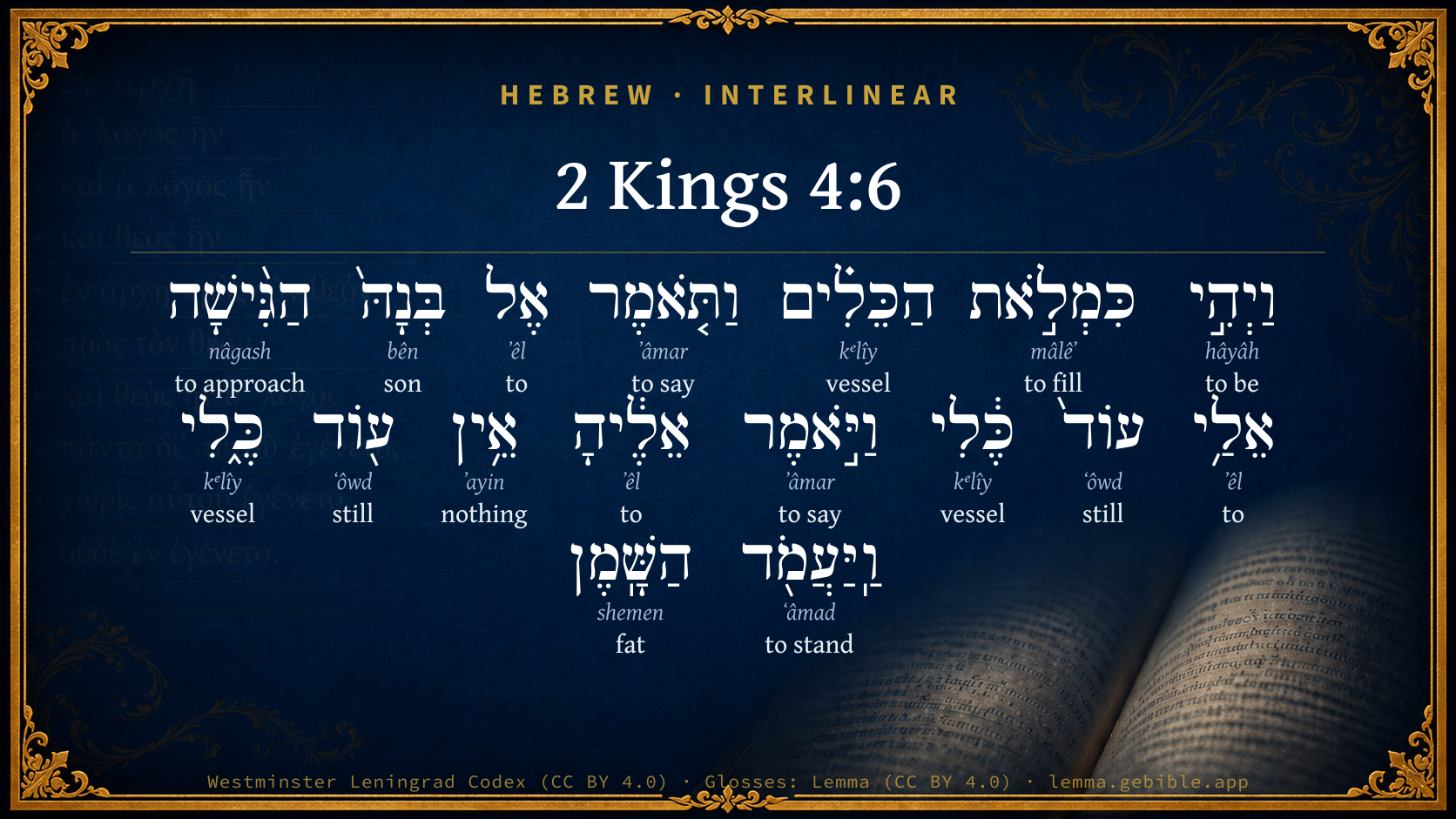
Hebrew (Westminster Leningrad Codex) 2 Kings 4:6 appears in the Hebrew Old Testament. The text above is from the Westminster Leningrad Codex. Each word links to its Strong’s number, a concise gloss, and parsing drawn from the Open Scriptures Hebrew Bible morphology. Click any word for its full Brown-Driver-Briggs (BDB) entry.
Download image
Cite this verse

2 Kings 4:6 (World English Bible). Public Domain. Lemma interlinear Bible study tool, https://lemma.gebible.app/v/2-kings/4/6.

Show BibTeX & RIS
BibTeX
RIS
English Translation
It happened, when the vessels were full, that she said to her son, Bring me yet a vessel. He said to her, There isn't another vessel. The oil stayed.
World English Bible · Public Domain
Download a study sheet

One document with this verse’s original text, its word-by-word gloss line, the meaning frame, cross-references with their text, attributed commentary, and full source and license credits — printable, and it pastes into notes with its structure intact.

This verse Autodidact and up

Study sheet (.html) Plain text (.txt)

A passage Seminary Student

Up to 50 verses in one chapter. A passage sheet keeps up to 6 commentary sources and 12 cross-references per verse, in the order this page ranks them, and says so on the sheet whenever that leaves anything out. Ask for a single verse and you get the Autodidact verse sheet above.

Everything on this page stays free to read, with no account — the sheet is a download of what is already on screen, not access to it.

Want to remove ads? Support Godless Engineer
Compare translations 3

The same verse in 3 English versions, stacked beneath the original-language interlinear above. Click any original word for its lexicon entry.

Each is an independent rendering of the whole verse — the interlinear is not word-aligned to these translations.

Highlighted words mark where these versions differ — a whole-verse word diff, not a word-by-word alignment.

  • World English Bible Public Domain
    It happened, when the vessels were full, that she said to her son, Bring me yet a vessel. He said to her, There isn't another vessel. The oil stayed.
  • King James Version Public Domain
    And it came to pass, when the vessels were full, that she said unto her son, Bring me yet a vessel. And he said unto her, There is not a vessel more. And the oil stayed.
  • unfoldingWord Literal Text CC BY-SA 4.0
    And it happened as she was filling the vessels that she said to her son, “Bring to me another vessel.” And he said to her, “There is not another vessel.” And the oil stopped.

unfoldingWord Literal Text — © unfoldingWord, licensed CC BY-SA 4.0. Word-aligned USFM3 via Door43 (git.door43.org/unfoldingWord/en_ult).

Versions to compare (up to 4)

3 of 4 selected

Show all 18 translations

Every available English version of this verse, each an independent rendering of the whole verse.

  • World English Bible Public Domain
    It happened, when the vessels were full, that she said to her son, Bring me yet a vessel. He said to her, There isn't another vessel. The oil stayed.
  • Berean Standard Bible Public Domain
    When all the jars were full, she said to her son, “Bring me another.” But he replied, “There are no more jars.” Then the oil stopped flowing.
  • Majority Standard Bible Public Domain
    When all the jars were full, she said to her son, “Bring me another.” But he replied, “There are no more jars.” Then the oil stopped flowing.
  • King James Version Public Domain
    And it came to pass, when the vessels were full, that she said unto her son, Bring me yet a vessel. And he said unto her, There is not a vessel more. And the oil stayed.
  • American Standard Version (1901) Public Domain
    And it came to pass, when the vessels were full, that she said unto her son, Bring me yet a vessel. And he said unto her, There is not a vessel more. And the oil stayed.
  • Revised Version (1885) Public Domain
    And it came to pass, when the vessels were full, that she said unto her son, Bring me yet a vessel. And he said unto her, There is not a vessel more. And the oil stayed.
  • Geneva Bible (1599) Public Domain
    And when the vessels were full, shee sayde vnto her sonne, Bring mee yet a vessel. And hee said vnto her, There is no moe vessels. And the oyle ceased.
  • Douay-Rheims (1899) Public Domain
    And when the vessels were full, she said to her son: Bring me yet a vessel. And he answered: I have no more. And the oil stood.
  • Young's Literal Translation Public Domain
    and it cometh to pass, at the filling of the vessels, that she saith unto her son, `Bring nigh unto me a vessel more,' and he saith unto her, `There is not a vessel more;' and the oil stayeth.
  • Literal Standard Version CC BY-SA 4.0
    and it comes to pass, at the filling of the vessels, that she says to her son, “Bring another vessel near to me,” and he says to her, “There is not another vessel”; and the oil stays.
  • Unlocked Literal Bible CC BY-SA 4.0
    When the vessels were full, she said to her son, “Bring me another jar.” But he said to her, “There are no more jars.” Then the oil stopped flowing.
  • unfoldingWord Literal Text CC BY-SA 4.0
    And it happened as she was filling the vessels that she said to her son, “Bring to me another vessel.” And he said to her, “There is not another vessel.” And the oil stopped.
  • Darby Bible Public Domain
    And it came to pass when the vessels were full, that she said to her son, Bring me yet a vessel. And he said to her, There is not a vessel more. And the oil stayed.
  • World Messianic Bible Public Domain
    When the containers were full, she said to her son, “Bring me another container.” He said to her, “There isn’t another container.” Then the oil stopped flowing.
  • Webster's Bible Public Domain
    And it came to pass, when the vessels were full, that she said to her son, Bring me yet a vessel. And he said to her, There is not a vessel more. And the oil stayed.
  • Free Bible Version CC BY-SA 4.0
    When all the jars were full, she told her son, “Bring me another one.” But he replied, “There aren't any jars left.” Then the olive oil stopped flowing.
  • Bible in Basic English Public Domain
    And when all the vessels were full, she said to her son, Get me another vessel. And he said, There are no more. And the flow of oil was stopped.
  • JPS Tanakh (1917) Public Domain
    And it came to pass, when the vessels were full, that she said unto her son: 'Bring me yet a vessel.' And he said unto her: 'There is not a vessel more.' And the oil stayed.

Literal Standard Version (2020), Covenant Press — licensed CC BY-SA 4.0. Text via the HelloAO Bible API (eBible.org). Unlocked Literal Bible (unfoldingWord) — licensed CC BY-SA 4.0. Text via the HelloAO Bible API (eBible.org). unfoldingWord Literal Text — © unfoldingWord, licensed CC BY-SA 4.0. Word-aligned USFM3 via Door43 (git.door43.org/unfoldingWord/en_ult). Free Bible Version, Dr. Jonathan Gallagher — licensed CC BY-SA 4.0. Text via the HelloAO Bible API (eBible.org).

Word by word

More ways to search: Search by grammar → Find every occurrence → Compare this word →

Practice this passage: Drill this verse → Learn its vocabulary →

הַגִּ֨ישָׁה
nâgash
H5066
“approach”
Verb, Hiphil, Imperative, 2nd Person, Masculine, Singular + Suffix, h
Part of Speech
Verb
Stem
Hiphil
Form
Imperative
Person
2nd Person
Gender
Masculine
Number
Singular
Full BDB Definition

Origin: a primitive root

TWOT: 1297

to draw near, approach - (Qal) to draw or come near - of humans - of sexual intercourse - of inanimate subject - to approach one another - (Niphal) to draw near - (Hiphil) to cause to approach, bring near, bring - (Hophal) to be brought near - (Hithpael) to draw near
  1. וַיְהִ֣י hâyâh H1961 “and · to be” Conjunction + Verb, Qal, Sequential Imperfect, 3rd Person, Masculine, Singular
  2. כִּמְלֹ֣את mâlêʼ H4390 “like/as · to fill” Preposition + Verb, Qal, Infinitive Construct
  3. הַכֵּלִ֗ים kᵉlîy H3627 “the · vessels” Particle, Definite Article + Noun, Common, Masculine, Plural, Absolute
  4. וַתֹּ֤אמֶר ʼâmar H559 “and · to say” Conjunction + Verb, Qal, Sequential Imperfect, 3rd Person, Feminine, Singular
  5. אֶל ʼêl H413 “to” Preposition
  6. בְּנָהּ֙ bên H1121 “son · her” Noun, Common, Masculine, Singular, Construct + Suffix, Personal, 3rd Person, Feminine, Singular
  7. אֵלַ֥י ʼêl H413 “to · me” Preposition + Suffix, Personal, 1st Person, Common, Singular
  8. עוֹד֙ ʻôwd H5750 “still” Adverb
  9. כֶּ֔לִי kᵉlîy H3627 “vessel” Noun, Common, Masculine, Singular, Absolute
  10. וַיֹּ֣אמֶר ʼâmar H559 “and · to say” Conjunction + Verb, Qal, Sequential Imperfect, 3rd Person, Masculine, Singular
  11. אֵלֶ֔יהָ ʼêl H413 “to · her” Preposition + Suffix, Personal, 3rd Person, Feminine, Singular
  12. אֵ֥ין ʼayin H369 “nothing” Particle, Negative
  13. ע֖וֹד ʻôwd H5750 “still” Adverb
  14. כֶּ֑לִי kᵉlîy H3627 “vessel” Noun, Common, Masculine, Singular, Absolute
  15. וַֽיַּעֲמֹ֖ד ʻâmad H5975 “and · to stand” Conjunction + Verb, Qal, Sequential Imperfect, 3rd Person, Masculine, Singular
  16. הַשָּֽׁמֶן shemen H8081 “the · fat” Particle, Definite Article + Noun, Common, Masculine, Singular, Absolute

About this verse

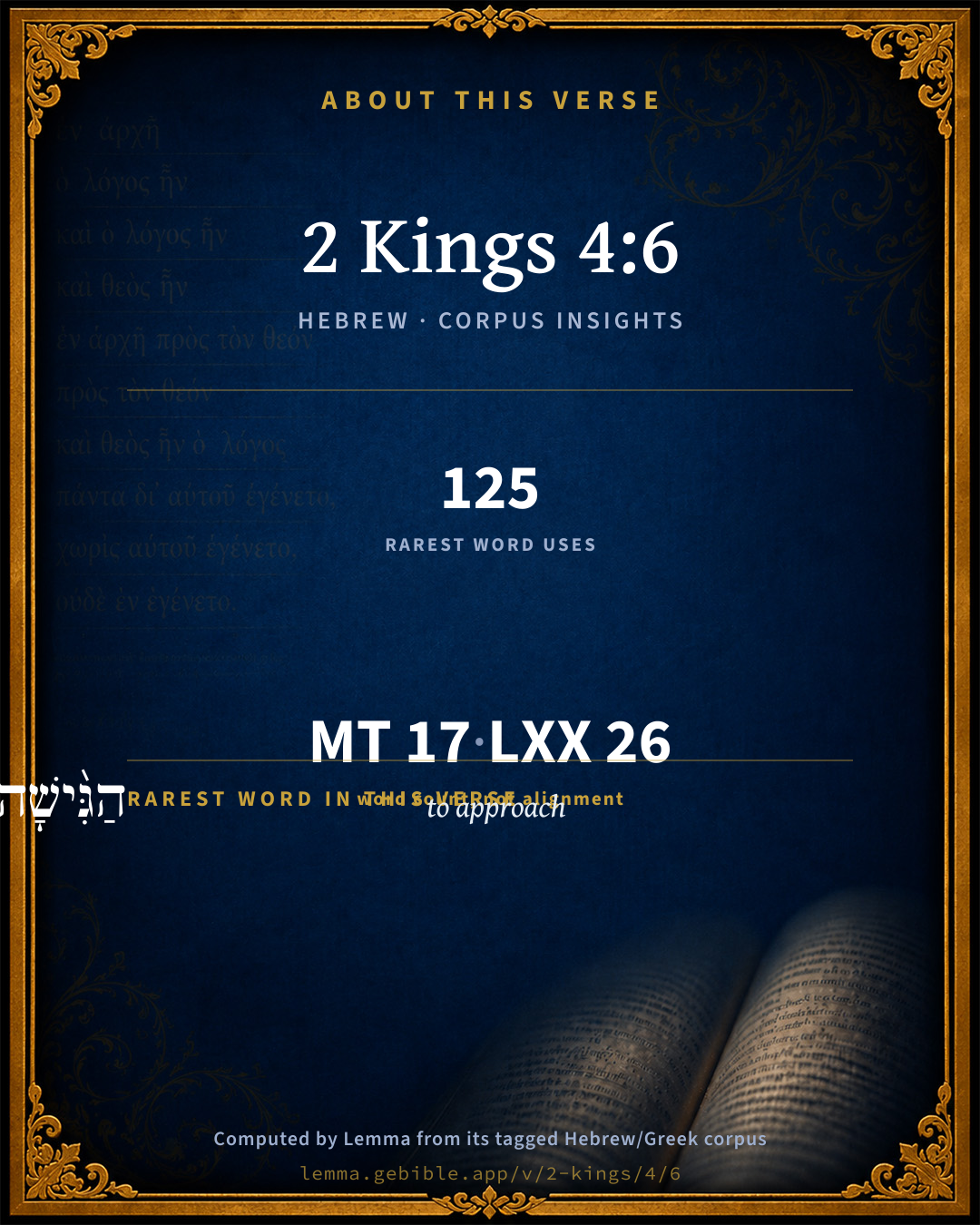
These counts appear in no published source. They are computed here, from the morphology-tagged text and Lemma’s own curated glosses. What Lemma adds →

17
words
11
distinct lemmas
Historical
section

Grammatical profile

  • 6 verbs
  • 5 nouns
  • 3 prepositions
  • 2 adverbs
  • 1 particle

Verb forms

  • וַיְהִ֣י Qal · Sequential Imperfect
  • כִּמְלֹ֣את Qal · Infinitive Construct
  • וַתֹּ֤אמֶר Qal · Sequential Imperfect
  • הַגִּ֨ישָׁה Hiphil · Imperative
  • וַיֹּ֣אמֶר Qal · Sequential Imperfect
  • וַֽיַּעֲמֹ֖ד Qal · Sequential Imperfect

Repetition

Words recur within this verse — often emphatic in Hebrew:

  • הַכֵּלִ֗ים vessel H3627 ×3
  • וַתֹּ֤אמֶר to say H559 ×2
  • עוֹד֙ still H5750 ×2
  • אֶל to H413 ×3

Hebrew & Septuagint length

In English translation the verse runs 29 words from the Hebrew and 26 from the Septuagint (LXX English) — closely comparable.

A rough comparison of the two English renderings, which tokenize alike — not a word-level alignment.

Word counts can differ between the Hebrew and the Greek without any difference in meaning — e.g. the Hebrew direct-object marker אֵת has no separate Greek word, and Greek often adds the article ὁ.

In the original languages it is 17 Hebrew tokens and 26 Greek tokens — but the two are counted differently (Hebrew bundles its prefixes and suffixes into one token; the Greek is in lemma form), so that isn’t a like-for-like length.

Cross-references

11

Topical passages linked to 2 Kings 4:6 in the Treasury of Scripture Knowledge — connected by theme and wording, ordered by reader-vote popularity; previews shown in the World English Bible.

  • Matthew 14:20 They all ate, and were filled. They took up twelve baskets full of that which remained left over from the broken pieces.
  • 2 Kings 13:19 The man of God was angry with him, and said, You should have struck five or six times: then had you struck Syria until you had consumed it, whereas now you shall strike Syria but thrice.
  • Luke 6:19 All the multitude sought to touch him, for power came out from him and healed them all.
  • Joshua 5:12 The manna ceased on the next day, after they had eaten of the produce of the land; neither had the children of Israel manna any more; but they ate of the fruit of the land of Canaan that year.
  • 1 Kings 17:14 For thus says Yahweh, the God of Israel, The jar of meal shall not empty, neither shall the jar of oil fail, until the day that Yahweh sends rain on the earth.
  • 2 Kings 4:43–44 His servant said, What, should I set this before a hundred men? But he said, Give the people, that they may eat; for thus says Yahweh, They shall eat, and shall leave of it.
  • 2 Chronicles 6:12–13 He stood before the altar of Yahweh in the presence of all the assembly of Israel, and spread forth his hands
  • Matthew 9:29 Then he touched their eyes, saying, "According to your faith be it done to you."
  • Matthew 13:58 He didn't do many mighty works there because of their unbelief.
  • Matthew 15:37 They all ate, and were filled. They took up seven baskets full of the broken pieces that were left over.
  • John 6:12 When they were filled, he said to his disciples, "Gather up the broken pieces which are left over, that nothing be lost."

Cross-references courtesy of OpenBible.info (CC BY 4.0).

Hebrew and Greek witnesses Masoretic Hebrew ↔ Greek Septuagint

The same verse in the two great witnesses to the Old Testament, shown verse-for-verse.

These are two independent witnesses, not word-aligned to each other, and the Septuagint is shown in lemma (dictionary) form.

Hebrew 2 Kings 4:6 Masoretic · Westminster Leningrad Codex

וַיְהִ֣י כִּמְלֹ֣את הַכֵּלִ֗ים וַתֹּ֤אמֶר אֶל בְּנָהּ֙ הַגִּ֨ישָׁה אֵלַ֥י עוֹד֙ כֶּ֔לִי וַיֹּ֣אמֶר אֵלֶ֔יהָ אֵ֥ין ע֖וֹד כֶּ֑לִי וַֽיַּעֲמֹ֖ד הַשָּֽׁמֶן

It happened, when the vessels were full, that she said to her son, Bring me yet a vessel. He said to her, There isn't another vessel. The oil stayed.

World English Bible · Public Domain

Greek LXX 2 Kings 4:6 Septuagint · lemma form

ἕως πίμπλημι ὁ σκεῦος καί εἶπον πρός ὁ υἱός αὐτός ἐγγίζω ἔτι πρός ἐγώ σκεῦος καί εἶπον αὐτός οὐ εἰμί ἔτι σκεῦος καί ἵστημι ὁ ἔλαιον

And she said to her sons, Bring me yet a vessel. And they said to her, There is not a vessel more. And the oil stayed.

LXX2012 (modern English Septuagint) · Public Domain

On this verse, Ellicott's Commentary for English Readers discusses the Septuagint’s reading. Read the note in Commentary ↓

Hebrew: Westminster Leningrad Codex (CC BY 4.0). Greek: Septuagint (public domain); English from LXX2012 (modern English Septuagint) (Public Domain). How the Septuagint differs from the Hebrew →

Targum (Aramaic paraphrase)

1

The Targum is the ancient Jewish Aramaic paraphrase of the Hebrew Scriptures — an interpretive translation, not the Hebrew text itself. Onkelos (literal) and Pseudo-Jonathan (expansive) render the Torah, and Jonathan the Prophets. Coverage is partial: where no permissively-licensed English translation exists for a verse, only the Aramaic is shown. This is verse-level text, not a word-by-word alignment to the Hebrew.

  1. Targum Jonathan Prophets (Joshua–Malachi)
    וַהֲוָה כְּמִשְׁלַם מָנַיָא וַאֲמַרַת לִבְרָהּ קְרִיב לִי עוֹד מָנָא וַאֲמַר לָהּ לֵית עוֹד מָנָא וּפְסַק מִשְׁחָא:

    (no public-domain English translation for this verse)

    Targum Jonathan — Aramaic: “Mikraot Gedolot” (public domain). English: “Sefaria Community Translation” (CC0 1.0 (public-domain dedication)); “London "Chaldee Paraphrase," 1871” (public domain). Text via Sefaria.

Commentary

Notes on 2 Kings 4:6 from classic Christian and Jewish commentators (each source and its license shown beneath its notes). The classic Christian expositions comment on the surrounding passage and are grouped to its opening verse, so a note may address several verses; the Jewish commentaries on the Tanakh (Rashi and others) are per-verse, so they appear only where the commentator wrote on this verse.

Lemma curates 59 commentaries, every one of them public domain or Creative Commons licensed, each selected and text-cleaned for this edition rather than reprinted as found. About our sources →

Trapp's Complete Commentary

John Trapp

2Ki 4:6 And it came to pass, when the vessels were full, that she said unto her son, Bring me yet a vessel. And he said unto her, [There is] not a vessel more. And the oil stayed.

Ver. 6. There is not a vessel more.] The cruse never ceased running, till there was no room; so elsewhere God never ceased abating, till Abraham stopped begging.

John Trapp, A Commentary or Exposition upon All the Books of the Old and New Testament (1647–1656) — public domain. Text from a community e-Sword module.

The Biblical Illustrator

Joseph S. Exell

2Ki_4:6

And it came to pass when the vessels were full.

Gods way of giving

This incident is rich in suggestiveness. It may be employed to illustrate the rapid changes of human fortune; the crushing weight of cumulative trials; or the practical sympathy of a true prophet who is never so faithful in his calling as when he visits the fatherless and widows in their affliction, and exerts his influence in their behalf. There are, however, considerations suggested by the particular method adopted in this case which throw light upon Gods way of giving, and indicate, not obscurely, the terms upon which we, who have no miraculous interpositions to expect, may become recipients of His continual bounty.

I. In the communication of his grace the most high makes the confession of our helplessness the condition of his help. The sense of need must be awakened before He will bestow the required aid. Tell me what hast thou in the house? was a question intended to fathom the depth of the womans poverty. Until this insufficiency of all human resource has been felt and acknowledged, the Divine assistance will not be sought and cannot be given. The Saviour in His miracles of mercy made it apparent that He did not interpose until all human help had failed. When He was about to feed the multitudes He asked the disciples, How many loaves have ye? and measured the limits of ordinary means before drawing on the infinite capabilities of Omnipotence. The trembling sufferer who sought to touch His robe had tried all other measures before resorting to Him. The disappointed fishermen were obliged to admit that they had taken nothing ere they could be gladdened by a great success. So is it still. The choice gifts of God are withholden from the self-complacent and lavished on the needy--He hath filled the hungry with good things, but the rich He hath sent empty away.

II. He enriches us by the multiplication and increase of previous gifts. It would be equally easy for Him to work without means, but He chooses rather to work by them. What hast thou in the house? is something more than a gauge of poverty; it is a wholesome reminder that in the poorest lot there is some remnant of former possessions, some basis for present hope. The multitudes whom our Lord miraculously fed might have been relieved by the creation of an altogether new and strange provision; but He used such common food as was available, and then multiplied the stock till every need was met. The persuasion of our helplessness does not warrant our neglect of such opportunities and the use of such talent as we have. Too often we covet fresh interpositions of Divine power when we have at our command previous gifts whose energy is unexhausted, and former experiences which may fitly stimulate activity and encourage hope. Moses held in his own hand the simple instrument whereby with Gods blessing he would compel attention to his words (Exo_4:2); and if not in our hands, we may have in our house that which, like the widows oil, shall be multiplied by the bounty of Him.

III. He measures his bestowments by our capacity to receive. While there is an empty vessel to hold it, His grace continues to flow. He entrusts talents to every man according to his several ability. A preoccupied heart has no room for the Saviour. He is gladly received when He is eagerly waited for (Luk_8:40). In the dispensation of spiritual gifts the same rule obtains--He giveth more grace, and again more, according to the ardour of our wishes and the measure of our preparedness to receive His favours. Still as of old--He satisfies the longing soul, and fills the hungry soul with goodness (Psa_107:9), drawing out our desires, and at the same time enlarging our capacity.

IV. He delights to exceed the requirements of present need. Not content to give enough to satisfy the clamorous creditor, He supplied a store for the maintenance of the widow and her sons for some time to come. The fragments left after each feast in the wilderness far exceeded the original provision. This generosity is a conspicuous feature in all the communications of grace. David was overwhelmed at the bounty of which he was the recipient, yet what he held in possession was small compared with future blessings secured to him by promise (2Sa_7:19). Jacob, in like manner, after giving up all hope that he should ever see Joseph again, was constrained to acknowledge that God had far exceeded his most sanguine expectation. I had not thought to see thy face; and lo, God hath showed me also thy seed (Gen_48:11). (Robert Lewis.)

When the oil flows

Now, if I may venture to be fanciful for once, let me tell you of three vessels that we have to bring if we would have the oil of the Divine Spirit poured into us.

I. The vessel of desire. God can give us a great many things that we do not wish, but He cannot give us His best gift, and that is Himself, unless we desire it. He never forces His company on anybody, and if we do not wish for Him He cannot give us Himself, His Spirit, or the gifts of His Spirit. For instance, He cannot make a man wise if he does not wish to be instructed. He cannot make a man holy if he has no aspiration after holiness. Measure the reality and intensity of desire, and you measure capacity. As the atmosphere rushes into every vacuum, or as the sea runs up into, and fills, every sinuosity of the coast, so wherever a heart opens, and the unbroken coast-line is indented, as it were, by desire, in rushes the tide of the Divine gifts. You have God in the measure in which you desire Him.

II. Another vessel that we have to bring is the vessel of out expectancy. Desire is one thing; confident anticipation that the desire will be fulfilled is quite another. And the two do not certainly go together anywhere except in this one region, and there they do go, linked arm-in-arm. For whatsoever, in the highest of all regions, we wish we have the right without presumption to believe that we shall receive. Expectation, like desire, opens the heart. There are some expectations, even in lower regions, that fulfil themselves. Doctors will tell you that a very large part of the curative power of their medicine depends upon the patients anticipation of recovery. If a man expects to die when he takes to Iris bed, the chances are that he will die; and if a man expects to get better, death will have a fight before it conquers him. All these illustrations fall far beneath the Christian aspect of the thought that what we expect from God we get. That is only another way of putting, According to thy faith be it unto thee. It is exactly what Jesus Christ said when He promised: Whatsoever things ye ask when ye stand praying, believe that ye receive them, and ye shall have them.

III. Lastly, one more vessel that we have to bring is obedience. If any man will do His will, he shall know of the doctrine. Desire, Anticipation, and Obedience. These three must never be separated if we are to receive the gift of Himself, which God delights and waits to give. All spiritual possessions and powers grow by use, even as exercised muscles are strengthened, and unused ones tend to be atrophied. (A. Maclaren, D. D.)

The oil and the vessels

So long as there were vessels to be filled the miraculous flow of the oil continued, and it only ceased when there were no more jars to contain it.

I. This is true in reference to our providential circumstances. So long as we have needs we shall have supplies, and we shall find our necessities exhausted far sooner than the Divine bounty.

II. The same principle holds good with regard to the bestowal of saving grace. In a congregation the Gospel is as the pot of oil, and those who receive from it are needy souls, desirous of the grace of God. Of these we have always too few in our assemblies.

III. The like is true with regard to other spiritual blessings. All fulness dwells in our Lord Jesus, and, as He needs not grace for Himself, it is stored up in Him, that He may give it out to believers. The saints with one voice confess Of His fulness have all we received.

IV. The same truth will be proved in reference to the purposes of grace in the world. The fulness of Divine grace will be equal to every demand upon it till the end of time. Men will never be saved apart from the atonement of our Lord Jesus, but never will that ransom price be found insufficient to redeem the souls that trust in the Redeemer. (C. H. Spurgeon.)

The Spirit of God supplying the need of the Church

The multiplication of the oil ran parallel with the demand of each successive vessel. As the sons brought them they became full. Whatever their size or shape, they were carried back, and set down, filled to the brim. When all were quite full, she bitterly lamented that there was not a vessel more. It is so that the Spirit of God has been supplying the need of the Church from that moment in the upper room, when the risen Lord began to pour Him forth. Vessel after vessel has been brought; men like Ambrose, Chrysostom, Augustine, Luther, John Knox have been filled, and still the stream of oil and grace of spiritual plenitude and anointing is being poured forth. (E. B. Meyer.)

The Biblical Illustrator, edited by Joseph S. Exell (c. 1880s–1900s) — public domain. Text from a community e-Sword module.

MacLaren's Expositions of Holy Scripture

Alexander MacLaren

2 Kings

WHEN THE OIL FLOWS

2Ki 4:6.

The series of miracles ascribed to Elisha are very unlike most of the wonderful works of even the Old Testament, and still more unlike those of the New. For about a great many of them there seems to have been no special purpose, either doctrinal or otherwise, but simply the relief of trivial and transient distresses. This story, from which my text is taken, is one of that sort. One of the sons of the prophets had died in Shunem. He left a widow and two little children. The creditor, according to the Mosaic law, had the right, which he was about to put in practice, of taking the children to be bondmen. And so the penniless, helpless woman comes to Elisha, as a kind of deliverer-general from all sorts of distresses, and tells him her pitiful tale. He asks her what she wants him to do, and she has no counsel to give. Then the thing to do strikes him. He asks what she has in the house. It was a poor, bare hovel of a place. There was not anything in it save a pot of oil, which was all her property. He sends her to borrow vessels, of all sorts and sizes. He takes the pot of oil, and shuts the door. Then she sets the two boys fetching and carrying; and herself taking up the one possession that she has, in faith she pours; and dish after dish is filled, and still she pours; and they were all filled, and she kept on pouring. Then she said, ‘Bring some more’; and the boys answered, ‘There are not any more,’ so then the oil stopped.

There was no very special reason for all this. It is not at all like most Biblical miracles. I do not suppose it had any symbolical intention; but I venture to do a little gentle violence to the incident, and to see in the staying of the oil when no more vessels were brought to be filled, a lesson addressed to us all, and it is this: God keeps giving Himself as long as we bring that into which He can pour Himself. And when we stop bringing, He stops giving.

Now, if I may venture to be fanciful for once, let me tell you of three vessels that we have to bring if we would have the oil of the Divine Spirit poured into us.

I. The vessel of desire.

God can give us a great many things that we do not wish, but He cannot give us His best gift, and that is Himself, unless we desire it. He never forces His company on any man, and if we do not wish for Him He cannot give us Himself, His Spirit, or the gifts of His Spirit. For instance, He cannot make a man wise if he does not wish to be instructed. He cannot make a man holy if he has no aspiration after holiness. He cannot save a man from his sins if the man holds on to his sin with both hands, like some shellfish with its claws when you try to drag it out of its cleft in the rock. He cannot give the oil unless we bring the vessels of our hearts opened by our desires.

If God could He would. ‘Ye have not because ye ask not.’ But we are never to forget that God is not led to begin His giving because we petition Him, but that the infinitude of His stores, and the endless, changeless, unmotived, perfect love of His heart, make self-communication-I was going to use a very strong word, and I do not know that it is too strong-necessary to the blessedness of the blessed God, and, long before we ever thought of Him, or sought anything from Him, there was pouring out from Him all the fulness of His love: just as we may conceive of the sunshine raying out before the orbs that were to circle round it had been completely shaped, but were still diffused and nebulous.

But, while God is always giving, our capacity to receive determines the degree of our individual possession of Him. Or, to put it in the plainest words-we have as much of God as we can take in; and the principal factor in settling how much we can take is-how much we wish. Measure the reality and intensity of desire, and you measure capacity. As the atmosphere rushes into every vacuum, or as the sea runs up into and fills every sinuosity of the shore, so wherever a heart opens, and the unbroken coast-line is indented, as it were, by desire, in rushes the tide of the divine gifts. You have God in the measure in which you desire Him.

Only remember that that desire which brings God must be more than a feeble, fleeting wish. Wishing is one thing; willing is quite another. Lazily wishing and strenuously desiring are two entirely different postures of mind; the former gets nothing and the latter gets everything, gets God, and with God all that God can bring.

But the wish must not only rise to intensity and earnestness, but it must be steadfast. Suppose these two little boys of the widow had held their vessels below the spout of the oil-pot with tremulous hands, while they looked away at something else, sometimes keeping the vessels right under, and sometimes shifting them on one side, it would have been slow work filling the unsteadily held vessels. So it is in regard to receiving God’s best gift. Our desires must be unwavering. A cup held by a shaking hand will spill its contents, or will never receive them. ‘Let not that man think that he shall receive anything of the Lord.’ The steadfast wish is the wish that is answered.

Is it not a strange indifference to our true good that we who have learned, as most of us have learned only too well, that in this world to wish is not to have, should turn away from the possibility that lies before us each, of passing from this disappointing world of vain longings into a region where we cannot wish anything that we do not get? There is only one thing about which it is true that, if you want, and as much as you want, you will have; and that thing is found when we turn away our wishes from the false, fleeting, and surface satisfactions of earth, and fasten them upon God, ‘Who is able to do exceeding abundantly above all that we . . . think.’ Wish for Him, and you have what you have wished. Wish for anything else, and you may have it or you may not, but depend upon it the fish is never half as big when it is out of the water as it felt to be when it was tugging at the hook.

II. Another vessel that we have to bring is the vessel of our expectancy.

Desire is one thing; confident anticipation that the desire will be fulfilled is quite another. And the two do not certainly go together anywhere except in this one region, and there they do go, linked arm in arm. For whatsoever, in the highest of all regions, we wish, we have the right without presumption to believe that we shall receive. Expectation, like desire, opens the heart.

There are some expectations, even in lower regions, that fulfil themselves. Doctors will tell you that a very large part of the curative power of their medicine depends upon the patient’s anticipation of recovery. If a man expects to die when he takes to his bed, the chances are that he will die; and if a man expects to get better, Death will have a fight before it conquers him. There are hundreds of cases, in all departments of life, where he who sets himself to a task with assured persuasion that he is going to do such and such a thing will do it. ‘Screw your courage to the sticking-place, and we’ll not fail,’ said the heroine in the tragedy; and there is a great truth in her fierce encouragement.

All these illustrations fall far beneath the Christian aspect of the thought that what we expect from God we receive. That is only another way of putting ‘According to thy faith be it unto thee.’ It is exactly what Jesus Christ said when He promised, ‘Whatsoever things ye ask when ye stand praying believe that ye receive them, and ye shall have them.’

I am afraid that a great many of us often have expectations fainter than desires; and that we should be very much surprised if the thing that we ask for, in the prayers that we so often repeat by rote, were granted to us. You will hear men praying for holiness, for clean hearts, for progress in the Christian life, for a hundred other such blessings. They do not expect that anything is going to come in consequence, and they would be mightily at a loss what to do with the gift if it did come. The absence of expectancy in our public petitions is to me one of the saddest features in the Christian life of this day. If you expect little, you will get little; and we do expect far less than we ought. We cannot raise our confident expectations too high; for ‘He is able to do for us exceeding abundantly above all that we ask’ as well as ‘think.’ The Apostle has set the limit of our expectations, in the same context, and here it is: ‘That we may be filled with all the fulness of God.’ There are two limits: one is the boundless illimitableness of God’s perfection, and the possibilities of our possession of Him are not exhausted until we have reached that infinite completeness. But then, there is a practical, working limit for each of us; and that is-what do you desire? and what do you expect? God can give more than we can ask or think, but He cannot at the moment give more than we expect or desire.

True, the vessels that we bring to be filled with the oil are not like the vessels that the fatherless boys brought. These were of a definite capacity; and the little cup when it was filled was filled, and there was an end of it. But the vessels that we bring are elastic, and widen out. The more that is put into them the more they can hold, so that there is no bound to the capacity of a heart for the reception and inrush of God; and there will not be a bound through all the ages of a growing possession of Him in eternity. But for to-day, desire and expectancy determine the measure of the gift.

III. Lastly, one more vessel that we have to bring is obedience.

‘If any man will do His will, he shall know of the doctrine.’ There is one case of the general principle that wishes and anticipations are all right and well, but unless they are backed up and verified by conduct, even wishes and anticipations will not bring God’s gift. For it is possible for a man who, in his better moments of devotion, has some desires after a loftier range of goodness and a completer conformity to God than he ordinarily has, to rise from his knees and rush into the world, and there live in some lust, or uncleanness, or vice, or indulgence, or absorption in the cares of this life, in such a way as that desires and anticipations shall vanish. If we fill our vessels full, before we take them to the source of supply, with all manner of baser liquids, there will be no room for the oil. We may contradict and stifle our desires by our conduct, and by it make our expectations perfectly impossible to be fulfilled. Are our daily doings of such a nature as that the Spirit of God, which is symbolised by the oil, can come into our hearts; or are we quenching and grieving Him so that He

‘Can but listen at the gate

And hear the household jar within’?

Desire, Expectancy, and Obedience-these three must never be separated if we are to receive the gift of Himself, which God delights and waits to give. All spiritual possessions and powers grow by use, even as exercised muscles are strengthened, and unused ones tend to be atrophied. It is possible, by neglect of God and of the gift given to us, to incur the stern sentence passed on the slothful servant-’Take it from him.’ By disobedience and negligence we choke the channel through which God’s gifts can flow to us. So, brethren, bring these three vessels, and you will not go away with them empty. ‘Open thy mouth wide, and I will fill it.’

Alexander MacLaren, Expositions of Holy Scripture (1904–1910) — public domain. Text from a community e-Sword module.

Geneva Bible (1599)

Geneva Bible translators

To augment and increase in the vessels.

Geneva Bible (1599) marginal notes — public domain. Text via Bolls.life.

Jamieson, Fausset & Brown

Robert Jamieson, A. R. Fausset & David Brown

the oil stayed--that is, ceased to multiply; the benevolent object for which the miracle had been wrought having been accomplished.

Jamieson, Fausset & Brown — Commentary Critical and Explanatory on the Whole Bible (1871) — public domain (CC PDM 1.0). Text via the HelloAO Bible API.

Adam Clarke's Commentary

Verse 6. And the oil stayed.] While there was a vessel to fill, there was oil sufficient; and it only ceased to flow when there was no vessel to receive it. This is a good emblem of the grace of God. While there is an empty, longing heart, there is a continual overflowing fountain of salvation. If we find in any place or at any time that the oil ceases to flow, it is because there are no empty vessels there, no souls hungering and thirsting for righteousness. We find fault with the dispensations of God's mercy, and ask, Why were the former days better than these? Were we as much in earnest for our salvation as our forefathers were for theirs, we should have equal supplies, and as much reason to sing aloud of Divine mercy.

Adam Clarke's Commentary on the Bible (1810–1826) — public domain. Text from a community e-Sword/MySword module.

Ellicott's Commentary for English Readers

(6) Her son.—Probably the eldest. The LXX. has plural here and in the verb that follows.

Stayed.—Heb., stood—i.e., halted, stopped. (Comp. Luk_8:44, ἡ ῥύσις ἔστη.) Bähr makes the word mean continued—i.e., to flow (!).

A Bible Commentary for English Readers, edited by Charles John Ellicott (1878–1897) — public domain. Text from a community e-Sword module.

The Cambridge Bible for Schools and Colleges

gen. ed. J. J. S. Perowne

6. she said unto her son] Here the LXX., apparently only because ‘sons’ had been mentioned before, has here also ‘sons’ and later on in the verse ‘and they said’. The Hebrew is far more natural. Both sons had helped, but it would be to one that her request ‘Bring me another’ would be addressed.

And the oil stayed] i.e. ceased to flow any longer. The English verb is a little antiquated in this sense, being now more commonly used for ‘to cause to stand’. But cf. Jos_10:13 ‘The sun stood still and the moon stayed’, i.e. ceased to move.

The Cambridge Bible for Schools and Colleges (gen. ed. J. J. S. Perowne; Cambridge University Press, 1878–1918) — public domain. Text from a community e-Sword module.

John Gill's Exposition

And it came to pass when the vessels were full,.... For the oil being miraculously increased as it was poured forth, there was enough to fill all the vessels; Ben Gersom and Abarbinel say, that when the pot was emptied, all the air that entered it was turned into oil:

that she said to her son, bring me yet a vessel; as she had two sons, one it is probable was employed in setting aside the full vessels, as she poured into them, and the other in bringing to her the empty vessels, and to whom she thus speaks:

and he said unto her, there is not a vessel more; not an empty one, they were all filled:

and the oil stayed; it ran no longer, it was no more multiplied; there was no necessity of continuing the miracle: this oil may be an emblem of the grace that flows from the fulness of it in Christ, to which it is compared, which will be always flowing, as long as there is a vessel of salvation, or faith in any to receive it; see Mat 25:3 Jo1 2:20.

John Gill's Exposition of the Whole Bible (1746–1763) — public domain (CC PDM 1.0). Text via the HelloAO Bible API.

Haydock's Catholic Bible Commentary

Stood. The grace of God ceases to flow, when the soul is full of vanity. (St. Bernard) --- Charity does not increase, when it bestows nothing. (St. Augustine, ser. 206. de Temp.)

George Leo Haydock (1774–1849), Haydock's Catholic Family Bible and Commentary, 1859 edition — public domain. Excludes Psalms (Douay-Rheims chapter numbering differs from Protestant) and Deuterocanonical books (Catholic canon only).

Matthew Poole's English Annotations

Unto her son; to one of them, for she had two, 2Ki 4:1. The oil stayed, to teach us, that we should not waste any of God’s good creatures, and that God would not work miracles unnecessarily.

Matthew Poole's English Annotations on the Holy Bible (1683–1685) — public domain. Text from a community e-Sword/MySword module.

Whedon's Commentary on the Bible

Daniel D. Whedon

6. The oil stayed — “It only ceased to flow when there was no vessel to receive it. This is a good emblem of the grace of God. While there is an empty, longing heart, there is a continual overflowing fountain of salvation. If we find in any place, or at any time, that the oil ceases to flow, it is because there are no empty vessels there, no souls hungering and thirsting for righteousness.” — Clarke. Compare 2Co_6:11-12.

Daniel D. Whedon (gen. ed.), Commentary on the Old and New Testaments (1874–1909) — public domain. Text from a community e-Sword module.

The Pulpit Commentary

And it came to pass, when the vessels were full, that she said unto her son, Bring me yet a vessel. It did not occur to her that all the vessels had been already filled; so she asked her son for another, that she might fill it. And he said unto her, There is not a vessel more; i.e. all the vessels that we have in the house are full; there remains no empty one. And the oil stayed. God will not have waste. If the oil had continued to flow, it would have fallen on the floor of the house, and have been of no service to any one. Therefore, when all the vessels were full, there was a sudden stoppage.

The Pulpit Commentary (1880–1919), ed. H.D.M. Spence-Jones & Joseph S. Exell — public domain. Text from a community e-Sword module.

Rashi

Rabbi Shlomo Yitzchaki (Rashi)

Then the oil stopped. From coming anymore. [According to] Midrash Aggadah, the price of oil went up.

Rashi on the Tanakh — English translations: “The Judaica Press complete Tanach with Rashi, translated by A. J. Rosenberg” (CC BY 4.0); “Pentateuch with Rashi's commentary by M. Rosenbaum and A.M. Silbermann, 1929-1934” (public domain); “The Metsudah Tanach series, Lakewood, N.J” (CC BY 4.0); and “The Book of Joshua, Metsudah Publications, 1997” (CC BY 4.0). Text via Sefaria.

Lesson kit

Teaching starters — assembled from the data on this page, not authored interpretation. Every prompt links to the verse data it draws on. Edit before teaching.

2 Kings, in the Historical, opens this verse with 17 words (11 distinct Hebrew lemmas). Its most distinctive word is nâgash (“to approach”). A historical commentator’s framing appears above. Read the whole chapter for the surrounding context.

Discussion questions

  1. The word nâgash carries the sense “to approach.” How does it shape the verse?
  2. Matthew 14:20 shares this passage’s theme. How do the two illuminate each other?
  3. “vessel” occurs 3× in this one verse. What is the effect of the repetition?
  4. These translations render this verse differently. What is at stake in choosing one wording over another?
  5. The verb «וַיְהִ֣י» is Qal Sequential Imperfect. How does its form color the action?
  6. Reading how Trapp's Complete Commentary and The Biblical Illustrator read this verse, where do the two commentators agree and where do they part?

Things to notice

Reading settings

Reading text

Shown beneath each verse's original-language words.

Old Testament
Old Testament edition

Read the OT as the Masoretic Hebrew (MT) or the Greek Septuagint (LXX).

English shown for the Greek Septuagint (in the Hebrew ↔ Greek comparison).

Comparing translations? Open the Compare panel on any verse page to stack up to four side by side.