
1 Kings 19:21

Hebrew (Westminster Leningrad Codex) 1 Kings 19:21 appears in the Hebrew Old Testament. The text above is from the Westminster Leningrad Codex. Each word links to its Strong’s number, a concise gloss, and parsing drawn from the Open Scriptures Hebrew Bible morphology. Click any word for its full Brown-Driver-Briggs (BDB) entry.
Download image
Cite this verse

1 Kings 19:21 (World English Bible). Public Domain. Lemma interlinear Bible study tool, https://lemma.gebible.app/v/1-kings/19/21.

Show BibTeX & RIS
BibTeX
RIS
English Translation
He returned from following him, and took the yoke of oxen, and killed them, and boiled their flesh with the instruments of the oxen, and gave to the people, and they ate. Then he arose, and went after Elijah, and ministered to him.
World English Bible · Public Domain
Download a study sheet

One document with this verse’s original text, its word-by-word gloss line, the meaning frame, cross-references with their text, attributed commentary, and full source and license credits — printable, and it pastes into notes with its structure intact.

This verse Autodidact and up

Study sheet (.html) Plain text (.txt)

A passage Seminary Student

Up to 50 verses in one chapter. A passage sheet keeps up to 6 commentary sources and 12 cross-references per verse, in the order this page ranks them, and says so on the sheet whenever that leaves anything out. Ask for a single verse and you get the Autodidact verse sheet above.

Everything on this page stays free to read, with no account — the sheet is a download of what is already on screen, not access to it.

Want to remove ads? Support Godless Engineer
Compare translations 3

The same verse in 3 English versions, stacked beneath the original-language interlinear above. Click any original word for its lexicon entry.

Each is an independent rendering of the whole verse — the interlinear is not word-aligned to these translations.

Highlighted words mark where these versions differ — a whole-verse word diff, not a word-by-word alignment.

  • World English Bible Public Domain
    He returned from following him, and took the yoke of oxen, and killed them, and boiled their flesh with the instruments of the oxen, and gave to the people, and they ate. Then he arose, and went after Elijah, and ministered to him.
  • King James Version Public Domain
    And he returned back from him, and took a yoke of oxen, and slew them, and boiled their flesh with the instruments of the oxen, and gave unto the people, and they did eat. Then he arose, and went after Elijah, and ministered unto him.
  • unfoldingWord Literal Text CC BY-SA 4.0
    And he returned from after him. And he took the pair of oxen, and he sacrificed it. And with the equipment of the oxen he boiled them, the flesh. And he gave to the people, and they ate. Then he arose and went after Elijah, and he served him.

unfoldingWord Literal Text — © unfoldingWord, licensed CC BY-SA 4.0. Word-aligned USFM3 via Door43 (git.door43.org/unfoldingWord/en_ult).

Versions to compare (up to 4)

3 of 4 selected

Show all 18 translations

Every available English version of this verse, each an independent rendering of the whole verse.

  • World English Bible Public Domain
    He returned from following him, and took the yoke of oxen, and killed them, and boiled their flesh with the instruments of the oxen, and gave to the people, and they ate. Then he arose, and went after Elijah, and ministered to him.
  • Berean Standard Bible Public Domain
    So Elisha turned back from him, took his pair of oxen, and slaughtered them. With the oxen’s equipment, he cooked the meat and gave it to the people, and they ate. Then he set out to follow and serve Elijah.
  • Majority Standard Bible Public Domain
    So Elisha turned back from him, took his pair of oxen, and slaughtered them. Using the oxen’s equipment for fuel, he cooked the meat and gave it to the people, and they ate. Then he set out to follow and serve Elijah.
  • King James Version Public Domain
    And he returned back from him, and took a yoke of oxen, and slew them, and boiled their flesh with the instruments of the oxen, and gave unto the people, and they did eat. Then he arose, and went after Elijah, and ministered unto him.
  • American Standard Version (1901) Public Domain
    And he returned from following him, and took the yoke of oxen, and slew them, and boiled their flesh with the instruments of the oxen, and gave unto the people, and they did eat. Then he arose, and went after Elijah, and ministered unto him.
  • Revised Version (1885) Public Domain
    And he returned from following him, and took the yoke of oxen, and slew them, and boiled their flesh with the instruments of the oxen, and gave unto the people, and they did eat. Then he arose, and went after Elijah, and ministered unto him.
  • Geneva Bible (1599) Public Domain
    And when he went backe againe from him, he tooke a couple of oxen, and slewe them, and sod their flesh with the instruments of the oxen, and gaue vnto the people, and they did eate: then he arose and went after Eliiah, and ministred vnto him.
  • Douay-Rheims (1899) Public Domain
    And returning back from him, he took a yoke of oxen, and killed them, and boiled the flesh with the plough of the oxen, and gave to the people, and they ate: and rising up he went away, and followed Elias, and ministered to him.
  • Young's Literal Translation Public Domain
    And he turneth back from after him, and taketh the yoke of oxen, and sacrificeth it, and with instruments of the oxen he hath boiled their flesh, and giveth to the people, and they eat, and he riseth, and goeth after Elijah, and serveth him.
  • Literal Standard Version CC BY-SA 4.0
    And he turns back from after him, and takes the yoke of the ox, and sacrifices it, and with [the] instruments of the ox he has boiled its flesh, and gives to the people, and they eat, and he rises, and goes after Elijah, and serves him.
  • Unlocked Literal Bible CC BY-SA 4.0
    So Elisha returned from Elijah and took the yoke of oxen, killed the animals, and cooked the meat with the wood from the ox yoke. Then he gave it to the people and they ate. Then he arose, went after Elijah and served him.
  • unfoldingWord Literal Text CC BY-SA 4.0
    And he returned from after him. And he took the pair of oxen, and he sacrificed it. And with the equipment of the oxen he boiled them, the flesh. And he gave to the people, and they ate. Then he arose and went after Elijah, and he served him.
  • Darby Bible Public Domain
    And he returned back from him, and took the yoke of oxen, and killed them, and boiled their flesh with the implements of the oxen, and gave to the people, and they ate. And he arose and went after Elijah, and ministered to him.
  • World Messianic Bible Public Domain
    He returned from following him, and took the yoke of oxen, killed them, and boiled their meat with the oxen’s equipment, and gave to the people; and they ate. Then he arose, and went after Elijah, and served him.
  • Webster's Bible Public Domain
    And he returned back from him, and took a yoke of oxen, and slew them, and boiled their flesh with the instruments of the oxen, and gave to the people, and they ate. Then he arose, and went after Elijah, and ministered to him.
  • Free Bible Version CC BY-SA 4.0
    Elisha left him, took his pair of oxen, and slaughtered them. Using the wood of the oxen's yoke as fuel, he cooked the meat and gave it to the people, and they ate it. Then he left to follow and serve Elijah.
  • Bible in Basic English Public Domain
    And he went back, and took the oxen and put them to death, and cooking their flesh with the yokes of the oxen, he gave the people a feast. Then he got up and went after Elijah and became his servant.
  • JPS Tanakh (1917) Public Domain
    And he returned from following him, and took the yoke of oxen, and slew them, and boiled their flesh with the instruments of the oxen, and gave unto the people, and they did eat. Then he arose, and went after Elijah, and ministered unto him.

Literal Standard Version (2020), Covenant Press — licensed CC BY-SA 4.0. Text via the HelloAO Bible API (eBible.org). Unlocked Literal Bible (unfoldingWord) — licensed CC BY-SA 4.0. Text via the HelloAO Bible API (eBible.org). unfoldingWord Literal Text — © unfoldingWord, licensed CC BY-SA 4.0. Word-aligned USFM3 via Door43 (git.door43.org/unfoldingWord/en_ult). Free Bible Version, Dr. Jonathan Gallagher — licensed CC BY-SA 4.0. Text via the HelloAO Bible API (eBible.org).

Word by word

More ways to search: Search by grammar → Find every occurrence → Compare this word →

Practice this passage: Drill this verse → Learn its vocabulary →

צֶ֧מֶד
tsemed
H6776
“yoke of”
Noun, Common, Masculine, Singular, Construct
Part of Speech
Noun
Type
Common
Gender
Masculine
Number
Singular
State
Construct
Full BDB Definition

Origin: a yoke or team (ie pair)

TWOT: 1927a

couple, pair, team, yoke - couple, pair, span (usually of animals) - acre - the amount of land a span of oxen could plow in one day
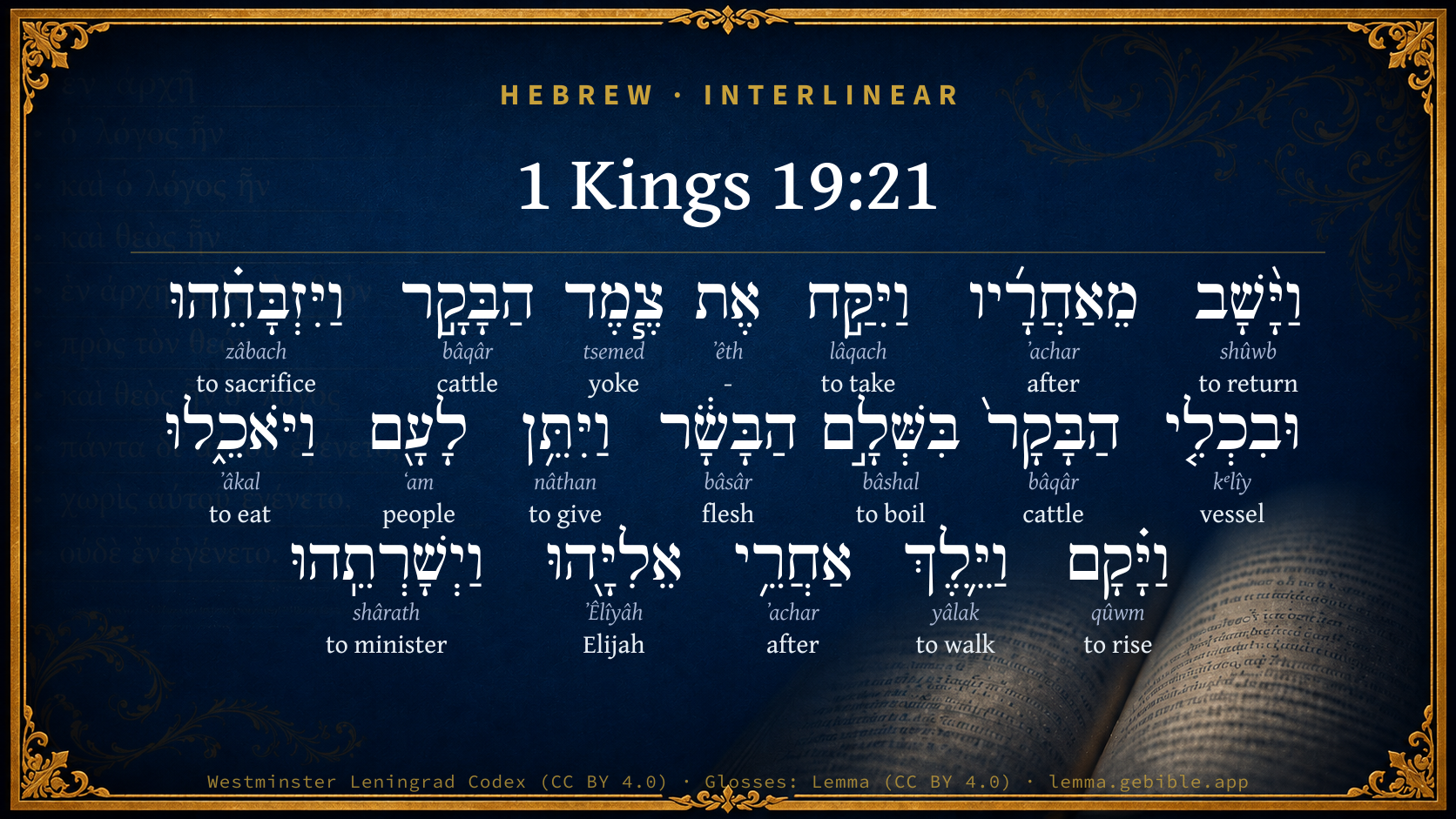
  1. וַיָּ֨שָׁב shûwb H7725 “and · to return” Conjunction + Verb, Qal, Sequential Imperfect, 3rd Person, Masculine, Singular
  2. מֵאַחֲרָ֜יו ʼachar H310 “from · after · him” Preposition + Preposition + Suffix, Personal, 3rd Person, Masculine, Singular
  3. וַיִּקַּ֣ח lâqach H3947 “and · to take” Conjunction + Verb, Qal, Sequential Imperfect, 3rd Person, Masculine, Singular
  4. אֶת ʼêth H853 “-” Particle, Direct Object
  5. הַבָּקָ֣ר bâqâr H1241 “the · cattle” Particle, Definite Article + Noun, Common, Both, Singular, Absolute
  6. וַיִּזְבָּחֵ֗הוּ zâbach H2076 “and · to sacrifice · him” Conjunction + Verb, Qal, Sequential Imperfect, 3rd Person, Masculine, Singular + Suffix, Personal, 3rd Person, Masculine, Singular
  7. וּבִכְלִ֤י kᵉlîy H3627 “and · in/at · vessel of” Conjunction + Preposition + Noun, Common, Masculine, Singular, Construct
  8. הַבָּקָר֙ bâqâr H1241 “the · cattle” Particle, Definite Article + Noun, Common, Both, Singular, Absolute
  9. בִּשְּׁלָ֣ם bâshal H1310 “to boil · them” Verb, Piel, Perfect, 3rd Person, Masculine, Singular + Suffix, Personal, 3rd Person, Masculine, Plural
  10. הַבָּשָׂ֔ר bâsâr H1320 “the · flesh” Particle, Definite Article + Noun, Common, Masculine, Singular, Absolute
  11. וַיִּתֵּ֥ן nâthan H5414 “and · to give” Conjunction + Verb, Qal, Sequential Imperfect, 3rd Person, Masculine, Singular
  12. לָעָ֖ם ʻam H5971 “to/for the · people” Preposition, Determined + Noun, Common, Masculine, Singular, Absolute
  13. וַיֹּאכֵ֑לוּ ʼâkal H398 “and · to eat” Conjunction + Verb, Qal, Sequential Imperfect, 3rd Person, Masculine, Plural
  14. וַיָּ֗קָם qûwm H6965 “and · to rise” Conjunction + Verb, Qal, Sequential Imperfect, 3rd Person, Masculine, Singular
  15. וַיֵּ֛לֶךְ yâlak H3212 “and · to walk” Conjunction + Verb, Qal, Sequential Imperfect, 3rd Person, Masculine, Singular
  16. אַחֲרֵ֥י ʼachar H310 “after” Preposition
  17. אֵלִיָּ֖הוּ ʼÊlîyâh H452 “Elijah” Noun, Proper
  18. וַיְשָׁרְתֵֽהוּ shârath H8334 “and · to minister · him” Conjunction + Verb, Piel, Sequential Imperfect, 3rd Person, Masculine, Singular + Suffix, Personal, 3rd Person, Masculine, Singular

About this verse

These counts appear in no published source. They are computed here, from the morphology-tagged text and Lemma’s own curated glosses. What Lemma adds →

19
words
17
distinct lemmas
Historical
section

Notable vocabulary

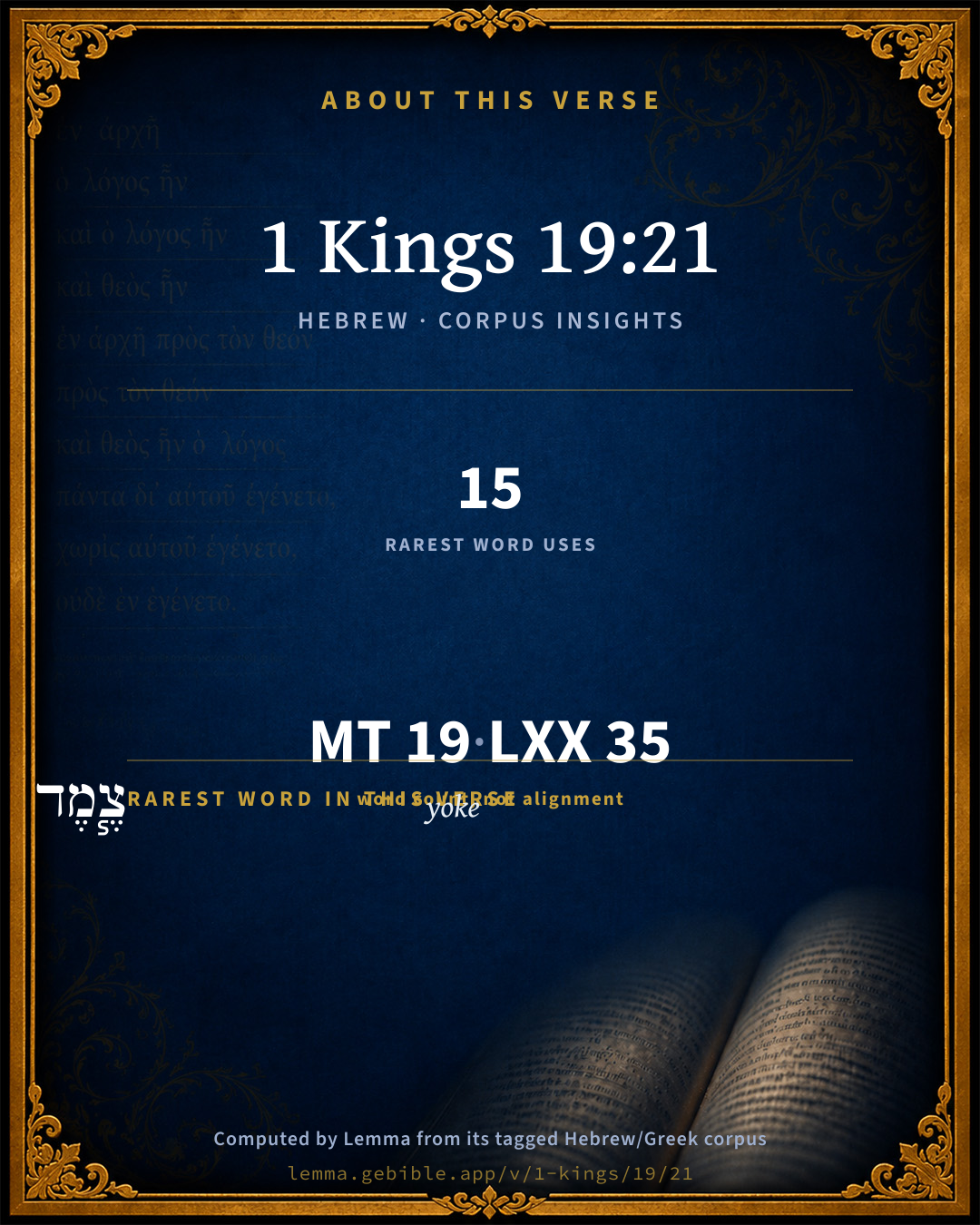
The rarest word here is צֶ֧מֶד yoke H6776 — appearing just 15 times in the whole Hebrew Bible.

Shared distinctive vocabulary

צֶ֧מֶד yoke H6776 occurs in 15 verses of the Hebrew Bible. Also found in:

Grammatical profile

  • 9 verbs
  • 7 nouns
  • 2 prepositions
  • 1 particle

Verb forms

  • וַיָּ֨שָׁב Qal · Sequential Imperfect
  • וַיִּקַּ֣ח Qal · Sequential Imperfect
  • וַיִּזְבָּחֵ֗הוּ Qal · Sequential Imperfect
  • בִּשְּׁלָ֣ם Piel · Perfect
  • וַיִּתֵּ֥ן Qal · Sequential Imperfect
  • וַיֹּאכֵ֑לוּ Qal · Sequential Imperfect
  • וַיָּ֗קָם Qal · Sequential Imperfect
  • וַיֵּ֛לֶךְ Qal · Sequential Imperfect
  • וַיְשָׁרְתֵֽהוּ Piel · Sequential Imperfect

Repetition

Words recur within this verse — often emphatic in Hebrew:

  • מֵאַחֲרָ֜יו after H310 ×2
  • הַבָּקָ֣ר cattle H1241 ×2

Hebrew & Septuagint length

In English translation the verse runs 43 words from the Hebrew and 43 from the Septuagint (LXX English) — the same length.

A rough comparison of the two English renderings, which tokenize alike — not a word-level alignment.

Word counts can differ between the Hebrew and the Greek without any difference in meaning — e.g. the Hebrew direct-object marker אֵת has no separate Greek word, and Greek often adds the article ὁ.

In the original languages it is 19 Hebrew tokens and 35 Greek tokens — but the two are counted differently (Hebrew bundles its prefixes and suffixes into one token; the Greek is in lemma form), so that isn’t a like-for-like length.

Cross-references

10

Topical passages linked to 1 Kings 19:21 in the Treasury of Scripture Knowledge — connected by theme and wording, ordered by reader-vote popularity; previews shown in the World English Bible.

  • 2 Samuel 24:22 Araunah said to David, Let my lord the king take and offer up what seems good to him: behold, the oxen for the burnt offering, and the threshing instruments and the yokes of the oxen for the wood:
  • Exodus 24:13 Moses rose up with Joshua, his servant, and Moses went up onto God's Mountain.
  • Luke 5:28–29 He left everything, and rose up and followed him.
  • 2 Timothy 4:11 Only Luke is with me. Take Mark, and bring him with you, for he is useful to me for ministering.
  • Philemon 1:13 whom I desired to keep with me, that on your behalf he might serve me in my chains for the Gospel.
  • Numbers 27:18–20 Yahweh said to Moses, Take Joshua the son of Nun, a man in whom is the Spirit, and lay your hand on him;
  • 1 Kings 18:43 He said to his servant, Go up now, look toward the sea. He went up, and looked, and said, There is nothing. He said, Go again seven times.
  • 2 Kings 2:3 The sons of the prophets who were at Bethel came forth to Elisha, and said to him, "Do you know that Yahweh will take away your master from your head today?" He said, "Yes, I know it; hold your peace."
  • 2 Kings 3:11 But Jehoshaphat said, Isn't there here a prophet of Yahweh, that we may inquire of Yahweh by him? One of the king of Israel's servants answered, Elisha the son of Shaphat is here, who poured water on the hands of Elijah.
  • Acts 13:5 When they were at Salamis, they proclaimed the word of God in the synagogues of the Jews. They had also John as their attendant.

Cross-references courtesy of OpenBible.info (CC BY 4.0).

Hebrew and Greek witnesses Masoretic Hebrew ↔ Greek Septuagint

The same verse in the two great witnesses to the Old Testament, shown verse-for-verse.

These are two independent witnesses, not word-aligned to each other, and the Septuagint is shown in lemma (dictionary) form.

Hebrew 1 Kings 19:21 Masoretic · Westminster Leningrad Codex

וַיָּ֨שָׁב מֵאַחֲרָ֜יו וַיִּקַּ֣ח אֶת צֶ֧מֶד הַבָּקָ֣ר וַיִּזְבָּחֵ֗הוּ וּבִכְלִ֤י הַבָּקָר֙ בִּשְּׁלָ֣ם הַבָּשָׂ֔ר וַיִּתֵּ֥ן לָעָ֖ם וַיֹּאכֵ֑לוּ וַיָּ֗קָם וַיֵּ֛לֶךְ אַחֲרֵ֥י אֵלִיָּ֖הוּ וַיְשָׁרְתֵֽהוּ

He returned from following him, and took the yoke of oxen, and killed them, and boiled their flesh with the instruments of the oxen, and gave to the people, and they ate. Then he arose, and went after Elijah, and ministered to him.

World English Bible · Public Domain

Greek LXX 1 Kings 19:21 Septuagint · lemma form

καί ἀναστρέφω ἐξόπισθεν αὐτός καί λαμβάνω ὁ ζεῦγος ὁ βοῦς καί θύω καί ἕψω αὐτός ἐν ὁ σκεῦος ὁ βοῦς καί δίδωμι ὁ λαός καί ἐσθίω καί ἀναἵστημι καί πορεύομαι ὀπίσω ηλιου καί λειτουργέω αὐτός

And he returned from following him, and took a yoke of oxen, and killed them, and boiled them with the instruments of the oxen, and gave to the people, and they ate: and he arose, and went after Eliu, and ministered to him.

LXX2012 (modern English Septuagint) · Public Domain

On this verse, The Pulpit Commentary discusses the Septuagint’s reading. Read the note in Commentary ↓

Hebrew: Westminster Leningrad Codex (CC BY 4.0). Greek: Septuagint (public domain); English from LXX2012 (modern English Septuagint) (Public Domain). How the Septuagint differs from the Hebrew →

Targum (Aramaic paraphrase)

1

The Targum is the ancient Jewish Aramaic paraphrase of the Hebrew Scriptures — an interpretive translation, not the Hebrew text itself. Onkelos (literal) and Pseudo-Jonathan (expansive) render the Torah, and Jonathan the Prophets. Coverage is partial: where no permissively-licensed English translation exists for a verse, only the Aramaic is shown. This is verse-level text, not a word-by-word alignment to the Hebrew.

  1. Targum Jonathan Prophets (Joshua–Malachi)
    וְתַב מִבַּתְרוֹהִי וּנְסִיב יַת פַּדַן תּוֹרַיָא וְהַדְמֵיהּ וּבְמָנֵי תוֹרַיָא בַּשֵׁיל לְהוֹן בִּסְרָא וִיהַב לְעַמָא וַאֲכָלוּ וְקָם וַאֲזַל בָּתַר אֵלִיָהוּ וְשַׁמְשֵׁיהּ:

    (no public-domain English translation for this verse)

    Targum Jonathan — Aramaic: “Mikraot Gedolot” (public domain). English: “Sefaria Community Translation” (CC0 1.0 (public-domain dedication)); “London "Chaldee Paraphrase," 1871” (public domain). Text via Sefaria.

Commentary

Notes on 1 Kings 19:21 from classic Christian and Jewish commentators (each source and its license shown beneath its notes). The classic Christian expositions comment on the surrounding passage and are grouped to its opening verse, so a note may address several verses; the Jewish commentaries on the Tanakh (Rashi and others) are per-verse, so they appear only where the commentator wrote on this verse.

Lemma curates 59 commentaries, every one of them public domain or Creative Commons licensed, each selected and text-cleaned for this edition rather than reprinted as found. About our sources →

Trapp's Complete Commentary

John Trapp

1Ki 19:21 And he returned back from him, and took a yoke of oxen, and slew them, and boiled their flesh with the instruments of the oxen, and gave unto the people, and they did eat. Then he arose, and went after Elijah, and ministered unto him.

Ver. 21. And took a yoke of oxen.] The same likely wherewith he ploughed, to show that he was now of another vocation.

And gave unto the people.] Making them a farewell feast, as also to express his joy. St Matthew did the like when first called to the apostleship.

John Trapp, A Commentary or Exposition upon All the Books of the Old and New Testament (1647–1656) — public domain. Text from a community e-Sword module.

Joseph Benson's Commentary

1Ki 19:21. From him — From Elijah to his parents; whom when he had seen and kissed, he returned to Elijah. The instruments — That is, with the wood belonging to the plough, &c., to which more was added, as occasion required: but that he burned, to show his total relinquishing of his former employment. And gave unto the people — That is, he made thereof a feast for his servants who had been ploughing with him, and for him, and his other friends and neighbours who came to take their leave of him. Hereby he showed how willingly and joyfully he forsook all his friends, that he might serve God in that high and honourable employment. It is of great advantage to young ministers to spend some time under the direction of those that are aged and experienced; and not to think much, if occasion be, to minister unto them. Those who would be fit to teach, must have time to learn: those should first serve, who may hereafter rule.

Joseph Benson's Commentary on the Old and New Testaments (1811–1818) — public domain. Text from a community e-Sword module.

Tyndale Open Study Notes

Tyndale Open Resources

19:21 Elisha burned his plow and slaughtered his oxen to signal a complete break from the past in his present calling. From now on, he would serve the Lord. His meal with family and friends may have been a thanksgiving sacrifice to God capped by a communal meal in joyful celebration of God’s claim upon Elisha’s life. • Elisha would first serve as Elijah’s assistant. Great leaders often begin as good learners. Joshua was Moses’ assistant (Exod 24:13) before becoming his successor (Num 27:18-23; Deut 34:9) and assuming command of the forces of Israel (Josh 1:1-9). Later, Elisha had an assistant named Gehazi (2 Kgs 4:12).

Tyndale Open Study Notes — © Tyndale Open Resources, licensed CC BY-SA 4.0. Text via the HelloAO Bible API.

Geneva Bible (1599)

Geneva Bible translators

He would not stay till wood was brought, so great was his desire to follow his vocation.

Geneva Bible (1599) marginal notes — public domain. Text via Bolls.life.

Jamieson, Fausset & Brown

Robert Jamieson, A. R. Fausset & David Brown

took a yoke of oxen--Having hastily prepared (Sa2 24:22) a farewell entertainment to his family and friends, he left his native place and attached himself to Elijah as his minister.

Next: 1 Kings Chapter 20

Jamieson, Fausset & Brown — Commentary Critical and Explanatory on the Whole Bible (1871) — public domain (CC PDM 1.0). Text via the HelloAO Bible API.

Adam Clarke's Commentary

Verse 21. He returned back] He went home to his house; probably he yet lived with his parents, for it appears he was a single man: and he slew a yoke of the oxen - he made a feast for his household, having boiled the flesh of the oxen with his agricultural implements, probably in token that he had abandoned secular life: then, having bidden them an affectionate farewell, he arose, went after Elijah, who probably still awaited his coming in the field or its vicinity, and ministered unto him.

ON the call of Elisha, I may make a few remarks.

1. Elijah is commanded, 1Kg 19:16, to anoint Elisha prophet in his room. Though it is generally believed that kings, priests, and prophets, were inaugurated into their respective offices by the right of unction, and this I have elsewhere supposed; yet this is the only instance on record where a prophet is commanded to be anointed; and even this case is problematical, for it does not appear that Elijah did anoint Elisha. Nothing is mentioned in his call to the prophetic office, but the casting the mantle of Elijah upon him; wherefore it is probable that the word anoint, here signifies no more than the call to the office, accompanied by the simple rite of having the prophet's mantle thrown over his shoulders.

2. A call to the ministerial office, though it completely sever from all secular occupations, yet never supersedes the duties of filial affection. Though Elisha must leave his oxen, and become a prophet to Israel: yet he may first go home, eat and drink with his parents and relatives, and bid them an affectionate farewell.

3. We do not find any attempt on the part of his parents to hinder him from obeying the Divine call: they had too much respect for the authority of God, and they left their son to the dictates of his conscience. Wo to those parents who strive, for filthy lucre's sake, to prevent their sons from embracing a call to preach Jesus to their perishing countrymen, or to the heathen, because they see that the life of a true evangelist is a life of comparative poverty, and they had rather he should gain money than save souls.

4. The cloak, we have already observed, was the prophet's peculiar habit; it was probably in imitation of this that the Greek philosophers wore a sort of mantle, that distinguished them from the common people; and by which they were at once as easily known as certain academical characters are by their gowns and square caps. The pallium was as common among the Greeks as the toga was among the Romans. Each of these was so peculiar to those nations, that Palliatus is used to signify a Greek, as Togatus is to signify a Roman.

5. Was it from this act of Elijah, conveying the prophetic office and its authority to Elisha by throwing his mantle upon him, that the popes of Rome borrowed the ceremony of collating an archbishop to the spiritualities and temporalities of his see, and investing him with plenary sacerdotal authority, by sending him what is well known in ecclesiastical history by the name pallium, pall, or cloak? I think this is likely; for as we learn from Zec 13:4, and 2Kg 1:8, that this mantle was a rough or hairy garment, so we learn from Durandus that the pallium or pall was made of white wool, after the following manner: -

The nuns of St. Agnes, annually on the festival of their patroness, offer two white lambs on the altar of their church, during the time they sing Agnus Dei, in a solemn mass; which lambs are afterwards taken by two of the canons of the Lateran church, and by them given to the pope's sub-deacons, who send them to pasture till shearing time; and then they are shorn, and the pall is made of their wool, mixed with other white wool. The pall is then carried to the Lateran church, and there placed on the high altar by the deacons, on the bodies of St. Peter and St. Paul; and, after a usual watching or vigil, it is carried away in the night, and delivered to the sub-deacons, who lay it up safely. Now, because it was taken from the body of St. Peter, it signifies the plenitude of ecclesiastical power: and, therefore, the popes assume it as their prerogative, being the professed successors of this apostle, to invest other prelates with it. This was at first confined to Rome, but afterwards it was sent to popish prelates in different parts of the world.

6. It seems, from the place in Zechariah, quoted above, that this rough cloak or garment became the covering of hypocrites and deceivers; and that persons assumed the prophetic dress without the prophetic call, and God threatens to unmask them. We know that this became general in the popish Church in the beginning of the 16th century; and God stripped those false prophets of their false and wicked pretensions, and exposed them to the people. Many of them profited by this exposure, and became reformed; and the whole community became at least more cautious. The Romish Church should be thankful to the Reformation for the moral purity which is now found in it; for, had not its vices, and usurpations, and super-scandalous sales of indulgences, been thus checked, the whole fabric had by this time been probably dissolved. Should it carry its reformation still farther, it would have a more legitimate pretension to the title of apostolic. Let them compare their ritual with the Bible and common sense, and they will find cause to lop many cumbrous and rotten branches from a good tree.

Adam Clarke's Commentary on the Bible (1810–1826) — public domain. Text from a community e-Sword/MySword module.

Ellicott's Commentary for English Readers

(21) And he returned.—Like Matthew in Luk_9:27-29, Elisha, probably after sacrifice, makes a feast of farewell to his home, and of homage to his new master. The hasty preparation is made by the use of the wooden implements for fuel, as in the sacrifice at the threshing-floor of Araunah (2Sa_24:22). Henceforth from a master he became a servant, ministering to Elijah, and willing to be known, even when he became himself the prophet of God, as “he that poured water on the hands of Elijah” (2Ki_3:11).

A Bible Commentary for English Readers, edited by Charles John Ellicott (1878–1897) — public domain. Text from a community e-Sword module.

The Cambridge Bible for Schools and Colleges

gen. ed. J. J. S. Perowne

21. And he returned back from [R.V. from following] him] Elisha clearly understood the permission which was given to him. He is allowed a short space for leave-taking, but the call is imperative, and he is to follow with all speed. Elijah goes his way, but leaves Elisha in no doubt whither he is going, and where he may be found.

and took a [R.V. the] yoke of oxen] The language in the original is definite, and no doubt refers to the particular pair of oxen which Elisha had himself been using.

and boiled their flesh] Thus he made a farewell feast to those with whom he had been working. Having a true conception of the great duty to which he was called, he would have them rejoice, and not sorrow, at his departure.

and gave unto the people] i.e. The plowmen, and other helpers in the work which they had been doing. There is nothing to guide us in deciding whether the feast was made at the place where the call was received, or whether it was a meal given in the home to which Elisha went to bid adieu to his parents. It seems however more natural to understand it of the latter. At such a parting meal the parents of him who was going away were hardly likely to be absent.

Because the word rendered ‘slew’ in this verse, is very frequently translated ‘sacrificed’ some have thought that the ceremony here described was a religious one. But there is no mention of an altar, which would have been necessary, nor of the devotion of any part of the slain beasts as an offering. The guests were invited to a family feast, after the patriarchal fashion, and joined in the festivities attendant on such an occasion. The parents of Elisha were perhaps likeminded with himself and felt the grandeur of the office to which he was called. In that case the feeling of joyous thankfulness would be the most prevalent.

went after Elijah, and ministered unto him] Josephus adds to the narrative, that ‘Elisha immediately began to prophesy.’ In the Scripture story he is not mentioned again till the departure of Elijah into heaven is close at hand (2Ki_2:1). But we cannot doubt that he was the companion of Elijah from that day forward, and we are shewn something of the nature of the attendance and ministration here alluded to in 2Ki_3:11, where we read of Elisha as he ‘which poured water on the hands of Elijah.’ The members of the prophetic school seem to have lived after the fashion of ‘Brethren of the common life,’ and the less prominent members did service of every kind for those who were at the head.

The Cambridge Bible for Schools and Colleges (gen. ed. J. J. S. Perowne; Cambridge University Press, 1878–1918) — public domain. Text from a community e-Sword module.

John Gill's Exposition

And he returned back from him,.... To his father's house, and took his leave, and then came back into the field, perhaps with others accompanying him:

and took a yoke of oxen and slew them, and boiled their flesh with the instruments of the oxen: their yokes, and the plough, with an addition of other things sufficient to boil them:

and gave unto the people, and they did eat; the ploughmen and others that came together on this occasion; he made a feast for them, to express his joy at being called to such service he was:

then he arose and went after Elijah; left his worldly employment, the riches he was heir to, his parents, and his friends, and followed the prophet:

and ministered unto him; became his servant, whereby he attained to great knowledge and understanding of divine things, and was trained up to the prophetic office, which he was invested with upon the removal of Elijah; see Mat 8:21.

Next: 1 Kings Chapter 20

John Gill's Exposition of the Whole Bible (1746–1763) — public domain (CC PDM 1.0). Text via the HelloAO Bible API.

Albert Barnes' Notes on the Bible

Elisha returns to his oxen and laborers. He indicates his relinquishment of his home and calling by the slaughter of the particular yoke of oxen with which he had himself been plowing, probably the best beasts of the twelve, and by burning the “instruments,” the p oughs and yokes, both made of wood. Next he feasts his people to show his gratitude for his call, Elijah apparently remaining the while; and then, leaving father and mother, cattle and land, good position and comfortable home, Elisha became the “minister” to the wanderer. Compare Exo 24:13; Jos 1:1.

Albert Barnes' Notes on the Bible (1834–1885) — public domain. Text from a community e-Sword/MySword module.

Haydock's Catholic Bible Commentary

Oxen, to shew that he had relinquished his profession. (Menochius) --- "He makes a vow of them." (St. Jerome, ep. xxviii.) --- Elias waited for him in the field, while he made a feast for his fellow-citizens, at parting. (Calmet) --- Then both probably retreated to Carmel, (Salien) to watch over the instruction of the college of prophets. (Haydock)

George Leo Haydock (1774–1849), Haydock's Catholic Family Bible and Commentary, 1859 edition — public domain. Excludes Psalms (Douay-Rheims chapter numbering differs from Protestant) and Deuterocanonical books (Catholic canon only).

Matthew Poole's English Annotations

He returned back from him; from Elijah to his parents, whom when he had seen and kissed, he returned to the field where Elijah was.

With the instruments of the oxen, i.e. with the wood belonging to the plough, &c., to which more was added, as occasion required; but that he burned, to show his total relinquishing of his former employment.

Gave unto the people, i.e. he made thereof a feast for his servants who had been ploughing with him, and for him, and his other friends and neighbours who came to take their leave of him. Hereby he showed how willingly and joyfully he forsook all his friends, that he might serve God in that high and honourable employment.

Matthew Poole's English Annotations on the Holy Bible (1683–1685) — public domain. Text from a community e-Sword/MySword module.

Whedon's Commentary on the Bible

Daniel D. Whedon

21. He returned back from him — But not, so far as we can learn, to kiss his father and mother. He went back to the spot where he had left his oxen, and made there a feast.

Took a yoke of oxen — Rather, the yoke of oxen; that is, the yoke with which he had been ploughing, and which was probably all that belonged to him.

The instruments of the oxen — The yoke and the plough used with the oxen. With these instruments he made the fire to cook the flesh. Compare the like use of instruments on Araunah’s threshingfloor, 2Sa_24:22.

Gave unto the people — What people? Doubtless his fellow-workmen in that field, and all in the same vicinity that could be readily summoned. Whether this field was near Elisha’s home, or whether his parents were present at this feast, does not appear. But this act of Elisha was a public declaration to the people that he now left his secular employment to become a prophet of Jehovah.

Went after Elijah — Who had gone slowly onward, or perhaps had lingered waiting for him in the distance.

Ministered unto him — Became his constant attendant and servant in place of the young man whom he had dismissed when he fled into the wilderness of Horeb. 1Ki_19:3. He was afterward known and spoken of as “Elisha, the son of Shaphat, which poured water on the hands of Elijah.” 2Ki_3:11.

Daniel D. Whedon (gen. ed.), Commentary on the Old and New Testaments (1874–1909) — public domain. Text from a community e-Sword module.

The Pulpit Commentary

And he returned back from him Wordsworth is not warranted in affirming that Elisha "did not go back and kiss," etc. The text rather implies that he did, and took a yoke Heb. the yoke; Cf. ver. 19 of oxen, and slew them Heb. sacrificed; LXX equse. But the word, though generally restricted to sacrificial acts, primarily means, to slay" simply, as here, and in Gen_31:54; 1Sa_28:24; 2Ch_18:2; Eze_39:17. There was no altar there, and the flesh of a sacrifice was never boiled and boiled their flesh Heb. boiled them, the flesh with the Instruments of the oxen the plough, yoke, etc. The plough of the East is extremely rude and slender, but the yoke, shaft, etc., would afford a fair supply of wood. The scarcity of timber may have had something to do with this application of the "instruments of the oxen;" but it is much more important to see it in a symbolical act, expressive of Elisha"s entire renunciation of his secular calling. He would henceforth need them no longer. (Cf. 1Sa_6:14; 2Sa_24:22) and gave unto the people Not only the servants or peasants who had been ploughing with him, but possibly his neighbours and friends. This was a farewell, not a religious feast. Cf., Luk_5:29, where Levi makes a "great feast" on the occasion of his call and they did eat. Then he arose, and went after Elijah, and ministered unto him i.e. , became his attendant, as Joshua had been the minister of Moses (Exo_24:13; Jos_1:1) and as Gehazi subsequently became servant to him. See 2Ki_3:11: "Elisha which poured water on the hands of Elijah;" and cf. Act_13:5

Took a yoke of oxen and slew them." He has done with earthly pursuits. He burns his ships behind him. It would be well for the Church of Christ if her ministers acted in like manner. The temptation to eke out a scanty income by trade, especially among missionaries, must be great; but a man cannot be half a clergyman, and must not be entangled with the affairs of this life. Some of the Swiss pastors have become hotel keepers, but if they have been the gainers, religion has not. Of all masters, religion and business are the two which can least be served together.

The Pulpit Commentary (1880–1919), ed. H.D.M. Spence-Jones & Joseph S. Exell — public domain. Text from a community e-Sword module.

John Wesley's Explanatory Notes

From him - From Elijah to his parents; whom when he had seen and kissed, he returned to Elijah. The instruments - That is, with the wood belonging to the plow, &c. to which more was added, as occasion required. But that he burned, to shew his total relinquishing of his former employment. And gave - That is, he made thereof a feast for his servants who had been ploughing with him, and for him, and his other friends and neighbours who came to take their leave of him. Hereby he shewed how willingly and joyfully he forsook all his friends, that he might serve God in that high and honourable employment. It is of great advantage to young ministers, to spend some time under the direction of those that are aged and experienced; and not to think much, if occasion be, to minister unto them. Those who would be fit to teach, must have time to learn; those should first serve, who may hereafter rule.

John Wesley, Explanatory Notes Upon the Whole Bible (1754–1765) — public domain. Text via the GEBible commentary corpus.

unfoldingWord translationNotes

Door43 World Missions Community

he gave it to the people

Elisha gave the cooked meat to the people of his city. (See: Assumed Knowledge and Implicit Information)

translationWords

Elisha

servant

unfoldingWord translationNotes — © Distant Shores Media and the Door43 World Missions Community, licensed CC BY-SA 4.0. Source: git.door43.org/Door43/en_tn.

Rashi

Rabbi Shlomo Yitzchaki (Rashi)

He cooked the meat for them. He cooked for them the meat, so do Dunash and Menachem explain, and so did [Targum] Yonoson render [בשלם] as two words [בשיל להון]. But I say, that it is unnecessary to divide it into two words, and what is the meaning of “בשלם הבשר”? He cooked the two oxen, their flesh, for צמד is a minimum of two.

And he gave it the people. He made a feast out of great joy.

Rashi on the Tanakh — English translations: “The Judaica Press complete Tanach with Rashi, translated by A. J. Rosenberg” (CC BY 4.0); “Pentateuch with Rashi's commentary by M. Rosenbaum and A.M. Silbermann, 1929-1934” (public domain); “The Metsudah Tanach series, Lakewood, N.J” (CC BY 4.0); and “The Book of Joshua, Metsudah Publications, 1997” (CC BY 4.0). Text via Sefaria.

Lesson kit

Teaching starters — assembled from the data on this page, not authored interpretation. Every prompt links to the verse data it draws on. Edit before teaching.

1 Kings, in the Historical, opens this verse with 19 words (17 distinct Hebrew lemmas). Its most distinctive word is tsemed (“yoke”). A historical commentator’s framing appears above. Read the whole chapter for the surrounding context.

Discussion questions

  1. How does “yoke” (tsemed) shape what this verse is saying?
  2. Judges 19:3 shares the word «yoke» with this verse. How do the two illuminate each other?
  3. “after” occurs 2× in this one verse. What is the effect of the repetition?
  4. These translations render this verse differently; the difference is in the English rendering, not the original. What questions does that raise?
  5. The verb «וַיָּ֨שָׁב» is Qal Sequential Imperfect. How does its form color the action?
  6. Reading how Trapp's Complete Commentary and Joseph Benson's Commentary read this verse, where do the two commentators agree and where do they part?

Things to notice

Reading settings

Reading text

Shown beneath each verse's original-language words.

Old Testament
Old Testament edition

Read the OT as the Masoretic Hebrew (MT) or the Greek Septuagint (LXX).

English shown for the Greek Septuagint (in the Hebrew ↔ Greek comparison).

Comparing translations? Open the Compare panel on any verse page to stack up to four side by side.