
2 Chronicles 4:16

Hebrew (Westminster Leningrad Codex) 2 Chronicles 4:16 appears in the Hebrew Old Testament. The text above is from the Westminster Leningrad Codex. Each word links to its Strong’s number, a concise gloss, and parsing drawn from the Open Scriptures Hebrew Bible morphology. Click any word for its full Brown-Driver-Briggs (BDB) entry.
Download image
Cite this verse

2 Chronicles 4:16 (World English Bible). Public Domain. Lemma interlinear Bible study tool, https://lemma.gebible.app/v/2-chronicles/4/16.

Show BibTeX & RIS
BibTeX
RIS
English Translation
The pots also, and the shovels, and the flesh-hooks, and all the vessels of it, did Huram his father make for king Solomon for the house of Yahweh of bright brass.
World English Bible · Public Domain
Download a study sheet

One document with this verse’s original text, its word-by-word gloss line, the meaning frame, cross-references with their text, attributed commentary, and full source and license credits — printable, and it pastes into notes with its structure intact.

This verse Autodidact and up

Study sheet (.html) Plain text (.txt)

A passage Seminary Student

Up to 50 verses in one chapter. A passage sheet keeps up to 6 commentary sources and 12 cross-references per verse, in the order this page ranks them, and says so on the sheet whenever that leaves anything out. Ask for a single verse and you get the Autodidact verse sheet above.

Everything on this page stays free to read, with no account — the sheet is a download of what is already on screen, not access to it.

Want to remove ads? Support Godless Engineer
Compare translations 3

The same verse in 3 English versions, stacked beneath the original-language interlinear above. Click any original word for its lexicon entry.

Each is an independent rendering of the whole verse — the interlinear is not word-aligned to these translations.

Highlighted words mark where these versions differ — a whole-verse word diff, not a word-by-word alignment.

  • World English Bible Public Domain
    The pots also, and the shovels, and the flesh-hooks, and all the vessels of it, did Huram his father make for king Solomon for the house of Yahweh of bright brass.
  • King James Version Public Domain
    The pots also, and the shovels, and the fleshhooks, and all their instruments, did Huram his father make to king Solomon for the house of the LORD of bright brass.
  • unfoldingWord Literal Text CC BY-SA 4.0
    And the tubs, and the shovels, and the forks, and all items Huram-Abi made for King Solomon for the house of Yahweh of polished bronze.

unfoldingWord Literal Text — © unfoldingWord, licensed CC BY-SA 4.0. Word-aligned USFM3 via Door43 (git.door43.org/unfoldingWord/en_ult).

Versions to compare (up to 4)

3 of 4 selected

Show all 18 translations

Every available English version of this verse, each an independent rendering of the whole verse.

  • World English Bible Public Domain
    The pots also, and the shovels, and the flesh-hooks, and all the vessels of it, did Huram his father make for king Solomon for the house of Yahweh of bright brass.
  • Berean Standard Bible Public Domain
    and the pots, shovels, meat forks, and all the other articles. All these objects that Huram-abi made for King Solomon for the house of the LORD were of polished bronze.
  • Majority Standard Bible Public Domain
    and the pots, shovels, meat forks, and all the other articles. All these objects that Huram-abi made for King Solomon for the house of the LORD were of polished bronze.
  • King James Version Public Domain
    The pots also, and the shovels, and the fleshhooks, and all their instruments, did Huram his father make to king Solomon for the house of the LORD of bright brass.
  • American Standard Version (1901) Public Domain
    The pots also, and the shovels, and the flesh-hooks, and all the vessels thereof, did Huram his father make for king Solomon for the house of Jehovah of bright brass.
  • Revised Version (1885) Public Domain
    The pots also, and the shovels, and the fleshhooks, and all the vessels thereof, did Huram his father make for king Solomon for the house of the LORD of bright brass.
  • Geneva Bible (1599) Public Domain
    Pottes also and besomes, and fleshhookes, and all these vessels made Huram his father, to King Salomon for the house of the Lord, of shining brasse.
  • Douay-Rheims (1899) Public Domain
    One sea, and twelve oxen under the sea;
  • Young's Literal Translation Public Domain
    and the pots, and the shovels, and the forks, and all their vessels, hath Huram his father made for king Solomon, for the house of Jehovah, of brass purified.
  • Literal Standard Version CC BY-SA 4.0
    and the pots, and the shovels, and the forks, and all their vessels, his father Huram has made for King Solomon, for the house of YHWH, of bronze purified.
  • Unlocked Literal Bible CC BY-SA 4.0
    also the pots, shovels, meat forks, and all the other implements that Huram-Abi made of polished bronze for King Solomon, for the house of Yahweh.
  • unfoldingWord Literal Text CC BY-SA 4.0
    And the tubs, and the shovels, and the forks, and all items Huram-Abi made for King Solomon for the house of Yahweh of polished bronze.
  • Darby Bible Public Domain
    And the pots, and the shovels, and the forks, and all their instruments did Huram Abiv make king Solomon for the house of Jehovah, of bright brass.
  • World Messianic Bible Public Domain
    Huram-abi also made the pots, the shovels, the forks, and all its vessels for King Solomon, for the LORD’s house, of bright bronze.
  • Webster's Bible Public Domain
    The pots also, and the shovels, and the flesh-hooks, and all their instruments, did Huram his father make to king Solomon for the house of the LORD of bright brass.
  • Free Bible Version CC BY-SA 4.0
    All the metalwork Hiram made for King Solomon for the house of the Lord was of polished bronze.
  • Bible in Basic English Public Domain
    All the pots and the spades and the meat-hooks and their vessels, which Huram, who was as his father, made for King Solomon for the house of the Lord, were of polished brass.
  • JPS Tanakh (1917) Public Domain
    The pots also, and the shovels, and the flesh-hooks, and all the vessels thereof, did Huram his master craftsman make for king Solomon for the house of the LORD of bright brass.

Literal Standard Version (2020), Covenant Press — licensed CC BY-SA 4.0. Text via the HelloAO Bible API (eBible.org). Unlocked Literal Bible (unfoldingWord) — licensed CC BY-SA 4.0. Text via the HelloAO Bible API (eBible.org). unfoldingWord Literal Text — © unfoldingWord, licensed CC BY-SA 4.0. Word-aligned USFM3 via Door43 (git.door43.org/unfoldingWord/en_ult). Free Bible Version, Dr. Jonathan Gallagher — licensed CC BY-SA 4.0. Text via the HelloAO Bible API (eBible.org).

Word by word

More ways to search: Search by grammar → Find every occurrence → Compare this word →

Practice this passage: Drill this verse → Learn its vocabulary →

מָרֽוּק
mâraq
H4838
“scoured”
Verb, Qal, Participle Passive, Masculine, Singular, Absolute
Part of Speech
Verb
Stem
Qal
Form
Participle Passive
Gender
Masculine
Number
Singular
State
Absolute
Full BDB Definition

Origin: a primitive root

TWOT: 1246

to scour, polish - (Qal) to scour, polish - (Pual) to be scoured
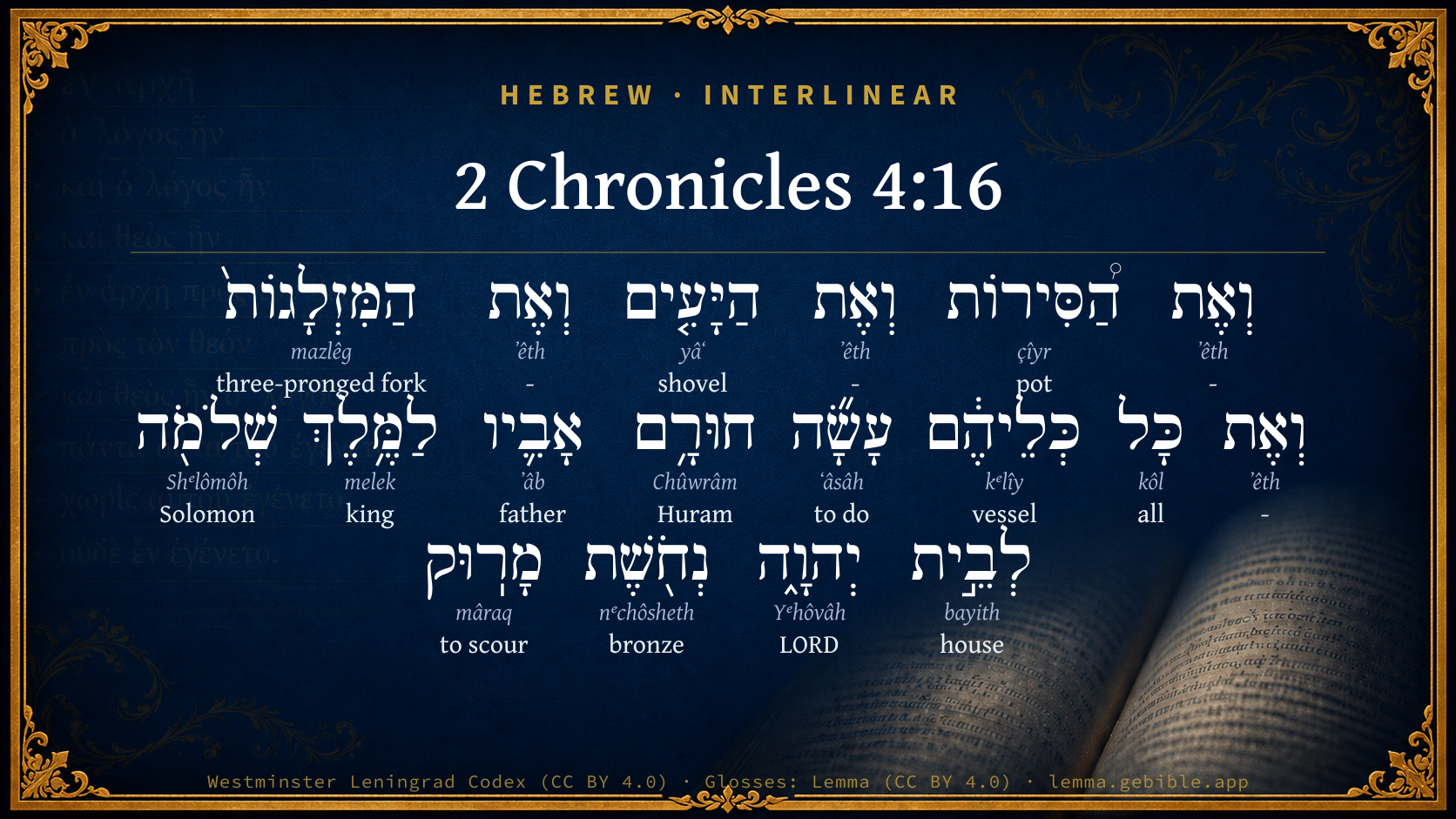
  1. וְאֶת ʼêth H853 “and · -” Conjunction + Particle, Direct Object
  2. הַ֠סִּירוֹת çîyr H5518 “the · pots” Particle, Definite Article + Noun, Common, Both, Plural, Absolute
  3. וְאֶת ʼêth H853 “and · -” Conjunction + Particle, Direct Object
  4. הַיָּעִ֤ים yâʻ H3257 “the · shovels” Particle, Definite Article + Noun, Common, Masculine, Plural, Absolute
  5. וְאֶת ʼêth H853 “and · -” Conjunction + Particle, Direct Object
  6. הַמִּזְלָגוֹת֙ mazlêg H4207 “the · three-pronged forks” Particle, Definite Article + Noun, Common, Feminine, Plural, Absolute
  7. וְאֶת ʼêth H853 “and · -” Conjunction + Particle, Direct Object
  8. כָּל kôl H3605 “all of” Noun, Common, Masculine, Singular, Construct
  9. כְּלֵיהֶ֔ם kᵉlîy H3627 “vessels · their” Noun, Common, Masculine, Plural, Construct + Suffix, Personal, 3rd Person, Masculine, Plural
  10. עָשָׂ֞ה ʻâsâh H6213 “to do” Verb, Qal, Perfect, 3rd Person, Masculine, Singular
  11. חוּרָ֥ם Chûwrâm H2361 “Huram” Noun, Proper
  12. אָבִ֛יו ʼâb H1 “father” Noun, Proper
  13. לַמֶּ֥לֶךְ melek H4428 “to/for the · king” Preposition, Determined + Noun, Common, Masculine, Singular, Absolute
  14. שְׁלֹמֹ֖ה Shᵉlômôh H8010 “Solomon” Noun, Proper
  15. לְבֵ֣ית bayith H1004 “to/for · house of” Preposition + Noun, Common, Masculine, Singular, Construct
  16. יְהוָ֑ה Yᵉhôvâh H3068 “LORD” Noun, Proper
  17. נְחֹ֖שֶׁת nᵉchôsheth H5178 “bronze” Noun, Common, Feminine, Singular, Absolute

About this verse

These counts appear in no published source. They are computed here, from the morphology-tagged text and Lemma’s own curated glosses. What Lemma adds →

18
words
15
distinct lemmas
Historical
section

Notable vocabulary

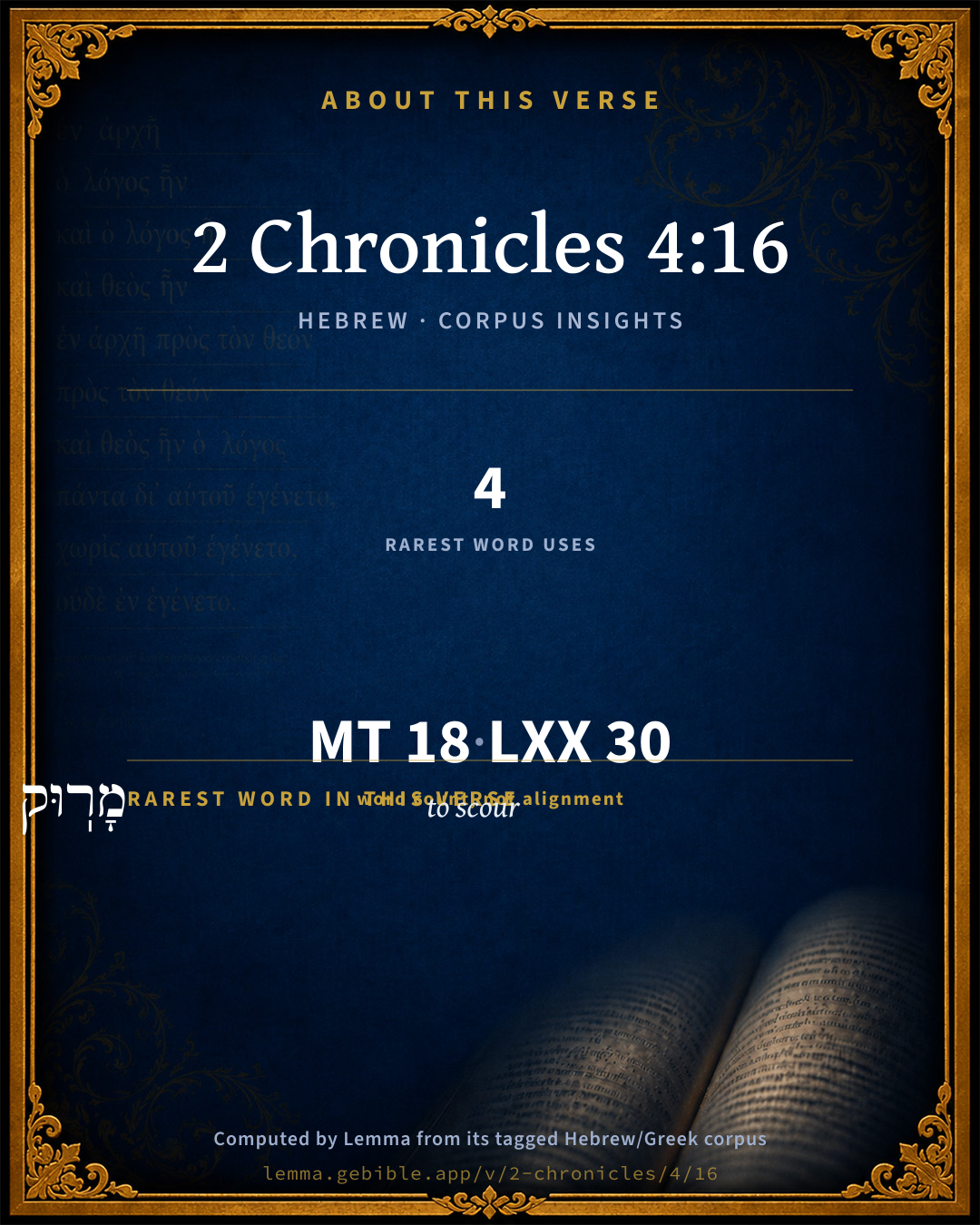
The rarest word here is מָרֽוּק to scour H4838 — appearing just 4 times in the whole Hebrew Bible.

Shared distinctive vocabulary

מָרֽוּק to scour H4838 occurs in 4 verses of the Hebrew Bible. Also found in:

Grammatical profile

  • 2 verbs
  • 12 nouns
  • 4 particles

Verb forms

  • עָשָׂ֞ה Qal · Perfect
  • מָרֽוּק Qal · Participle Passive

Hebrew & Septuagint length

In English translation the verse runs 31 words from the Hebrew and 34 from the Septuagint (LXX English) — closely comparable.

A rough comparison of the two English renderings, which tokenize alike — not a word-level alignment.

Word counts can differ between the Hebrew and the Greek without any difference in meaning — e.g. the Hebrew direct-object marker אֵת has no separate Greek word, and Greek often adds the article ὁ.

In the original languages it is 18 Hebrew tokens and 30 Greek tokens — but the two are counted differently (Hebrew bundles its prefixes and suffixes into one token; the Greek is in lemma form), so that isn’t a like-for-like length.

Cross-references

9

Topical passages linked to 2 Chronicles 4:16 in the Treasury of Scripture Knowledge — connected by theme and wording, ordered by reader-vote popularity; previews shown in the World English Bible.

  • 2 Chronicles 2:13 Now I have sent a skillful man, endowed with understanding, of Huram my father's,
  • 1 Kings 7:13–14 King Solomon sent and fetched Hiram out of Tyre.
  • 1 Chronicles 28:17 and the flesh-hooks, and the basins, and the cups, of pure gold; and for the golden bowls by weight for every bowl; and for the silver bowls by weight for every bowl;
  • 2 Chronicles 4:11 Huram made the pots, and the shovels, and the basins. So Huram made an end of doing the work that he did for king Solomon in the house of God:
  • Exodus 27:3 You shall make its pots to take away its ashes, its shovels, its basins, its flesh hooks, and its fire pans: all its vessels you shall make of brass.
  • Exodus 38:3 He made all the vessels of the altar, the pots, the shovels, the basins, the flesh-hooks, and the fire pans. He made all its vessels of brass.
  • 1 Samuel 2:13–14 The custom of the priests with the people was that when any man offered sacrifice, the priest's servant came, while the flesh was boiling, with a flesh-hook of three teeth in his hand;
  • 1 Kings 7:45 and the pots, and the shovels, and the basins: even all these vessels, which Hiram made for king Solomon, in the house of Yahweh, were of burnished brass.
  • Zechariah 14:20–21 In that day there will be on the bells of the horses, "HOLY TO YAHWEH;" and the pots in Yahweh's house will be like the bowls before the altar.

Cross-references courtesy of OpenBible.info (CC BY 4.0).

Hebrew and Greek witnesses Masoretic Hebrew ↔ Greek Septuagint

The same verse in the two great witnesses to the Old Testament, shown verse-for-verse.

These are two independent witnesses, not word-aligned to each other, and the Septuagint is shown in lemma (dictionary) form.

Hebrew 2 Chronicles 4:16 Masoretic · Westminster Leningrad Codex

וְאֶת הַ֠סִּירוֹת וְאֶת הַיָּעִ֤ים וְאֶת הַמִּזְלָגוֹת֙ וְאֶת כָּל כְּלֵיהֶ֔ם עָשָׂ֞ה חוּרָ֥ם אָבִ֛יו לַמֶּ֥לֶךְ שְׁלֹמֹ֖ה לְבֵ֣ית יְהוָ֑ה נְחֹ֖שֶׁת מָרֽוּק

The pots also, and the shovels, and the flesh-hooks, and all the vessels of it, did Huram his father make for king Solomon for the house of Yahweh of bright brass.

World English Bible · Public Domain

Greek LXX 2 Chronicles 4:16 Septuagint · lemma form

καί ὁ ποδιστήρ καί ὁ ἀναλημπτήρ καί ὁ λέβης καί ὁ κρεάγρα καί πᾶς ὁ σκεῦος αὐτός ὅς ποιέω χιραμ καί ἀναφέρω ὁ βασιλεύς σαλωμών ἐν οἶκος κύριος χαλκοῦς καθαρός

and the foot-baths, and the buckets, and the caldrons, and the flesh hooks, and all their furniture (which Chiram made, and brought to king Solomon in the house of the Lord) of pure brass.

LXX2012 (modern English Septuagint) · Public Domain

On this verse, Ellicott's Commentary for English Readers discusses the Septuagint’s reading. Read the note in Commentary ↓

Hebrew: Westminster Leningrad Codex (CC BY 4.0). Greek: Septuagint (public domain); English from LXX2012 (modern English Septuagint) (Public Domain). How the Septuagint differs from the Hebrew →

Commentary

Notes on 2 Chronicles 4:16 from classic Christian and Jewish commentators (each source and its license shown beneath its notes). The classic Christian expositions comment on the surrounding passage and are grouped to its opening verse, so a note may address several verses; the Jewish commentaries on the Tanakh (Rashi and others) are per-verse, so they appear only where the commentator wrote on this verse.

Lemma curates 59 commentaries, every one of them public domain or Creative Commons licensed, each selected and text-cleaned for this edition rather than reprinted as found. About our sources →

Trapp's Complete Commentary

John Trapp

2Ch 4:16 The pots also, and the shovels, and the fleshhooks, and all their instruments, did Huram his father make to king Solomon for the house of the LORD of bright brass.

Ver. 16. Did Huram his father,] i.e., Whom Solomon called father for his age and great worth.

John Trapp, A Commentary or Exposition upon All the Books of the Old and New Testament (1647–1656) — public domain. Text from a community e-Sword module.

Geneva Bible (1599)

Geneva Bible translators

Whom Solomon reverenced for the gifts that God had given him, as a father: he had the same name also that Huram the king of Tyre had, his mother was a Jewess, and his father a Tyrian. Some read for his father, the author of this work.

Geneva Bible (1599) marginal notes — public domain. Text via Bolls.life.

Adam Clarke's Commentary

Verse 16. Huram his father] אב ab, father, is often used in Hebrew to signify a master, inventor, chief operator, and is very probably used here in the former sense by the Chaldee: All these Chiram his master made for King Solomon; or Chiram Abi, or rather Hiram, made for the king.

Adam Clarke's Commentary on the Bible (1810–1826) — public domain. Text from a community e-Sword/MySword module.

Ellicott's Commentary for English Readers

(16) The pots also, and the shovels, and the fleshhooks.—“Fleshhooks” (mizlâgôth) should apparently be “bowls” (mizrâqôth). (Comp. 2Ch_4:1, and 1Ki_7:45.) But in Exo_27:3, pots and shovels and bowls and fleshhooks are mentioned in succession as utensils of the altar. Perhaps, therefore, both words should be read here and in Kings. LXX., καὶ τοὺς ποδιστήρας καὶ τοὺς ἀναλημπτῆρας καὶ τοὺς λέβητας καὶ τὰς κρεάγρας . The Vulg. merely repeats 2Ch_4:11 (et lebetes et creagras et phialas). A stop should follow the last; “And all their instruments,” &c., being a new sentence.

And all their instruments.—1Ki_7:45, and all these instruments, which appears correct, though the LXX. supports our present reading (πάντα τὰ σκέυη αὐτῶν). “Their instruments” could hardly mean the moulds in which they were cast, as Zöckler suggests. The moulds would not be made in “polished brass.”

Huram his father.—See Note on 2Ch_2:13.

Bright.—Polished. Jer_46:4 (mârûq). Kings has the synonym mĕmôrât. (Comp. Isa_18:2.)

A Bible Commentary for English Readers, edited by Charles John Ellicott (1878–1897) — public domain. Text from a community e-Sword module.

The Cambridge Bible for Schools and Colleges

gen. ed. J. J. S. Perowne

16. the fleshhooks] Heb. mizlagoth. In 2Ch_4:11 and 1Ki_7:45 (the parallel passages) the basons (Heb. mizraḳoth).

Huram his father] See note on 2Ch_2:13.

The Cambridge Bible for Schools and Colleges (gen. ed. J. J. S. Perowne; Cambridge University Press, 1878–1918) — public domain. Text from a community e-Sword module.

Albert Barnes' Notes on the Bible

Huram his father - Or, “Huram his master-workman” (2Ch 2:13 note).

Albert Barnes' Notes on the Bible (1834–1885) — public domain. Text from a community e-Sword/MySword module.

Haydock's Catholic Bible Commentary

His father. Hebrew Abib, which is considered by some as a surname, (Menochius) or the title may be given to Hiram, on account of his skill. (Calmet) --- He is so called by the king of Tyre, (chap. ii. 13.) for having instructed him in the true faith. (Worthington)

George Leo Haydock (1774–1849), Haydock's Catholic Family Bible and Commentary, 1859 edition — public domain. Excludes Psalms (Douay-Rheims chapter numbering differs from Protestant) and Deuterocanonical books (Catholic canon only).

Matthew Poole's English Annotations

His father, i.e. Solomon’s father; the relative being put before the antecedent, which is not unusual in the Hebrew tongue. And he is so called here, because Solomon usually called him by that name, out of that great respect which he bore to him for his excellent art and service which he did for him; it being usual to call great artists and inventors of things by this name; of which see Gen 4:20,21. Or, Huram Abiu, or Abif, a man so called, or Huram Abi, as 2Ch 2:18.

Matthew Poole's English Annotations on the Holy Bible (1683–1685) — public domain. Text from a community e-Sword/MySword module.

The Pulpit Commentary

Flesh-hooks. Hebrew, jwOglzmi, occurring twice in Exodus, (Exo_27:3 Exo_38:3) once in Numbers, and twice in Chronicles. Another form of the same root, glezm occurs twice in Samuel, in the same sense of "flesh-hook", (1Sa_2:13, 1Sa_2:14) where also its use is made dramatically plain. Huram his father; i.e. his chief artist.

The Pulpit Commentary (1880–1919), ed. H.D.M. Spence-Jones & Joseph S. Exell — public domain. Text from a community e-Sword module.

John Wesley's Explanatory Notes

His father - He is so called because Solomon usually called him by that name out of that great respect which he bare to him for his excellent art and service which he did for him: it being usual to call great artists and inventors of things by this name.

John Wesley, Explanatory Notes Upon the Whole Bible (1754–1765) — public domain. Text via the GEBible commentary corpus.

Rashi

Rabbi Shlomo Yitzchaki (Rashi)

And the pots, and the shovels, and the forks Although we already mentioned it above, he repeats it again, to let us know that they were copper, and also to let us know about the forks, which were not mentioned above.

burnished - Heb. מָרוּק, similar to (Jer. 46:4): “polish (מִרְקוּ) the spears,”; (Lev. 6: 21): “it shall be scoured (וּמרַק) and rinsed with water.” In I Kings (7:45), it is written מְמרָט, like (Lev. 13:40): “whose head will become bald (יִמָּרֵט),” and the Targum renders: fine copper.

Rashi on the Tanakh — English translations: “The Judaica Press complete Tanach with Rashi, translated by A. J. Rosenberg” (CC BY 4.0); “Pentateuch with Rashi's commentary by M. Rosenbaum and A.M. Silbermann, 1929-1934” (public domain); “The Metsudah Tanach series, Lakewood, N.J” (CC BY 4.0); and “The Book of Joshua, Metsudah Publications, 1997” (CC BY 4.0). Text via Sefaria.

Lesson kit

Teaching starters — assembled from the data on this page, not authored interpretation. Every prompt links to the verse data it draws on. Edit before teaching.

2 Chronicles, in the Historical, opens this verse with 18 words (15 distinct Hebrew lemmas). Its most distinctive word is mâraq (“to scour”). A historical commentator’s framing appears above. Read the whole chapter for the surrounding context.

Discussion questions

  1. How does “to scour” (mâraq) shape what this verse is saying?
  2. How does Leviticus 6:28, which shares the word «to scour», read alongside this verse?
  3. The translations on this page render this verse differently — a whole-verse word diff, not a word-by-word alignment. What might account for the different wordings?
  4. «עָשָׂ֞ה» is a Qal Perfect verb. How does that grammatical form shape the action described?
  5. Compare how Trapp's Complete Commentary and Geneva Bible (1599) read this verse. Where do they agree or differ?

Things to notice

Reading settings

Reading text

Shown beneath each verse's original-language words.

Old Testament
Old Testament edition

Read the OT as the Masoretic Hebrew (MT) or the Greek Septuagint (LXX).

English shown for the Greek Septuagint (in the Hebrew ↔ Greek comparison).

Comparing translations? Open the Compare panel on any verse page to stack up to four side by side.