
Numbers 4:32

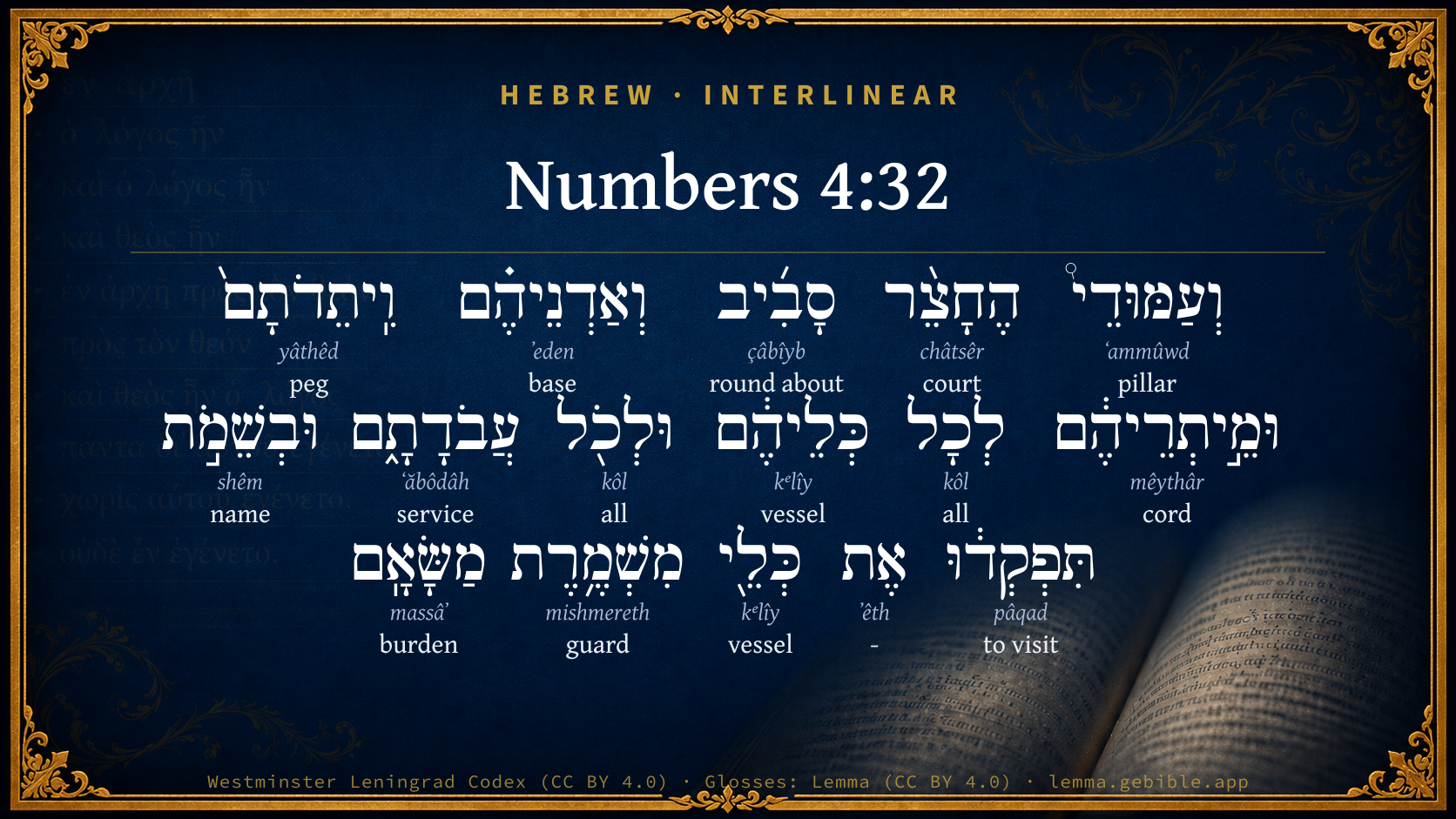
Hebrew (Westminster Leningrad Codex) Numbers 4:32 appears in the Hebrew Old Testament. The text above is from the Westminster Leningrad Codex. Each word links to its Strong’s number, a concise gloss, and parsing drawn from the Open Scriptures Hebrew Bible morphology. Click any word for its full Brown-Driver-Briggs (BDB) entry.
Download image
Cite this verse

Numbers 4:32 (World English Bible). Public Domain. Lemma interlinear Bible study tool, https://lemma.gebible.app/v/numbers/4/32.

Show BibTeX & RIS
BibTeX
RIS
English Translation
and the pillars of the court around it, and their sockets, and their pins, and their cords, with all their instruments, and with all their service: and by name you shall appoint the instruments of the charge of their burden.
World English Bible · Public Domain
Download a study sheet

One document with this verse’s original text, its word-by-word gloss line, the meaning frame, cross-references with their text, attributed commentary, and full source and license credits — printable, and it pastes into notes with its structure intact.

This verse Autodidact and up

Study sheet (.html) Plain text (.txt)

A passage Seminary Student

Up to 50 verses in one chapter. A passage sheet keeps up to 6 commentary sources and 12 cross-references per verse, in the order this page ranks them, and says so on the sheet whenever that leaves anything out. Ask for a single verse and you get the Autodidact verse sheet above.

Everything on this page stays free to read, with no account — the sheet is a download of what is already on screen, not access to it.

Want to remove ads? Support Godless Engineer
Compare translations 3

The same verse in 3 English versions, stacked beneath the original-language interlinear above. Click any original word for its lexicon entry.

Each is an independent rendering of the whole verse — the interlinear is not word-aligned to these translations.

Highlighted words mark where these versions differ — a whole-verse word diff, not a word-by-word alignment.

  • World English Bible Public Domain
    and the pillars of the court around it, and their sockets, and their pins, and their cords, with all their instruments, and with all their service: and by name you shall appoint the instruments of the charge of their burden.
  • King James Version Public Domain
    And the pillars of the court round about, and their sockets, and their pins, and their cords, with all their instruments, and with all their service: and by name ye shall reckon the instruments of the charge of their burden.
  • unfoldingWord Literal Text CC BY-SA 4.0
    and the pillars of the courtyard all around and their bases and their pegs and their ropes, for all their vessels and for all their service; and by names you shall count the vessels of the keeping of their burden.

unfoldingWord Literal Text — © unfoldingWord, licensed CC BY-SA 4.0. Word-aligned USFM3 via Door43 (git.door43.org/unfoldingWord/en_ult).

Versions to compare (up to 4)

3 of 4 selected

Show all 18 translations

Every available English version of this verse, each an independent rendering of the whole verse.

  • World English Bible Public Domain
    and the pillars of the court around it, and their sockets, and their pins, and their cords, with all their instruments, and with all their service: and by name you shall appoint the instruments of the charge of their burden.
  • Berean Standard Bible Public Domain
    and the posts of the surrounding courtyard with their bases, tent pegs, and ropes, including all their equipment and everything related to their use. You shall assign by name the items that they are responsible to carry.
  • Majority Standard Bible Public Domain
    and the posts of the surrounding courtyard with their bases, tent pegs, and ropes, including all their equipment and everything related to their use. You shall assign by name the items that they are responsible to carry.
  • King James Version Public Domain
    And the pillars of the court round about, and their sockets, and their pins, and their cords, with all their instruments, and with all their service: and by name ye shall reckon the instruments of the charge of their burden.
  • American Standard Version (1901) Public Domain
    and the pillars of the court round about, and their sockets, and their pins, and their cords, with all their instruments, and with all their service: and by name ye shall appoint the instruments of the charge of their burden.
  • Revised Version (1885) Public Domain
    and the pillars of the court round about, and their sockets, and their pins, and their cords, with all their instruments, and with all their service: and by name ye shall appoint the instruments of the charge of their burden.
  • Geneva Bible (1599) Public Domain
    And the pillars rounde about the court, with their sockets and their pinnes, and their cords, with all their instruments, euen for all their seruice: and by name ye shall recken the instruments of their office and charge.
  • Douay-Rheims (1899) Public Domain
    The pillars also of the court round about, with their sockets and pins and cords. They shall receive by account all the vessels and furniture, and so shall carry them.
  • Young's Literal Translation Public Domain
    and the pillars of the court round about, and their sockets, and their pins, and their cords, of all their vessels, and of all their service; and by name ye do number the vessels of the charge of their burden.
  • Literal Standard Version CC BY-SA 4.0
    and the pillars of the court all around, and their sockets, and their pins, and their cords, of all their vessels, and of all their service; and you number the vessels of the charge of their burden by name.
  • Unlocked Literal Bible CC BY-SA 4.0
    along with the posts of the courtyard around the tabernacle, their sockets, pegs, and their ropes, with all their hardware. List by name the articles they must carry.
  • unfoldingWord Literal Text CC BY-SA 4.0
    and the pillars of the courtyard all around and their bases and their pegs and their ropes, for all their vessels and for all their service; and by names you shall count the vessels of the keeping of their burden.
  • Darby Bible Public Domain
    and the pillars of the court round about, and their bases, and their pegs, and their cords, all their instruments, according to all their service; and by name ye shall number to them the materials which are their charge to carry.
  • World Messianic Bible Public Domain
    the pillars of the court around it, their sockets, their pins, their cords, with all their instruments, and with all their service. You shall appoint the instruments of the duty of their burden to them by name.
  • Webster's Bible Public Domain
    And the pillars of the court round about, and their sockets, and their pins, and their cords, with all their instruments, and with all their service: and by name ye shall reckon the instruments of the charge of their burden.
  • Free Bible Version CC BY-SA 4.0
    the posts of the surrounding courtyard with their stands, tent pegs, and ropes, all their equipment and everything connected with their use. You are to tell them by name what they are responsible for carrying.
  • Bible in Basic English Public Domain
    And the pillars of the open space outside it, with their bases and their nails and cords and all the instruments used, and everything which has to be done there; all the instruments for which they are responsible are to be numbered by name.
  • JPS Tanakh (1917) Public Domain
    and the pillars of the court round about, and their sockets, and their pins, and their cords, even all their appurtenance, and all that pertaineth to their service; and by name ye shall appoint the instruments of the charge of their burden.

Literal Standard Version (2020), Covenant Press — licensed CC BY-SA 4.0. Text via the HelloAO Bible API (eBible.org). Unlocked Literal Bible (unfoldingWord) — licensed CC BY-SA 4.0. Text via the HelloAO Bible API (eBible.org). unfoldingWord Literal Text — © unfoldingWord, licensed CC BY-SA 4.0. Word-aligned USFM3 via Door43 (git.door43.org/unfoldingWord/en_ult). Free Bible Version, Dr. Jonathan Gallagher — licensed CC BY-SA 4.0. Text via the HelloAO Bible API (eBible.org).

Word by word

More ways to search: Search by grammar → Find every occurrence → Compare this word →

Practice this passage: Drill this verse → Learn its vocabulary →

וּמֵ֣יתְרֵיהֶ֔ם
mêythâr
H4340
“and · cords · their”
Conjunction + Noun, Common, Masculine, Plural, Construct + Suffix, Personal, 3rd Person, Masculine, Plural
Part of Speech
Conjunction + Noun
Type
Common
Gender
Masculine
Number
Plural
State
Construct
Full BDB Definition

Origin: from H3498

TWOT: 936h

cord, string
  1. וְעַמּוּדֵי֩ ʻammûwd H5982 “and · pillars of” Conjunction + Noun, Common, Masculine, Plural, Construct
  2. הֶחָצֵ֨ר châtsêr H2691 “the · court” Particle, Definite Article + Noun, Common, Both, Singular, Absolute
  3. סָבִ֜יב çâbîyb H5439 “round about” Noun, Common, Both, Singular, Absolute
  4. וְאַדְנֵיהֶ֗ם ʼeden H134 “and · bases · their” Conjunction + Noun, Common, Masculine, Plural, Construct + Suffix, Personal, 3rd Person, Masculine, Plural
  5. וִֽיתֵדֹתָם֙ yâthêd H3489 “and · pegs · their” Conjunction + Noun, Common, Feminine, Plural, Construct + Suffix, Personal, 3rd Person, Masculine, Plural
  6. לְכָל kôl H3605 “to/for · all of” Preposition + Noun, Common, Masculine, Singular, Construct
  7. כְּלֵיהֶ֔ם kᵉlîy H3627 “vessels · their” Noun, Common, Masculine, Plural, Construct + Suffix, Personal, 3rd Person, Masculine, Plural
  8. וּלְכֹ֖ל kôl H3605 “and · to/for · all of” Conjunction + Preposition + Noun, Common, Masculine, Singular, Construct
  9. עֲבֹדָתָ֑ם ʻăbôdâh H5656 “service · their” Noun, Common, Feminine, Singular, Construct + Suffix, Personal, 3rd Person, Masculine, Plural
  10. וּבְשֵׁמֹ֣ת shêm H8034 “and · in/at · names” Conjunction + Preposition + Noun, Common, Masculine, Plural, Absolute
  11. תִּפְקְד֔וּ pâqad H6485 “to visit” Verb, Qal, Imperfect, 2nd Person, Masculine, Plural
  12. אֶת ʼêth H853 “-” Particle, Direct Object
  13. כְּלֵ֖י kᵉlîy H3627 “vessels of” Noun, Common, Masculine, Plural, Construct
  14. מִשְׁמֶ֥רֶת mishmereth H4931 “guard of” Noun, Common, Feminine, Singular, Construct
  15. מַשָּׂאָֽם massâʼ H4853 “burden · their” Noun, Common, Masculine, Singular, Construct + Suffix, Personal, 3rd Person, Masculine, Plural

About this verse

These counts appear in no published source. They are computed here, from the morphology-tagged text and Lemma’s own curated glosses. What Lemma adds →

16
words
14
distinct lemmas
Pentateuch
section

Notable vocabulary

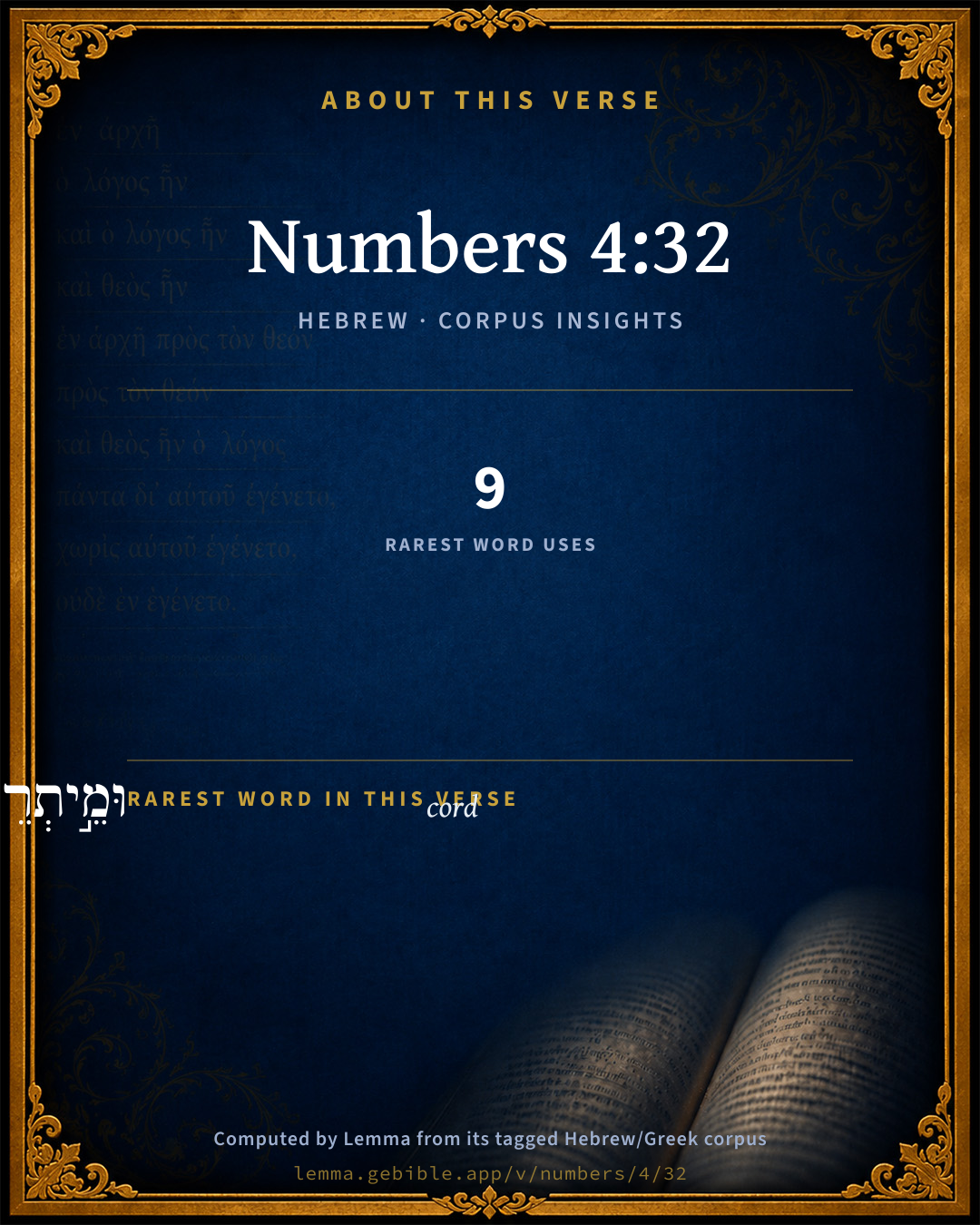
The rarest word here is וּמֵ֣יתְרֵיהֶ֔ם cord H4340 — appearing just 9 times in the whole Hebrew Bible.

Shared distinctive vocabulary

וּמֵ֣יתְרֵיהֶ֔ם cord H4340 occurs in 9 verses of the Hebrew Bible. Also found in:

Grammatical profile

  • 1 verb
  • 14 nouns
  • 1 particle

Verb forms

  • תִּפְקְד֔וּ Qal · Imperfect

Repetition

Words recur within this verse — often emphatic in Hebrew:

  • לְכָל all H3605 ×2
  • כְּלֵיהֶ֔ם vessel H3627 ×2

Hebrew & Septuagint length

In English translation the verse runs 40 words from the Hebrew and 70 from the Septuagint (LXX English) — the Septuagint runs noticeably longer here. See the side-by-side →

A rough comparison of the two English renderings, which tokenize alike — not a word-level alignment.

Word counts can differ between the Hebrew and the Greek without any difference in meaning — e.g. the Hebrew direct-object marker אֵת has no separate Greek word, and Greek often adds the article ὁ.

Cross-references

6

Topical passages linked to Numbers 4:32 in the Treasury of Scripture Knowledge — connected by theme and wording, ordered by reader-vote popularity; previews shown in the World English Bible.

  • Exodus 38:21 This is the amount of material used for the tent, even the Tent of the Testimony, as they were counted, according to the commandment of Moses, for the service of the Levites, by the hand of Ithamar, the son of Aaron the priest.
  • Exodus 25:9 According to all that I show you, the pattern of the tent, and the pattern of all of its furniture, even so you shall make it.
  • Exodus 38:17 The sockets for the pillars were of brass. The hooks of the pillars and their fillets were of silver; and the overlaying of their capitals, of silver; and all the pillars of the court were filleted with silver.
  • Numbers 3:8 They shall keep all the furnishings of the Tent of Meeting, and the obligations of the children of Israel, to do the service of the tabernacle.
  • Numbers 7:1 It happened on the day that Moses had finished setting up the tabernacle, and had anointed it and sanctified it, with all its furniture, and the altar with all its vessels, and had anointed and sanctified them;
  • 1 Chronicles 9:29 Some of them also were appointed over the furniture, and over all the vessels of the sanctuary, and over the fine flour, and the wine, and the oil, and the frankincense, and the spices.

Cross-references courtesy of OpenBible.info (CC BY 4.0).

Hebrew and Greek witnesses Masoretic Hebrew ↔ Greek Septuagint

The same verse in the two great witnesses to the Old Testament, shown verse-for-verse.

Here the Septuagint runs noticeably longer than the Hebrew — LXX2012 (modern English Septuagint) 70 words vs World English Bible 40. A rough length comparison of the two English translations, not a word-level alignment — read both below.

These are two independent witnesses, not word-aligned to each other, and the Septuagint is shown in lemma (dictionary) form.

Hebrew Numbers 4:32 Masoretic · Westminster Leningrad Codex

וְעַמּוּדֵי֩ הֶחָצֵ֨ר סָבִ֜יב וְאַדְנֵיהֶ֗ם וִֽיתֵדֹתָם֙ וּמֵ֣יתְרֵיהֶ֔ם לְכָל כְּלֵיהֶ֔ם וּלְכֹ֖ל עֲבֹדָתָ֑ם וּבְשֵׁמֹ֣ת תִּפְקְד֔וּ אֶת כְּלֵ֖י מִשְׁמֶ֥רֶת מַשָּׂאָֽם

and the pillars of the court around it, and their sockets, and their pins, and their cords, with all their instruments, and with all their service: and by name you shall appoint the instruments of the charge of their burden.

World English Bible · Public Domain

Greek LXX Numbers 4:32 Septuagint · lemma form

καί ὁ στῦλος ὁ αὐλή κύκλος καί ὁ βάσις αὐτός καί ὁ στῦλος ὁ καταπέτασμα ὁ πύλη ὁ αὐλή καί ὁ βάσις αὐτός καί ὁ πάσσαλος αὐτός καί ὁ καλός αὐτός καί πᾶς ὁ σκεῦος αὐτός καί πᾶς ὁ λειτούργημα αὐτός ἐκ ὄνομα ἐπισκέπτω αὐτός καί πᾶς ὁ σκεῦος ὁ φυλακή ὁ αἴρω ὑπό αὐτός

And they shall bear the pillars of the court round about, and there shall be their sockets, and they shall bear the pillars of the veil of the door of the court, and their sockets and their pins, and their cords, and all their furniture, and all their instruments of service: take you⌃ their number by name, and all the articles of the charge of the things borne by them.

LXX2012 (modern English Septuagint) · Public Domain

On this verse, The Pulpit Commentary discusses the Septuagint’s reading. Read the note in Commentary ↓

Hebrew: Westminster Leningrad Codex (CC BY 4.0). Greek: Septuagint (public domain); English from LXX2012 (modern English Septuagint) (Public Domain). How the Septuagint differs from the Hebrew →

Targum (Aramaic paraphrase)

2

The Targum is the ancient Jewish Aramaic paraphrase of the Hebrew Scriptures — an interpretive translation, not the Hebrew text itself. Onkelos (literal) and Pseudo-Jonathan (expansive) render the Torah, and Jonathan the Prophets. Coverage is partial: where no permissively-licensed English translation exists for a verse, only the Aramaic is shown. This is verse-level text, not a word-by-word alignment to the Hebrew.

  1. Targum Onkelos Torah (Genesis–Deuteronomy)
    וְעֲמוּדֵי דְדַרְתָּא סְחוֹר סְחוֹר וְסַמְכֵיהוֹן וְסִכֵּיהוֹן וְאַטוּנֵיהוֹן לְכָל מָנֵיהוֹן וּלְכֹל פּוּלְחַנְהוֹן וּבִשְׁמָהָן תְּמַנוּן יָת מָנֵי מַטְרַת מַטוּלְהוֹן

    (no public-domain English translation for this verse)

    Targum Onkelos — Aramaic: “Onkelos Genesis” (public domain); “Onkelos Exodus” (public domain); “Onkelos Leviticus” (public domain); “Onkelos Numbers” (public domain); “Onkelos Deuteronomy” (public domain). English: “Sefaria Community Translation” (CC0 1.0 (public-domain dedication)); “J.W. Etheridge. The Targums of Onkelos and Jonathan Ben Uzziel on the Pentateuch. London: Longmans, Green, 1862” (public domain). Text via Sefaria.

  2. Targum Pseudo-Jonathan Torah (Genesis–Deuteronomy)
    וְעַמוּדֵי דַרְתָּא חֲזוֹר חֲזוֹר וְחוּמְרֵיהוֹן וְסִיכֵיהוֹן וּמַתְחֵיהוֹן לְכָל מָאנֵיהוֹן וּלְכָל פּוּלְחַנְהוֹן וּבִשְׁמָהָן תִּמְנוּן יַת כָּל מָאנֵי מַטְרַת מַטוּלְהוֹן

    the pillars of the court also round about, their pins and their cords, with all the instruments of their whole service, and all those of the charge of their burdens, thou shalt number by their names.

    Targum Pseudo-Jonathan — Aramaic: “Targum Jonathan on Genesis” (public domain); “Targum Jonathan on Exodus” (public domain); “Targum Jonathan on Leviticus” (public domain); “Targum Jonathan on Numbers” (public domain); “Targum Jonathan on Deuteronomy” (public domain). English: “The Targum of Jonathan ben Uzziel, trans. J. W. Etheridge, London, 1862” (public domain). Text via Sefaria.

Commentary

Notes on Numbers 4:32 from classic Christian and Jewish commentators (each source and its license shown beneath its notes). The classic Christian expositions comment on the surrounding passage and are grouped to its opening verse, so a note may address several verses; the Jewish commentaries on the Tanakh (Rashi and others) are per-verse, so they appear only where the commentator wrote on this verse.

Lemma curates 59 commentaries, every one of them public domain or Creative Commons licensed, each selected and text-cleaned for this edition rather than reprinted as found. About our sources →

Trapp's Complete Commentary

John Trapp

Num 4:32 And the pillars of the court round about, and their sockets, and their pins, and their cords, with all their instruments, and with all their service: and by name ye shall reckon the instruments of the charge of their burden.

Ver. 32. By name ye shall reckon.] That all might be ready and forthcoming, when the sanctuary was set up again. Christ "knoweth" and "calleth" all his "by name," {Joh 10:3} not the meanest of them is missing. {Joh 17:12}

John Trapp, A Commentary or Exposition upon All the Books of the Old and New Testament (1647–1656) — public domain. Text from a community e-Sword module.

Joseph Benson's Commentary

Num 4:32. Ye shall reckon — Every part and parcel shall be put in an inventory; which is required here rather than in the foregoing particulars, because these were much more numerous than the former; because, being meaner things, they might otherwise have been neglected; and also to teach us that God esteems nothing small in his service, and that he expects his will should be observed in the minutest circumstances. The death of the saints is represented as the taking down of the tabernacle. The immortal soul, like the most holy things, is first covered and taken away, carried by angels unseen, and care is taken also of the body, the skin and the flesh, which are as the curtains, the bones and sinews, which are as the bars and pillars. None of these shall be lost. Commandment is given concerning the bones, a covenant made with the dust. They are in safe custody, and shall be produced in the great day, when this tabernacle shall be set up again, and these vile bodies made like the glorious body of Jesus Christ.

Joseph Benson's Commentary on the Old and New Testaments (1811–1818) — public domain. Text from a community e-Sword module.

Geneva Bible (1599)

Geneva Bible translators

Ye shall make an inventory of all the things, which ye commit to their charge.

Geneva Bible (1599) marginal notes — public domain. Text via Bolls.life.

Ellicott's Commentary for English Readers

(32) Ye shall reckon.—Better, ye shall assign or appoint. (See Note on the preceding verse.)

A Bible Commentary for English Readers, edited by Charles John Ellicott (1878–1897) — public domain. Text from a community e-Sword module.

The Cambridge Bible for Schools and Colleges

gen. ed. J. J. S. Perowne

32. the instruments of the charge of their burden] i.e. the articles committed to their charge to carry.

The Cambridge Bible for Schools and Colleges (gen. ed. J. J. S. Perowne; Cambridge University Press, 1878–1918) — public domain. Text from a community e-Sword module.

John Gill's Exposition

From thirty years old and upward even unto fifty years old,.... See Gill on Num 4:34.

.

Numbers 4:36

num 4:36

num 4:36

num 4:36And those that were numbered of them by their families,.... See Gill on Num 4:34.

John Gill's Exposition of the Whole Bible (1746–1763) — public domain (CC PDM 1.0). Text via the HelloAO Bible API.

Matthew Poole's English Annotations

Every part and parcel therefore shall be put in an inventory; which is required here rather than in the foregoing particulars, partly, because these were much more numerous than the former; partly, because being meaner things, and such as might easily be supplied, they might otherwise have been neglected; and partly, to teach us that God esteems nothing small in his worship and service, and that he expects his will should be observed in the minutest circumstances.

Matthew Poole's English Annotations on the Holy Bible (1683–1685) — public domain. Text from a community e-Sword/MySword module.

Whedon's Commentary on the Bible

Daniel D. Whedon

32. By name… the instruments — As there was a great difference in the weight of these various parts, the burdens might be very unequally distributed if each was left free to choose his own. Hence this precaution prevented strife and injustice. The phrase “by name” implies that an inventory was kept, not only on account of the number and variety, but of the comparative commonness and smallness of those things which might have been easily lost through carelessness. There is nothing trivial in the service of God.

Daniel D. Whedon (gen. ed.), Commentary on the Old and New Testaments (1874–1909) — public domain. Text from a community e-Sword module.

The Pulpit Commentary

By name ye shall reckon the instruments of the charge of their burden. This injunction only occurs here. The Septuagint has "number them by name, and all the articles borne by them." Perhaps the solid parts of the fabric were numbered for convenience of setting up, and, therefore, were assigned each to its own bearer.

The Pulpit Commentary (1880–1919), ed. H.D.M. Spence-Jones & Joseph S. Exell — public domain. Text from a community e-Sword module.

John Wesley's Explanatory Notes

Ye shall reckon - Every part and parcel shall be put in an inventory; which is required here rather than in the fore-going particulars; because these were much more numerous than the former; because being meaner things, they might otherwise have been neglected; and also to teach us, that God esteems nothing small in his service, and that he expects his will should be observed in the minutest circumstances. The death of the saints is represented us the taking down of the tabernacle. The immortal soul, like the most holy things, is first covered and taken away, carried by angels unseen, and care is taken also of the body, the skin and flesh, which are as the curtains, the bones and sinews, which are as the bars and pillars. None of these shall be lost. Commandment is given concerning the bones, a covenant made with the dust. They are in safe custody, and shall be produced in the great day, when this tabernacle shall be set up again, and these vile bodies made like the glorious body of Jesus Christ.

John Wesley, Explanatory Notes Upon the Whole Bible (1754–1765) — public domain. Text via the GEBible commentary corpus.

Keil & Delitzsch

C. F. Keil & F. Delitzsch

לכל־כּליהם: with regard to all their instruments, i.e., all the things used for setting up, fastening, or undoing the beams, bolts, etc.; see Num 3:36 and Exo 27:19.

Keil & Delitzsch — Biblical Commentary on the Old Testament (1861–1891) — public domain (CC PDM 1.0). Text via the HelloAO Bible API. (Old Testament only.)

Rashi

Rabbi Shlomo Yitzchaki (Rashi)

ויתדתם ומיתריהם [AND THE COLUMNS OF THE ENCLOSURE ROUND ABOUT IT AND THEIR SOCKETS] AND THEIR PINS, AND THEIR CORDS — i.e. the pins and cords of the columns only, because the pins and cords of the hangings were part of the burden of the Gershonites (not of the sons of Merari). There were, as a matter of fact, pegs and cords for the curtains and the hangings on their lower edges in order that the wind should not raise them, there were also pegs and cords for the columns, round about, upon which to suspend the hangings by their upper edges on poles and rails, just as it is set forth in the Boraitha dealing with the work of the Tabernacle (cf. Rashi on Exodus 27:10, 19; Numbers 3:26 and our Note thereon).

Rashi on the Tanakh — English translations: “The Judaica Press complete Tanach with Rashi, translated by A. J. Rosenberg” (CC BY 4.0); “Pentateuch with Rashi's commentary by M. Rosenbaum and A.M. Silbermann, 1929-1934” (public domain); “The Metsudah Tanach series, Lakewood, N.J” (CC BY 4.0); and “The Book of Joshua, Metsudah Publications, 1997” (CC BY 4.0). Text via Sefaria.

Ramban (Nachmanides)

Rabbi Moshe ben Nachman (Ramban / Nachmanides)

AND THE PILLARS OF THE COURT ROUND ABOUT, AND THEIR SOCKETS, AND THEIR PINS, AND THEIR CORDS. “[These sockets, pins and cords refer only to] those of the pillars, because the pins and cords of the hangings were part of the burden of the Gershonites [as stated above in Verse 26, and here Scripture is speaking of the work of the sons of Merari]. For there were pins and cords for the curtains and hangings on their lower edges, so that the wind should not raise them, and there were [also] pins and cords round about the pillars, in order to suspend the hangings on them at their upper edges with poles and rails, as we have been taught in [the Beraitha] on the work of the Tabernacle.” This is Rashi’s language. But I do not understand what pins have to do with the pillars! of the hangings was fixed, however, were made of wood, not of brass, and are not included in the Hebrew word for pins. Therefore Ramban asks what do the pins [made of brass] have to do with the pillars? (Kur Zahav). Moreover, [even if the pillars did have pins], why were the pins of the pillars different from the other pins, in that [the other pins were given] to the sons of Gershon, and those [of the pillars were given] to the sons of Merari? Nor have I found in the Mishnah on the work of the Tabernacle that there were pins to the pillars! Instead, the Rabbis taught there the following: “He [Moses] joined the rails by means of cords to the pillars, and attached them to the pins of the Tent. And just as there were pins to the Tabernacle, so were there pins to the court, as it is said, All the instruments of the Tabernacle in all the service thereof, and all the pins thereof, and all the pins of the court, round about, shall be of brass. ”, 38:20. This is the language of the Beraitha. And it does not teach there that there were pins to the pillars.But we must rather explain that the pins and cords of the hangings of the court were in the hands of the sons of Merari [not, as Rashi understands, that they were in the charge of the Gershonites]; whereas it is the cords and pins of the Tabernacle and Tent. that were in the hands of the Gershonites, for [the prepositions] and ‘their’ cords, and all the instruments of ‘their’ service [mentioned in connection with the charge of the Gershonites] are a reference to the curtains of the Tabernacle and the Tent of Meeting, Verse 25. mentioned in [the beginning of] the previous verse [relating to the work to be done by the Gershonite], and do not refer to [the hangings of] the court [as Rashi wrote]. Similarly, when He said above [with reference to the charge of the Gershonites], and the cords ‘of it’, 3:26. [the preposition “it”] alludes to the Tabernacle mentioned there [in the preceding verse], Verse 25: And the charge of the sons of Gershon in the Tent of Meeting, the Tabernacle and the Tent etc. — Ramban is thus, interpreting the preposition “it” [and the cords of ‘it’] — in 3:26 — as referring back to Verse 25 which mentions the Tabernacle and Tent and does not refer to the hangings of the court mentioned in the selfsame Verse 26. To prove this method of exegesis, Ramban proceeds to bring examples from other places in Scripture where this principle perforce applies. and not to the hangings of the court [mentioned in the same verse]. A similar case [of a Scriptural reference to a prior subject] is [G-d’s command addressed to Aaron]: only ‘they’ shall not come nigh unto the vessels of holiness and unto the altar [where the pronoun “they”] refers back to the more distant [phrase, namely: thy brethren, the tribe of Levi] the tribe of thy father, Verse 2. [mentioned] in the preceding verse, and does not refer to the nearer [phrase] thy sons. So also the verse, And ‘their’ redemption-money — from a month old shalt thou redeem them, Verse 16. [where the word “their”] refers back to the firstborn of man, Verse 15. [mentioned in the earlier part of the preceding verse], and not to the firstling of unclean beasts [stated at the end of the preceding verse]. There are many cases like this.However, it appears to me that according to the text of the Beraitha [mentioned further on] the Gershonites only carried cloths, but [did] not [carry] any brass and wood at all. This is the Beraitha wherein we are taught: “The sons of Gershon were assigned [to pitch] on the west [of the Tabernacle], and they were in charge of all woven materials.” If so, the meaning of the term and their pins [mentioned in the verse before us dealing with the charge of the sons of Merari] is: “[the pins] of the Tabernacle and of the pillars of the court,” while [the term] and their cords refers only to those of the pillars of the court [since the cords of the Tabernacle itself were in the hands of the Gershonites]. Similarly He said above [with reference to the burden of the sons of Merari]: the boards of the Tabernacle, and the bars thereof, and the pillars thereof, and the sockets thereof, and all the instruments thereof, and all that pertaineth to the service thereof, Verse 36. including [in general terms] the pins thereof [i.e., of both the Tabernacle and the pillars of the court]. Therefore He mentioned the cords [in speaking of] both [the burdens of the sons of Gershon and those of Merari, because the cords of the Tabernacle were carried by the sons of Gershon, and those of the pillars of the court by the sons of Merari], but the pins He mentioned only [in the verse before us] with reference to the sons of Merari [because the Gershonites carried no objects of brass or wood at all, but which instead were carried by the sons of Merari].

AND BY NAME YE SHALL APPOINT THE INSTRUMENTS OF THE CHARGE OF THEIR BURDENS. This means that he [Ithamar] should put the vessels which they were to carry in the hands of each man, according to the number of names, by their polls. He [Ithamar] is to say: “This person shall carry a certain number of the boards, and that person a certain number of the bars or of the pillars,” rather than commanding [generally]: “The sons of Merari as a whole shall carry all the boards, sockets and pillars.” He mentioned this first in the case of the sons of Merari although this principle applied also to the work done by the sons of Kohath and Gershon because of the weight of their burdens, for each one [of the sons of Merari] might [be inclined to] make his load lighter by putting it upon his fellowman, [therefore the command had to be given to each person individually].

Ramban (Nachmanides) on the Tanakh — English translation: “Commentary on the Torah by Ramban (Nachmanides). Translated and annotated by Charles B. Chavel. New York, Shilo Pub. House, 1971-1976” (CC BY 4.0). Text via Sefaria.

Lesson kit

Teaching starters — assembled from the data on this page, not authored interpretation. Every prompt links to the verse data it draws on. Edit before teaching.

Numbers, in the Pentateuch, opens this verse with 16 words (14 distinct Hebrew lemmas). Its most distinctive word is mêythâr (“cord”). The Greek Septuagint runs longer here. A historical commentator’s framing appears above. Read the whole chapter for the surrounding context.

Discussion questions

  1. What does “cord” (mêythâr) contribute to the verse as a whole?
  2. How does Exodus 35:18, which shares the word «cord», read alongside this verse?
  3. What does the repetition of “all” (2× in this one verse) do in this verse?
  4. The Septuagint runs longer here than the Hebrew. What might account for the difference?
  5. The translations on this page render this verse differently — a whole-verse word diff, not a word-by-word alignment. What might account for the different wordings?
  6. «תִּפְקְד֔וּ» is a Qal Imperfect verb. How does that grammatical form shape the action described?
  7. Compare how Trapp's Complete Commentary and Joseph Benson's Commentary read this verse. Where do they agree or differ?

Things to notice

Reading settings

Reading text

Shown beneath each verse's original-language words.

Old Testament
Old Testament edition

Read the OT as the Masoretic Hebrew (MT) or the Greek Septuagint (LXX).

English shown for the Greek Septuagint (in the Hebrew ↔ Greek comparison).

Comparing translations? Open the Compare panel on any verse page to stack up to four side by side.