
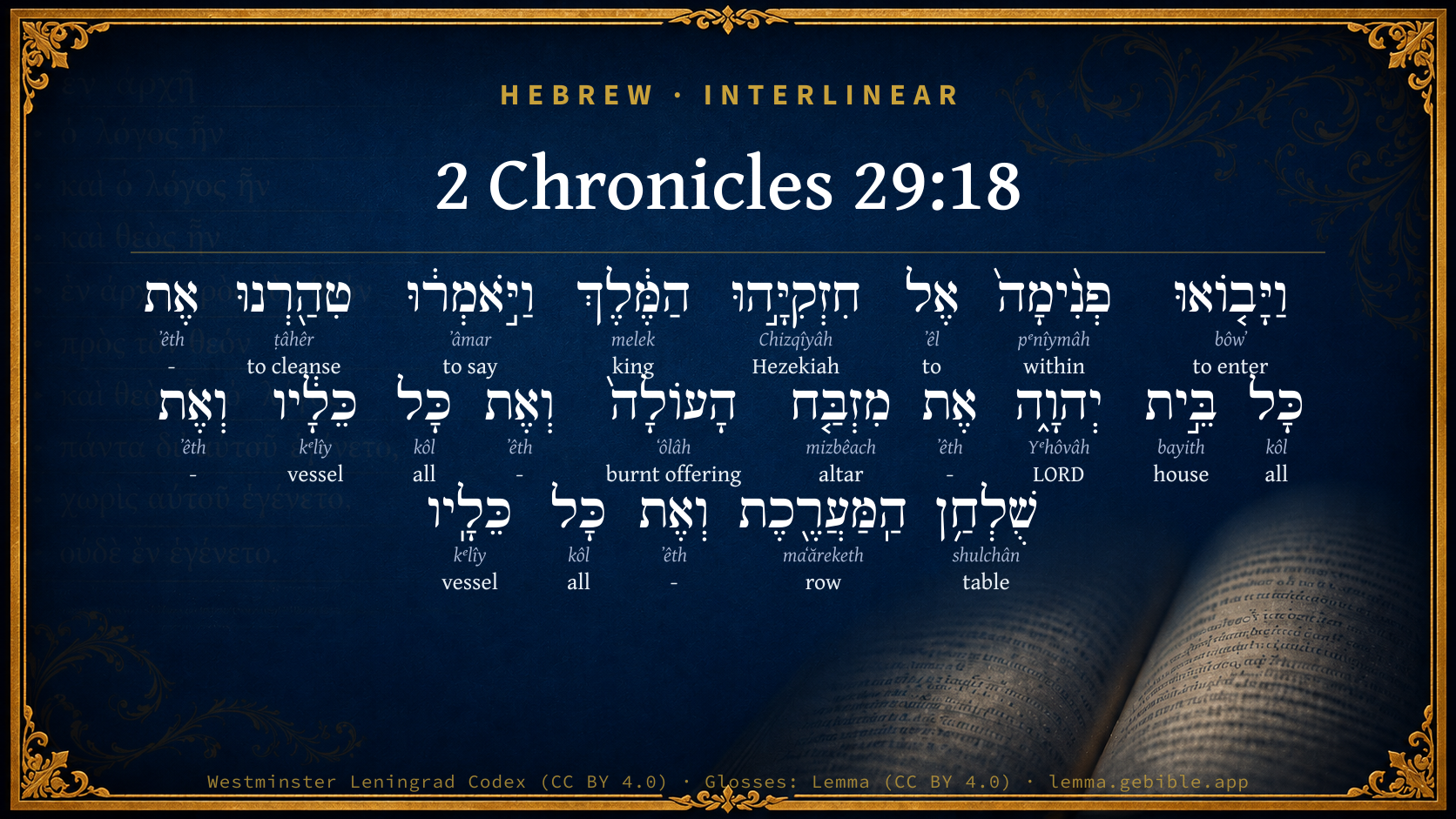
2 Chronicles 29:18

Hebrew (Westminster Leningrad Codex) 2 Chronicles 29:18 appears in the Hebrew Old Testament. The text above is from the Westminster Leningrad Codex. Each word links to its Strong’s number, a concise gloss, and parsing drawn from the Open Scriptures Hebrew Bible morphology. Click any word for its full Brown-Driver-Briggs (BDB) entry.
Download image
Cite this verse

2 Chronicles 29:18 (World English Bible). Public Domain. Lemma interlinear Bible study tool, https://lemma.gebible.app/v/2-chronicles/29/18.

Show BibTeX & RIS
BibTeX
RIS
English Translation
Then they went in to Hezekiah the king within [the palace], and said, We have cleansed all the house of Yahweh, and the altar of burnt offering, with all the vessels of it, and the table of show bread, with all the vessels of it.
World English Bible · Public Domain
Download a study sheet

One document with this verse’s original text, its word-by-word gloss line, the meaning frame, cross-references with their text, attributed commentary, and full source and license credits — printable, and it pastes into notes with its structure intact.

This verse Autodidact and up

Study sheet (.html) Plain text (.txt)

A passage Seminary Student

Up to 50 verses in one chapter. A passage sheet keeps up to 6 commentary sources and 12 cross-references per verse, in the order this page ranks them, and says so on the sheet whenever that leaves anything out. Ask for a single verse and you get the Autodidact verse sheet above.

Everything on this page stays free to read, with no account — the sheet is a download of what is already on screen, not access to it.

Want to remove ads? Support Godless Engineer
Compare translations 3

The same verse in 3 English versions, stacked beneath the original-language interlinear above. Click any original word for its lexicon entry.

Each is an independent rendering of the whole verse — the interlinear is not word-aligned to these translations.

Highlighted words mark where these versions differ — a whole-verse word diff, not a word-by-word alignment.

  • World English Bible Public Domain
    Then they went in to Hezekiah the king within [the palace], and said, We have cleansed all the house of Yahweh, and the altar of burnt offering, with all the vessels of it, and the table of show bread, with all the vessels of it.
  • King James Version Public Domain
    Then they went in to Hezekiah the king, and said, We have cleansed all the house of the LORD, and the altar of burnt offering, with all the vessels thereof, and the shewbread table, with all the vessels thereof.
  • unfoldingWord Literal Text CC BY-SA 4.0
    And they came within to Hezekiah, the king, and they said, “We have cleansed all the house of Yahweh, the altar of burnt offerings and all its items, and the table of the arrangement and all its items,

unfoldingWord Literal Text — © unfoldingWord, licensed CC BY-SA 4.0. Word-aligned USFM3 via Door43 (git.door43.org/unfoldingWord/en_ult).

Versions to compare (up to 4)

3 of 4 selected

Show all 18 translations

Every available English version of this verse, each an independent rendering of the whole verse.

  • World English Bible Public Domain
    Then they went in to Hezekiah the king within [the palace], and said, We have cleansed all the house of Yahweh, and the altar of burnt offering, with all the vessels of it, and the table of show bread, with all the vessels of it.
  • Berean Standard Bible Public Domain
    Then they went in to King Hezekiah and reported, “We have cleansed the entire house of the LORD, the altar of burnt offering with all its utensils, and the table of the showbread with all its utensils.
  • Majority Standard Bible Public Domain
    Then they went in to King Hezekiah and reported, “We have cleansed the entire house of the LORD, the altar of burnt offering with all its utensils, and the table of the showbread with all its utensils.
  • King James Version Public Domain
    Then they went in to Hezekiah the king, and said, We have cleansed all the house of the LORD, and the altar of burnt offering, with all the vessels thereof, and the shewbread table, with all the vessels thereof.
  • American Standard Version (1901) Public Domain
    Then they went in to Hezekiah the king within `the palace', and said, We have cleansed all the house of Jehovah, and the altar of burnt-offering, with all the vessels thereof, and the table of showbread, with all the vessels thereof.
  • Revised Version (1885) Public Domain
    Then they went in to Hezekiah the king within the palace, and said, We have cleansed all the house of the LORD, and the altar of burnt offering, with all the vessels thereof, and the table of shewbread, with all the vessels thereof.
  • Geneva Bible (1599) Public Domain
    Then they went in to Hezekiah ye King, and sayde, We haue clensed all the house of the Lord and the altar of burnt offring, with all the vessels thereof, and the shewbread table, with all the vessels thereof:
  • Douay-Rheims (1899) Public Domain
    And they went is to king Ezechias, and said to him: We have sanctified all the house of the Lord, and the altar of holocaust, and the vessels thereof, and the table of proposition with all its vessels,
  • Young's Literal Translation Public Domain
    And they come in within unto Hezekiah the king, and say, `We have cleansed all the house of Jehovah, and the altar of the burnt-offering, and all its vessels, and the table of the arrangement, and all its vessels,
  • Literal Standard Version CC BY-SA 4.0
    And they come in to Hezekiah the king within, and say, “We have cleansed all the house of YHWH, and the altar of the burnt-offering, and all its vessels, and the table of the arrangement, and all its vessels,
  • Unlocked Literal Bible CC BY-SA 4.0
    Then they went to Hezekiah, the king, inside the palace and said, “We have cleansed all the house of Yahweh, the altar for burnt offerings with all its implements, and the table of the bread of the presence, with all its implements.
  • unfoldingWord Literal Text CC BY-SA 4.0
    And they came within to Hezekiah, the king, and they said, “We have cleansed all the house of Yahweh, the altar of burnt offerings and all its items, and the table of the arrangement and all its items,
  • Darby Bible Public Domain
    And they went in to king Hezekiah, and said, We have cleansed all the house of Jehovah, and the altar of burnt-offering with all its vessels, and the table of the [bread] to be set in rows, and all its vessels;
  • World Messianic Bible Public Domain
    Then they went in to Hezekiah the king within the palace and said, “We have cleansed all the LORD’s house, including the altar of burnt offering with all its vessels, and the table of show bread with all its vessels.
  • Webster's Bible Public Domain
    Then they went in to Hezekiah the king, and said, We have cleansed all the house of the LORD, and the altar of burnt-offering, with all its vessels, and the show-bread table, with all its vessels.
  • Free Bible Version CC BY-SA 4.0
    Then they went in to tell King Hezekiah, “We have cleaned the entire Temple of the Lord, the altar of burnt offering with all its utensils, and the table of the showbread with all its utensils.
  • Bible in Basic English Public Domain
    Then they went in to King Hezekiah and said, We have made all the house of the Lord clean, as well as the altar of burned offerings with all its vessels, and the table for the holy bread, with all its vessels.
  • JPS Tanakh (1917) Public Domain
    Then they went in to Hezekiah the king within the palace, and said: 'We have cleansed all the house of the LORD, even the altar of burnt-offering, with all the vessels thereof, and the table of showbread, with all the vessels thereof.

Literal Standard Version (2020), Covenant Press — licensed CC BY-SA 4.0. Text via the HelloAO Bible API (eBible.org). Unlocked Literal Bible (unfoldingWord) — licensed CC BY-SA 4.0. Text via the HelloAO Bible API (eBible.org). unfoldingWord Literal Text — © unfoldingWord, licensed CC BY-SA 4.0. Word-aligned USFM3 via Door43 (git.door43.org/unfoldingWord/en_ult). Free Bible Version, Dr. Jonathan Gallagher — licensed CC BY-SA 4.0. Text via the HelloAO Bible API (eBible.org).

Word by word

More ways to search: Search by grammar → Find every occurrence → Compare this word →

Practice this passage: Drill this verse → Learn its vocabulary →

הַֽמַּעֲרֶ֖כֶת
maʻăreketh
H4635
“the · row”
Particle, Definite Article + Noun, Common, Feminine, Singular, Absolute
Part of Speech
Particle + Noun
Type
Common
Gender
Feminine
Number
Singular
State
Absolute
Full BDB Definition

Origin: from H6186

TWOT: 1694e

row, line
  1. וַיָּב֤וֹאוּ bôwʼ H935 “and · to enter” Conjunction + Verb, Qal, Sequential Imperfect, 3rd Person, Masculine, Plural
  2. פְנִ֨ימָה֙ pᵉnîymâh H6441 “within” Adverb
  3. אֶל ʼêl H413 “to” Preposition
  4. חִזְקִיָּ֣הוּ Chizqîyâh H2396 “Hezekiah” Noun, Proper
  5. הַמֶּ֔לֶךְ melek H4428 “the · king” Particle, Definite Article + Noun, Common, Masculine, Singular, Absolute
  6. וַיֹּ֣אמְר֔וּ ʼâmar H559 “and · to say” Conjunction + Verb, Qal, Sequential Imperfect, 3rd Person, Masculine, Plural
  7. טִהַ֖רְנוּ ṭâhêr H2891 “to cleanse” Verb, Piel, Perfect, 1st Person, Common, Plural
  8. אֶת ʼêth H853 “-” Particle, Direct Object
  9. כָּל kôl H3605 “all of” Noun, Common, Masculine, Singular, Construct
  10. בֵּ֣ית bayith H1004 “house of” Noun, Common, Masculine, Singular, Construct
  11. יְהוָ֑ה Yᵉhôvâh H3068 “LORD” Noun, Proper
  12. אֶת ʼêth H853 “-” Particle, Direct Object
  13. מִזְבַּ֤ח mizbêach H4196 “altar of” Noun, Common, Masculine, Singular, Construct
  14. הָעוֹלָה֙ ʻôlâh H5930 “the · burnt offering” Particle, Definite Article + Noun, Common, Feminine, Singular, Absolute
  15. וְאֶת ʼêth H853 “and · -” Conjunction + Particle, Direct Object
  16. כָּל kôl H3605 “all of” Noun, Common, Masculine, Singular, Construct
  17. כֵּלָ֔יו kᵉlîy H3627 “vessels · his” Noun, Common, Masculine, Plural, Construct + Suffix, Personal, 3rd Person, Masculine, Singular
  18. וְאֶת ʼêth H853 “and · -” Conjunction + Particle, Direct Object
  19. שֻׁלְחַ֥ן shulchân H7979 “table of” Noun, Common, Masculine, Singular, Construct
  20. וְאֶת ʼêth H853 “and · -” Conjunction + Particle, Direct Object
  21. כָּל kôl H3605 “all of” Noun, Common, Masculine, Singular, Construct
  22. כֵּלָֽיו kᵉlîy H3627 “vessels · his” Noun, Common, Masculine, Plural, Construct + Suffix, Personal, 3rd Person, Masculine, Singular

About this verse

These counts appear in no published source. They are computed here, from the morphology-tagged text and Lemma’s own curated glosses. What Lemma adds →

23
words
16
distinct lemmas
Historical
section

Notable vocabulary

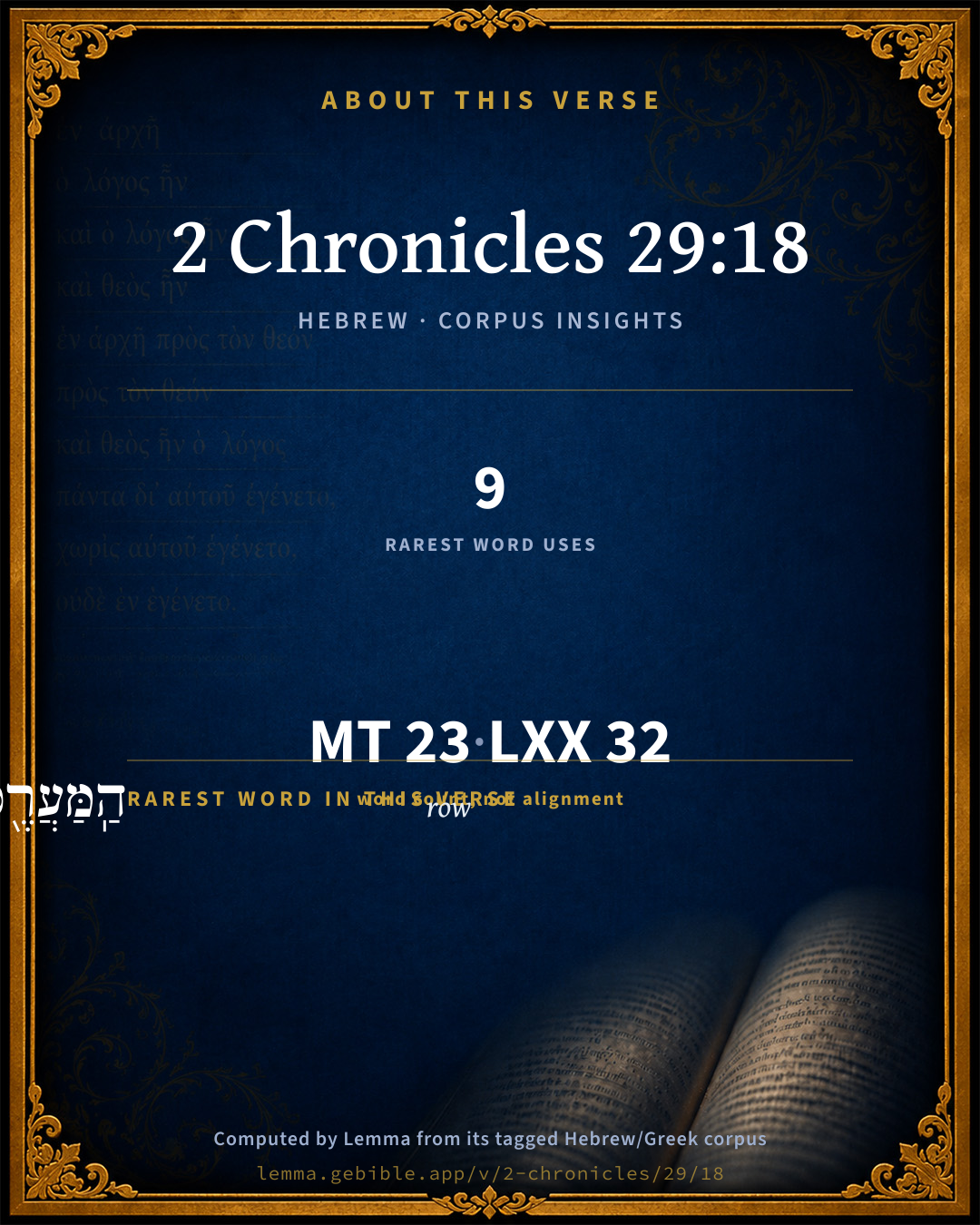
The rarest word here is הַֽמַּעֲרֶ֖כֶת row H4635 — appearing just 9 times in the whole Hebrew Bible.

Shared distinctive vocabulary

הַֽמַּעֲרֶ֖כֶת row H4635 occurs in 9 verses of the Hebrew Bible. Also found in:

Grammatical profile

  • 3 verbs
  • 13 nouns
  • 1 preposition
  • 1 adverb
  • 5 particles

Verb forms

  • וַיָּב֤וֹאוּ Qal · Sequential Imperfect
  • וַיֹּ֣אמְר֔וּ Qal · Sequential Imperfect
  • טִהַ֖רְנוּ Piel · Perfect

Repetition

Words recur within this verse — often emphatic in Hebrew:

  • כָּל all H3605 ×3
  • כֵּלָ֔יו vessel H3627 ×2

Hebrew & Septuagint length

In English translation the verse runs 45 words from the Hebrew and 38 from the Septuagint (LXX English) — closely comparable.

A rough comparison of the two English renderings, which tokenize alike — not a word-level alignment.

Word counts can differ between the Hebrew and the Greek without any difference in meaning — e.g. the Hebrew direct-object marker אֵת has no separate Greek word, and Greek often adds the article ὁ.

In the original languages it is 23 Hebrew tokens and 32 Greek tokens — but the two are counted differently (Hebrew bundles its prefixes and suffixes into one token; the Greek is in lemma form), so that isn’t a like-for-like length.

Cross-references

3

Topical passages linked to 2 Chronicles 29:18 in the Treasury of Scripture Knowledge — connected by theme and wording, ordered by reader-vote popularity; previews shown in the World English Bible.

  • 2 Chronicles 4:1 Moreover he made an altar of brass, twenty cubits the length of it, and twenty cubits the breadth of it, and ten cubits the height of it.
  • 2 Chronicles 4:7–8 He made the ten lampstands of gold according to the ordinance concerning them; and he set them in the temple, five on the right hand, and five on the left.
  • 2 Chronicles 13:11 and they burn to Yahweh every morning and every evening burnt offerings and sweet incense: the show bread also [set they] in order on the pure table; and the lampstand of gold with the lamps of it, to burn every evening: for we keep the charge of Yahweh our God; but you have forsaken him.

Cross-references courtesy of OpenBible.info (CC BY 4.0).

Hebrew and Greek witnesses Masoretic Hebrew ↔ Greek Septuagint

The same verse in the two great witnesses to the Old Testament, shown verse-for-verse.

These are two independent witnesses, not word-aligned to each other, and the Septuagint is shown in lemma (dictionary) form.

Hebrew 2 Chronicles 29:18 Masoretic · Westminster Leningrad Codex

וַיָּב֤וֹאוּ פְנִ֨ימָה֙ אֶל חִזְקִיָּ֣הוּ הַמֶּ֔לֶךְ וַיֹּ֣אמְר֔וּ טִהַ֖רְנוּ אֶת כָּל בֵּ֣ית יְהוָ֑ה אֶת מִזְבַּ֤ח הָעוֹלָה֙ וְאֶת כָּל כֵּלָ֔יו וְאֶת שֻׁלְחַ֥ן הַֽמַּעֲרֶ֖כֶת וְאֶת כָּל כֵּלָֽיו

Then they went in to Hezekiah the king within [the palace], and said, We have cleansed all the house of Yahweh, and the altar of burnt offering, with all the vessels of it, and the table of show bread, with all the vessels of it.

World English Bible · Public Domain

Greek LXX 2 Chronicles 29:18 Septuagint · lemma form

καί εἰςἔρχομαι ἔσω πρός εζεκιας ὁ βασιλεύς καί εἶπον ἁγνίζω πᾶς ὁ ἐν οἶκος κύριος ὁ θυσιαστήριον ὁ ὁλοκαύτωσις καί ὁ σκεῦος αὐτός καί ὁ τράπεζα ὁ πρόθεσις καί ὁ σκεῦος αὐτός

And they went in to king Ezekias, and said, We have purified all the things in the house of the Lord, the altar of whole burnt offering, and its vessels, and the table of show-bread, and its vessels;

LXX2012 (modern English Septuagint) · Public Domain

Hebrew: Westminster Leningrad Codex (CC BY 4.0). Greek: Septuagint (public domain); English from LXX2012 (modern English Septuagint) (Public Domain). How the Septuagint differs from the Hebrew →

Commentary

Notes on 2 Chronicles 29:18 from classic Christian and Jewish commentators (each source and its license shown beneath its notes). The classic Christian expositions comment on the surrounding passage and are grouped to its opening verse, so a note may address several verses; the Jewish commentaries on the Tanakh (Rashi and others) are per-verse, so they appear only where the commentator wrote on this verse.

Lemma curates 59 commentaries, every one of them public domain or Creative Commons licensed, each selected and text-cleaned for this edition rather than reprinted as found. About our sources →

Trapp's Complete Commentary

John Trapp

2Ch 29:18 Then they went in to Hezekiah the king, and said, We have cleansed all the house of the LORD, and the altar of burnt offering, with all the vessels thereof, and the shewbread table, with all the vessels thereof.

Ver. 18. Then they went in to Hezekiah the king.] To whom they knew they should be most welcome, coming on such an errand.

John Trapp, A Commentary or Exposition upon All the Books of the Old and New Testament (1647–1656) — public domain. Text from a community e-Sword module.

MacLaren's Expositions of Holy Scripture

Alexander MacLaren

2 Chronicles

SACRIFICE RENEWED

2Ch 29:18 - 2Ch 29:31.

Ahaz, Hezekiah’s father, had wallowed in idolatry, worshipping any and every god but Jehovah. He had shut up the Temple, defiled the sacred vessels, and ‘made him altars in every corner of Jerusalem.’ And the result was that he brought the kingdom very near ruin, was not allowed to be buried in the tombs of the kings, and left his son a heavy task to patch up the mischief he had wrought. Hezekiah began at the right end of his task. ‘In the first year of his reign, in the first month,’ he set about restoring the worship of Jehovah. The relations with Syria and Damascus would come right if the relations with Judah’s God were right. ‘First things first’ was his motto, and perhaps he discerned the true sequence more accurately than some great political pundits do nowadays. So neglected had the Temple been that a strong force of priests and Levites took a fortnight to ‘carry forth the filthiness out of the holy place to the brook Kidron,’ and to cleanse and ceremonially sanctify the sacred vessels. Then followed at once the re-establishment of the Temple worship, which is narrated in the passage.

The first thing to be noted is that the whole movement back to Jehovah was a one-man movement. It was Hezekiah’s doing and his only. No priest is named as prominent in it, and the slowness of the whole order is especially branded in 2Ch 29:34. No prophet is named; was there any one prompting the king? Perhaps Isaiah did, though his Isa 1:1 with its scathing repudiation of ‘the burnt offerings of rams and the fat of fed beasts,’ suggests that he did not think the restoration of sacrifice so important as that the nation should ‘cease to do evil and learn to do well.’ The people acquiesced in the king’s worship of Jehovah, as they had acquiesced in other kings’ worship of Baal or Moloch or Hadad. When kings take to being religious reformers, they make swift converts, but their work is as slight as it is speedy, and as short-lived as it is rapid. Manasseh was Hezekiah’s successor, and swept away all his work after twenty-nine years, and apparently the mass of his people followed him just as they had followed Hezekiah. Religion must be a matter of personal conviction and individual choice. Imposed from without, or adopted because other people adopt it, it is worthless.

Another point to notice is that Hezekiah’s reformation was mainly directed to ritual, and does not seem to have included either theology or ethics. Was be quite right in his estimate of what was the first thing? Isaiah, in the passage already referred to, does not seem to think so. To him, as to all the prophets, foul hands could not bring acceptable sacrifices, and worship was an abomination unless preceded by obedience to the command: ‘Put away the evil of your doings from before Mine eyes.’ The filth in the hearts of the men of Judah was more ‘rank, and smelt to heaven’ more offensively, than that in the Temple, which took sixteen days to shovel into Kidron. No doubt ceremonial bulked more largely in the days of the Old Covenant than it does in those of the New, and both the then stage of revelation and the then spiritual stature of the recipients of revelation required that it should do so. But the true religious reformers, the prophets, were never weary of insisting that, even in those days, moral and spiritual reformation should come first, and that unless it did, ritual worship, though it were nominally offered to Jehovah, was as abhorrent to Him as if it had been avowedly offered to Baal. Not a little so-called Christian worship today, judged by the same test, is as truly heathen superstition as if it had been paid to Mumbo-Jumbo.

But when all deductions have been made, the scene depicted in the passage is not only an affecting, but an instructive one. Strangely unlike our notions of worship, and to us almost repulsive, must have been the slaying of three hundred and seventy animals and the offering of them as burnt offerings. Try to picture the rivers of blood, the contortions of the dumb brutes, the priests bedaubed with gore, the smell of the burnt flesh, the blare of the trumpets, the shouts of the worshippers, the clashing cymbals, and realise what a world parts it from ‘They went up into the upper chamber where they were abiding . . . these all with one accord continued steadfastly in prayer, with the women, and Mary, the mother of Jesus, and with His brethren’! Sacrifice has been the essential feature in all religions before Christ. It has dropped out of worship wherever Christ has been accepted. Why? Because it spoke of a deep, permanent, universal need, and because Christ was recognised as having met the need. People who deny the need, and people who deny that Jesus on the Cross has satisfied it, may be invited to explain these two facts, written large on the history of humanity.

That brings us to the most important aspect of Hezekiah’s great sacrifice. It sets forth the stages by which men can approach to God. It is symbolic of spiritual facts, and prophetic of Christ’s work and of our way of coming to God through Him. The first requisite for Judah’s return to Jehovah, whom they had forsaken, was the presentation of a ‘sin offering.’ The king and the congregation laid their hands on the heads of the goats, thereby, as it were, transferring their own sinful personality to them. Thus laden with the nation’s sins, they were slain, and in their death the nation, as it were, bore the penalty of its sin. Representation and substitution were dramatised in the sacrifice. The blood sprinkled on the altar {which had previously been ‘sanctified’ by sprinkling of blood, and so made capable of presenting what touched it to Jehovah}, made ‘atonement for all Israel.’ We note in passing the emphasis of ‘Israel’ here, extending the benefit of the sacrifice to the separated tribes of the Northern Kingdom, in a gush of yearning love and desire that they, too, might be reconciled to Jehovah. And is not this the first step towards any man’s reconciliation with God? Is not

‘My faith would lay her hand

On that dear head of Thine,’

the true expression of the first requisite for us all? Jesus is the sin-offering for the world. In His death He bears the world’s sin. His blood is presented to God, and if we have associated ourselves with Him by faith, that blood sprinkled on the altar covers all our sins.

Then followed in this parabolic ceremonial the burnt offering. And that is the second stage of our return to God, for it expresses the consecration of our forgiven selves, as being consumed by the holy and blessed fire of a self-devotion, kindled by the ‘unspeakable gift,’ which fire, burning away all foulness, will make us tenfold ourselves. That fire will burn up only our bonds, and we shall walk at liberty in it. And that burnt-offering will always be accompanied with ‘the song of Jehovah,’ and the joyful sound of the trumpets and ‘the instruments of David.’ The treasures of Christian poetry have always been inspired by the Cross, and the consequent rapture of self-surrender. Calvary is the true fountain of song.

The last stage in Hezekiah’s great sacrifice was ‘thank-offerings,’ brought by ‘as many as were of a willing heart.’ And will not the self-devotion, kindled by the fire of love, speak in daily life by practical service, and the whole activities of the redeemed man be a long thank-offering for the Lamb who ‘bears away the sins of the world’? And if we do not thus offer our whole lives to God, how shall we profess to have taken the priceless benefit of Christ’s death? Hezekiah followed the order laid down in the Law, and it is the only order that leads to the goal. First, the atoning sacrifice of the slain Lamb; next, our identification with Him and it by faith; then the burnt-offering of a surrendered self, with the song of praise sounding ever through it; and last, the life of service, offering all our works to God, and so reaching the perfection of life on earth and antedating the felicities of heaven.

Alexander MacLaren, Expositions of Holy Scripture (1904–1910) — public domain. Text from a community e-Sword module.

Geneva Bible (1599)

Geneva Bible translators

Or, table where the bread was set in order.

Geneva Bible (1599) marginal notes — public domain. Text via Bolls.life.

Ellicott's Commentary for English Readers

(18) They went in.—Heb., into the interior (pĕnîmah, “inner part” 2Ch_29:16) of the palace.

Hezekiah.—Hizkiyahu. So also in 2Ch_29:27; but in 2Ch_29:30, Yehizkiyahu. (See Note on 2Ch_29:1.)

The altar of burnt offering.—Which Ahaz appears to have superseded (2Ki_16:14-15), besides removing it from its legal position.

And the shewbread table.—Literally, the table of the pile (of sacred cakes). Only one table is here mentioned. (Comp. 1Ch_28:16; 2Ch_4:8; 2Ch_4:19.) The metal work of all the sacred apparatus would be greatly tarnished, if only from neglect, apart from wanton ill usage.

A Bible Commentary for English Readers, edited by Charles John Ellicott (1878–1897) — public domain. Text from a community e-Sword module.

The Cambridge Bible for Schools and Colleges

gen. ed. J. J. S. Perowne

18. the king] R.V. the king within the palace.

the shewbread table] R.V. the table of shewbread.

The Cambridge Bible for Schools and Colleges (gen. ed. J. J. S. Perowne; Cambridge University Press, 1878–1918) — public domain. Text from a community e-Sword module.

John Gill's Exposition

Then Hezekiah the king rose early,.... Took the first opportunity to attend the worship of God, and set an example to his people:

and gathered the rulers of the city; the elders of the people, the chief magistrates in Jerusalem:

and went up to the house of the Lord; the temple, to worship there.

John Gill's Exposition of the Whole Bible (1746–1763) — public domain (CC PDM 1.0). Text via the HelloAO Bible API.

The Pulpit Commentary

This and the following verse purport to say that, while all "filthiness" had been swept out and away to Kidron"s dark waters, all that had been polluted of the proper furniture of the temple and its worship had now been cleansed and sanctified by those who had been entrusted with the work, and likewise that things misplaced and removed had been replaced, also after cleansing and sanctifying. This is the happy report that the priests bring now to Hezekiah. (2Ch_28:24 2Ki_16:14)

The Pulpit Commentary (1880–1919), ed. H.D.M. Spence-Jones & Joseph S. Exell — public domain. Text from a community e-Sword module.

Scofield Reference Notes

C. I. Scofield

shewbread

(See Scofield "Exo 25:30").

The Scofield Reference Bible (1917 edition), notes by C. I. Scofield — public domain. Text from a community e-Sword module.

unfoldingWord translationNotes

Door43 World Missions Community

the bread of the presence

This is a reference to the 12 loaves of bread that were placed in front of the altar. See how you translated this in 2 Chronicles 2:4.

See, they are

"Look at them. You can see for yourself that they are"

translationWords

Hezekiah

altar

burnt offering

bread

unfoldingWord translationNotes — © Distant Shores Media and the Door43 World Missions Community, licensed CC BY-SA 4.0. Source: git.door43.org/Door43/en_tn.

Lesson kit

Teaching starters — assembled from the data on this page, not authored interpretation. Every prompt links to the verse data it draws on. Edit before teaching.

2 Chronicles, in the Historical, opens this verse with 23 words (16 distinct Hebrew lemmas). Its most distinctive word is maʻăreketh (“row”). A historical commentator’s framing appears above. Read the whole chapter for the surrounding context.

Discussion questions

  1. The word maʻăreketh carries the sense “row.” How does it shape the verse?
  2. Leviticus 24:6 shares the word «row» with this verse. How do the two illuminate each other?
  3. “all” occurs 3× in this one verse. What is the effect of the repetition?
  4. These translations render this verse differently. What is at stake in choosing one wording over another?
  5. The verb «וַיָּב֤וֹאוּ» is Qal Sequential Imperfect. How does its form color the action?
  6. Reading how Trapp's Complete Commentary and MacLaren's Expositions of Holy Scripture read this verse, where do the two commentators agree and where do they part?

Things to notice

Reading settings

Reading text

Shown beneath each verse's original-language words.

Old Testament
Old Testament edition

Read the OT as the Masoretic Hebrew (MT) or the Greek Septuagint (LXX).

English shown for the Greek Septuagint (in the Hebrew ↔ Greek comparison).

Comparing translations? Open the Compare panel on any verse page to stack up to four side by side.